speed MERCEDES-BENZ C-Class 2000 W202 Owner's Guide
[x] Cancel search | Manufacturer: MERCEDES-BENZ, Model Year: 2000, Model line: C-Class, Model: MERCEDES-BENZ C-Class 2000 W202Pages: 130, PDF Size: 2.43 MB
Page 93 of 130
Spare Wheel for Model C 43 AMG
The spare wheel rim size is 71/2 J x 17 H2
In the case of a flat tire or breakdown, you may temporarily use a 71/2 J x 17 H 2 instead of the
81/2 J x 17 H 2 wheel rim on the rear axle, when observing the following restrictions:
• Do not exceed vehicle speed of 50 mph (80 km/h).
• Drive to the nearest repair facility to have the flat tire repaired or replaced as appropriate.
For additional information, refer to "Technical Data".
Warning !
The dimensions of the spare wheel are different from those of road wheels. As a result, the
vehicle handling characteristics change when driving with a mounted spare wheel.
The spare wheel should only be used temporarily, and replaced with a regular road
wheel as quickly as possible.
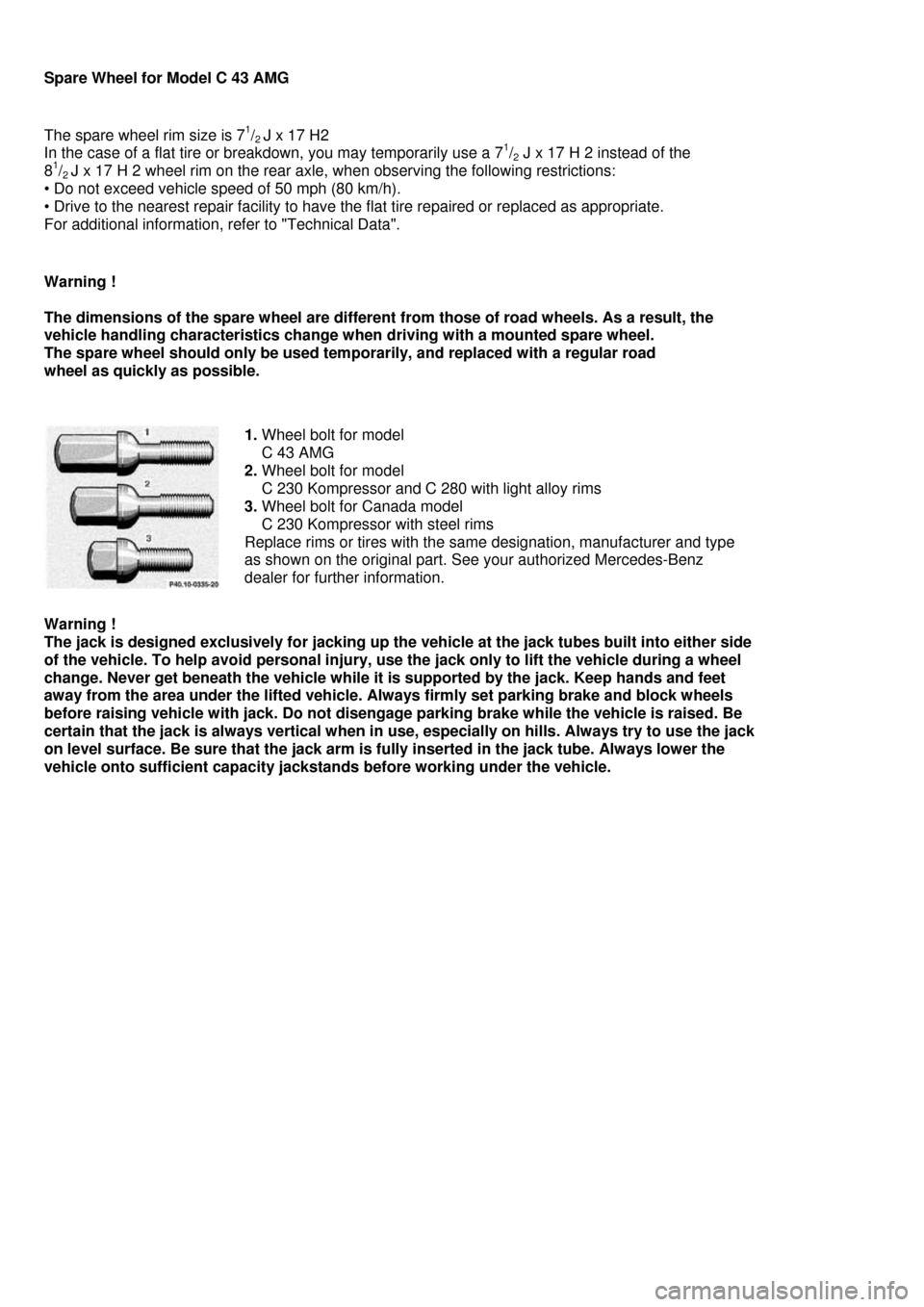
1. Wheel bolt for model
C 43 AMG
2. Wheel bolt for model
C 230 Kompressor and C 280 with light alloy rims
3. Wheel bolt for Canada model
C 230 Kompressor with steel rims
Replace rims or tires with the same designation, manufacturer and type
as shown on the original part. See your authorized Mercedes-Benz
dealer for further information.
Warning !
The jack is designed exclusively for jacking up the vehicle at the jack tubes built into either side
of the vehicle. To help avoid personal injury, use the jack only to lift the vehicle during a wheel
change. Never get beneath the vehicle while it is supported by the jack. Keep hands and feet
away from the area under the lifted vehicle. Always firmly set parking brake and block wheels
before raising vehicle with jack. Do not disengage parking brake while the vehicle is raised. Be
certain that the jack is always vertical when in use, especially on hills. Always try to use the jack
on level surface. Be sure that the jack arm is fully inserted in the jack tube. Always lower the
vehicle onto sufficient capacity jackstands before working under the vehicle.
Page 95 of 130

Tire Inflation Pressure
A table (see fuel filler flap) lists the tire inflation pressures specified for Mercedes-Benz recommended tires as well as
for the varying operating conditions.
Important !
Tire pressure changes by approx. 1.5 psi (0.1 bar) per 18°F (10°C) of air temperature change. Keep this in mind
when checking tire pressure inside a garage - especially in the winter.
Example:
If garage temperature = approx. +68°F (+20°C) and ambient te mperature = approx. +32°F (0°C) then the adjusted air
pressure = specified air pressure +3 psi (+0.2 bar).
Tire pressures listed for light loads are minimum values o ffering high driving comfort. Increased inflation pressures for
heavy loads produce favorable handling characteristics with lighter loads arid are perfectly permissible. The ride of
the vehicle, however, will become somewhat harder.
Tire temperature and pressure increase with the vehicle speed. Tire pressure should therefore only be corrected on
cold tires. Correct tire pressure in warm tires only if pressure has dropped below the pressure listed in the table and
the respective operating conditions are taken into consideration.
An underinflated tire due to a slow leak (e.g. due to a
nail in the tire) may cause damage such as tread separation, bulging etc.. Regular tire pressure checks (including the
spare tire) at intervals of no more than 14 days are therefore essential. If a tire constantly loses air, it should be
inspected for damage.
Warning !
Do not overinflate tires. Overinfiating tires can result in sudden deflation (blowout) because they are more
likely to become punctured or damaged by road debris, potholes etc.. Follow recommended inflation
pressures.
Do not overload the tires by exceeding the specified vehicle capacity weight (as indicated by the label on the
driver's door latch post). Overloading the tires can overheat them, possibly causing a blowout.
Page 104 of 130
Towing the Vehicle
Warning!
Prior to towing the vehicle with all wheels on the ground, make
certain that the electronic key is in steering lock position 2.
If the electronic key is left in the steering lock position 0 for
an extended period of time, it can no longer be turned in the
lock. In this case, the steering is locked. To unlock, remove
electronic key from steering lock and reinsert.
Important !
When towing the vehicle, please, note the following:
With the automatic central locking activated and the electronic key inn steering lock position 2, the vehicle
doors lock if the left front wheel as well as the right rear wheel are turning at vehicle speeds of approx. 9 mph (15
km/h) or more. To prevent the vehicle door locks from locking, deactivate the automatic central locking.
All except C 43 AMG
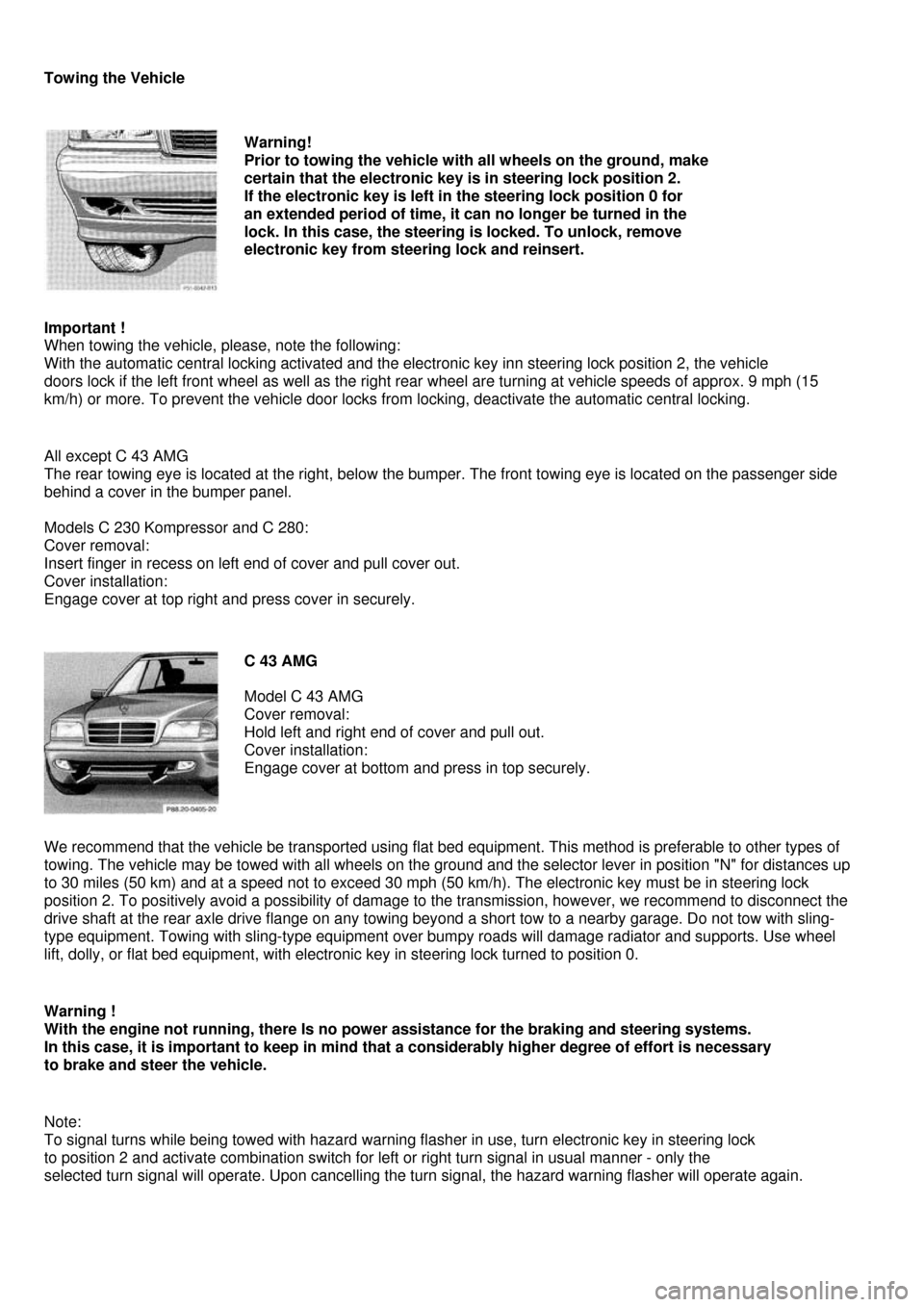
The rear towing eye is located at the right, below the bumper. The front towing eye is located on the passenger side
behind a cover in the bumper panel.
Models C 230 Kompressor and C 280:
Cover removal:
Insert finger in recess on left end of cover and pull cover out.
Cover installation:
Engage cover at top right and press cover in securely.
C 43 AMG
Model C 43 AMG
Cover removal:
Hold left and right end of cover and pull out.
Cover installation:
Engage cover at bottom and press in top securely.
We recommend that the vehicle be transported using flat bed equipment. This method is preferable to other types of
towing. The vehicle may be towed with all wheels on the ground and the selector lever in position "N" for distances up
to 30 miles (50 km) and at a speed not to exceed 30 mph (50 km/h). The electronic key must be in steering lock
position 2. To positively avoid a possibility of damage to the transmission, however, we recommend to disconnect the
drive shaft at the rear axle drive flange on any towing beyond a short tow to a nearby garage. Do not tow with sling-
type equipment. Towing with sling-type equipment over bumpy roads will damage radiator and supports. Use wheel
lift, dolly, or flat bed equipment, with electronic key in steering lock turned to position 0.
Warning !
With the engine not running, there Is no power assistance for the braking and steering systems.
In this case, it is important to keep in mind that a considerably higher degree of effort is necessary
to brake and steer the vehicle.
Note:
To signal turns while being towed with hazard warning flasher in use, turn electronic key in steering lock
to position 2 and activate combination switch for left or right turn signal in usual manner - only the
selected turn signal will operate. Upon cancelling the turn signal, the hazard warning flasher will operate again.
Page 118 of 130

Technical Data C 230 KOMPRESSOR
Model C 230 KOMMPRESSOR
(202 024)1 Rims - Tires (except Sport Package)
Engine 111 Rims (light
alloy rims)
7J x 15 H 2
Mode of operation 4-stroke engine,
gasoline injection
Wheel offset 1.46 in (37 mm)
No. of cylinders 4
All season
tires:;
Radial-ply tires
205/60R 15 91 H
Bore 3.58 in (90.90 mm) Winter tires;
Radial-ply tires
205/60 R 15 91 T M+S
Stroke 3.48 in (88.40 mm) C 230 KOMMPRESSOR - Canada only (ikl.spare wheel)
Total piston displacemen 140.8 cu.in. (2295 cm3)
Rims (steel
rims)
Wheel offset
61/2J x 15 H 2
1.46 in (37 mm)
Compression ratio 8.8:1
All
season;Radial-
ply tires
Winter
tires;Radial-ply
tires
195/65 R 15 91 H
S
Output acc. to SAE J
1349
185 hp/5300 rpm
(136 kW/5300 rpm)
Rims All season Tires ( Sport Package)
Maximum torque acc.
to SAE J 1349
200 ft.lb./2500 rpm
(270 Nm/2500rpm)
Rims (light
alloy rims)
Wheel offset
7J x 16 H 2
1.46 in (37 mm)
Maximum engine speed 5800 rpm
All season
tires:
Radial-ply tires205/55 R 16 91 H
Firing order 1-3-4-2 Electrical System
tPoly-V-belt routing I 1875 mm Generator
(alternator)
14 V/90 A
Poly-V-belt routing II 1339 mm Starter motor 12 V/1.7KW
Weights See certification tag Battery 12 V/100 Ah
Roof load max.
Trunk load max.
220 lb(100 kg)
220 lb(100 kg)
Spark plugs
Electrode gap
Tightening
torque
Bosch F 7 KTCR
0.039 in (1,0 mm)
15-22ft.lb. (20-30 Mm)
Spare Wheel Main Dimensions
Rim (light alloy rim)
Wheel offset 7 J x 16 H 2
1.46 in (37 mm) Overall vehicle
length 178.2 in (4526 mm)
All season tire:
Radial-ply tire 205/55 R 16 91 H Overall vehicle
width 67.8 in (1723mm)
Overall height 56.1 in (1424 mm)
Spare Wheel ( exept Canada model with steel rims) Wheel base 105.9 in (2690 mm)
Rim (light alloy rim)
Wheel offset 7 J x 15 H 2
1.46 in (37 mm) Track, front 59.0 in (1499 mm)
All season tire:
Radial-ply tire 205/55 R 16 91 H Track, rear 57.6 in (1464mm)
1 The quoted data apply only to the standard vehicle. See an authorized Mercedes-Benz
dealer for the correspon-ding data of ali specialbodies and special equipment,
Page 119 of 130

Technical Data C 280
Model C 280 (202 029)1 Rims - Tires (except Sport Package)
Engine 112 Rims (light
alloy rims)7J x 15 H 2
Mode of operation 4-stroke engine,
gasoline injection Wheel
offset 1.46 in (37 mm)
No. of cylinders 6
All season
tires;
Radial-ply
tires
205/60R 15 91 H
Bore 3.54 in (89.90 mm)
Winter
tires;
Radial-ply
tires
205/60 R 15 91 T M+S
Stroke 2.89 in (73.50 mm) Weights See certification tag
Total piston displacemen 170.8 cu.in. (2799cm3) Roof load
max. 220 lb(100 kg)
Compression ratio 10.1 Trunk load
max. 220 lb(100 kg)
Output acc. to SAE J
1349 194 hp/5800 rpm
(145 kW/5800 rpm) Rims All season Tires ( Sport Package)
Maximum torque acc.
to SAE J 1349 195 ft.lb./3000 rpm
(265 Nm/3000rpm)
Rims (light
alloy rims)
Wheel
offset
7J x 16 H 2
1.46 in (37 mm)
Maximum engine speed 6000 rpm
tires:
Radial-ply
tires 205/55 R 16 91 H
Firing order 1-4-3-6-2-5 Electrical System
tPoly-V-belt 2390 mm Generator
(alternator)14 V/90 A
Starter
motor 12 V/1.7KW
Spare Wheel Battery 12 V/100 Ah
Rim (light alloy rim)
Wheel offset
7 J x 15 H 2
1.46 in (37 mm)
Spark
plugs
Electrode
gap
Tightening
torque Bosch F 8 DPER
Beru 14 FGH 8 DPUR X 20.03 in (1,0 mm)
15-22ft.lb. (20-30 Mm)
All season tire:
Radial-ply tire 205/55 R 16 91 H Main Dimensions
Overall
vehicle
length 178.4 in (4526 mm)
Overall
vehicle
width 67.8 in (1723mm)
Overall
height 56.1 in (1424 mm)
Wheel
base 105.9 in (2690 mm)
Track,
front 59.0 in (1499 mm)
Track, rear57.6 in (1464mm)
1 The quoted data apply only to the standard vehicle. See an authorized Mercedes-Benz dealer
for the correspon-ding data of ali specialbodies and special equipment,
Page 120 of 130
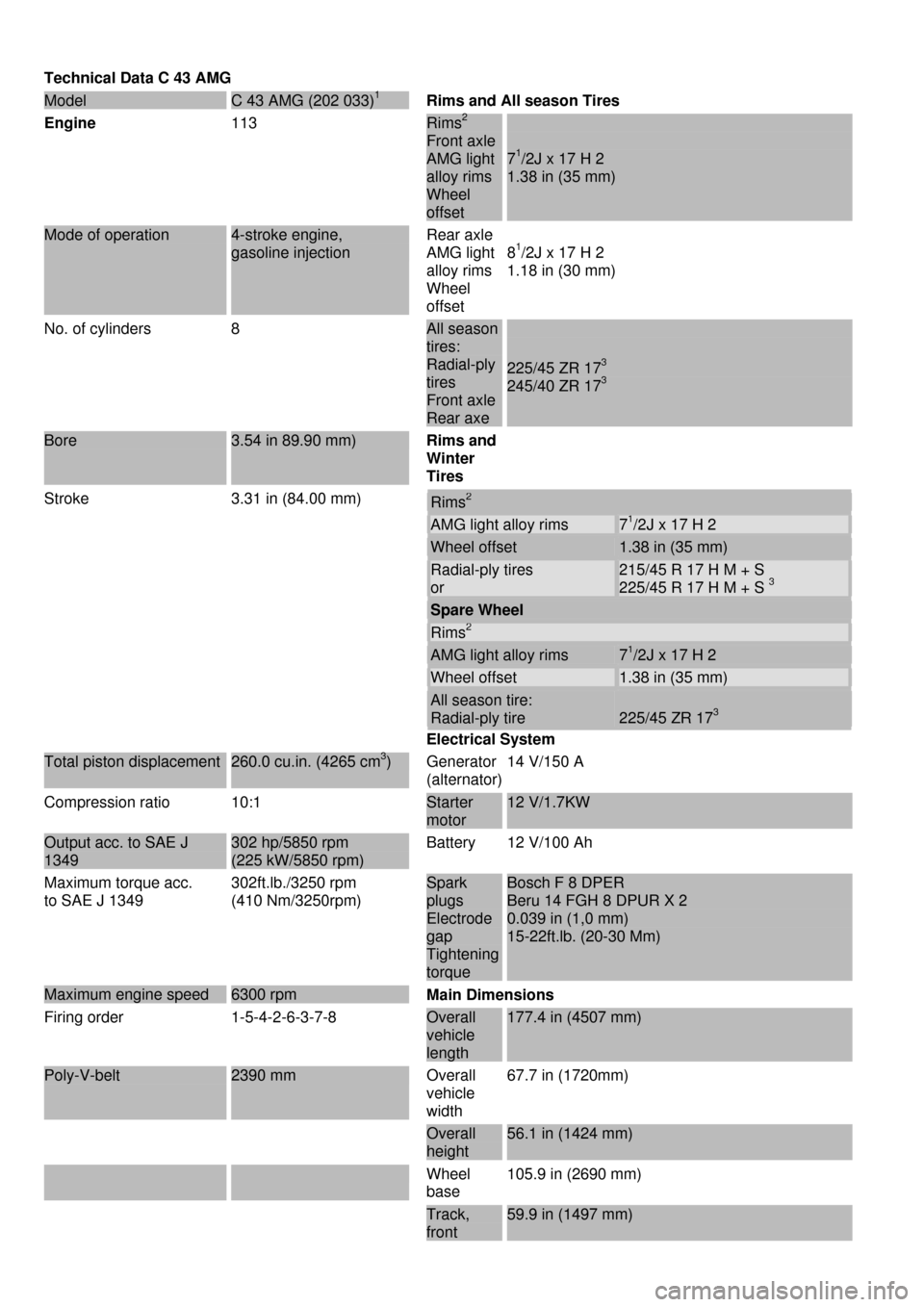
Technical Data C 43 AMG
Model C 43 AMG (202 033)1 Rims and All season Tires
Engine 113
Rims2
Front axle
AMG light
alloy rims
Wheel
offset
71/2J x 17 H 2
1.38 in (35 mm)
Mode of operation 4-stroke engine,
gasoline injection
Rear axle
AMG light
alloy rims
Wheel
offset
81/2J x 17 H 2
1.18 in (30 mm)
No. of cylinders 8
All season
tires:
Radial-ply
tires
Front axle
Rear axe
225/45 ZR 173
245/40 ZR 173
Bore 3.54 in 89.90 mm)
Rims and
Winter
Tires
Stroke 3.31 in (84.00 mm)
Rims2
AMG light alloy rims 71/2J x 17 H 2
Wheel offset 1.38 in (35 mm)
Radial-ply tires
or
215/45 R 17 H M + S
225/45 R 17 H M + S 3
Spare Wheel
Rims2
AMG light alloy rims 71/2J x 17 H 2
Wheel offset 1.38 in (35 mm)
All season tire:
Radial-ply tire
225/45 ZR 173
Electrical System
Total piston displacement 260.0 cu.in. (4265 cm3) Generator
(alternator)14 V/150 A
Compression ratio 10:1 Starter
motor
12 V/1.7KW
Output acc. to SAE J
1349
302 hp/5850 rpm
(225 kW/5850 rpm) Battery 12 V/100 Ah
Maximum torque acc.
to SAE J 1349
302ft.lb./3250 rpm
(410 Nm/3250rpm)
Spark
plugs
Electrode
gap
Tightening
torque
Bosch F 8 DPER
Beru 14 FGH 8 DPUR X 2
0.039 in (1,0 mm)
15-22ft.lb. (20-30 Mm)
Maximum engine speed 6300 rpm Main Dimensions
Firing order 1-5-4-2-6-3-7-8
Overall
vehicle
length
177.4 in (4507 mm)
Poly-V-belt 2390 mm
Overall
vehicle
width 67.7 in (1720mm)
Overall
height
56.1 in (1424 mm)
Wheel
base 105.9 in (2690 mm)
Track,
front
59.9 in (1497 mm)
Page 124 of 130

Premium Unleaded Gasoline
Caution !
To maintain the engine's durability and performance, premium unleaded gasoline must be used. If
premium unleaded is not available and low octane fuel is used, follow these precautions:
• have the fuel tank filled only partially with unleaded regular and fill up with premium unleaded
as soon as possible,
• avoid full throttle driving and abrupt acceleration,
• do not exceed an engine speed of 3000 rpm, if the vehicle is loaded with a light load such as two
persons and no luggage,
• do not exceed 2/3 of maximum accelerator pedal positi on, if the vehicle is fully loaded or operating
in mountainous terrain.
Fuel Requirements
Use only Premium unleaded meeting ASTM standar d D 439: The octane number (posted at the
pump) must be 91 min. It is an average of both the Research (R) octane number and the Motor (M)
octane number: [(R+M)/2]. This is also k nown as ANTI-KNOCK INDEX. Unleaded gasoline
containing oxygenates such as Ethanol, I PA, IBA and TBA can be used provided the ratio of any
one of these oxygenates to gasoline does not exce ed 10%, MTBE not to exceed 15%. The ratio of
Methanol to gasoline must not exceed 3% plus additional components. Using mixtures of Ethanol
and Methanol is not allowed. Gasohol, which c ontains 10% Ethanol and 90% unleaded gasoline, can
be used. These blends must also meet all other fuel requirements such as resistance to spark
knock, boiling range, vapor pressure etc..
Gasoline Additives
A major concern among engine manufacturers is carbon build up caused by gasoline. Mercedes-
Benz recommends the use of only quality gasoline cont aining additives that prevent the build up of
carbon deposits. After an extended period of using fu els without such additives, carbon deposits can
build up especially on the intake valves and in the combustion area, leading to engine performance
problems such as:
• warm-up hesitation,
• unstable idle,
• knocking/pinging,
• misfire,
• power loss.
Do not blend other specific fuel additives with fuel. They only result in unnecessary cost, and may be
harmful to the engine operation. Damage or malfunct ions resulting from poor fuel quality or from
blending specific fuel additives are not covered by the Mercedes-Benz Limited Warranty.
Page 126 of 130

Consumer Information
This has been prepared as required of all manufacturers of passenger cars under Title 49, Code of U.S. Federal
Regulations, Part 575 pursuant to the "National Traffic and Motor Vehicle Safety Act of 1966".
Uniform Tire Quality Grading
Refer to the tire sidewall for the specific tire grades for t he tires with which this vehicle is equipped. All passenger car
tires must conform to federal safety requirements in addition to these grades.
Treadwear
The treadwear grade is a comparative rating based on t he wear rate of the tire when tested under controlled
conditions on a specified government test course. For ex ample, a tire graded 150 would wear one and one-half (11/2)
times as well on the government course as a tire grad ed 100. The relative performance of tires depends upon the
actual conditions of their use, however, and may depart signi ficantly from the norm due to variations in driving habits,
service practices and differences in road characteristics and climate.
Traction
The traction grades, from highest to lowest, are AA, A, B, and C, Those grade represent the tire's ability to stop on
wet pavement as measured under controlled conditions on specified government test surfaces of asphalt and
concrete. A tire marked "C" ma y have poor traction performance.
Warning !
The traction grade assigned to this tire is based on straight-ahead braking traction tests and does not
include cornering, hydroplaning or peak traction characteristics.
Temperature
The temperature grades are A (the highest), B, and C, representing the tire's resistance to the generation of heat and
its ability to dissipate heat when tested under controlled conditions on a specified indoor laboratory test wheel.
Sustained high temperature can cause the material of the tire to degenerate and reduce tire life, and excessive
temperature can lead to sudden tire failure. The grade C co rresponds to a level of performance which all passenger
car tires must meet under the Federal Motor Vehicle Safety Standard No.109. Grades B and A represent higher
levels of performance on the laboratory test wheel than the minimum required by law.
Warning !
The temperature grade for this tire is established for a tire that is properly inflated and not overloaded.
Excessive speed, underinflation, or excessive loading, either separately or in combination, can cause
excessive heat build up and possible tire failure.