start MERCEDES-BENZ C-Class 2000 W202 Owner's Guide
[x] Cancel search | Manufacturer: MERCEDES-BENZ, Model Year: 2000, Model line: C-Class, Model: MERCEDES-BENZ C-Class 2000 W202Pages: 130, PDF Size: 2.43 MB
Page 77 of 130
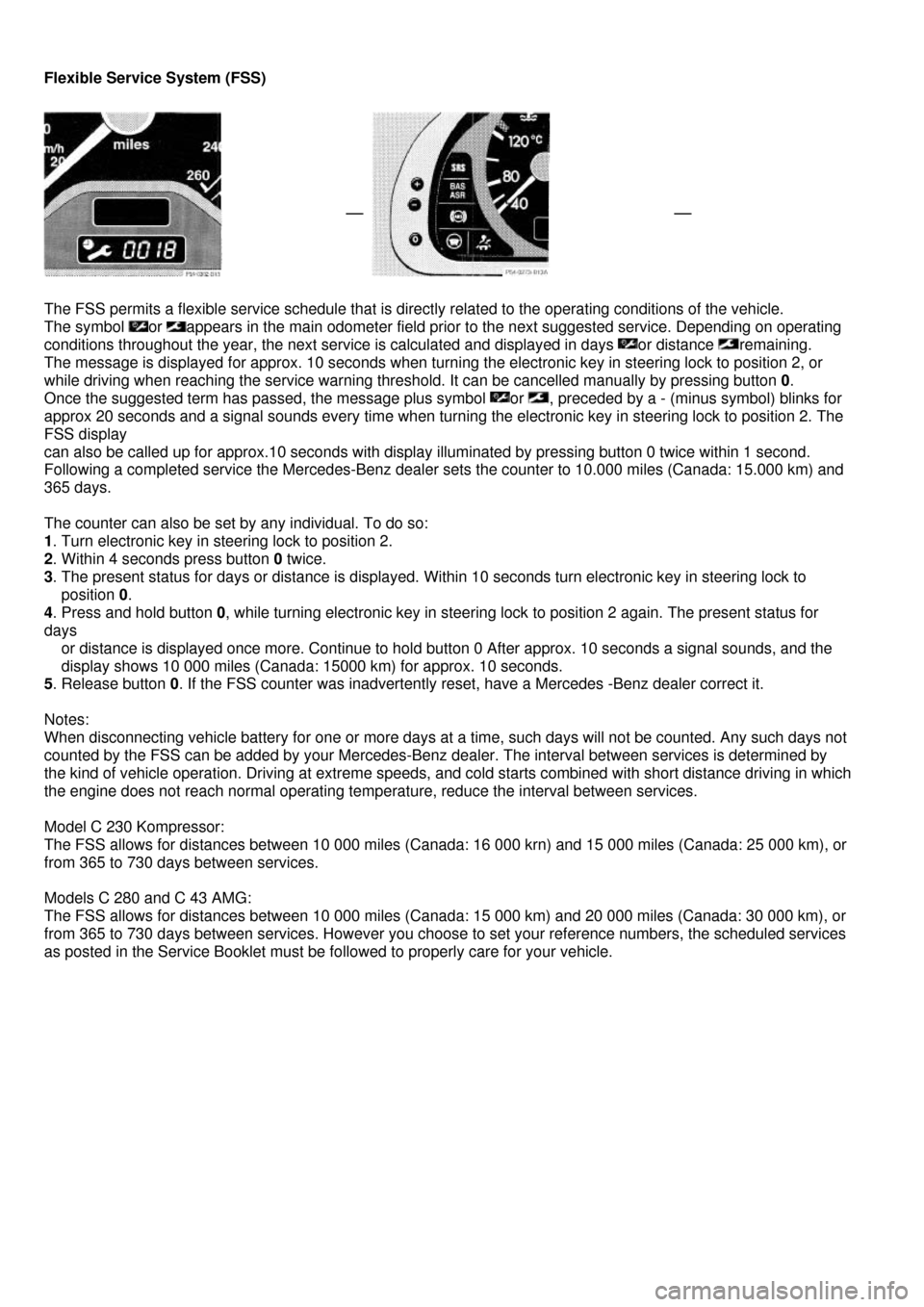
Flexible Service System (FSS)
The FSS permits a flexible service schedule that is directly related to the operating conditions of the vehicle.
The symbol or appears in the main odometer field prior to the next suggested service. Depending on operating
conditions throughout the year, the next service is calculated and displayed in days or distance remaining.
The message is displayed for approx. 10 seconds when turning the electronic key in steering lock to position 2, or
while driving when reaching the service warning threshold. It can be cancelled manually by pressing button 0.
Once the suggested term has passed, the message plus symbol or , preceded by a - (minus symbol) blinks for
approx 20 seconds and a signal sounds every time when turning the electronic key in steering lock to position 2. The
FSS display
can also be called up for approx.10 seconds with display illuminated by pressing button 0 twice within 1 second.
Following a completed service the Mercedes-Benz dealer sets the counter to 10.000 miles (Canada: 15.000 km) and
365 days.
The counter can also be set by any individual. To do so:
1. Turn electronic key in steering lock to position 2.
2. Within 4 seconds press button 0 twice.
3. The present status for days or distance is displayed. Within 10 seconds turn electronic key in steering lock to
position 0.
4. Press and hold button 0, while turning electronic key in steering lock to position 2 again. The present status for
days
or distance is displayed once more. Continue to hold button 0 After approx. 10 seconds a signal sounds, and the
display shows 10 000 miles (Canada: 15000 km) for approx. 10 seconds.
5. Release button 0. If the FSS counter was inadvertently reset, have a Mercedes -Benz dealer correct it.
Notes:
When disconnecting vehicle battery for one or more days at a time, such days will not be counted. Any such days not
counted by the FSS can be added by your Mercedes-Benz dealer. The interval between services is determined by
the kind of vehicle operation. Driving at extreme speeds, and cold starts combined with short distance driving in which
the engine does not reach normal operating temperature, reduce the interval between services.
Model C 230 Kompressor:
The FSS allows for distances between 10 000 miles (Canada: 16 000 krn) and 15 000 miles (Canada: 25 000 km), or
from 365 to 730 days between services.
Models C 280 and C 43 AMG:
The FSS allows for distances between 10 000 miles (Canada: 15 000 km) and 20 000 miles (Canada: 30 000 km), or
from 365 to 730 days between services. However you choose to set your reference numbers, the scheduled services
as posted in the Service Booklet must be followed to properly care for your vehicle.
Page 80 of 130
Acceleration Slip Regulation (ASR)
The acceleration slip regulation will engage at all vehicle speeds, if one or both drive wheels begin to lose traction
and spin in acceleration. While engaged, the yellow warning lamp in the speedometer dial flashes. With the
acceleration slip regulation engaged, the brake is applied to the spinning drive wheel until slip is brought under
control. If both drive wheels spin, the brake is applied to both drive wheels and simultaneously, engine torque is
limited, to improve the vehicle's driving stability. As traction on the road surface increases, thus allowing
acceleration without slip, the allowable engine torque also increases again and the brake is no longer applied to
drive wheels.
Important !
If the ASR warning lamp flashes, adapt your speed and driving to the prevailing road conditions.
Caution!
If the vehicle is towed with the front axle raised (see Towing the vehicle in Index), the engine must be shut off
(electronic key in steering lock position 0 or 1). Otherwise, the ASR regulation will immediately be
engaged and will apply the rear wheel brakes.
Notes:
The indicator lamp for the ASR is combined with that of the BAS The yellow BAS/ASR malfunction indicator
lamp in the instrument cluster and the yellow ASR warning lamp in the speedometer dial come on with the
electronic key in steering lock position 2. They should go out with the engine running. If the BAS/ASR malfunction
indicator lamp comes on with the engine running, a malfunction has been detected in either system. Pressing the
accelerator pedal will require greater effort. Only partial engine output will be available.
If the BAS malfunctions, the brake system functions in the usual manner, but without BAS. Have the BAS or ASR
checked at your authorized Mercedes-Benz dealer as soon as possible. With the ABS malfunctioning, the ASR
is also switched off. Driving the vehicle with varied size tires will cause the wheels to rotate at different speeds,
therefore the ASR may activate (yellow ASR warning lamp in speedometer dial comes on).
For this reason, all wheels, including the spare wheel, must have the same tire size. When testing the parking
brake on a brake test dynamometer, the engine must be shut off. Otherwise, the ASR will immediately be engaged
and will apply the rear wheel brakes. In winter operation, the maximum effectiveness of the ASR is only achieved
with Mercedes-Benz recommended M+S rated radial-ply tires and/or snow chains.
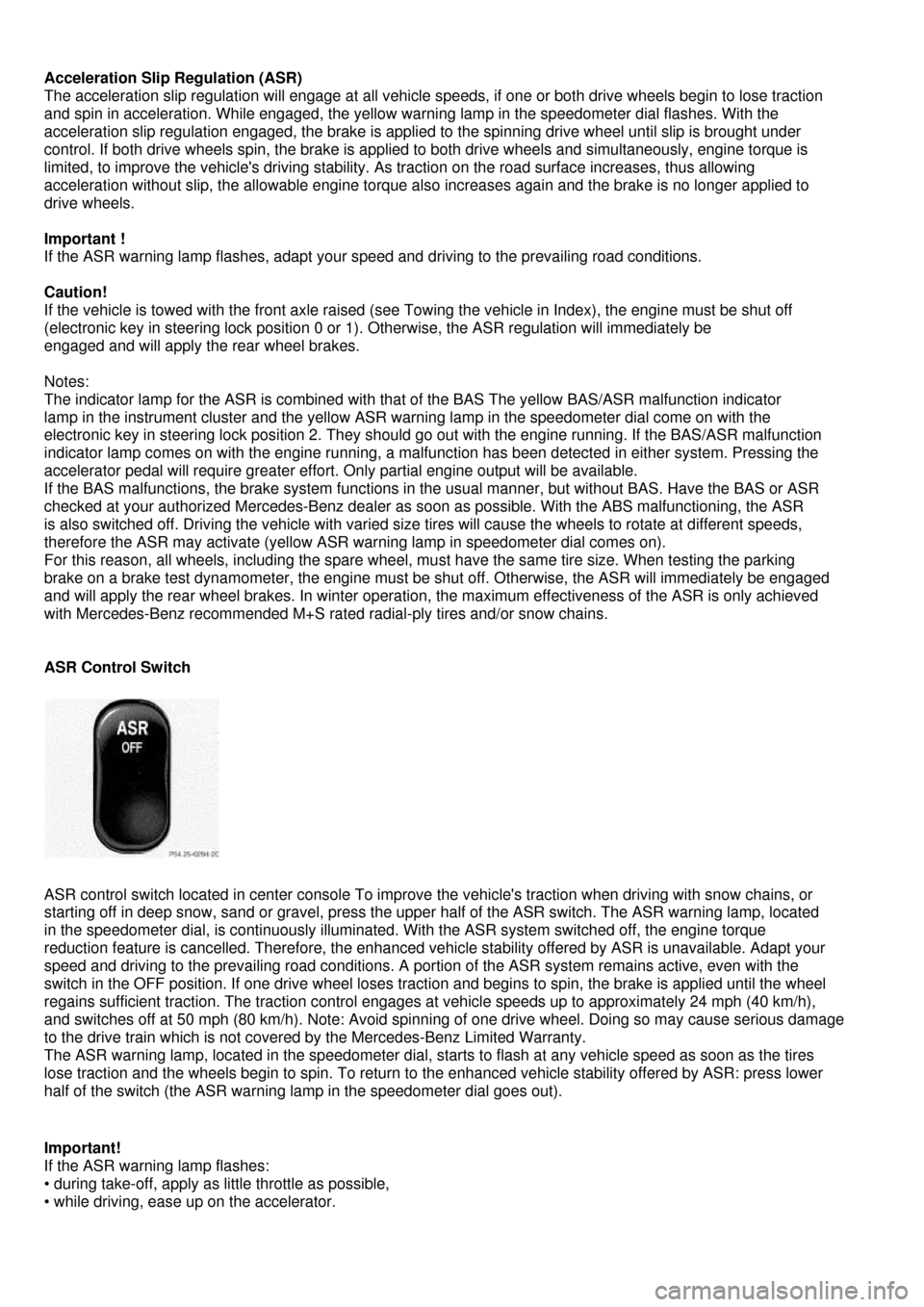
ASR Control Switch
ASR control switch located in center console To improve the vehicle's traction when driving with snow chains, or
starting off in deep snow, sand or gravel, press the upper half of the ASR switch. The ASR warning lamp, located
in the speedometer dial, is continuously illuminated. With the ASR system switched off, the engine torque
reduction feature is cancelled. Therefore, the enhanced vehicle stability offered by ASR is unavailable. Adapt your
speed and driving to the prevailing road conditions. A portion of the ASR system remains active, even with the
switch in the OFF position. If one drive wheel loses traction and begins to spin, the brake is applied until the wheel
regains sufficient traction. The traction control engages at vehicle speeds up to approximately 24 mph (40 km/h),
and switches off at 50 mph (80 km/h). Note: Avoid spinning of one drive wheel. Doing so may cause serious damage
to the drive train which is not covered by the Mercedes-Benz Limited Warranty.
The ASR warning lamp, located in the speedometer dial, starts to flash at any vehicle speed as soon as the tires
lose traction and the wheels begin to spin. To return to the enhanced vehicle stability offered by ASR: press lower
half of the switch (the ASR warning lamp in the speedometer dial goes out).
Important!
If the ASR warning lamp flashes:
• during take-off, apply as little throttle as possible,
• while driving, ease up on the accelerator.
Page 81 of 130
Electronic Stability Program (ESP) (optional)
The ESP enhances directional control and reduces driving wheel spin of the vehicle under any driving condition.
Over/understeering of the vehicle is counteracted by applying brakes to the appropriate wheel to create a
counterpointing vehicle movement. The ESP warning lamp, located in the speedometer dial, starts to flash.
Important !
If the ESP warning lamp flashes, adapt your speed and driving to the prevailing road conditions.
Caution !
If the vehicle is towed with the front axle raised (see Towing the vehicle in Index), the engine must be shut off
(electronic key in steering lock position 0 or 1). Otherwise, the ESP will immediately be engaged and will apply
the rear wheel brakes.
Notes:
The indicator lamp for the ESP is combined with that of the BAS. The yellow BAS/ESP malfunction indicator lamp
in the instrument cluster and the yellow ESP warning lamp in the speedometer dial come on with the electronic key
in steering lock position 2. They should go out with the engine running. If the BAS/ESP multifunction indicator lamp
comes on permanently with the engine running, a malfunction has been detected in either system.
Pressing the accelerator pedal will require greater effort. Only partial engine output will be available. If the BAS
malfunctions, the brake system functions in the usual manner, but without BAS. Have the BAS or ESP checked at
your authorized Mercedes-Benz dealer as soon as possible. With the ABS malfunctioning, the ESP is also switched
off. Driving the vehicle with varied size tires will cause the wheels to rotate at different speeds, therefore the electronic
stability program may activate (yellow ESP warning lamp in speedometer dialcomes on).
For this reason, all wheels, including the spare wheel, must have the same tire size. When testing the parking brake
on a brake test dynamometer, the engine must be shut off. Otherwise, the electronic stability program will
immediately
be engaged and will apply the rear wheel brakes. In winter operation, the maximum effectiveness of the ESP is only
achieved with Mercedes-Benz recommended M+S rated radial-ply tires and/or snow chains.
Synchronizing ESP
If the power supply was interrupted(battery disconnected or empty), the BAS/ESP multifunction indicator lamp
may be illuminated with the engine running. Turn steering wheel completely to the left and then to the right. The
BAS/ESP malfunction indicator lamp should go out.
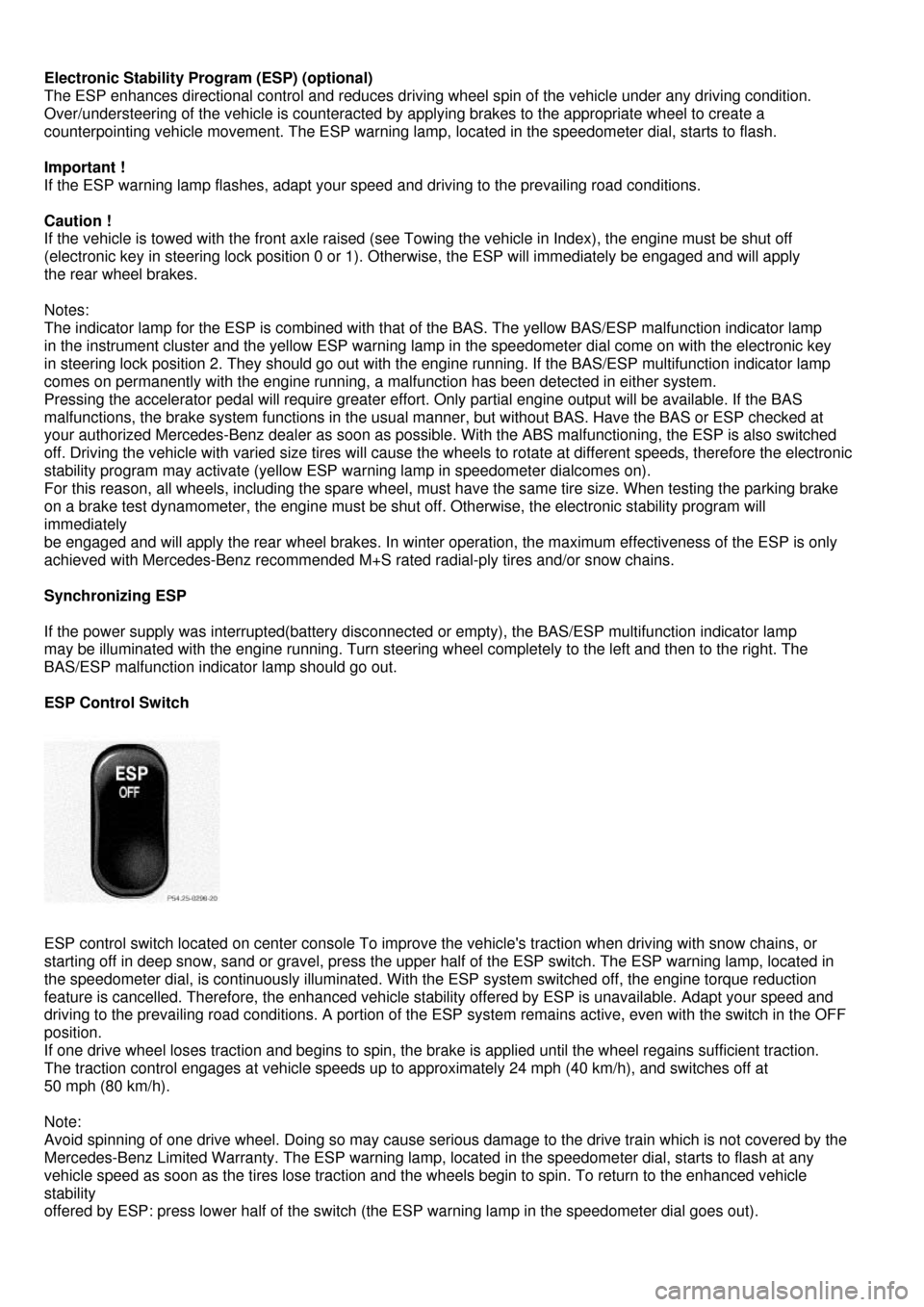
ESP Control Switch
ESP control switch located on center console To improve the vehicle's traction when driving with snow chains, or
starting off in deep snow, sand or gravel, press the upper half of the ESP switch. The ESP warning lamp, located in
the speedometer dial, is continuously illuminated. With the ESP system switched off, the engine torque reduction
feature is cancelled. Therefore, the enhanced vehicle stability offered by ESP is unavailable. Adapt your speed and
driving to the prevailing road conditions. A portion of the ESP system remains active, even with the switch in the OFF
position.
If one drive wheel loses traction and begins to spin, the brake is applied until the wheel regains sufficient traction.
The traction control engages at vehicle speeds up to approximately 24 mph (40 km/h), and switches off at
50 mph (80 km/h).
Note:
Avoid spinning of one drive wheel. Doing so may cause serious damage to the drive train which is not covered by the
Mercedes-Benz Limited Warranty. The ESP warning lamp, located in the speedometer dial, starts to flash at any
vehicle speed as soon as the tires lose traction and the wheels begin to spin. To return to the enhanced vehicle
stability
offered by ESP: press lower half of the switch (the ESP warning lamp in the speedometer dial goes out).
Page 84 of 130

Winter Driving
Have your car winterized at your authorized Mercedes-Benz dealer before the onset of winter.
• Change the engine oil if the engine contains an oil which is not approved for winter operation.
For viscosity (SAE/CCMC class) and filling quantity, see Capacities: Fuels, Coolants,
Lubricants etc. in Index.
• Check engine coolant anticorr osion/antifreeze concentration.
• Additive for the windshield washer and headl amp cleaning system: Add MB Concentrate "S"
to a premixed windshield washer solvent/ant ifreeze which is formulated for below freezing
temperatures (see Index).
• Test battery: Battery capacity drops with dec reasing ambient temperature. A well charged
battery helps to ensure that the engine can be started, even at low ambient temperatures.
• Tires: We recommend M+S rated radial-ply tires on all four wheels for the winter season.
Observe permissible maximum speed for M+S rated radial-ply tires and the legal speed limit.
Note:
In winter operation, the maximum effectiveness of the Antilock Brake System (ABS), Acceleration Slip Regulation
(ASR) or the Electronic Stab ility Program (ESP) can only be achieved with M+S rated radial-ply tires and/or snow
chains recommended by Mercedes-Benz. Snow chains maximize performance.
Snow Chains
Use only snow chains that are tested and recommended by Mercedes-Benz. Your authorized Mercedes-Benz
dealer will be glad to advise you on this subject. Ch ains should only be used on the rear wheels.
Follow the manufacturer's mounting instructions. Snow ch ains should only be driven on snow covered roads at
speeds not to exceed 30 mph (50 km/h). Remove chains as soon as possible when driving on roads without snow.
For tips on driving on slippery winter roads, refer to In dex. Vehicles with Acceleration Slip Regulation (ASR) or
Electronic Stability Program (ESP): When driving with snow chains, press the ASR or ESP control switch, refer to
Index.
Model C 43 AMG
Important !
Use of snow chains is permissible only on winter tire size 215/45 R 17 H M+S. Refer to "Rims - Tires" in section
"Technical Data" (see Index).
Travelling Abroad
Abroad, there is a widely-spread Mercedes-Benz service network at your disposal. If you plan to travel into areas
which are not listed in the index of your dealer directory, you should request pertinent information from your
authorized Mercedes-Benz dealer.
Page 85 of 130
Hood
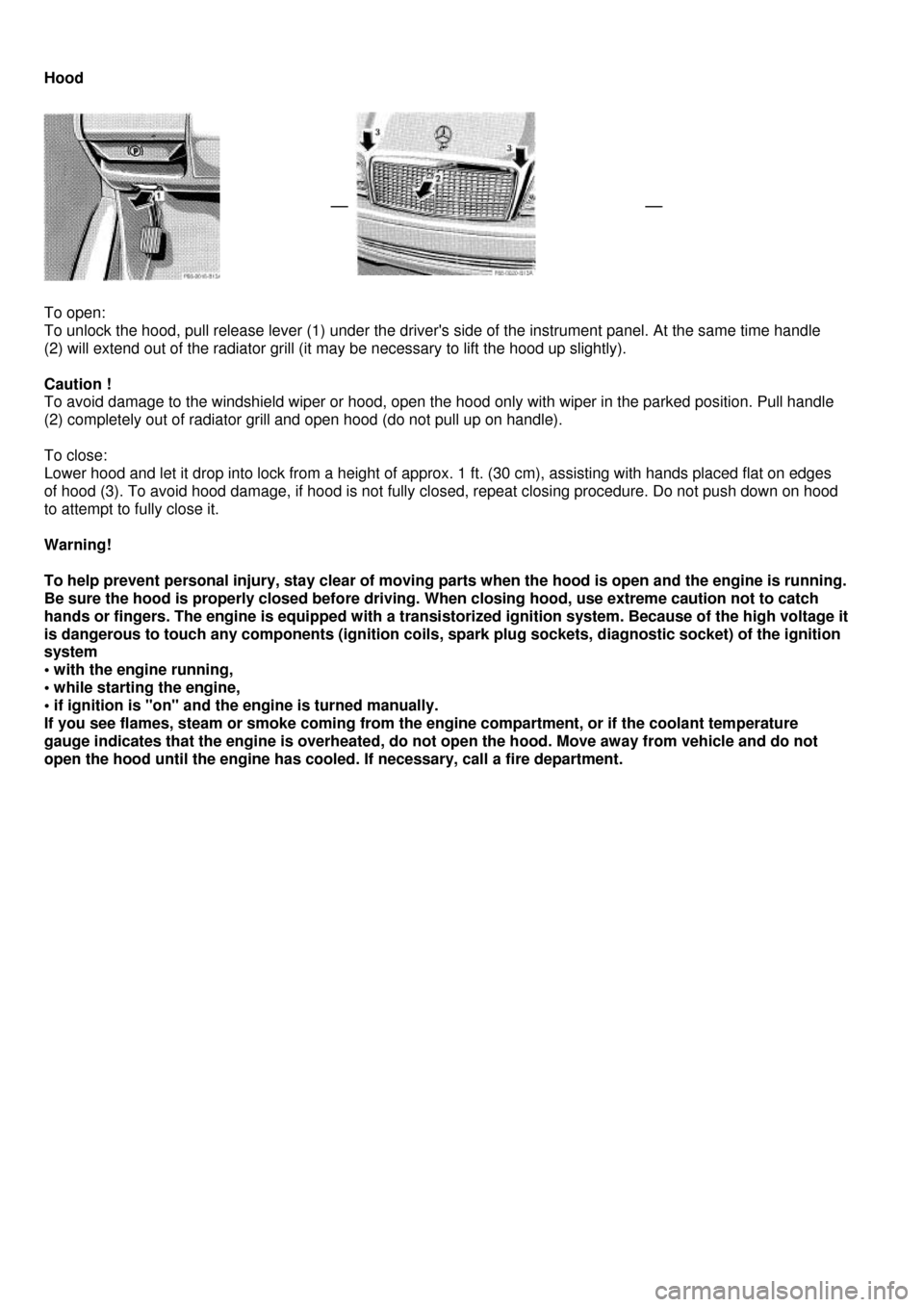
To open:
To unlock the hood, pull release lever (1) under the driver's side of the instrument panel. At the same time handle
(2) will extend out of the radiator grill (it may be necessary to lift the hood up slightly).
Caution !
To avoid damage to the windshield wiper or hood, open the hood only with wiper in the parked position. Pull handle
(2) completely out of radiator grill and open hood (do not pull up on handle).
To close:
Lower hood and let it drop into lock from a height of approx. 1 ft. (30 cm), assisting with hands placed flat on edges
of hood (3). To avoid hood damage, if hood is not fully closed, repeat closing procedure. Do not push down on hood
to attempt to fully close it.
Warning!
To help prevent personal injury, stay clear of moving parts when the hood is open and the engine is running.
Be sure the hood is properly closed before driving. When closing hood, use extreme caution not to catch
hands or fingers. The engine is equipped with a transistorized ignition system. Because of the high voltage it
is dangerous to touch any components (ignition coils, spark plug sockets, diagnostic socket) of the ignition
system
• with the engine running,
• while starting the engine,
• if ignition is "on" and the engine is turned manually.
If you see flames, steam or smoke coming from the engine compartment, or if the coolant temperature
gauge indicates that the engine is overheated, do not open the hood. Move away from vehicle and do not
open the hood until the engine has cooled. If necessary, call a fire department.
Page 94 of 130
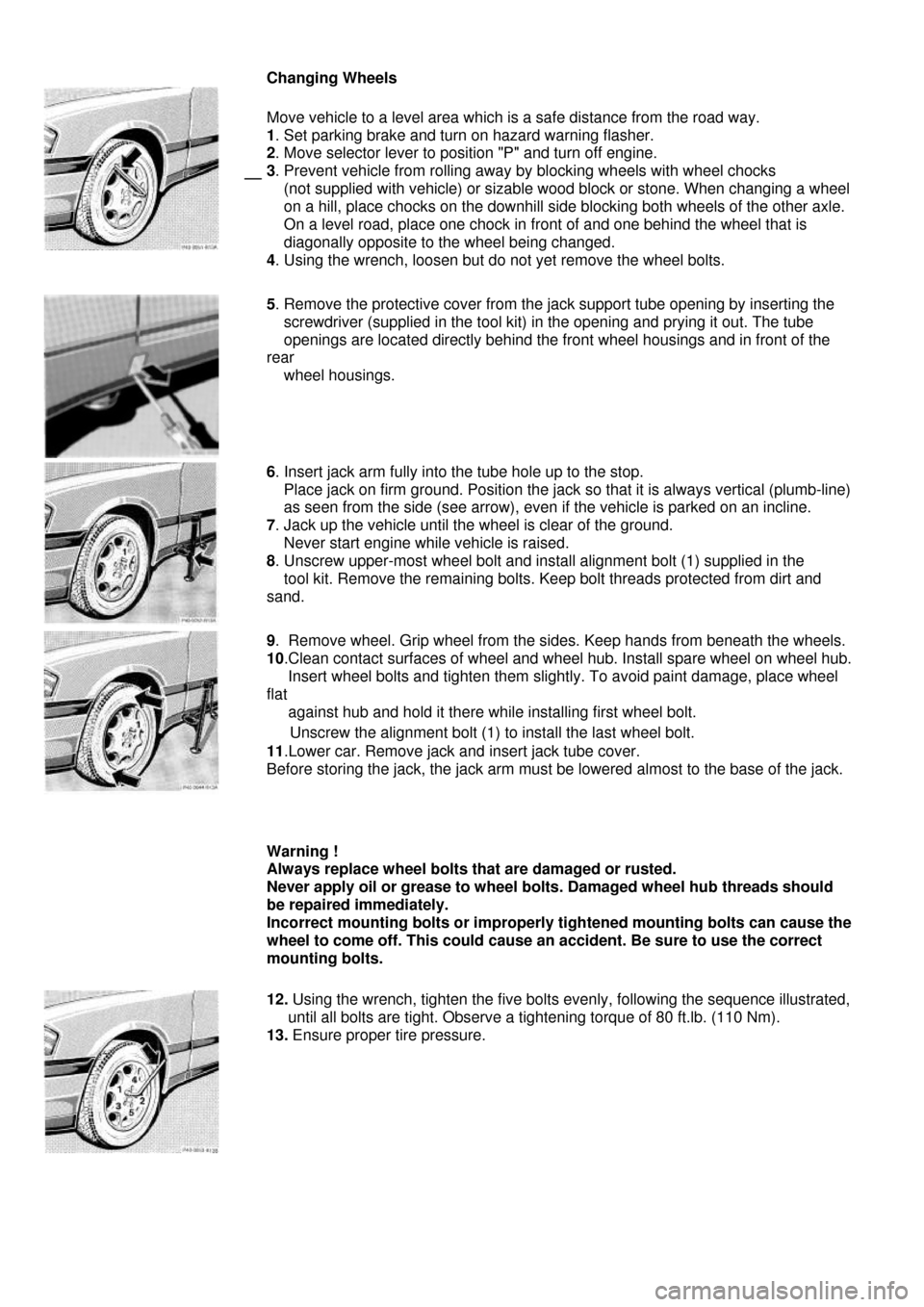
Changing Wheels
Move vehicle to a level area which is a safe distance from the road way.
1. Set parking brake and turn on hazard warning flasher.
2. Move selector lever to position "P" and turn off engine.
3. Prevent vehicle from rolling away by blocking wheels with wheel chocks
(not supplied with vehicle) or sizable wood block or stone. When changing a wheel
on a hill, place chocks on the downhill side blocking both wheels of the other axle.
On a level road, place one chock in front of and one behind the wheel that is
diagonally opposite to the wheel being changed.
4. Using the wrench, loosen but do not yet remove the wheel bolts.
5. Remove the protective cover from the jack support tube opening by inserting the
screwdriver (supplied in the tool kit) in the opening and prying it out. The tube
openings are located directly behind the front wheel housings and in front of the
rear
wheel housings.
6. Insert jack arm fully into the tube hole up to the stop.
Place jack on firm ground. Position the jack so that it is always vertical (plumb-line)
as seen from the side (see arrow), even if the vehicle is parked on an incline.
7. Jack up the vehicle until the wheel is clear of the ground.
Never start engine while vehicle is raised.
8. Unscrew upper-most wheel bolt and install alignment bolt (1) supplied in the
tool kit. Remove the remaining bolts. Keep bolt threads protected from dirt and
sand.
9. Remove wheel. Grip wheel from the sides. Keep hands from beneath the wheels.
10.Clean contact surfaces of wheel and wheel hub. Install spare wheel on wheel hub.
Insert wheel bolts and tighten them slightly. To avoid paint damage, place wheel
flat
against hub and hold it there while installing first wheel bolt.
Unscrew the alignment bolt (1) to install the last wheel bolt.
11.Lower car. Remove jack and insert jack tube cover.
Before storing the jack, the jack arm must be lowered almost to the base of the jack.
Warning !
Always replace wheel bolts that are damaged or rusted.
Never apply oil or grease to wheel bolts. Damaged wheel hub threads should
be repaired immediately.
Incorrect mounting bolts or improperly tightened mounting bolts can cause the
wheel to come off. This could cause an accident. Be sure to use the correct
mounting bolts.
12. Using the wrench, tighten the five bolts evenly, following the sequence illustrated,
until all bolts are tight. Observe a tightening torque of 80 ft.lb. (110 Nm).
13. Ensure proper tire pressure.
Page 103 of 130

Jump Starting
Warning !
Failure to follow these directions will cause damage to the electronic components, and can
lead to a battery explosion and severe injury or death. Never lean over batteries while
connecting or jump starting, you might get injure d. Battery fluid contains sulfuric acid. Do
not allow this fluid to come in contact with ey es, skin or clothing. In case it does, immediately
flush affected area with water, and seek medical help if necessary. A battery will also produce
hydrogen gas, which is flammable and very explosive. Keep flames or sparks away from
battery, avoid improper connection of jumper cables, smoking etc.. Read all instructions
before proceeding.
If the battery is discharged, the engine should be start ed with jumper cables and the (12 V) battery of
another vehicle.
The battery is located in the trunk under the trunk floor.
Proceed as follows:
1 . Position the vehicle with the charged battery so that the jumper cables will reach, but never
let the vehicles touch. Make sure the jump er cables do not have loose or missing insulation.
2. On both vehicles:
• Turn off engine and all lights and accessories, except hazard warning flashers or work lights.
• Apply parking brake and shift selector lever to position "P".
Important !
3. Clamp one end of the first jumper cable to the positive (+) terminal of the discharged
battery and the other end to the positive (+ ) terminal of the charged battery. Make sure
the cable clamps do not touch any other metal parts.
4. Clamp one end of the second jumper cable to the grounded negative (-) terminal of the
charged battery and the final connection to the negative (-) terminal of the discharged battery.
Important !
5. Start engine of the vehicle with the charged battery and run at high idle. Make sure the
cables are not on or near pulleys, fans, or other parts that will move when the engine is
started. Allow the discharged battery to charge for a few minutes. Start engine of the
disabled vehicle in the usual manner.
6. After the engine has started, remove jumper cables exactly reversing the above
installation sequence, starting with the last connection made first. When removing each
clamp, make sure that it does not touch any other metal while the other end is still attached.
Important !
A discharged battery can freeze at approx. +14°F (-10°C ). In that case, it must be thawed out before
jumper cables are used. A frozen battery can explode and cause personal injury.
Jumper cable specifications:
• Minimum cable cross-section of 25 mm
2 or approx. 2 AWG
• Maximum length of 11.5 ft. (3.5 m).
Note:
If engine does not run after several unsuccessful starting attempts, have it checked at the nearest
authorized Mercedes-Benz dealer. Excessive unbur ned fuel may damage the catalytic converter.
Page 106 of 130

Cleaning and Care of the Vehicle
Warning !
Many cleaning products can be hazardous. Some are poisonous, others are flammable.
Always follow the instructions on the particular container. Always open your car's doors or
windows when cleaning the inside. Never use fluids or solvents that are not designed for
cleaning your car.
In operation, your vehicle is subjected to varying external influences which, if gone unchecked, can
attack the paintwork as well as the underbody and cause lasting damage.
Such damage is caused not only by extreme and varying climatic conditions, but also by air
pollution, road salt, tar, gravel and stone chipping. Grease and oil, fuel, coolant, brake fluid, bird
droppings, insects, tree resins etc. should be removed immediately to avoid paint damage. Frequent
washing reduces and/or eliminates the aggr essiveness and potency of the above adverse
influences.
More frequent washings are necessary to deal with unfavorable conditions; for example, near the
ocean, in industrial areas (smoke, exhaust emissions), or during winter operation.
You should check your vehicle from time to time for stone chipping or other damage. Any damage
should be repaired as soon as possible to prevent the start of corrosion. In doing so, do not neglect
the underside of the car. A prerequisite for a t horough check is a washing of the underbody followed
by a thorough inspection. Damage d areas need to be reundercoated.
Your vehicle has been treated at the factory with a wax-base rustproofing in the body cavities which
will last for the lifetime of t he vehicle. Post-production treatment is neither necessary nor
recommended by Mercedes-Be nz because of the possibility of incompatibility between materials
used in the production proc ess and others applied later.
We have selected car care products and compiled recommendations which are specially matched to
our vehicles and which always reflect the late st technology. You can obtain Mercedes- Benz
approved car care products at your authorized Mercedes-Benz dealer.
Scratches, corrosive deposits, corrosion or damage due to negligent or incorrect care cannot always
be removed or repaired with the car care products recommended here. In such cases it is best to
seek aid at your authorized Mercedes-Benz dealer. The following topics deal with the cleaning and
care of your vehicle and give important "how-to" in formation as well as references to Mercedes-Benz
approved car care products. Additional information can be found in the booklet titled "Car Care".
Engine Cleaning
Prior to cleaning the engine compartment make sure to protect electrical components and
connectors from the intrusion of water and cleaning agents.
Corrosion protection, such as MB Anticorrosion Wax should be applied to the engine compartment
after every engine cleaning. Before applying, all control linkage bushings and joints should be
lubricated. The poly-V-belt and all pulleys should be protected from any wax.
Car Washing
Do not use hot water or wash your car in direct sunlight. Use only a mild car wash detergent, such
as Mercedes-Benz approved Car Shampoo.
Thoroughly spray the car with a diffused jet of wa ter. Direct only a very weak spray towards the
ventilation intake. Use plenty of water an d rinse the sponge and chamois frequently.
Rinse with clear water and thoroughly wipe dry with a chamois. Do not allow cleaning agents to dry
on the finish. If the vehicle has been run through an automatic car wash - in particular one of the
older installations - rewipe the recessed sections in the taillamps (designed to prevent soiling) if
necessary. No solvents (fuels, thi nners etc.) must be used. In the winter, thoroughly remove all
traces of road salt as soon as possible.
When washing the underbody, do not forget to clean the inner sides of the wheels.
Tar Stains
Quickly remove tar stains before they dry and beco me more difficult to remove. A tar remover is
recommended.
Window Cleaning
Use a window cleaning solution on all glass surfac es. An automotive glass cleaner is recommended.
Page 118 of 130
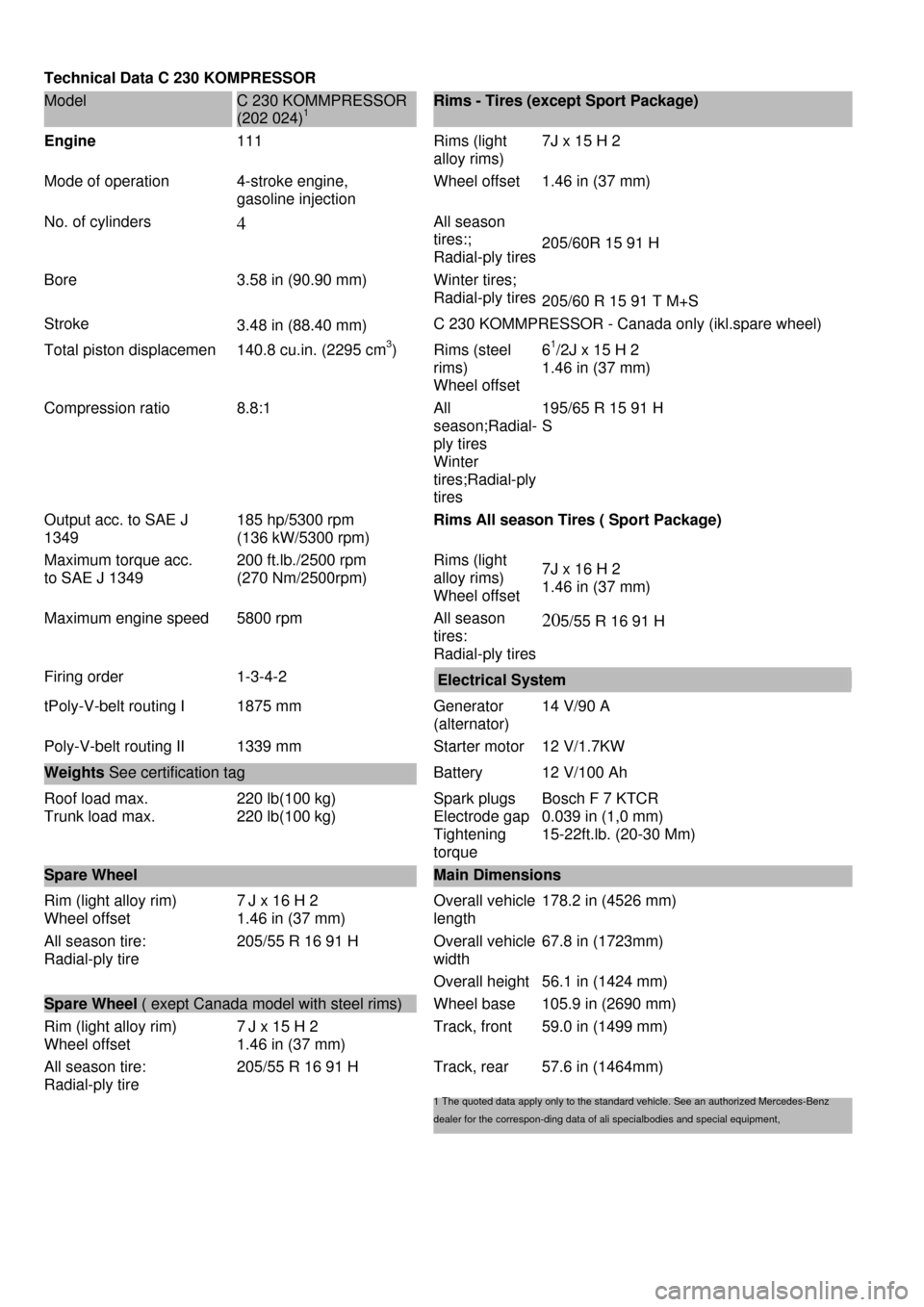
Technical Data C 230 KOMPRESSOR
Model C 230 KOMMPRESSOR
(202 024)1 Rims - Tires (except Sport Package)
Engine 111 Rims (light
alloy rims)
7J x 15 H 2
Mode of operation 4-stroke engine,
gasoline injection
Wheel offset 1.46 in (37 mm)
No. of cylinders 4
All season
tires:;
Radial-ply tires
205/60R 15 91 H
Bore 3.58 in (90.90 mm) Winter tires;
Radial-ply tires
205/60 R 15 91 T M+S
Stroke 3.48 in (88.40 mm) C 230 KOMMPRESSOR - Canada only (ikl.spare wheel)
Total piston displacemen 140.8 cu.in. (2295 cm3)
Rims (steel
rims)
Wheel offset
61/2J x 15 H 2
1.46 in (37 mm)
Compression ratio 8.8:1
All
season;Radial-
ply tires
Winter
tires;Radial-ply
tires
195/65 R 15 91 H
S
Output acc. to SAE J
1349
185 hp/5300 rpm
(136 kW/5300 rpm)
Rims All season Tires ( Sport Package)
Maximum torque acc.
to SAE J 1349
200 ft.lb./2500 rpm
(270 Nm/2500rpm)
Rims (light
alloy rims)
Wheel offset
7J x 16 H 2
1.46 in (37 mm)
Maximum engine speed 5800 rpm
All season
tires:
Radial-ply tires205/55 R 16 91 H
Firing order 1-3-4-2 Electrical System
tPoly-V-belt routing I 1875 mm Generator
(alternator)
14 V/90 A
Poly-V-belt routing II 1339 mm Starter motor 12 V/1.7KW
Weights See certification tag Battery 12 V/100 Ah
Roof load max.
Trunk load max.
220 lb(100 kg)
220 lb(100 kg)
Spark plugs
Electrode gap
Tightening
torque
Bosch F 7 KTCR
0.039 in (1,0 mm)
15-22ft.lb. (20-30 Mm)
Spare Wheel Main Dimensions
Rim (light alloy rim)
Wheel offset 7 J x 16 H 2
1.46 in (37 mm) Overall vehicle
length 178.2 in (4526 mm)
All season tire:
Radial-ply tire 205/55 R 16 91 H Overall vehicle
width 67.8 in (1723mm)
Overall height 56.1 in (1424 mm)
Spare Wheel ( exept Canada model with steel rims) Wheel base 105.9 in (2690 mm)
Rim (light alloy rim)
Wheel offset 7 J x 15 H 2
1.46 in (37 mm) Track, front 59.0 in (1499 mm)
All season tire:
Radial-ply tire 205/55 R 16 91 H Track, rear 57.6 in (1464mm)
1 The quoted data apply only to the standard vehicle. See an authorized Mercedes-Benz
dealer for the correspon-ding data of ali specialbodies and special equipment,
Page 119 of 130
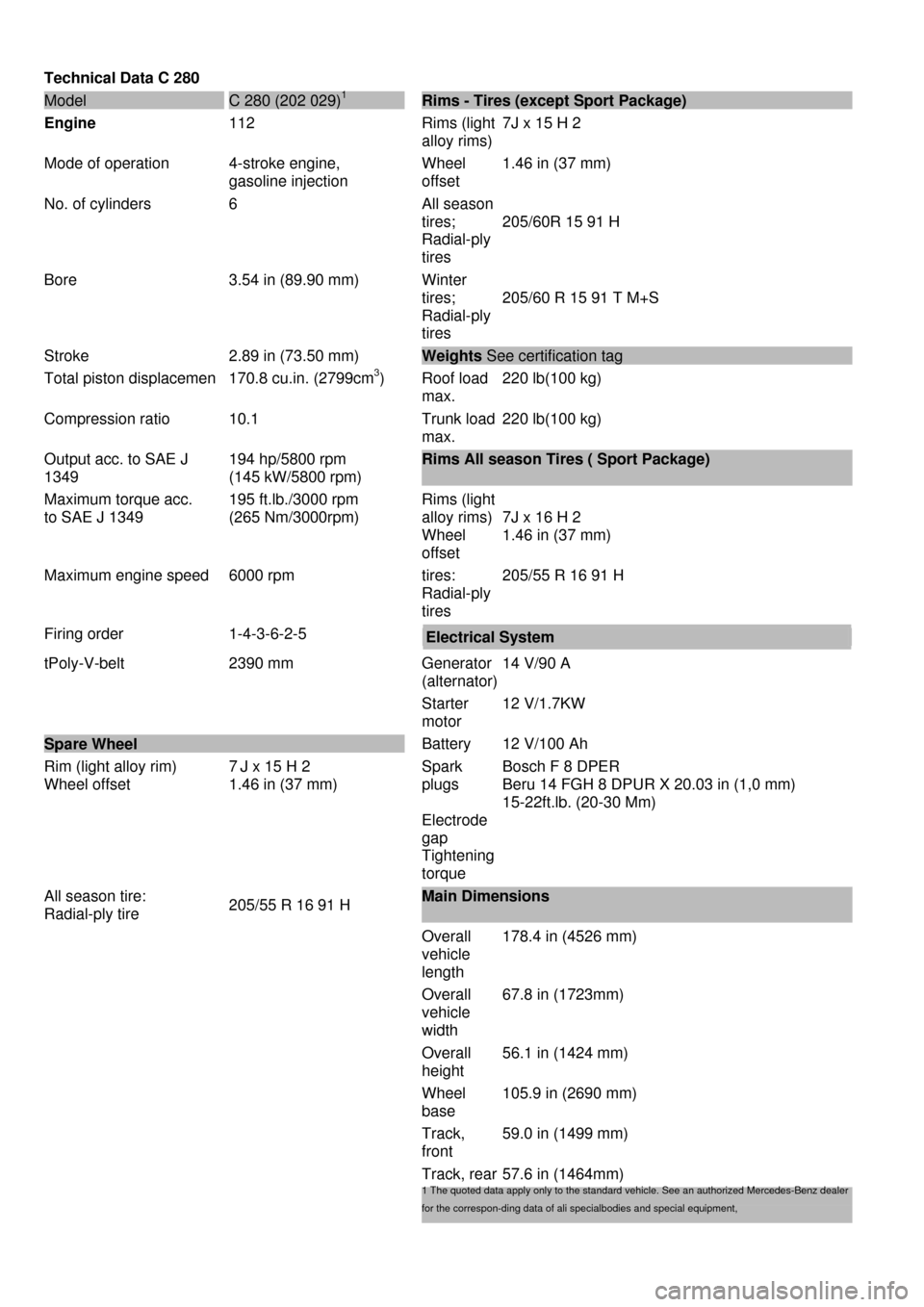
Technical Data C 280
Model C 280 (202 029)1 Rims - Tires (except Sport Package)
Engine 112 Rims (light
alloy rims)7J x 15 H 2
Mode of operation 4-stroke engine,
gasoline injection Wheel
offset 1.46 in (37 mm)
No. of cylinders 6
All season
tires;
Radial-ply
tires
205/60R 15 91 H
Bore 3.54 in (89.90 mm)
Winter
tires;
Radial-ply
tires
205/60 R 15 91 T M+S
Stroke 2.89 in (73.50 mm) Weights See certification tag
Total piston displacemen 170.8 cu.in. (2799cm3) Roof load
max. 220 lb(100 kg)
Compression ratio 10.1 Trunk load
max. 220 lb(100 kg)
Output acc. to SAE J
1349 194 hp/5800 rpm
(145 kW/5800 rpm) Rims All season Tires ( Sport Package)
Maximum torque acc.
to SAE J 1349 195 ft.lb./3000 rpm
(265 Nm/3000rpm)
Rims (light
alloy rims)
Wheel
offset
7J x 16 H 2
1.46 in (37 mm)
Maximum engine speed 6000 rpm
tires:
Radial-ply
tires 205/55 R 16 91 H
Firing order 1-4-3-6-2-5 Electrical System
tPoly-V-belt 2390 mm Generator
(alternator)14 V/90 A
Starter
motor 12 V/1.7KW
Spare Wheel Battery 12 V/100 Ah
Rim (light alloy rim)
Wheel offset
7 J x 15 H 2
1.46 in (37 mm)
Spark
plugs
Electrode
gap
Tightening
torque Bosch F 8 DPER
Beru 14 FGH 8 DPUR X 20.03 in (1,0 mm)
15-22ft.lb. (20-30 Mm)
All season tire:
Radial-ply tire 205/55 R 16 91 H Main Dimensions
Overall
vehicle
length 178.4 in (4526 mm)
Overall
vehicle
width 67.8 in (1723mm)
Overall
height 56.1 in (1424 mm)
Wheel
base 105.9 in (2690 mm)
Track,
front 59.0 in (1499 mm)
Track, rear57.6 in (1464mm)
1 The quoted data apply only to the standard vehicle. See an authorized Mercedes-Benz dealer
for the correspon-ding data of ali specialbodies and special equipment,