rear MERCEDES-BENZ C-Class 2000 W202 Owner's Guide
[x] Cancel search | Manufacturer: MERCEDES-BENZ, Model Year: 2000, Model line: C-Class, Model: MERCEDES-BENZ C-Class 2000 W202Pages: 130, PDF Size: 2.43 MB
Page 68 of 130
Automatic Transmission
The automatic transmission selects individual gears automatically, dependent upon
• Selector lever position
• Program mode selector
• Accelerator position
• Vehicle speed
The gear shifting is process is continuously adapted, dependent on the driving style, the driving situation and the road
characteristics.
Important !
When parking the car or before working on the vehicle with the engine running, firmly depress the parking brake
pedal and shift the selector lever into "P".
Driving
The selector lever is automatically locked while in position "P". To move the selector lever out of position "P", the
service brake pedal must be firmly depressed before the shift lock will release. Shift selector leverto the desired
position only when the engine is idling normally and the service brake is applied. Do not release the brake until
ready to drive. The vehicle may otherwise start creeping when the selector lever is in drive or reverse position.
Warning !
It is dangerous to shift the selector lever out of "P" or "N" if the engine speed is higher than idle speed. If
your foot is not firmly on the brake pedal, the car could accelerate quickly forward or in reverse. You
could lose control of the car and hit someone or something. Only shift into gear when the engine is idling
normally and when your right foot is firmly on the brake pedal.
Important !
After selecting any driving position from "N" or "P", wait a moment to allow the gear to fully engage before
accelerating, especially when the engine is cold.
Accelerator Position
Partial throttle = early upshifting = normal acceleration
Full throttle = later upshifting = rapid acceleration
Kickdown (depressing the accelerator beyond full throttle) = downshifting to a lower gear maximum acceleration.
Once the desired speed is attained, ease up on the accelerator - the transmission shifts up again.
Selector Lever Positions
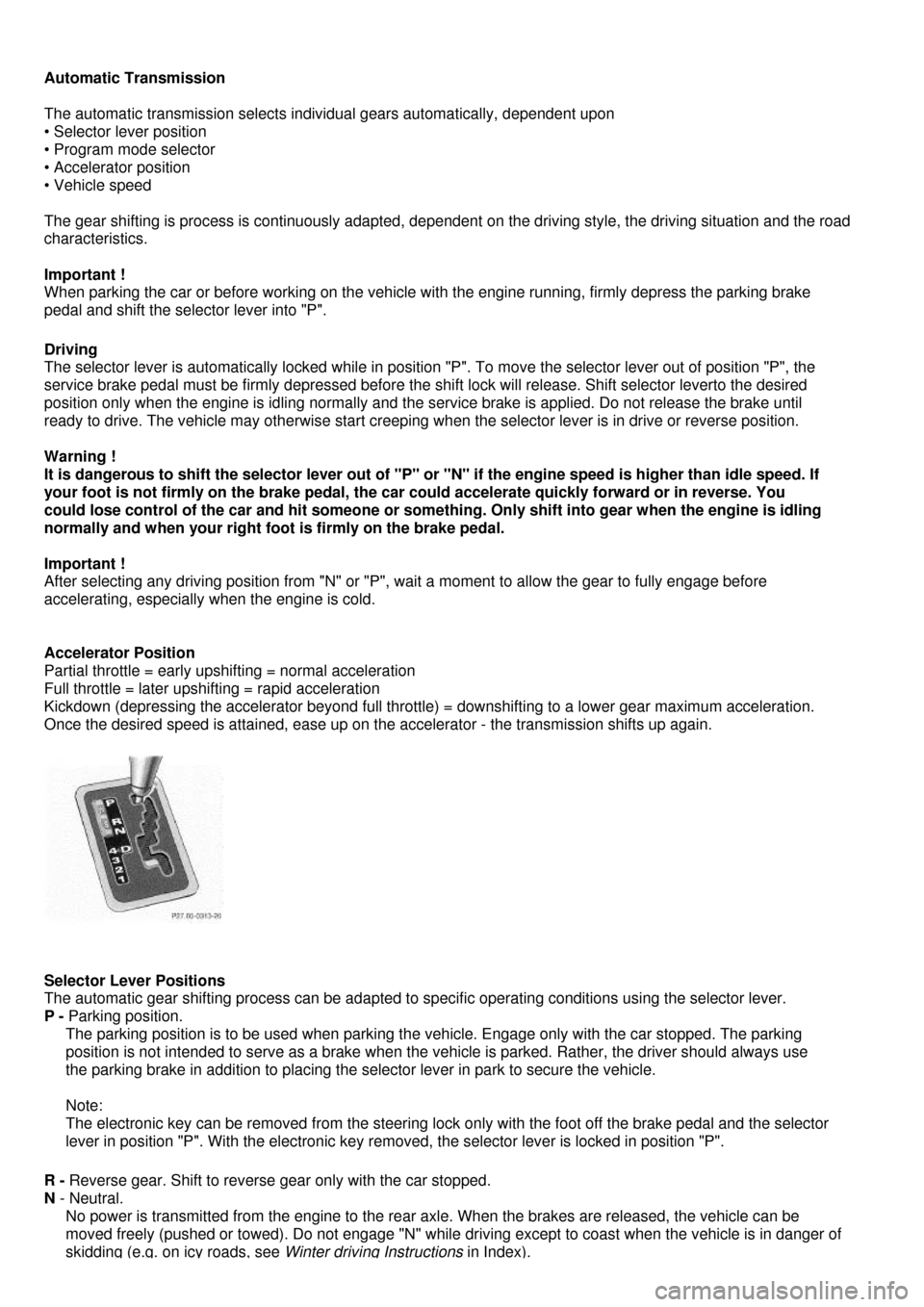
The automatic gear shifting process can be adapted to specific operating conditions using the selector lever.
P - Parking position.
The parking position is to be used when parking the vehicle. Engage only with the car stopped. The parking
position is not intended to serve as a brake when the vehicle is parked. Rather, the driver should always use
the parking brake in addition to placing the selector lever in park to secure the vehicle.
Note:
The electronic key can be removed from the steering lock only with the foot off the brake pedal and the selector
lever in position "P". With the electronic key removed, the selector lever is locked in position "P".
R - Reverse gear. Shift to reverse gear only with the car stopped.
N - Neutral.
No power is transmitted from the engine to the rear axle. When the brakes are released, the vehicle can be
moved freely (pushed or towed). Do not engage "N" while driving except to coast when the vehicle is in danger of
skidding (e.g. on icy roads, see Winter driving Instructions in Index).
Page 69 of 130

Important !
Coasting the vehicle, or driving for any other reason with selector lever in "N" can result in transmission damage
that is not covered by the Mercedes-Benz Limited Warranty.
D - The transmission automatically upshifts through 5th gear. Position "D" provides optimum driving characteristics
under all normal operating conditions.
4 - Upshift through 4th gear only.
Suitable for performance driving. To shift from position "D" to "4", push selector lever to the left.
3 - Upshift through 3rd gear only.
Suitable for moderately steep hill s. Since the transmission does not shift hi gher than 3rd gear, this gear selection
will allow use of the engine's braking power downhill.
2 - Upshift through 2nd gear only.
For driving in mountainous regions or under extreme operating conditions. This gear selection will allow use of the
engine's braking power when descending steep grades.
1 - In this position, the engine's braking effect is utilized by shifting into 1st gear.
Use this position while descending very steep or l engthy downgrades and only at speeds below 40 mph (60
km/h).
Important !
With selector lever in position "D", "4" or "3", upshifting from 1st to 2nd to 3rd gear is delayed depending on vehicle
speed and engine temperature. This allows the catalytic converter to heat up more quickly to operating temperatures.
During the brief warm-up period this delayed upshift and increased engine noise might be perceived as a malfunction.
However, neither the engine nor transmission are negatively affected by this mode of operation.
The delayed upshift is effective with vehicle speeds below 31 mph (50 km/h) at partial throttle and engine
temperatures below 95°F (35°C). To avoid overrevving the engi ne when the selector lever is moved to a lower driving
range, the transmission will not shift to a lower gear, if the engine's speed limit would be exceeded. In this case there
will be no downshift, even when the vehicle speed reaches t he engine's speed limit of that gear, e.g. by applying the
service brakes. Continue driving in the usual manner. The transmission will then shift down automatically.
To prevent the engine from laboring at low RPM when driv ing uphill gradients or with your vehicle heavily loaded, the
automatic transmission will downshift when necessary to maintain engine RPM within the best torque range.
Warning!
On slippery road surfaces, never downshift in order to obtain braking action. This could result in drive wheel
slip and reduced vehicle control. Your vehicle's AB S will not prevent this type of loss of control.
Warning !
On slippery road surfaces, never downshift in order to obtain braking action. This could result in rear
wheel slip and reduced vehicle control. Your vehicle' s ABS will not prevent this type of loss of control.
Maneuvering
To maneuver in tight areas, e.g. when pulling into a parki ng space, control the vehicle speed by gradually releasing
the
brakes. Accelerate gently and never abruptly step on the ac celerator. To rock a vehicle out of soft ground (mud or
snow),
alternately shift from forward to revers e, while applying slight partial throttle. Rocking a vehicle free in this manner
may
cause the ABS malfunction indicator lamp to come on. Turn off and restart the engine to clear the malfunction
indication.
Stopping
For brief stops, e.g. at traffic lights, leave the transmission in gear and hold vehicle with the service brake. For longer
stops with the engine idling, shift into "N" or "P" and hold the vehicle with the service brake. When stopping the
vehicle
on an uphill gradient, do not hold it with the accelerator, use the brake. This avoids unnecessary transmission heat
build up.
Warning !
Getting out of your vehicle with the selector lever not fully engaged in position "P" is dangerous. Also,
when parked on an incline, position "P" alone may not prevent your vehicle from moving, possibly hitting
people or objects. Always set the parking brake in a ddition to shifting to position "P". When parked on
an incline, also turn front wheel against curb.
Page 80 of 130
Acceleration Slip Regulation (ASR)
The acceleration slip regulation will engage at all vehicle speeds, if one or both drive wheels begin to lose traction
and spin in acceleration. While engaged, the yellow warning lamp in the speedometer dial flashes. With the
acceleration slip regulation engaged, the brake is applied to the spinning drive wheel until slip is brought under
control. If both drive wheels spin, the brake is applied to both drive wheels and simultaneously, engine torque is
limited, to improve the vehicle's driving stability. As traction on the road surface increases, thus allowing
acceleration without slip, the allowable engine torque also increases again and the brake is no longer applied to
drive wheels.
Important !
If the ASR warning lamp flashes, adapt your speed and driving to the prevailing road conditions.
Caution!
If the vehicle is towed with the front axle raised (see Towing the vehicle in Index), the engine must be shut off
(electronic key in steering lock position 0 or 1). Otherwise, the ASR regulation will immediately be
engaged and will apply the rear wheel brakes.
Notes:
The indicator lamp for the ASR is combined with that of the BAS The yellow BAS/ASR malfunction indicator
lamp in the instrument cluster and the yellow ASR warning lamp in the speedometer dial come on with the
electronic key in steering lock position 2. They should go out with the engine running. If the BAS/ASR malfunction
indicator lamp comes on with the engine running, a malfunction has been detected in either system. Pressing the
accelerator pedal will require greater effort. Only partial engine output will be available.
If the BAS malfunctions, the brake system functions in the usual manner, but without BAS. Have the BAS or ASR
checked at your authorized Mercedes-Benz dealer as soon as possible. With the ABS malfunctioning, the ASR
is also switched off. Driving the vehicle with varied size tires will cause the wheels to rotate at different speeds,
therefore the ASR may activate (yellow ASR warning lamp in speedometer dial comes on).
For this reason, all wheels, including the spare wheel, must have the same tire size. When testing the parking
brake on a brake test dynamometer, the engine must be shut off. Otherwise, the ASR will immediately be engaged
and will apply the rear wheel brakes. In winter operation, the maximum effectiveness of the ASR is only achieved
with Mercedes-Benz recommended M+S rated radial-ply tires and/or snow chains.
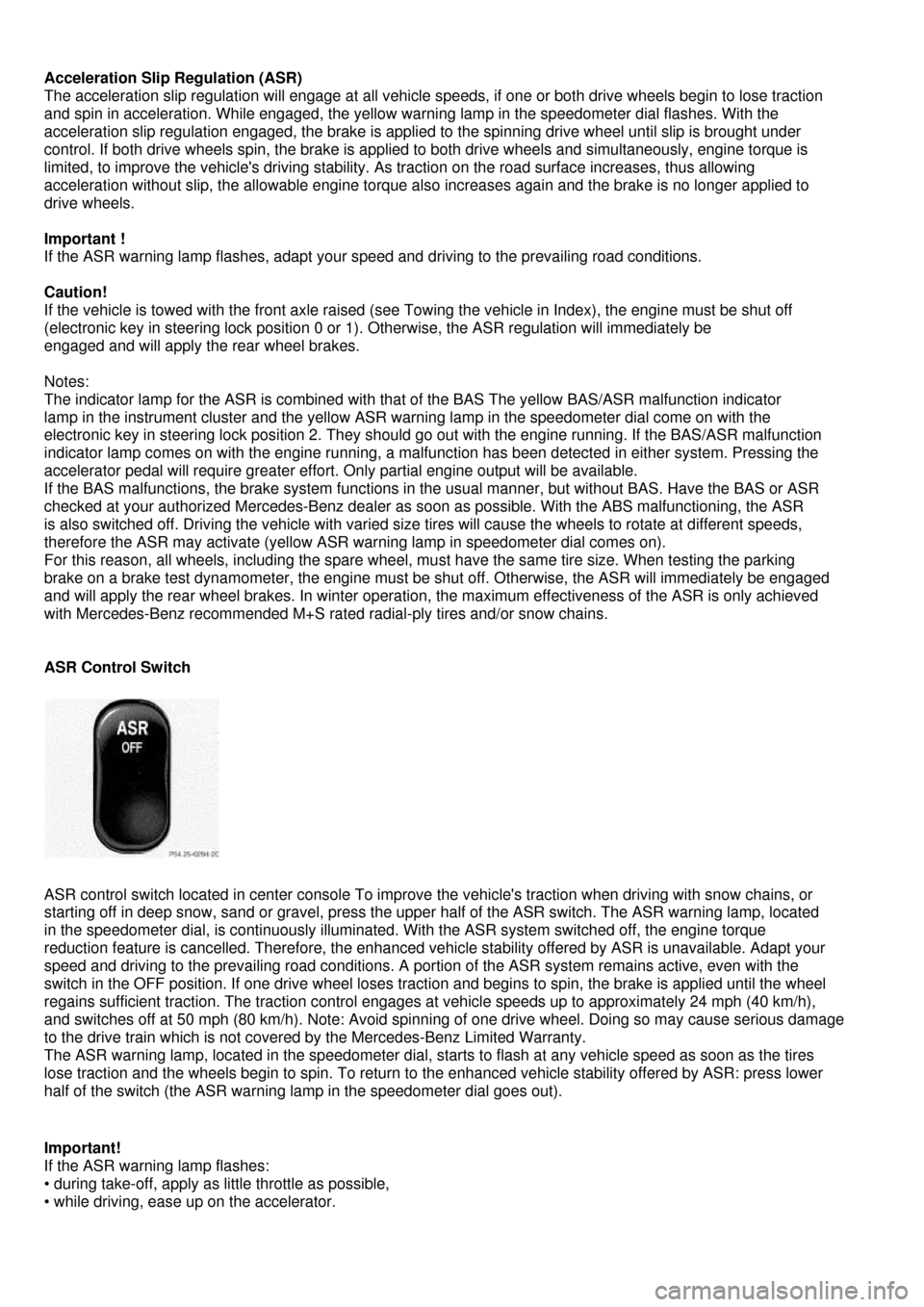
ASR Control Switch
ASR control switch located in center console To improve the vehicle's traction when driving with snow chains, or
starting off in deep snow, sand or gravel, press the upper half of the ASR switch. The ASR warning lamp, located
in the speedometer dial, is continuously illuminated. With the ASR system switched off, the engine torque
reduction feature is cancelled. Therefore, the enhanced vehicle stability offered by ASR is unavailable. Adapt your
speed and driving to the prevailing road conditions. A portion of the ASR system remains active, even with the
switch in the OFF position. If one drive wheel loses traction and begins to spin, the brake is applied until the wheel
regains sufficient traction. The traction control engages at vehicle speeds up to approximately 24 mph (40 km/h),
and switches off at 50 mph (80 km/h). Note: Avoid spinning of one drive wheel. Doing so may cause serious damage
to the drive train which is not covered by the Mercedes-Benz Limited Warranty.
The ASR warning lamp, located in the speedometer dial, starts to flash at any vehicle speed as soon as the tires
lose traction and the wheels begin to spin. To return to the enhanced vehicle stability offered by ASR: press lower
half of the switch (the ASR warning lamp in the speedometer dial goes out).
Important!
If the ASR warning lamp flashes:
• during take-off, apply as little throttle as possible,
• while driving, ease up on the accelerator.
Page 81 of 130
Electronic Stability Program (ESP) (optional)
The ESP enhances directional control and reduces driving wheel spin of the vehicle under any driving condition.
Over/understeering of the vehicle is counteracted by applying brakes to the appropriate wheel to create a
counterpointing vehicle movement. The ESP warning lamp, located in the speedometer dial, starts to flash.
Important !
If the ESP warning lamp flashes, adapt your speed and driving to the prevailing road conditions.
Caution !
If the vehicle is towed with the front axle raised (see Towing the vehicle in Index), the engine must be shut off
(electronic key in steering lock position 0 or 1). Otherwise, the ESP will immediately be engaged and will apply
the rear wheel brakes.
Notes:
The indicator lamp for the ESP is combined with that of the BAS. The yellow BAS/ESP malfunction indicator lamp
in the instrument cluster and the yellow ESP warning lamp in the speedometer dial come on with the electronic key
in steering lock position 2. They should go out with the engine running. If the BAS/ESP multifunction indicator lamp
comes on permanently with the engine running, a malfunction has been detected in either system.
Pressing the accelerator pedal will require greater effort. Only partial engine output will be available. If the BAS
malfunctions, the brake system functions in the usual manner, but without BAS. Have the BAS or ESP checked at
your authorized Mercedes-Benz dealer as soon as possible. With the ABS malfunctioning, the ESP is also switched
off. Driving the vehicle with varied size tires will cause the wheels to rotate at different speeds, therefore the electronic
stability program may activate (yellow ESP warning lamp in speedometer dialcomes on).
For this reason, all wheels, including the spare wheel, must have the same tire size. When testing the parking brake
on a brake test dynamometer, the engine must be shut off. Otherwise, the electronic stability program will
immediately
be engaged and will apply the rear wheel brakes. In winter operation, the maximum effectiveness of the ESP is only
achieved with Mercedes-Benz recommended M+S rated radial-ply tires and/or snow chains.
Synchronizing ESP
If the power supply was interrupted(battery disconnected or empty), the BAS/ESP multifunction indicator lamp
may be illuminated with the engine running. Turn steering wheel completely to the left and then to the right. The
BAS/ESP malfunction indicator lamp should go out.
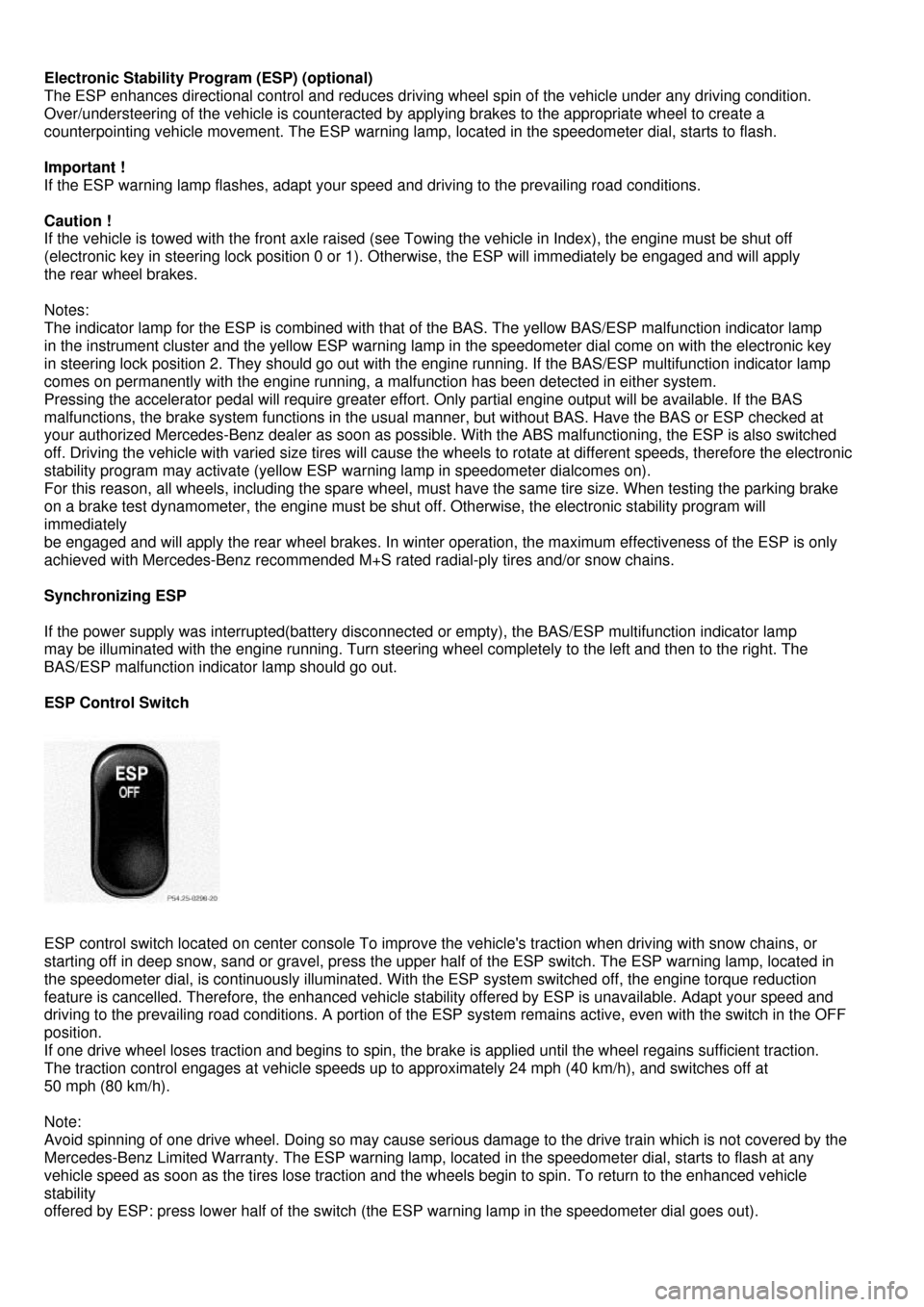
ESP Control Switch
ESP control switch located on center console To improve the vehicle's traction when driving with snow chains, or
starting off in deep snow, sand or gravel, press the upper half of the ESP switch. The ESP warning lamp, located in
the speedometer dial, is continuously illuminated. With the ESP system switched off, the engine torque reduction
feature is cancelled. Therefore, the enhanced vehicle stability offered by ESP is unavailable. Adapt your speed and
driving to the prevailing road conditions. A portion of the ESP system remains active, even with the switch in the OFF
position.
If one drive wheel loses traction and begins to spin, the brake is applied until the wheel regains sufficient traction.
The traction control engages at vehicle speeds up to approximately 24 mph (40 km/h), and switches off at
50 mph (80 km/h).
Note:
Avoid spinning of one drive wheel. Doing so may cause serious damage to the drive train which is not covered by the
Mercedes-Benz Limited Warranty. The ESP warning lamp, located in the speedometer dial, starts to flash at any
vehicle speed as soon as the tires lose traction and the wheels begin to spin. To return to the enhanced vehicle
stability
offered by ESP: press lower half of the switch (the ESP warning lamp in the speedometer dial goes out).
Page 84 of 130

Winter Driving
Have your car winterized at your authorized Mercedes-Benz dealer before the onset of winter.
• Change the engine oil if the engine contains an oil which is not approved for winter operation.
For viscosity (SAE/CCMC class) and filling quantity, see Capacities: Fuels, Coolants,
Lubricants etc. in Index.
• Check engine coolant anticorr osion/antifreeze concentration.
• Additive for the windshield washer and headl amp cleaning system: Add MB Concentrate "S"
to a premixed windshield washer solvent/ant ifreeze which is formulated for below freezing
temperatures (see Index).
• Test battery: Battery capacity drops with dec reasing ambient temperature. A well charged
battery helps to ensure that the engine can be started, even at low ambient temperatures.
• Tires: We recommend M+S rated radial-ply tires on all four wheels for the winter season.
Observe permissible maximum speed for M+S rated radial-ply tires and the legal speed limit.
Note:
In winter operation, the maximum effectiveness of the Antilock Brake System (ABS), Acceleration Slip Regulation
(ASR) or the Electronic Stab ility Program (ESP) can only be achieved with M+S rated radial-ply tires and/or snow
chains recommended by Mercedes-Benz. Snow chains maximize performance.
Snow Chains
Use only snow chains that are tested and recommended by Mercedes-Benz. Your authorized Mercedes-Benz
dealer will be glad to advise you on this subject. Ch ains should only be used on the rear wheels.
Follow the manufacturer's mounting instructions. Snow ch ains should only be driven on snow covered roads at
speeds not to exceed 30 mph (50 km/h). Remove chains as soon as possible when driving on roads without snow.
For tips on driving on slippery winter roads, refer to In dex. Vehicles with Acceleration Slip Regulation (ASR) or
Electronic Stability Program (ESP): When driving with snow chains, press the ASR or ESP control switch, refer to
Index.
Model C 43 AMG
Important !
Use of snow chains is permissible only on winter tire size 215/45 R 17 H M+S. Refer to "Rims - Tires" in section
"Technical Data" (see Index).
Travelling Abroad
Abroad, there is a widely-spread Mercedes-Benz service network at your disposal. If you plan to travel into areas
which are not listed in the index of your dealer directory, you should request pertinent information from your
authorized Mercedes-Benz dealer.
Page 89 of 130

Trunk Lamp
If the trunk is to remain open for a long period of time, the trunk lamp can be switched off by pulling out the plunger
in the switch (arrow). This prevents the vehicle battery from being discharged. When the trunk lid is closed, the switch
will reset and turn on the lamp next time the lid is opened.
Stowing Things in the Vehicle
Warning !
To help avoid personal injury during a collision or sudden maneuver, exercise care when stowing things.
Put luggage or cargo in the trunk if possible. Do not pile luggage or cargo higher than the seat backs.
Do not place anything on the shelf below the rear window.
Page 90 of 130

First Aid Kit
1. Opening lid
The first aid kit is stored in the shelf below the rear window.
Spare Wheel, Vehicle Tools,
Storage Compartment
1. Trunk floor
2. Handle
3. Luggage bowl
4. Vehicle tools
5. Tab
Lift trunk floor and engage handle in upper edge of the trunk. To remove spare tire: Turn luggage bowl
counterclockwise and remove. To store spare tire: Place spare tire in wheel well and secure it with luggage bowl.
Turn luggage bowl clockwise to its stop. The tab must point toward front of vehicle.
Note:
Always lower trunk floor before closing trunk lid.
Page 92 of 130

Wheels
Replace rims or tires with the same designation, manufacturer and type as shown on the original part. See your
authorized Mercedes-Benz dealer for further information. See your authorized Mercedes-Benz dealer for information
on tested and recommended rims and tires for summer and wi nter operation. They can also offer advice concerning
tire service and purchase.
Tire Replacement
Front tires should be replaced in sets. Rims and tires must be of the correct size and type. For dimensions, see
"Technical Data". We recommend that you break in new ti res for approx. 60 miles (100 km) at moderate speed. It is
imperative that the wheel mounting bolts be fastened to a tightening torque of 80 ft.lb. (110 Nm) whenever wheels are
mounted. For rim and tire specifications, refer to "Technical Data".
Warning !
Worn, old tires can cause accidents. If the tire tread is badly worn, or if the tires have sustained damage, replace
them. When replacing rirns, use only genuine Mercedes-Benz w heel bolts specified for the particular rim type. Failure
to do so can result in the bolts loosening and possibly an accident.
Rotating Wheels
Rotation of wheels with summer tires does not apply to m odel C 43 AMG. The wheels can be rotated according to the
degree of tire wear while retaining the same direction of travel. Rotating, however, should be carried out at the
scheduled service intervals, before the characteristic tire wear pattern (shoulder wear on front wheels and tread
center wear on rear wheels) becomes visible, as otherwise the driving properties deteriorate.
Important !
Unidirectional tires must always be mounted with arrow on tire sidewall pointing in direction of vehicle forward
movement.
Notes:
Thoroughly clean the inner side of the wheels any time you rotate the wheels or wash the vehicle underside. The use
of retread tires is not recommended. Retread tires may adversely affect the handling charac teristics and safety of the
vehicle. Dented or bent rims can caus e tire pressure loss and damage to the tire beads. For this reason, check rims
for damage at regular intervals. The rim flanges must be checked for wear before a tire is mounted. Remove burrs, if
any. Check and ensure proper tire inflation pressure after rotating the wheels. For Tire Inflation Pressure refer to
Index.
Spare Wheel (except C 43 AMG)
Important !
The spare wheel rim is mounted with a full size tire of the same type as on the vehicle, and is fully functional.
However, that spare wheel rim is weight optimized an d has a limited service life of 12 000 miles (20 000 km) use
before a standard wheel rim must replace it. In the case of a flat tire, you may temporarily use the spare wheel. Do
not operate vehicle with more than one spare wheel mounted.
Unidirectional tires must always be mounted with arrow on tire sidewall pointing in direction of vehicle forward
movement. If the arrow on tire side wall does not point in direction of vehicle forward movement when using the spare
wheel, observe the following restrictions:
• Drive to the nearest tire repair facility as soon as possible.
For rim and tire specifications, refer to "Technical Data".
Warning !
The spare wheel rim is for temporary use only. Use for over a total of 12 000 miles
(20 000 km) may cause wheel rim failure leading to an accident and possible injuries.
Page 93 of 130
Spare Wheel for Model C 43 AMG
The spare wheel rim size is 71/2 J x 17 H2
In the case of a flat tire or breakdown, you may temporarily use a 71/2 J x 17 H 2 instead of the
81/2 J x 17 H 2 wheel rim on the rear axle, when observing the following restrictions:
• Do not exceed vehicle speed of 50 mph (80 km/h).
• Drive to the nearest repair facility to have the flat tire repaired or replaced as appropriate.
For additional information, refer to "Technical Data".
Warning !
The dimensions of the spare wheel are different from those of road wheels. As a result, the
vehicle handling characteristics change when driving with a mounted spare wheel.
The spare wheel should only be used temporarily, and replaced with a regular road
wheel as quickly as possible.
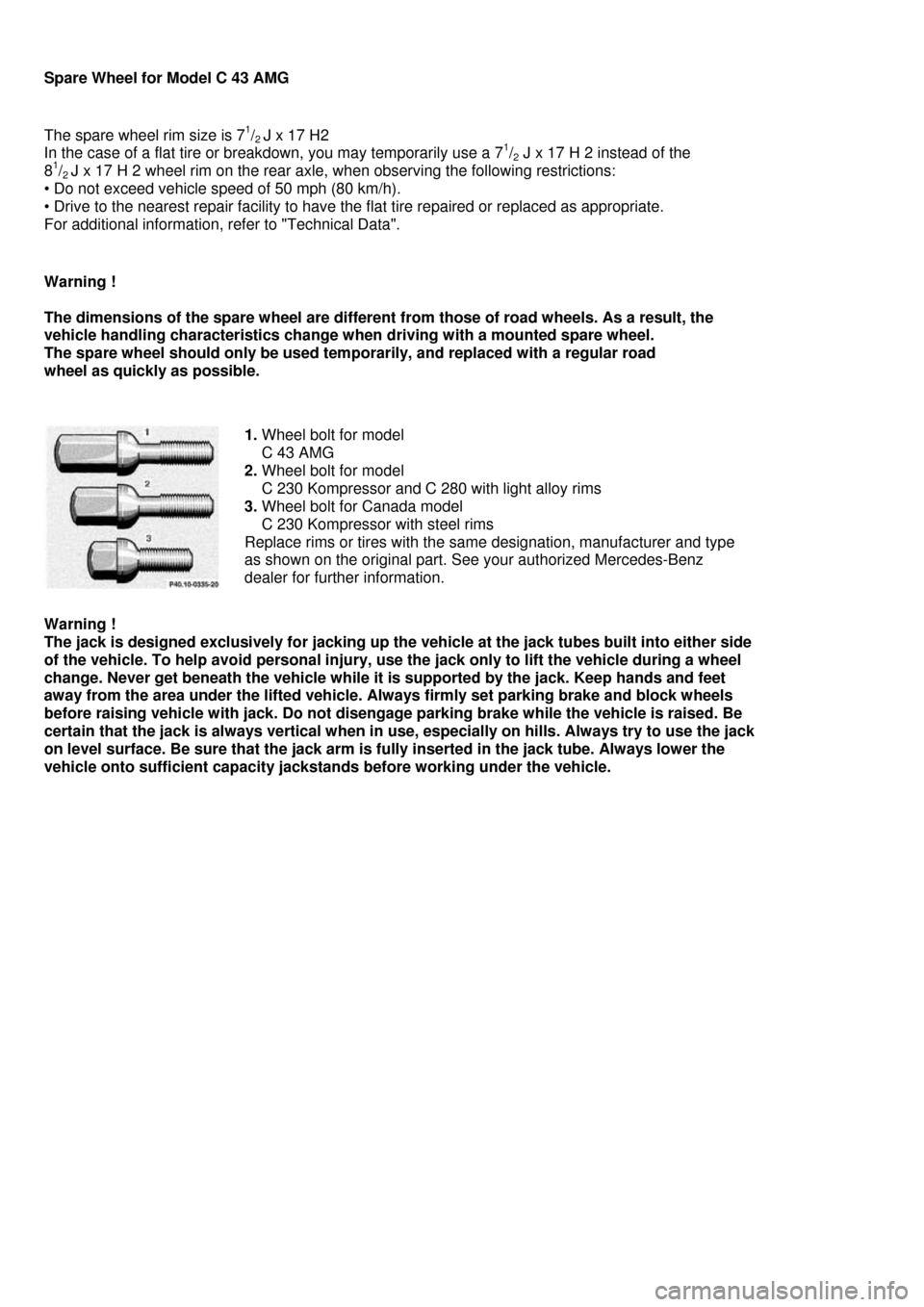
1. Wheel bolt for model
C 43 AMG
2. Wheel bolt for model
C 230 Kompressor and C 280 with light alloy rims
3. Wheel bolt for Canada model
C 230 Kompressor with steel rims
Replace rims or tires with the same designation, manufacturer and type
as shown on the original part. See your authorized Mercedes-Benz
dealer for further information.
Warning !
The jack is designed exclusively for jacking up the vehicle at the jack tubes built into either side
of the vehicle. To help avoid personal injury, use the jack only to lift the vehicle during a wheel
change. Never get beneath the vehicle while it is supported by the jack. Keep hands and feet
away from the area under the lifted vehicle. Always firmly set parking brake and block wheels
before raising vehicle with jack. Do not disengage parking brake while the vehicle is raised. Be
certain that the jack is always vertical when in use, especially on hills. Always try to use the jack
on level surface. Be sure that the jack arm is fully inserted in the jack tube. Always lower the
vehicle onto sufficient capacity jackstands before working under the vehicle.
Page 94 of 130
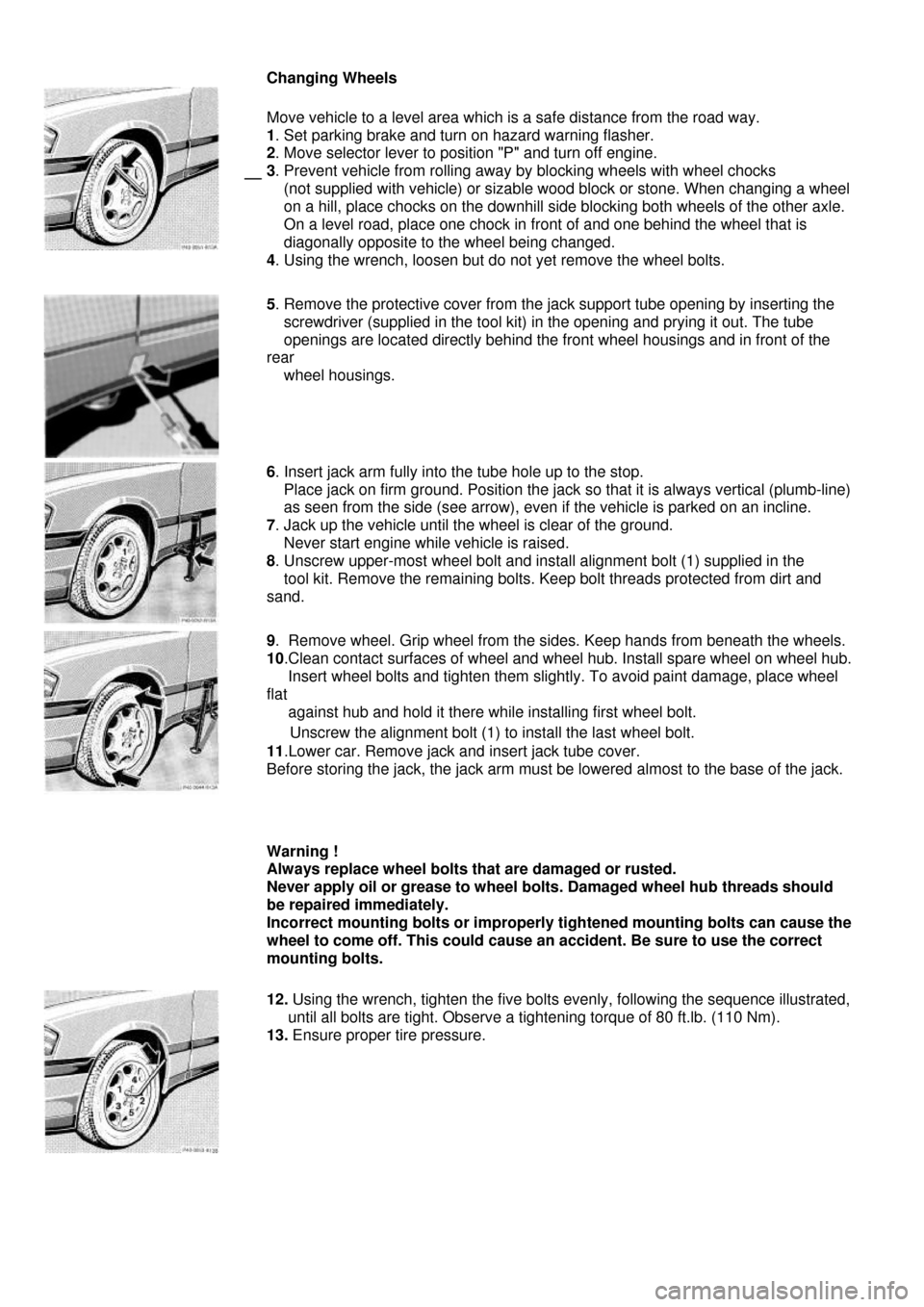
Changing Wheels
Move vehicle to a level area which is a safe distance from the road way.
1. Set parking brake and turn on hazard warning flasher.
2. Move selector lever to position "P" and turn off engine.
3. Prevent vehicle from rolling away by blocking wheels with wheel chocks
(not supplied with vehicle) or sizable wood block or stone. When changing a wheel
on a hill, place chocks on the downhill side blocking both wheels of the other axle.
On a level road, place one chock in front of and one behind the wheel that is
diagonally opposite to the wheel being changed.
4. Using the wrench, loosen but do not yet remove the wheel bolts.
5. Remove the protective cover from the jack support tube opening by inserting the
screwdriver (supplied in the tool kit) in the opening and prying it out. The tube
openings are located directly behind the front wheel housings and in front of the
rear
wheel housings.
6. Insert jack arm fully into the tube hole up to the stop.
Place jack on firm ground. Position the jack so that it is always vertical (plumb-line)
as seen from the side (see arrow), even if the vehicle is parked on an incline.
7. Jack up the vehicle until the wheel is clear of the ground.
Never start engine while vehicle is raised.
8. Unscrew upper-most wheel bolt and install alignment bolt (1) supplied in the
tool kit. Remove the remaining bolts. Keep bolt threads protected from dirt and
sand.
9. Remove wheel. Grip wheel from the sides. Keep hands from beneath the wheels.
10.Clean contact surfaces of wheel and wheel hub. Install spare wheel on wheel hub.
Insert wheel bolts and tighten them slightly. To avoid paint damage, place wheel
flat
against hub and hold it there while installing first wheel bolt.
Unscrew the alignment bolt (1) to install the last wheel bolt.
11.Lower car. Remove jack and insert jack tube cover.
Before storing the jack, the jack arm must be lowered almost to the base of the jack.
Warning !
Always replace wheel bolts that are damaged or rusted.
Never apply oil or grease to wheel bolts. Damaged wheel hub threads should
be repaired immediately.
Incorrect mounting bolts or improperly tightened mounting bolts can cause the
wheel to come off. This could cause an accident. Be sure to use the correct
mounting bolts.
12. Using the wrench, tighten the five bolts evenly, following the sequence illustrated,
until all bolts are tight. Observe a tightening torque of 80 ft.lb. (110 Nm).
13. Ensure proper tire pressure.