speed MERCEDES-BENZ C-Class 2011 W204 Owner's Manual
[x] Cancel search | Manufacturer: MERCEDES-BENZ, Model Year: 2011, Model line: C-Class, Model: MERCEDES-BENZ C-Class 2011 W204Pages: 320, PDF Size: 13.17 MB
Page 6 of 320
1, 2, 3 ...
115 V socket ...................................... 225
12 V socket ........................................ 224
4ETS see ETS/4ETS
4MATIC (permanent four-wheel
drive) .................................................. 159
A
ABS (Anti-lock Braking System) Display message ............................ 189
Function/notes ................................ 62
Warning lamp ................................. 206
Accident (notes) ................................ 253
Active light function (display
message) ............................................ 194
Active service system see Service interval display
ADAPTIVE BRAKE ................................. 66
Additional speedometer ................... 179
Air bags Display message ............................ 187
Front air bag (driver, front
passenger) ....................................... 37
Important safety notes ....................36
Knee bag .......................................... 38
PASSENGER AIRBAG OFF
indicator lamp (only Canada) ...........46
PASSENGER AIRBAG OFF
indicator lamp (only USA) ................41
Pelvis air bag ................................... 40
Safety guidelines ............................. 35
Side impact air bag ..........................39
Window curtain air bag ....................40
Air-conditioning system
see Climate control
Air dehumidification
Activating/deactivating with
cooling ........................................... 122
Air distribution
Setting ........................................... 123
Airflow
Setting ........................................... 124
Air nozzles
see Air vents .................................. 126
Air pressure
see Tire pressure
Air-recirculation mode
Activating/deactivating .................125
Air vents ............................................. 126
Glove box ....................................... 127
Important safety information .........126
Rear ............................................... 127
Setting the center air vents ...........126
Setting the side air vents ...............126
Alarm system
see ATA
AMG menu (on-board computer) ..... 171
Anti-lock Braking System see ABS
Anti-Theft Alarm system
see ATA
Anti-theft system
ATA (Anti-Theft Alarm system) .........67
Ashtray ............................................... 223
Assistance menu (on-board
computer) .......................................... 178
ATA (Anti-Theft Alarm system) Activating/deactivating ...................67
Function ........................................... 67
Switching off the alarm ....................67
Audio menu (on-board computer) .... 175
AUTO lights see Light sensor
Automatic car wash .......................... 244
Automatic transmission Display message ............................ 200
Driving tips .................................... 139
Emergency running mode ..............144
Kickdown ....................................... 140
Malfunction .................................... 144
Program selector button ................140
Pulling away ................................... 134
Releasing the parking lock
manually ........................................ 144
Selector lever ................................ 138
Starting .......................................... 133
B
Backrest (display message) ............. 201
Bag hook ............................................ 219
BAS (Brake Assist System) ................. 62
4IndexBA 204 USA, CA Edition A 2011; 1; 5, en-UShereepeVersion: 3.0.3.62010-05-20T09:17:30+02:00 - Seite 4
Page 8 of 320
Child-proof locksRear doors ....................................... 60
Children
In the vehicle ................................... 55
Restraint systems ............................ 56
Child seat
Automatic recognition .....................46
Automatic recognition/air bag
deactivation, self-test ......................48
Display message ............................ 185
LATCH-type (ISOFIX ) child seat
anchors ............................................ 58
Special seat belt retractor ...............58
Top Tether ....................................... 59
Troubleshooting ............................... 49
Cigarette lighter ................................ 224
Classification system for
occupants (OCS) Faults ............................................... 45
Operation ......................................... 41
System self-test ............................... 44
Climate control
Activating/deactivating .................122
Activating/deactivating air-
recirculation mode .........................125
Controlling automatically ...............123
Cooling with air dehumidification ..122
Defrosting the windshield ..............124
Demisting the windows .................. 125
Dual-zone automatic climate
control ........................................... 121
Important safety information .........120
Indicator lamp ................................ 123
Maximum cooling .......................... 124
Problems with "cooling with air
dehumidification" ........................... 123
Problems with the rear window
heating .......................................... 125
Refrigerant ..................................... 309
Setting the air distribution .............123
Setting the airflow .........................124
Setting the air vents ......................126
Setting the temperature ................123
Switching the MONO function on/
off .................................................. 124
Switching the rear window
heating on/off ............................... 125
Clock (on-board computer) ............... 179Cockpit ................................................. 25
Combination switch .......................... 108
Compass ............................................ 235
Consumption statistics (on-board
computer) .......................................... 170
Convenience closing feature .............. 84
Convenience opening feature ............ 84
Coolant (engine) Checking the level .........................240
Display message ............................ 194
Notes ............................................. 310
Temperature (on-board computer) . 171
Temperature gauge ........................ 166
Warning lamp ................................. 210
Cooling
see Climate control
Cornering light (display message) ... 191
Crash-responsive emergency
lighting ............................................... 111
Cruise control Cruise control lever .......................156
Display message ............................ 197
Function/notes ............................. 156
Cup holder ......................................... 220
Center console .............................. 221
Rear compartment .........................221
Current fuel consumption (on-
board computer) ............................... 170
Customer Assistance Center (CAC) ............................................... 21
Customer Relations Department ....... 21
D
Dashboard see Cockpit
Date (on-board computer) ................ 179
Daytime running lamps Display message ............................ 194
Switching on/off (on-board
computer) ...................................... 180
Delayed switch-off
Exterior lighting (on-board
computer) ...................................... 180
Interior lighting (on-board
computer) ...................................... 180
Digital speedometer ......................... 171
Display (cleaning instructions) ........ 247
6IndexBA 204 USA, CA Edition A 2011; 1; 5, en-UShereepeVersion: 3.0.3.62010-05-20T09:17:30+02:00 - Seite 6
Page 15 of 320
Correct usage .................................. 51
Emergency Tensioning Devices ........ 54
Fastening ......................................... 52
Important safety guidelines .............50
Releasing ......................................... 53
Safety guidelines ............................. 35
Special seat belt retractor ...............58
Warning lamp ................................. 204
Warning lamp (function) ................... 54
Seat heating
Indicator lamp (Malfunction) ............98
Seats
Adaptive seat backrests (AMG
vehicles) .......................................... 97
Adjusting (electrically) .....................94
Adjusting (manually and
electrically) ...................................... 94
Adjusting the head restraint ............95
Adjusting the lumbar support ..........97
Cleaning the cover .........................248
Correct driver's seat position ........... 92
Important safety notes ....................93
Storing settings (memory
function) ........................................ 102
Switching seat heating on/off .........97
Sensors (cleaning instructions) ....... 247
Service indicator see Service interval display
Service interval display .................... 242
Displaying a service message (on-
board computer) ............................ 243
Service menu (on-board computer) . 178
Service products Brake fluid ..................................... 309
Capacities ...................................... 305
Coolant (engine) ............................ 310
Engine oil ....................................... 308
Fuel ................................................ 306
Important safety notes ..................304
Notes ............................................. 304
Refrigerant (air-conditioning
system) .......................................... 309
Washer fluid ................................... 310
Settings
Factory (on-board computer) .........182
On-board computer .......................178
SETUP (on-board computer) ............. 171
Shift ranges ....................................... 141Shift recommendation ...................... 138
Side impact air bag ............................. 39
Side marker lamp (display
message) ............................................ 193
Side windows Convenience closing feature ............84
Convenience opening feature ..........84
Important safety information ...........83
Opening/closing .............................. 84
Resetting ......................................... 85
Troubleshooting ............................... 86
Sliding sunroof
Important safety information ...........86
Troubleshooting ............................... 90
see Panorama roof with power
tilt/sliding panel
see Tilt/sliding sunroof
SmartKey
Changing the battery .......................74
Changing the programming .............73
Checking the battery .................70, 74
Convenience closing feature ............84
Convenience opening feature ..........84
Display message ............................ 201
Important safety notes ....................70
Malfunction ...................................... 76
Starting the engine ........................133
Snow chains ...................................... 154
Socket ................................................ 224
Dashboard ..................................... 224
Rear compartment .........................225
SOS
see mbrace
Spare wheel
Notes/data .................................... 298
Storage location ............................ 254
see Emergency spare wheel
Speedometer
Activating/deactivating
additional speedometer (on-
board computer) ............................ 179
Additional speedometer (on-
board computer) ............................ 171
Segments ...................................... 167
Setting the unit (on-board
computer) ...................................... 178Index13BA 204 USA, CA Edition A 2011; 1; 5, en-UShereepeVersion: 3.0.3.62010-05-20T09:17:30+02:00 - Seite 13
Page 17 of 320
Engine oil (on-board computer) ...... 171
Outside temperature ...................... 167
Setting ........................................... 123
Theft deterrent locking system
Immobilizer ...................................... 66
Through-loading feature ................... 218
Tilt/sliding sunroof Opening/closing .............................. 88
Resetting ......................................... 88
Time (on-board computer) ................ 179
Timer (on-board computer) .............. 172
Tire pressure Calling up (on-board computer) .....277
Checking manually ........................275
Display message ............................ 197
Maximum ....................................... 280
Notes ............................................. 273
Pressure loss warning ....................275
Recommended ............................... 272
Tire pressure monitoring system
Function/notes ............................. 277
Restarting ...................................... 279
Warning lamp ................................. 212
Tires
Aspect ratio (definition) .................292
Average weight of the vehicle
occupants (definition) ....................290
Bar (definition) ............................... 290
Characteristics .............................. 290
Checking ........................................ 271
Cleaning ......................................... 272
Definition of terms .........................290
Direction of rotation ......................284
Distribution of the vehicle
occupants (definition) ....................293
DOT, Tire Identification Number
(TIN) ............................................... 289
DOT (Department of
Transportation) (definition) ............290
Flat tire .......................................... 254
GAWR (Gross Axle Weight Rating)
(definition) ..................................... 291
Guidelines to be observed .............271
GVW (Gross Vehicle Weight)
(definition) ..................................... 291
GVWR (Gross Vehicle Weight
Rating) (definition) .........................291Increased vehicle weight due to
optional equipment (definition) ......291
Kilopascal (kPa) (definition) ...........291
Labeling (overview) ........................286
Load bearing index (definition) ......292
Load index ..................................... 289
Load index (definition) ...................291
Maximum loaded vehicle weight
(definition) ..................................... 291
Maximum load on a tire
(definition) ..................................... 292
Maximum permissible tire
pressure (definition) ....................... 292
Maximum tire load .........................284
Maximum tire load (definition) .......291
Optional equipment weight
(definition) ..................................... 292
PSI (pounds per square inch)
(definition) ..................................... 292
Replacing ....................................... 286
Service life ..................................... 271
Sidewall (definition) .......................292
Speed index (definition) .................291
Storing ........................................... 272
Structure and characteristics
(definition) ..................................... 290
Temperature .................................. 285
TIN (Tire Identification Number)
(definition) ..................................... 292
Tire bead (definition) ......................292
Tire pressure (definition) ................292
Tire pressures (recommended) ......290
Tire size (data) ............................... 293
Tire size designation, load-bearing
capacity, speed index ....................287
Tire tread ....................................... 271
Tire tread (definition) .....................292
Total load limit (definition) .............293
Traction ......................................... 285
Traction (definition) .......................292
Tread wear ..................................... 285
Uniform Tire Quality Grading
Standards ...................................... 284
Uniform Tire Quality Grading
Standards (definition) ....................290
Unladen weight (definition) ............291
Wear indicator (definition) .............292
Wheel rim (definition) ....................291Index15BA 204 USA, CA Edition A 2011; 1; 5, en-UShereepeVersion: 3.0.3.62010-05-20T09:17:30+02:00 - Seite 15
Page 28 of 320
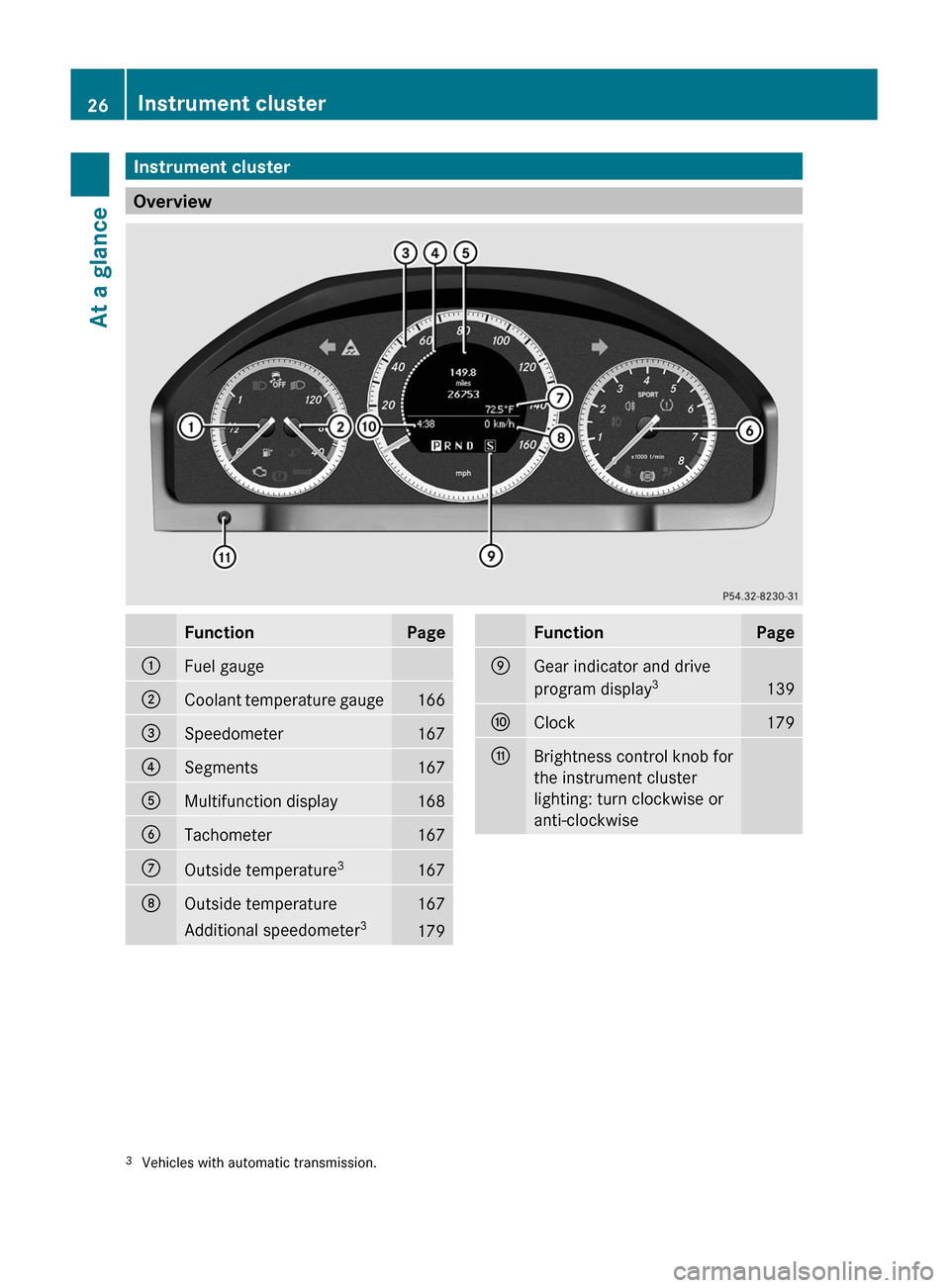
Instrument cluster
Overview
FunctionPage:Fuel gauge;Coolant temperature gauge166=Speedometer167?Segments167AMultifunction display168BTachometer167COutside temperature3167DOutside temperature167Additional speedometer 3179FunctionPageEGear indicator and drive
program display 3
139
FClock179GBrightness control knob for
the instrument cluster
lighting: turn clockwise or
anti-clockwise3 Vehicles with automatic transmission.26Instrument clusterAt a glance
BA 204 USA, CA Edition A 2011; 1; 5, en-UShereepeVersion: 3.0.3.62010-05-20T09:17:30+02:00 - Seite 26
Page 38 of 320
performed by qualified technicians.
Contact an authorized Mercedes-Benz
Center.
R For your protection and the protection of
others, when scrapping the air bag unit or
ETD, our safety instructions must be
followed. These instructions are available
from any authorized Mercedes-Benz
Center.
R Given the considerable deployment speed,
required inflation volume, and the material
of the air bags, there is the possibility of
abrasions or other, potentially more serious
injuries resulting from air bag deployment.
If you sell your vehicle, Mercedes-Benz
strongly recommends that you inform the
subsequent owner that the vehicle is
equipped with SRS. Also refer them to the
applicable section in the Operator's Manual.
Air bags
Important safety notes
GWarning
Air bags are designed to reduce the incidence
of injuries and fatalities in certain situations:
R frontal impacts (driver's and front-
passenger front air bags and driver's knee
bag)
R side impacts (side impact air bags, window
curtain air bags and pelvis air bags)
However, no system available today can
completely eliminate injuries and fatalities.
When the air bags are deployed, a small
amount of powder is released. The powder
generally does not constitute a health hazard
and does not indicate that there is a fire in the
vehicle. In order to prevent potential
breathing difficulties, you should leave the
vehicle as soon as it is safe to do so. If you
have any breathing difficulty but cannot get
out of the vehicle after the air bag inflates,
then get fresh air by opening a window or
door.
GWarning
To reduce the risk of injuries during front air
bag inflation, the driver and front-passenger
must always be seated correctly and have
their seat belts fastened accordingly.
For maximum protection in the event of a
collision, you must always be in the normal
seat position with your back against the
backrest. Fasten your seat belt and make sure
that it is correctly positioned on your body.
Since the air bag inflates with considerable
speed and force, a proper seating position
and correct positioning of the hands on the
steering wheel will help to keep you at a safe
distance from the air bag. Occupants who are
not wearing their seat belt, are not seated
properly or are too close to the air bag can be
seriously injured or killed by an air bag as it
inflates with great force instantaneously:
R Sit with the seat belt properly fastened in a
position that is as upright as possible with
your back against the seat backrest.
R Move the driver's seat as far back as
possible, still permitting proper operation
of vehicle controls. The distance from the
center of the driver's chest to the center of
the air bag cover on the steering wheel
must be at least 10 inches (25 cm) or more.
You should be able to accomplish this by
adjusting the seat and steering wheel. If
you have any difficulties, please contact an
authorized Mercedes-Benz Center.
R Do not lean your head or chest close to the
steering wheel or dashboard.
R Only hold the steering wheel by the rim.
Placing hands and arms inside the rim can
increase the risk and potential severity of
hand/arm injury when the driver front air
bag inflates.
R Adjust the front-passenger seat as far back
as possible from the dashboard when the
seat is occupied.
R Occupants, especially children, should
never place their bodies or lean their heads
in the area of the door where the side
36Occupant safetySafety
BA 204 USA, CA Edition A 2011; 1; 5, en-UShereepeVersion: 3.0.3.62010-05-20T09:17:30+02:00 - Seite 36
Page 56 of 320
Belt warning for driver and front
passenger
Regardless of whether the driver's and front-
passenger seat belts have already been
fastened, the 7 seat belt warning lamp
lights up for six seconds each time the engine
is started. It then goes out once the driver and
the front passenger have fastened their seat
belts.
If the driver's seat belt is not fastened after
the engine is started, an additional warning
tone will sound. The warning tone goes out
after approximately six seconds or once the
driver's seat belt is fastened.
If, after six seconds, the driver or front-
passenger have not fastened their seat belts
and the doors are closed:
R the 7 seat belt warning lamp remains
illuminated as long as either the driver's or
front-passenger seat belt is not fastened.
R if the vehicle speed exceeds 15 mph
(25 km/h), the 7 seat belt warning
lamp lights up. Additionally, a warning tone
will sound with increasing intensity for a
maximum of 60 seconds or until the
driver's and front-passenger seat belt are
fastened.
If the driver/front passenger unfasten their
seat belt while the vehicle is in motion, the
7 seat belt warning lamp lights up and a
warning tone sounds again.
The warning tone ceases even if the driver or
front passenger have still not fastened their
seat belt after 60 seconds. The 7 seat belt
warning lamp stops flashing but remains
illuminated.
After the vehicle comes to a standstill, the
warning tone is reactivated and the 7 seat
belt warning lamp flashes again if the vehicle
speed again exceeds 15 mph (25 km/h) .
The 7 seat belt warning lamp only goes
out if:
R both the driver and the front passenger
have fastened their seat belts.
or
R the vehicle is stationary and a door is open.
i For more information on the 7 seat
belt warning lamp, see "Indicator and
warning lamps in the instrument cluster,
seat belt" ( Y page 204).
Emergency Tensioning Devices and
seat belt force limiters
The front seat belts and the outer seat belts
in the rear are equipped with ETDs and belt
force limiters.
! If the front-passenger seat is not
occupied, do not engage the seat belt
tongue in the buckle on the front-
passenger seat. Otherwise, the Emergency
Tensioning Device could be triggered in the
event of an accident.
The ETDs tighten the seat belts in an accident,
pulling them close against the body.
ETDs do not correct incorrect seat positions
or incorrectly fastened seat belts.
ETDs do not pull vehicle occupants back
towards the backrest.
Seat belt force limiters, when activated, are
employed to help reduce the force exerted by
the seat belts on occupants during a crash.
The front belt force limiters are synchronized
with the front air bags, which take on a part
of the deceleration force. Thus, the force
exerted on the occupant is distributed over a
greater area.
The ETDs can only be activated if:
R the ignition is switched on.
R the restraint systems are operational; see
"SRS warning lamp" ( Y page 34).
R the belt tongue is engaged in the buckle on
each of the lap-shoulder belts in the front.
R the front-passenger seat is occupied and
the belt tongue is engaged in the buckle on
the front-passenger side.
54Occupant safetySafety
BA 204 USA, CA Edition A 2011; 1; 5, en-UShereepeVersion: 3.0.3.62010-05-20T09:17:30+02:00 - Seite 54
Page 63 of 320
operation is possible using the switches in
the rear compartment.
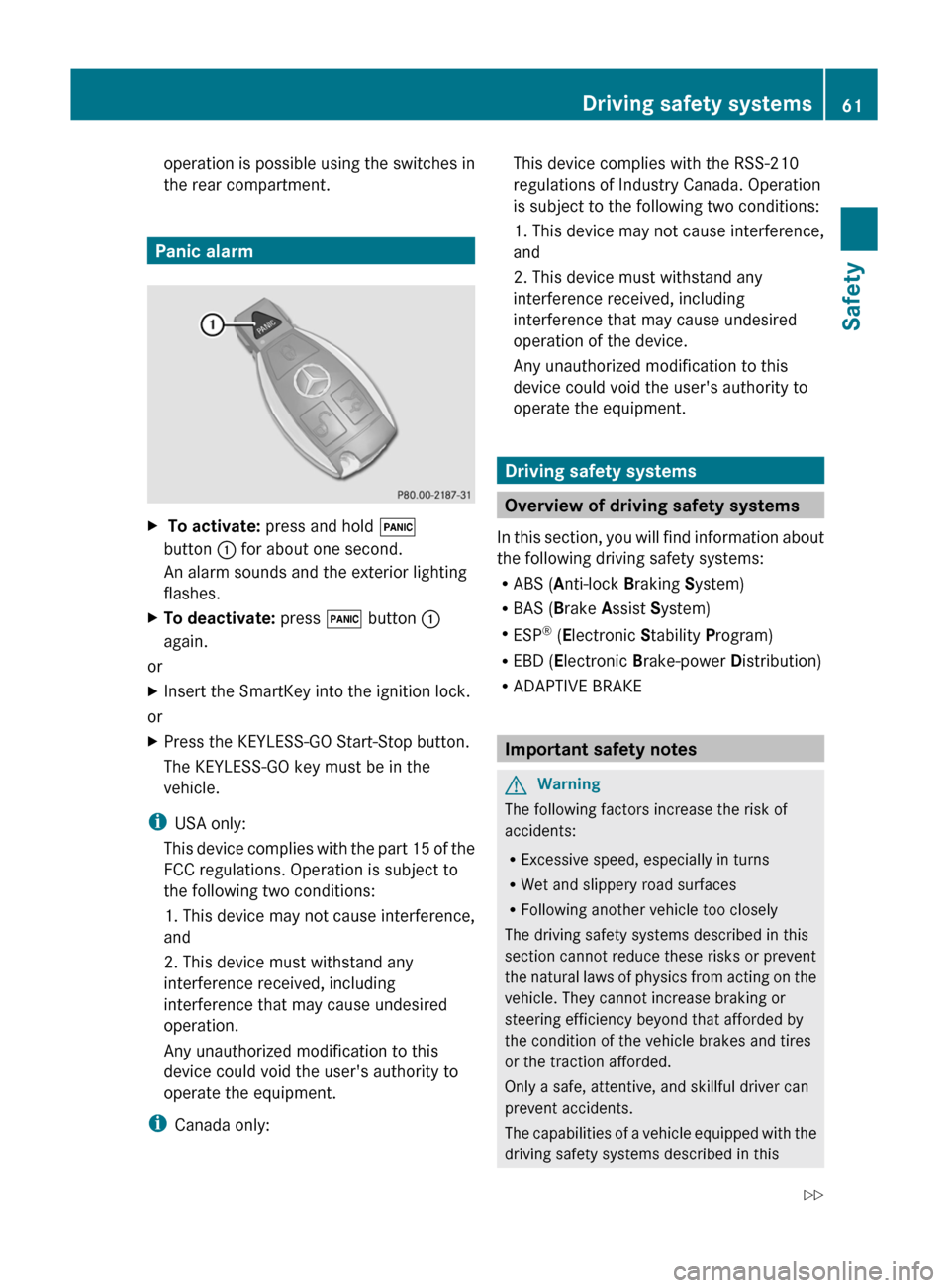
Panic alarm
X To activate: press and hold !
button : for about one second.
An alarm sounds and the exterior lighting
flashes.XTo deactivate: press ! button :
again.
or
XInsert the SmartKey into the ignition lock.
or
XPress the KEYLESS-GO Start-Stop button.
The KEYLESS-GO key must be in the
vehicle.
i USA only:
This device complies with the part 15 of the
FCC regulations. Operation is subject to
the following two conditions:
1. This device may not cause interference,
and
2. This device must withstand any
interference received, including
interference that may cause undesired
operation.
Any unauthorized modification to this
device could void the user's authority to
operate the equipment.
i Canada only:
This device complies with the RSS-210
regulations of Industry Canada. Operation
is subject to the following two conditions:
1. This device may not cause interference,
and
2. This device must withstand any
interference received, including
interference that may cause undesired
operation of the device.
Any unauthorized modification to this
device could void the user's authority to
operate the equipment.
Driving safety systems
Overview of driving safety systems
In this section, you will find information about
the following driving safety systems:
R ABS ( Anti-lock Braking System)
R BAS ( Brake Assist System)
R ESP ®
(E lectronic Stability Program)
R EBD ( Electronic Brake-power Distribution)
R ADAPTIVE BRAKE
Important safety notes
GWarning
The following factors increase the risk of
accidents:
R Excessive speed, especially in turns
R Wet and slippery road surfaces
R Following another vehicle too closely
The driving safety systems described in this
section cannot reduce these risks or prevent
the natural laws of physics from acting on the
vehicle. They cannot increase braking or
steering efficiency beyond that afforded by
the condition of the vehicle brakes and tires
or the traction afforded.
Only a safe, attentive, and skillful driver can
prevent accidents.
The capabilities of a vehicle equipped with the
driving safety systems described in this
Driving safety systems61SafetyBA 204 USA, CA Edition A 2011; 1; 5, en-UShereepeVersion: 3.0.3.62010-05-20T09:17:30+02:00 - Seite 61Z
Page 64 of 320
section must never be exploited in a reckless
or dangerous manner which could jeopardize
the user's safety or the safety of others.
Always adjust your driving style to the
prevailing road and weather conditions and
keep a safe distance to other road users and
objects on the street.
If a driving system malfunctions, other driving
safety systems may also switch off. Observe
indicator and warning lamps that may come
on as well as messages in the multifunction
display that may appear.
i In wintry driving conditions, always use
winter tires (M+S tires) and if necessary,
snow chains. Only in this way will the
driving safety systems described in this
section work as effectively as possible.
ABS (Anti-lock Braking System)
Important safety notes
GWarning
Observe "Important safety notes"
( Y page 61).
GWarning
Do not pump the brake pedal. Use firm, steady
brake pedal pressure instead. Pumping the
brake pedal defeats the purpose of the ABS
and significantly reduces braking
effectiveness.
ABS regulates brake pressure in such a way
that the wheels do not lock when you brake.
This allows you to continue steering the
vehicle when braking.
ABS works from a speed of about
5 mph (8 km/h) upwards, regardless of road-
surface conditions. ABS works on slippery
surfaces, even when you only brake gently.
The ! warning lamp in the instrument
cluster lights up when the ignition is switched
on. It goes out when the engine is running.
Braking
If ABS intervenes when braking, you will feel
a pulsing in the brake pedal.
XIf ABS intervenes: continue to depress the
brake pedal with force until the braking
situation is over.XTo make a full brake application:
depress the brake pedal with full force.GWarning
If the ABS malfunctions, other driving systems
such as the BAS or the ESP ®
are also switched
off. Observe indicator and warning lamps that
may come on as well as messages in the
multifunction display that may appear.
If the ABS malfunctions, the wheels may lock
during hard braking, reducing the steering
capability and extending the braking distance.
The pulsating brake pedal can be an
indication of hazardous road conditions and
functions as a reminder to take extra care
while driving.
BAS (Brake Assist)
GWarning
Observe "Important safety notes"
( Y page 61).
BAS operates in emergency braking
situations. If you depress the brake pedal
quickly, BAS automatically boosts the braking
force, thus shortening the stopping distance.
XKeep the brake pedal firmly depressed until
the emergency braking situation is over.
ABS prevents the wheels from locking.
The brakes will function as usual once you
release the brake pedal. BAS is deactivated.
GWarning
If the BAS malfunctions, the brake system still
functions, but without the additional brake
boost available that the BAS would normally
provide in an emergency braking maneuver.
Therefore, the braking distance may increase.
62Driving safety systemsSafety
BA 204 USA, CA Edition A 2011; 1; 5, en-UShereepeVersion: 3.0.3.62010-05-20T09:17:30+02:00 - Seite 62
Page 65 of 320
ESP®
(Electronic Stability Program)
Important safety notesGWarning
Observe "Important safety notes"
( Y page 61).
If ESP ®
detects that the vehicle is deviating
from the direction desired by the driver, one
or more wheels are braked to stabilize the
vehicle. If necessary, the engine output is also
modified to keep the vehicle on the desired
course within physical limits. ESP ®
assists
the driver when pulling away on wet or
slippery roads. ESP ®
can also stabilize the
vehicle during braking.
If ESP ®
intervenes, the ä warning lamp
flashes in the instrument cluster.
GWarning!
Never switch off the ESP when you see the
ESP warning lamp ä flashing in the
instrument cluster. In this case proceed as
follows:
R When driving off, apply as little throttle as
possible.
R While driving, ease up on the accelerator
pedal.
R Adapt your speed and driving style to the
prevailing road conditions.
Failure to observe these guidelines could
cause the vehicle to skid. The ESP cannot
prevent accidents resulting from excessive
speed.
! Vehicles without 4MATIC: switch the
ignition off when:
R the parking brake is being tested using a
dynamometer
R the vehicle is being towed with the front
axle raised
Application of the brakes by ESP ®
may
otherwise destroy the brake system.
! Vehicles with 4MATIC: switch off the
ignition when the parking brake is being
tested on a brake dynamometer.
Application of the brakes by ESP ®
may
otherwise destroy the brake system.
! Vehicles with 4MATIC: function or
performance tests may only be carried out
on a 2-axle dynamometer. If you wish to
operate the vehicle on such a
dynamometer, please consult an
authorized Mercedes-Benz Center in
advance. You could otherwise damage the
drive train or the brake system.
i Only use wheels with the recommended
tire sizes. Only then will ESP ®
function
properly.
ETS/4ETS (Electronic Traction System)GWarning
Observe "Important safety notes"
( Y page 61).
Traction control is part of ESP ®
.
Traction control brakes the drive wheels
individually if they spin. This enables you to
pull away and accelerate on slippery surfaces,
for example if the road surface is slippery on
one side. On vehicles with 4MATIC, more
drive torque is also transferred to the wheel
or wheels with traction.
Traction control remains active if you
deactivate ESP ®
.
Deactivating/activating ESP ®
(except
AMG vehicles)
GWarning
The ESP ®
should not be switched off during
normal driving other than in the
circumstances described below. Disabling
the system will reduce vehicle stability in
driving maneuvers.
Do not switch off the ESP ®
when a spare
wheel is mounted.
Driving safety systems63SafetyBA 204 USA, CA Edition A 2011; 1; 5, en-UShereepeVersion: 3.0.3.62010-05-20T09:17:30+02:00 - Seite 63Z