battery MERCEDES-BENZ C CLASS 2016 Service Manual
[x] Cancel search | Manufacturer: MERCEDES-BENZ, Model Year: 2016, Model line: C CLASS, Model: MERCEDES-BENZ C CLASS 2016Pages: 398, PDF Size: 11.64 MB
Page 196 of 398
the multifunction display. Steering Assist and
Stop&Go Pilot are activated.
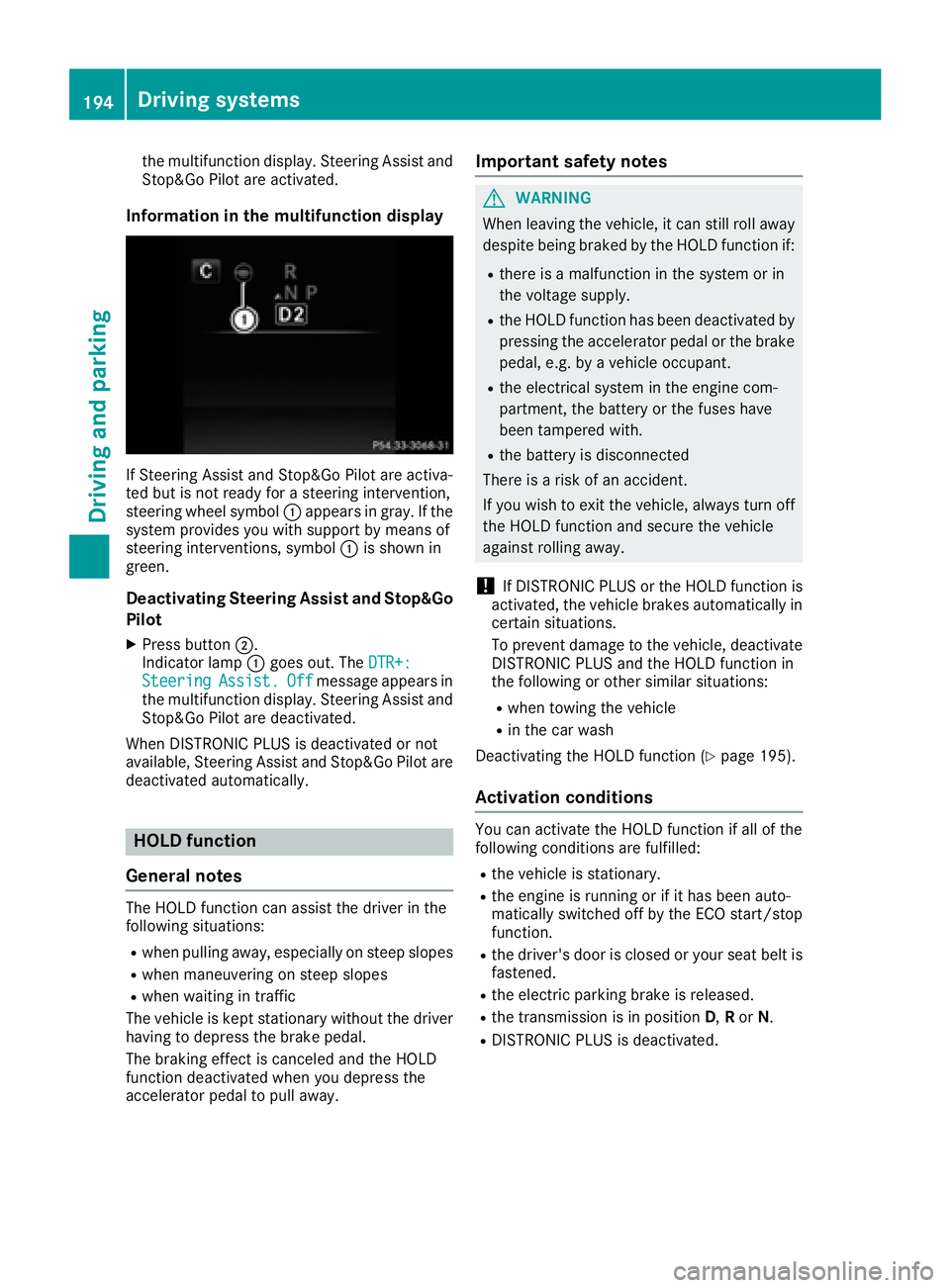
Information in the multifunction display
If Steering Assist and Stop&Go Pilot are activa-
ted but is not ready for a steering intervention,
steering wheel symbol C appears in gray. If the
system provides you with support by means of
steering interventions, symbol C is shown in
green.
Deactivating Steering Assist and Stop&Go
Pilot X
Press button D .
Indicator lamp C goes out. The DTR+:
Steering Assist. Off message appears in
the multifunction display. Steering Assist and
Stop&Go Pilot are deactivated.
When DISTRONIC PLUS is deactivated or not
available, Steering Assist and Stop&Go Pilot are
deactivated automatically.
HOLD function
General notes The HOLD function can assist the driver in the
following situations: R
when pulling away, especially on steep slopes R
when maneuvering on steep slopes R
when waiting in traffic
The vehicle is kept stationary without the driver
having to depress the brake pedal.
The braking effect is canceled and the HOLD
function deactivated when you depress the
accelerator pedal to pull away. Important safety notes
G WARNING
When leaving the vehicle, it can still roll away
despite being braked by the HOLD function if: R
there is a malfunction in the system or in
the voltage supply. R
the HOLD function has been deactivated by
pressing the accelerator pedal or the brake
pedal, e.g. by a vehicle occupant. R
the electrical system in the engine com-
partment, the battery or the fuses have
been tampered with. R
the battery is disconnected
There is a risk of an accident.
If you wish to exit the vehicle, always turn off
the HOLD function and secure the vehicle
against rolling away.
! If DISTRONIC PLUS or the HOLD function is
activated, the vehicle brakes automatically in
certain situations.
To prevent damage to the vehicle, deactivate
DISTRONIC PLUS and the HOLD function in
the following or other similar situations: R
when towing the vehicle R
in the car wash
Deactivating the HOLD function ( Y
page 195).
Activation conditions You can activate the HOLD function if all of the
following conditions are fulfilled: R
the vehicle is stationary. R
the engine is running or if it has been auto-
matically switched off by the ECO start/stop
function. R
the driver's door is closed or your seat belt is
fastened. R
the electric parking brake is released. R
the transmission is in position D , R or N .R
DISTRONIC PLUS is deactivated.194
Driving system s
Dr ivi ng an d parking
Page 206 of 398
R
that are parallel to the direction of travel and
at least 39.5 in (1.0 m) longer than your vehi-
cle R
that are at right angles to the direction of
travel and at least 39.5 in (1.0 m) wider than
your vehicle
i Note that Active Parking Assist cannot
measure the size of a parking space if it is at
right angles to the direction of travel. You will
need to judge whether your vehicle will fit into
the parking space.
When driving at speeds below 19 mph
(30 km/h), you will see the parking symbol as a
status indicator in the instrument cluster. When
a parking space has been detected, an arrow
towards the right or the left also appears. By
default, Active Parking Assist only displays park-
ing spaces on the front-passenger side. Parking
spaces on the driver's side are displayed as
soon as the turn signal on the driver's side is
activated. When parking on the driver's side,
this must remain switched on until you acknowl-
edge the use of Active Parking Assist by press-
ing the v button on the multifunction steer-
ing wheel. The system automatically determines
whether the parking space is parallel or at right
angles to the direction of travel.
A parking space is displayed while you are driv-
ing past it, and until you are approximately 50 ft
(15 m) away from it.
Parking
G WARNING
If you leave the vehicle when it is only being
braked by Active Parking Assist it could roll
away if: R
there is a malfunction in the system or in
the voltage supply. R
the electrical system in the engine com-
partment, the battery or the fuses have
been tampered with. R
the battery is disconnected. R
the accelerator pedal has been depressed,
e.g. by a vehicle occupant.
There is a risk of an accident.
Before leaving the vehicle, always secure it
against rolling away. i When PARKTRONIC detects obstacles,
Active Parking Assist brakes automatically
during the parking process. You are respon-
sible for braking in good time. X
Stop the vehicle when the parking space sym-
bol shows the desired parking space in the
instrument cluster. X
Shift the transmission to position R .
The Start Park Assist?Yes: OKNo: 8
message appears in the multifunction display. X
To cancel the procedure: press the 8
button on the multifunction steering wheel or
pull away.
or X
To park using Active Parking Assist: press
the v button on the multifunction steering
wheel.
The Park Assist Active Accelerate
and Brake Observe Surroundings mes-
sage appears in the multifunction display. X
Let go of the multifunction steering wheel. X
Back up the vehicle, being ready to brake at all
times. When backing up, drive at a speed
below approximately 6 mph (10 km/h). Oth-
erwise Active Parking Assist will be canceled.
Active Parking Assist brakes the vehicle to a
standstill when the vehicle approaches the
rear border of the parking space.
Maneuvering may be required in tight parking
spaces.
The Park Assist Active Select D Observe
Surroundings message appears in the multi-
function display. X
Shift the transmission to position D while the
vehicle is stationary.
Active Parking Assist immediately steers in
the other direction.
The Park Assist Active Accelerate
and Brake Observe Surroundings mes-
sage appears in the multifunction display.
i You will achieve the best results by waiting
for the steering procedure to complete before
pulling away. X
Drive forwards and be ready to brake at all
times.
Active Parking Assist brakes the vehicle to a
standstill when the vehicle approaches the
front border of the parking space.
Maneuvering may be required in tight parking
spaces.204
Driving systems
Driving and parking
Page 227 of 398
drive system automatically selects the most effi-
cient operating mode for every driving situation.
Drive the vehicle in the usual manner.
To save fuel in HYBRID mode, the hybrid drive
system switches off the combustion engine as
often as possible during the journey when power
output requirements are low. When power out-
put requirements are low, the electric motor
powers the vehicle. When power output require-
ments are high, the combustion engine is auto-
matically switched on. The engine is usually
switched off when the vehicle is stationary. Con-
sequently, there is usually no engine idling as
with combustion engine vehicles.
For pulling away and accelerating, the electric
motor supports the internal combustion engine
using the power stored in the high-voltage bat-
tery. In addition, the power is used for partially
electric driving, operation of the electric coolant
compressor and to support the 12 V on-board
electrical system. In this way the hybrid drive
system helps to reduce your vehicle's fuel con-
sumption.
Observe the driving tips on plug-in hybrid oper-
ation ( Y
page 230).
Recuperative Brake System If you release the accelerator pedal when the
vehicle is in motion, overrun recuperation is ini-
tiated. The electric motor is operated as a gen-
erator when in overrun mode and when you
brake. Hybrid technology converts the kinetic
energy of the vehicle into electricity and stores
it in the high-voltage battery.
Observe the important safety notes for the
Recuperative Brake System ( Y
page 45).
Important safety notes If the engine is switched off by the ECO start/
stop function and you open the driver's door: R
a message appears in the multifunction dis-
play and R
a warning tone sounds
Further information ( Y
page 272).
All of the vehicle's systems remain active, if: R
the vehicle is stationary R
the combustion engine is switched off and R
the READY indicator in the instrument cluster
lights up If you remove your foot from the brake pedal
while in transmission position D or R, the vehicle
may pull away automatically.
Observe the notes on the READY display of the
ECO start/stop function ( Y
page 231).
Vehicles with an electric motor generate much
less driving noise than vehicles with internal
combustion engines. As a result, your vehicle
may not be heard by other road users in certain
situations. This is the case, for example, when
you are parking and your vehicle is not seen by
other road users.
This requires you to adopt a particularly antici-
patory driving style, as it is necessary to allow
for the possibility that other road users may
behave erratically.
Displays and operation
Electric motor performance display
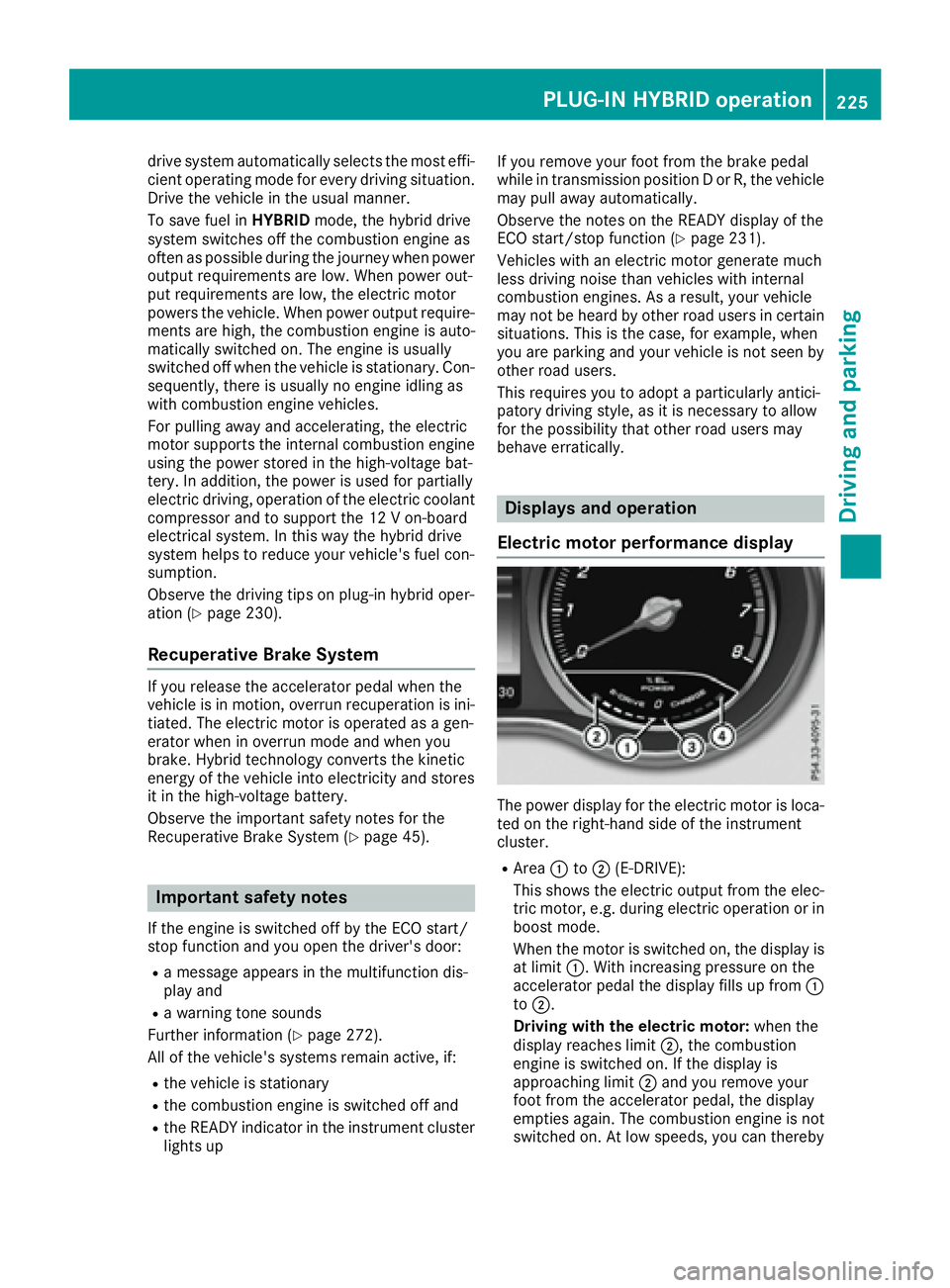
The power display for the electric motor is loca-
ted on the right-hand side of the instrument
cluster. R
Area C to D (E-DRIVE):
This shows the electric output from the elec-
tric motor, e.g. during electric operation or in
boost mode.
When the motor is switched on, the display is
at limit C . With increasing pressure on the
accelerator pedal the display fills up from C
to D .
Driving with the electric motor: when the
display reaches limit D , the combustion
engine is switched on. If the display is
approaching limit D and you remove your
foot from the accelerator pedal, the display
empties again. The combustion engine is not
switched on. At low speeds, you can therebyPLUG ‑ IN HYBRID operation 225
Driving and parking Z
Page 229 of 398
E-SAVE R
Electric mode or driving
with the internal combus-
tion engine is possible R
Automatic selection of
drive mode with electric
mode as often as possi-
ble R
The current condition of
charge of the high-volt-
age battery is maintained
so the electrical energy
can be used at a later
time
CHARGE R
Electric drive is not pos-
sible R
Charging the high-volt-
age battery while driving
using the combustion
engine
In automatic drive program S ( Y
page 229) and
during manual gearshifting ( Y
page 229), only
HYBRID operating mode is available.
If you switch from automatic drive program S to
automatic drive program E , HYBRID operating
mode continues to be selected.
If manual drive program M is deactivated, the
automatic transmission shifts: R
into the automatic drive program that was last
selected R
into the driving mode that was last selected
Each time the engine is started, HYBRID mode
is automatically selected.
Operating the on-board computer You can display the current operating condition
of the hybrid drive system in the multifunction
display and on the display of the multimedia
system ( Y
page 227).
In the multimedia system display, you can also
call up a graphic display of the fuel consumption
and generated electricity ( Y
page 228). Menus and submenus
Selecting displays in the display of the
multimedia system X
Press the
Page 233 of 398
Overrun mode or braking There are three possible operating modes when
the hybrid vehicle is decelerating: R
energy recovery takes place even when the
vehicle is decelerating purely in overrun mode
( Y
page 225). The electric motor operates as
a generator and stores the recovered energy
in the high-voltage battery R
when the brakes are applied lightly, the vehi-
cle is slowed down further by the electric
motor This increases the energy recovery tak-
ing place ( Y
page 225) The electric motor
operates as a generator and stores the recov-
ered energy in the high-voltage battery. R
when the brakes are applied with greater
force, the service brakes are also used to slow
the vehicle down. The two systems work
together
Urban driving Energy is recuperated during frequent deceler-
ation and stopping in city traffic.
The vehicle can be driven by the electric motor
alone up to a speed of approximately 120 km/ h.
The vehicle is driven by the electric motor alone
only when all conditions for the automatic
engine switch-off are fulfilled.
Further information on the automatic engine
switch-off ( Y
page 231).
Driving on inter-urban roads The following phases are possible when driving
on inter-urban roads: R
rapid acceleration (boost mode) R
constant energy consumption R
energy recuperation R
electric operation mode
A great deal of recovered energy may be avail-
able, depending on the route profile. This
reduces consumption and emissions.
Highway driving
During highway driving, fuel consumption and
emissions are favorably influenced in particular
by reduced power losses.
If the driver removes his foot from the acceler-
ator pedal in drive program E and a speed of
160 km/h is not exceeded, the combustion
engine is automatically switched off.
Further information on the automatic engine
switch-off ( Y
page 231). ECO start/stop function General notes The ECO start/stop function switches the inter-
nal combustion engine off automatically when
the vehicle stops moving and at high speeds
( Y
page 232).
All vehicle systems remain active, e.g. the auto-
matic climate control.
The ECO start/stop function is only available in
drive programs C and E . Electric-only operation
is only possible in drive programs C and E . Addi-
tional information for drive programs
( Y
page 229).
Automatic engine switch-off The engine is switched off automatically, includ-
ing when: R
the driver removes his foot from the acceler-
ator in drive program E and a speed of
160 km/h is not exceeded ( Y
page 232)R
the engine has reached its operating temper-
ature R
the driver’s seat belt is fastened and the
driver’s door is closed R
the driver only slightly depresses the accel-
erator pedal in order to, for example, maintain
the current speed for a limited distance R
the hood is closed and engaged properly R
the high-voltage battery is charged suffi-
ciently R
no malfunctions are present in the hybrid
drive system
The internal combustion engine will not be
switched off automatically, if: R
the self-diagnosis function of the engine con-
trol unit is still active R
there is a malfunction in the hybrid drive sys-
tem R
the climate control of the vehicle requires it R
the high-voltage battery is being charged
( Y
page 227) R
automatic emissions tests are runningPLUG ‑ IN HYBRID operation 231
Driving and parking Z
Page 234 of 398
Aut oma tic engine startThe automatically switched-off internal combus -
tio n engin e start s automatically in certai n situa-
tions , if:R
th e power demand from th e driver via th e
accelerato r pedal is greate r than th e electric
motor alon e can provideR
th e driver switches to driv e program S or MR
th e condition of charge of th e high-voltage
battery has reached th e lower limitR
th e settings of th e automatic climat e control
require it, e.g. at external temperatures abov e
30 †
Over ru n mod eIn overrun mode, th e combustio n engin e is
switched off and is disconnected from th e driv e
train. The electric motor: R
generates low thrust , whic h correspond s to
th e overrun mod e of an active combustio n
engin eR
function s as a generator and produce s th e
necessary energ y for th e auxiliary consumer s
and charge s th e high-voltage battery
Ove rrun mod e is available in driv e program E
below 16 0 km/h.
In driv e program E , after th e accelerato r pedal
has been released th e coasting characteristic s
of th e vehicl e are adapted to th e traffic condi-
tions . Further information about th e haptic
accelerato r pedal ( Y
page 230).
Route-based energy management Fo r route-based energ y management, th e sys-
te m factors in information about th e expecte d
rout e when rout e guidance is active.
The information on th e rout e is provide d by th e
multimedia system and includes th e following:R
road categories R
spee d limitation sR
dat a on downhill gradients
The use of electric energ y is automatically opti-
mally distributed from th e beginning to th e en d
of th e journey, usin g information about th e
route. The distribution is pre-emptive and takes
int o consideration :R
th e sections of th e journey aheadR
th e energ y consumption on th e whole rout e The condition of charge of th e high-voltage bat -
tery is thus systematically controlled. In addi-
tion, th e control function takes int o accoun t
that: R
th e fuel saving s throug h th e use of electrical
energ y can vary, depending on th e rout e (e.g.
urban , interurban or highway) R
th e use of electrical energ y is held available in
particular for electric operation (e.g. urban
routes)
The vehicl e thus automatically select s th e opti-
mum driving mod e for th e respectiv e sectio n of
th e route.
Route-based energ y managemen t is available
under th e followin g conditions:R
driv e program E is selected R
HYBRID driving mod e is selectedR
active rout e guidance is activated R
suitable map dat a is available
When route-based energ y managemen t is in
operation , th e area in fron t of th e vehicl e is
shown as green in th e multifunction display.
Parking X
Apply th e electric parking brake.
The red $ indicator lamp in th e instrumen t
cluste r lights up. X
Use th e DIRECT SELECT leve r to shif t th e
automatic transmission to P .X
Switch th e ignition off .
The READY indicator in th e instrumen t cluste r
goes out .
Further information on parking and switching off
th e internal combustio n engin e ( Y
page 177).232
PLUG ‑ IN HYBRID operation
Driving and parking
Page 251 of 398
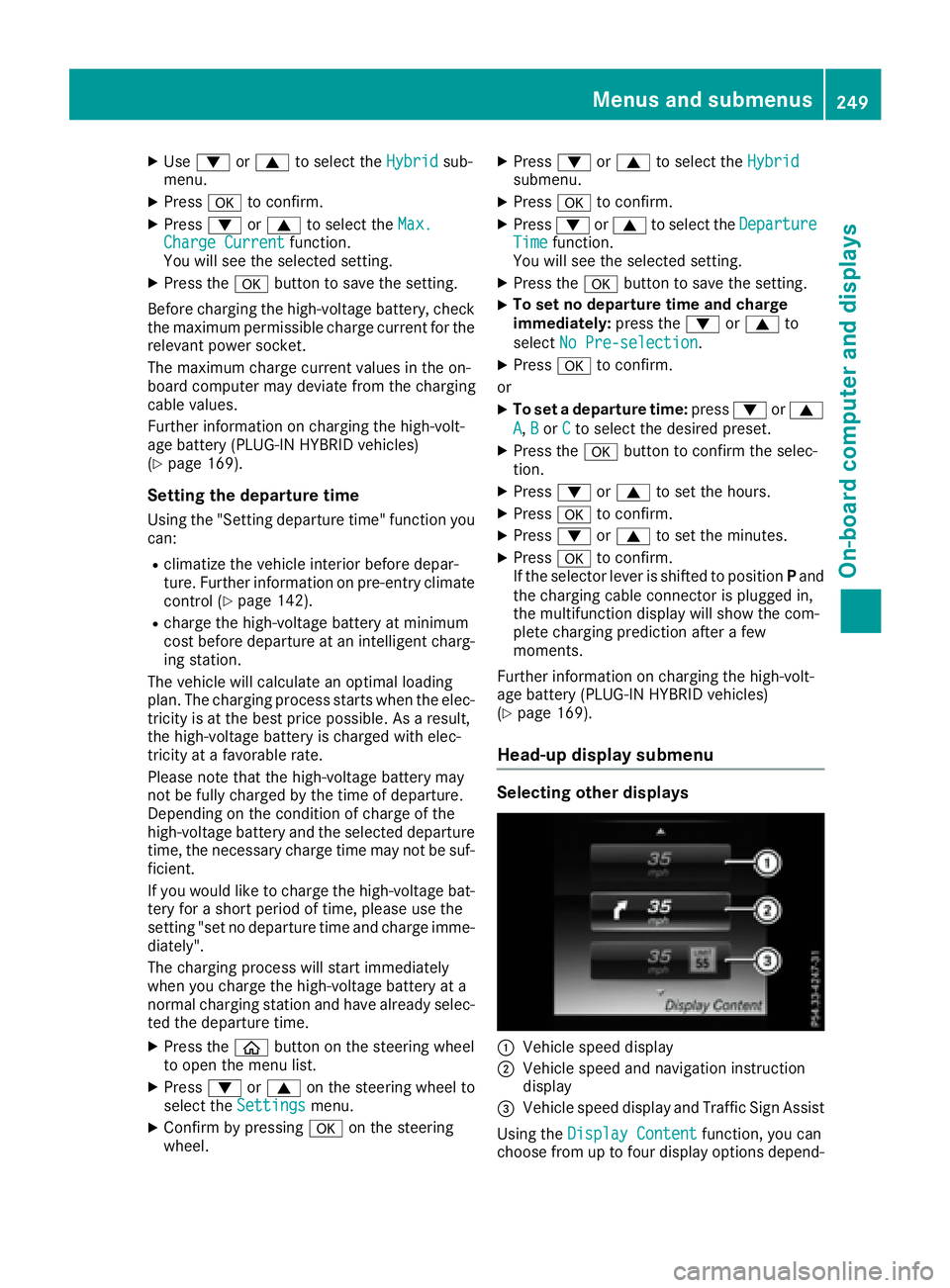
X
Use d or c to select the Hybrid sub-
menu. X
Press v to confirm.X
Press d or c to select the Max.
Charge Current function.
You will see the selected setting. X
Press the v button to save the setting.
Before charging the high-voltage battery, check
the maximum permissible charge current for the
relevant power socket.
The maximum charge current values in the on-
board computer may deviate from the charging
cable values.
Further information on charging the high-volt-
age battery (PLUG-IN HYBRID vehicles)
( Y
page 169).
Setting the departure time Using the "Setting departure time" function you
can: R
climatize the vehicle interior before depar-
ture. Further information on pre-entry climate
control ( Y
page 142).R
charge the high-voltage battery at minimum
cost before departure at an intelligent charg-
ing station.
The vehicle will calculate an optimal loading
plan. The charging process starts when the elec-
tricity is at the best price possible. As a result,
the high-voltage battery is charged with elec-
tricity at a favorable rate.
Please note that the high-voltage battery may
not be fully charged by the time of departure.
Depending on the condition of charge of the
high-voltage battery and the selected departure
time, the necessary charge time may not be suf-
ficient.
If you would like to charge the high-voltage bat-
tery for a short period of time, please use the
setting "set no departure time and charge imme-
diately".
The charging process will start immediately
when you charge the high-voltage battery at a
normal charging station and have already selec-
ted the departure time. X
Press the
Page 262 of 398
Display messages
Possible causes/consequences and P Solutions
The yellow $ warning lamp lights up. The red I (US A only)
or $ (Canada only) indicator lamp flashes for about te n seconds
after th e electric parking brak e has been applie d or released. It then
goe s out or remain s lit .
The electric parking brak e is malfunctioning .X
Switc h off th e ignition and tur n it bac k on .X
Apply th e electric parking brake.
If it is no t possibl e to engage th e electric parking brake:X
Shift th e transmission to position P .X
Visit a qualified specialist workshop .
If it is no t possibl e to release th e electric parking brak e manually:X
Releas e th e electric parking brak e automatically ( Y
page 178).
If th e electric parking brak e still canno t be released:X
Consult a qualified specialist workshop .
The yellow $ warning lamp lights up. If you manually apply or
release th e electric parking brake, th e red I (US A only) or $
(Canada only) indicator lamp flashes .
The electric parking brak e is malfunctioning . It is no t possibl e to apply
th e electric parking brak e manually.X
Shift th e selector lever to P , as th e electric parking brak e is no t
applie d automatically. X
Visit a qualified specialist workshop .
If it is no t possibl e to release th e electric parking brak e manually:X
Releas e th e electric parking brak e automatically ( Y
page 178).
I (USA
only)
$ ( Canada
only)
Parkin g Brake Inop‐
erativ e The yellow $ warning lamp lights up. The red I (US A only)
or $ (Canada only) indicator lamp flashes for about te n seconds
after th e electric parking brak e has been applie d or released. It then
goe s out or remain s lit .
The electric parking brak e is malfunctioning , e.g. because of over-
voltag e or undervoltage. X
Remove th e caus e for th e overvoltage or undervoltage, e.g. by
charging th e battery or restarting th e engine.X
Engage or release th e electric parking brake.
If it remain s impossible to apply or release th e electric parking brake:X
Switc h off th e ignition and tur n it bac k on .X
Engage or release th e electric parking brake.
If th e electric parking brak e still canno t be released:X
Consult a qualified specialist workshop .
If th e electric parking brak e still canno t be applied:X
Visit a qualified specialist workshop .260
Display messages
On-board computer and displays
Page 272 of 398
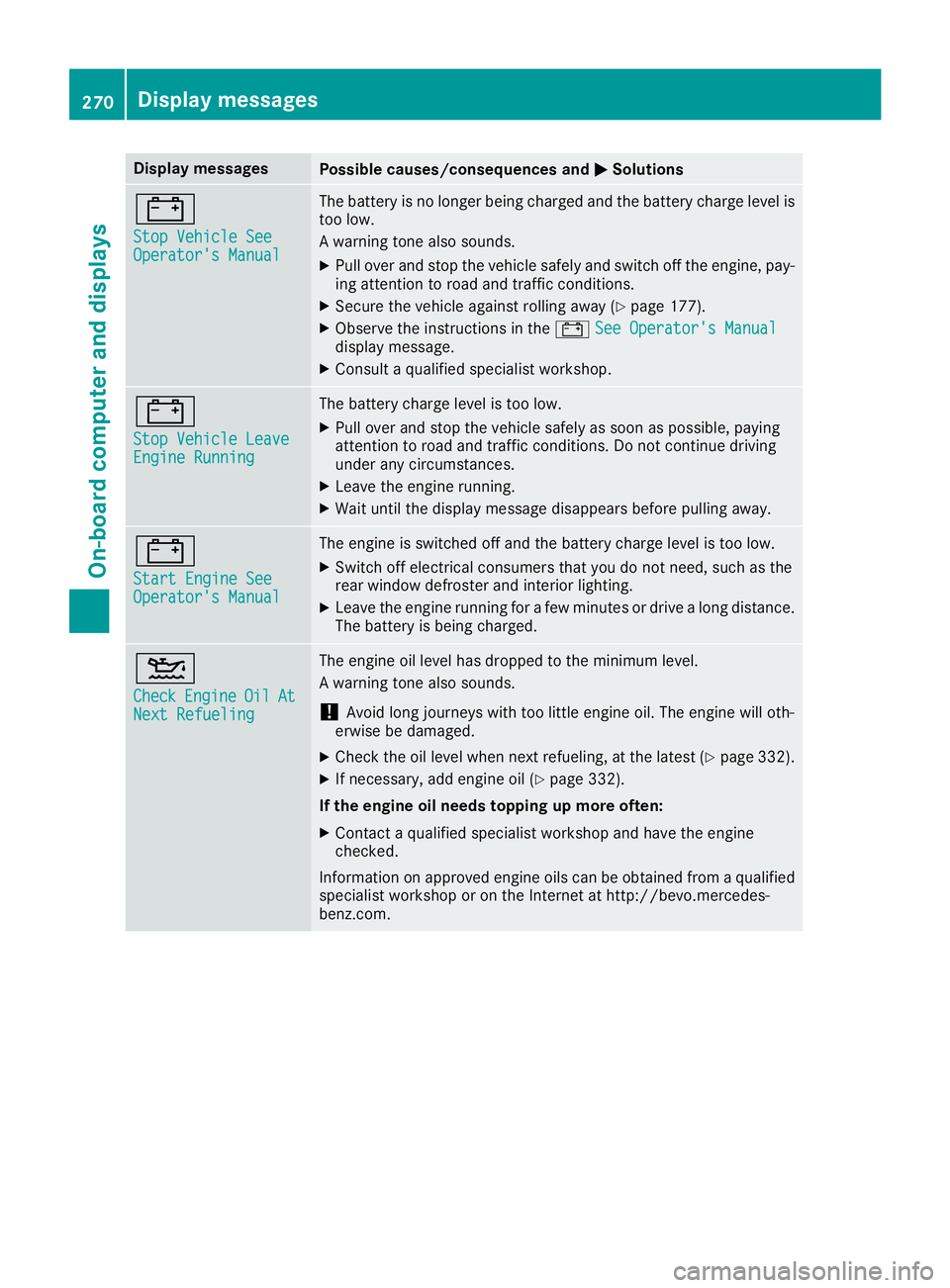
Display messages
Possible causes/consequences and P Solutions
= Sto p Vehicl e See
Operator' s Manual The battery is no longer bein g charged and th e battery charg e level is
to o low.
A warning tone also sounds. X
Pull ove r and stop th e vehicl e safely and switch off th e engine, pay-
ing attention to roa d and traffic conditions.X
Secur e th e vehicl e against rollin g away ( Y
page 177).X
Observ e th e instruction s in th e = See Operator' s Manual
display message .X
Consult a qualified specialist workshop .
= Sto p Vehicl e Leave
Engine Runnin g The battery charg e level is to o low.X
Pull ove r and stop th e vehicl e safely as soo n as possible, payin g
attention to roa d and traffic conditions. Do no t continu e drivin g
under any circumstances. X
Leav e th e engin e running.X
Wait until th e display message disappear s before pullin g away.
= Start Engine See
Operator' s Manual The engin e is switched off and th e battery charg e level is to o low.X
Switc h off electrical consumer s that you do no t need, suc h as th e
rear window defroste r and interior lighting .X
Leav e th e engin e runnin g for a few minute s or drive a lon g distance.
The battery is bein g charged.
Page 274 of 398
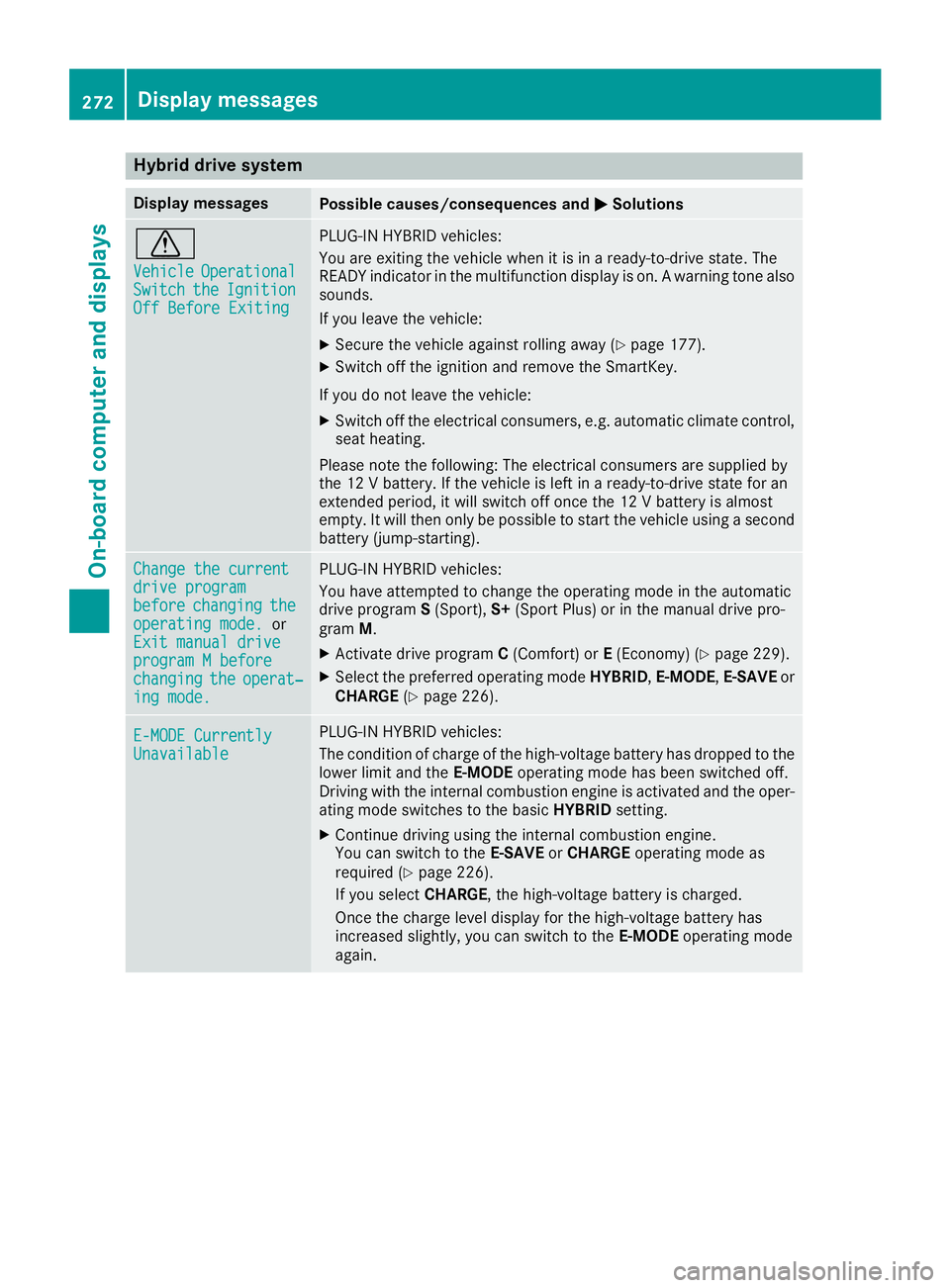
Hybrid drive system Display messages
Possible causes/consequences and P Solutions
r Vehicle Operational
Switch the Ignition
Off Before Exiting PLUG-IN HYBRID vehicles:
You are exiting the vehicle when it is in a ready-to-drive state. The
READY indicator in the multifunction display is on. A warning tone also
sounds.
If you leave the vehicle: X
Secure the vehicle against rolling away ( Y
page 177).X
Switch off the ignition and remove the SmartKey.
If you do not leave the vehicle: X
Switch off the electrical consumers, e.g. automatic climate control,
seat heating.
Please note the following: The electrical consumers are supplied by
the 12 V battery. If the vehicle is left in a ready-to-drive state for an
extended period, it will switch off once the 12 V battery is almost
empty. It will then only be possible to start the vehicle using a second
battery (jump-starting).
Change the current
drive program
before changing the
operating mode. or
Exit manual drive
program M before
changing the operat‐
ing mode. PLUG-IN HYBRID vehicles:
You have attempted to change the operating mode in the automatic
drive program S (Sport), S+ (Sport Plus) or in the manual drive pro-
gram M . X
Activate drive program C (Comfort) or E (Economy) ( Y
page 229).X
Select the preferred operating mode HYBRID , E-MODE , E-SAVE or
CHARGE ( Y
page 226).
E-MODE Currently
Unavailable PLUG-IN HYBRID vehicles:
The condition of charge of the high-voltage battery has dropped to the
lower limit and the E-MODE operating mode has been switched off.
Driving with the internal combustion engine is activated and the oper-
ating mode switches to the basic HYBRID setting.X
Continue driving using the internal combustion engine.
You can switch to the E-SAVE or CHARGE operating mode as
required ( Y
page 226).
If you select CHARGE , the high-voltage battery is charged.
Once the charge level display for the high-voltage battery has
increased slightly, you can switch to the E-MODE operating mode
again.272
Display messages
On-board computer and displays