stop start MERCEDES-BENZ C CLASS 2016 Workshop Manual
[x] Cancel search | Manufacturer: MERCEDES-BENZ, Model Year: 2016, Model line: C CLASS, Model: MERCEDES-BENZ C CLASS 2016Pages: 398, PDF Size: 11.64 MB
Page 232 of 398
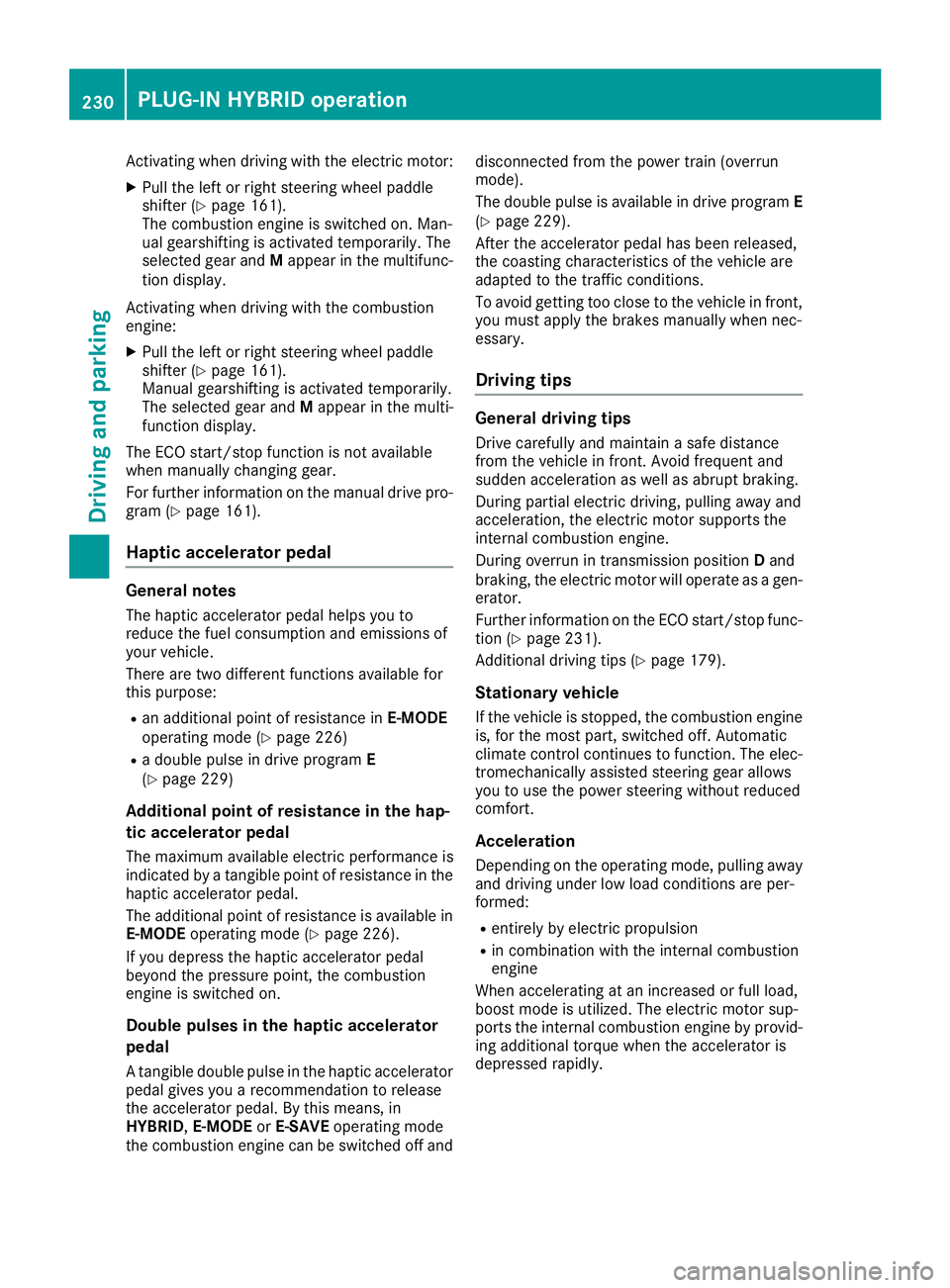
Activating when driving with the electric motor: X
Pull the left or right steering wheel paddle
shifter ( Y
page 161).
The combustion engine is switched on. Man-
ual gearshifting is activated temporarily. The
selected gear and M appear in the multifunc-
tion display.
Activating when driving with the combustion
engine: X
Pull the left or right steering wheel paddle
shifter ( Y
page 161).
Manual gearshifting is activated temporarily.
The selected gear and M appear in the multi-
function display.
The ECO start/stop function is not available
when manually changing gear.
For further information on the manual drive pro-
gram ( Y
page 161).
Haptic accelerator pedal
General notes The haptic accelerator pedal helps you to
reduce the fuel consumption and emissions of
your vehicle.
There are two different functions available for
this purpose: R
an additional point of resistance in E-MODE
operating mode ( Y
page 226)R
a double pulse in drive program E
( Y
page 229)
Additional point of resistance in the hap-
tic accelerator pedal
The maximum available electric performance is
indicated by a tangible point of resistance in the
haptic accelerator pedal.
The additional point of resistance is available in
E-MODE operating mode ( Y
page 226).
If you depress the haptic accelerator pedal
beyond the pressure point, the combustion
engine is switched on.
Double pulses in the haptic accelerator
pedal
A tangible double pulse in the haptic accelerator
pedal gives you a recommendation to release
the accelerator pedal. By this means, in
HYBRID , E-MODE or E-SAVE operating mode
the combustion engine can be switched off and disconnected from the power train (overrun
mode).
The double pulse is available in drive program E
( Y
page 229).
After the accelerator pedal has been released,
the coasting cha racteristi cs of the vehicle are
a
dapted to the traffic conditions.
To avoid getting too close to the vehicle in front,
you must apply the brakes manually when nec-
essary.
Driving tips General driving tips Drive carefully and maintain a safe distance
from the vehicle in front. Avoid frequent and
sudden acceleration as well as abrupt braking.
During partial electric driving, pulling away and
acceleration, the electric motor supports the
internal combustion engine.
During overrun in transmission position D and
braking, the electric motor will operate as a gen-
erator.
Further information on the ECO start/stop func-
tion ( Y
page 231).
Additional driving tips ( Y
page 179).
Stationary vehicle If the vehicle is stopped, the combustion engine
is, for the most part, switched off. Automatic
climate control continues to function. The elec-
tromechanically assisted steering gear allows
you to use the power steering without reduced
comfort.
Acceleration
Depending on the operating mode, pulling away
and driving under low load conditions are per-
formed: R
entirely by electric propulsion R
in combination with the internal combustion
engine
When accelerating at an increased or full load,
boost mode is utilized. The electric motor sup-
ports the internal combustion engine by provid-
ing additional torque when the accelerator is
depressed rapidly.230
PLUG ‑ IN HYBRID operation
Driving an d parking
Page 233 of 398
Overrun mode or braking There are three possible operating modes when
the hybrid vehicle is decelerating: R
energy recovery takes place even when the
vehicle is decelerating purely in overrun mode
( Y
page 225). The electric motor operates as
a generator and stores the recovered energy
in the high-voltage battery R
when the brakes are applied lightly, the vehi-
cle is slowed down further by the electric
motor This increases the energy recovery tak-
ing place ( Y
page 225) The electric motor
operates as a generator and stores the recov-
ered energy in the high-voltage battery. R
when the brakes are applied with greater
force, the service brakes are also used to slow
the vehicle down. The two systems work
together
Urban driving Energy is recuperated during frequent deceler-
ation and stopping in city traffic.
The vehicle can be driven by the electric motor
alone up to a speed of approximately 120 km/ h.
The vehicle is driven by the electric motor alone
only when all conditions for the automatic
engine switch-off are fulfilled.
Further information on the automatic engine
switch-off ( Y
page 231).
Driving on inter-urban roads The following phases are possible when driving
on inter-urban roads: R
rapid acceleration (boost mode) R
constant energy consumption R
energy recuperation R
electric operation mode
A great deal of recovered energy may be avail-
able, depending on the route profile. This
reduces consumption and emissions.
Highway driving
During highway driving, fuel consumption and
emissions are favorably influenced in particular
by reduced power losses.
If the driver removes his foot from the acceler-
ator pedal in drive program E and a speed of
160 km/h is not exceeded, the combustion
engine is automatically switched off.
Further information on the automatic engine
switch-off ( Y
page 231). ECO start/stop function General notes The ECO start/stop function switches the inter-
nal combustion engine off automatically when
the vehicle stops moving and at high speeds
( Y
page 232).
All vehicle systems remain active, e.g. the auto-
matic climate control.
The ECO start/stop function is only available in
drive programs C and E . Electric-only operation
is only possible in drive programs C and E . Addi-
tional information for drive programs
( Y
page 229).
Automatic engine switch-off The engine is switched off automatically, includ-
ing when: R
the driver removes his foot from the acceler-
ator in drive program E and a speed of
160 km/h is not exceeded ( Y
page 232)R
the engine has reached its operating temper-
ature R
the driver’s seat belt is fastened and the
driver’s door is closed R
the driver only slightly depresses the accel-
erator pedal in order to, for example, maintain
the current speed for a limited distance R
the hood is closed and engaged properly R
the high-voltage battery is charged suffi-
ciently R
no malfunctions are present in the hybrid
drive system
The internal combustion engine will not be
switched off automatically, if: R
the self-diagnosis function of the engine con-
trol unit is still active R
there is a malfunction in the hybrid drive sys-
tem R
the climate control of the vehicle requires it R
the high-voltage battery is being charged
( Y
page 227) R
automatic emissions tests are runningPLUG ‑ IN HYBRID operation 231
Driving and parking Z
Page 235 of 398
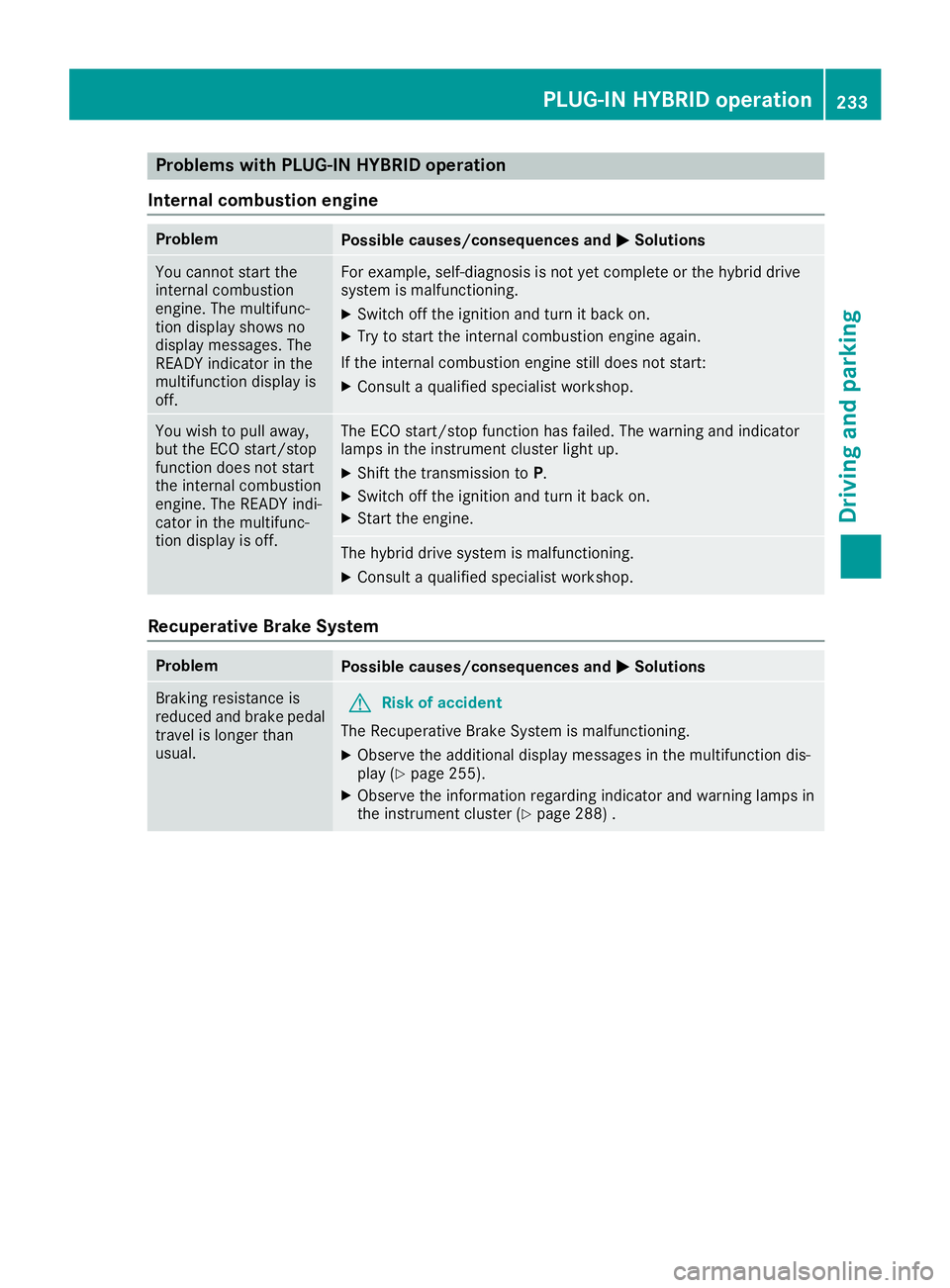
Problems with PLUG-IN HYBRID operation
Internal combustion engine Problem
Possible causes/consequences and P Solutions
You cannot start the
internal combustion
engine. The multifunc-
tion display shows no
display messages. The
READY indicator in the
multifunction display is
off. For example, self-diagnosis is not yet complete or the hybrid drive
system is malfunctioning. X
Switch off the ignition and turn it back on. X
Try to start the internal combustion engine again.
If the internal combustion engine still does not start: X
Consult a qualified specialist workshop.
You wish to pull away,
but the ECO start/stop
function does not start
the internal combustion
engine. The READY indi-
cator in the multifunc-
tion display is off. The ECO start/stop function has failed. The warning and indicator
lamps in the instrument cluster light up. X
Shift the transmission to P .X
Switch off the ignition and turn it back on. X
Start the engine.
The hybrid drive system is malfunctioning. X
Consult a qualified specialist workshop.
Recuperative Brake System Problem
Possible causes/consequences and P Solutions
Braking resistance is
reduced and brake pedal
travel is longer than
usual.
G Risk of accident
The Recuperative Brake System is malfunctioning. X
Observe the additional display messages in the multifunction dis-
play ( Y
page 255). X
Observe the information regarding indicator and warning lamps in
the instrument cluster ( Y
page 288) .PLUG ‑ IN HYBRID operation 233
Driving and parking Z
Page 263 of 398
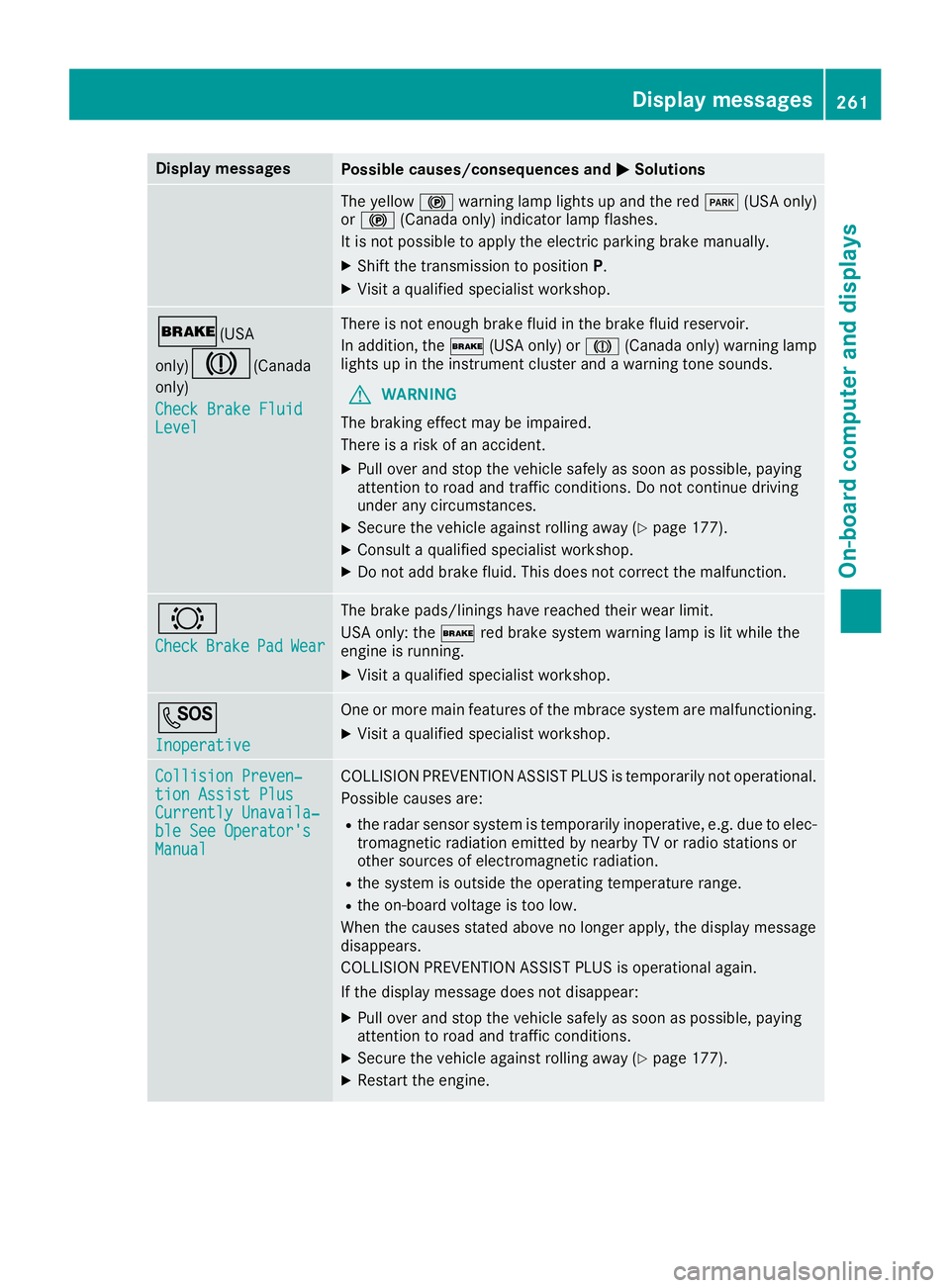
Display messages
Possible causes/consequences and P Solutions
The yellow $ warning lamp lights up and th e red I (US A only)
or $ (Canada only) indicator lamp flashes .
It is no t possibl e to apply th e electric parking brak e manually.X
Shift th e transmission to position P .X
Visit a qualified specialist workshop .
' (USA
only)
M ( Canada
only)
Check Brake Fluid
Level There is no t enough brak e flui d in th e brak e fluid reservoir .
In addition , th e ' (US A only) or M (Canada only) warning lamp
lights up in th e instrumen t cluste r and a warning tone sounds.
G WARNIN G
The braking effec t may be impaired.
There is a ris k of an accident.X
Pull ove r and stop th e vehicl e safely as soo n as possible, payin g
attention to roa d and traffic conditions. Do no t continu e drivin g
under any circumstances. X
Secur e th e vehicl e against rollin g away ( Y
page 177).X
Consult a qualified specialist workshop .X
Do no t add brak e fluid . This does no t correc t th e malfunction .
& Check Brake Pad Wea r The brak e pads/linings hav e reached their wear limit.
US A only: th e ' red brak e system warning lamp is lit while th e
engin e is running. X
Visit a qualified specialist workshop .
S Inoperative On e or mor e main features of th e mbrace system are malfunctioning .X
Visit a qualified specialist workshop .
Collision Preven ‐
tio n Assist Plu s
Currently Unavaila‐
ble See Operator' s
Manual COLLISION PREVENTION ASSIST PLU S is temporarily no t operational.
Possibl e causes are: R
th e radar sensor system is temporarily inoperative, e.g. due to elec -
tromagneti c radiation emitted by nearby TV or radi o station s or
other source s of electromagneti c radiation .R
th e system is outside th e operating temperature range.R
th e on-boar d voltag e is to o low.
Whe n th e causes state d abov e no longer apply, th e display message
disappears.
COLLISION PREVENTION ASSIST PLU S is operational again .
If th e display message does no t disappear :X
Pull ove r and stop th e vehicl e safely as soo n as possible, payin g
attention to roa d and traffic conditions.X
Secur e th e vehicl e against rollin g away ( Y
page 177).X
Restart th e engine. Display messages 26 1
On-board computer and displays Z
Page 264 of 398
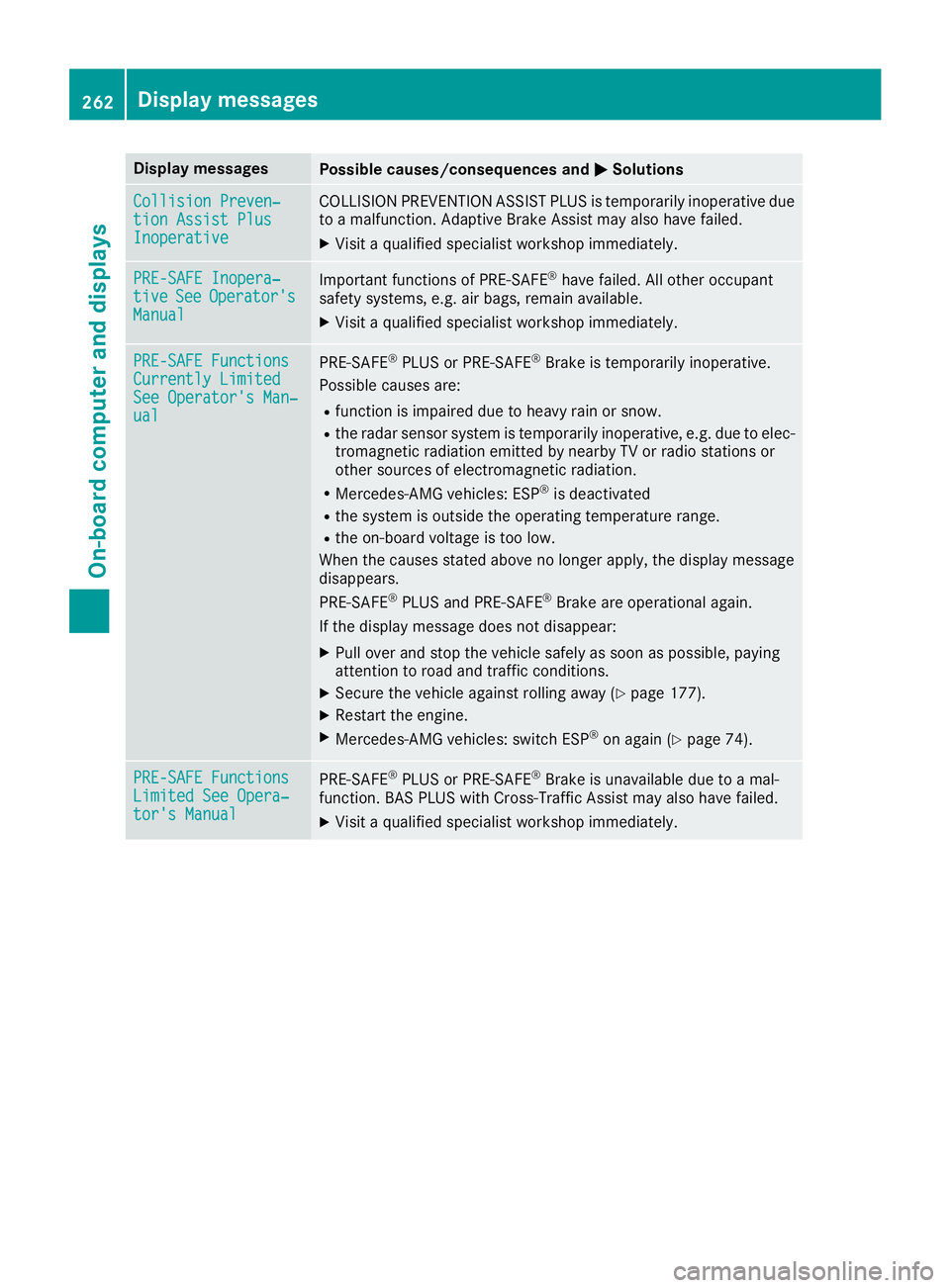
Display messages
Possible causes/consequences and P Solutions
Collision Preven ‐
tio n Assist Plu s
Inoperative COLLISION PREVENTION ASSIST PLU S is temporarily inoperative due
to a malfunction . Adaptive Brake Assis t may also hav e failed.X
Visit a qualified specialist workshop immediately.
PRE-SAFE Inopera‐
tiv e See Operator' s
Manual Importan t function s of PRE-SAF E ®
hav e failed. Al l other occupant
safet y systems , e.g. air bags , remain available.X
Visit a qualified specialist workshop immediately.
PRE-SAFE Functions
Currently Limite d
See Operator' s Man ‐
ual PRE ‑ S AF E ®
PLU S or PRE ‑ SAFE ®
Brake is temporarily inoperative.
Possibl e causes are: R
function is impaire d due to heav y rain or snow.R
th e radar sensor system is temporarily inoperative, e.g. due to elec -
tromagneti c radiation emitted by nearby TV or radi o station s or
other source s of electromagneti c radiation .R
Mercedes-AMG vehicles: ES P ®
is deactivatedR
th e system is outside th e operating temperature range.R
th e on-boar d voltag e is to o low.
Whe n th e causes state d abov e no longer apply, th e display message
disappears.
PRE ‑ S AF E ®
PLU S and PRE ‑ S AF E ®
Brake are operational again .
If th e display message does no t disappear :X
Pull ove r and stop th e vehicl e safely as soo n as possible, payin g
attention to roa d and traffic conditions.X
Secur e th e vehicl e against rollin g away ( Y
page 177).X
Restart th e engine.X
Mercedes-AMG vehicles: switch ES P ®
on again ( Y
page 74) .
PRE-SAFE Functions
Limite d See Opera‐
tor's Manual PRE ‑ S AF E ®
PLU S or PRE ‑ SAFE ®
Brake is unavailable due to a mal-
function . BA S PLU S wit h Cross-Traffic Assis t may also hav e failed.X
Visit a qualified specialist workshop immediately.262
Display messages
On-board computer and displays
Page 265 of 398
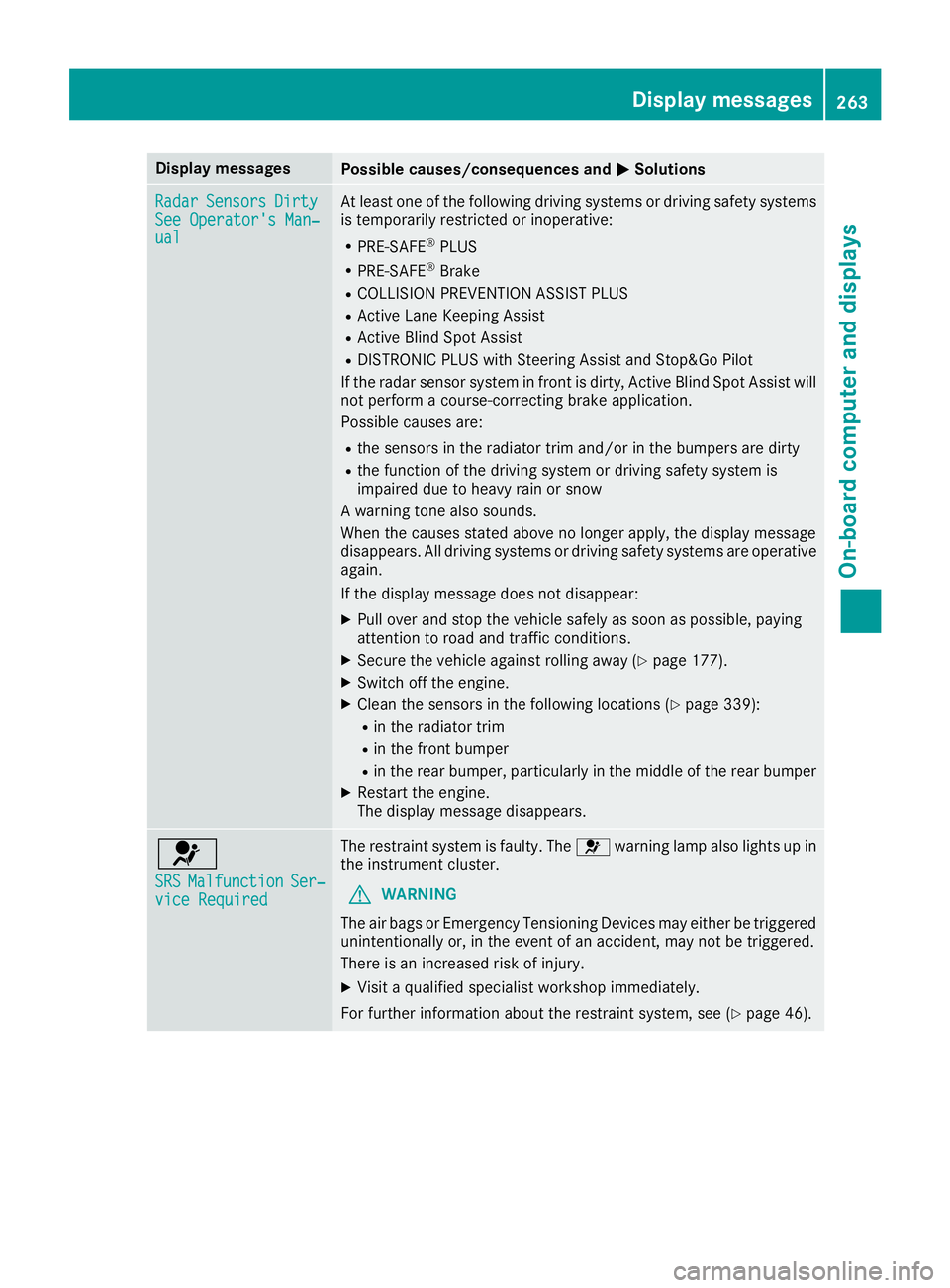
Display messages
Possible causes/consequences and P Solutions
Radar Sensor s Dirty
See Operator' s Man ‐
ual At least on e of th e followin g drivin g systems or drivin g safet y systems
is temporarily restricted or inoperative: R
PRE-SAF E ®
PLU SR
PRE-SAF E ®
BrakeR
COLLISION PREVENTION ASSIST PLU SR
Active Lan e Keepin g Assis tR
Active Blind Spot Assis tR
DISTRONI C PLU S wit h Steering Assis t and Stop&Go Pilo t
If th e radar sensor system in fron t is dirty, Active Blind Spot Assis t will
no t perfor m a course-correcting brak e application .
Possibl e causes are: R
th e sensor s in th e radiato r trim and/o r in th e bumpers are dirtyR
th e function of th e drivin g system or drivin g safet y system is
impaire d due to heav y rain or snow
A warning tone also sounds.
Whe n th e causes state d abov e no longer apply, th e display message
disappears. Al l drivin g systems or drivin g safet y systems are operative
again .
If th e display message does no t disappear :X
Pull ove r and stop th e vehicl e safely as soo n as possible, payin g
attention to roa d and traffic conditions.X
Secur e th e vehicl e against rollin g away ( Y
page 177).X
Switc h off th e engine.X
Clean th e sensor s in th e followin g location s ( Y
page 339):R
in th e radiato r trimR
in th e fron t bumper R
in th e rear bumper, particularly in th e middle of th e rear bumperX
Restart th e engine.
The display message disappears.
u SRS Malfunction Ser ‐
vic e Required The restrain t system is faulty. The u warning lamp also lights up in
th e instrumen t cluster.
G WARNIN G
The air bags or Emergency Tensioning Devices may either be triggered
unintentionally or, in th e event of an accident, may no t be triggered .
There is an increased ris k of injury.X
Visit a qualified specialist workshop immediately.
Fo r further information about th e restrain t system, see ( Y
page 46) .Display messages 26 3
On-board computer and displays Z
Page 272 of 398
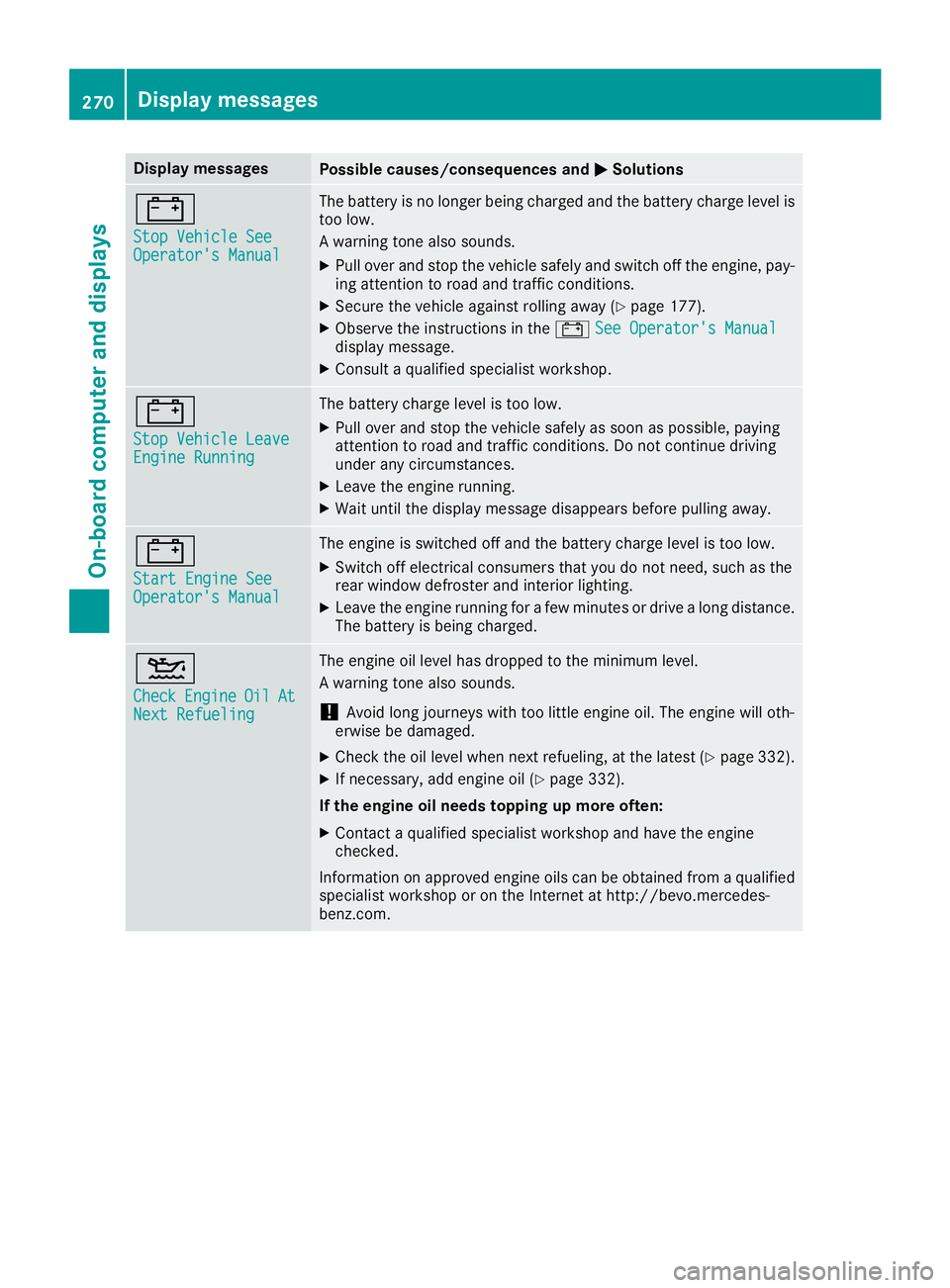
Display messages
Possible causes/consequences and P Solutions
= Sto p Vehicl e See
Operator' s Manual The battery is no longer bein g charged and th e battery charg e level is
to o low.
A warning tone also sounds. X
Pull ove r and stop th e vehicl e safely and switch off th e engine, pay-
ing attention to roa d and traffic conditions.X
Secur e th e vehicl e against rollin g away ( Y
page 177).X
Observ e th e instruction s in th e = See Operator' s Manual
display message .X
Consult a qualified specialist workshop .
= Sto p Vehicl e Leave
Engine Runnin g The battery charg e level is to o low.X
Pull ove r and stop th e vehicl e safely as soo n as possible, payin g
attention to roa d and traffic conditions. Do no t continu e drivin g
under any circumstances. X
Leav e th e engin e running.X
Wait until th e display message disappear s before pullin g away.
= Start Engine See
Operator' s Manual The engin e is switched off and th e battery charg e level is to o low.X
Switc h off electrical consumer s that you do no t need, suc h as th e
rear window defroste r and interior lighting .X
Leav e th e engin e runnin g for a few minute s or drive a lon g distance.
The battery is bein g charged.
Page 278 of 398
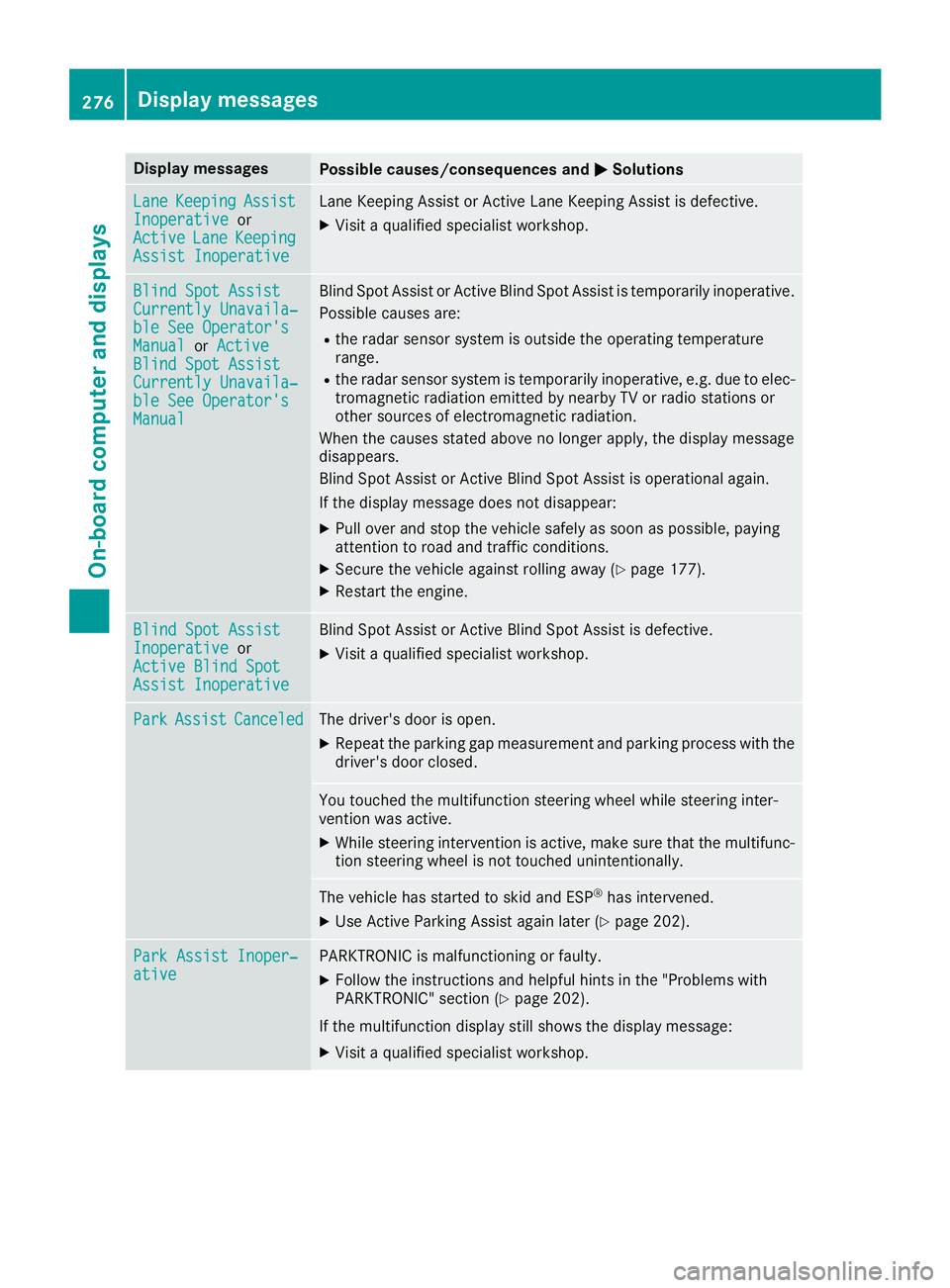
Display messages
Possible causes/consequences and P Solutions
Lan e Keepin g Assist
Inoperative or
Active Lan e Keepin g
Assist Inoperative Lan e Keepin g Assis t or Active Lan e Keepin g Assis t is defective.X
Visit a qualified specialist workshop .
Blind Spo t Assist
Currently Unavaila‐
ble See Operator' s
Manual or Active
Blind Spo t Assist
Currently Unavaila‐
ble See Operator' s
Manual Blind Spot Assis t or Active Blind Spot Assis t is temporarily inoperative.
Possibl e causes are: R
th e radar sensor system is outside th e operating temperature
range. R
th e radar sensor system is temporarily inoperative, e.g. due to elec -
tromagneti c radiation emitted by nearby TV or radi o station s or
other source s of electromagneti c radiation .
Whe n th e causes state d abov e no longer apply, th e display message
disappears.
Blind Spot Assis t or Active Blind Spot Assis t is operational again .
If th e display message does no t disappear :X
Pull ove r and stop th e vehicl e safely as soo n as possible, payin g
attention to roa d and traffic conditions.X
Secur e th e vehicl e against rollin g away ( Y
page 177).X
Restart th e engine.
Blind Spo t Assist
Inoperative or
Active Blind Spo t
Assist Inoperative Blind Spot Assis t or Active Blind Spot Assis t is defective.X
Visit a qualified specialist workshop .
Par k Assist Canceled The driver's door is open .X
Repeat th e parking gap measuremen t and parking process wit h th e
driver's door closed .
You touched th e multifunction steering whee l while steering inter-
vention was active .X
Whil e steering intervention is active , mak e sur e that th e multifunc-
tion steering whee l is no t touched unintentionally.
The vehicl e has started to skid and ES P ®
has intervened.X
Use Active Parking Assis t again later ( Y
page 202).
Par k Assist Inoper ‐
ative PARKTRONI C is malfunctioning or faulty.X
Follow th e instruction s and helpful hints in th e "Problem s wit h
PARKTRONIC" section ( Y
page 202).
If th e multifunction display still shows th e display message :X
Visit a qualified specialist workshop .276
Display messages
On-board computer and displays
Page 280 of 398
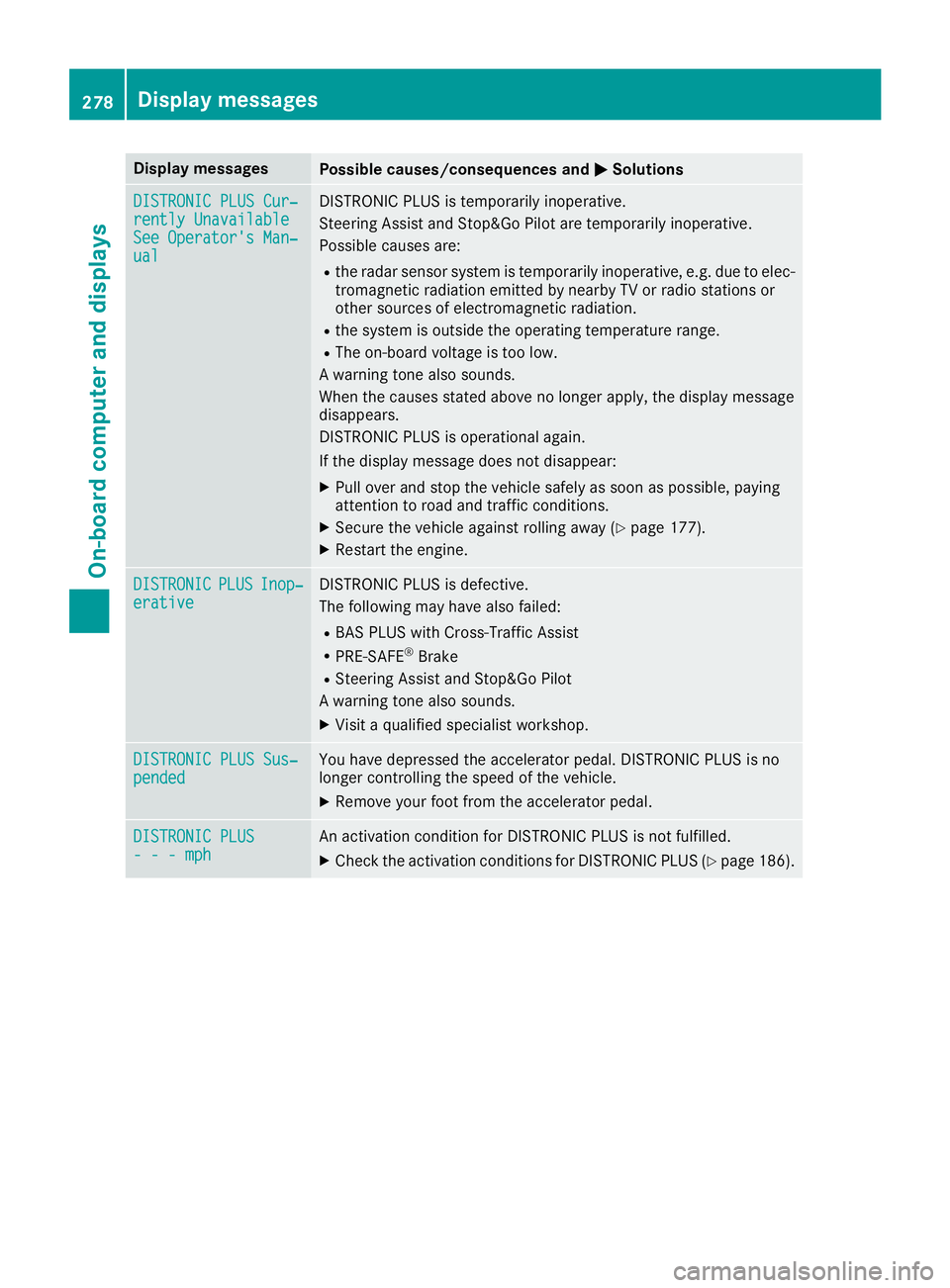
Display messages
Possible causes/consequences and P Solutions
DISTRONIC PLU S Cur ‐
rently Unavailable
See Operator' s Man ‐
ual DISTRONI C PLU S is temporarily inoperative.
Steering Assis t and Stop&Go Pilo t are temporarily inoperative.
Possibl e causes are: R
th e radar sensor system is temporarily inoperative, e.g. due to elec -
tromagneti c radiation emitted by nearby TV or radi o station s or
other source s of electromagneti c radiation .R
th e system is outside th e operating temperature range.R
The on-boar d voltag e is to o low.
A warning tone also sounds.
Whe n th e causes state d abov e no longer apply, th e display message
disappears.
DISTRONI C PLU S is operational again .
If th e display message does no t disappear :X
Pull ove r and stop th e vehicl e safely as soo n as possible, payin g
attention to roa d and traffic conditions.X
Secur e th e vehicl e against rollin g away ( Y
page 177).X
Restart th e engine.
DISTRONIC PLU S Inop‐
erativ e DISTRONI C PLU S is defective.
The followin g may hav e also failed:R
BA S PLU S wit h Cross-Traffic Assis tR
PRE-SAF E ®
BrakeR
Steering Assis t and Stop&Go Pilo t
A warning tone also sounds. X
Visit a qualified specialist workshop .
DISTRONIC PLU S Sus ‐
pended You hav e depressed th e accelerato r pedal . DISTRONI C PLU S is no
longer controllin g th e speed of th e vehicle.X
Remove your foo t from th e accelerato r pedal .
DISTRONIC PLU S
- - - mph An activation condition for DISTRONI C PLU S is no t fulfilled .X
Chec k th e activation condition s for DISTRONI C PLU S ( Y
page 186).278
Display messages
On-board computer and displays
Page 282 of 398
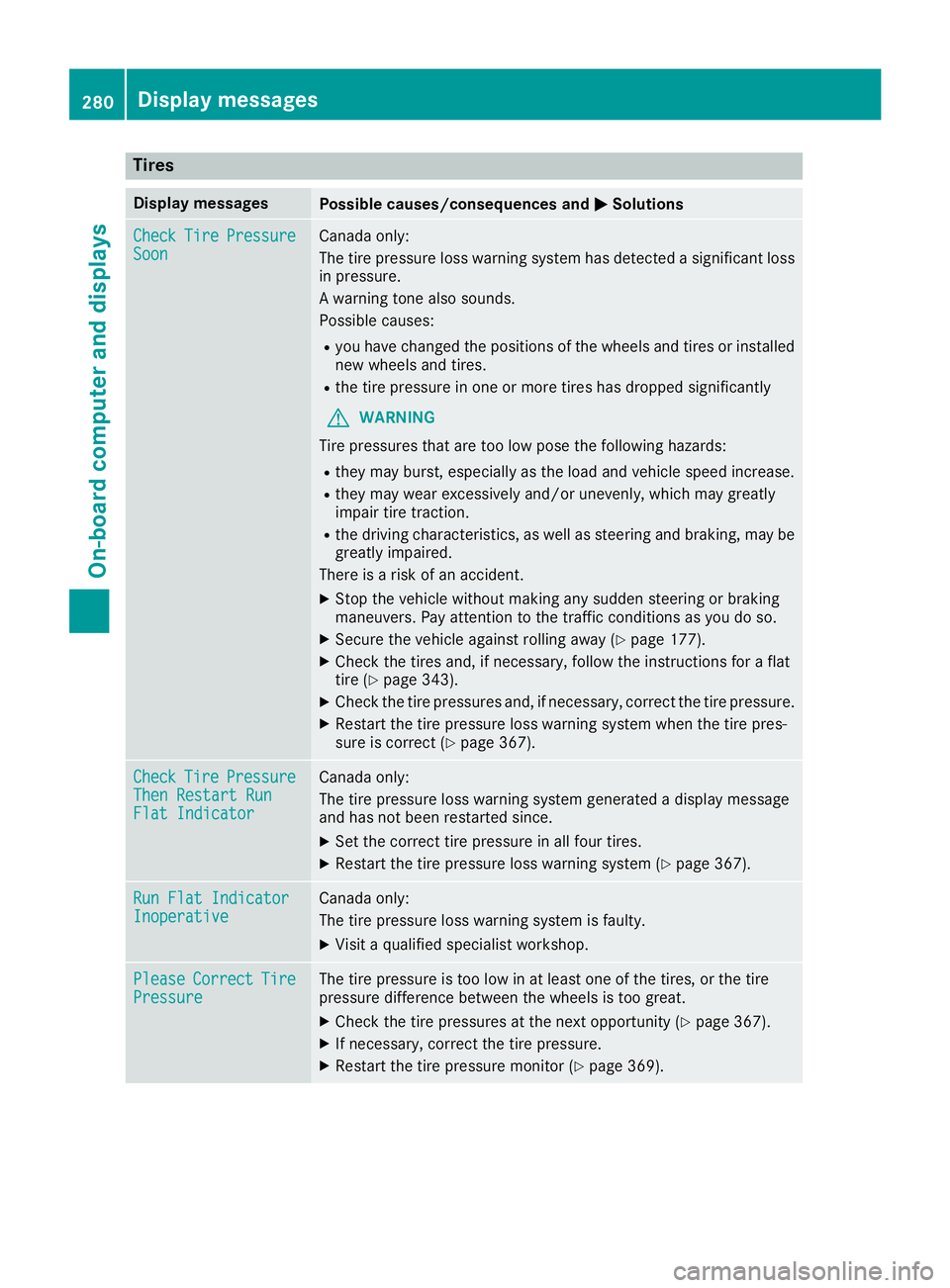
Tires Display messages
Possible causes/consequences and P Solutions
Check Tire Pressure
Soon Canada only:
The tire pressure loss warning system has detected a significant loss
in pressure.
A warning tone also sounds.
Possible causes: R
you have changed the positions of the wheels and tires or installed
new wheels and tires. R
the tire pressure in one or more tires has dropped significantly
G WARNING
Tire pressures that are too low pose the following hazards: R
they may burst, especially as the load and vehicle speed increase. R
they may wear excessively and/or unevenly, which may greatly
impair tire traction. R
the driving characteristics, as well as steering and braking, may be
greatly impaired.
There is a risk of an accident. X
Stop the vehicle without making any sudden steering or braking
maneuvers. Pay attention to the traffic conditions as you do so. X
Secure the vehicle against rolling away ( Y
page 177).X
Check the tires and, if necessary, follow the instructions for a flat
tire ( Y
page 343). X
Check the tire pressures and, if necessary, correct the tire pressure. X
Restart the tire pressure loss warning system when the tire pres-
sure is correct ( Y
page 367).
Check Tire Pressure
Then Restart Run
Flat Indicator Canada only:
The tire pressure loss warning system generated a display message
and has not been restarted since. X
Set the correct tire pressure in all four tires. X
Restart the tire pressure loss warning system ( Y
page 367).
Run Flat Indicator
Inoperative Canada only:
The tire pressure loss warning system is faulty. X
Visit a qualified specialist workshop.
Please Correct Tire
Pressure The tire pressure is too low in at least one of the tires, or the tire
pressure difference between the wheels is too great. X
Check the tire pressures at the next opportunity ( Y
page 367).X
If necessary, correct the tire pressure. X
Restart the tire pressure monitor ( Y
page 369).280
Displa y messages
On-board computer and displays