mirror MERCEDES-BENZ C-CLASS CABRIOLET 2016 User Guide
[x] Cancel search | Manufacturer: MERCEDES-BENZ, Model Year: 2016, Model line: C-CLASS CABRIOLET, Model: MERCEDES-BENZ C-CLASS CABRIOLET 2016Pages: 377, PDF Size: 6.9 MB
Page 82 of 377

X
Vehicles with KEYLESS-GO start function
or KEYLESS-GO: remove the Start/Stop but-
ton from the ignition lock (Y page 133).
X Insert the key into the ignition lock.
The alarm stops.
X To stop the alarm using KEYLESS-GO:
grasp the outside door handle. The key must
be outside the vehicle.
The alarm stops.
or X Press the Start/Stop button on the dash-
board. The key must be inside the vehicle.
The alarm stops.
The alarm does not stop, even if you close the
open door that has triggered it, for example.
i If the alarm stays on for more than
30 seconds, the Mercedes‑Benz emergency
call system automatically sends a message to
the Customer Centre. This is sent via text
message or a data connection.
The emergency call system sends a message
or establishes a data connection provided
that:
R you have subscribed to the Mercedes‑Benz
emergency call system
R the Mercedes‑ Benz emergency call system
has been activated properly
R the necessary mobile phone network is
available Tow-away protection
Function An audible and visual alarm is triggered if your
vehicle's angle of inclination is altered while
tow-away protection is primed. This can occur if
the vehicle is jacked up on one side, for exam-
ple.
Activating/deactivating Tow-away protection is automatically switched
on and off with the ATA (anti-theft alarm system) when:
R the doors are closed
R the boot lid is closed
Tow-away protection is active around
60 seconds after the ATA has been switched on (Y page 78). Deactivating To prevent a false alarm, deactivate tow-away
protection if you lock your vehicle and it:
R is being transported
R is being loaded, e.g. onto a ferry or car trans-
porter
R is parked on a movable surface, e.g. in a split-
level garage
The tow-away alarm remains deactivated until
you switch the ATA on again after opening a
door.
You can deactivate tow-away protection via the
multimedia system (see the Digital Owner's
Manual). Interior motion sensor
Function When the interior motion sensor is switched on,
a visual and audible alarm is triggered if move-
ment is detected in the vehicle interior. This can occur if someone reaches into the vehicle inte-
rior, for example.
Switching on/off The interior motion sensor is automatically
switched on and off with the ATA (Anti-Theft
Alarm system) when:
R the doors are closed
R the boot lid is closed
The interior motion sensor is active around ten
seconds after the ATA has been switched on
(Y page 78).
You can prevent false alarms by doing the fol-
lowing before switching on the ATA:
R close the side windows
R close the soft top
R make sure that no objects, such as mascots,
are attached to the rear-view mirror
Deactivating If you want to lock your vehicle and people or
animals are inside it, you can deactivate the
interior motion sensor.
The interior motion sensor remains deactivated
until you switch the ATA on again after opening
a door. Protection against theft
79Safety Z
Page 103 of 377

Correct driver's seat position
G
WARNING
You could lose control of the vehicle while
driving if you:
R adjust the driver's seat, steering wheel or
mirrors
R fasten the seat belt
There is a risk of an accident.
Adjust the driver's seat, head restraint, steer-
ing wheel and mirrors and fasten your seat
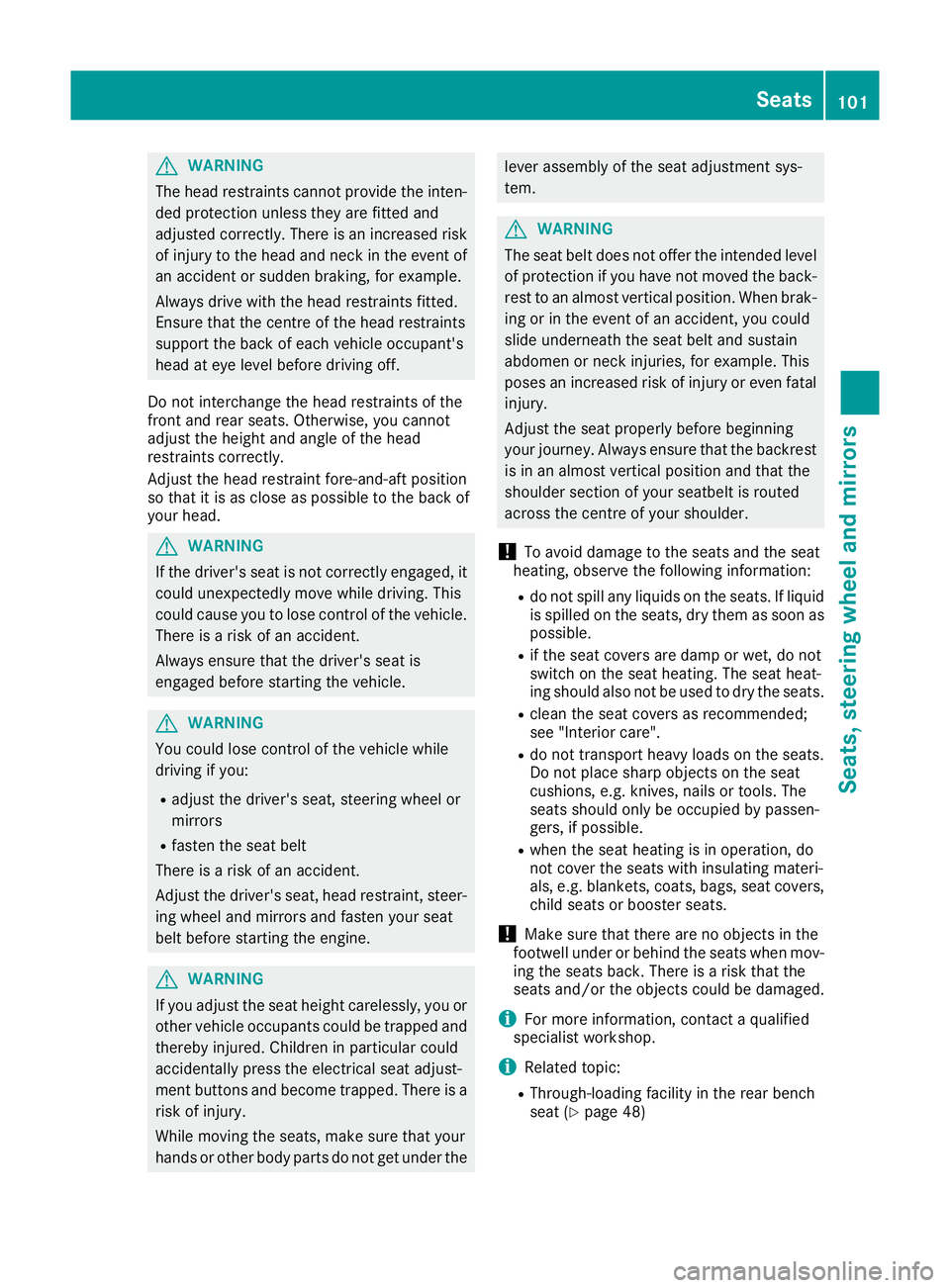
belt before starting the engine. Observe the following when adjusting steering
wheel
:, seat belt ;and driver's seat =:
R You are as far away from the driver's airbag as
possible.
R You are sitting in an upright position.
R Your thighs are slightly supported by the seat
cushion.
R Your legs are not entirely stretched and you
can depress the pedals properly.
R The back of your head is supported at eye
level by the centre of the head restraint.
R You can hold the steering wheel with your
arms slightly bent.
R You can move your legs freely.
R You can see all the displays in the instrument
cluster clearly. R
You have a good overview of traffic condi-
tions.
R The seat belt is pulled snugly against the body
and must be routed across the centre of your
shoulder and across your hips in the pelvic
area.
Further related subjects:
R Adjusting the seats mechanically and electri-
cally (Y page 102).
R Adjusting the seats electrically (Y page 102).
R Adjusting the steering wheel mechanically
(Y page 107).
R Adjusting the steering wheel electrically
(Y page 108).
R Fastening the seat belt correctly (Y page 46).
R Adjusting the rear-view mirror and exterior
mirrors (Y page 110).
R You can store the seat, steering wheel, exte-
rior mirror and head-up display settings with
the memory function (Y page 112). Seats
Important safety notes
G
WARNING
If children adjust the seats, they could
become trapped, especially if they are unat-
tended. There is a risk of injury.
When leaving the vehicle, always take the key with you and lock the vehicle. Never leave
children unattended in the vehicle.
The seats can still be adjusted when there is no
key in the ignition lock. G
WARNING
When adjusting a seat, you or another vehicle occupant could become trapped by the guiderail of the seat, for instance. There is a risk of
injury.
Make sure that no one has any part of their
body within the sweep of the seat when
adjusting it.
Observe the safety notes on "Airbags"
(Y page 48) and "Children in the vehicle"
(Y page 59). 100
SeatsSeats, steering wheel and
mirrors
Page 104 of 377
G
WARNING
The head restraints cannot provide the inten-
ded protection unless they are fitted and
adjusted correctly. There is an increased risk of injury to the head and neck in the event of
an accident or sudden braking, for example.
Always drive with the head restraints fitted.
Ensure that the centre of the head restraints
support the back of each vehicle occupant's
head at eye level before driving off.
Do not interchange the head restraints of the
front and rear seats. Otherwise, you cannot
adjust the height and angle of the head
restraints correctly.
Adjust the head restraint fore-and-aft position
so that it is as close as possible to the back of
your head. G
WARNING
If the driver's seat is not correctly engaged, it could unexpectedly move while driving. This
could cause you to lose control of the vehicle. There is a risk of an accident.
Always ensure that the driver's seat is
engaged before starting the vehicle. G
WARNING
You could lose control of the vehicle while
driving if you:
R adjust the driver's seat, steering wheel or
mirrors
R fasten the seat belt
There is a risk of an accident.
Adjust the driver's seat, head restraint, steer-
ing wheel and mirrors and fasten your seat
belt before starting the engine. G
WARNING
If you adjust the seat height carelessly, you or other vehicle occupants could be trapped andthereby injured. Children in particular could
accidentally press the electrical seat adjust-
ment buttons and become trapped. There is a
risk of injury.
While moving the seats, make sure that your
hands or other body parts do not get under the lever assembly of the seat adjustment sys-
tem.
G
WARNING
The seat belt does not offer the intended level of protection if you have not moved the back-
rest to an almost vertical position. When brak-
ing or in the event of an accident, you could
slide underneath the seat belt and sustain
abdomen or neck injuries, for example. This
poses an increased risk of injury or even fatal injury.
Adjust the seat properly before beginning
your journey. Always ensure that the backrest
is in an almost vertical position and that the
shoulder section of your seatbelt is routed
across the centre of your shoulder.
! To avoid damage to the seats and the seat
heating, observe the following information:
R do not spill any liquids on the seats. If liquid
is spilled on the seats, dry them as soon as possible.
R if the seat covers are damp or wet, do not
switch on the seat heating. The seat heat-
ing should also not be used to dry the seats.
R clean the seat covers as recommended;
see "Interior care".
R do not transport heavy loads on the seats.
Do not place sharp objects on the seat
cushions, e.g. knives, nails or tools. The
seats should only be occupied by passen-
gers, if possible.
R when the seat heating is in operation, do
not cover the seats with insulating materi-
als, e.g. blankets, coats, bags, seat covers,
child seats or booster seats.
! Make sure that there are no objects in the
footwell under or behind the seats when mov- ing the seats back. There is a risk that the
seats and/or the objects could be damaged.
i For more information, contact a qualified
specialist workshop.
i Related topic:
R Through-loading facility in the rear bench
seat (Y page 48) Seats
101Seats, steering wheel and mirrors Z
Page 105 of 377
Adjusting the seats mechanically and
electrically
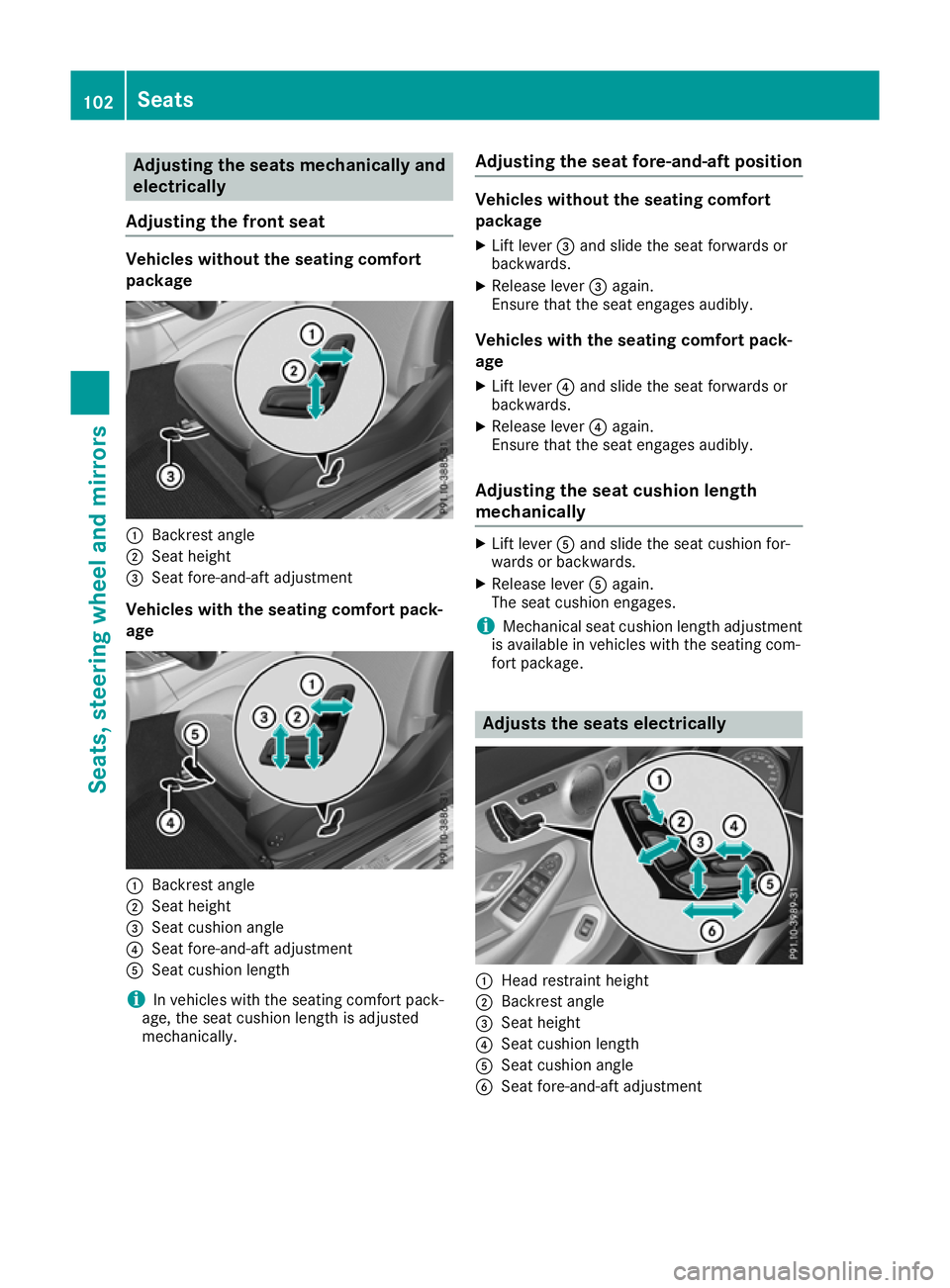
Adjusting the front seat Vehicles without the seating comfort
package :
Backrest angle
; Seat height
= Seat fore-and-aft adjustment
Vehicles with the seating comfort pack-
age :
Backrest angle
; Seat height
= Seat cushion angle
? Seat fore-and-aft adjustment
A Seat cushion length
i In vehicles with the seating comfort pack-
age, the seat cushion length is adjusted
mechanically. Adjusting the seat fore-and-aft position Vehicles without the seating comfort
package
X Lift lever =and slide the seat forwards or
backwards.
X Release lever =again.
Ensure that the seat engages audibly.
Vehicles with the seating comfort pack-
age X Lift lever ?and slide the seat forwards or
backwards.
X Release lever ?again.
Ensure that the seat engages audibly.
Adjusting the seat cushion length
mechanically X
Lift lever Aand slide the seat cushion for-
wards or backwards.
X Release lever Aagain.
The seat cushion engages.
i Mechanical seat cushion length adjustment
is available in vehicles with the seating com-
fort package. Adjusts the seats electrically
:
Head restraint height
; Backrest angle
= Seat height
? Seat cushion length
A Seat cushion angle
B Seat fore-and-aft adjustment 102
SeatsSeats
, steering wheel and mirrors
Page 106 of 377
i
Further related subjects:
R You can store the seat settings using the
memory function (Y page 112).
R If PRE-SAFE ®
is triggered, the front-
passenger seat will be moved to a better
position if it was previously in an unfavour- able position (Y page 57).
R When the seat is moved forwards or back-
wards, the head restraint is moved up or
down automatically.
Vehicles with AMG Performance Seat: the
height of the head restraint cannot be adjusted. Adjusting the head restraints
Important safety notes G
WARNING
You could lose control of the vehicle while
driving if you:
R adjust the driver's seat, steering wheel or
mirrors
R fasten the seat belt
There is a risk of an accident.
Adjust the driver's seat, head restraint, steer-
ing wheel and mirrors and fasten your seat
belt before starting the engine. G
WARNING
The head restraints cannot provide the inten-
ded protection unless they are fitted and
adjusted correctly. There is an increased risk of injury to the head and neck in the event of
an accident or sudden braking, for example.
Always drive with the head restraints fitted.
Ensure that the centre of the head restraints
support the back of each vehicle occupant's
head at eye level before driving off. Adjusting the head restraint height
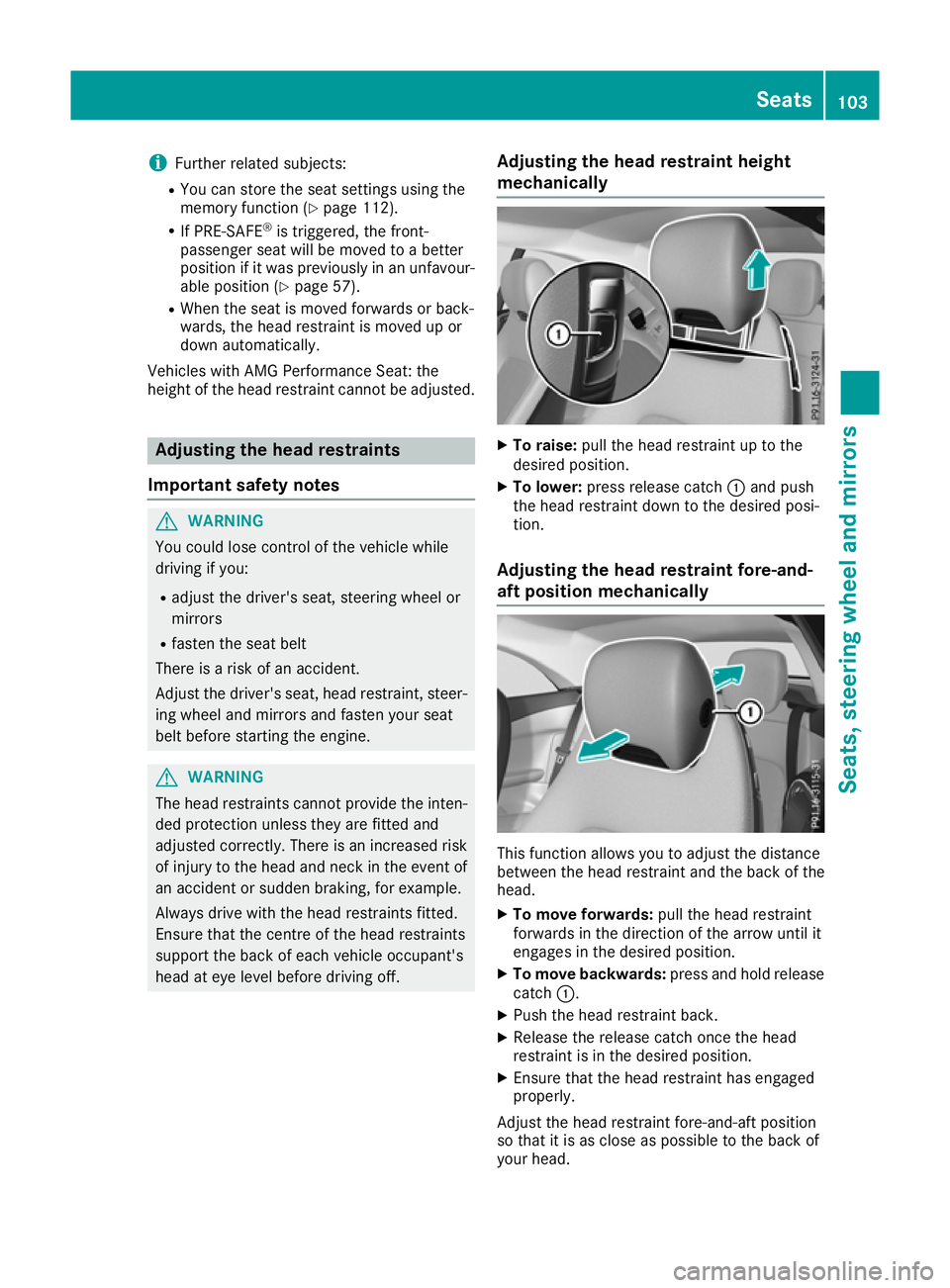
mechanically X
To raise: pull the head restraint up to the
desired position.
X To lower: press release catch :and push
the head restraint down to the desired posi-
tion.
Adjusting the head restraint fore-and-
aft position mechanically This function allows you to adjust the distance
between the head restraint and the back of the
head.
X To move forwards: pull the head restraint
forwards in the direction of the arrow until it
engages in the desired position.
X To move backwards: press and hold release
catch :.
X Push the head restraint back.
X Release the release catch once the head
restraint is in the desired position.
X Ensure that the head restraint has engaged
properly.
Adjust the head restraint fore-and-aft position
so that it is as close as possible to the back of
your head. Seats
103Seats, steering wheel and mirrors Z
Page 107 of 377
Adjusting the head restraints electri-
cally X
To adjust the head restraint height: slide
the switch for the head restraint adjustment
(Y page 102) up or down in the direction of the
arrow.
Vehicles with AMG Performance Seat: the
height of the head restraint cannot be adjusted.
Fitting and removing rear head
restraints You can have the head restraints of the rear
seats removed and installed by a qualified spe-
cialist workshop. This may be necessary for the use of certain child seats. Folding the front seat backrests for-
wards/back
Important safety notes G
WARNING
The seat belt does not offer the intended level of protection if you have not moved the back-
rest to an almost vertical position. When brak-
ing or in the event of an accident, you could
slide underneath the seat belt and sustain
abdomen or neck injuries, for example. This
poses an increased risk of injury or even fatal injury.
Adjust the seat properly before beginning
your journey. Always ensure that the backrest
is in an almost vertical position and that the
shoulder section of your seatbelt is routed
across the centre of your shoulder. G
WARNING
When adjusting a seat, you or another vehicle occupant could become trapped by the guiderail of the seat, for instance. There is a risk of
injury.
Make sure that no one has any part of their
body within the sweep of the seat when
adjusting it. Observe the safety notes on "Airbags"
(Y
page 48) and "Children in the vehicle"
(Y page 59).
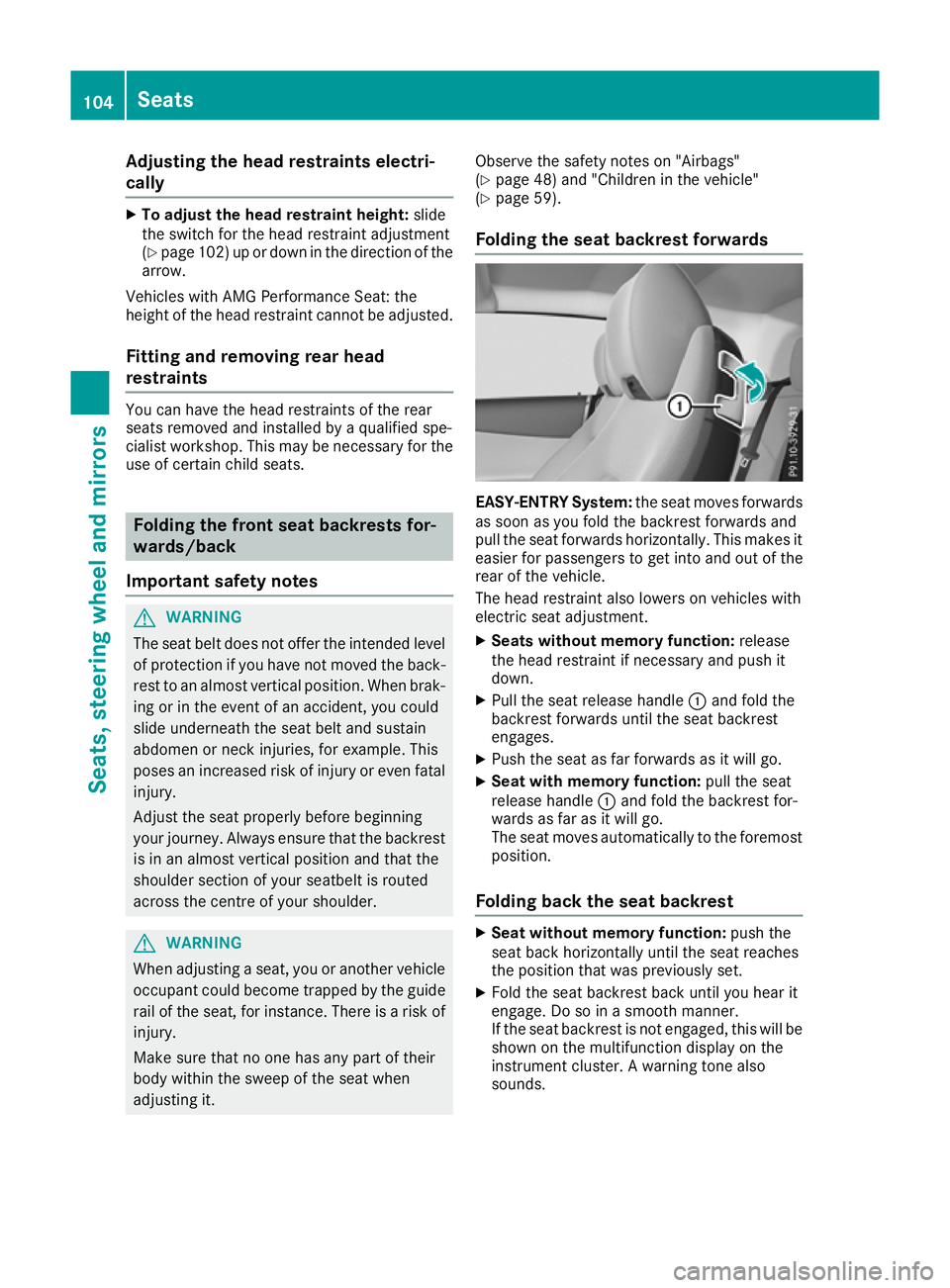
Folding the seat backrest forwards EASY-ENTRY System:
the seat moves forwards
as soon as you fold the backrest forwards and
pull the seat forwards horizontally. This makes it
easier for passengers to get into and out of the
rear of the vehicle.
The head restraint also lowers on vehicles with
electric seat adjustment.
X Seats without memory function: release
the head restraint if necessary and push it
down.
X Pull the seat release handle :and fold the
backrest forwards until the seat backrest
engages.
X Push the seat as far forwards as it will go.
X Seat with memory function: pull the seat
release handle :and fold the backrest for-
wards as far as it will go.
The seat moves automatically to the foremost
position.
Folding back the seat backrest X
Seat without memory function: push the
seat back horizontally until the seat reaches
the position that was previously set.
X Fold the seat backrest back until you hear it
engage. Do so in a smooth manner.
If the seat backrest is not engaged, this will be
shown on the multifunction display on the
instrument cluster. A warning tone also
sounds. 104
SeatsSeats
, steering wheel and mirrors
Page 108 of 377

X
After the seat backrest has been folded back,
check the position of the head restraint and
set it to the correct position.
X Seat with memory function: swing back the
seat backrest horizontally.
If the seat backrest is not engaged, this will be
shown on the multifunction display on the
instrument cluster. A warning tone also
sounds.
The seat moves automatically to the stored
position.
If the previous position can no longer be set, e.g. because of luggage in the rear footwell or after
occupants have entered the rear of the vehicle:
X Pull the seat release handle :again and
return the seat backrest to an upright posi-
tion.
The seat locks in the new fore-and-aft adjust-
ment position. G
WARNING
If the backrest is not engaged, it could fold
forwards during a braking manoeuvre or in the event of an accident, for example. The seat
backrest will then push the vehicle occupant
against the seat belt. The seat belt cannot
protect as intended and could result in addi-
tional injury. This poses an increased risk of
injury.
Before each journey, make sure that the back- rest engages fully as described. Adjusting the 4-way lumbar support
:
To raise the backrest contour
; To soften the backrest contour
= To lower the backrest contour
? To harden the backrest contour You can adjust the contour of the front seat
backrests individually to provide optimum sup-
port for your back. Adjusting the AMG performance seat
To adjust the contour of the seat and for
improved lateral support, you can individually
adjust the front seats. Adjusting the side bolsters of the seat cush-
ion
X To set narrower: press:button.
X To set wider: press;button.
To adjust the side bolsters of the seat back- rest
X To set narrower: press=button.
X To set wider: press?button. Switching the seat heating on/off
Switching on/off G
WARNING
If you repeatedly switch on seat heating, the
seat cushion and backrest padding may
become very hot. The health of vehicle occu-
pants with limited temperature sensitivity or a limited ability to react to excessively high
temperatures may be affected or they may
even suffer burn-like injuries. There is a risk of
injury.
Therefore, do not switch on the seat heating
repeatedly. Seats
105Seats, steering wheel and mirrors Z
Page 109 of 377

The three red indicator lamps in the button indi-
cate the heating level you have selected.
The system automatically switches down from
level 3to level 2after approximately eight
minutes.
The system automatically switches down from
level 2to level 1after approximately ten
minutes.
The system automatically switches off approx-
imately 20 minutes after it is set to level 1.
X Turn the key to position 1or 2in the ignition
lock (Y page 133).
X To switch on: press button:repeatedly
until the desired heating level is set.
X To switch off: press button:repeatedly
until all the indicator lamps go out.
i If the vehicle battery voltage is too low, the
seat heating may switch off.
i If drive program Eis selected, the power of
the seat heating is reduced:
R Manual transmission (Y page 144)
R Automatic transmission (Y page 148) Switching the seat ventilation on/off
Switching on/off The blue indicator lamps in the button indicate
the ventilation level you have selected.
X Turn the key to position 1or 2in the ignition
lock (Y page 133).
X To switch on: press button:repeatedly
until the desired ventilation level is set.
X To switch off: press button:repeatedly
until all the indicator lamps go out.
i If the vehicle battery voltage is too low, the
seat ventilation may switch off.
i You can open the side windows and the soft
top with the key (Y page 95). The seat venti-
lation of the driver's seat automatically
switches to the highest level.
i When the vehicle is stationary, the fan
speed can be reduced automatically. This
reduces the noise of the seat ventilation. Problems with the seat heating / seat ventilation
Problem
Possible causes/consequences and
M MSolutions The seat heating or seat
ventilation has switched
off prematurely or can-
not be switched on. The on-board voltage is too low because too many electrical consum-
ers are switched on.
X Switch off electrical consumers that you do not need, such as the
rear window heating or interior lighting.
Once the battery is sufficiently charged, the seat heating or seat
ventilation can be switched back on manually. 106
SeatsSeats, steering wheel and mirrors
Page 110 of 377
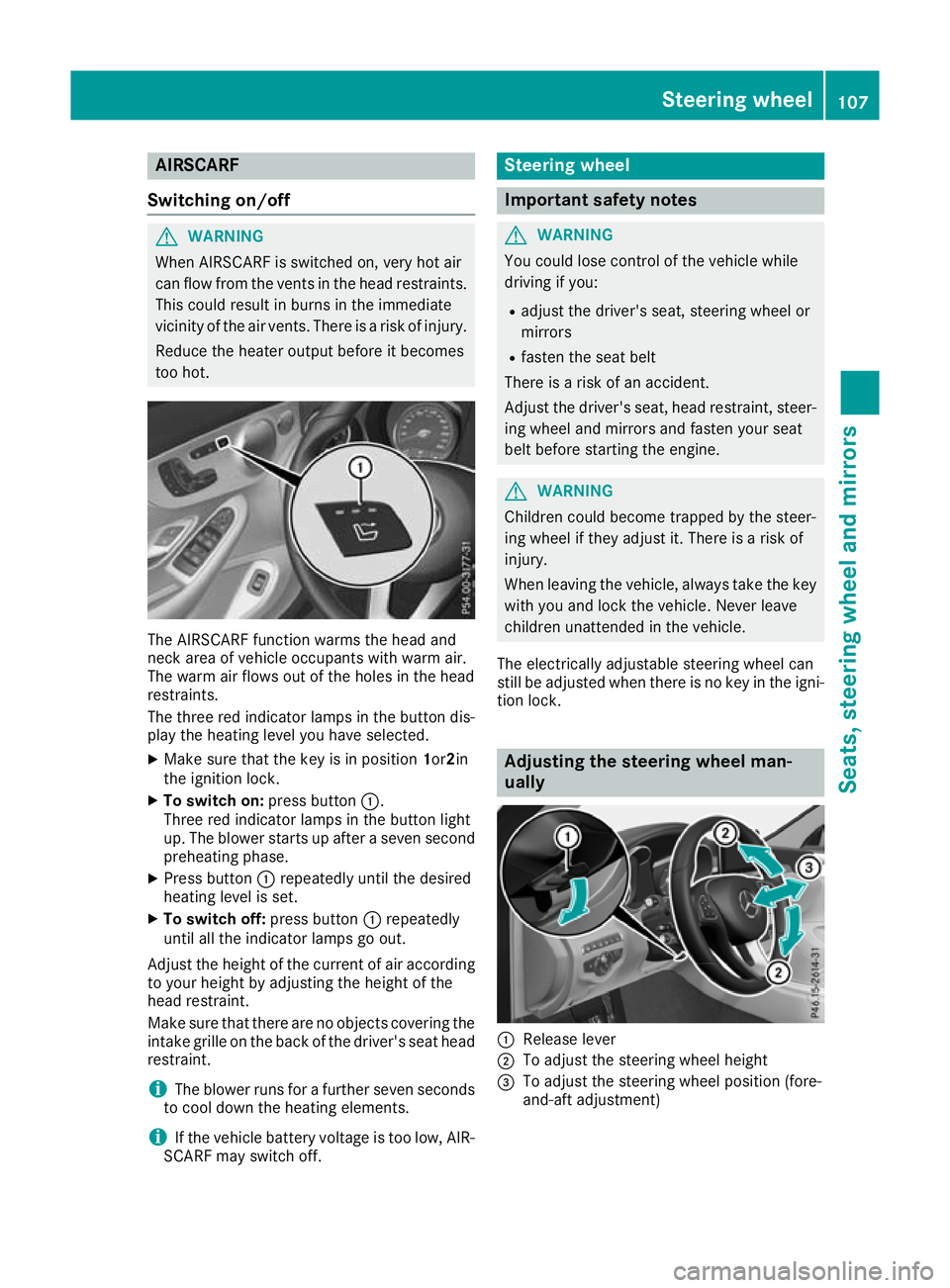
AIRSCARF
Switching on/off G
WARNING
When AIRSCARF is switched on, very hot air
can flow from the vents in the head restraints. This could result in burns in the immediate
vicinity of the air vents. There is a risk of injury.
Reduce the heater output before it becomes
too hot. The AIRSCARF function warms the head and
neck area of vehicle occupants with warm air.
The warm air flows out of the holes in the head
restraints.
The three red indicator lamps in the button dis-
play the heating level you have selected.
X Make sure that the key is in position 1or2in
the ignition lock.
X To switch on: press button:.
Three red indicator lamps in the button light
up. The blower starts up after a seven second
preheating phase.
X Press button :repeatedly until the desired
heating level is set.
X To switch off: press button:repeatedly
until all the indicator lamps go out.
Adjust the height of the current of air according
to your height by adjusting the height of the
head restraint.
Make sure that there are no objects covering the intake grille on the back of the driver's seat headrestraint.
i The blower runs for a further seven seconds
to cool down the heating elements.
i If the vehicle battery voltage is too low, AIR-
SCARF may switch off. Steering wheel
Important safety notes
G
WARNING
You could lose control of the vehicle while
driving if you:
R adjust the driver's seat, steering wheel or
mirrors
R fasten the seat belt
There is a risk of an accident.
Adjust the driver's seat, head restraint, steer-
ing wheel and mirrors and fasten your seat
belt before starting the engine. G
WARNING
Children could become trapped by the steer-
ing wheel if they adjust it. There is a risk of
injury.
When leaving the vehicle, always take the key with you and lock the vehicle. Never leave
children unattended in the vehicle.
The electrically adjustable steering wheel can
still be adjusted when there is no key in the igni-
tion lock. Adjusting the steering wheel man-
ually
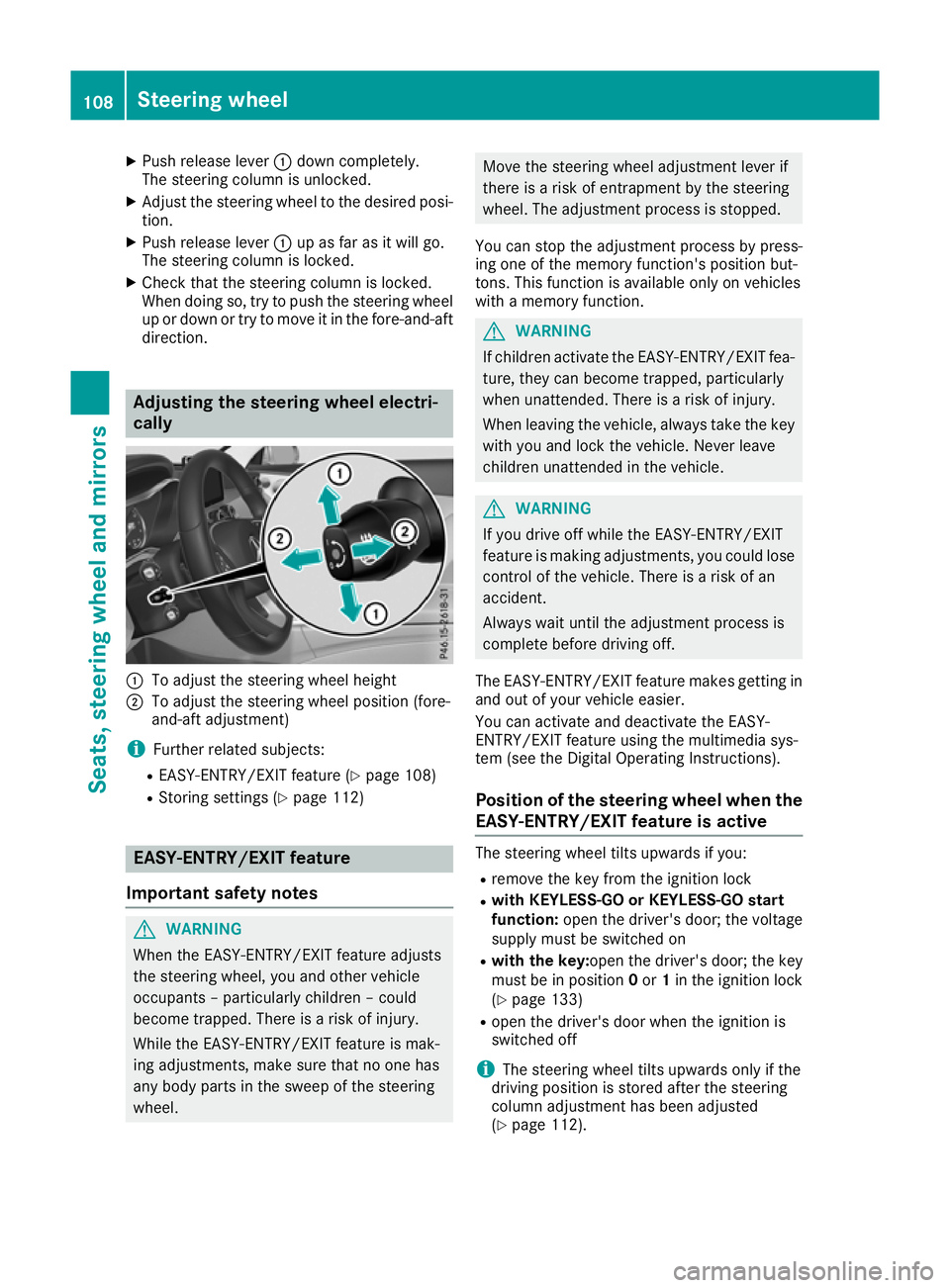
:
Release lever
; To adjust the steering wheel height
= To adjust the steering wheel position (fore-
and-aft adjustment) Steering wheel
107Seats, steering wheel and mirrors Z
Page 111 of 377
X
Push release lever :down completely.
The steering column is unlocked.
X Adjust the steering wheel to the desired posi-
tion.
X Push release lever :up as far as it will go.
The steering column is locked.
X Check that the steering column is locked.
When doing so, try to push the steering wheel up or down or try to move it in the fore-and-aft
direction. Adjusting the steering wheel electri-
cally
:
To adjust the steering wheel height
; To adjust the steering wheel position (fore-
and-aft adjustment)
i Further related subjects:
R EASY-ENTRY/EXIT feature (Y page 108)
R Storing settings (Y page 112)EASY-ENTRY/EXIT feature
Important safety notes G
WARNING
When the EASY-ENTRY/EXIT feature adjusts
the steering wheel, you and other vehicle
occupants – particularly children – could
become trapped. There is a risk of injury.
While the EASY-ENTRY/EXIT feature is mak-
ing adjustments, make sure that no one has
any body parts in the sweep of the steering
wheel. Move the steering wheel adjustment lever if
there is a risk of entrapment by the steering
wheel. The adjustment process is stopped.
You can stop the adjustment process by press-
ing one of the memory function's position but-
tons. This function is available only on vehicles
with a memory function. G
WARNING
If children activate the EASY-ENTRY/EXIT fea- ture, they can become trapped, particularly
when unattended. There is a risk of injury.
When leaving the vehicle, always take the key with you and lock the vehicle. Never leave
children unattended in the vehicle. G
WARNING
If you drive off while the EASY-ENTRY/EXIT
feature is making adjustments, you could lose
control of the vehicle. There is a risk of an
accident.
Always wait until the adjustment process is
complete before driving off.
The EASY-ENTRY/EXIT feature makes getting in
and out of your vehicle easier.
You can activate and deactivate the EASY-
ENTRY/EXIT feature using the multimedia sys-
tem (see the Digital Operating Instructions).
Position of the steering wheel when the
EASY-ENTRY/EXIT feature is active The steering wheel tilts upwards if you:
R remove the key from the ignition lock
R with KEYLESS-GO or KEYLESS-GO start
function: open the driver's door; the voltage
supply must be switched on
R with the key: open the driver's door; the key
must be in position 0or 1in the ignition lock
(Y page 133)
R open the driver's door when the ignition is
switched off
i The steering wheel tilts upwards only if the
driving position is stored after the steering
column adjustment has been adjusted
(Y page 112). 108
Steering wheelSeats, steering wheel and mirrors