belt MERCEDES-BENZ C-CLASS COUPE 2011 Owners Manual
[x] Cancel search | Manufacturer: MERCEDES-BENZ, Model Year: 2011, Model line: C-CLASS COUPE, Model: MERCEDES-BENZ C-CLASS COUPE 2011Pages: 373, PDF Size: 8.17 MB
Page 9 of 373
B
Bag hook ............................................ 287
Ball coupling Folding in ....................................... 202
Folding out ..................................... 201
BAS (Brake Assist System) .................66
Basic settings see Settings
BAS PLUS (Brake Assist System
PLUS) .................................................... 66
Battery (key) Checking .......................................... 81
Important safety notes ....................80
Replacing ......................................... 81
Battery (vehicle)
Charging ........................................ 328
Connecting .................................... 327
Disconnecting ................................ 327
Display message (12-button mul-
tifunctio nsteering wheel) ..............255
Display message (4-button multi-
function steering wheel) ................252
Important safety notes ..................325
Jump starting ................................. 329
Location ......................................... 326
Removing/fitting ........................... 327
Belt
see Seat belt
Belt force limiters (activation) ...........45
Belt tensioner Activation ......................................... 45
Function .......................................... .54
Blind Spo tAssist
Activating/deactivating .................222
Display message (12-button mul-
tifunctio nsteering wheel) ..............259
Notes/function .............................. 190
Trailer towing ................................. 192
see Active Blind Spot Assist
Bonnet
Active bonnet (pedestrian protec-
tion) ............................................... 300
Closing .......................................... .302
Display message (12-button mul-
tifunctio nsteering wheel) ..............268Display message (4-button multi-
function steering wheel)
................266
Opening ......................................... 301
Boot
Emergency release ..........................87
Important safety guidelines .............85
Locking separatel y........................... 87
Opening (automatically from
inside) .............................................. 87
Opening (automatically from out-
side) ................................................ .86
Boo tlid
Display message (12-button mul-
tifunction steering wheel) ..............268
Display message (4-button multi-
function steering wheel) ................266
Opening/closing .............................. 85
Opening dimensions ......................360
Boot load (maximum)
see Technical data
Brake Assist System
see BAS (Brake Assist System)
Brake fluid
Display message (12-button mul-
tifunctio nsteering wheel) ..............241
Display message (4-button multi-
function steering wheel) ................236
Notes ............................................. 356
Brake lamp
Display message (12-button mul-
tifunctio nsteering wheel) ..............249
Display message (4-button multi-
function steering wheel) ................245
Brake lamps
Adaptive .......................................... .67
Changin gbulbs .............................. 118
Brakes
ABS .................................................. 65
BAS .................................................. 66
BAS PLUS ........................................ 66
Brake fluid (notes) .........................356
Display message (12-button mul-
tifunctio nsteering wheel) ..............238
Display message (4-button multi-
function steering wheel) ................234
Driving tips .................................... 159
High-performance brake system ....161
Important safety notes ..................1596
Index
Page 21 of 373
Radio
Selecting a station (12-button
multifunction steering wheel )........ 217
see separate operating instructions
Rain closing feature (panorama
sliding sunroof) ................................... 91
Range (fuel) Displaying (12-button multifunc-
tion steering wheel) .......................215
Displaying (4-button multifunc-
tion steering wheel) .......................210
Reading lamp ..................................... 114
Rear compartment Setting the airv ents...................... 133
Rear-compartment seat belt sta-
tus indicator ........................................ 54
Rear foglamp Display message (12-button mul-
tifunctio nsteering wheel) ..............249
Display message (4-button multi-
function steering wheel) ................246
Switching on/off ........................... 109
Rear seat (folding the backrest for-
wards/back) ...................................... 286
Rear-view mirror Anti-dazzle mode (automatic) ........104
Dipping (manual )........................... 103
Rear window heating
Problem (fault) ............................... 127
Switching on/off ........................... 126
Refuelling
Fuel gauge ....................................... 32
Important safety notes ..................152
Refuelling proces s......................... 155
see Fuel
Releasing the parking loc kman-
ually (automatic transmission) ........152
Remote control Auxiliary heating/ventilation .......... 129
Changing the batteries (auxiliary
heating) ......................................... 130
Garage door opene r....................... 294
Replacing the battery (auxiliary
heating remote control) .................... 130
Reserve (fuel tank) see Fuel Reserve fuel
Display message (12-button mul-
tifunctio nsteering wheel) ..............255
Display message (4-button multi-
function steering wheel) ................253
Warning lamp ................................. 280
Restraint system
see SRS (Supplemental Restraint
System)
Rev counter
12-button multifunction steering
wheel ............................................. 210
4-button multifunction steering
wheel ............................................. 206
Reverse gear
Engaging (automatic transmis-
sion) ............................................... 146
Engaging (manual transmission) ....145
Reversing camera
Cleaning instructions .....................309
Function/notes ............................. 186
Reversing lamp
Changing bulbs .............................. 118
Display message (12-button mul-
tifunctio nsteering wheel) ..............250
Display message (4-button multi-
function steering wheel) ................246
Roller blind
see Roller sunblind
Roller sunblind
Opening/closing .............................. 92
Panorama sliding sunroo f................ 92
Roof carrier ........................................ 288
Roof load (maximum) see Technical data
Route
see Route guidance (navigation)
Route guidance (navigation) ............216 S
Safety Childre ninthe vehicle ..................... 55
Child restraint systems ....................55
Safety systems
see Driving safety systems 18
Index
Page 22 of 373
Seat
Seat backrest display message
(12-button multifunction steering
wheel) ............................................ 268
Seat backrest display message (4-
button multifunction steering
wheel) ............................................ 266
Seat belt
Activating/deactivating seat-belt
adjustment (12-button multifunc-
tion steering wheel) .......................228
Adjusting the driver's and front-
passenger sea tbelt ......................... 53
Belt force limiter .............................. 54
Belt tensioner .................................. 54
Cleaning ......................................... 311
Display message (12-button mul-
tifunctio nsteering wheel) ..............242
Display message (4-button multi-
function steering wheel) ................236
Fastening ......................................... 53
Important safety guidelines .............51
Rea rseat belt status indicator .........54
Releasing ......................................... 53
Warning lamp (function) ................... 54
Seat belts
Warning lamp ................................. 273
Seats
Adjusting (electrically). ....................98
Adjusting (manually and electri-
cally) ................................................ 98
Adjusting the 4-way lumba rsup-
por t.................................................. 99
Adjusting the head restraint ............98
Cleaning the cover .........................311
Correct driver's seat position ........... 96
Folding the backrests forward/
back ................................................ .99
Important safety notes ....................97
Seat heating problem ....................100
Seat ventilation problem ................101
Storing settings (memory func-
tion) ............................................... 105
Switching sea theating on/off .......100
Switching the sea tventilation on/
off .................................................. 100
Sensors (cleaning instructions) .......309 Service
see ASSYST PLUS service interval
display
Service menu (12-button multi-
function steering wheel) ..................222
Service products Brake fluid ..................................... 356
Coolant (engine) ............................ 356
Engine oil ....................................... 355
Fuel ................................................ 354
Important safety notes ..................353
Settings
Factory (12-button multifunction
steering wheel) .............................. 228
On-board computer (12-button
multifunctio nsteering wheel) ........223
Setting the air distribution ...............125
Setting the airflow ............................125
SETUP (on-board computer) .............229
Shifting to neutral (manual trans-
mission) ............................................. 145
Sidebag ................................................ 48
Side marker lamp Display message (12-button mul-
tifunctio nsteering wheel) ..............250
Display message (4-button multi-
function steering wheel) ................246
Side windows
Convenience closing ........................89
Convenience opening ......................88
Important safety notes ....................88
Opening/closing .............................. 88
Problem (malfunction) .....................90
resetting .......................................... 90
Sliding sunroof
see Panorama sliding sunroof
Snow chains ...................................... 338
Socket Centre console .............................. 292
Points to observe before use .........291
Rea rcompartmen t......................... 292
Spare wheel
Storage location ............................ 316
see Emergency spare wheel
Specialist workshop ............................ 26
Speed, controlling see Cruise control Index
19
Page 37 of 373
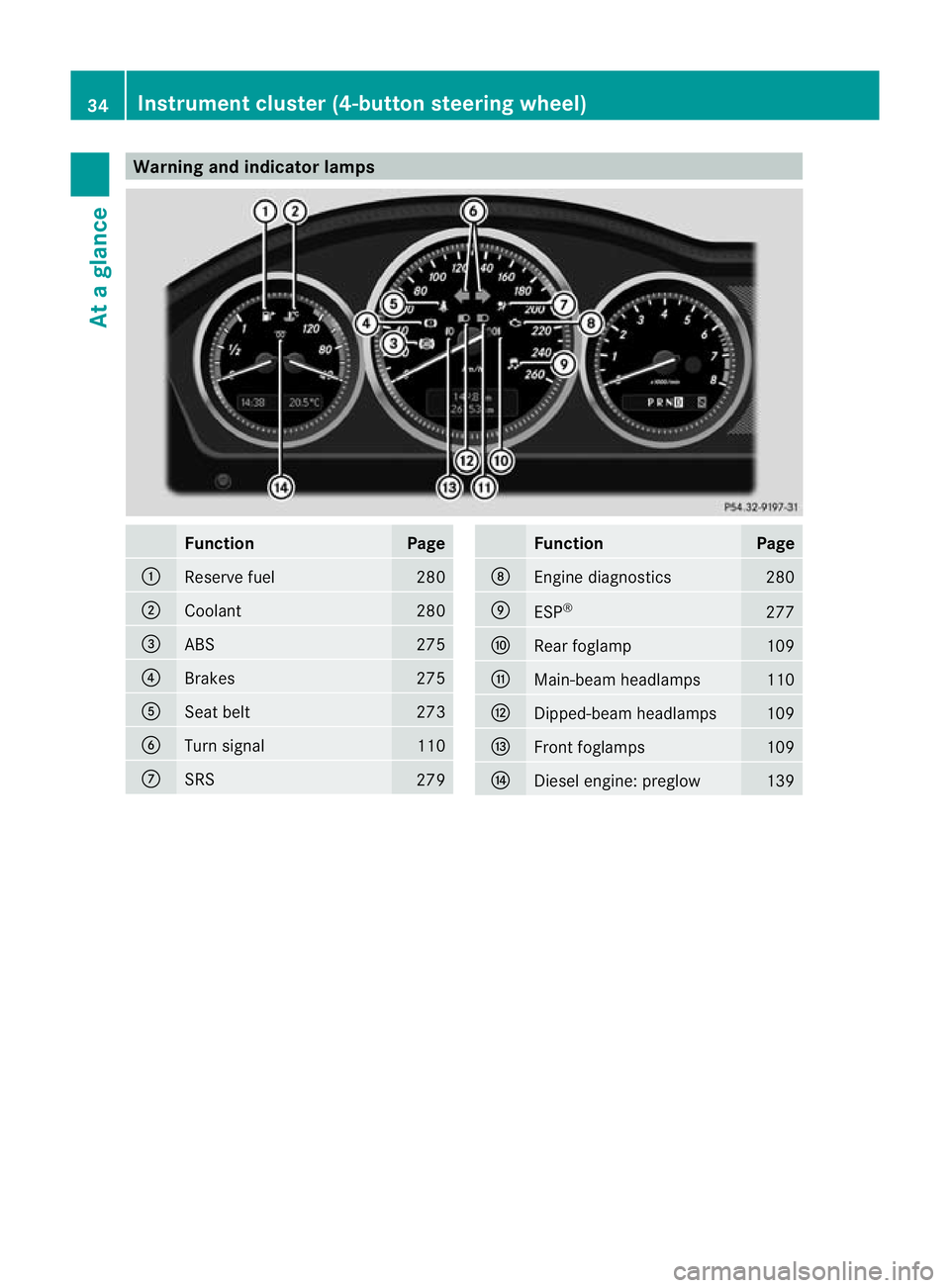
Warning and indicator lamps
Function Page
:
Reserve fuel 280
;
Coolant 280
=
ABS 275
?
Brakes 275
A
Seat belt 273
B
Turn signal 110
C
SRS
279 Function Page
D
Engine diagnostics 280
E
ESP
® 277
F
Rea
rfoglamp 109
G
Main-beam headlamps 110
H
Dipped-beam headlamps 109
I
Front foglamps 109
J
Diesel engine: preglow 13934
Instrument cluster (4-button steering wheel)At a glance
Page 40 of 373
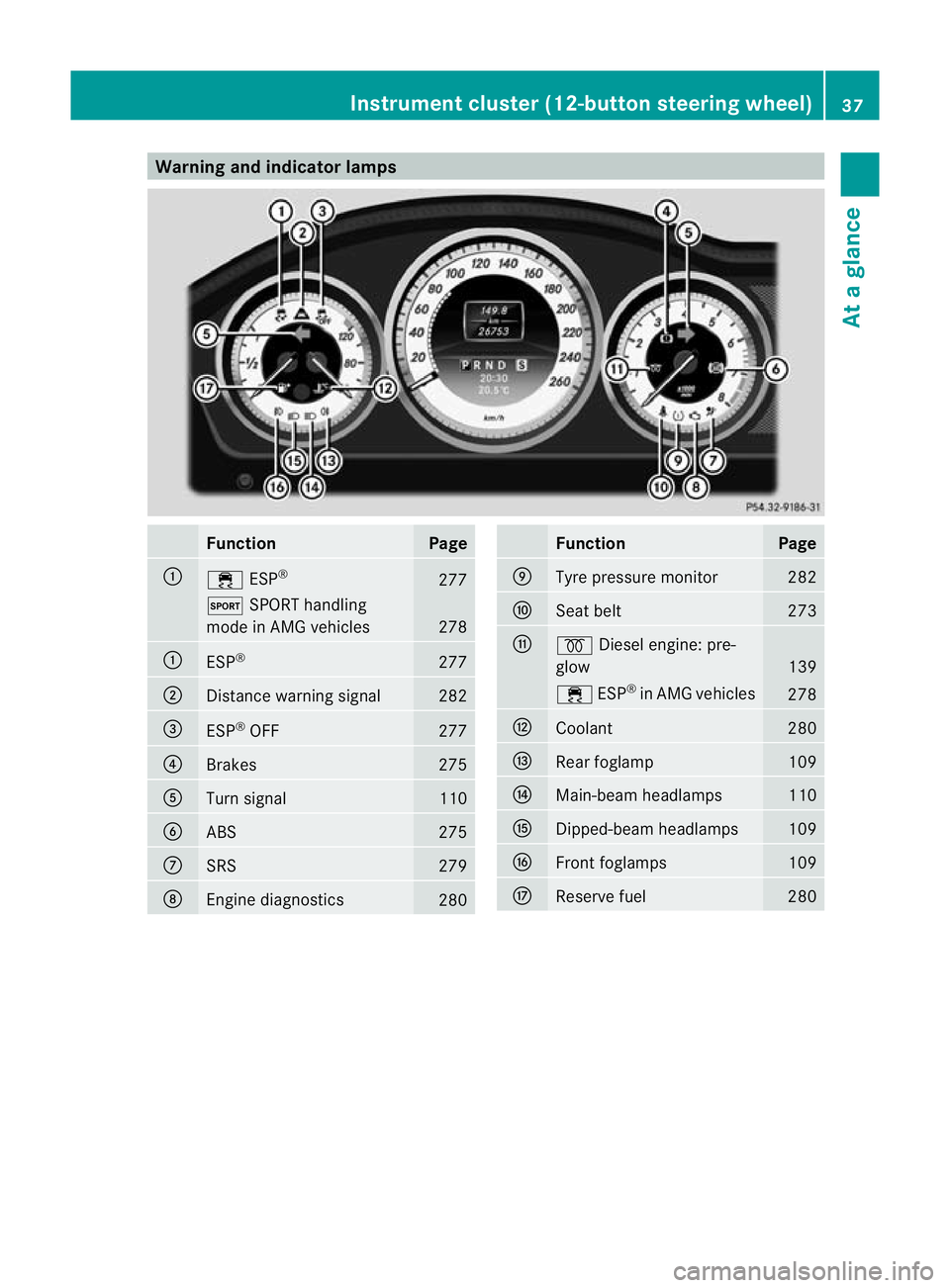
Warning and indicator lamps
Function Page
:
÷
ESP® 277
M
SPORT handling
mode in AMG vehicles 278
:
ESP
® 277
;
Distance warning signal 282
=
ESP
®
OFF 277
?
Brakes 275
A
Turn signal 110
B
ABS 275
C
SRS 279
D
Engine diagnostics
280 Function Page
E
Tyre pressure monitor 282
F
Seat belt 273
G
%
Diesel engine: pre-
glow 139
÷
ESP®
in AMG vehicles 278
H
Coolant 280
I
Rea
rfoglamp 109
J
Main-beam headlamps 110
K
Dipped-beam headlamps 109
L
Front foglamps 109
M
Reserve fuel 280Instrument cluster (12-button steering wheel)
37At a glance
Page 47 of 373
Useful information
i This Owner's Manual describes all models
and all standard and optional equipment
available to your vehicle at the time of pub-
lication of the Owner's Manual. Country-
specific deviations are possible. Please
note that your vehicle may not be equipped
with all features described. This also
applies to safety-relevan tsystems and
functions.
i Please read the information on qualified
specialist workshops (Y page 26).Occupant safety
Important safety notes
Seat belts, together with the Supplemental
Restraint System – SRS (Y page 45), are
complementary, co-ordinated restrain tsys-
tems .They reduce the risk of injury in spe-
cific, pre-defined types of accident situations
and thereby increase occupant safety. How-
ever, seat belts and airbags generally do not
protect against objects penetrating the vehi-
cle from the outside.
To ensure that the restraint systems can
deliver their full potential protection, make
sure that:
R the seat and head restraint are adjusted
properly (Y page 96).
R the seat belt has been fastened properly
(Y page 53).
R the airbags can inflate unrestricted if
deployed (Y page 46).
R the steering wheel is adjusted properly
(Y page 96).
R the restraint systems have not been modi-
fied.
i An airbag increases the protection of
vehicle occupants wearing a seat belt. As
such, they are only an additional restraint
system which complements, but does not
replace, the seat belt. All vehicle occupants must wear their seat belt correctly at all
times, even if the vehicle is equipped with
airbags. The airbags are not deployed in all
types of accidents. For example, if the pro-
tective capacity of correctly fastened seat
belts is not increased by deploying the air-
bags, the airbags will not deploy.A
irbag
deploymen tonly provides increased pro-
tection if the seat belt is worn correctly
because:
R the sea tbelt helps to keep the vehicle
occupan tinthe best position in relation
to the airbag.
R in a head-on collision, for example, the
seat belt prevents the vehicle occupant
from being propelled towards the point
of impact. It can thus reduce the risk of
injury.
In accidents in which an airbag is deployed,
it provides increased protection only if the
seat belt is worn correctly. G
WARNING
If service work is not carried out correctly, the
operating safety of your vehicle may be affec-
ted. This could cause you to lose control of
your vehicle and cause an accident. More-
over, the safety systems may no longer be
able to protect you or others as they are
designed to do.
Always have service work carried out at a
qualified specialist workshop. The workshop
must have the necessary specialist knowl-
edge and tools to carry out the work required.
Mercedes-Ben zrecommends that you use a
Mercedes-Benz Service Centre for this pur-
pose. In particular, work relevant to safety or
on safety-related systems must be carried out
at a qualified specialist workshop. 44
Occupant safetySafety
Page 48 of 373
G
WARNING
Modifications to or work performed incor-
rectly on the following parts can result in the
restraint systems not functioning as intended:
R the restraint system, consisting of seat
belts and their anchorage points, beltt en-
sioners, belt force limiters and airbags
R the wiring
R networked electronic systems
Airbags and belt tensioners could fail to
deploy or be triggered in an acciden tdespite
the deceleration force being sufficien tto trig-
ger the systems, or could be triggered unin-
tentionally. For this reason, never make any
modifications to the restraint systems.
Therefore, you must not tamper with elec-
tronic components or their software. SRS (Supplemental Restraint System)
Introduction SRS consists of:
R
the 6 SRS warning lamp
R airbags
R airbag control unit (with crash sensors)
R belt tensioners
R belt force limiters
SRS reduces the risk of occupants coming
into contact with the vehicle's interior in the
event of an accident. It can also reduce the
effect of the forces to which occupants are
subjected during an accident.
SRS warning lamp SRS functions are checked regularly when
you switch on the ignition and when the
engine is running. Therefore, malfunctions
can be detected in good time.
The 6 SRS warning lamp in the instrument
cluster lights up when the ignition is switched
on. It goes out no later than a few seconds
after the engine is started. G
WARNING
If SRS is malfunctioning, individual systems
may be activated unintentionally or may not
be triggered in the event of an accident with
a high rate of vehicle deceleration.
A malfunction has occurred if:
R the 6 SRS warning lamp does not light
up when the ignition is switched on.
R the engine is running and the 6SRS
warning lamp does not go out after a few
seconds.
R the engine is running and the 6SRS
warning lamp lights up again.
In this case, have SRS checked immediately
at a qualified specialist workshop. Mercedes-
Benz recommends that you use a Mercedes-
Benz Service Centre for this purpose.
In particular, work relevant to safety or on
safety-related systems must be carried out at
a qualified specialist workshop.
Triggering of belt tensioners, belt force
limiters and airbags During the first stage of a collision, the airbag
control unit evaluates important physical
data relating to vehicle deceleration or accel-
eration, such as:
R
duration
R direction
R magnitude
Based on the evaluation of this data, the air-
bag control unit pre-emptively triggers the
belt tensioners in the first stage.
i The front belt tensioners can only be trig-
gered if the seat belt tongues on the front
seats are correctly engaged in the seat belt
buckles.
If there is an even higher rate of vehicle decel-
eration or acceleration in a longitudinal direc-
tion, the front airbags are also deployed.
Your vehicle has adaptive, two-stage front air-
bags. The airbag control unit evaluates vehi-
cle deceleration or acceleration in the event Occupant safety
45Safety Z
Page 49 of 373
of a collision. In the first deployment stage,
the front airbag is filled with enough propel-
lant gas to reduce the risk of injuries. The
front airbag is fully deployed if a second
deployment threshold is exceeded within a
few milliseconds.
The belt tensioner and airbag triggering
thresholds are variable and are adapted to the
rate of deceleration or acceleration of the
vehicle. This process is pre-emptive in nature.
The triggering process must take place in
good time at the start of the collision.
i Airbags are not deployed in all types of
accidents. Also, not all airbags are
deployed together in an accident .The dif-
ferent airbag systems work independently
of each other.
How the airbag system works is deter-
mined by the severity of the collision detec-
ted, especially the vehicle deceleration or
acceleration, and the apparent type of acci-
dent:
R head-on collision
R side impact
R rear impact
The rate of vehicle deceleration or accelera-
tion and the direction of the force are essen-
tially determined by:
R the distribution of forces during the colli-
sion
R the collision angle
R the deformation characteristics of the vehi-
cle
R the characteristics of the object with which
the vehicle has collided
Factors which can only be seen and measured
after a collision has occurred do not play a
decisive role in the deployment of an airbag,
nor do they provide an indication of airbag
deployment.
The vehicle may be deformed significantly,
e.g. the bonnet or the wing, without an airbag
being deployed. This is the case if only parts
which are relatively easily deformed are affec- ted and the rate of deceleration is not high.
Conversely, airbags may be deployed even
though the vehicle suffers only minor defor-
mation. This is the case if, for example, very
rigid vehicle parts such as longitudinal body
members are hit, and sufficient deceleration
occurs as a result.
Airbags
Important safety notes Airbag deployment slows down and restricts
the movement of the vehicle occupant.
If the airbags are deployed, you will hear a
bang and a small amount of powder may also
be released. Only in rare cases will the bang
affect your hearing. The powder that is
released generally does not constitute a
health hazard. The 6SRS warning lamp
lights up.
The airbag installation locations are identified
by the AIRBAG symbol. G
WARNING
Airbags provide additional protection; they
are not, however, a substitute for seat belts.
Observe the following notes to reduce the risk
of serious or even fatal injury caused by airbag
deployment:
R all vehicle occupants –inparticular, preg-
nant women – must wear their seat belt
correctly at all times and lean back against
the backrest, which should be positioned
as close to the vertical as possible. The
head restraint must support the back of the
head at about eye level.
R always secure childre nless than 1.50mt all
and unde r12years of age in suitable child
restraint systems.
R all vehicle occupants must select a seat
position that is as far away from the airbag
as possible. The driver's seat position must
allow the vehicle to be driven safely. The
driver's chest should be as far away from 46
Occupant safetySafety
Page 51 of 373
G
WARNING
The airbag parts are hot after the airbag has
been deployed. Do not touch them as you
could burn yourself.
Have the airbags replaced at a qualified spe-
cialist workshop. Otherwise, occupants are
not protected by the airbags in the event of
another accident.
Fron tairbags The fron
tairbags increase protection for the
driver's and front-passenger's head and
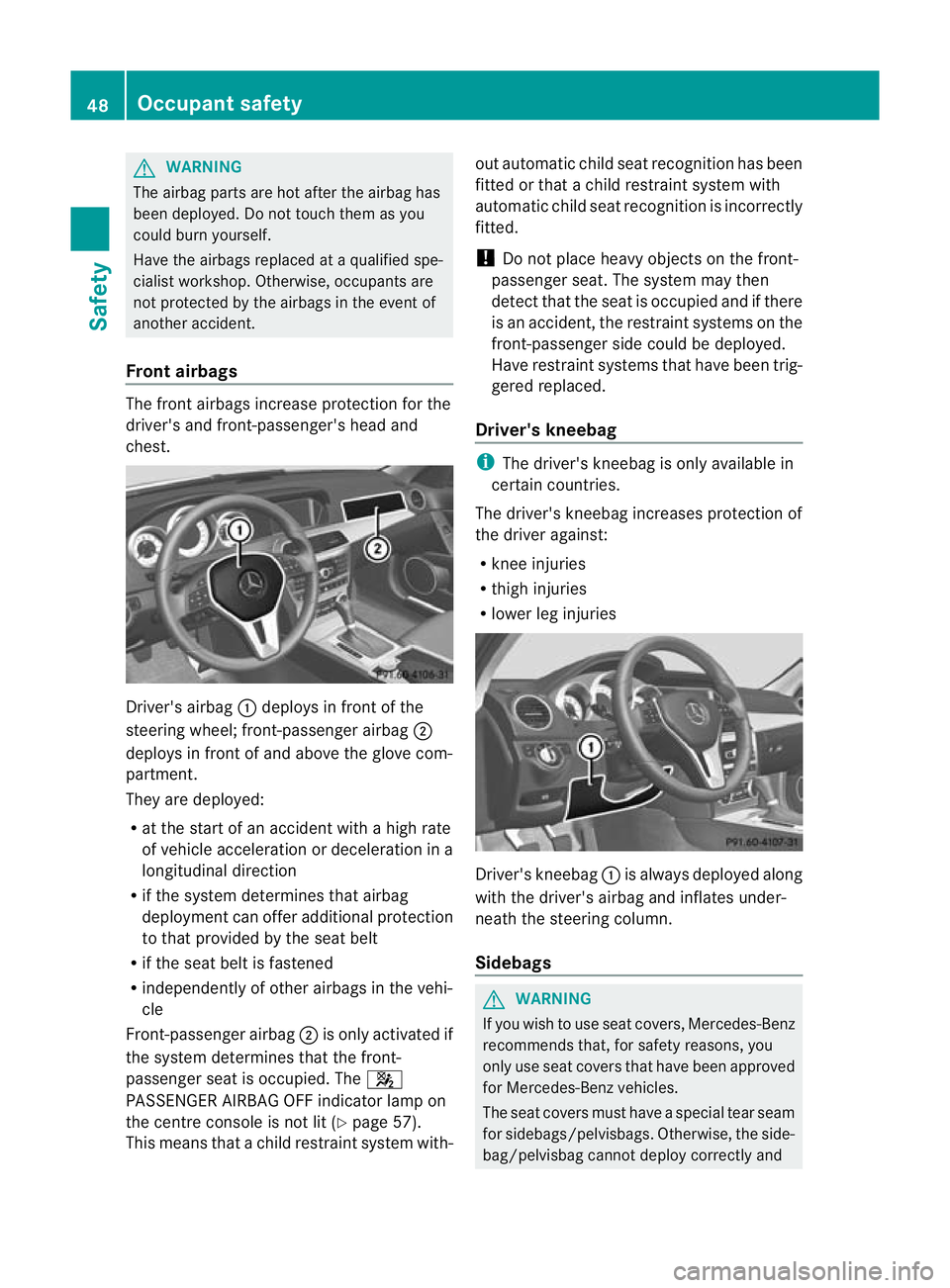
chest. Driver's airbag
:deploys in front of the
steering wheel; front-passenger airbag ;
deploys in front of and above the glove com-
partment.
They are deployed:
R at the start of an accident with a high rate
of vehicle acceleration or deceleration in a
longitudinal direction
R if the system determines that airbag
deploymen tcan offer additional protection
to that provided by the seat belt
R if the seat belt is fastened
R independently of other airbag sinthe vehi-
cle
Front-passenger airbag ;is only activated if
the system determines that the front-
passenger seat is occupied. The 4
PASSENGER AIRBAG OFF indicator lamp on
the centre console is not lit (Y page 57).
This means that a child restraint system with- out automatic child seat recognition has been
fitted or that a child restraint system with
automatic child seat recognition is incorrectly
fitted.
!
Do not place heavy objects on the front-
passenger seat. The system may then
detect that the seat is occupied and if there
is an accident, the restraint systems on the
front-passenger side could be deployed.
Have restraint systems that have been trig-
gered replaced.
Driver's kneebag i
The driver's kneebag is only available in
certain countries.
The driver's kneebag increases protection of
the driver against:
R knee injuries
R thigh injuries
R lower leg injuries Driver's kneebag
:is always deployed along
with the driver's airbag and inflates under-
neath the steering column.
Sidebags G
WARNING
If you wish to use seat covers, Mercedes-Benz
recommends that, for safety reasons, you
only use seat covers that have been approved
for Mercedes-Ben zvehicles.
The seat covers must have a special tear seam
for sidebags/pelvisbags. Otherwise, the side-
bag/pelvisbag cannot deploy correctly and 48
Occupant safetySafety
Page 52 of 373
would fail to provide the intended protection
in the event of an accident. Appropriate seat
covers can be obtained, for example, from a
Mercedes-Benz Service Centre.
When deployed, the sidebags offer additional
protection for the thorax of the vehicle occu-
pants on the side of the vehicle on which the
impac toccurs .However, they do not protect
the:
R head
R neck
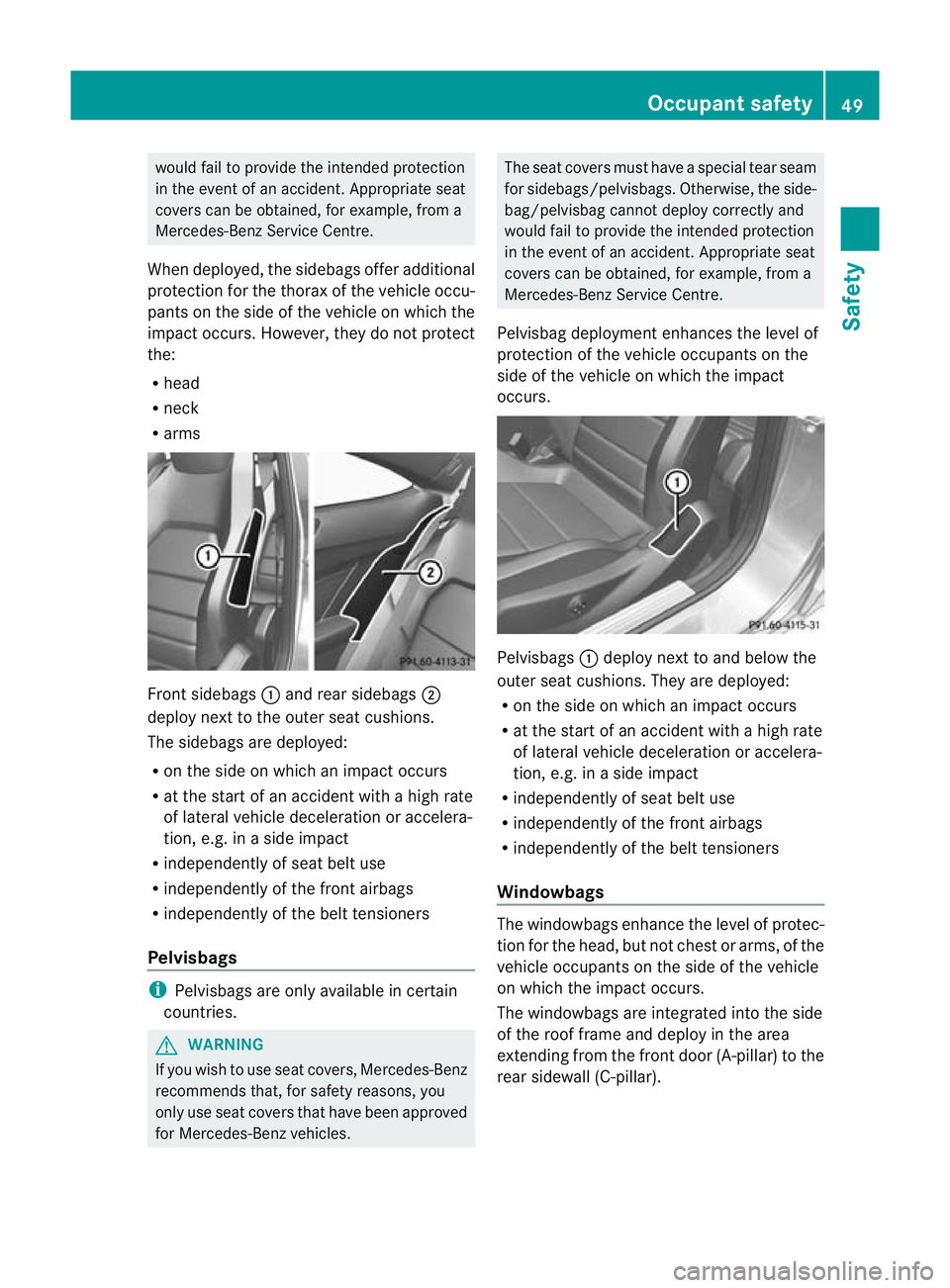
R arms Fronts
idebags :and rear sidebags ;
deploy nex tto the outer seat cushions.
The sidebags are deployed:
R on the side on which an impact occurs
R at the start of an accident with a high rate
of lateral vehicle deceleration or accelera-
tion, e.g. in a side impact
R independently of seat belt use
R independently of the front airbags
R independently of the belt tensioners
Pelvisbags i
Pelvisbags are only available in certain
countries. G
WARNING
If you wish to use seat covers, Mercedes-Benz
recommends that, for safety reasons, you
only use seat covers that have been approved
for Mercedes-Benz vehicles. The seat covers must have a special tear seam
for sidebags/pelvisbags. Otherwise, the side-
bag/pelvisbag cannot deploy correctly and
would fail to provide the intended protection
in the event of an accident. Appropriate seat
covers can be obtained, for example, from a
Mercedes-Benz Service Centre.
Pelvisbag deployment enhances the level of
protection of the vehicle occupants on the
side of the vehicle on which the impact
occurs. Pelvisbags
:deploy next to and below the
outer seat cushions. They are deployed:
R on the side on which an impact occurs
R at the start of an accident with a high rate
of lateral vehicle deceleration or accelera-
tion, e.g. in a side impact
R independently of seat belt use
R independently of the front airbags
R independently of the belt tensioners
Windowbags The windowbags enhance the level of protec-
tion for the head, but not chest or arms, of the
vehicle occupants on the side of the vehicle
on which the impact occurs.
The windowbags are integrated into the side
of the roof frame and deploy in the area
extending from the front door (A-pillar) to the
rear sidewall (C-pillar). Occupant safety
49Safety Z