light MERCEDES-BENZ C-Class COUPE 2017 CL205 User Guide
[x] Cancel search | Manufacturer: MERCEDES-BENZ, Model Year: 2017, Model line: C-Class COUPE, Model: MERCEDES-BENZ C-Class COUPE 2017 CL205Pages: 354, PDF Size: 8.66 MB
Page 20 of 354
Start/Stop buttonStarting the engine ........................ 133
Start/stop function
see ECO start/stop function
Starting (engine) ................................ 133
STEER CONTROL ..................................7 2
Steering
Display message ............................2 45
Warning lamps ............................... 257
Steering Assist and Stop&Go Pilot
(DISTRONI CPLUS)
Display message ............................ 240
Steering assistant STEE RCON-
TROL
see STEER CONTROL
Steering wheel
Adjusting (electrically). .................. 104
Adjusting (manually). ..................... 103
Butto noverview ............................... 35
Buttons (on-board computer) ......... 201
Cleaning ......................................... 297
EASY ENTRY/EXI Tfeature ............. 105
Important safety notes .................. 103
Steering wheelh eating .................. 104
Storing settings (memory func-
tion) ............................................... 109
Steering whee lheating
Problem (malfunction) ................... 105
Switching on/of f........................... 104
Steering whee lpaddle shifters ........ 146
Stopwatch (RACETIMER) ................... 217
Stowag eareas ................................... 268
Stowag ecom partments
Armrest (under )............................. 269
Center console .............................. 269
Cu ph olders ................................... 274
Door ............................................... 270
Eyeglasses compartment ............... 269
Glove box ....................................... 269
Important safety information ......... 268
Mapp ockets .................................. 270
Stowag enet ................................... 270
see Stowag eareas
Stowag enet....................................... 270
Stowag ewellb enea th the trunk
floor .................................................... 273 Summert
ires
In winter ........................................ 318
Sun visor ............................................ 274
Suspension setting
AIRMATIC. ..................................... 173
AMG adaptive sport suspension
system ........................................... 173
Suspension settings
SETUP (on-board computer) .......... 216
Switchin gair-recirculatio nmode
on/o ff
................................................. 126
Sw
itchin gonm ediam ode
Via the device list .......................... 266
T
Tachometer ........................................ 201
Tail lamps
Displa ymessage ............................ 231
see Lights
Tank content
Fuelgauge ....................................... 34
Technical data
Capacities ...................................... 344
Information .................................... 342
Tires/wheels ................................. 340
Vehicl edata. .................................. 349
Telephone
Accepting acall( multifunction
steering wheel) .............................. 210
Authorizing amobilephone (con-
necting) ......................................... 265
Connecting amobilephone (gen-
era linformation) ............................ 265
Displa ymessage ............................ 245
Introduction ................................... 210
Menu (on-board computer) ............ 210
Numbe rfrom the phone boo k........ 210
Redialing ........................................ 211
Rejecting/ending acall. ................ 210
see also Digital Operator's Man-
ua l.................................................. 258
Switching between mobile
phones ........................................... 266
Temperature
Coolant (displa yinthe instrument
cluster) .......................................... 201
18Index
Page 32 of 354
Reporting safety defects
USA only:
The following text is published as required of
manufacturers under Title 49, Code of U.S. Fed-
eralRegulat ions,Part5 75 pursuant to the
"Nationa lTraffic and Moto rVehicl eSafety Act of
1966".
If yo ubelieve that your vehicl ehasad efect
which could cause acras horc ould cause injury
or death, yo ushoul dimmediately inform the
NationalH ighway Traffic Safety Administration
(NHTSA) in addition to notifying Mercedes-Benz
USA, LLC.
If NHTSA receive ssimilar complaints, it may
ope nani nvestigation, and if it find sthat asafety
defect exists in agroup of vehicles, it may order
ar ecall and remedy campaign. However, NHTSA
canno tbecome involve dinindividual problems
between you, your dealer, or Mercedes-Benz
USA, LLC.
To contact NHTSA, yo umay cal lthe Vehicle
Safety Hotline toll-free at
1-888-327-4236(TTY: 1-800-424-9153) ;goto
http://www.safercar.gov ;orwrite to: Admin-
istrator, NHTSA, 400 Seventh Street, SW.,
Washington, DC 20590.
Yo uc an also obtain othe rinformation about
motor vehicl esafety from
http://www.safercar.gov
LimitedW arranty
!
Follo wthe instructions in this manual about
the proper operation of your vehicl easwella s
aboutp ossible vehicl edamage. Damage to
your vehicl ethat arises from culpabl econtra-
ventions against thes einstructions is not cov-
ere deither by the Mercedes-Benz Limited
Warranty or by the New or Used-Vehicle War-
ranty.
QR codes for the rescue card
The QR code sare secured in the fue lfille rflap
and on the opposite sid eonthe B-pillar. In the
event of an accident, rescue service scan use
the QR code to quickl yfind the appropriate res-
cue card for your vehicle. The current rescue
card contains the most important information abouty
ourv ehicl einac ompact form, e.g. the
routing of the electri ccables.
Yo uc an find more information under http://
portal.aftersales.i.daimler.com/public/
content/asportal/en/communication/
informationen_fuer/QRCode.html.
Data stored in the vehicle
Data storage
Aw ider ang eofe lectronic components in your
vehicl econtain data memories.
These data memorie stemporaril yorperma-
nently store technical information about:
Rvehicle's operating state
Rincidents
Rmalfunctions
In general ,this technical information docu-
ments the state of acomponent, amodule, a
system or the surroundings.
These include, for example:
Roperating conditions of system components,
e.g. fluid levels
Rthe vehicle's statu smessages and thos eofits
individual components ,e.g. number of wheel
revolutions/speed, deceleration in move-
ment, latera lacceleration, accelerato rpedal
position
Rmalfunctions and defects in important system
components ,e.g. lights ,brakes
Rvehicl ereactions and operating conditions in
specia ldriving situations, e.g. ai rbag deploy-
ment, intervention of stability control sys-
tems
Rambient conditions ,e.g. outsid etemperature
Thi sd ataisofane xclusively technical nature
and can be used to:
Rassis tinrecognizing and rectifying malfunc-
tions and defects
Ranalyze vehicl efunctions, e.g. afte ranacci-
dent
Roptimize vehicl efunction
The data canno tbeu sedtot race the vehicle's
movements.
Whe nyourv ehicl eiss erviced, technical infor-
mation can be rea dfrom the event data memory
and malfunction data memory.
30Data stored in the vehicle
Introduction
Page 35 of 354
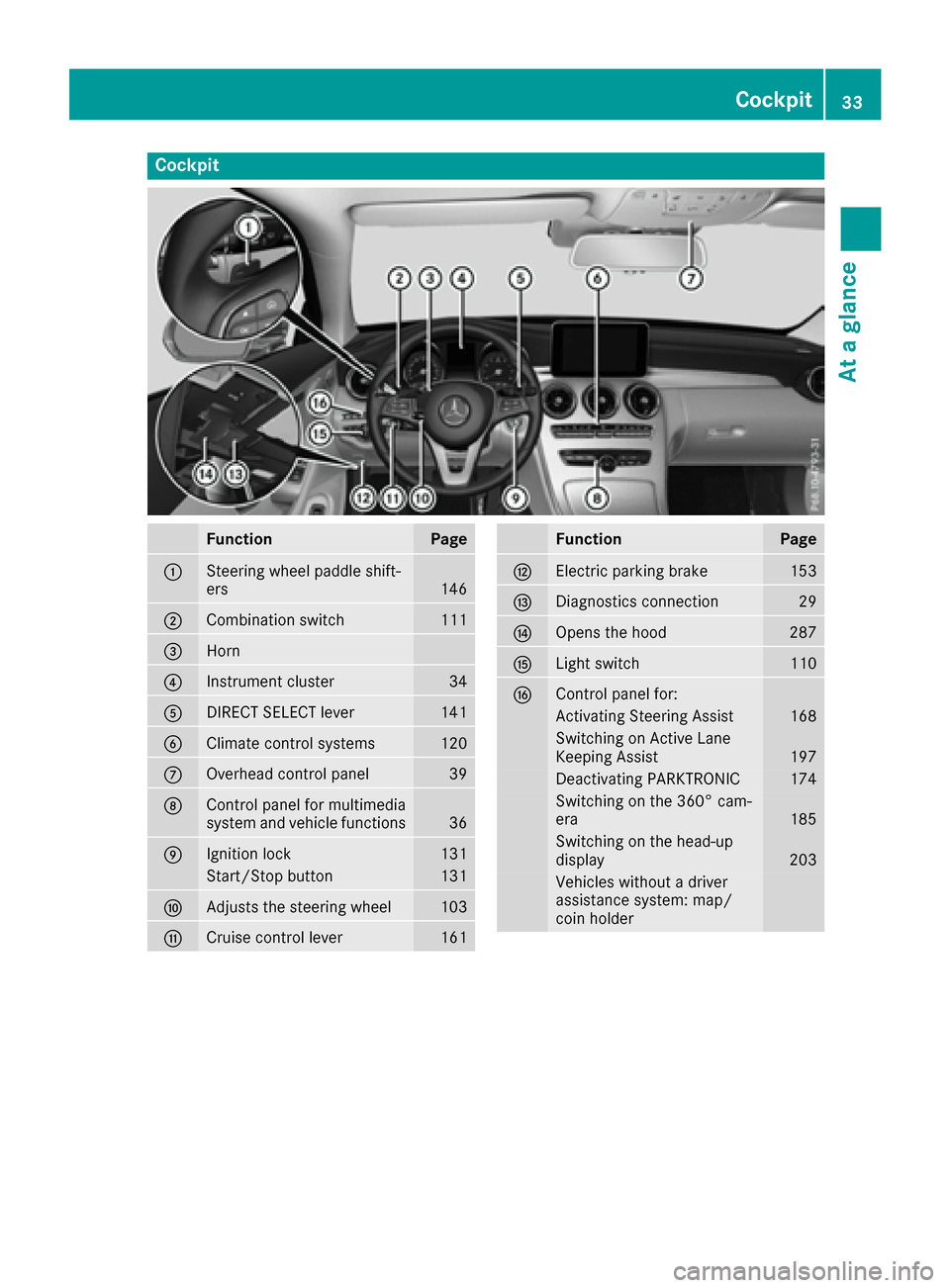
Cockpit
FunctionPage
:Steering wheel paddle shift-
ers146
;Combination switch111
=Horn
?Instrumentcluster34
ADIRECT SELECT lever141
BClimatecontrol systems120
COverhead control panel39
DControl panel for multimedia
system and vehicle functions36
EIgnition lock131
Start/Sto pbutton131
FAdjustst hesteering wheel103
GCruis econtrol lever161
FunctionPage
HElectric parking brake153
IDiagnostics connection29
JOpenst hehood287
KLights witch110
LControl panel for:
Activatin gSteering Assist168
Switching on Activ eLane
Keeping Assist197
Deactivating PARKTRONIC174
Switching on th e360°c am-
era185
Switching on th ehead-up
display203
Vehicle swithout adriver
assistance system: map/
coi nh older
Cockpit33
Atag lance
Page 39 of 354
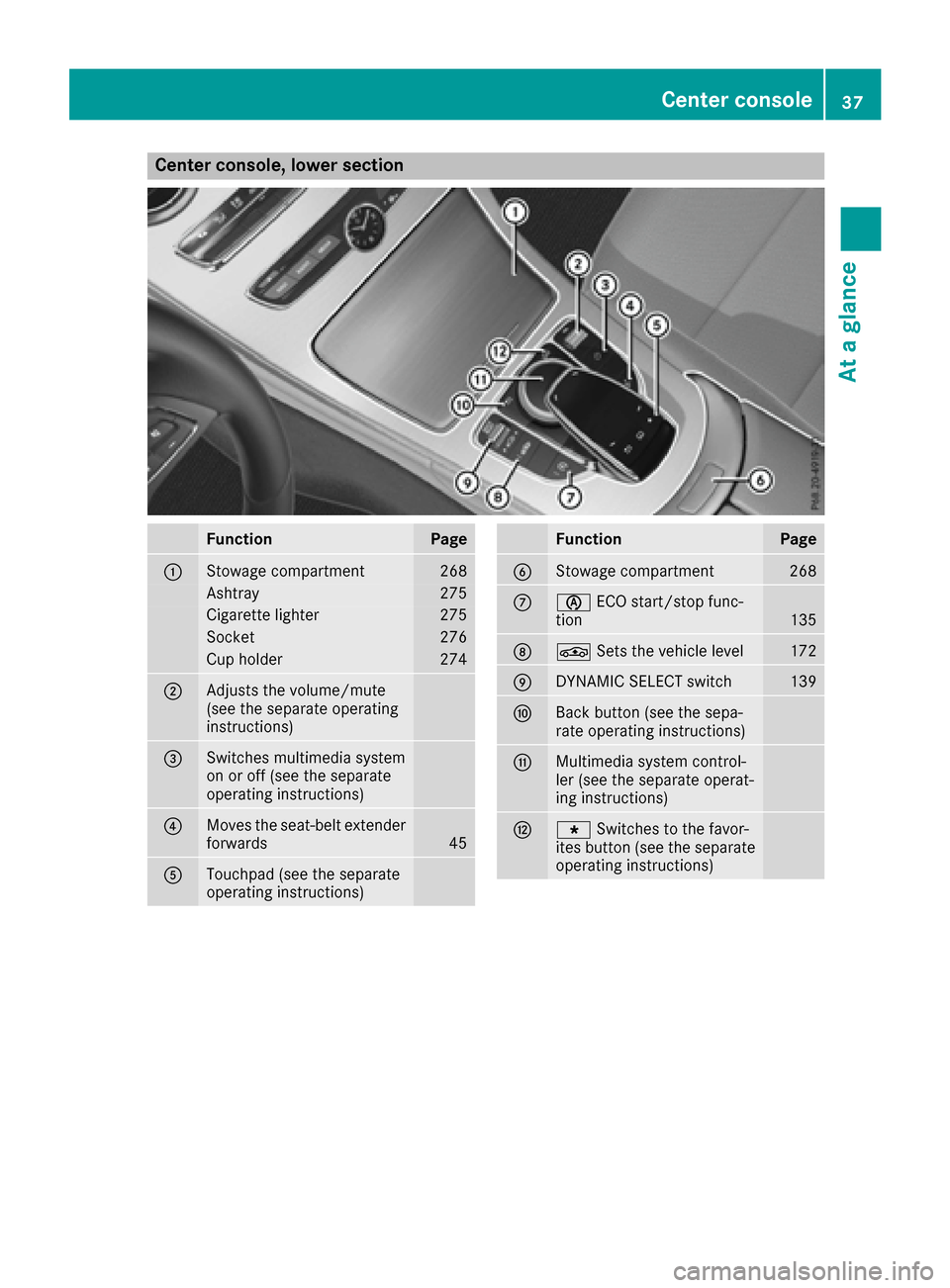
Center console, lower section
FunctionPage
:Stowage compartment268
Ashtray275
Cigarettelighter275
Socket276
Cup holder274
;Adjustst hevolume/mute
(see th eseparate operating
instructions)
=Switches multimedia system
on or off (see th eseparate
operatin ginstructions)
?Moves th eseat-belt extender
forwards45
ATouchpad (see th eseparate
operatin ginstructions)
FunctionPage
BStowage compartment268
Cè ECO start/sto pfunc-
tion135
DÉ Setsthe vehicle level172
EDYNAMIC SELECT switch139
FBac kbutto n(see th esepa-
rat eo peratin ginstructions)
GMultimedia system control-
ler (see th eseparate operat-
ing instructions)
Hg Switches to th efavor-
ite sb utto n(see th eseparate
operatin ginstructions)
Center console37
At ag lance
Page 40 of 354
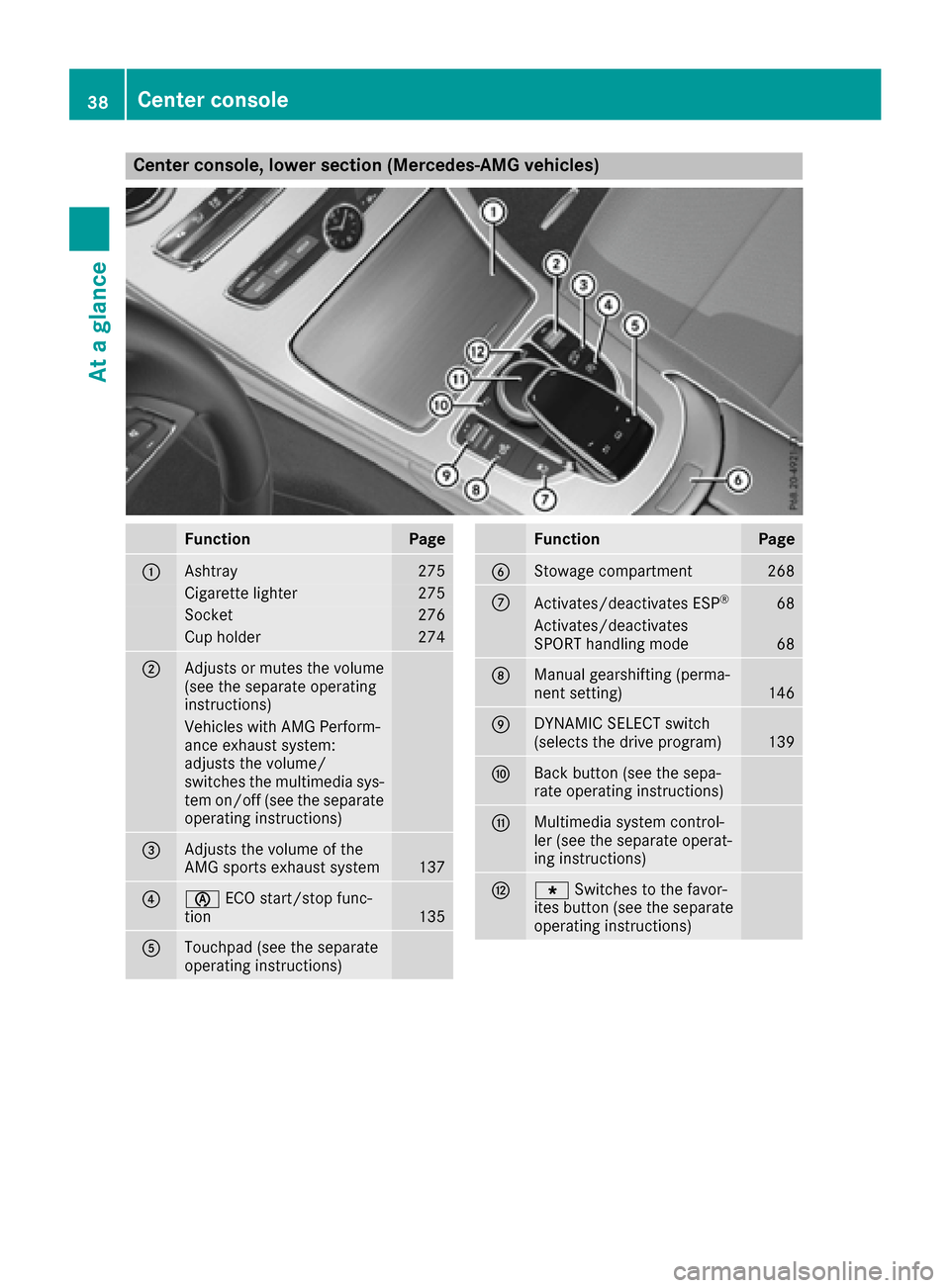
Center console, lower section (Mercedes-AMGvehicles)
FunctionPage
:Ashtray275
Cigarett elighter275
Socket276
Cup holder274
;Adjustsorm utes thevolume
(see th eseparate operating
instructions)
Vehicle swithA MGPerform-
anc eexhaust system:
adjustst hevolume/
switches th emultimedia sys-
te mo n/off(see th eseparate
operatin ginstructions)
=Adjustst hevolum eofthe
AM Gsports exhaust system137
?è ECO start/sto pfunc-
tion135
ATouchpad (see th eseparate
operatin ginstructions)
FunctionPage
BStowage compartment268
CActivates/deactivate sESP®68
Activates/deactivates
SPORT handlingm ode68
DManual gearshiftin g(perma-
nent setting)146
EDYNAMIC SELECT switch
(select sthe driv eprogram)139
FBac kbutto n(see th esepa-
rat eo peratin ginstructions)
GMultimedia system control-
ler (see th eseparate operat-
ing instructions)
Hg Switches to th efavor-
ite sb utto n(see th eseparate
operatin ginstructions)
38Center console
At ag lance
Page 41 of 354
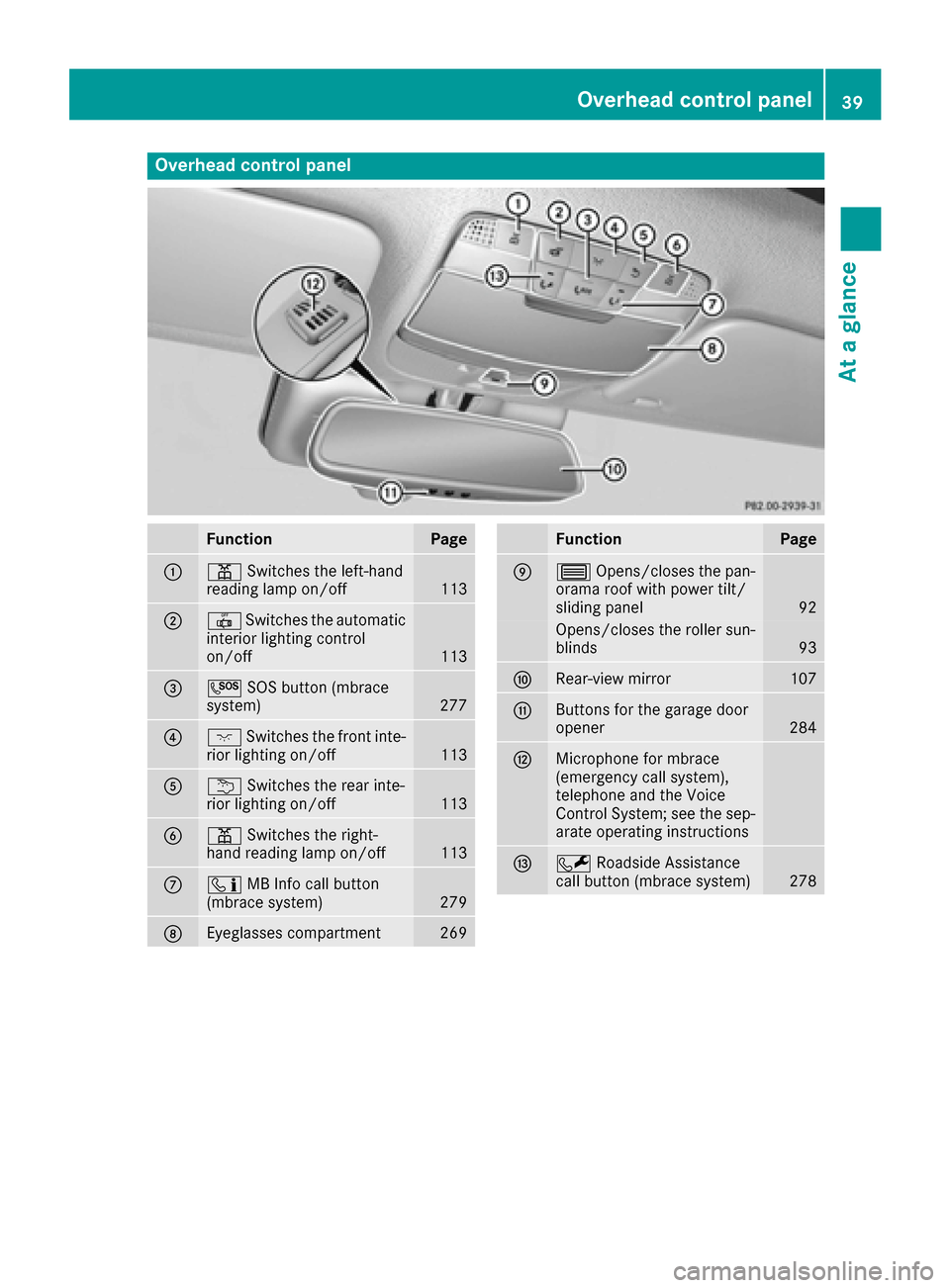
Overheadcontrol panel
FunctionPage
:p Switches the left-hand
reading lamp on/off113
;| Switches the automatic
interior lighting control
on/off
113
=G SOS button (mbrace
system)277
?c Switches the fronti nte-
rior lighting on/off113
Au Switches the rear inte-
rior lighting on/off113
Bp Switches the right-
hand reading lamp on/off113
Cï MB Inf ocall button
(mbrace system)279
DEyeglasses compartment269
FunctionPage
E3 Opens/closes the pan-
orama roof with power tilt/
sliding panel
92
Opens/closes the roller sun-
blinds93
FRear-view mirror107
GButtons for the garage door
opener284
HMicrophonef or mbrace
(emergency call system),
telephon eand the Voice
Control System ;see the sep-
arate operatin ginstructions
IF Roadside Assistance
call button (mbrace system)278
Overhea dcontrol panel39
Atag lance
Page 44 of 354
regular intervalswhile the engine is running.
Therefore, malfunctions can be detected in
good time.
The 6 restraint system warning lamp in the
instrument cluster lights up when the ignitio nis
switched on. It goes out no later than afew sec-
onds after the vehicl eisstarted. The compo-
nents of the restraint system are in operational
readiness.
Am alfunction has occurred if the 6restraint
system warning lamp:
Rdoes not light up after the ignitio nisswitched
on
Rdoes not go out after afew seconds with the
engine running
Rlights up again while the engine is running
GWARNING
If restraint system is malfunctioning, restraint
system components may be triggeredu nin-
tentionall yormight not be triggeredata ll in
the event of an accident with ahigh rate of
vehicl edeceleration. This can affect the Emer-
gency Tensioning Device or air bag ,for exam-
ple. This poses an increase drisk of injury or
even fatal injury.
Have the restraint system checked and
repaired in aqualified specialist workshop as
soon as possible.
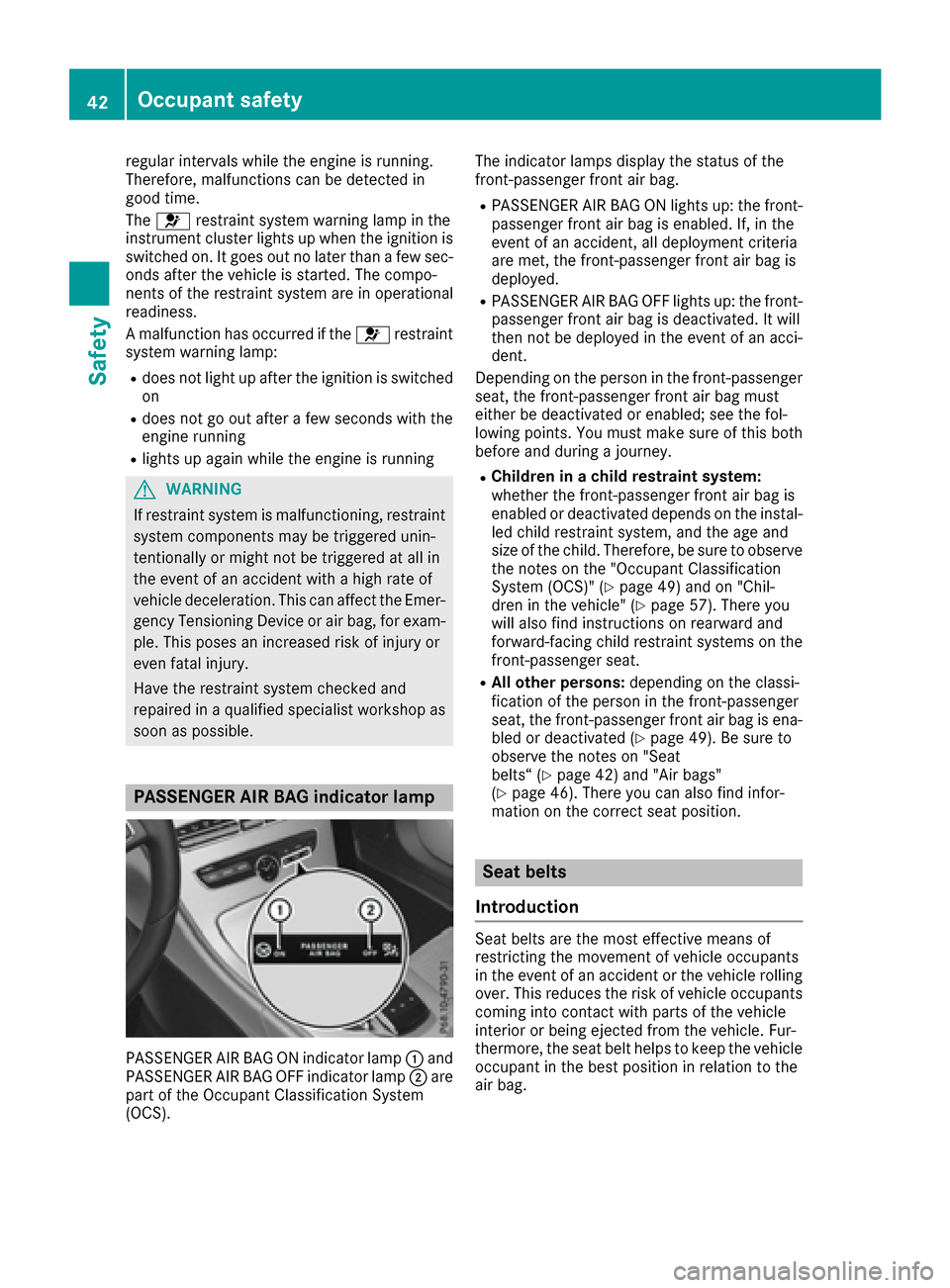
PASSENGER AI RBAG indicator lamp
PASSENGER AIR BAG ON indicator lamp :and
PASSENGER AIR BAG OFF indicator lamp ;are
part of the Occupant Classification System
(OCS). The indicator lamp
sdisplay the status of the
front-passenge rfront air bag.
RPASSENGER AIR BAG ON lights up: the front-
passenger front air bag is enabled. If, in the
event of an accident, all deployment criteria
are met, the front-passenge rfront air bag is
deployed.
RPASSENGER AIR BAG OFF lights up: the front-
passenger front air bag is deactivated. It will
then not be deploye dinthe event of an acci-
dent.
Depending on the person in the front-passenger
seat, the front-passenge rfront air bag must
either be deactivated or enabled; see the fol-
lowing points. You must make sure of this both
before and during ajourney.
RChildren in achildr estraint system:
whethe rthe front-passenge rfront air bag is
enabled or deactivated depends on the instal-
led child restraint system, and the age and
size of the child .Therefore, be sure to observe
the notes on the "Occupant Classification
System (OCS)" (
Ypag e49) and on "Chil-
dren in the vehicle" (Ypag e57). There you
wil lalsof ind instructions on rearward and
forward-facing child restraint systems on the
front-passenge rseat.
RAll other persons: depending on the classi-
ficatio nofthe person in the front-passenger
seat, the front-passenge rfront air bag is ena-
bled or deactivated (
Ypag e49). Be sure to
observe the notes on "Seat
belts“ (
Ypag e42) and "Air bags"
(Ypag e46). There you can als ofind infor-
mation on the correct seat position.
Seat belts
Introduction
Seat belts are the most effective means of
restricting the movement of vehicl eoccupants
in the event of an accident or the vehicl erolling
over. This reduces the risk of vehicl eoccupants
coming into contact with parts of the vehicle
interior or being ejected from the vehicle. Fur-
thermore, the seat belt help stokeep the vehicle
occupant in the best position in relation to the
air bag.
42Occupant safety
Safety
Page 48 of 354
All seatbelts except the driver's sea tbelta re
equipped with aspecia lsea tb eltr etractor to
securel yfasten child restraint system sinthe
vehicle. Further informatio ncan be found under
"Special sea tbeltr etractor" (
Ypage 57).
Releasin gseatb elts
!Make sure thatt he seatbeltisf ullyrolle dup.
Otherwise, the sea tbeltorb eltt ongu ewillb e
trappe dinthe door or in the sea tmechanism.
Thi scould damage the door, the door trim
panel and the sea tbelt. Damaged sea tbelts
can no longerf ulfill thei rprotective function
and must be replaced .Visit aquali fied spe-
cialist workshop.
XPress the release button in the belt buckle,
hol dthe belt tongu efirmly and guid ethe belt
back.
Seat belt adjustment
The seat-belt adjustment is an integra lparto f
the PRE-SAFE®convenience function. Thi sfun c-
tio na djusts the driver's and front-passenger
sea tbelttot he uppe rbodyoft he occupants.
The belt strapist ightenedslightly when:
Rthe belt tongu eisengaged in the buckle and
Rthe ignition is switched on
The seat-belt adjustment will appl yacertain
retractio nforc eifa ny slack is detecte dbetween
the vehicl eoccupant and the sea tbelt. Do not
hol dontot he seatbeltt ightlyw hileit is adjust-
ing.
Yo uc an activate and deactivate the seat-belt
adjustment functio nusing the multimedia sys-
tem. Informatio nonactivating and deactivating
the seat-belt adjustment functio ncan be found
in the Digita lOperator' sManualorint he sepa-
rate multimedia system operating instructions.
Bel twarning fort he driver and front
passenger
The 7 seatbeltw arning lamp in the instru-
ment cluster is areminder thata llvehicl eoccu-
pants must wear thei rseatb elts .Itm aylight up
continuously or flash. In addition, ther emaybe
aw arning tone.
Regardless of whethe rthe driver's sea tbelth as
already been fastened, the 7seatbeltw arn-
ing lamp lights up for sixs econdseach timethe
engine is started. If th edoorsa re closed and the driver'sorf
ront-passenger seat belt has not
been fastened, the 7seat belt warning lamp
lightsupa gain after th esix seconds. As soon as
th ed river'sa nd front-passenger seat beltsa re
fastene dorad oor is opened again,t he7
seat belt warning lamp goes out.
If th edriver'ss eat belt is no tfastene dafter the
engine is started, an additional warning tone will
sound. The warning tone switches off after six
seconds or once th edriver'ss eat belt is fas-
tened.
If th evehicle's speede xceeds 15 mph
(25 km/h) once and th edriver'sa nd front-
passenger seat beltsa re notfastened, awarning
tone sounds. Awarning tone also sounds with
increasing intensity for 60 seconds or until the
driver or frontp assenger have fastene dtheir
seat belts.
If th edriver or frontp assenger unfasten their
seat beltsd uringthejourney, th eseat belt warn-
ing is activ
ated again.
Air bags
Introduction
The installatio npointofana ir bag can be rec-
ognize dbytheAIRB AG symbol.
An air bag complement sthe correctly fastened
seat belt.Itisnos ubstitutefor th eseat belt.T he
air bag provides additional protection in appli-
cable accidents ituations.
Not all air bags are deployed in an accident. The
differenta ir bag systems function independ-
ently from onea nother (
Ypage 53).
However ,nosystem availabl etoday can com-
pletely eliminat einjuries and fatalities.
It is also no tpossible to rule out arisk of injury
caused by an air bag due to th ehigh speeda t
whicht heair bag must be deployed.
Important safety notes
GWARNING
If you do no tsit in th ecorrec tseat position,
th ea ir bag canno tprotect as intended and
coul deven caus eadditional injury when
deployed. This posesani ncreased risk of
injury or even fatal injury.
46Occupant safety
Safety
Page 52 of 354
The indicator lamps inform you whether the
front-passenger front air bag is deactivated or
enabled.
XPress the Start/Stop button once or twice, or
turn the SmartKey to position1or 2in the
ignition lock.
The system carries out self-diagnostics.
The PASSENGER AIR BAG OFF and PASSENGER
AIR BAG ON indicator lamps must light up simul-
taneously for approximately six seconds.
The indicator lamps display the status of the
front-passenger front air bag.
RPASSENGER AIR BAG ON lights up: the front-
passenger front air bag is enabled. If, in the
event of an accident ,all deployment criteria
are met, the front-passenger front air bag is
deployed.
RPASSENGER AIR BAG OFF lights up: the front-
passenger front air bag is deactivated. It will
then not be deployed in the event of an acci-
dent.
If the status of the front-passenger front air bag changes while the vehicle is in motion,ana ir bag
display message appears in the instrument clus-
ter (
Ypage 229). When the front-passenger
seat is occupied, alwaysp ay attention to the
PASSENGER AIR BAG ON and PASSENGER AIR
BAG OFF indicator lamps. Be aware of the status
of the front-passenger front air bag both before
and during the journey.
GWARNING
If the PASSENGER AIR BAG OFF indicator
lamp is lit, the front-passenger front air bag is
disabled. It will not be deployed in the event of
an accident and cannot perform its intended
protective function. Aperson in the front-
passenger seat could then ,for example, come
into contact with the vehicle's interior, espe-
cially if the person is sittin gtoo close to the
dashboard. This poses an increased risk of
injury or even fatal injury.
When the front-passenger seat is occupied,
alwayse nsure that:
Rthe classification of the person in the front-
passenger seat is correcta nd the front-
passenger front air bag is enabled or disa-
bled in accordanc ewith the person in the
front-passenger seat
Rthe front-passenger seat has been moved
back as far back as possible.
Rthe person is seated correctly.
Make sure, both before and during the jour-
ney, that the status of the front-passenger
front air bag is correct.
GWARNING
If you secure achild in arearward-facing child
restraint system on the front-passenger seat
and the PASSENGER AIR BAG ON indicator
lamp is lit up, the front-passenger front air bag may deploy in an accident .The child could be
struck by the air bag. This poses an increased
risk of injury or even fatal injury.
Make sure that the front-passenger front air
bag has been disabled. The PASSENGER AIR
BAG OFF indicator lamp must be lit.
If the PASSENGER AIR BAG OFF indicator lamp
remains off and/or the PASSENGER AIR BAG
ON indicator lamp lights up, do not install arear-
ward-facing child restraint system on the front-
passenger seat. You can find more information
on OCS under "Problems with the Occupant
Classification System" (
Ypage 53).
GWARNING
If you secure achild in aforward-facing child
restraint system on the front-passenger seat
and you position the front-passenger seat too close to the dashboard, in the event of an
accident ,the child could:
Rcome into contact with the vehicle's inte-
rior if the PASSENGER AIR BAG OFF indi-
cator lamp is lit, for example
Rbe struck by the air bag if the PASSENGER
AIR BAG ON is lit up
This poses an increased risk of injury or even fatal injury.
Always move the front-passenger seat as far
back as possible and fully retrac tthe seat
cushion length. Always make sure that the
shoulder belt strap is correctly routed from
the vehicle belt sash guide to the shoulder
50Occupant safety
Safety
Page 53 of 354
belt guide on the child restraint system. The
shoulder belt strap must be routed forwards
and downwards from the vehicle belt sash
guide. If necessary, adjust the vehicle belt
sash guide and the front-passenger seat
accordingly. Always observe the child
restraint system manufacturer's installation
instructions.
If OCS determines that:
Rthe front-passenger seat is unoccupied, the
PASSENGER AIR BAGO FF indicator lamp
lights up after the system self-test and
remains lit. This indicates that the front-
passenger fronta ir bag is deactivated.
Rthe front-passenger seat is occupied by a
child of up to twelve months old, in astandard
child restraint system, the PASSENGER AIR
BAGO FF indicator lamp lights up after the
system self-test and remains lit. This indi-
cates that the front-passenger fronta ir bag is
deactivated.
But even in the case of atwelve-month-old
child, in astandard child restraint system, the
PASSENGER AIR BAGONc an light up perma-
nently after the system self-test. This indi-
cates that the front-passenger fronta ir bag is
activated. The result of the classification is
dependen ton, among other factors, the child
restraint system and the child's stature. It is
recommended that you install the child
restraint system on asuitable rear seat.
Rthe front-passenger seat is occupied by aper-
son of smaller stature (e.g. ateenager or
small adult), either the PASSENGER AIR BAG
ON or PASSENGER AIR BAGO FF indicator
lamp lights up and remains lit after the system
self-test dependin gonthe result of the clas-
sification.
-If the PASSENGER AIR BAGONi ndicator
lamp lights up, move the front-passenger
seat as far back as possible. Alternatively, a
person of smaller stature can sit on arear
seat.
-If the PASSENGER AIR BAGO FF indicator
lamp is lit, aperson of smaller stature
should not use the front-passenger seat.
Rthe front-passenger seat is occupied by an
adult or aperson of adult stature, the
PASSENGER AIR BAGONi ndicator lamp
lights up after the system self-test and remains lit. This indicates that the front-
passenger fronta
ir bag is activated.
If children are traveling in the vehicle, be sure to
observe the notes on "Children in the vehicle"
(
Ypage 57).
When OCS is malfunctioning, the red 6
restraint system warning lamp in the instrument
cluster and the PASSENGER AIR BAGO FF indi-
cator lamp light up simultaneously. The front-
passenger fronta ir bag is deactivated in this
case and does not deploy during an accident.
Have the system checked by qualified techni-
cians as soon as possible. Consult an authorized
Mercedes-Benz Center .The front-passenger
seat should only be repaired at an authorized
Mercedes-Benz Center.
If the front-passenger seat, the seat cover or the seat cushion is damaged, have the necessary
repair work carried out at an authorized
Mercedes-Benz Center.
For safety reasons ,Mercedes-Benz recom-
mends that you only use seat accessories that
have been approved by Mercedes-Benz.
If the driver'sa ir bag deploys, this does not
mean that the front-passenger fronta ir bag will
also deploy. The Occupant Classification Sys-
tem (OCS) categorizes the occupant in the front-
passenger seat. Depending on that result, the
front-passenger fronta ir bag is either enabled or
deactivated.
System self-test
GDANGER
If both the PASSENGER AIR BAGO FF and
PASSENGER AIR BAGONi ndicator lamps do
not light up during the system self-test, the
system is malfunctioning. The front-
passenger fronta ir bag might be triggered
unintentionally or might not be triggered at all
in the event of an accidentw ith high deceler-
ation. This poses an increased risk of injury or
even fatal injury.
In this case the front-passenger seat may not
be used. Do not install achild restraint system
on the front-passenger seat. Have the Occu-
pant Classification System (OCS) checked
and repaired immediately at aqualified spe-
cialist workshop.
Occupant safety51
Safety
Z