steering wheel MERCEDES-BENZ C-Class COUPE 2017 CL205 User Guide
[x] Cancel search | Manufacturer: MERCEDES-BENZ, Model Year: 2017, Model line: C-Class COUPE, Model: MERCEDES-BENZ C-Class COUPE 2017 CL205Pages: 354, PDF Size: 8.66 MB
Page 43 of 354
Panic alarm
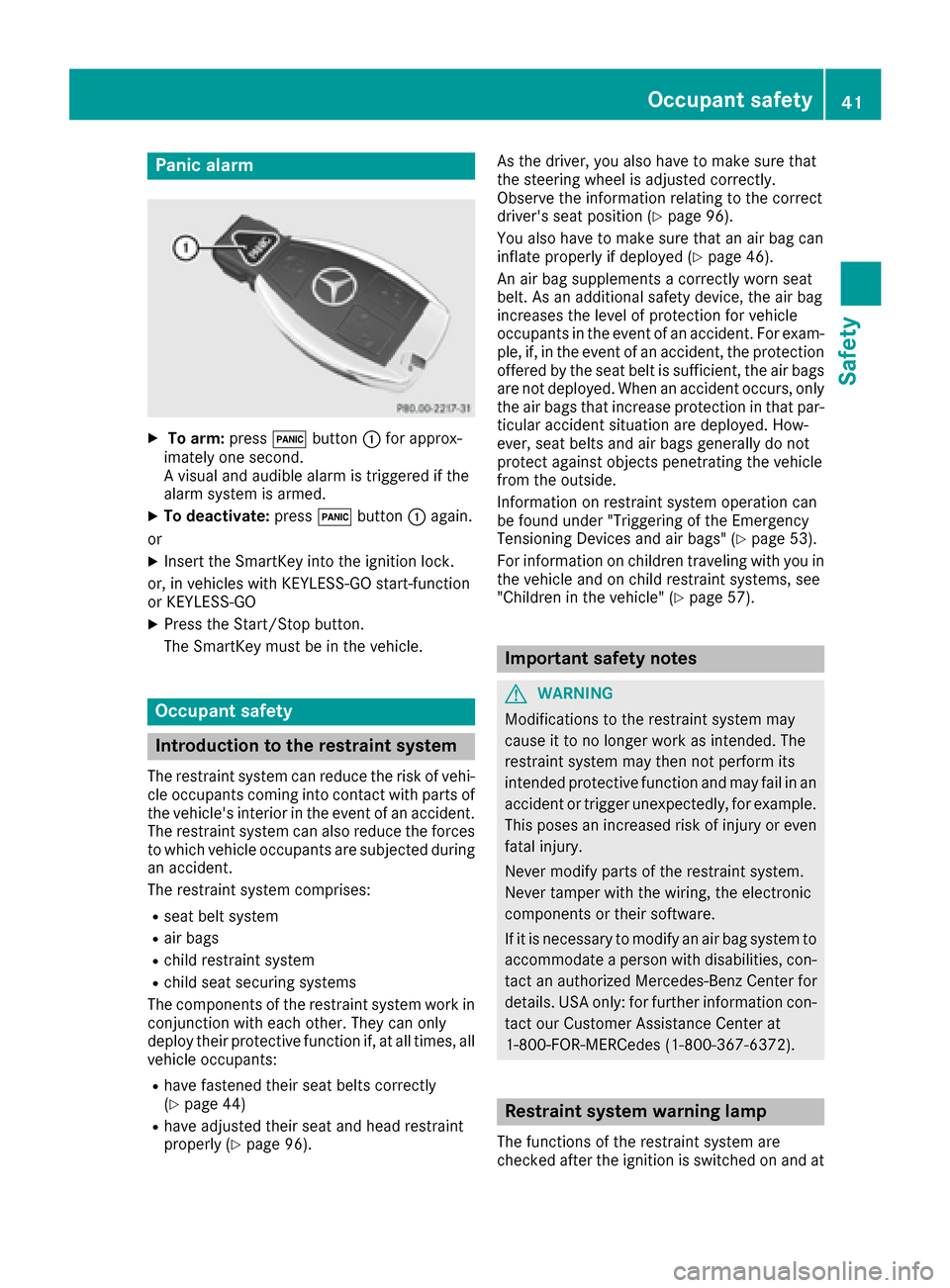
XTo arm:press!button :for approx-
imately one second.
Av isual and audible alarm is triggered if the
alarm system is armed.
XTo deactivate: press!button :again.
or
XInsert the SmartKey into the ignition lock.
or, in vehicles with KEYLESS-GO start-function
or KEYLESS ‑GO
XPress the Start/Stop button.
The SmartKey must be in the vehicle.
Occupant safety
Introduction to the restraint system
The restraint system can reduce the risk of vehi-
cle occupants coming into contact with parts of
the vehicle's interior in the event of an accident.
The restraint system can also reduce the forces to which vehicle occupants are subjected during
an accident.
The restraint system comprises:
Rseat belt system
Rair bags
Rchild restraint system
Rchild seat securing systems
The components of the restraint system work in
conjunction with each other. They can only
deploy their protective function if, at all times, all vehicle occupants:
Rhave fastened their seat belts correctly
(Ypage 44)
Rhave adjusted their seat and head restraint
properly (Ypage 96). As the driver, you also have to make sure that
the steering wheel is adjusted correctly.
Observe the information relating to the correct
driver's seat position (
Ypage 96).
You also have to make sure that an air bag can
inflate properly if deploye d(
Ypage 46).
An air bag supplements acorrectly worn seat
belt. As an additional safety device, the air bag
increases the level of protection for vehicle
occupants in the event of an accident. For exam-
ple, if, in the event of an accident, the protection
offered by the seat belt is sufficient, the air bags are not deployed. When an accident occurs, only
the air bags that increase protection in that par-ticular accident situation are deployed. How-
ever, seat belts and air bags generally do not
protect against object spenetrating the vehicle
from the outside.
Information on restraint system operation can
be found under "Triggering of the Emergency
Tensioning Devices and air bags" (
Ypage 53).
For information on children traveling with you in
the vehicle and on child restraint systems, see
"Children in the vehicle" (
Ypage 57).
Important safety notes
GWARNING
Modifications to the restraint system may
cause it to no longer work as intended. The
restraint system may then not perform its
intended protective function and may fail in an
accident or trigger unexpectedly, for example.
This poses an increased risk of injury or even fatal injury.
Never modify parts of the restraint system.
Never tamper with the wiring, the electronic
components or their software.
If it is necessary to modify an air bag system to
accommodate aperson with disabilities, con-
tact an authorized Mercedes-Benz Center for
details. USA only: for further information con-
tact our Customer AssistanceC enter at
1-800-FOR-MERCedes (1‑800‑367‑6372).
Restraint system warning lamp
The functions of the restraint system are
checked after the ignition is switched on and at
Occupant safety41
Safety
Z
Page 50 of 354
Frontair bags
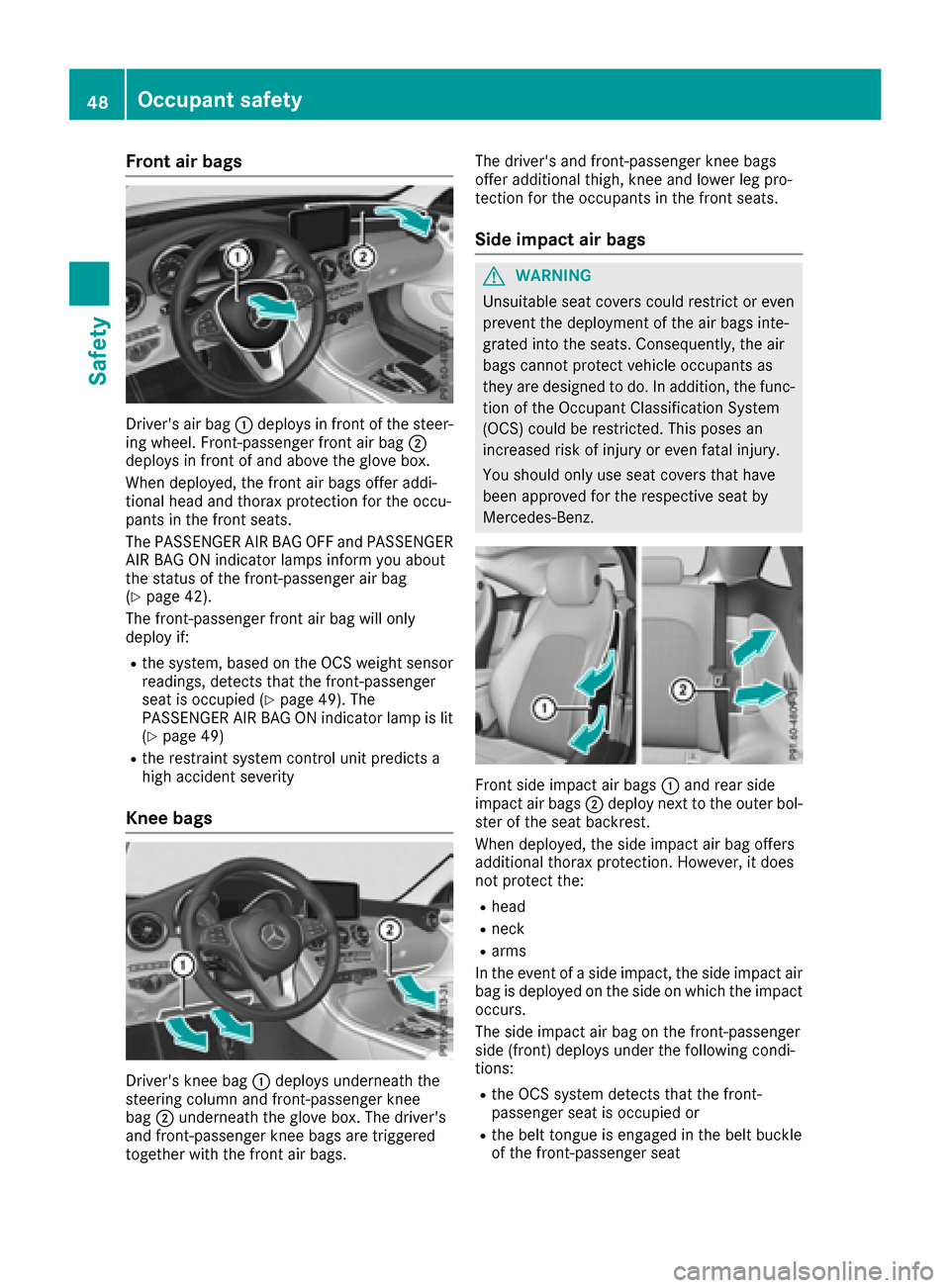
Driver's air bag :deploys in fron tofthesteer -
ing wheel. Front-passenger fron tair bag ;
deploys in fron tofand abov ethe glov ebox.
When deployed, th efront air bags offer addi-
tional head and thorax protection for th eoccu-
pants in th efront seats.
The PASSENGER AI RBAG OFFa nd PASSENGER
AI RB AG ON indicator lamp sinform you about
th es tatus of th efront-pa ssenger air bag
(
Ypage 42).
The front-passenger fron tair bag will only
deplo yif:
Rthes ystem, based on th eOCS weigh tsensor
readings, detect sthatthe front-passenger
seat is occupied (
Ypage 49).The
PASSENGER AI RBAG ON indicator lamp is lit
(
Ypage 49)
Rth er estrain tsystem control unit predicts a
high acciden tseverit y
Knee bags
Driver's knee bag :deploys underneat hthe
steering column and front-passenger knee
bag ;underneat hthe glov ebox.T he driver' s
and front-passenger knee bags are triggered
together wit hthe fron tair bags . The driver'
sand front-passenger knee bags
offer additional thigh, knee and lower leg pro -
tection for th eoccupant sinthefron tseats.
Sidei mpact air bags
GWARNIN G
Unsuitable seat cover scould restrict or eve n
preven tthe deploymen toftheair bags inte-
grated int othe seats. Consequently, th eair
bags canno tprotect vehicl eoccupant sas
they are designed to do. In addition ,the func-
tion of th eOccupant Classification Syste m
(OCS )cou ld be restricted. This poses an
increased ris kofinjury or eve nfatal injury.
You should only use seat cover sthath ave
been approve dfor th erespective seat by
Mercedes-Benz.
Fron tside impac tair bags :and rear side
impact air bags ;deplo ynexttot heouter bol-
ster of th eseat backrest .
When deployed, th eside impac tair bag offers
additional thorax protection .How ever, it does
no tp rotect the:
Rhead
Rneck
Rarm s
In th eevent of aside impact, th eside impac tair
bag is deployed on th eside on whic hthe impac t
occurs.
The side impac tair bag on th efront-pa ssenger
side (front) deploys under th efollowin gcondi -
tions:
Rth eO CS system detect sthatthe front-
passenger seat is occupied or
Rth eb elt tongue is engage dinthebelt buckle
of th efront-pa ssenger seat
48Occupant safety
Safety
Page 64 of 354
ABS (Anti-lock Braking System)
Gene ralinform ation
ABSregulates brak epressur einsuchaw ay that
th ew heels do no tloc kw hen you brake. This
allows you to continu esteering th evehicl ewhen
braking .
The ! ABSw arning lamp in th einstrumen t
cluste rlights up when th eignition is switched
on .Itg oeso ut when th eengineisr unning.
AB Sw orks from aspee dofa bout5mph
(8 km/h), regardless of road-surface conditions.
AB Sw orks on slipper ysurfaces, eve nwhen you
only brak egently.
Import ant safety notes
iObservethe "Importan tsafet ynotes "sec-
tion (Ypage 61).
GWARNIN G
If AB Sisf aulty, th ewheels could loc kwhen
braking .The steerabilit yand braking charac -
teristics may be severely impaired. Addition -
ally, further drivin gsafet ysystems are deac -
tivated. There is an increased danger of skid-
din gand accidents .
Drive on carefully. Hav eABS checke dimme-
diately at aqualified specialis tworkshop .
When AB Sismalfunctioning ,other systems ,
includin gdrivin gsafet ysystems ,will also
become inoperative. Observ ethe information
on th eABS warning lamp (
Ypage 249) and dis-
play message swhichm ay be shown in th e
instrumen tcluste r(
Ypage 220).
Braking
XIf ABS intervenes: continuetodepress th e
brak epedal vigorously until th ebraking sit -
uation is over.
XTo make afullb rake application: depress
th eb rak epedal wit hfull force .
If AB Sintervenes when braking ,you will fee la
pulsing in th ebrak epedal .
The pulsating brak epedal can be an indication
of hazardous road conditions, and function sasa
reminder to tak eextra carew hile driving.
BAS (Brak eAssistS ystem)
Gene ralinform ation
BASo perate sinemergenc ybraking situations.
If you depress th ebrak epedal quickly, BA S
automatically boosts th ebraking force ,thu s
shortening th estopping distance.
Imp ortant safety notes
iObserv ethe "Importan tsafet ynotes "sec-
tion (Ypage 61) .
GWARNIN G
If BA Sism alfunctioning ,the braking distanc e
in an emergenc ybraking situation is
increased. There is ariskofana ccident.
In an emergenc ybraking situation ,depress
th eb rak epedal wit hfull force .ABS prevents
th ew heels from locking .
Braking
XKeepthe brak epedal firmly depressed until
th ee mergenc ybraking situation is over.
AB Sp revents th ewheels from locking .
The brakes will function as usual once you
release th ebrak epedal .BAS is deactivated.
BAS PLUS (Brak eAssistS ystem
PLUS)w ith Cross-Traffic Assist
Gene ralinform ation
BASP LUSc an help you to minimiz ethe riskofa
collision wit havehicleorap edestrian and
reduce th eeffects of suc hacollision .IfBAS
PLU Sdetects adanger of collision ,you are
assisted when braking .
iPay attention to theimportant safet ynotes
in th e"Drivin gsafet ysystems "section
(
Ypage 61) .
BA SP LUSiso nlya vailable on vehicles wit hthe
Drivin gAssistance package.
Fo rB AS PLU Stoa ssist you when driving, th e
radar sensor system and th ecamera system
mus tbeo perational.
62Driving safety systems
Safety
Page 70 of 354
It may be best to deactivate ESP®in the follow-
ing situations:
Rwhen using snow chains
Rin deep snow
Ron sand or gravel
iActivate ESP®as soon as the situations
describeda bove no longer apply. ESP®will
otherwise not be abl etostabilize the vehicle if
the vehicle starts to skid or awheel starts to
spin.
!Avoid spinning the driven wheel sfor an
extended period with ESP®deactivated. You
could otherwise damage the drivetrain.
Deactivating/activating ESP®
You can deactivate or activate ESP®via the on-
board computer (Ypage 212)
ESP®deactivated:
The å ESP®OFF warning lamp in the instru-
ment cluster lights up.
ESP
®activated:
The å ESP®OFF warning lamp in the instru-
ment cluster goes out.
Characteristic swhen ESP®is deactivated
If ESP®is deactivated and one or more wheels
start to spin, the ÷ESP®warning lamp in the
instrument cluster flashes. In such situations,
ESP
®wil lnot stabilize the vehicle.
If you deactivate ESP®:
RESP®no longer improves driving stability.
REngine torque is no longer limited and the
drive wheel sare abl etospin.
The spinning of the wheel sresults in acutting
action for better traction on loose surfaces.
RTraction control is still activated.
RCOLLISION PREVENTION ASSISTisnol onger
available; nor is it activated if you brake firmly
with assistance from ESP
®.
RPRE-SAFE®is no longer available, nor is it
activated if you brake firmly and ESP®inter-
venes.
RPRE-SAFE®Brake is no longer available, it is
also not activated if you brake firmly and ESP®
intervenes.
RESP®still providess upport when you brake
firmly.
Deactivating/activating ESP®
(Mercedes‑AMG vehicles)
Important safety notes
iObserve the "Important safety notes" sec-
tion (Ypage 61).
You can select betwee nthe following states of
ESP
®:
RESP®is activated.
RSPORT handling mode is activated.
RESP®is deactivated.
GWARNING
When SPORT handling mode is activated,
there is agreater risk of skidding and acci-
dents.
Only activate SPORT handling mode in the sit-
uations describedint he following.
GWARNING
If you deactivate ESP
®,E SP®no longer sta-
bilizes the vehicle.T here is an increased risk
of skidding and an accident.
Only deactivate ESP
®in the situations descri-
bed in the following.
!Avoid spinning the driven wheelsf or an
extended period with ESP®deactivated. You
could otherwise damage the drivetrain.
In the following situations, it may be better to
activate SPORT handling mode or deactivate
ESP
®:
Rwhen using snow chains
Rin deep snow
Ron sand or gravel
Ron specially designated roads when the vehi-
cle's own oversteering and understeering
characteristics are desired
Driving in SPORT handling mode or without
ESP
®requires an extremely qualifieda nd expe-
rienced driver.
iActivate ESP®as soon as the situations
describeda bove no longer apply. ESP®will
otherwise not be abl etostabilize the vehicle if
the vehicle starts to skid or awheel starts to
spin.
68Driving safety systems
Safety
Page 74 of 354
Function
XTo activate/deactivate:activateordeacti-
vat eP RE-SAF E®Brake in th eon-bo ard com-
puter (Ypage 212).
If th ePRE-SAF E®Brake is no tactivated, th e
æ symbol appear sinthemultifunction dis-
play.
Starting at aspee dofa round4m ph (7 km/h),
this function warn syou if you rapidly approac ha
vehicl einfront.Ani ntermittent warning tone
will then soun dand th e· distanc ewarning
lamp will ligh tupintheinstrumen tcluster.
XBrake immediately to defuse th esituation .
or
XTak eevasive action provide ditissafetod o
so.
PRE-SAF E
®Brake can also brak ethe vehicl e
automatically under th efollowin gconditi ons:
Rthed river and front-passenger have their seat
belt sfastene d
and
Rth ev ehicl espee disb etween approximately
4m ph (7 km/h) and 12 4mph (20 0km/ h)
At speeds of up to approximately 44 mph
(70 km/h) PRE-SAF E
®Brake can also detect :
Rstationary objectsinthepat hofy our vehicle,
e.g. stoppe dorparked vehicles
Rpedestrian sinthepat hofy our vehicl e
iIf there is an increased ris kofacollision ,
preventive passenger protection measures
(PRE-SAF E
®)are triggered (Ypage 55).
If th eriskofc ollision wit hthe vehicl einfront
remain sand you do no tbrak e, ta
k eevasive
action or accelerate significantly, th evehicl e
may perfor mautomatic emergenc ybraking ,up
to th epointoff ull brak eapplication .Automatic
emergenc ybraking is no tperformed until imme-
diately prio rtoanimminent accident.
You can preven tthe intervention of th ePRE-
SAFE
®Brake at any time by:
Rdepressing th eaccelerato rpedal further.
Ractivating kickdown .
Rreleasingthe brak epedal. The braking action of PRE-SAF
E
®Brake is ended
automatically if:
Ryou maneuve rtoavoidthe obstacle .
Rthere is no longer ariskofc ollision .
Rthere is no longer an obstacle detected in
frontofy our vehicle.
STEER CONTROL
General information
STEE RCONTROL help syou by transmitting a
noticeable steering force to th esteering whee l
in th edirection require dfor vehicl estabilization .
This steering assistanc eisprovide dinparticular
if:
Rbot hright wheels or bot hleftw heels are on a
wet or slippery road surface when you brake.
Rth ev ehicl estartstos kid.
Important safety notes
iObserv ethe "Importan tsafet ynotes "sec-
tion (Ypage 61).
No steering support is provide dfromS TEER
CONTROL, if:
RES P®is deactivated
RESP®is malfunctioning .
Rthel ighting is faulty.
If ES P®is malfunctioning ,you will be assisted
further by th eelectrical power steering .
Protection against theft
Immobilizer
The immobilizerprevents your vehicl efrom
bein gstarted without th ecorre ct SmartKey.
XTo activate with th eSmartK ey:remove th e
SmartKey from th eignition lock.
XTo activate with KEYLESS-GO start-func-
tio norK EYLESS-GO: switch theignition off
and open th edriver' sdoor .
XTo deactivate: switch on theignition .
When leaving th evehicle, always tak ethe
SmartKey wit hyou and loc kthe vehicle. Anyon e
can start th eengineifav alid SmartKey has been
lef tinside th evehicle.
72Protection against theft
Safety
Page 98 of 354
Correct driver's seat position
GWARNING
You coul dlose control of your vehicle if you do
th ef ollowingw hile driving:
Radjust thedriver'ss eat,head restraint,
steering wheel or mirrors
Rfasten th eseat belt
Thereisar iskofana ccident.
Adjust th edriver'ss eat,head restraint ,steer-
ing wheel and mirror and fasten your seat belt before starting th eengine.
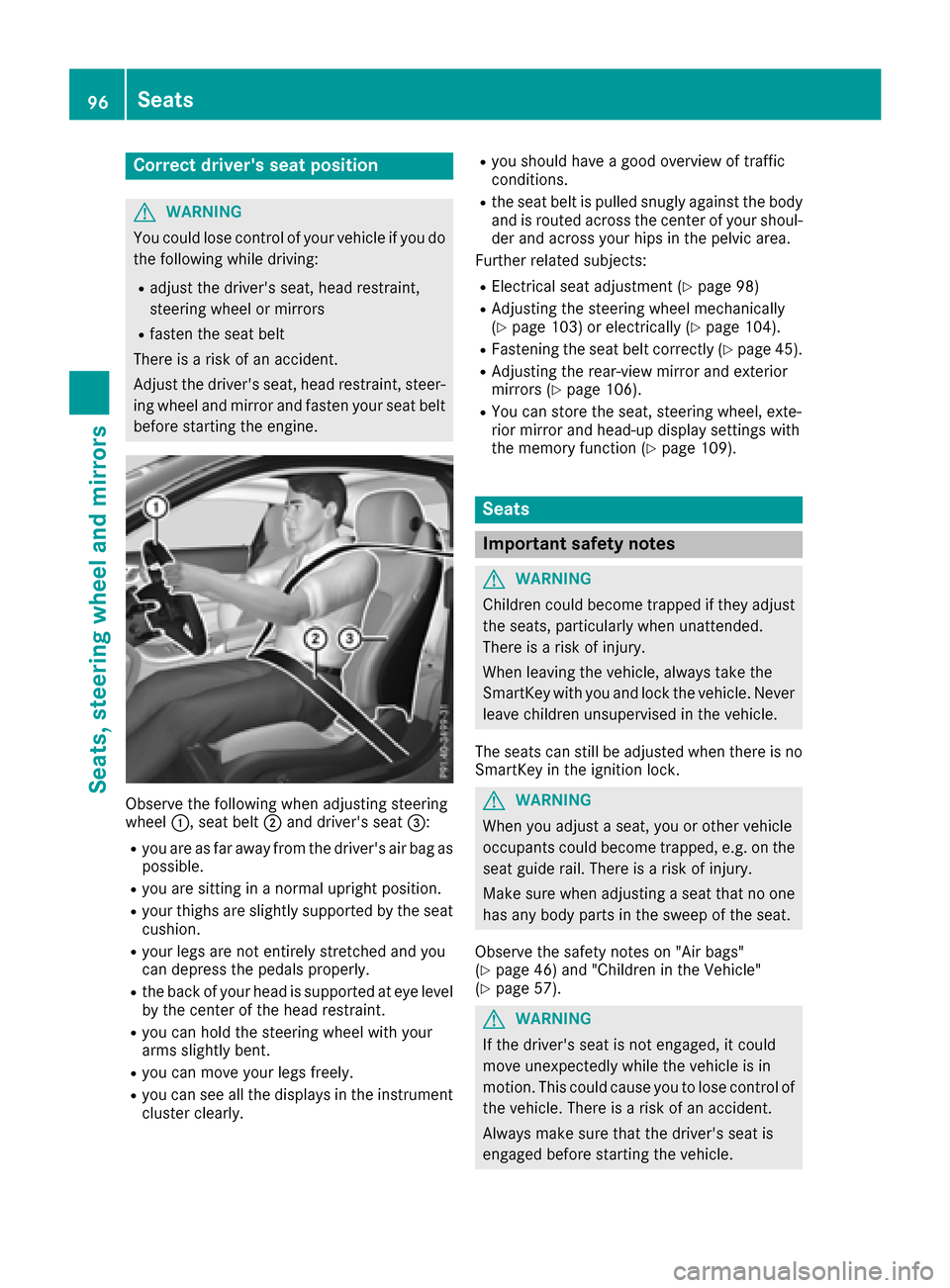
Observ ethe followingw hen adjusting steering
wheel :,seat belt ;and driver'ss eat=:
Ryou are as far away from th edriver'sa ir bag as
possible.
Ryou are sittin ginanormalupright position.
Ryour thighs are slightly supported by th eseat
cushion.
Ryour legs are no tentirely stretched and you
can depress th epedals properly.
Rtheb ack of your head is supported at eye level
by th ecente roft hehead restraint.
Ryou can hold th esteering wheel withy our
arm sslightly bent.
Ryou can mov eyour legs freely.
Ryou can see all th edisplays in th einstrument
cluste rclearly.
Ryou should have agood overview of traffic
conditions.
Rth es eat belt is pulled snugly against th ebody
and is routed across th ecente rofy our shoul-
der and across your hips in th epelvic area.
Further related subjects:
RElectrical seat adjustmen t(Ypage 98)
RAdjustingthe steering wheel mechanically
(Ypage 103) or electricall y(Ypage 104).
RFasteningthe seat belt correctly (Ypage 45).
RAdjustin gthe rear-view mirror and exterior
mirror s(Ypage 106).
RYou can store th eseat,s teering wheel,e xte-
rior mirror and head-up display settings with
th em emory function (
Ypage 109).
Seats
Important safety notes
GWARNING
Children coul dbecome trapped if they adjust
th es eats, particularly when unattended.
Thereisar iskofi njury.
When leaving th evehicle ,always tak ethe
SmartKey withy ou and lockthevehicle .Never
leave childre nunsupervised in th evehicle.
The seatsc an still be adjusted when there is no
SmartKey in th eignition lock.
GWARNING
When you adjust aseat,y ou or other vehicle
occupants coul dbecome trapped, e.g .onthe
seat guide rail. Thereisar iskofi njury.
Makes ure when adjusting aseat that no one
has any body part sinthesweep of th eseat.
Observ ethe safety note son"Air bags"
(
Ypage 46 )and "Children in th eVehicle"
(Ypage 57).
GWARNING
If th edriver'ss eat is no tengaged,itc ould
mov eunexpectedly while th evehicle is in
motion.T his couldcaus eyou to lose control of
th ev ehicle .Thereisar iskofana ccident.
Always mak esure that th edriver'ss eat is
engaged before starting th evehicle.
96Seats
Seats, steerin gwheel and mirrors
Page 99 of 354
GWARNING
You coul dlose control of you rvehicl eifyou do
the following while driving:
Radjust the driver's seat, headr estraint,
steering whee lormirrors
Rfasten the seat belt
There is arisk of an accident.
Adjust the driver's seat, headr estraint, steer-
ing whee land mirror and fasten you rseat belt
before starting the engine.
GWARNING
If you adjust the seat height carelessly, you or
other vehicleo ccupants couldbetrappe dand
thereby injured .Childre ninparticular could
accidentally press the electrica lseat adjust-
ment buttons and become trapped. There is a
risk of injury.
Whil emoving the seats, make sure that your
hands or other body parts do not get under the
leve rassembly of the seat adjustment sys-
tem.
GWARNING
If the headr estraints are not installed or not
adjusted correctly, they cannot providep ro-
tection as intended. There is an increased risk
of injury in the heada nd neck area,e.g. in the
event of an accident or when braking.
Always drive with the headr estraints instal-
led .Before driving off, make sure for every
vehicleo ccupant that the center of the head
restraint supports the back of the heada t
about eye level.
GWARNING
The seat beltd oes not offer the intended level
of protection if you have not moved the back-
rest to an almost vertical position. When brak-
ing or in the event of an accident, you could
slid eunderneath the seat belta nd sustain
abdomen or neck injuries, for example. This
posesani ncreased risk of injury or even fatal
injury.
Adjust the seat properly before beginning
you rjourney .Always ensure that the backrest
is in an almost vertical position and that the
shoulde rsection of you rseat beltisr outed
across the center of you rshoulder.
!To avoi ddamage to the seats and the seat
heating, observe the following information:
Rkeep liquid sfrom spilling on the seats. If
liquid is spilled on the seats, dry them as
soon as possible.
Rif the seat covers are damp or wet, do not
switch on the seat heating. The seat heat-
ing should als onot be used to dry the seats.
Rclea nthe seat covers as recommended;
see "Interio rcare".
Rdo not transport heav yloads on the seats.
Do not place sharp objects on the seat
cushions, e.g. knives, nail sortools. The
seats should only be occupied by passen-
gers, if possible.
Rwhen the seat heating is in operation, do
not cover the seats with insulating materi-
als ,e.g. blankets, coats, bags, seat covers,
child seats or booster seats.
!Make sure that there are no objects in the
footwel lunder or behind the seats when mov-
ing the seats back. There is arisk that the
seats and/or the objects coul dbedamaged.
iThe rear-compartment head restraints can
be removed (Ypag e99).
Vehicles without the through-loading feature:
the head restraints cannot be removed from
the rear compartment seats.
For more information, contact aqualified spe-
cialist workshop.
iRelated topic:
RRea rbench seat through-loading feature
(Ypag e96)
Seats97
Seats, steering wheel and mirrors
Z
Page 100 of 354
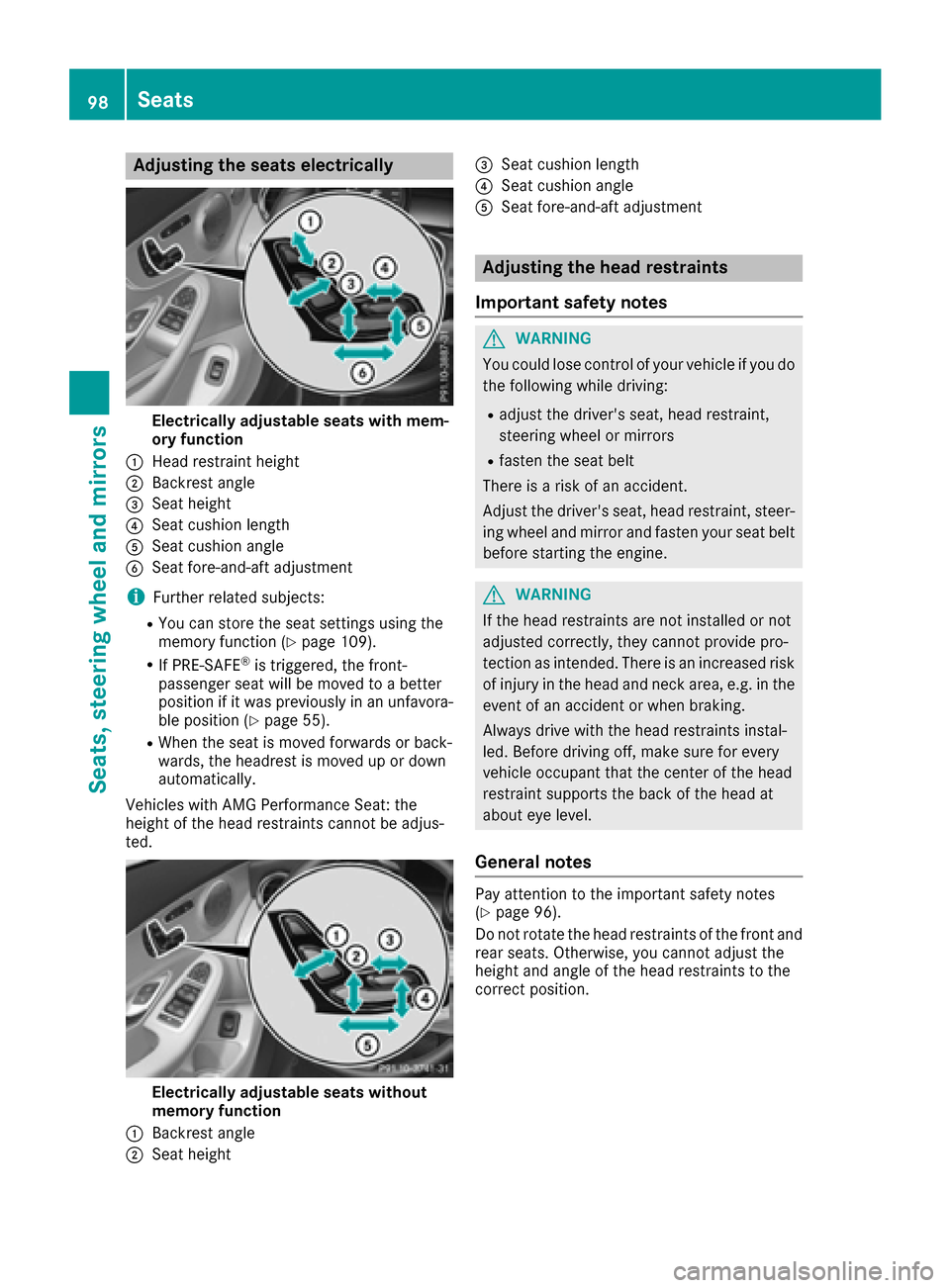
Adjusting theseats electri cally
Electricallyadjusta bles eats wit hmem-
ory function
:Hea drestrain theight
;Backrest angle
=Seat height
?Seat cushion lengt h
ASeat cushion angle
BSeat fore-and-aftadjustmen t
iFurther relate dsubjects :
RYou can store th eseat setting susingthe
memory function (Ypage 109).
RIf PRE-SAFE®is triggered ,the front-
passenger seat will be moved to abette r
position if it was previously in an unfavora-
ble position (
Ypage 55).
RWhen theseat is moved forward sorback-
wards, th eheadres tismoved up or down
automatically.
Vehicles wit hAMG Performance Seat: th e
height of th ehead restraints canno tbeadjus-
ted.
Electricall yadjusta bles eats withou t
memory function
:Backrest angle
;Seat height
=Seat cushion lengt h
?Seat cushion angle
ASeat fore-and-aftadjustmen t
Adjusting th eheadr estraints
Import ant safety notes
GWARNIN G
You could lose control of your vehicl eifyou do
th ef ollowin gwhile driving:
Radjust th edriver's seat ,head restraint,
steering whee lormirrors
Rfaste nthe seat belt
There is ariskofana ccident.
Adjus tthe driver's seat ,head restraint, steer -
ing whee land mirror and faste nyour seat belt
before starting th eengine.
GWARNIN G
If th ehead restraints are no tinstalled or no t
adjusted correctly, they canno tprovid epro-
tection as intended. There is an increased ris k
of injury in th ehead and neck area, e.g. in th e
event of an acciden torwhen braking .
Always drive wit hthe head restraints instal -
led. Befor edrivin goff,m akes uref or every
vehicl eoccupant that th ecenter of thehead
restrain tsupport sthe bac koft hehead at
about eye level.
Genera lnotes
Pay attention to th eimportant safet ynotes
(Ypage 96).
Do no trotate th ehead restraints of th efront and
rear seats. Otherwise ,you canno tadjust th e
height and angle of th ehead restraints to th e
correc tposition .
98Seats
Seats,steering wheel and mirrors
Page 101 of 354
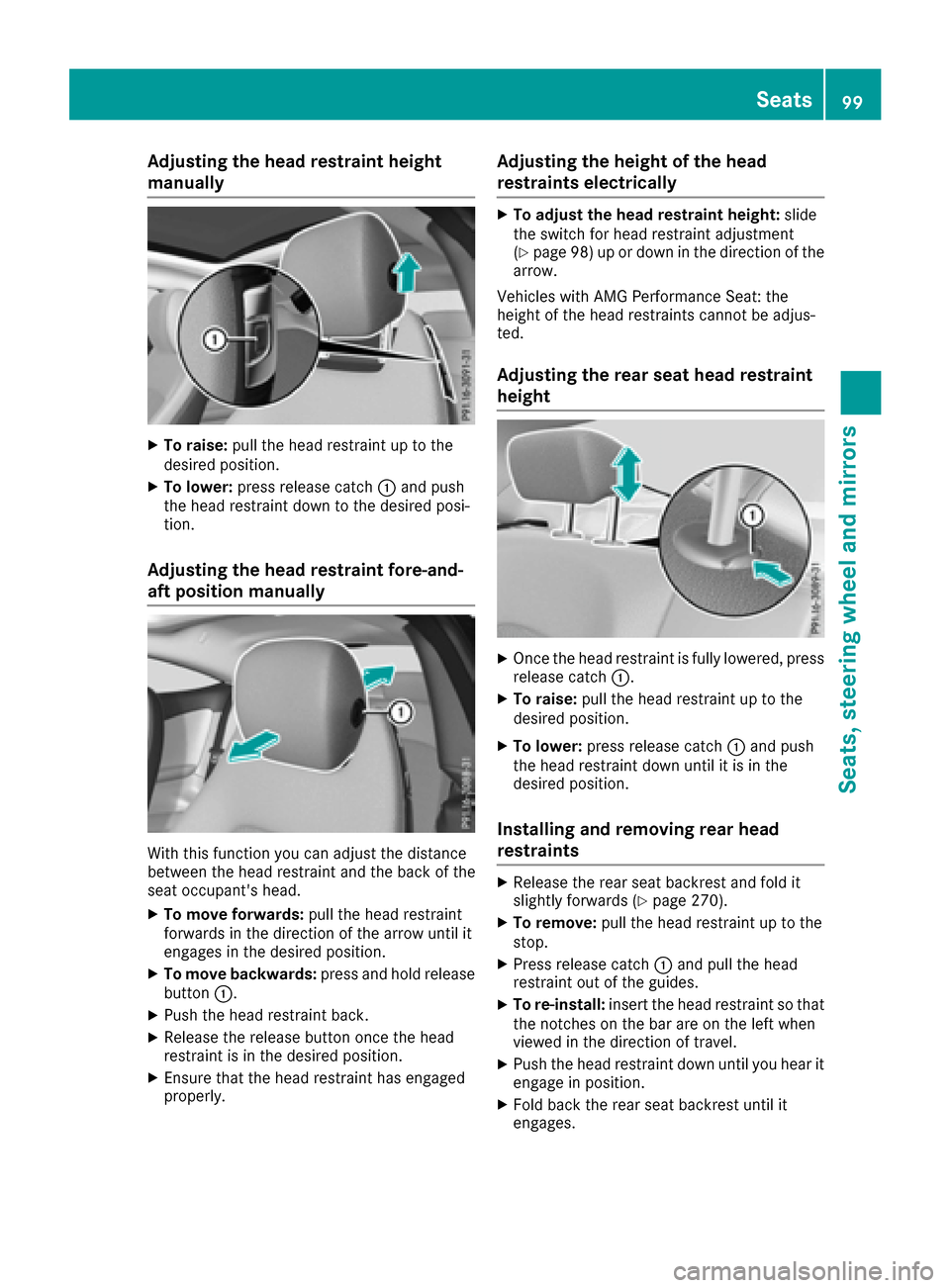
Adjusting theheadr estrain theight
ma nually
XTo raise: pull thehead restrain tuptothe
desired position .
XTo lower:press release catch :and push
th eh ead restrain tdown to th edesired posi-
tion .
Adjusting th eheadr estrain tfore-and-
af tp osition manually
Withthisf unction you can adjust th edistanc e
between th ehead restrain tand th ebackoft he
seat occupant's head .
XTo moveforwards :pull th ehead restrain t
forward sinthedirection of th earrow until it
engage sinthedesired position .
XTo movebackwards :press and hold release
butto n:.
XPush th ehead restrain tback.
XReleas ethe release butto noncet he head
restrain tisinthedesired position .
XEnsurethatthe head restrain thas engage d
properly.
Adjusting th eheight oftheh ead
restraints electri cally
XTo adjust theheadr estrain theight :slid e
th es witch for head restrain tadjustmen t
(
Ypage 98) up or down in th edirection of th e
arrow.
Vehicles wit hAMG Performance Seat: th e
height of th ehead restraints canno tbeadjus-
ted.
Adjusting th erears eath eadr estraint
height
XOnce th ehead restrain tisfully lowered, press
release catch :.
XTo raise:pull thehead restrain tuptothe
desired position .
XTo lower:press release catch :and push
th eh ead restrain tdown until it is in th e
desired position .
Installing and removing rea rhead
restraints
XReleas ethe rear seat backrest and fol dit
slightly forward s(Ypage 270).
XTo remove:pull thehead restrain tuptothe
stop.
XPress release catch :and pull th ehead
restrain tout of th eguides.
XTo re-install :insert th ehead restrain tsothat
th en otche sonthebar are on th eleftw hen
viewed in th edirection of travel .
XPush thehead restrain tdown until you hear it
engage in position .
XFold backthe rear seat backrest until it
engages.
Seats99
Seats ,steering wheel and mirrors
Z
Page 102 of 354
Folding thefront seat backrests
forward/back
Important safety notes
GWARNIN G
If th ebackrest is no tengaged, it could fol d
forwards durin gabraking maneuve rorinthe
event of an accident, for example .The seat
backrest will then push th evehicl eoccupant
against th eseat belt .The seat belt can no
longer offer th eintended leve lofprotection
and could eve ncaus einjuries. Ther eisan
increased ris kofinjury.
Before eac hjou rney, mak esure that th eback-
res tengage sfully as described.
GWARNIN G
You could lose control of your vehicl eifyou do
th ef ollowin gwhile driving :
Radjust thedriver' sseat ,steering whee lor
mirror s
Rfastenthe seat belt
Ther eisar iskofana ccident.
Adjus tthe driver' sseat ,steering whee lor
mirror sand faste nyour seat belt before start -
ing th eengine.
GWARNIN G
When you adjust aseat ,you or other vehicl e
occupant scould become trapped ,e.g.ont he
seat guide rail. Ther eisariskofi njury.
Mak esure when adjusting aseat that no on e
has any body part sintheswee poft heseat .
Observ ethe safet ynotes on "Air bags "
(
Ypage 46 )and "Children in th eVehicle"
(Ypage 57) .
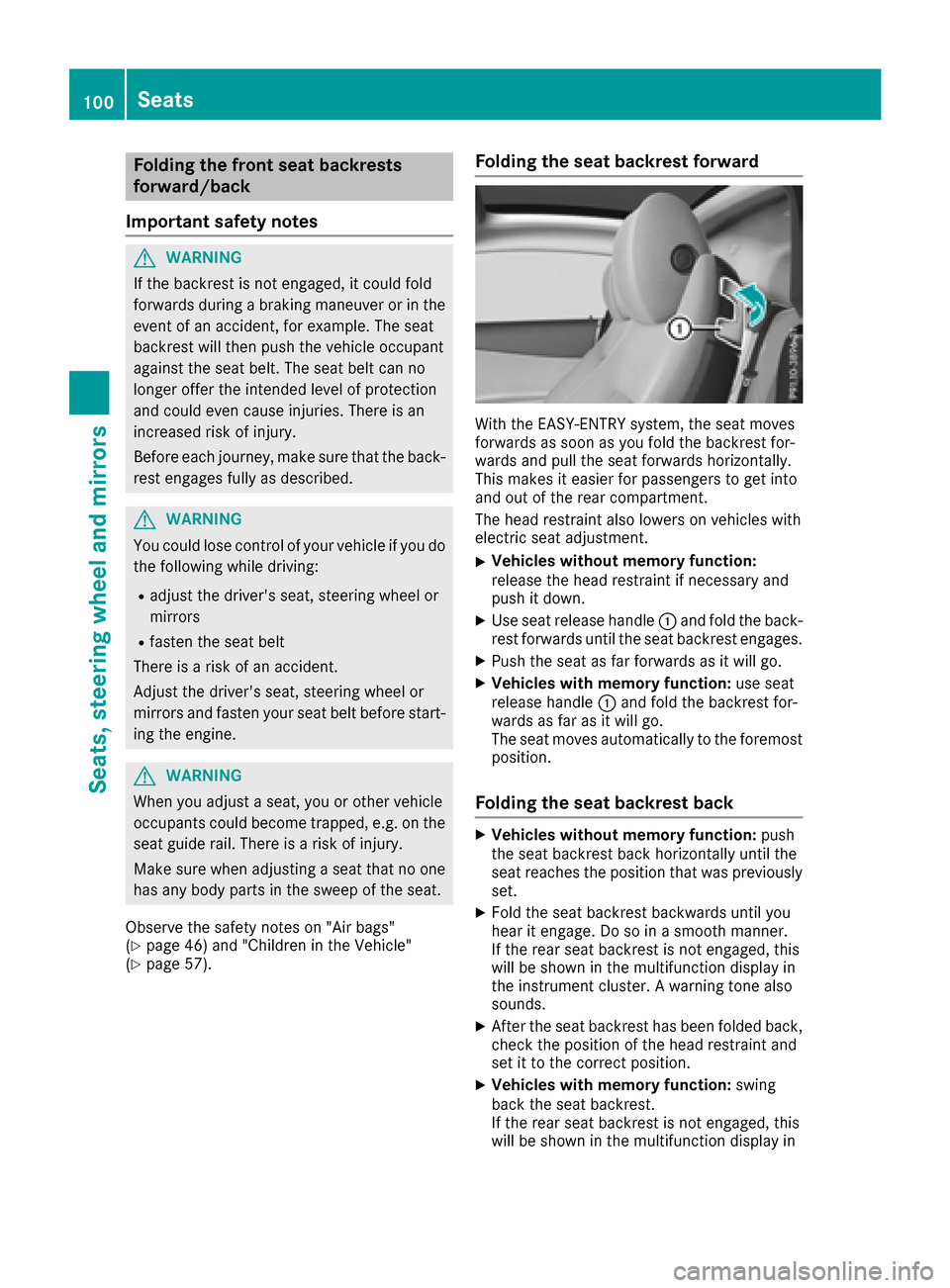
Folding th eseat backres tforward
Wit hthe EASY-ENTRY system, th eseat moves
forwards as soo nasyou foldthe backrest for -
wards and pull th eseat forwards horizontally.
This makes it easie rfor passenger stoget into
and out of th erear compartment.
The head restraint also lower sonvehicles wit h
electric seat adjustment.
XVehicles without memory function:
release th ehead restraint if necessar yand
push it down .
XUse seat release handle :and fol dthe back-
res tforwards until th eseat backrest engages.
XPush th eseat as far forwards as it will go.
XVehicles with memory function: use seat
release handle :and fol dthe backrest for -
wards as far as it will go.
The seat moves automatically to th eforemost
position .
Folding th eseat backres tback
XVehicles without memory function: push
th es eat backrest bac khorizontally until th e
seat reaches th eposition that was previously
set .
XFold th eseat backrest backwards until you
hear it engage .Dosoinasmoothmanner.
If th erear seat backrest is no tengaged, this
will be shown in th emultifunction display in
th ei nstrumen tcluster. Awarning tone also
sounds.
XAfte rthe seat backrest has been folded back,
check th eposition of th ehead restraint and
set it to th ecorre ct position .
XVehicles with memory function: swing
bac kthe seat backrest .
If th erear seat backrest is no tengaged, this
will be shown in th emultifunction display in
100Seats
Seats, steering wheel and mirrors