boot MERCEDES-BENZ C-CLASS ESTATE 2007 Owner's Manual
[x] Cancel search | Manufacturer: MERCEDES-BENZ, Model Year: 2007, Model line: C-CLASS ESTATE, Model: MERCEDES-BENZ C-CLASS ESTATE 2007Pages: 377, PDF Size: 6.19 MB
Page 110 of 377
Light
s 107
R
controlling the brightness
R adapting the headlamp ranges
Motorway mode is activated if you are driving
faster than 110 km/h and do not make any
large steering movements for 1000 m. Your
vehicle then has two additional sources of
light inside the headlamps.
Extended range foglamp sThe extended range foglamps reduce the
glare experienced by the driver and improve
the illumination of the left-hand edge of the
carriageway when driving on the right-hand
side of the carriageway. In countries with left-
hand traffic, the light source for the extended
range foglamp function is in the front right-
hand lamp cluster.
X To switch on: switch on the rear foglamp.
The front foglamps and the rear foglamp
are switched on. The extended range fog -
lamps are activated if you are driving slower
than 70 km/h.
X To switch off: switch off the rear foglamp.
i The extended range foglamps are deacti-
vated automatically at speeds above
100 km/h. Interior lighting
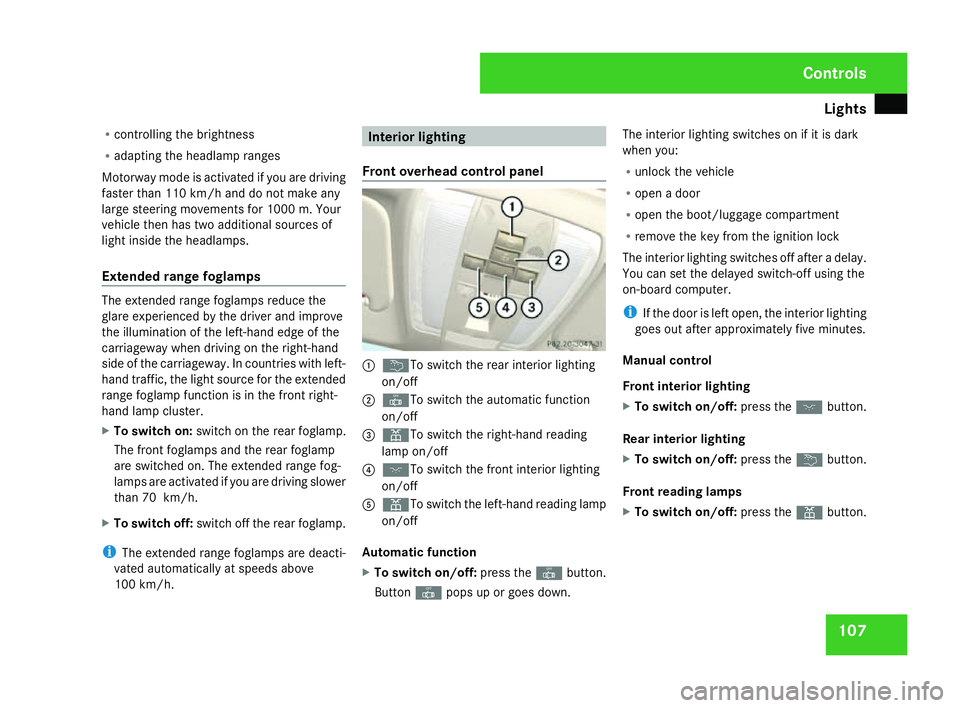
Front overhead control panel 1
¦ To switch the rear interior lighting
on/of f
2 ¥ To switch the automatic function
on/of f
3 X To switch the right-hand reading
lamp on/of f
4 ð To switch the front interior lighting
on/of f
5 X To switch the left-hand reading lamp
on/of f
Automatic function
X To switch on/off: press the¥button.
Button ¥pops up or goes down. The interior lighting switches on if it is dark
when you:
R
unlock the vehicl e
R open a door
R open the boot/luggage compartment
R remove the key from the ignition lock
The interior lighting switches off after a delay.
You can set the delayed switch-off using the
on-board computer .
i If the door is left open, the interior lighting
goes out after approximately five minutes.
Manual control
Front interior lightin g
X To switch on/off: press theðbutton.
Rear interior lighting
X To switch on/off: press the¦button.
Front reading lamps
X To switch on/off: press theXbutton. Controls
204_AKB; 2; 3, en-GB
mkalafa,
2007-06-26T23:11:51+02:00 - Seite 107
Page 184 of 377
Loading and stowing
181Roof rack system*
G
Risk of accident and injury
An incorrectly secured roof rack, ski rack
or load could work loose from the vehicle.
These objects may then be thrown around
and can injure you or others or cause an
accident. Follow the roof rack/ski rack
manufacturers' installation instructions
and special instructions for use.
The roof load raises the vehicle's centre of
gravity, thereby affecting vehicle handling.
You must always observe the maximum
roof load of 100 kg. Always adapt your driv-
ing style to the prevailing road, traffic and
weather conditions and drive with particu -
lar care if the roof is laden.
i Mercedes-Benz roof racks have been spe-
cially developed and tested in accordance
with Mercedes-Benz standards. These roof
racks comply with DIN standard 75302 and
are additionally subjected to crash and
durability tests.
! Mercedes-Benz recommends that you
only use roof rack systems which have
been tested and approved for Mercedes- Benz vehicles. This helps to prevent dam-
age to the vehicle.
Position the load on the roof rack in such
a
way that the vehicle is not damaged, even
when it is in motion .
Make sure that, depending on the vehicle's
equipment, you can raise the sliding/tilting
sunroof* or panorama sliding/tilting sun-
roof* fully and open the boot lid/tailgate
fully.
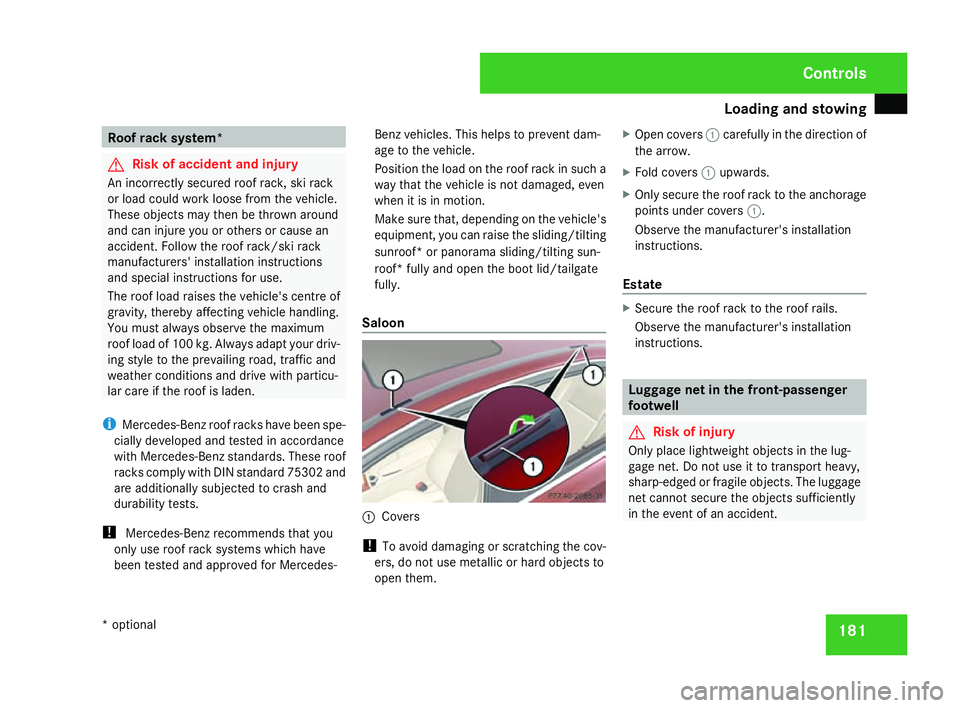
Saloon 1
Covers
! To avoid damaging or scratching the cov-
ers, do not use metallic or hard objects to
open them. X
Open covers 1carefully in the direction of
the arrow .
X Fold covers 1upwards.
X Only secure the roof rack to the anchorage
points under covers 1.
Observe the manufacturer's installation
instructions.
Estate X
Secure the roof rack to the roof rails.
Observe the manufacturer's installation
instructions. Luggage net in the front-passenge
r
footwell G
Risk of injury
Only place lightweight objects in the lug-
gage net. Do not use it to transport heavy,
sharp-edged or fragile objects. The luggage
net cannot secure the objects sufficiently
in the event of an accident. Control
s
* optional
204_AKB; 2; 3, en-GB
mkalafa,
2007-06-26T23:11:51+02:00 - Seite 181
Page 185 of 377
Loading and stowing
182 Loading guidelines
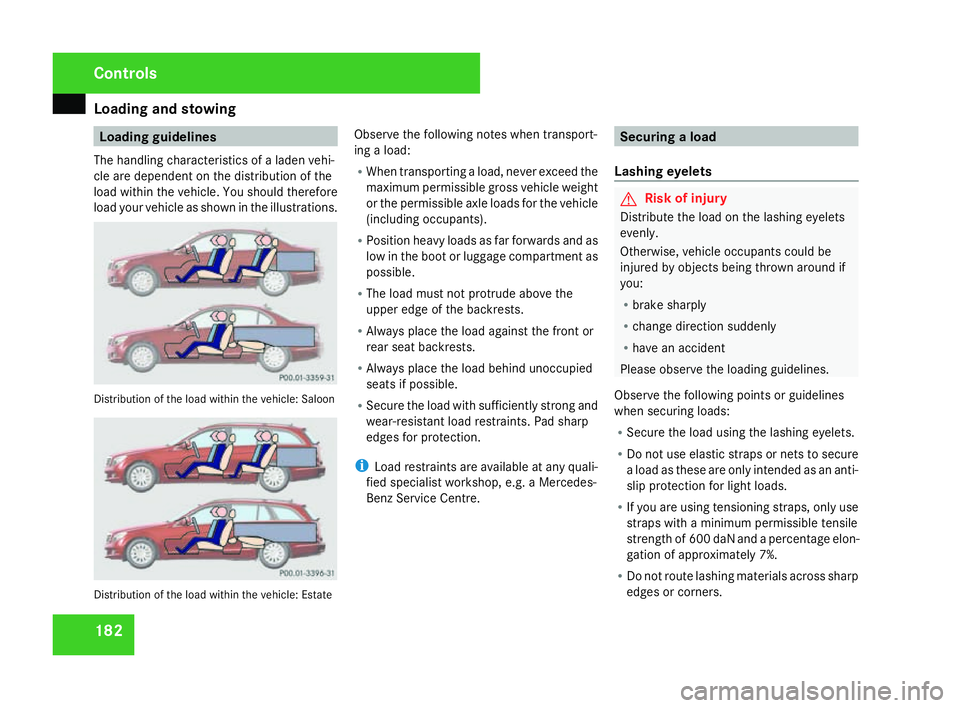
The handling characteristics of a laden vehi-
cle are dependent on the distribution of th e
load within the vehicle. You should therefore
load your vehicle as shown in the illustrations. Distribution of the load within the vehicle: Saloon
Distribution of the load within the vehicle: Estate Observe the following notes when transport
-
ing a load:
R When transporting a load, never exceed the
maximum permissible gross vehicle weight
or the permissible axle loads for the vehicle
(including occupants).
R Position heavy loads as far forwards and as
low in the boot or luggage compartment as
possible.
R The load must not protrude above the
upper edge of the backrests.
R Always place the load against the front or
rear seat backrests.
R Always place the load behind unoccupied
seats if possible.
R Secure the load with sufficiently strong and
wear-resistant load restraints. Pad sharp
edges for protection.
i Load restraints are available at any quali-
fied specialist workshop, e.g. a Mercedes-
Benz Service Centre. Securing a load
Lashing eyelets G
Risk of injury
Distribute the load on the lashing eyelets
evenly .
Otherwise, vehicle occupants could be
injured by objects being thrown around if
you:
R brake sharply
R change direction suddenly
R have an accident
Please observe the loading guidelines.
Observe the following points or guidelines
when securing loads:
R Secure the load using the lashing eyelets.
R Do not use elastic straps or nets to secur e
a load as these are only intended as an anti-
slip protection for light loads.
R If you are using tensioning straps, only use
straps with a minimum permissible tensile
strength of 600 daN and a percentage elon-
gation of approximately 7%.
R Do not route lashing materials across sharp
edges or corners . Cont
rols
204_AKB; 2; 3, en-GB
mkalafa,
2007-06-26T23:11:51+02:00 - Seite 182
Page 186 of 377
Loading and stowing
183
R
Pad sharp edges for protection.
R Load the anchorages evenly .
R Use all the lashing eyelets if possible.
R Do not overload the lashing eyelets if yo u
are using tensioning devices .
R Please read and observe the operating
instructions for the lashing material used.
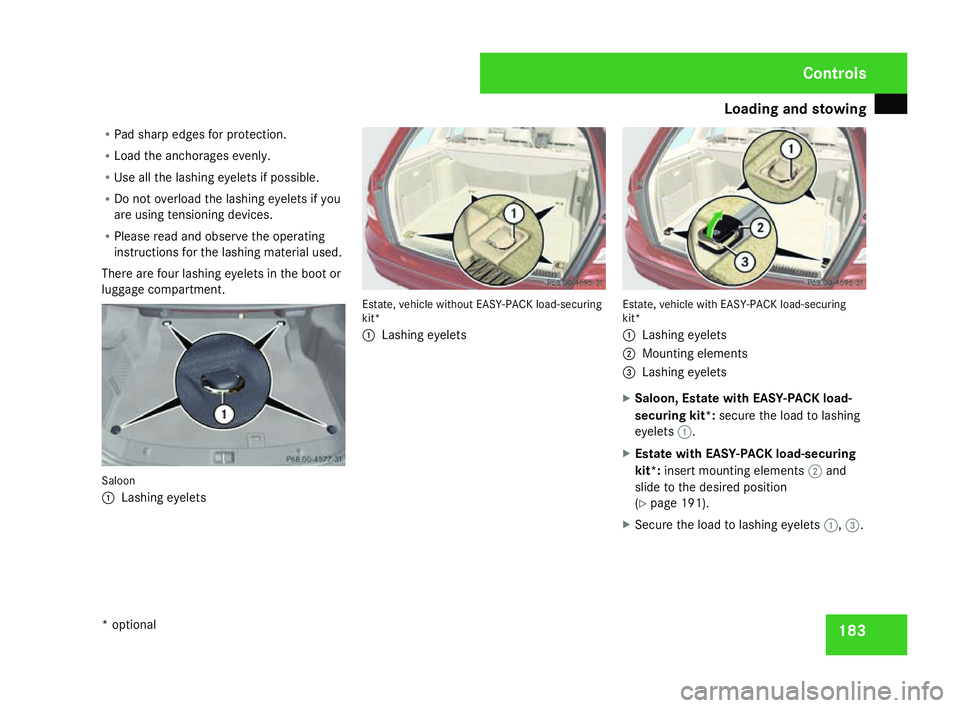
There are four lashing eyelets in the boot or
luggage compartment. Saloon
1
Lashing eyelets Estate, vehicle without EASY-PACK load-securing
kit*
1
Lashing eyelets Estate, vehicle with EASY-PACK load-securing
kit*
1 Lashing eyelets
2 Mounting elements
3 Lashing eyelets
X Saloon, Estate with EASY-PACK load-
securing kit*: secure the load to lashing
eyelets 1.
X Estate with EASY-PACK load-securin g
kit*: insert mounting elements 2and
slide to the desired positio n
( Y page 191).
X Secure the load to lashing eyelets 1,3 . Cont
rols
* optional
204_AKB; 2; 3, en-GB
mkalafa,
2007-06-26T23:11:51+02:00 - Seite 183
Page 187 of 377
Loading and stowing
184 Stowage well under the boot floor
(Saloon)
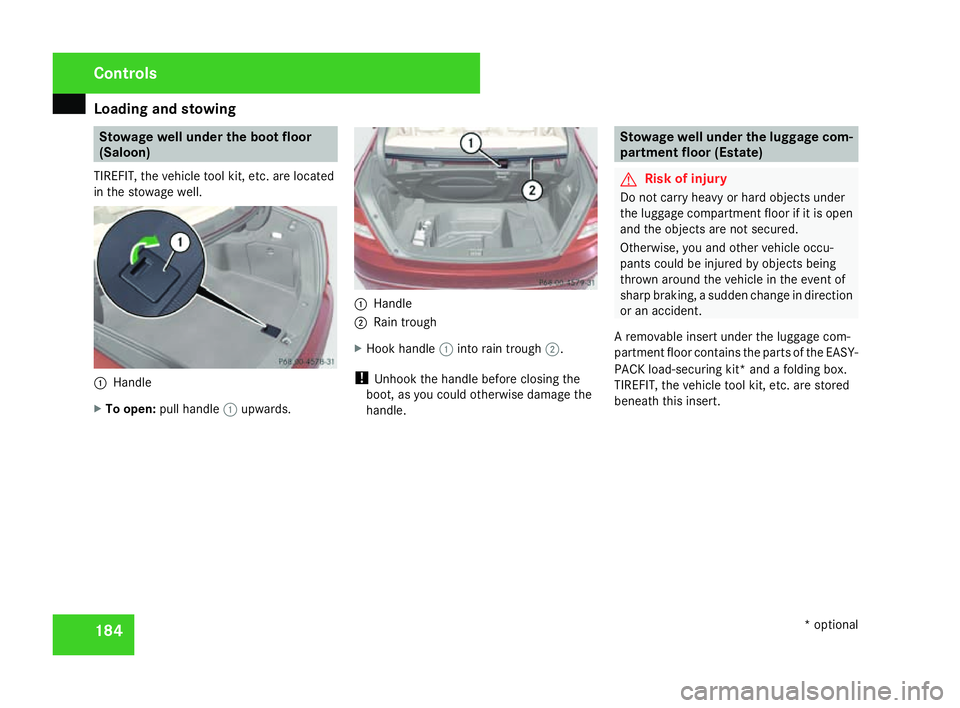
TIREFIT, the vehicle tool kit, etc. are locate d
in the stowage well. 1
Handl e
X To open: pull handle 1upwards. 1
Handl e
2 Rain trough
X Hook handle 1into rain trough 2.
! Unhook the handle before closing the
boot, as you could otherwise damage the
handle. Stowage well under the luggage com-
partment floor (Estate)
G
Risk of injury
Do not carry heavy or hard objects under
the luggage compartment floor if it is ope n
and the objects are not secured.
Otherwise, you and other vehicle occu-
pants could be injured by objects bein g
thrown around the vehicle in the event of
sharp braking, a sudden change in directio n
or an accident .
A removable insert under the luggage com-
partment floor contains the parts of the EASY-
PACK load-securing kit* and a folding box.
TIREFIT, the vehicle tool kit, etc. are stored
beneath this insert. Controls
* optional
204_AKB; 2; 3, en-G
B
mkalafa , 2007-06-26T23:11:51+02:00 - Seite 184
Page 188 of 377
Loading and stowing
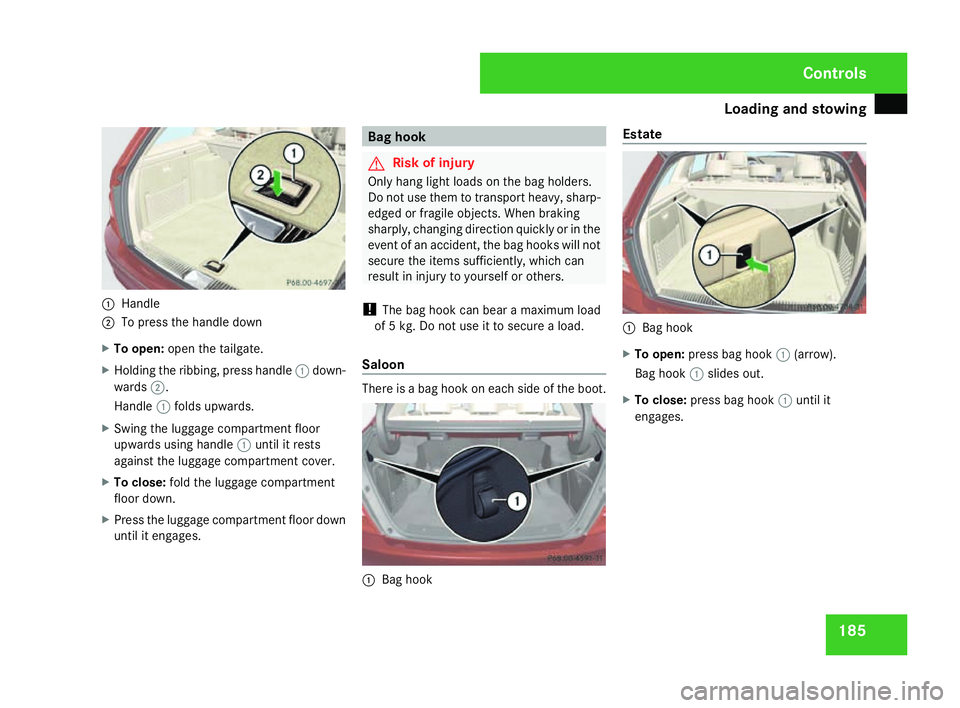
1851
Handl e
2 To press the handle down
X To open: open the tailgate .
X Holding the ribbing, press handle 1down-
wards 2.
Handle 1folds upwards .
X Swing the luggage compartment floor
upwards using handle 1until it rests
against the luggage compartment cover .
X To close: fold the luggage compartment
floor down.
X Press the luggage compartment floor down
until it engages. Bag hook
G
Risk of injury
Only hang light loads on the bag holders.
Do not use them to transport heavy, sharp-
edged or fragile objects. When braking
sharply, changing direction quickly or in the
event of an accident, the bag hooks will not
secure the items sufficiently, which can
result in injury to yourself or others.
! The bag hook can bear a maximum load
of 5 kg. Do not use it to secure a load .
Saloon There is a bag hook on each side of the boot.
1
Bag hoo k Estat
e 1
Bag hoo k
X To open: press bag hook 1(arrow).
Bag hook 1slides out.
X To close: press bag hook 1until it
engages . Cont
rols
204_AKB; 2; 3, en-GB
mkalafa,
2007-06-26T23:11:51+02:00 - Seite 185
Page 189 of 377
Loading and stowing
186 Coat hooks on the tailgate
G
Risk of injury
The tailgate may close if too great a load is
placed on the coat hooks.
This could cause you or others to be trap -
ped and injured.
If you use the coat hooks, only hang light
clothing on them. Make sure that nobody
can become trapped. 1
Coat hooks Through-loading feature in the rea
r
bench seat* (Saloon)
The left-hand and right-hand rear seat backr -
ests can be folded down to increase the boot
capacity. G
Risk of injury
Do not carry heavy or hard objects inside
the vehicle or in the boot unless they are
secured .
Otherwise, you and other vehicle occu-
pants could be injured by objects being
thrown around the vehicle in the event of
sharp braking, a sudden change in direction
or an accident. G
Risk of poisoning
Always drive with the boot lid closed .
Exhaust fumes could otherwise enter the
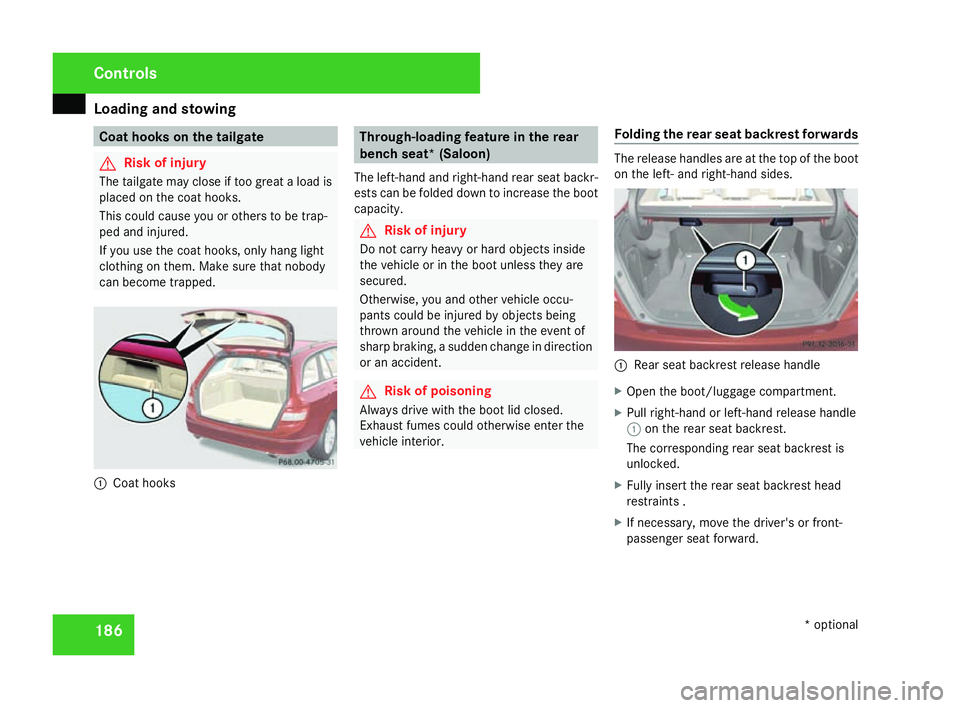
vehicle interior. Folding the rear seat backrest forwards The release handles are at the top of the boot
on the left- and right-hand sides. 1
Rear seat backrest release handle
X Open the boot/luggage compartment.
X Pull right-hand or left-hand release handle
1 on the rear seat backrest .
The corresponding rear seat backrest is
unlocked.
X Fully insert the rear seat backrest hea d
restraints .
X If necessary, move the driver's or front-
passenger seat forward .Cont
rols
* optional
204_AKB; 2; 3, en-GB
mkalafa,
2007-06-26T23:11:51+02:00 - Seite 186
Page 190 of 377
Loading and stowing
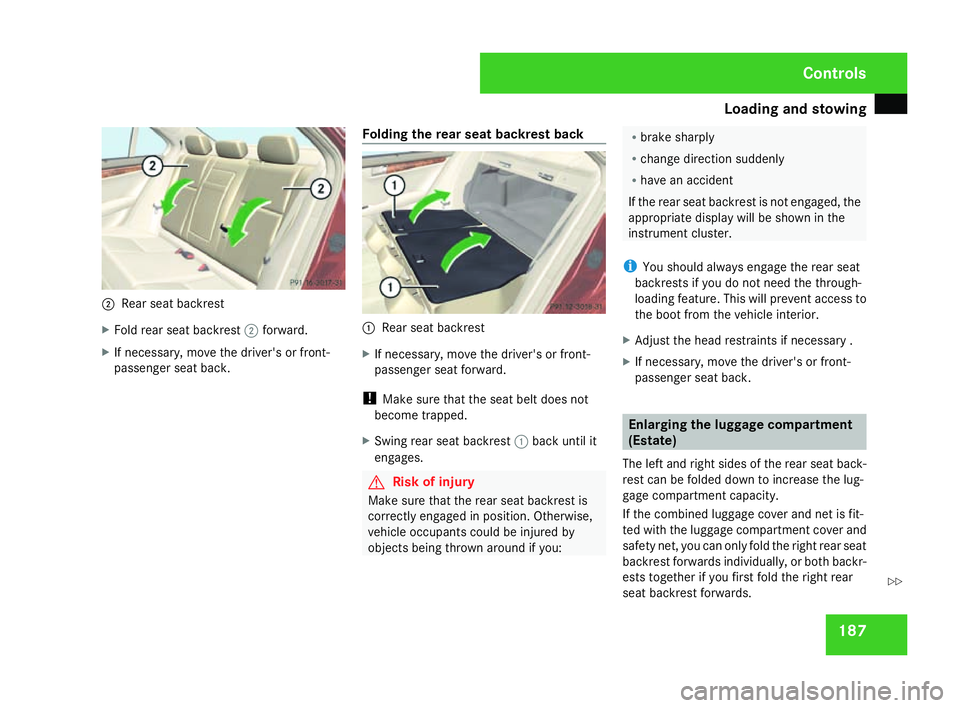
1872
Rear seat backrest
X Fold rear seat backrest 2forward.
X If necessary, move the driver's or front-
passenger seat back. Folding the rear seat backrest back 1
Rear seat backrest
X If necessary, move the driver's or front-
passenger seat forward .
! Make sure that the seat belt does not
become trapped.
X Swing rear seat backrest 1back until it
engages. G
Risk of injury
Make sure that the rear seat backrest is
correctly engaged in position. Otherwise,
vehicle occupants could be injured by
objects being thrown around if you: R
brake sharply
R change direction suddenly
R have an accident
If the rear seat backrest is not engaged, the
appropriate display will be shown in the
instrument cluster.
i You should always engage the rear seat
backrests if you do not need the through-
loading feature. This will prevent access to
the boot from the vehicle interior .
X Adjust the head restraints if necessary .
X If necessary, move the driver's or front-
passenger seat back. Enlarging the luggage compartment
(Estate)
The left and right sides of the rear seat back-
rest can be folded down to increase the lug-
gage compartment capacity.
If the combined luggage cover and net is fit-
ted with the luggage compartment cover and
safety net, you can only fold the right rear seat
backrest forwards individually, or both backr-
ests together if you first fold the right rear
seat backrest forwards. Controls
204_AKB; 2; 3, en-GB
mkalafa,
2007-06-26T23:11:51+02:00 - Seite 187 Z
Page 223 of 377
Trailer towing*
22
0 Driving abroad
An extensive Mercedes-Benz Service networ k
is also available in other countries. You can
obtain the relevant workshop directories
from any Mercedes-Benz Service Centre.
Only low-octane fuel is available in certain
countries.
You can find further information about fuel
grades on (Y page 204). Symmetrical dipped beam
If your journey takes you to countries where
vehicles are driven on the opposite side of the
road to the country in which the vehicle is
registered, your headlamps must be switched
to symmetrical dipped beam. Oncoming traf -
fic will be dazzled less .
X Have the headlamps switched over at a
qualified specialist workshop, e. g. a
Mercedes-Benz Service Centre. G
Risk of accident
Have your headlamps switched back to
asymmetrical dipped beam if you visit a
country in which traffic drives on the same
side of the road as in the country in which
your vehicle was registered. You may oth- erwise dazzle the oncoming traffic and
could cause an accident.
Trailer towing*
Folding out the ball coupling
Please also observe the notes on the restric-
ted function of Parktronic* when towing a
trailer on (Y page 155).
Before you can tow a trailer with your vehicle,
you must fold out the ball coupling.
The release wheel is located behind the left-
hand side trim panel in the boot/luggage
compartment . G
Risk of accident
Make sure that the ball coupling is
engaged, either in its folded out or folded
in position, and that the indicator lamp is
off.
Do not turn the release wheel when a traile r
is coupled up. The trailer might otherwise
become detached. Operation
* optional
204_AKB; 2; 3, en-GB
mkalafa,
2007-06-26T23:11:51+02:00 - Seite 220
Page 226 of 377
Trailer towing*
22
3
R
has an increased braking distance
R is affected more by strong crosswinds
R demands more sensitive steering
R consumes more fue l
On long and steep downhill gradients you
must select a lower gear in good time, or on
vehicles with automatic transmission*, select
the shift range 1,2 or 3.
i This also applies if you have activated
cruise control* or Speedtronic*.
This uses the braking effect of the engine and
you will not have to brake to such an exten t
to maintain the same speed. This relieves the
load on the brake system and prevents the
brakes from overheating and wearing too
quickly. If you need additional braking ,
depress the brake pedal repeatedly rather
than continuously. G
Risk of accident
Never depress the brake pedal continu -
ously while the vehicle is in motion, e.g.
never cause the brakes to rub by applying
constant slight pedal pressure. This causes
the brake system to overheat, increases
the braking distance and can lead to the
brakes failing completely. Driving tips
R
Maintain a greater distance from the vehi-
cle in front than when driving without a
trailer.
R Avoid braking abruptly. If possible, brake
gently at first to allow the trailer to run on.
Then increase the braking force rapidly.
R The values given for gradient-climbing
capabilities from a standstill refer to sea
level. When driving in mountainous areas,
note that the power output of the engine
and with it its gradient-climbing capability
decrease with increasing altitude.
If the trailer swings from side to side:
X Do not accelerate.
X Do not counter-steer.
X Brake if necessary. G
Risk of accident
On no account should you attempt to dra w
the vehicle/trailer combination out by
increasing speed. Folding in the ball couplin
g
i Fold in the ball coupling when you are not
using the trailer tow hitch . G
Risk of injury
Make sure that no persons or animals are
in the pivoting range of the ball coupling.
Otherwise, they could be injured .
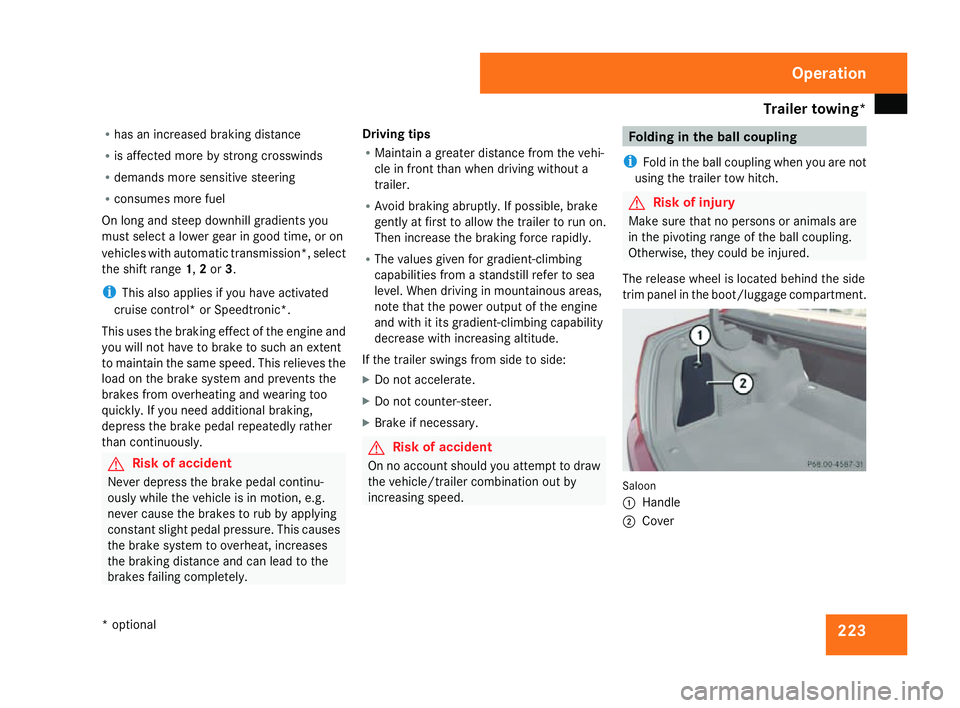
The release wheel is located behind the side
trim panel in the boot/luggage compartment. Saloon
1 Handl e
2 Cove r Operation
* optional
204_AKB; 2; 3, en-GB
mkalafa,
2007-06-26T23:11:51+02:00 - Seite 223