clock MERCEDES-BENZ C-CLASS ESTATE 2007 Owner's Manual
[x] Cancel search | Manufacturer: MERCEDES-BENZ, Model Year: 2007, Model line: C-CLASS ESTATE, Model: MERCEDES-BENZ C-CLASS ESTATE 2007Pages: 377, PDF Size: 6.19 MB
Page 325 of 377
Flat tyre
322 G
Risk of accident
If a wheel hub thread is damaged, you mus t
not drive the vehicle any further. Consult a
qualified specialist workshop which has the
necessary specialist knowledge and tools
to carry out the work required. Mercedes-
Benz recommends that you use a
Mercedes-Benz Service Centre or Service
24h for this purpose. In particular, work rel-
evant to safety or on safety-related systems
must be carried out at a qualified specialist
workshop. G
Risk of accident
Only use wheel bolts that have bee n
designed for the wheel and the vehicle. For
safety reasons, Mercedes-Benz recom -
mends that you only use wheel bolts which
have been approved for Mercedes-Benz
vehicles. Other bolts could work loose .
Do not tighten the wheel bolts completel y
while the vehicle is still jacked up. The vehi -
cle could topple off the jack.
X Clean the wheel and wheel hub contact
surfaces. X
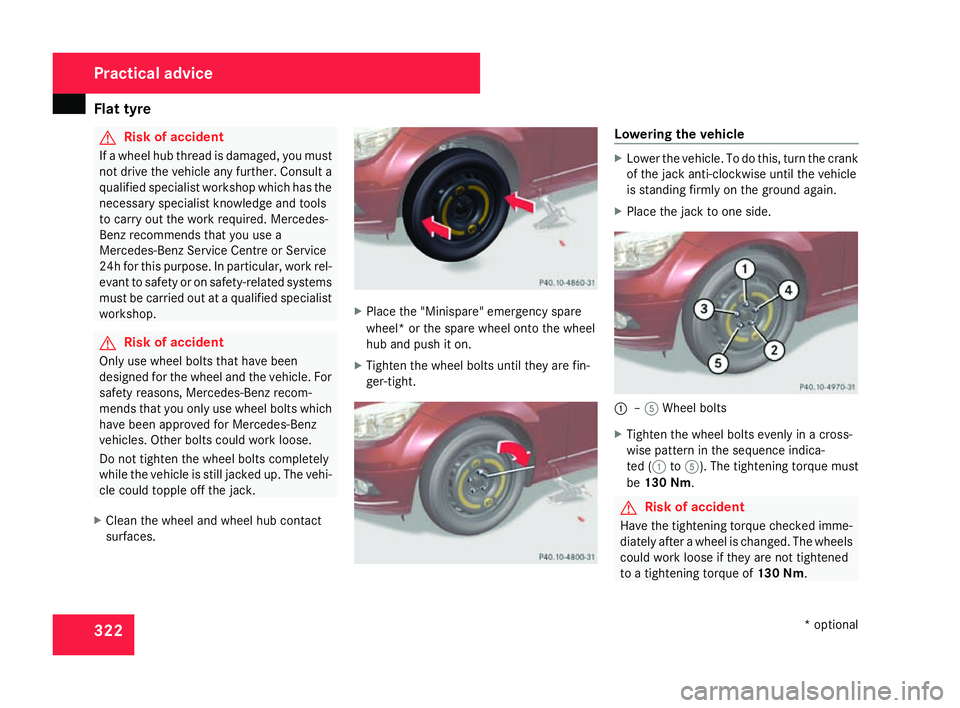
Place the "Minispare" emergency spare
wheel* or the spare wheel onto the wheel
hub and push it on.
X Tighten the wheel bolts until they are fin-
ger-tight. Lowering the vehicle
X
Lower the vehicle. To do this, turn the crank
of the jack anti-clockwise until the vehicle
is standing firmly on the ground again.
X Place the jack to one side. 1
–5 Wheel bolts
X Tighten the wheel bolts evenly in a cross-
wise pattern in the sequence indica-
ted (1 to5 ). The tightening torque must
be 130 Nm. G
Risk of accident
Have the tightening torque checked imme-
diately after a wheel is changed. The wheel s
could work loose if they are not tightened
to a tightening torque of 130 Nm.Practical advice
* optional
204_AKB; 2; 3, en-GB
mkalafa,
2007-06-26T23:11:51+02:00 - Seite 322
Page 334 of 377
Towing and tow-startin
g 331
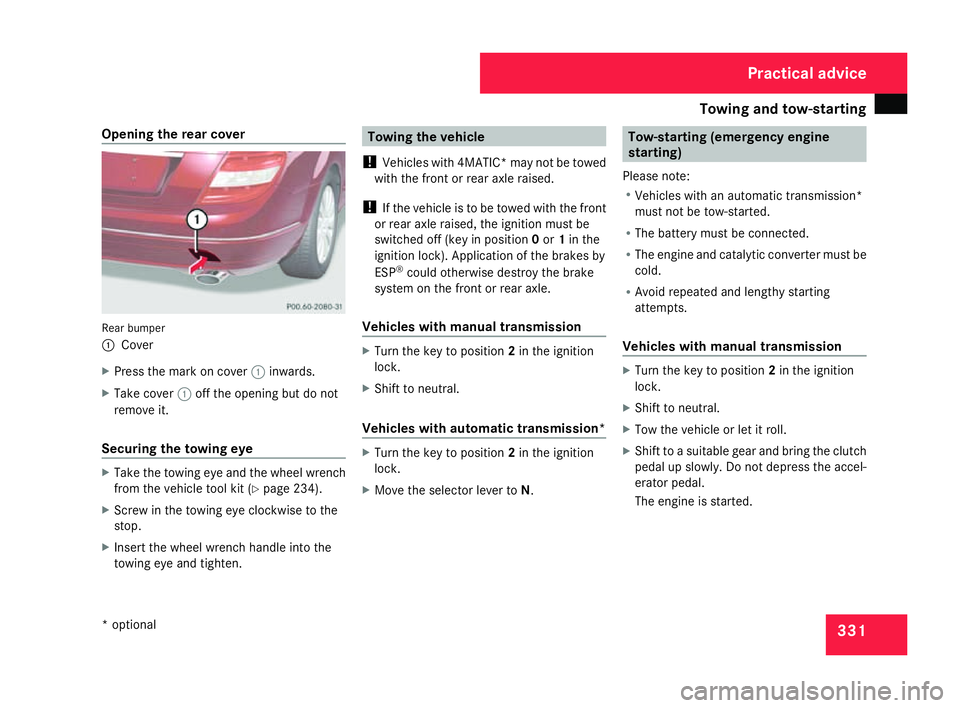
Opening the rear cover
Rear bumper
1
Cove r
X Press the mark on cover 1inwards.
X Take cover 1off the opening but do not
remove it.
Securing the towing eye X
Take the towing eye and the wheel wrench
from the vehicle tool kit (Y page 234).
X Screw in the towing eye clockwise to the
stop .
X Insert the wheel wrench handle into the
towing eye and tighten. Towing the vehicle
! Vehicles with 4MATIC* may not be towed
with the front or rear axle raised.
! If the vehicle is to be towed with the front
or rear axle raised, the ignition must be
switched off (key in position 0or 1in the
ignition lock). Application of the brakes by
ESP ®
could otherwise destroy the brake
system on the front or rear axle.
Vehicles with manual transmission X
Turn the key to position 2in the ignition
lock .
X Shift to neutral .
Vehicles with automatic transmission * X
Turn the key to position 2in the ignition
lock .
X Move the selector lever to N. Tow-starting (emergency engine
starting )
Please note:
R Vehicles with an automatic transmission*
must not be tow-started.
R The battery must be connected.
R The engine and catalytic converter must be
cold.
R Avoid repeated and lengthy starting
attempts .
Vehicles with manual transmission X
Turn the key to position 2in the ignition
lock .
X Shift to neutral .
X Tow the vehicle or let it roll.
X Shift to a suitable gear and bring the clutch
pedal up slowly. Do not depress the accel-
erator pedal.
The engine is started. Practical advice
* optiona l
204_AKB; 2; 3, en-GB
mkalafa,
2007-06-26T23:11:51+02:00 - Seite 331
Page 335 of 377
Fuse
s 332 Removing the towing eye
X Take the wheel wrench from the vehicle
tool kit (Y page 234).
X Insert the wheel wrench handle into the
towing eye and turn it anti-clockwise.
X Unscrew the towing eye.
X Replace the cover and press it until it
engages.
X Return the towing eye and the whee l
wrench to the vehicle tool kit .Transporting the vehicle
The towing eyes can be used to pull the vehi-
cle onto a trailer or transporter for transport-
ing purposes.
! Only lash the vehicle down by the wheels
or wheel rims, not by parts of the vehicl e
such as axle or steering components. The
vehicle could otherwise be damaged.
Vehicles with manual transmission X
Shift to neutral . Vehicles with automatic transmission
* X
Turn the key to position 2in the ignition
lock .
X Move the selector lever to N. Fuses
Notes on changing fuses
The fuses in your vehicle serve to close down
faulty circuits. If a fuse blows, all the compo -
nents on the circuit and their functions will
fail .
i Blown fuses must be replaced with fuses
of the same rating (which can be recog -
nised by the colour and amperage) and
which have the amperage specified in the
fuse allocation chart. A Mercedes-Benz
Service Centre will be happy to advise you. G
Risk of fire
Only use fuses that have been approved for
Mercedes-Benz vehicles and which have
the correct amperage for the system con-
cerned. Do not attempt to repair or bridge
faulty fuses. A circuit overload could other-
wise cause a fire. Have the cause trace d
and rectified at a qualified specialist work -
shop, e.g. a Mercedes-Benz Service Centre.
If the newly inserted fuse also blows, have the
cause traced and rectified at a qualified spe-
cialist workshop, e.g. a Mercedes-Benz
Service Centre. Practical advice
* optional
204_AKB; 2; 3, en-GB
mkalafa,
2007-06-26T23:11:51+02:00 - Seite 332