fuel reserve MERCEDES-BENZ C-CLASS ESTATE 2014 Owners Manual
[x] Cancel search | Manufacturer: MERCEDES-BENZ, Model Year: 2014, Model line: C-CLASS ESTATE, Model: MERCEDES-BENZ C-CLASS ESTATE 2014Pages: 489, PDF Size: 15.08 MB
Page 15 of 489
Flat tyre
Changing a wheel/fitting the
spare wheel .................................. .441
MOExtended tyres ......................... 413
Preparing the vehicle ..................... 412
TIREFIT kit ...................................... 414
see Emergency spare wheel
Floormat ............................................. 391
Foglamps (extended range) .............. 139
Fording
On flooded roads ........................... 219
Frequencies
Mobile phone ................................. 468
Two-way radio ................................ 468
Front-passenger front airbag deac-
tivation
Display message ............................ 330
Front-passenger front airbag deac-
tivation system
Operation ......................................... 54
Problems ......................................... 59
System self-test ............................... 57
Fuel
Additives ........................................ 473
Consumption information .............. 474
Consumption statistics .................. 301
Displaying the current consump-
tion ................................................ 300
Displaying the range ..................... .300
Driving tips ................................... .215
E10 ................................................ 472
Fuel gauge ....................................... 34
Grade (petrol) ................................ 472
Important safety notes .................. 471
Low outside temperatures ............. 473
Problem (malfunction) ................... 207
Quality (diesel )............................... 473
Refuelling ....................................... 204
Tank content/reserve fue l............. 471
Fuel consumption (Audio 20) ........... 279
Fuel consumption (COMAND
Online) ................................................ 279
Fuel filler flap
Opening ......................................... 206
Fuel filter (white display message) .. 337Fuel level
Calling up the range (on-board
computer) ...................................... 300
Gaug e.............................................. 34
Fuel tank
Capacity ........................................ 471
Problem (malfunction) ................... 207
Fuses
Allocation chart ............................. 430
Before changing ............................. 428
Dashboard fuse box ....................... 429
Fuse box in the engine compart-
ment .............................................. 429
Fuse box in the front-passenger
footwell .......................................... 429
Fuse box in the luggage compart-
ment .............................................. 430
Important safety notes .................. 428 G
Generated electrical energy (Audio 20) ...................................................... 279
Generated electrical energy
(COMAND Online) .............................. 279
Genuine Mercedes-Benz parts ........... 24
Glove compartment .......................... 371 H
HANDS-FREE ACCESS ....................... 103
Hazard warning lamps ...................... 137
Head restraints
Adjusting ....................................... 121
Adjusting (electrically) ................... 122
Adjusting (manually) ...................... 122
Adjusting (rear) .............................. 122
Fitting/removing (rear) .................. 122
Head-up display
Adjusting the brightness ................ 312
Function/note s............................. 297
Important safety notes .................. 297
Setting the position ....................... 312
Storing settings (memory func-
tion) ............................................... 131
Switching on or off ......................... 298
Switching the display on/off ......... 312 12
Index
Page 21 of 489
Setting the airflow ......................... 165
Setting the temperature ................ 163
Rear foglamp
Display message ............................ 333
Switching on/of f........................... 135
Rear lamps
see Lights
Rear window heating
Problem (fault) ............................... 168
Switching on/of f........................... 167
Rear window wiper
Replacing the wiper blad e.............. 149
Switching on/of f........................... 147
Rear-compartment seat belt sta-
tus indicator ........................................ 50
Rear-view mirror
Anti-dazzle mode (automatic) ........ 129
Dipping (manual) ........................... 127
Recuperation display ........................ 300
Refuelling
Fuel gaug e....................................... 34
Important safety notes .................. 204
Refuelling process ......................... 205
see Fuel
Remote control
Auxiliary heating/ventilation .......... 177
Changing the batteries (auxiliary
heating) ......................................... 179
Replacing bulbs
Important safety notes .................. 141
Overview of bulb types .................. 142
Removing/replacing the cover
(front wheel arch) .......................... 143
Replacing the battery (auxiliary
heating remote control) .................... 179
Reserve (fuel tank)
see Fuel
Reserve fuel
Display message ............................ 337
Warning lamp ................................. 362
Residual heat (climate control) ........ 169
Restraint system
Display message ............................ 327
Introduction ..................................... 44
Warning lamp ................................. 361
Warning lamp (function) ................... 45
Rev counter ........................................ 295 Reverse gear
Engaging (manual transmission) .... 195
Reversing camera
Cleaning instructions ..................... 405
Function/note s............................. 248
Switching on/of f........................... 249
Reversing feature
Panorama sliding sunroo f.............. 111
Roller sunblind s............................. 113
Side windows ................................. 107
Sliding sunroof ............................... 111
Tailgate .......................................... 101
Reversing lamp
Changing bulb s.............................. 144
Reversing lamp (display message) .. 333
Roller sunblind
Panorama sliding sunroo f.............. 113
Roller sunblinds (panorama sliding
sunroof)
Operating ....................................... 114
Roof carrier ........................................ 380
Roof lining and carpets (cleaning
instructions) ...................................... 408
Roof load (maximum) ........................ 478 S
Safety Automatic front-passenger front
airbag deactivation system .............. 54
Child restraint systems .................... 64
Children in the vehicle ..................... 63
see Operating safety
Safety net
Attaching ....................................... 378
Important safety information ......... 378
Safety notes
Hybrid vehicles ................................ 42
Safety system
see Driving safety systems
Seat
Folding the backrest (rear com-
partment) forwards/back .............. 374
Seat belt
Centre rear-compartment sea t........ 49
Correct usage .................................. 48 18
Index
Page 26 of 489
Hybrid system ................................ 364
LIM (cruise control) ........................ 220
LIM (DISTRONIC PLUS) .................. 227
LIM (variable SPEEDTRONIC) ......... 223
Overview .......................................... 35
Parking brake ................................ 361
PASSENGER AIR BAG ...................... 46
RBS (Recuperative Brake Sys-
tem) ............................................... 364
Reserve fuel ................................... 362
Seat belt ........................................ 353
SRS ................................................ 285
Steering ......................................... 367
Tyre pressure monitor ................... 366
Warning triangle ................................ 410
Warnings
Stickers ........................................... 42
Washer fluid
Display messag e............................ 351
Wheel and tyre combinations
see Tyres
Wheel bolt tightening torque ........... 447
Wheel chock ...................................... 443
Wheels
Changing a whee l.......................... 441
Changing/replacing ....................... 442
Checking ........................................ 433
Cleaning ......................................... 403
Emergency spare wheel ................. 463
Fitting a new wheel ........................ 446
Fitting a wheel ............................... 442
Important safety notes .................. 432
Removing a whee l.......................... 446
Storing ........................................... 442
Tightening torque ........................... 447
Wheel size/tyre size ...................... 448
Windowbag
Display message ............................ 328
Operation ......................................... 53
Windows
Cleaning ......................................... 403
see Side windows
Windscreen
Demisting ...................................... 166
Windscreen washer fluid
see Windscreen washer system
Windscreen washer system
Notes ............................................. 477 Topping up ..................................... 398
Windscreen wipers
Problem (malfunction) ................... 150
Rear window wipe r........................ 147
Replacing the wiper blades ............ 147
Switching on/of f........................... 146
Winter operation
Important safety notes .................. 434
Radiator cover ............................... 396
Slippery road surfaces ................... 219
Snow chains .................................. 435
Summer tyres ................................ 434
Winter tyres
Limiting the speed (on-board com-
puter) ............................................. 315
M+S tyres ...................................... 434
Wiper blades
Cleaning ......................................... 404
Important safety notes .................. 147
Replacing ....................................... 147
Replacing (on the rear window )..... 149
Replacing (windscreen) .................. 147
Wooden trim (cleaning instruc-
tions) .................................................. 407
Workshop
see Qualified specialist workshop Index
23
Page 38 of 489
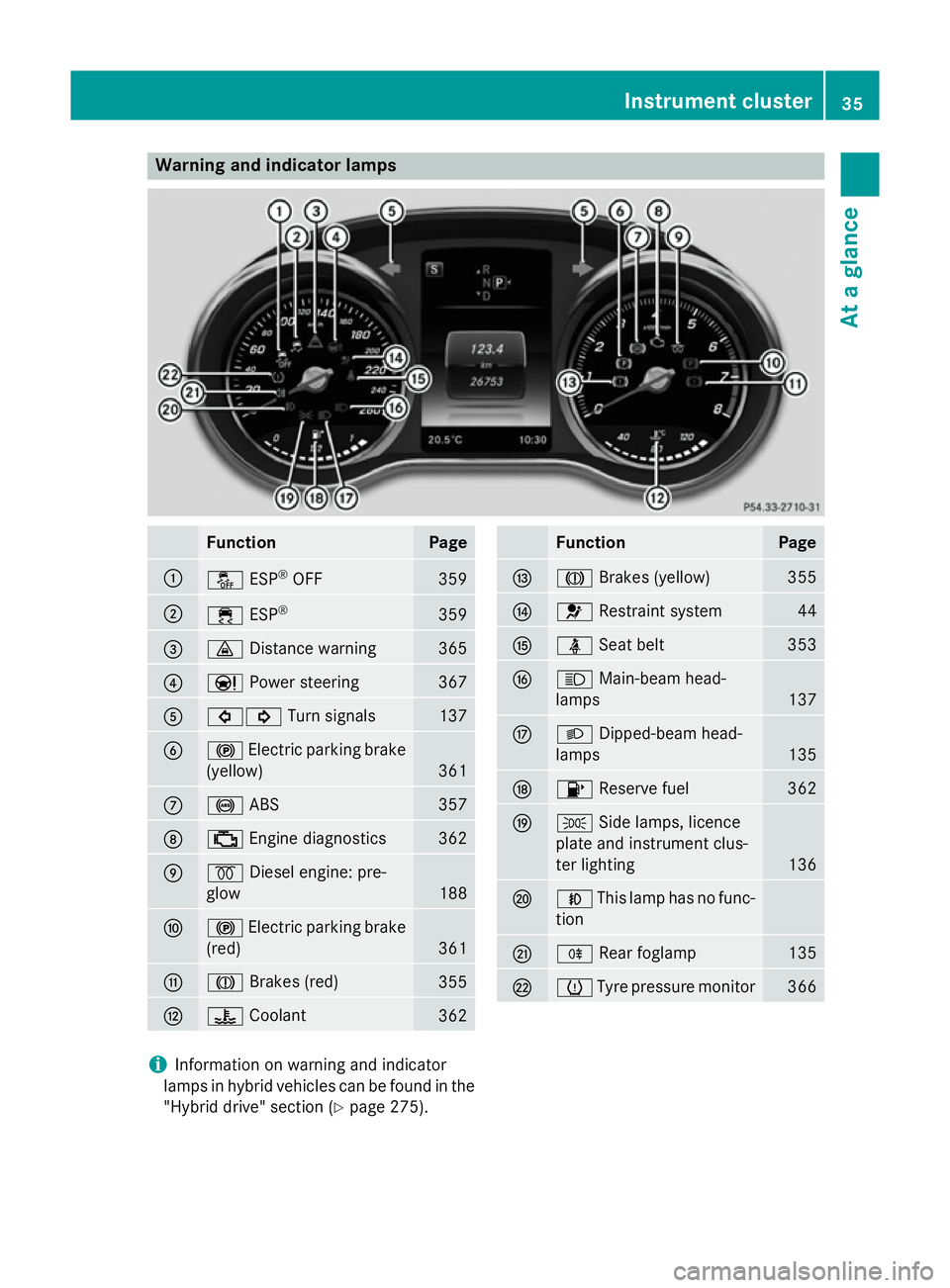
Warning and indicator lamps
Function Page
:
å
ESP®
OFF 359
;
÷
ESP® 359
=
·
Distance warning 365
?
Ð
Power steering 367
A
#!
Turn signals 137
B
!
Electric parking brake
(yellow) 361
C
!
ABS 357
D
;
Engine diagnostics 362
E
%
Diesel engine: pre-
glow 188
F
!
Electric parking brake
(red) 361
G
J
Brakes (red) 355
H
?
Coolant 362 Function Page
I
J
Brakes (yellow) 355
J
6
Restraint system 44
K
ü
Seat belt 353
L
K
Main-beam head-
lamps 137
M
L
Dipped-beam head-
lamps 135
N
8
Reserve fuel 362
O
T
Side lamps, licence
plate and instrument clus-
ter lighting 136
P
N
This lamp has no func-
tion Q
R
Rear foglamp 135
R
h
Tyre pressure monitor 366
i
Information on warning and indicator
lamps in hybrid vehicles can be found in the
"Hybrid drive" section (Y page 275). Instrument cluster
35At a glance
Page 179 of 489
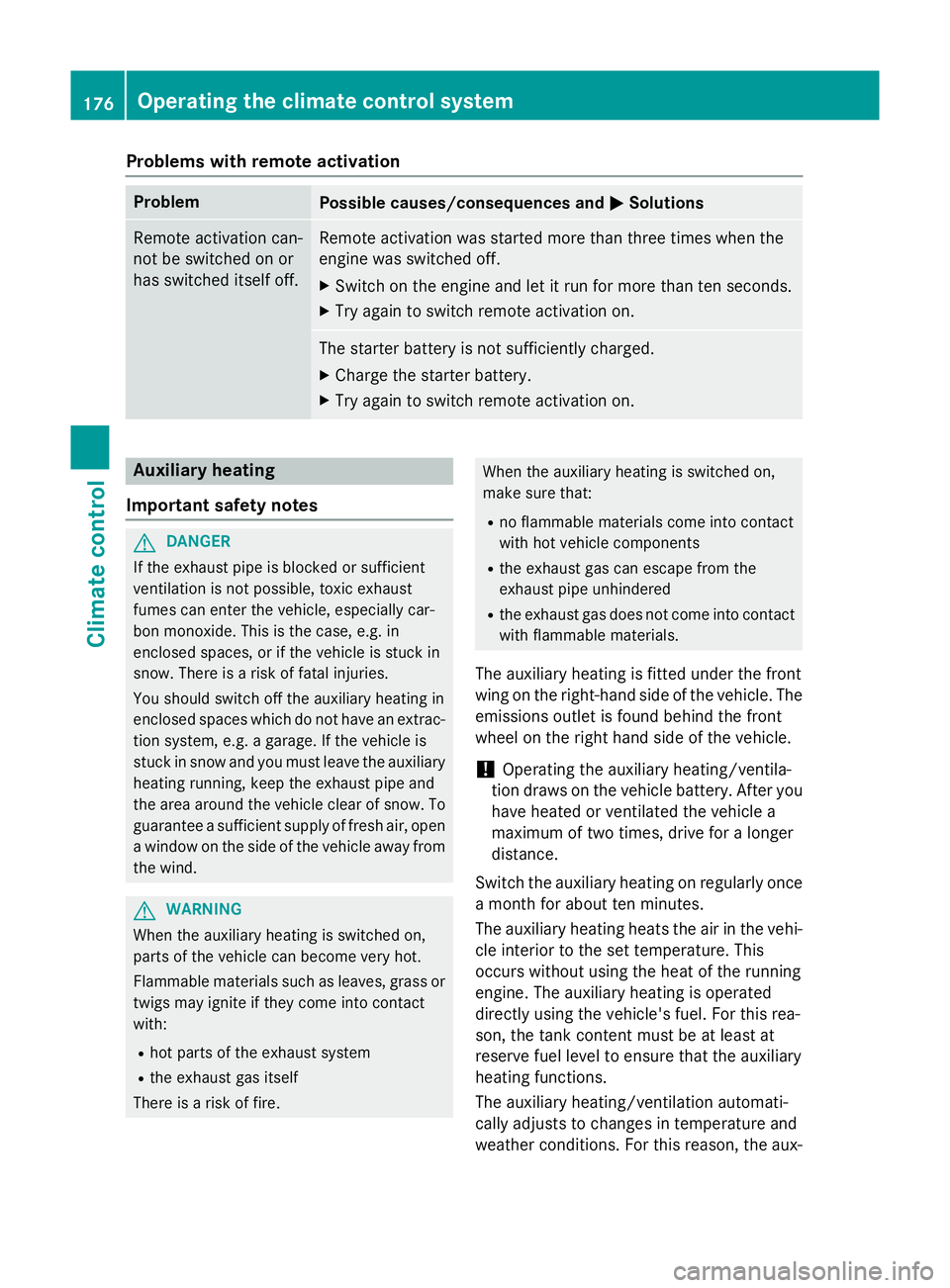
Problems with remote activation
Problem
Possible causes/consequences and
M
MSolutions Remote activation can-
not be switched on or
has switched itself off. Remote activation was started more than three times when the
engine was switched off.
X Switch on the engine and let it run for more than ten seconds.
X Try again to switch remote activation on. The starter battery is not sufficiently charged.
X Charge the starter battery.
X Try again to switch remote activation on. Auxiliary heating
Important safety notes G
DANGER
If the exhaust pipe is blocked or sufficient
ventilation is not possible, toxic exhaust
fumes can enter the vehicle, especially car-
bon monoxide. This is the case, e.g. in
enclosed spaces, or if the vehicle is stuck in
snow. There is a risk of fatal injuries.
You should switch off the auxiliary heating in
enclosed spaces which do not have an extrac- tion system, e.g. a garage. If the vehicle is
stuck in snow and you must leave the auxiliary
heating running, keep the exhaust pipe and
the area around the vehicle clear of snow. To guarantee a sufficient supply of fresh air, open
a window on the side of the vehicle away from the wind. G
WARNING
When the auxiliary heating is switched on,
parts of the vehicle can become very hot.
Flammable materials such as leaves, grass or twigs may ignite if they come into contact
with:
R hot parts of the exhaust system
R the exhaust gas itself
There is a risk of fire. When the auxiliary heating is switched on,
make sure that:
R no flammable materials come into contact
with hot vehicle components
R the exhaust gas can escape from the
exhaust pipe unhindered
R the exhaust gas does not come into contact
with flammable materials.
The auxiliary heating is fitted under the front
wing on the right-hand side of the vehicle. The emissions outlet is found behind the front
wheel on the right hand side of the vehicle.
! Operating the auxiliary heating/ventila-
tion draws on the vehicle battery. After you
have heated or ventilated the vehicle a
maximum of two times, drive for a longer
distance.
Switch the auxiliary heating on regularly once a month for about ten minutes.
The auxiliary heating heats the air in the vehi-
cle interior to the set temperature. This
occurs without using the heat of the running
engine. The auxiliary heating is operated
directly using the vehicle's fuel. For this rea-
son, the tank content must be at least at
reserve fuel level to ensure that the auxiliary
heating functions.
The auxiliary heating/ventilation automati-
cally adjusts to changes in temperature and
weather conditions. For this reason, the aux- 176
Operating the climate control systemClimate control
Page 184 of 489
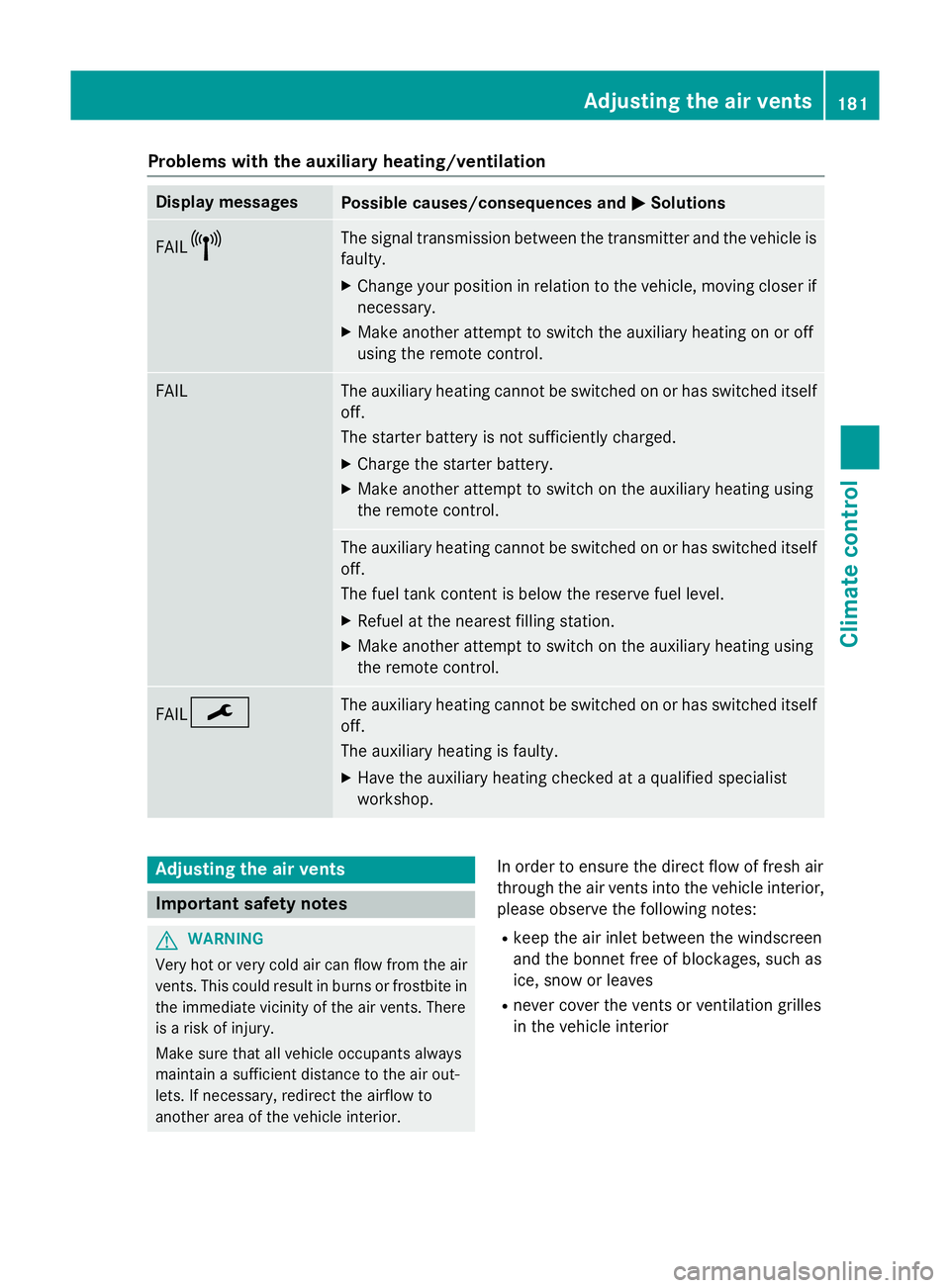
Problems with the auxiliary heating/ventilation
Display messages
Possible causes/consequences and
M
MSolutions FAIL¨ The signal transmission between the transmitter and the vehicle is
faulty.
X Change your position in relation to the vehicle, moving closer if
necessary.
X Make another attempt to switch the auxiliary heating on or off
using the remote control. FAIL The auxiliary heating cannot be switched on or has switched itself
off.
The starter battery is not sufficiently charged.
X Charge the starter battery.
X Make another attempt to switch on the auxiliary heating using
the remote control. The auxiliary heating cannot be switched on or has switched itself
off.
The fuel tank content is below the reserve fuel level.
X Refuel at the nearest filling station.
X Make another attempt to switch on the auxiliary heating using
the remote control. FAIL¯ The auxiliary heating cannot be switched on or has switched itself
off.
The auxiliary heating is faulty.
X Have the auxiliary heating checked at a qualified specialist
workshop. Adjusting the air vents
Important safety notes
G
WARNING
Very hot or very cold air can flow from the air vents. This could result in burns or frostbite in the immediate vicinity of the air vents. There
is a risk of injury.
Make sure that all vehicle occupants always
maintain a sufficient distance to the air out-
lets. If necessary, redirect the airflow to
another area of the vehicle interior. In order to ensure the direct flow of fresh air
through the air vents into the vehicle interior,
please observe the following notes:
R keep the air inlet between the windscreen
and the bonnet free of blockages, such as
ice, snow or leaves
R never cover the vents or ventilation grilles
in the vehicle interior Adjusting the air vents
181Climate control Z
Page 196 of 489
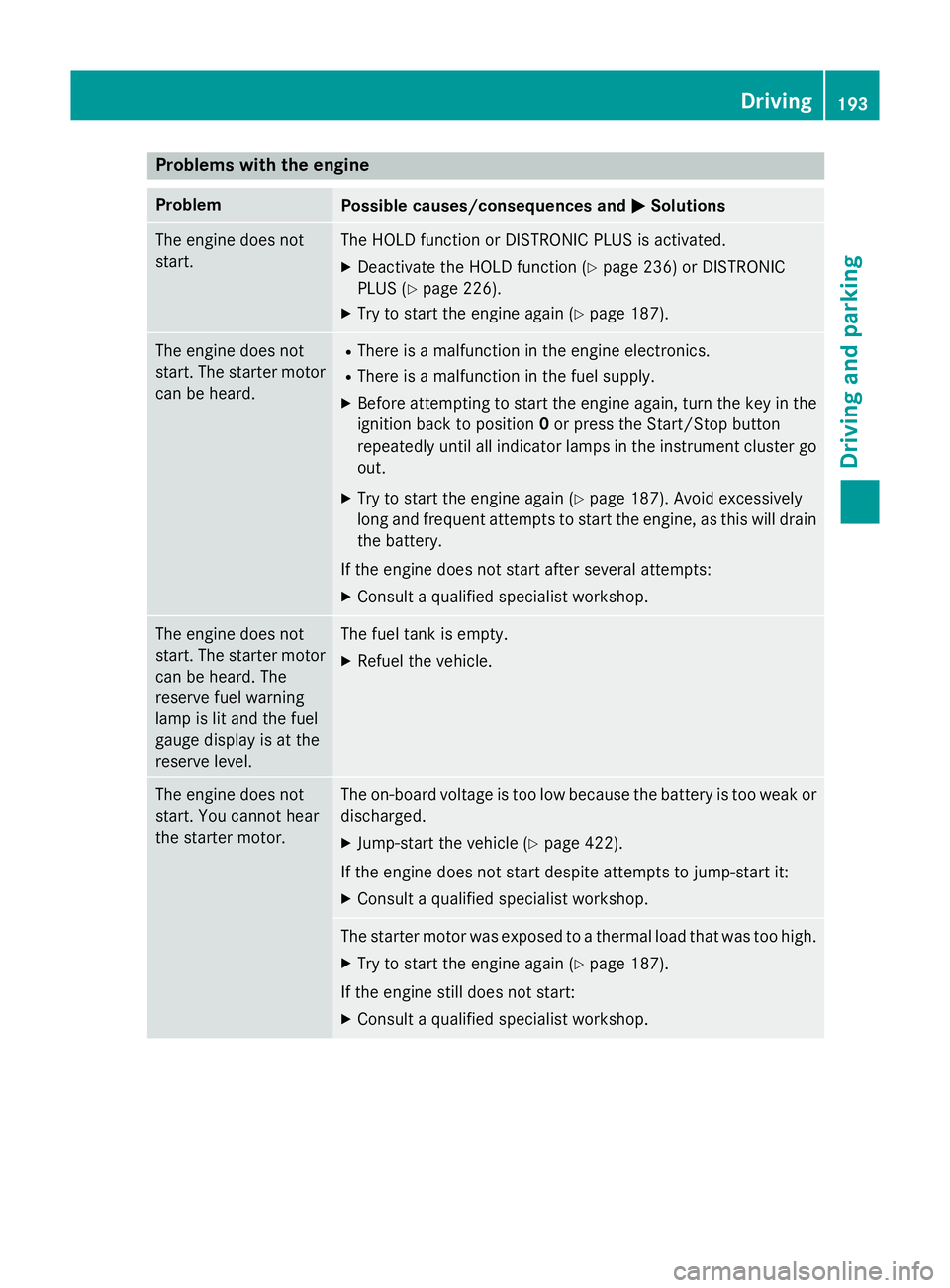
Problems with the engine
Problem
Possible causes/consequences and
M
MSolutions The engine does not
start. The HOLD function or DISTRONIC PLUS is activated.
X Deactivate the HOLD function (Y page 236) or DISTRONIC
PLUS (Y page 226).
X Try to start the engine again (Y page 187).The engine does not
start. The starter motor
can be heard. R
There is a malfunction in the engine electronics.
R There is a malfunction in the fuel supply.
X Before attempting to start the engine again, turn the key in the
ignition back to position 0or press the Start/Stop button
repeatedly until all indicator lamps in the instrument cluster go
out.
X Try to start the engine again (Y page 187). Avoid excessively
long and frequent attempts to start the engine, as this will drain
the battery.
If the engine does not start after several attempts: X Consult a qualified specialist workshop. The engine does not
start. The starter motor
can be heard. The
reserve fuel warning
lamp is lit and the fuel
gauge display is at the
reserve level. The fuel tank is empty.
X Refuel the vehicle. The engine does not
start. You cannot hear
the starter motor. The on-board voltage is too low because the battery is too weak or
discharged.
X Jump-start the vehicle (Y page 422).
If the engine does not start despite attempts to jump-start it:
X Consult a qualified specialist workshop. The starter motor was exposed to a thermal load that was too high.
X Try to start the engine again (Y page 187).
If the engine still does not start: X Consult a qualified specialist workshop. Driving
193Driving and parking Z
Page 219 of 489
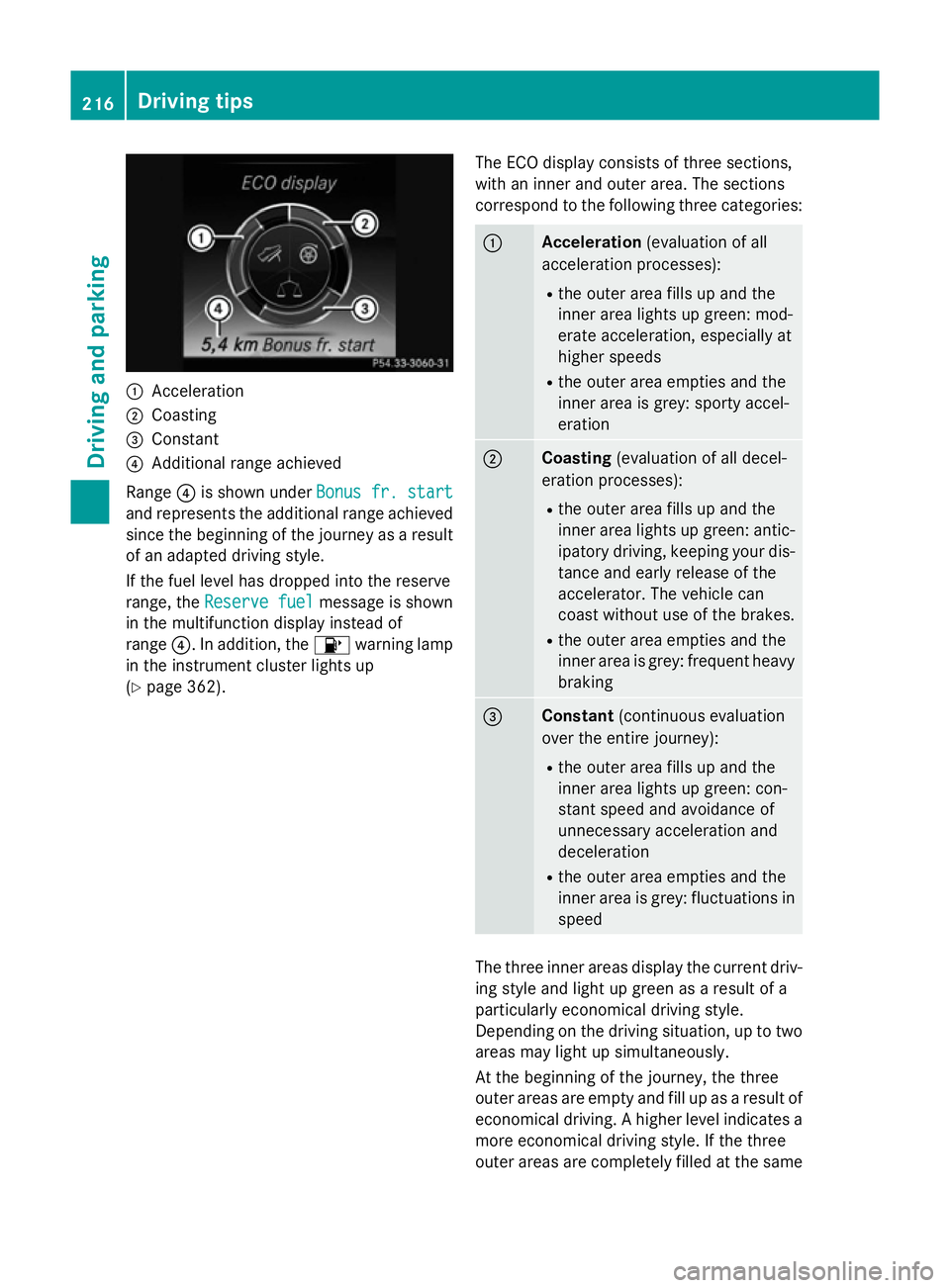
:
Acceleration
; Coasting
= Constant
? Additional range achieved
Range ?is shown under Bonus fr. start
Bonus fr. start
and represents the additional range achieved
since the beginning of the journey as a result of an adapted driving style.
If the fuel level has dropped into the reserve
range, the Reserve fuel Reserve fuel message is shown
in the multifunction display instead of
range ?. In addition, the 8warning lamp
in the instrument cluster lights up
(Y page 362). The ECO display consists of three sections,
with an inner and outer area. The sections
correspond to the following three categories: :
Acceleration
(evaluation of all
acceleration processes):
R the outer area fills up and the
inner area lights up green: mod-
erate acceleration, especially at
higher speeds
R the outer area empties and the
inner area is grey: sporty accel-
eration ;
Coasting
(evaluation of all decel-
eration processes):
R the outer area fills up and the
inner area lights up green: antic-
ipatory driving, keeping your dis- tance and early release of the
accelerator. The vehicle can
coast without use of the brakes.
R the outer area empties and the
inner area is grey: frequent heavy
braking =
Constant
(continuous evaluation
over the entire journey):
R the outer area fills up and the
inner area lights up green: con-
stant speed and avoidance of
unnecessary acceleration and
deceleration
R the outer area empties and the
inner area is grey: fluctuations in
speed The three inner areas display the current driv-
ing style and light up green as a result of a
particularly economical driving style.
Depending on the driving situation, up to two
areas may light up simultaneously.
At the beginning of the journey, the three
outer areas are empty and fill up as a result of economical driving. A higher level indicates a more economical driving style. If the three
outer areas are completely filled at the same 216
Driving tipsDriving an
d parking
Page 340 of 489
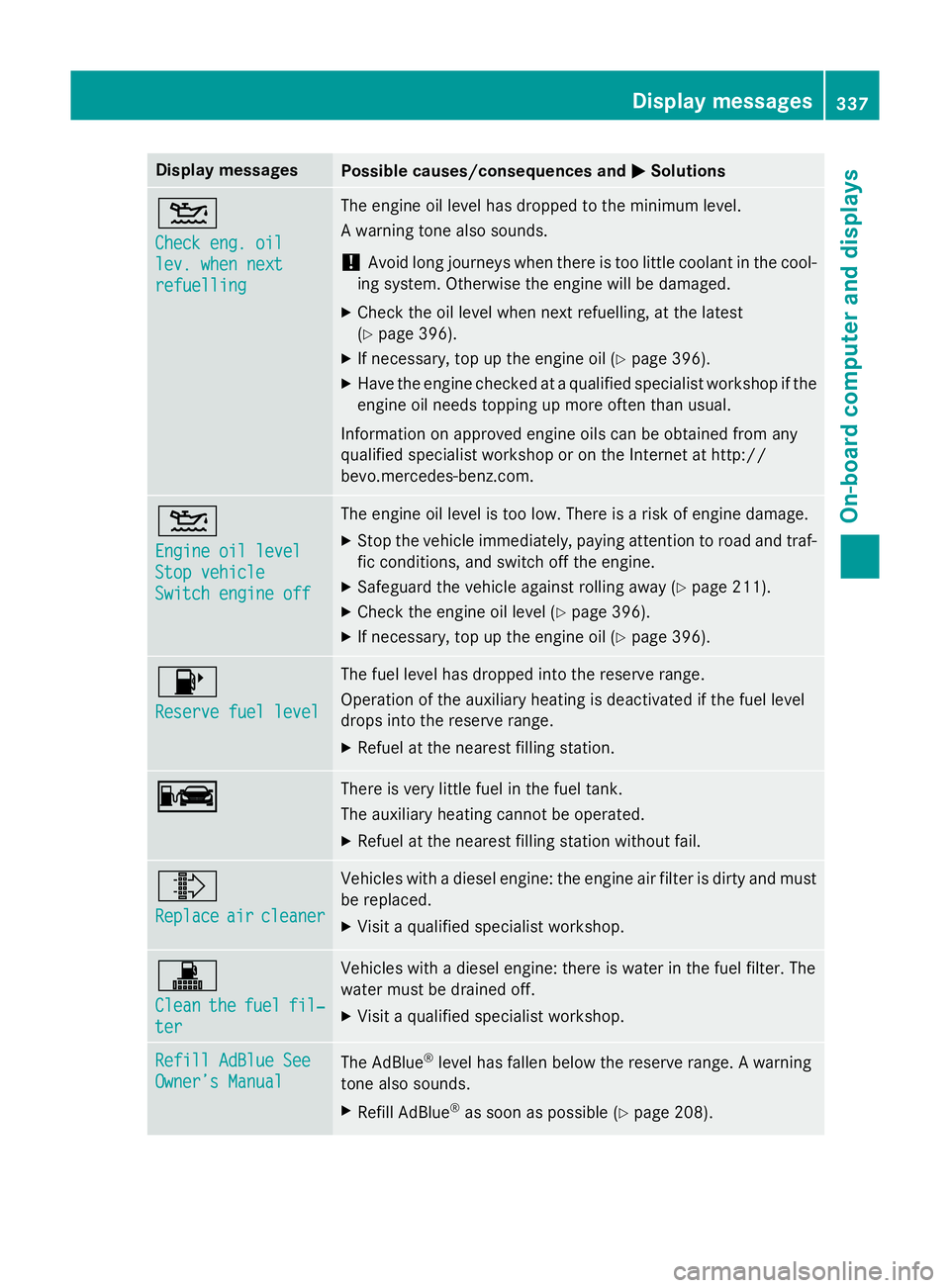
Display messages
Possible causes/consequences and
M
MSolutions 4
Check eng. oil Check eng. oil
lev. when next lev. when next
refuelling refuelling The engine oil level has dropped to the minimum level.
A warning tone also sounds.
! Avoid long journeys when there is too little coolant in the cool-
ing system. Otherwise the engine will be damaged.
X Check the oil level when next refuelling, at the latest
(Y page 396).
X If necessary, top up the engine oil (Y page 396).
X Have the engine checked at a qualified specialist workshop if the
engine oil needs topping up more often than usual.
Information on approved engine oils can be obtained from any
qualified specialist workshop or on the Internet at http://
bevo.mercedes-benz.co m.4
Engine oil level Engine oil level
Stop vehicle Stop vehicle
Switch engine off Switch engine off The engine oil level is too low. There is a risk of engine damage.
X Stop the vehicle immediately, paying attention to road and traf-
fic conditions, and switch off the engine.
X Safeguard the vehicle against rolling away (Y page 211).
X Check the engine oil level (Y page 396).
X If necessary, top up the engine oil (Y page 396).8
Reserve fuel level Reserve fuel level The fuel level has dropped into the reserve range.
Operation of the auxiliary heating is deactivated if the fuel level
drops into the reserve range.
X Refuel at the nearest filling station. C C There is very little fuel in the fuel tank.
The auxiliary heating cannot be operated.
X Refuel at the nearest filling station without fail. ¸
Replace Replace
air
aircleaner
cleaner Vehicles with a diesel engine: the engine air filter is dirty and must
be replaced.
X Visit a qualified specialist workshop. !
Clean Clean
the
thefuel
fuel fil‐
fil‐
ter
ter Vehicles with a diesel engine: there is water in the fuel filter. The
water must be drained off.
X Visit a qualified specialist workshop. Refill AdBlue See Refill AdBlue See
Owner’s Manual Owner’s Manual
The AdBlue
®
level has fallen below the reserve range. A warning
tone also sounds.
X Refill AdBlue ®
as soon as possible (Y page 208). Display messages
337On-board computer and displays Z
Page 365 of 489
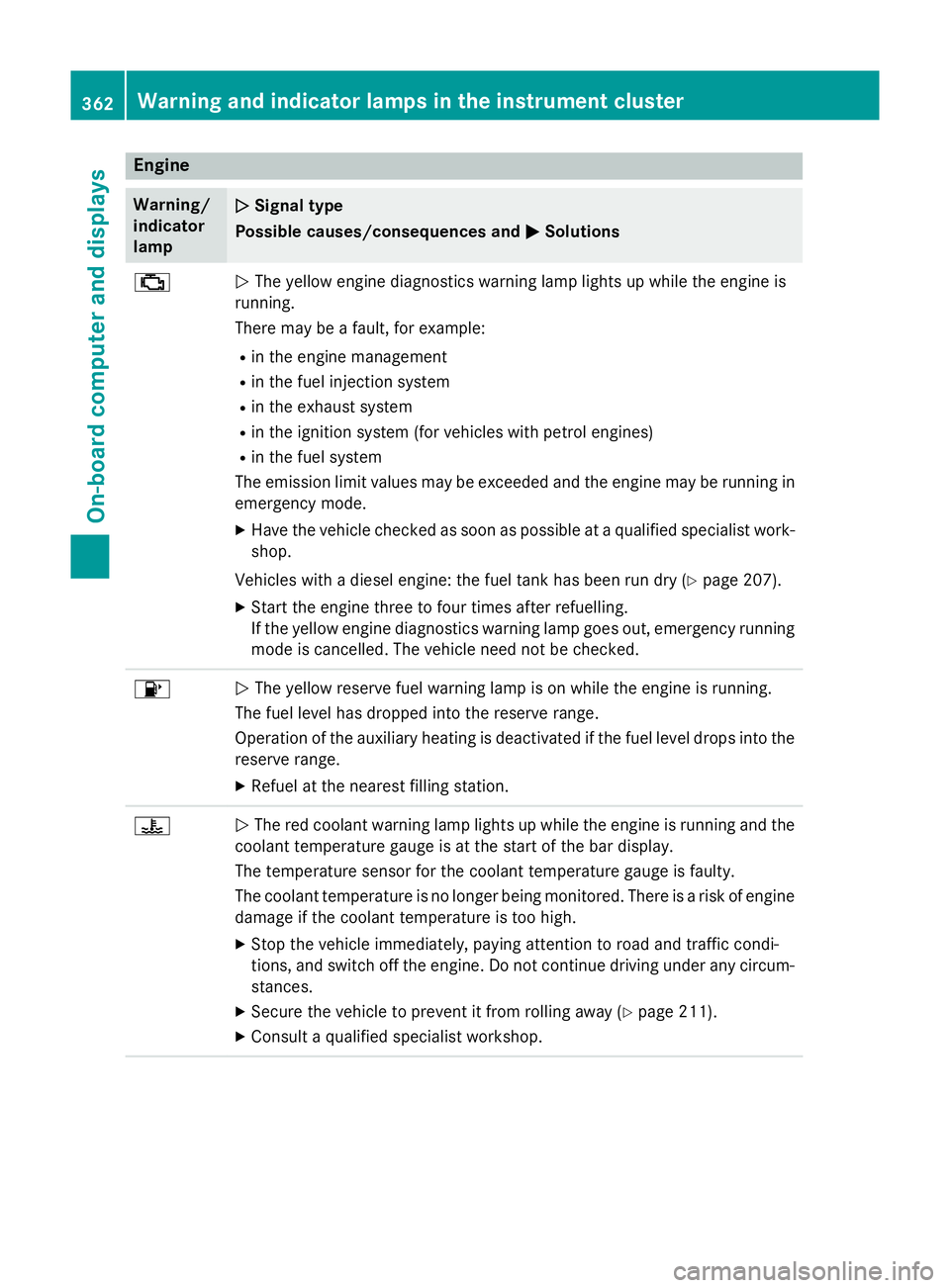
Engine
Warning/
indicator
lamp
N N
Signal type
Possible causes/consequences and M
MSolutions ;
N
The yellow engine diagnostics warning lamp lights up while the engine is
running.
There may be a fault, for example:
R in the engine management
R in the fuel injection system
R in the exhaust system
R in the ignition system (for vehicles with petrol engines)
R in the fuel system
The emission limit values may be exceeded and the engine may be running in emergency mode.
X Have the vehicle checked as soon as possible at a qualified specialist work-
shop.
Vehicles with a diesel engine: the fuel tank has been run dry (Y page 207).
X Start the engine three to four times after refuelling.
If the yellow engine diagnostics warning lamp goes out, emergency running
mode is cancelled. The vehicle need not be checked. 8
N
The yellow reserve fuel warning lamp is on while the engine is running.
The fuel level has dropped into the reserve range.
Operation of the auxiliary heating is deactivated if the fuel level drops into the reserve range.
X Refuel at the nearest filling station. ?
N
The red coolant warning lamp lights up while the engine is running and the
coolant temperature gauge is at the start of the bar display.
The temperature sensor for the coolant temperature gauge is faulty.
The coolant temperature is no longer being monitored. There is a risk of engine
damage if the coolant temperature is too high.
X Stop the vehicle immediately, paying attention to road and traffic condi-
tions, and switch off the engine. Do not continue driving under any circum- stances.
X Secure the vehicle to prevent it from rolling away (Y page 211).
X Consult a qualified specialist workshop. 362
Warning and indicator lamps in the instrument clusterOn-board computer and displays