belt MERCEDES-BENZ C-CLASS SALOON 2007 User Guide
[x] Cancel search | Manufacturer: MERCEDES-BENZ, Model Year: 2007, Model line: C-CLASS SALOON, Model: MERCEDES-BENZ C-CLASS SALOON 2007Pages: 377, PDF Size: 6.19 MB
Page 49 of 377
Occupant safet
y46 Occupant safet
y
Seat belts, together with belt tensioners, belt
force limiters and airbags, are coordinate d
restraint systems. They reduce the risk of
injury in critical driving situations and thereby
increase your driving safety. However, seat
belts and airbags are generally unable to pre-
vent injuries caused by objects penetrating
the vehicle from the outside.
To ensure that the restraint systems can
deliver their full potential protection, you
should ensure that:
R the seat and head restraint are adjusted
properly (Y page 86)
R the seat belt has been fastened properl y
( Y page 98)
R the airbags can inflate properly if they ar e
deployed (Y page 49)
R the steering wheel is adjusted properl y
( Y page 92)
R the restraint systems have not been modi-
fied
i An airbag increases the protection of
vehicle occupants wearing a seat belt.
However, airbags are only an additional
restraint system which complements, bu tdoes not replace, the seat belt. All vehicle
occupants must wear their seat belt cor-
rectly at all times, even if the vehicle is
equipped with airbags. This is because – on
the one hand – airbags are not deployed in
all types of accident, as in some situation
s
airbag deployment would not increase th e
protection afforded to vehicle occupants,
provided they are wearing their seat belt
correctly.
On the other hand, airbag deployment only
provides increased protection if the seat
belt is worn correctly, because:
R the seat belt helps to keep the vehicl e
occupant in the best position in relation
to the airbag
R for example, in a head-on collision, the
seat belt can more adequately prevent
the occupant from being propelle d
towards the force of the impact, and is
thus better suited to prevent injury
Thus, in accident situations where an air-
bag is deployed, it only provides protection
in addition to the seat belt if the seat belt
is being worn correctly. G
Risk of injury
The restraint system may not work as inten-
ded if the following components have bee n
modified or work on these components has
not been performed correctly:
R restraint system, consisting of the seat
belts and anchorages, belt tensioners,
belt force limiters, airbags
R wirin g
R networked electronic system s
Airbags or belt tensioners could then fail ,
e.g. in the event of an accident in which the
deceleration force would normally be high
enough to trigger the systems, or they
could be triggered unintentionally. Never
carry out any modifications on the restraint
systems. Never tamper with electronic
components and their software. G
Risk of accident and injury
Always have maintenance work carried ou t
at a qualified specialist workshop whic h
has the necessary specialist knowledge
and tools to carry out the work required.
Mercedes-Benz recommends that you use
a Mercedes-Benz Service Centre for this
purpose. Safety
204_AKB; 2; 3, en-GB
mkalafa,
2007-06-26T23:11:51+02:00 - Seite 46
Page 50 of 377
Occupant safet
y 47In particular, work relevant to safety or on
safety-related systems must be carried out
at a qualified specialist workshop. If this
work is not carried out correctly, the oper-
ating safety of your vehicle may be affec -
ted. There is a risk of an accident and injury .SRS (Supplemental Restraint System)
The SRS reduces the risk of occupants com-
ing into contact with the vehicle's interior in
the event of an accident.
The SRS consists of:
R The SRS warning lamp =
R Belt tensioners
R Belt force limiters
R Airbag s
The SRS warning lamp ==The SRS functions are checked regularly
when you turn on the ignition and when the
engine is running. Malfunctions can therefore
be detected in good time.
The = warning lamp in the instrumen t
cluster lights up when you switch on the igni -tion and goes out a few seconds after the
engine is started
. G
Risk of injury
If SRS is malfunctioning, individual systems
may be activated unintentionally or not be
triggered in the event of an accident with
heavy braking.
A malfunction has occurred if the =
warning lamp:
R does not light up when you switch on the
ignition
R does not go out after the engine has been
running for a few seconds
R lights up again once the engine is running
In this case, have SRS checked immedi-
ately at a qualified specialist workshop.
Triggering of belt tensioners, belt force
limiters and airbags In the event of a collision, the sensor in the
airbag control unit evaluates important phys-
ical data such as duration, direction and force
of the vehicle deceleration or acceleration.
Based on the evaluation of this data and
depending on the vehicle's rate of longitudi-
nal deceleration in a collision, in the firs
tstage the airbag control unit pre-emptively
triggers the belt tensioners.
The front airbags are only deployed if there is
an even higher rate of vehicle deceleration in
a longitudinal direction.
If your vehicle is fitted with adaptive dual-
stage front airbags, the front airbag is filled
with enough gas to reduce the risk of injuries
at the first deployment threshold. The front
airbag is only fully inflated if a second thresh-
old is reached within a few milliseconds due
to the control unit having detected further
deceleration.
i
The front belt tensioners can only be trig-
gered if the belt tongue is correctly
engaged in the seat belt buckle.
Criteria for triggering belt tensioners and
airbags
In the first stages of a collision, the sensor in
the airbag control unit evaluates physical
data such as duration, direction and rate of
vehicle deceleration or acceleration in order
to determine whether it is necessary to trig-
ger the belt tensioners and/or airbags.
The belt tensioner and airbag triggerin g
thresholds are variable and are adapted to the
rate of deceleration of the vehicle. This proc-
ess is pre-emptive in nature as the airba g Safety
204_AKB; 2; 3, en-GB
mkalafa,
2007-06-26T23:11:51+02:00 - Seite 47 Z
Page 51 of 377
Occupant safet
y48
must be deployed during – and not at the end
of – the collision
.
i Airbags are not deployed in all types of
accident. They are controlled by comple x
sensor technology and evaluation logic.
This process is pre-emptive in nature as
airbag deployment must take place during
the impact and must be adapted to provide
calculated, additional protection for the
vehicle occupants. Not all airbags are
deployed in an accident.
The different airbag systems work inde-
pendently of each other. However, the
deployment of each individual system will
depend on the type of accident determined
by the control system in the first stages of
the collision (head-on collision, side impact
and overturn) and the extent of the acci-
dent (in particular, the vehicle's rate of
deceleration or acceleration).
The rate of vehicle deceleration or accelera-
tion and the direction of the force are basi-
cally determined by:
R the distribution of forces during the colli -
sion
R the collision angle R
the deformation characteristics of the vehi-
cle
R the characteristics of the object with which
the vehicle has collided, e.g. the other vehi-
cle
Factors which can only be seen and measured
after the collision has taken place do not play
a decisive role in the deployment of an airbag,
nor do they provide an indication of it.
The vehicle may be considerably deformed
without an airbag being deployed if, for exam-
ple, only relatively easily deformable parts
such as the bonnet or wings have been hit and
the required rate of deceleration has not been
reached. It is also possible that airbags ma y
be deployed even though the vehicle is only
slightly deformed if, for example, very rigid
vehicle parts such as the longitudinal mem-
bers are hit in an accident and the rate of
deceleration is sufficient .
Belt tensioners, belt force limiters The front seat belts and the outer seat belts
in the rear are equipped with belt tensioners.
! Do not engage the seat belt tongue in the
buckle on the front-passenger seat if the
seat is not occupied. Otherwise the belt tensioner could be activated in an emer-
gency.
If the seat belt is also equipped with a belt
force limiter, the force exerted by the sea t
belt on the seat occupant is reduced.
Belt tensioners tighten the seat belts in an
accident, pulling them close against the body.
i Belt tensioners do not correct incorrect
seat positions or incorrectly fastened sea t
belts.
Belt tensioners do not pull occupants back
towards the backrest.
The front belt force limiters are synchronised
with the front airbags, which spread the
forces exerted by the belt force limiters on
the occupant over a greater area.
When the ignition is switched on, the belt ten -
sioner is triggered:
R only if the restraint systems are operational
(the = warning lamp lights up after th e
ignition is switched on and goes out onc e
the engine is running)( Ypage 47)
R for each three-point seat belt in the front of
the vehicle when the belt tongue is
engaged in the buckle
R in the event of a head-on or rear-end colli-
sion if the vehicle decelerates or acceler- Safety
204_AKB; 2; 3, en-GB
mkalafa,
2007-06-26T23:11:51+02:00 - Seite 48
Page 52 of 377
Occupant safet
y 49
ates rapidly in a longitudinal direction
during the initial stages of the collision
When the belt tensioners are triggered, you
will hear a bang, which will not cause any
harm to your hearing, and a small amount of
powder may also be released. The =warn-
ing lamp lights up. G
Risk of injury
If the seat belt tensioners have been trig -
gered, they provide no additional protec -
tion in the event of another accident.
Therefore, have belt tensioners which have
been triggered replaced at a qualified spe-
cialist workshop .
Comply with safety regulations when dis-
posing of belt tensioners. Any Mercedes-
Benz Service Centre can provide details of
these regulations.
Airbag s Airbag deployment slows down and restricts
the movement of the vehicle occupant.
When the airbags are triggered, you will hear
a bang, which will not cause any harm to your
hearing, and a small amount of powder ma y
also be released. The =warning lamp
lights up. The SRS/AIRBAG symbol indicates the loca-
tion of the airbags
. G
Risk of injury
Airbags provide additional protection; they
are not, however, a substitute for the sea t
belts.
Observe the following notes to reduce the
risk of serious or even fatal injury if an air-
bag is deployed:
R Vehicle occupants — in particular preg-
nant woman — must wear their seat belt
correctly at all times and lean back
against their backrest, which should be
positioned as close to the vertical as pos-
sible. The head restraint must support
the back of the seat occupant's head at
about eye level.
R Always secure children less tha n
1.50 mtall or under 12 years of age in
suitable child restraint systems.
R All vehicle occupants must select a sea t
position that is as far away from the air-
bag as possible. The driver's seat posi-
tion must allow the vehicle to be driven
safely. The driver's chest should be as far
away from the middle of the driver's fron t
airbag cover as possible. R
Move the front-passenger seat as far
back as possible, in particular, if a child
is secured in a child restraint system on
the seat.
R Vehicle occupants – in particular, chil-
dren – must not lean their head into the
area of the window in which the sidebag/
windowbag is deployed.
R Rearward-facing child restraint systems
must not be fitted to the front-passenger
seat unless the front-passenger front air-
bag has been disabled. On the front-
passenger seat, the front-passenger
front airbag is only deactivated if a child
restraint system with automatic child
seat recognition is fitted to the front-
passenger seat *.The 5 PASSENGER
AIRBAG OFF warning lamp must be li t
constantly .
If either the rearward-facing child
restraint system or the front-passenger
seat* of your vehicle does not have auto-
matic child seat recognition, childre n
must be secured in a child restraint sys-
tem on a suitable seat in the rear. If you
secure a forward-facing child restraint
system to the front-passenger seat, you Safety
* optiona l
204_AKB; 2; 3, en-GB
mkalafa,
2007-06-26T23:11:51+02:00 - Seite 49 Z
Page 53 of 377
Occupant safet
y50 must move the front-passenger seat as
far back as possible.
R Make sure there are no heavy or sharp-
edged objects in pockets of clothing.
R Do not lean forwards, e.g. over the cove r
of the driver's front airbag, particularly
when the vehicle is in motion .
R Do not put your feet on the dashboard.
R Only hold the steering wheel by the rim.
This allows the airbag to inflate fully. You
could be injured if the airbag is deployed
and you are holding the inside of the
steering wheel.
R Do not lean on the doors from inside the
vehicle.
R Make sure that there are no people, ani-
mals or objects between the vehicle
occupants and the area of deployment of
the airbag.
R Do not place any objects between the
seat backrest and the door.
R Do not hang any hard objects, for exam-
ple coat hangers, on the grab handles or
coat hooks .
R Do not attach accessories, e.g. cup hold -
ers, to the doors. It is not possible to rule out the risk of inju-
ries caused by an airbag due to the high
speed at which the airbag is required to
deploy.
G
Risk of injury
The airbag's functionality can only be guar-
anteed if the following parts are not cov-
ered and no badges or stickers are
attached to them:
R Padded steering wheel boss
R Knee airbag cover below the steering col-
umn
R Front-passenger front airbag cover
R Outer side of front seats
R Side panel next to the rear seat backres t G
Risk of injury
When an airbag deploys, a small amount of
powder is released. The powdery dust may
cause short term breathing difficulties to
persons suffering from asthma or pulmo -
nary problems .
In order to prevent possible breathing dif-
ficulties you should leave the vehicle as
soon as it is safe to do so. You can also open
the window to allow fresh air to enter the interior. The powder does not constitute
a
health hazard and does not indicate that
there is a fire in the vehicle. G
Risk of injury
The airbag parts are hot after the airbag ha s
been triggered. Do not touch them, other -
wise you may burn yourself.
Occupants are not protected by the airbags
in the event of another accident. Have th e
airbags checked at a qualified specialist
workshop.
Front airbag s
The front airbags are designed to increase
protection for the driver's and front-passeng-
er's head and chest .
The driver's front airbag and front-passenger
front airbag are deployed:
R at the start of an accident with a high rat e
of vehicle acceleration or deceleration in a
longitudinal direction
R if the system determines that airbag
deployment can offer additional protection
to that provided by the seat belt
R if the seat belt is fastened Safety
204_AKB; 2; 3, en-GB
mkalafa,
2007-06-26T23:11:51+02:00 - Seite 50
Page 55 of 377
Occupant safet
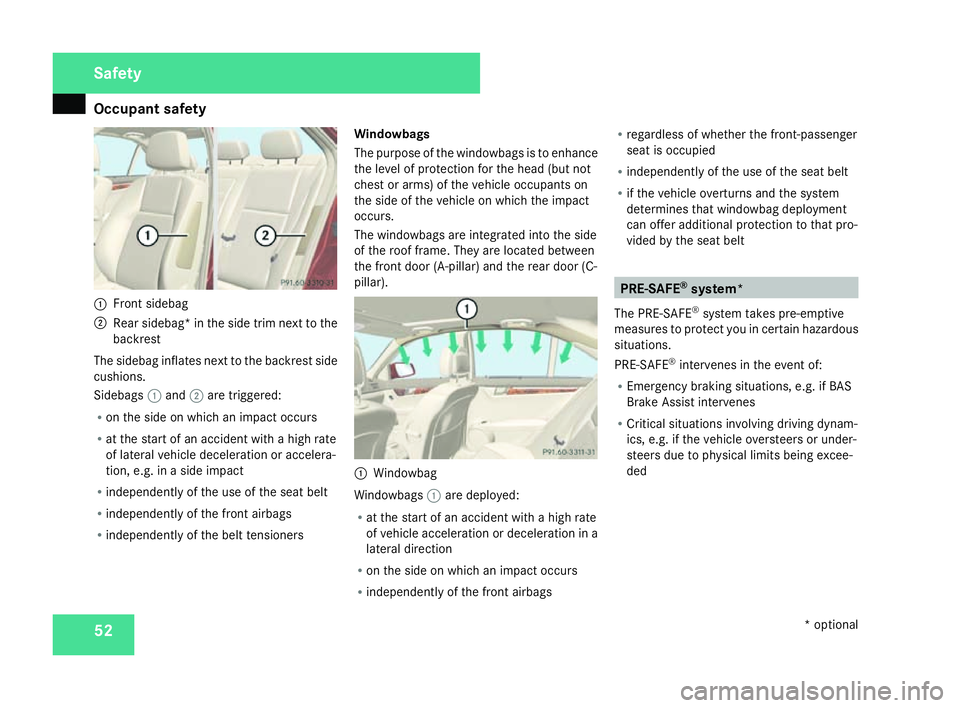
y521
Front sideba g
2 Rear sidebag* in the side trim next to th e
backrest
The sidebag inflates next to the backrest side
cushions.
Sidebags 1and 2are triggered:
R on the side on which an impact occurs
R at the start of an accident with a high rat e
of lateral vehicle deceleration or accelera-
tion, e.g. in a side impact
R independently of the use of the seat belt
R independently of the front airbags
R independently of the belt tensioners Windowbags
The purpose of the windowbags is to enhanc
e
the level of protection for the head (but not
chest or arms) of the vehicle occupants on
the side of the vehicle on which the impact
occurs.
The windowbags are integrated into the side
of the roof frame. They are located between
the front door (A-pillar) and the rear door (C -
pillar). 1
Windowbag
Windowbags 1are deployed:
R at the start of an accident with a high rat e
of vehicle acceleration or deceleration in a
lateral direction
R on the side on which an impact occurs
R independently of the front airbags R
regardless of whether the front-passenge r
seat is occupied
R independently of the use of the seat belt
R if the vehicle overturns and the system
determines that windowbag deploymen t
can offer additional protection to that pro -
vided by the seat belt PRE-SAFE
®
system *
The PRE-SAFE ®
system takes pre-emptive
measures to protect you in certain hazardous
situations.
PRE-SAFE ®
intervenes in the event of:
R Emergency braking situations, e.g. if BAS
Brake Assist intervenes
R Critical situations involving driving dynam-
ics, e.g. if the vehicle oversteers or under-
steers due to physical limits being excee -
ded Safet
y
* optional
204_AKB; 2; 3, en-GB
mkalafa,
2007-06-26T23:11:51+02:00 - Seite 52
Page 56 of 377
Occupant safet
y 53
If you are driving faster than approximately
35 km/h, PRE-SAFE ®
takes the following
measures in the aforementioned situations:
R It tensions the front seat belts.
R On vehicles with the memory package*: it
adjusts the front-passenger seat to a more
favourable position.
R If the vehicle skids, it closes the sliding/
tilting sunroof* or panorama sliding/tilting
sunroof* and the side windows, leaving a
small gap.
If the hazardous situation passes without
resulting in an accident, PRE-SAFE ®
releases
the belt pretensioning. You can then readjust
the front-passenger seat and, on vehicles
with the memory package*, the sides win-
dows and the sliding/tilting sunroof* or pan-
orama sliding/tilting sunroof* .
If the seat belts are not released:
X Move the backrest or the seat back slightly
until the belt tension is reduced.
The locking mechanism releases. G
Risk of injury
Make sure that nobody can become trap -
ped as you adjust the seat. !
Make sure that there are no objects in the
footwell or behind the seats when adjustin g
the seats. You could otherwise damage the
seats and the objects . NECK-PRO head restrain
t
NECK-PRO head restraints are designed to
increase protection to the driver's and front-
passenger's head and neck. To this end, the
head restraints on the driver's and front-
passenger seats are moved forwards and
upwards in the event of a rear-end collision in
the direction of travel. This provides better
head support. G
Risk of injury
Head restraint covers prevent the NECK -
PRO head restraints from triggering cor-
rectly. Consequently, the NECK-PRO head
restraints cannot provide the intended level
of protection. Do not use head restraint
covers .
If the NECK-PRO head restraints are triggered
in an accident, you must reset the head
restraints on the driver's and front-passenger
seats (Y page 303). Head restraints that have
been triggered are tilted forwards. Children in the vehicle
If a child is travelling in your vehicle, secure
the child, preferably on a suitable seat in the
rear, using a child restraint system appropri-
ate to the size and age of the child and rec-
ommended for Mercedes-Benz vehicles. If
possible you should do this on a suitable rear
seat.
You can obtain information about the correct
child restraint system from any Mercedes-
Benz Service Centre.
i It is advisable to use Mercedes-Benz care
products to clean child restraint systems.
You can obtain information about this from
any Mercedes-Benz Service Centre. G
Risk of injury
Do not leave children unsupervised in the
vehicle, even if they are secured in a chil d
restraint system. They could be injured on
parts of the vehicle. They could be seriously
or even fatally injured by prolonged expo-
sure to extreme heat or cold.
Do not expose the child restraint system to
direct sunlight. The metallic parts of the
child restraint system could heat up and the
child could be burned by them. Safety
* optional
204_AKB; 2; 3, en-GB
mkalafa,
2007-06-26T23:11:51+02:00 - Seite 53 Z
Page 57 of 377
Occupant safet
y54 If the children open a door, they could injure
others. They could get out and injure them
-
selves or be injured by a passing vehicle.
An unsecured or incorrectly positioned load
increases the risk of injury to the child in
the event of:
R an acciden t
R a braking manoeuvre
R a sudden change of direction
Do not carry heavy or hard objects inside
the vehicle unless they are secured. You
will find further information under "Loading
guidelines" in the index .
Child restraint systems Mercedes-Benz recommends that you only
use the child restraint systems listed on
( Y page 60). G
Risk of injury
To reduce the risk of serious or even fata l
injury to the child in the event of an acci-
dent, braking or sudden change in direc -
tion:
R Children less than 1.50 m tall and under
twelve years of age must always be secured in special child restraint systems
on a suitable seat. This is necessary
because the seat belts are not designed
for children
.
R Do not secure children under twelv e
years of age on the front-passenger seat .
Exception: the vehicle is fitted with auto-
matic child seat recognition on the front-
passenger seat* and the child is secured
in a child restraint system with automatic
child seat recognition.
R If you fit a child restraint system to the
front-passenger seat, you must move the
front-passenger seat as far back as pos-
sible.
R Never allow children to travel sitting on
the lap of another occupant. Due to the
forces occurring in the event of an acci-
dent, heavy braking or sudden change in
direction, it would not be possible to
restrain the child. The child would be
thrown against parts of the vehicle inte-
rior and be seriously or even fatally
injured. G
Risk of injury
If a child restraint system is not fitted prop-
erly to a suitable seat in the vehicle, it
cannot provide its protective function. It
would not be possible to restrain the chil d
in the event of an accident, sudden braking
or a sudden change in direction. The child
could be seriously or even fatally injured.
For this reason, observe the manufac-
turer’s installation instructions and correc t
use when fitting the child restraint system.
Child restraint systems should preferably
be fitted to the rear seats. The child is gen -
erally better protected there.
The entire base of the child restraint system
must always be resting on the seat cushion.
For this reason you should never place
objects, e.g. a cushion, under the child
restraint system.
Only use child restraint systems with the
original cover designed for them. Only
replace damaged covers with genuine
Mercedes-Benz covers.
Only use child restraint systems which have
been approved for use in Mercedes-Benz
vehicles. Safety
* optional
204_AKB; 2; 3, en-GB
mkalafa,
2007-06-26T23:11:51+02:00 - Seite 54
Page 59 of 377
Occupant safet
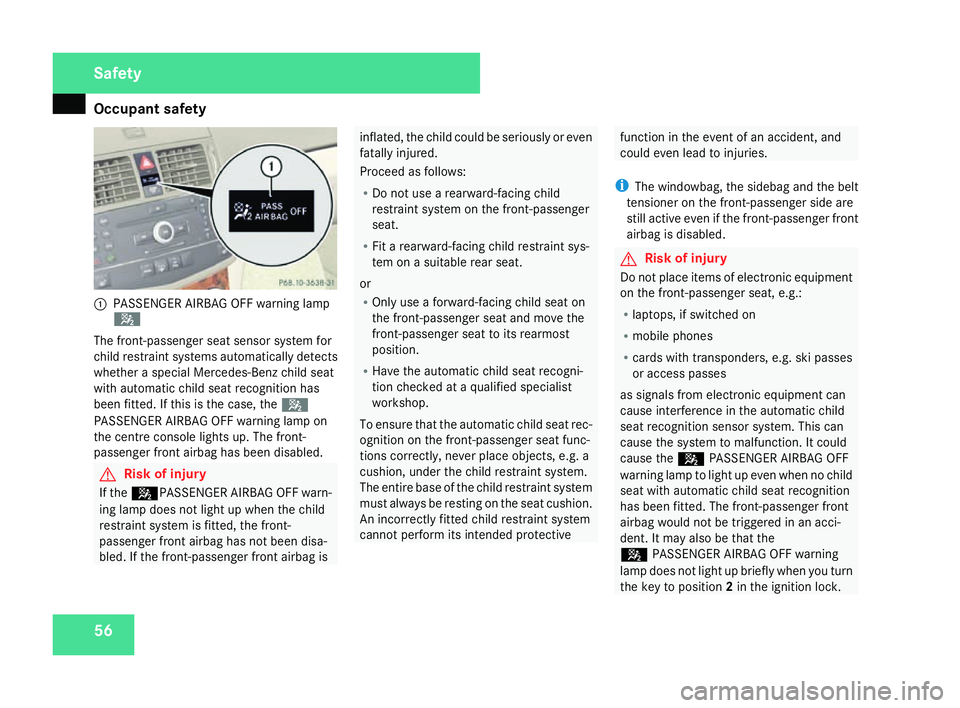
y561
PASSENGER AIRBAG OFF warning lamp
5
The front-passenger seat sensor system for
child restraint systems automatically detect s
whether a special Mercedes-Benz child seat
with automatic child seat recognition has
been fitted. If this is the case, the 5
PASSENGER AIRBAG OFF warning lamp on
the centre console lights up. The front-
passenger front airbag has been disabled. G
Risk of injury
If the 5PASSENGER AIRBAG OFF warn-
ing lamp does not light up when the child
restraint system is fitted, the front-
passenger front airbag has not been disa-
bled. If the front-passenger front airbag is inflated, the child could be seriously or even
fatally injured.
Proceed as follows:
R
Do not use a rearward-facing child
restraint system on the front-passenge r
seat.
R Fit a rearward-facing child restraint sys-
tem on a suitable rear seat.
or
R Only use a forward-facing child seat on
the front-passenger seat and move the
front-passenger seat to its rearmost
position.
R Have the automatic child seat recogni-
tion checked at a qualified specialist
workshop .
To ensure that the automatic child seat rec-
ognition on the front-passenger seat func-
tions correctly, never place objects, e.g. a
cushion, under the child restraint system.
The entire base of the child restraint system
must always be resting on the seat cushion.
An incorrectly fitted child restraint system
cannot perform its intended protective function in the event of an accident, and
could even lead to injuries.
i The windowbag, the sidebag and the belt
tensioner on the front-passenger side are
still active even if the front-passenger front
airbag is disabled. G
Risk of injury
Do not place items of electronic equipment
on the front-passenger seat, e.g.:
R laptops, if switched on
R mobile phones
R cards with transponders, e.g. ski passe s
or access passes
as signals from electronic equipment can
cause interference in the automatic child
seat recognition sensor system. This can
cause the system to malfunction. It could
cause the 5PASSENGER AIRBAG OFF
warning lamp to light up even when no child
seat with automatic child seat recognition
has been fitted. The front-passenger front
airbag would not be triggered in an acci-
dent. It may also be that th e
5 PASSENGER AIRBAG OFF warning
lamp does not light up briefly when you turn
the key to position 2in the ignition lock .Safety
204_AKB; 2; 3, en-GB
mkalafa,
2007-06-26T23:11:51+02:00 - Seite 56
Page 65 of 377
Occupant safet
y62
ISOFIX child seat securing system in the
rea
r ISOFIX is a standardised securing system for
specially designed child restraint systems in
the rear. There are securing rings for two child
restraint systems on the left and right-hand
rear seats between the seat cushions and the
backrest.
G
Risk of injury
A child restraint system secured by the ISO-
FIX child seat securing system does not
provide sufficient protection for children
weighing more than 22 kg. For this reason,
do not secure children weighing more than
22 kg in a child restraint system secured by
the ISOFIX child seat securing system. If
the child weighs more than 22 kg, secure
the child restraint system using a lap-shoul-
der belt. G
Risk of injury
If a child restraint system is not fitted prop-
erly to a suitable seat in the vehicle, it
cannot provide its protective function. It
would not be possible to restrain the child
in the event of an accident, sudden braking
or a sudden change in direction. The child
could be seriously or even fatally injured . For this reason, observe the manufac-
turer’s installation instructions and correct
use when fitting the child restraint system.
On the rear seats, only use child restraint
systems with an ISOFIX child seat securing
system which have been recommended for
use in Mercedes-Benz vehicles .
An incorrectly fitted child restraint system
could come loose and seriously or eve n
fatally injure the child or other vehicle occu-
pants. When fitting the child restraint sys -
tem, make sure that it is engaged in the
securing rings on both sides. G
Risk of injury
Please note that child restraint systems
cannot provide a protective function if they
or their retaining systems are damaged or
have been subjected to a load in an acci -
dent. The child secured in this system could
be injured seriously or even fatally in the
event of an accident, sudden braking or a
sudden change in direction.
You must therefore have child restraint sys-
tems that are damaged or have been sub-
jected to a heavy load in an accident
checked immediately along with their
anchorages at a qualified specialist work-
shop. !
When fitting the child restraint system,
make sure that the seat belt for the middle
seat does not get trapped. It could other-
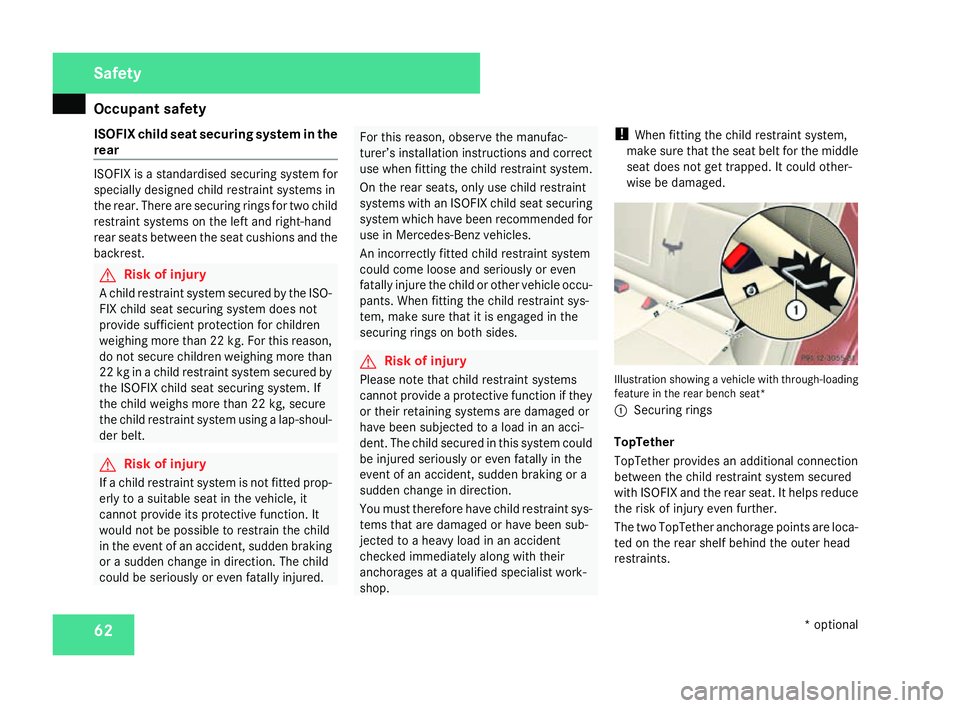
wise be damaged. Illustration showing a vehicle with through-loading
feature in the rear bench seat*
1
Securing ring s
TopTether
TopTether provides an additional connectio n
between the child restraint system secured
with ISOFIX and the rear seat. It helps reduce
the risk of injury even further.
The two TopTether anchorage points are loca-
ted on the rear shelf behind the outer head
restraints. Safet
y
* optional
204_AKB; 2; 3, en-GB
mkalafa,
2007-06-26T23:11:51+02:00 - Seite 62