brakes MERCEDES-BENZ C-CLASS SALOON 2007 User Guide
[x] Cancel search | Manufacturer: MERCEDES-BENZ, Model Year: 2007, Model line: C-CLASS SALOON, Model: MERCEDES-BENZ C-CLASS SALOON 2007Pages: 377, PDF Size: 6.19 MB
Page 221 of 377
Driving
tips 21
8
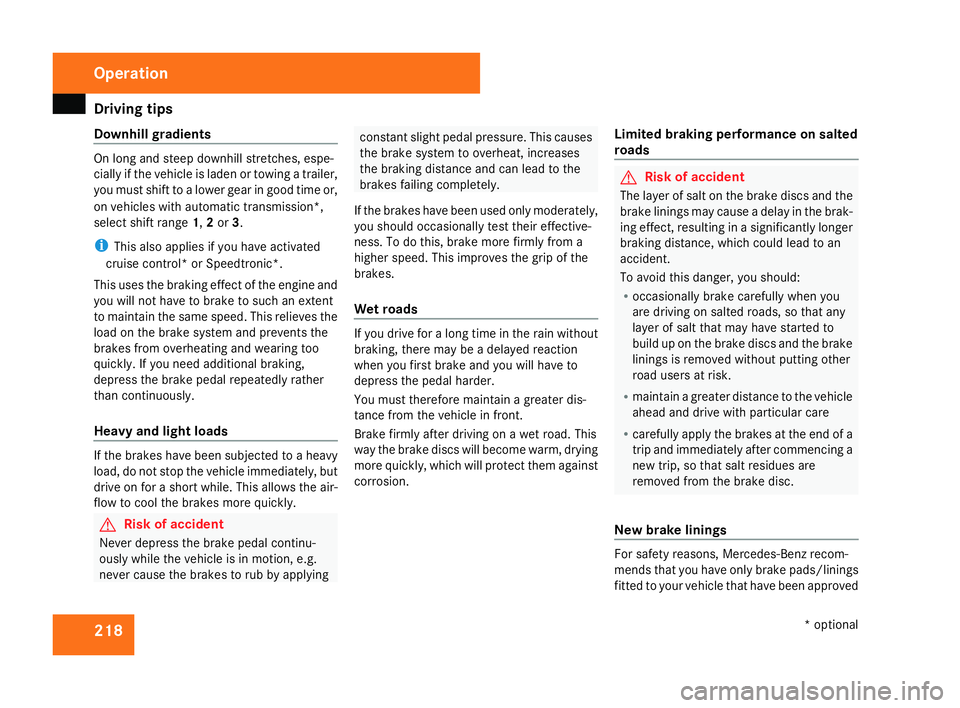
Downhill gradient
sOn long and steep downhill stretches, espe-
cially if the vehicle is laden or towing a trailer,
you must shift to a lower gear in good time or,
on vehicles with automatic transmission*,
select shift range 1,2 or 3.
i This also applies if you have activated
cruise control* or Speedtronic*.
This uses the braking effect of the engine and
you will not have to brake to such an exten t
to maintain the same speed. This relieves the
load on the brake system and prevents the
brakes from overheating and wearing too
quickly. If you need additional braking ,
depress the brake pedal repeatedly rather
than continuously.
Heavy and light loads If the brakes have been subjected to a heavy
load, do not stop the vehicle immediately, but
drive on for a short while. This allows the air-
flow to cool the brakes more quickly. G
Risk of accident
Never depress the brake pedal continu -
ously while the vehicle is in motion, e.g.
never cause the brakes to rub by applying constant slight pedal pressure. This causes
the brake system to overheat, increases
the braking distance and can lead to the
brakes failing completely.
If the brakes have been used only moderately,
you should occasionally test their effective-
ness. To do this, brake more firmly from a
higher speed. This improves the grip of the
brakes.
Wet roads If you drive for a long time in the rain without
braking, there may be a delayed reaction
when you first brake and you will have to
depress the pedal harder.
You must therefore maintain a greater dis-
tance from the vehicle in front.
Brake firmly after driving on a wet road. Thi
s
way the brake discs will become warm, dryin g
more quickly, which will protect them against
corrosion. Limited braking performance on salted
roads G
Risk of accident
The layer of salt on the brake discs and the
brake linings may cause a delay in the brak-
ing effect, resulting in a significantly longer
braking distance, which could lead to an
accident.
To avoid this danger, you should:
R occasionally brake carefully when you
are driving on salted roads, so that any
layer of salt that may have started to
build up on the brake discs and the brake
linings is removed without putting other
road users at risk.
R maintain a greater distance to the vehicl e
ahead and drive with particular car e
R carefully apply the brakes at the end of a
trip and immediately after commencing a
new trip, so that salt residues ar e
removed from the brake disc.
New brake linings For safety reasons, Mercedes-Benz recom
-
mends that you have only brake pads/linings
fitted to your vehicle that have been approved Operation
* optional
204_AKB; 2; 3, en-GB
mkalafa,
2007-06-26T23:11:51+02:00 - Seite 218
Page 226 of 377
Trailer towing*
22
3
R
has an increased braking distance
R is affected more by strong crosswinds
R demands more sensitive steering
R consumes more fue l
On long and steep downhill gradients you
must select a lower gear in good time, or on
vehicles with automatic transmission*, select
the shift range 1,2 or 3.
i This also applies if you have activated
cruise control* or Speedtronic*.
This uses the braking effect of the engine and
you will not have to brake to such an exten t
to maintain the same speed. This relieves the
load on the brake system and prevents the
brakes from overheating and wearing too
quickly. If you need additional braking ,
depress the brake pedal repeatedly rather
than continuously. G
Risk of accident
Never depress the brake pedal continu -
ously while the vehicle is in motion, e.g.
never cause the brakes to rub by applying
constant slight pedal pressure. This causes
the brake system to overheat, increases
the braking distance and can lead to the
brakes failing completely. Driving tips
R
Maintain a greater distance from the vehi-
cle in front than when driving without a
trailer.
R Avoid braking abruptly. If possible, brake
gently at first to allow the trailer to run on.
Then increase the braking force rapidly.
R The values given for gradient-climbing
capabilities from a standstill refer to sea
level. When driving in mountainous areas,
note that the power output of the engine
and with it its gradient-climbing capability
decrease with increasing altitude.
If the trailer swings from side to side:
X Do not accelerate.
X Do not counter-steer.
X Brake if necessary. G
Risk of accident
On no account should you attempt to dra w
the vehicle/trailer combination out by
increasing speed. Folding in the ball couplin
g
i Fold in the ball coupling when you are not
using the trailer tow hitch . G
Risk of injury
Make sure that no persons or animals are
in the pivoting range of the ball coupling.
Otherwise, they could be injured .
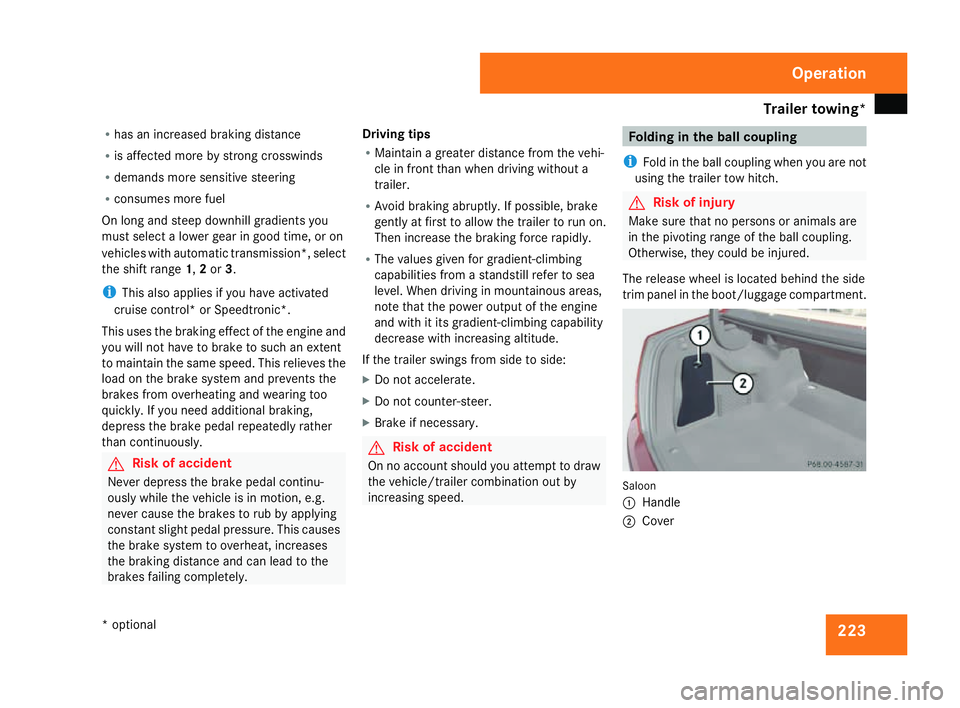
The release wheel is located behind the side
trim panel in the boot/luggage compartment. Saloon
1 Handl e
2 Cove r Operation
* optional
204_AKB; 2; 3, en-GB
mkalafa,
2007-06-26T23:11:51+02:00 - Seite 223
Page 244 of 377
Display
messages 24
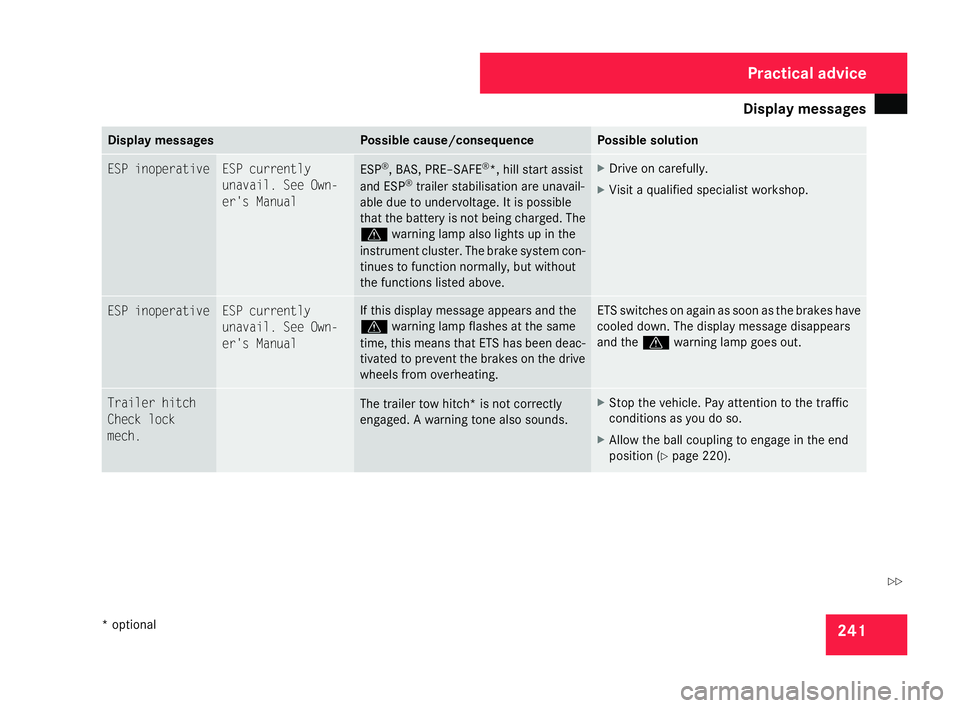
1 Display messages Possible cause/consequence Possible solution
ESP inoperative ESP currently
unavail. See Own
-
er's Manual ESP
®
, BAS, PRE–SAFE ®
*, hill start assist
and ESP ®
trailer stabilisation are unavail -
able due to undervoltage. It is possible
that the battery is not being charged. The
v warning lamp also lights up in th e
instrument cluster. The brake system con -
tinues to function normally, but without
the functions listed above . X
Drive on carefully.
X Visit a qualified specialist workshop. ESP inoperative ESP currently
unavail. See Own-
er's Manual If this display message appears and the
v
warning lamp flashes at the same
time, this means that ETS has been deac-
tivated to prevent the brakes on the driv e
wheels from overheating . ETS switches on again as soon as the brakes have
cooled down. The display message disappears
and the
vwarning lamp goes out. Trailer hitch
Check loc
k
mech. The trailer tow hitch* is not correctly
engaged. A warning tone also sounds. X
Stop the vehicle. Pay attention to the traffic
conditions as you do so.
X Allow the ball coupling to engage in the end
position (Y page 220). Practical advice
* optional
204_AKB; 2; 3, en-GB
mkalafa,
2007-06-26T23:11:51+02:00 - Seite 241 Z
Page 283 of 377
Troubleshooting
28
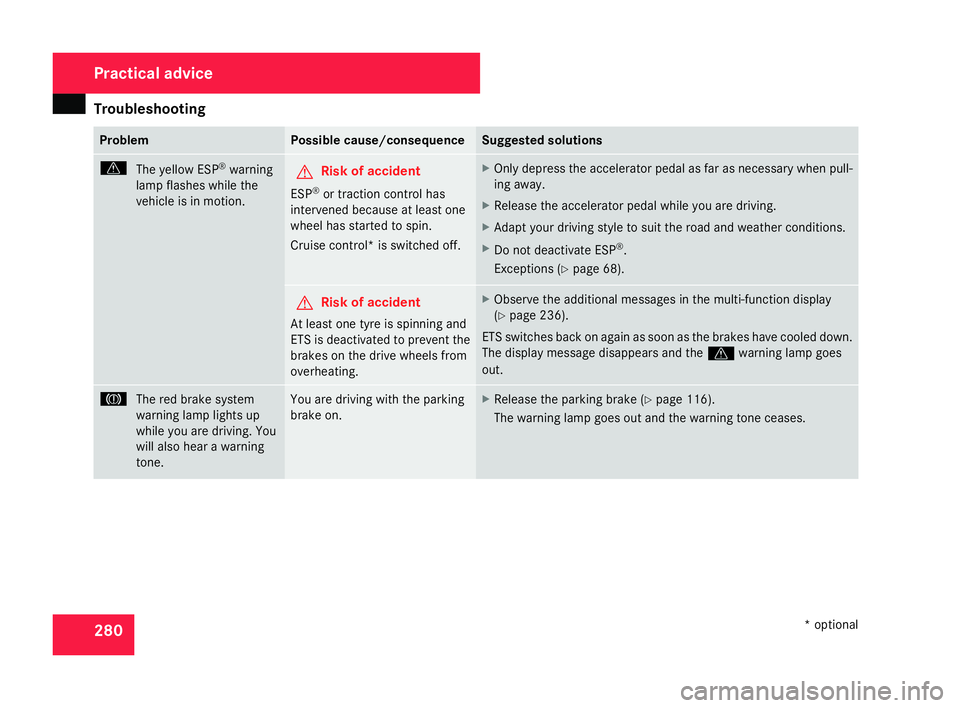
0 Problem Possible cause/consequence Suggested solutions
v
The yellow ESP ®
warning
lamp flashes while th e
vehicle is in motion. G
Risk of accident
ESP ®
or traction control has
intervened because at least one
wheel has started to spin.
Cruise control* is switched off. X
Only depress the accelerator pedal as far as necessary when pull-
ing away.
X Release the accelerator pedal while you are driving.
X Adapt your driving style to suit the road and weather conditions.
X Do not deactivate ESP ®
.
Exceptions (Y page 68). G
Risk of accident
At least one tyre is spinning and
ETS is deactivated to prevent the
brakes on the drive wheels from
overheating. X
Observe the additional messages in the multi-function display
(Y page 236).
ETS switches back on again as soon as the brakes have cooled down.
The display message disappears and the vwarning lamp goes
out. 3
The red brake system
warning lamp lights up
while you are driving. You
will also hear a warning
tone. You are driving with the parking
brake on. X
Release the parking brake (Y page 116).
The warning lamp goes out and the warning tone ceases. Practical advice
* optional
204_AKB; 2; 3, en-GB
mkalafa,
2007-06-26T23:11:51+02:00 - Seite 280
Page 334 of 377

Towing and tow-startin
g 331
Opening the rear cover
Rear bumper
1
Cove r
X Press the mark on cover 1inwards.
X Take cover 1off the opening but do not
remove it.
Securing the towing eye X
Take the towing eye and the wheel wrench
from the vehicle tool kit (Y page 234).
X Screw in the towing eye clockwise to the
stop .
X Insert the wheel wrench handle into the
towing eye and tighten. Towing the vehicle
! Vehicles with 4MATIC* may not be towed
with the front or rear axle raised.
! If the vehicle is to be towed with the front
or rear axle raised, the ignition must be
switched off (key in position 0or 1in the
ignition lock). Application of the brakes by
ESP ®
could otherwise destroy the brake
system on the front or rear axle.
Vehicles with manual transmission X
Turn the key to position 2in the ignition
lock .
X Shift to neutral .
Vehicles with automatic transmission * X
Turn the key to position 2in the ignition
lock .
X Move the selector lever to N. Tow-starting (emergency engine
starting )
Please note:
R Vehicles with an automatic transmission*
must not be tow-started.
R The battery must be connected.
R The engine and catalytic converter must be
cold.
R Avoid repeated and lengthy starting
attempts .
Vehicles with manual transmission X
Turn the key to position 2in the ignition
lock .
X Shift to neutral .
X Tow the vehicle or let it roll.
X Shift to a suitable gear and bring the clutch
pedal up slowly. Do not depress the accel-
erator pedal.
The engine is started. Practical advice
* optiona l
204_AKB; 2; 3, en-GB
mkalafa,
2007-06-26T23:11:51+02:00 - Seite 331
Page 374 of 377

Service products and capacities
371Brake fluid
Over a period of time, the brake fluid absorbs
moisture from the air; this lowers its boiling
point. G
Risk of accident
If the boiling point of the brake fluid is too
low, vapour pockets may form in the brake
system when the brakes are applied hard
(e.g. when driving downhill). This woul d
impair braking efficiency.
Have the brake fluid renewed every two
years with a brake fluid that has been
approved by Mercedes-Benz and have this
confirmed in the Service Booklet.
i There is usually a notice in the engine
compartment to remind you when the next
brake fluid change is due. Windscreen washer system
The washer fluid reservoir holds approxi-
mately 4.0 litres.
The headlamp cleaning system* and the
windscreen washer system are both supplied
from the washer fluid reservoir.
X At temperatures above freezing point:
Top up the washer fluid reservoir with a
mixture of water and windscreen washer
concentrate (Y page 210).
X At temperatures below freezing point:
Top up the washer fluid reservoir with a
mixture of water, antifreeze and wind-
screen washer concentrate (Y page 210).
Adapt the mixing ratio to the outside tem-
peratures . G
Risk of fire
Windscreen washer concentrate is highly
flammable. Fire, naked flames and smoking
are prohibited when windscreen washe r
concentrate is being handled. Technical data
* optiona l
204_AKB; 2; 3, en-GB
mkalafa,
2007-06-26T23:11:51+02:00 - Seite 371