engine MERCEDES-BENZ C-CLASS SALOON 2011 Owners Manual
[x] Cancel search | Manufacturer: MERCEDES-BENZ, Model Year: 2011, Model line: C-CLASS SALOON, Model: MERCEDES-BENZ C-CLASS SALOON 2011Pages: 401, PDF Size: 9.74 MB
Page 357 of 401
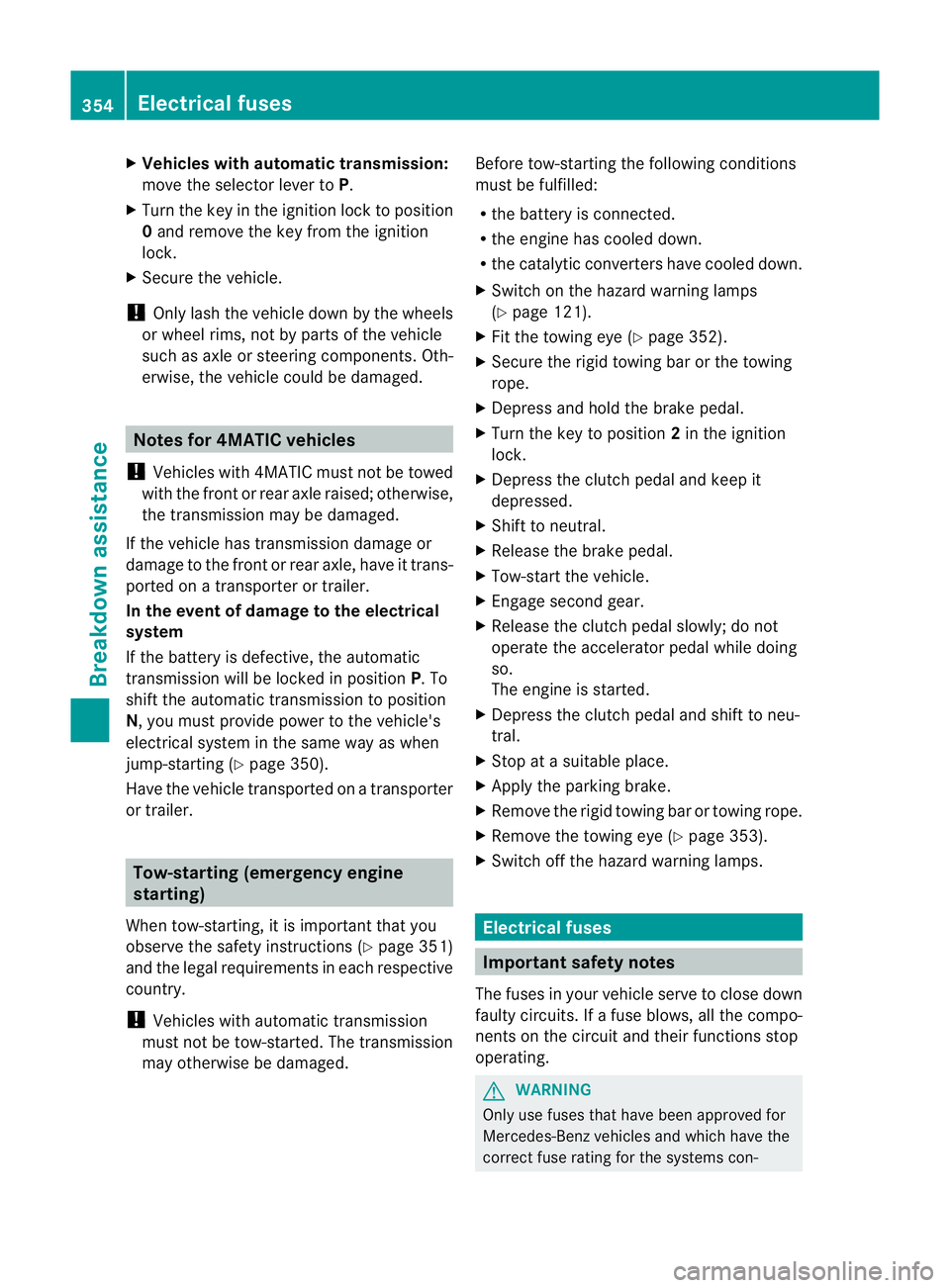
X
Vehicles with automatic transmission:
move the selector lever to P.
X Turn the key in the ignition lock to position
0and remove the key from the ignition
lock.
X Secure the vehicle.
! Only lash the vehicle dow nby the wheels
or wheel rims, no tby parts of the vehicle
such as axle or steering components. Oth-
erwise, the vehicle could be damaged. Notes for 4MATIC vehicles
! Vehicles with 4MATIC mus tnot be towed
with the front or rear axle raised; otherwise,
the transmission may be damaged.
If the vehicle has transmission damage or
damage to the front or rear axle, have it trans-
ported on a transporter or trailer.
In the event of damage to the electrical
system
If the battery is defective, the automatic
transmission will be locked in position P. To
shift the automatic transmission to position
N, you must provide power to the vehicle's
electrical system in the same way as when
jump-starting (Y page 350).
Have the vehicle transported on a transporter
or trailer. Tow-starting (emergency engine
starting)
When tow-starting, it is important that you
observe the safety instructions (Y page 351)
and the legal requirements in each respective
country.
! Vehicles with automatic transmission
must not be tow-started. The transmission
may otherwise be damaged. Before tow-starting the following conditions
must be fulfilled:
R
the battery is connected.
R the engine has cooled down.
R the catalytic converters have cooled down.
X Switch on the hazard warning lamps
(Y page 121).
X Fit the towing eye (Y page 352).
X Secure the rigid towing bar or the towing
rope.
X Depress and hold the brake pedal.
X Turn the key to position 2in the ignition
lock.
X Depress the clutch pedal and keep it
depressed.
X Shift to neutral.
X Release the brake pedal.
X Tow-start the vehicle.
X Engage second gear.
X Release the clutch pedal slowly; do not
operate the accelerator pedal while doing
so.
The engine is started.
X Depress the clutch pedal and shift to neu-
tral.
X Stop at a suitable place.
X Apply the parking brake.
X Remove the rigid towing bar or towing rope.
X Remove the towing eye (Y page 353).
X Switch off the hazard warning lamps. Electrical fuses
Important safety notes
The fuses in your vehicle serve to close down
faulty circuits. If afuse blows, all the compo-
nents on the circuit and their functions stop
operating. G
WARNING
Only use fuses that have been approved for
Mercedes-Ben zvehicles and which have the
correct fuse rating for the systems con- 354
Electrical fusesBreakdown assistance
Page 358 of 401

cerned. Do not attempt to repair or bridge
faulty fuses. Otherwise, a circuit overload
could cause a fire .Have the cause traced and
rectified at a qualified specialist workshop,
e.g. a Mercedes-Benz Service Centre.
Blown fuses must be replaced with fuses of
the same rating, which you can recognise by
the colour and value. The fuse ratings are lis-
ted in the fuse allocatio nchart. AMercedes-
BenzS ervice Centre will be happy to advise
you.
If the newly inserted fuse also blows, have the
cause traced and rectified at a qualified spe-
cialist workshop, e.g. a Mercedes-Benz
Service Centre.
! Only use fuses that have been approved
for Mercedes-Benzv ehicles and which
have the correct fuse rating for the system
concerned. Otherwise, components or sys-
tems could be damaged. Before changing a fuse
X Park the vehicle and apply the parking
brake.
X Switch off all electrical consumers.
X Remove the key from the ignition lock.
The fuses are located in various fuse boxes:
R fuse box on the driver's side of the dash-
board
R fuse box in the engine compartment on the
left-hand side of the vehicle, when viewed
in the direction of travel
R fuse box in the boot/luggage compartment
on the right-hand side of the vehicle, when
viewed in the direction of travel
The fuse allocation chart is located in the
vehicle tool kit (Y page 335) in the stowage
compartment under the boot/luggage com-
partment floor. Dashboard fuse box
! Do not use a pointed objec tsuch as a
screwdriver to open the cover in the dash-
board. You could damage th edashboard or
the cover. X
To open: pull out cover :slightly at the
bottom in the direction of arrow =.
X Pull cover :outwards in the direction of
arrow ;and remove it.
X To close: clip in cover :on the front of
the dashboard.
X Fold cover :inwards until it engages. Fuse box in the engine compartment
X Make sure that the windscree nwipers are
turned off. G
WARNING
Make sure that the windscreen wipers are
turned off and the key is pulled out of the igni-
tion lock before you open the cover of the fuse
box. Otherwise, the windscreen wipers and
the wiper rods above the cover could be set
in motion. This could lead to you or others
being injured by the wiper rods.
X Open the bonnet (Y page 322). Electrical fuses
355Breakdown assistance Z
Page 374 of 401
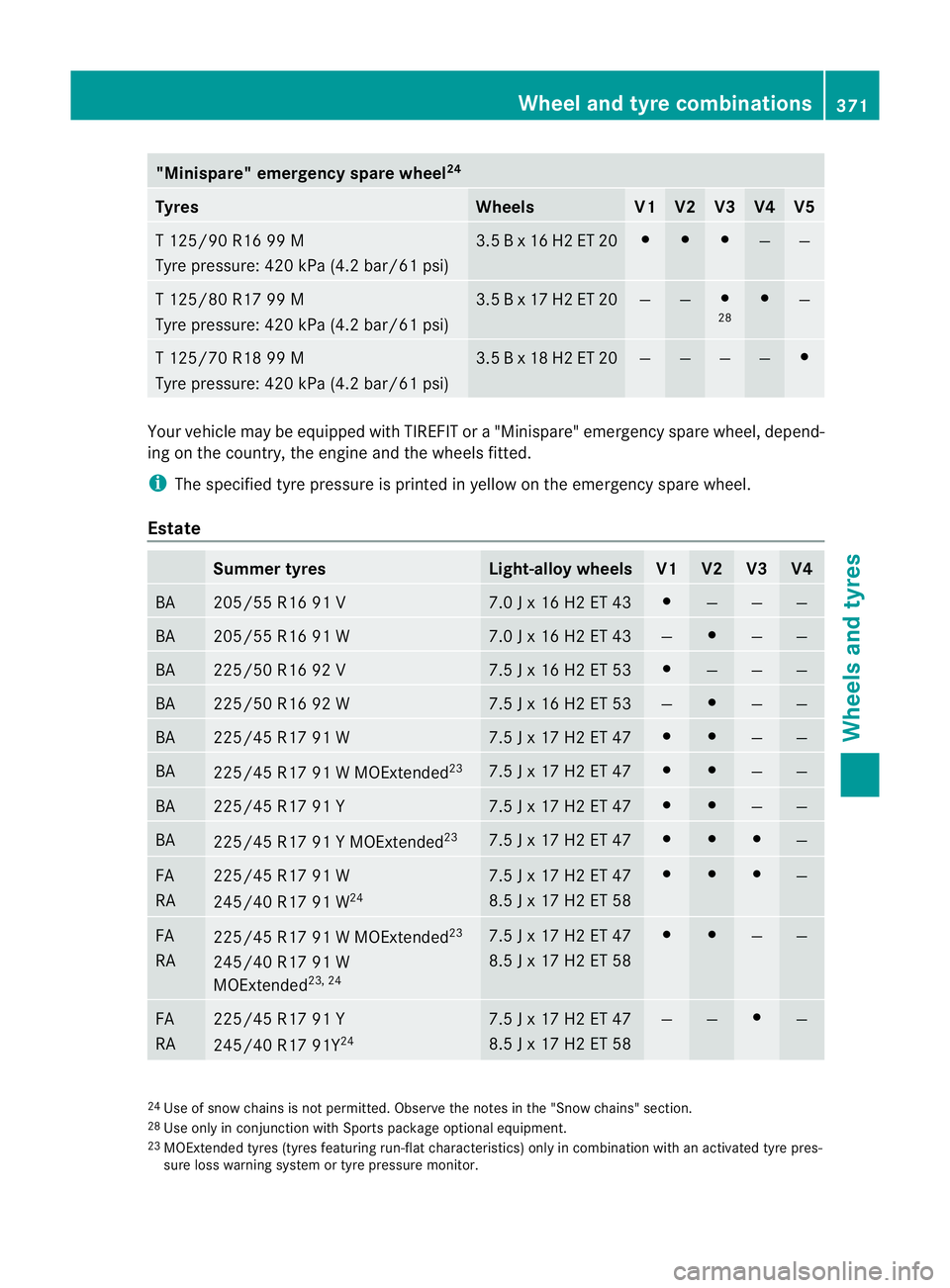
"Minispare" emergency spare wheel
24Tyres Wheels V1 V2 V3 V4 V5
T 125/90 R16 99 M
Tyre pressure: 420 kPa (4.2 bar/61 psi) 3.5 B x 16 H2 ET 20 # # #
— —
T 125/80 R17 99 M
Tyre pressure: 420 kPa (4.2 bar/61 psi) 3.5 B x 17 H2 ET 20 — — #
28 #
—
T 125/70 R18 99 M
Tyre pressure: 420 kPa (4.2 bar/61 psi) 3.5 B x 18 H2 ET 20 — — — — #
Your vehicle may be equipped with TIREFIT or a "Minispare" emergency spare wheel, depend-
ing on the country, the engine and the wheels fitted.
i The specified tyre pressure is printed in yellow on the emergency spare wheel.
Estate Summer tyres Light-alloy wheels V1 V2 V3 V4
BA 205/55 R16 91 V 7.0 J x 16 H2 ET 43 #
— — —
BA 205/55 R16 91 W 7.0 J x 16 H2 ET 43 — #
— —
BA 225/50 R16 92 V 7.5 J x 16 H2 ET 53 #
— — —
BA 225/50 R16 92 W 7.5 J x 16 H2 ET 53 — #
— —
BA 225/45 R17 91 W 7.5 J x 17 H2 ET 47 # #
— —
BA
225/45 R17 91 W MOExtended
23 7.5 J x 17 H2 ET 47 # #
— —
BA 225/45 R17 91 Y 7.5 J x 17 H2 ET 47 # #
— —
BA
225/45 R17 91 Y MOExtended
23 7.5 J x 17 H2 ET 47 # # #
—
FA
RA 225/45 R17 91 W
245/40 R17 91 W
24 7.5 J x 17 H2 ET 47
8.5 J x 17 H2 ET 58 # # #
—
FA
RA
225/45 R17 91 W MOExtended
23
245/40 R17 91 W
MOExtended 23, 24 7.5 J x 17 H2 ET 47
8.5 J x 17 H2 ET 58 # #
— —
FA
RA 225/45 R17 91 Y
245/40 R17 91Y
24 7.5 J x 17 H2 ET 47
8.5 J x 17 H2 ET 58 — — #
—
24
Use of snow chains is not permitted. Observe the notes in the "Snow chains" section.
28 Use only in conjunction with Sports package optional equipment.
23 MOExtended tyres (tyres featuring run-flat characteristics) only in combination with an activated tyre pres-
sure loss warning system or tyre pressure monitor. Wheel and tyre combinations
371Wheels and tyres Z
Page 376 of 401
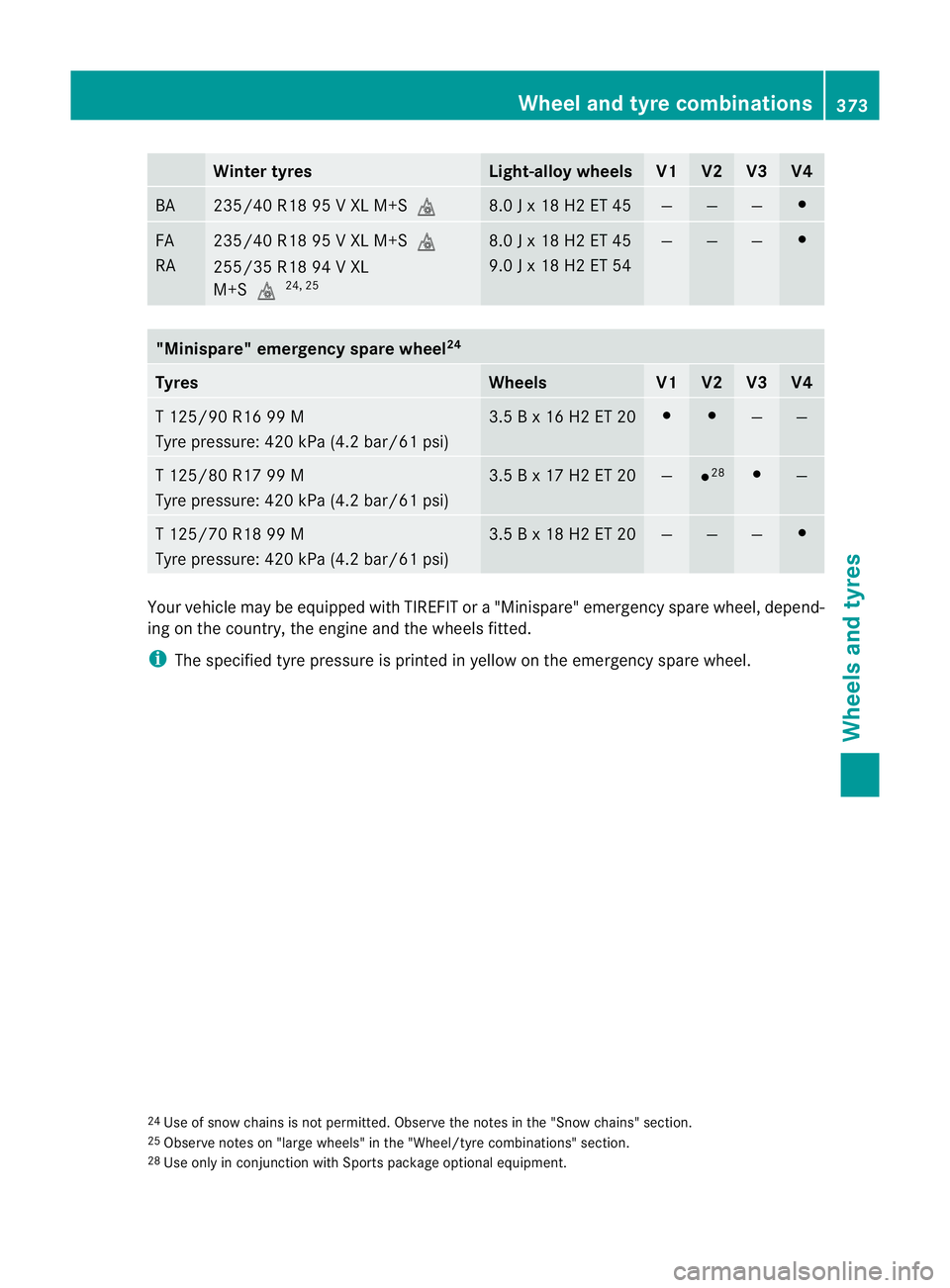
Winter tyres Light-alloy wheels V1 V2 V3 V4
BA 235/40 R18 95 V XL M+S
i 8.0 J x 18 H2 ET 45 — — — #
FA
RA 235/40 R18 95 V XL M+S
i
255/35 R18 94 V XL
M+Si 24, 25 8.0 J x 18 H2 ET 45
9.0 J x 18 H2 ET 54 — — — #
"Minispare" emergency spare wheel
24Tyres Wheels V1 V2 V3 V4
T 125/90 R16 99 M
Tyre pressure: 420 kPa (4.2 bar/61 psi) 3.5 B x 16 H2 ET 20 # #
— —
T 125/80 R17 99 M
Tyre pressure: 420 kPa (4.2 bar/61 psi) 3.5 B x 17 H2 ET 20 —
#
28 #
—
T 125/70 R18 99 M
Tyre pressure: 420 kPa (4.2 bar/61 psi) 3.5 B x 18 H2 ET 20 — — — #
Yourv
ehicle may be equipped with TIREFIT or a "Minispare" emergency spare wheel, depend-
ing on the country, the engine and the wheels fitted.
i The specified tyre pressure is printed in yellow on the emergency spare wheel.
24 Use of snow chains is not permitted. Observe the notes in the "Snow chains" section.
25 Observe notes on "large wheels" in the "Wheel/tyre combinations" section.
28 Use only in conjunction with Sports package optional equipment. Wheel and tyre combinations
373Wheels and tyres Z
Page 380 of 401
H
Environmental note
Daimler AG also supplies reconditioned
assemblies and parts which are of the same
quality as new parts. For these, the same war-
ranty applies as for new parts.
Always specify the vehicle identification num-
ber (VIN) (Y page 379) and the engine num-
ber (Y page 379) when ordering genuine
Mercedes-Ben zparts. Vehicle electronics
Tampering with the engine electron-
ics
G
WARNING
Only have work on the engine electronics and
related components carried out at a qualified
specialist workshop which has the necessary
specialist knowledge and tools to carry out
the work required. Mercedes-Benz recom-
mends that you use a Mercedes-Ben zService
Centre for this purpose. In particular, work
relevant to safety or on safety-related sys-
tems must be carried out at a qualified spe-
cialist workshop. Otherwise, the vehicle's
roadworthiness could be affected.
! Only have maintenance work on the
engine electronics and its associated parts,
such as control units, sensors and connec-
tor leads, carried out at a qualified special-
ist workshop, e.g. a Mercedes-Benz Service
Centre. Vehicle componentsm ay other-
wise wear more quickly and the vehicle's
operating permit may be invalidated. Retrofitting of two-way radios and
mobile phones (RF transmitters)
Use the Technical Specification
ISO/TS 21609 30
implementation regulation
when retrofitting RF (radio frequency) trans-
mitters. If your vehicle has fittings for two-way radio
equipment, use the power supply or aerial
connections intended for use with the basic
wiring. Be sure to observe the manufacturer's
additional instructions when installing the fit-
tings.
!
Have aftermarket radio frequency trans-
mitting equipmen tinstalled at a qualified
specialist workshop .Mercedes-Benzr ec-
ommends that you use a Mercedes-Benz
Service Centre for this purpose.
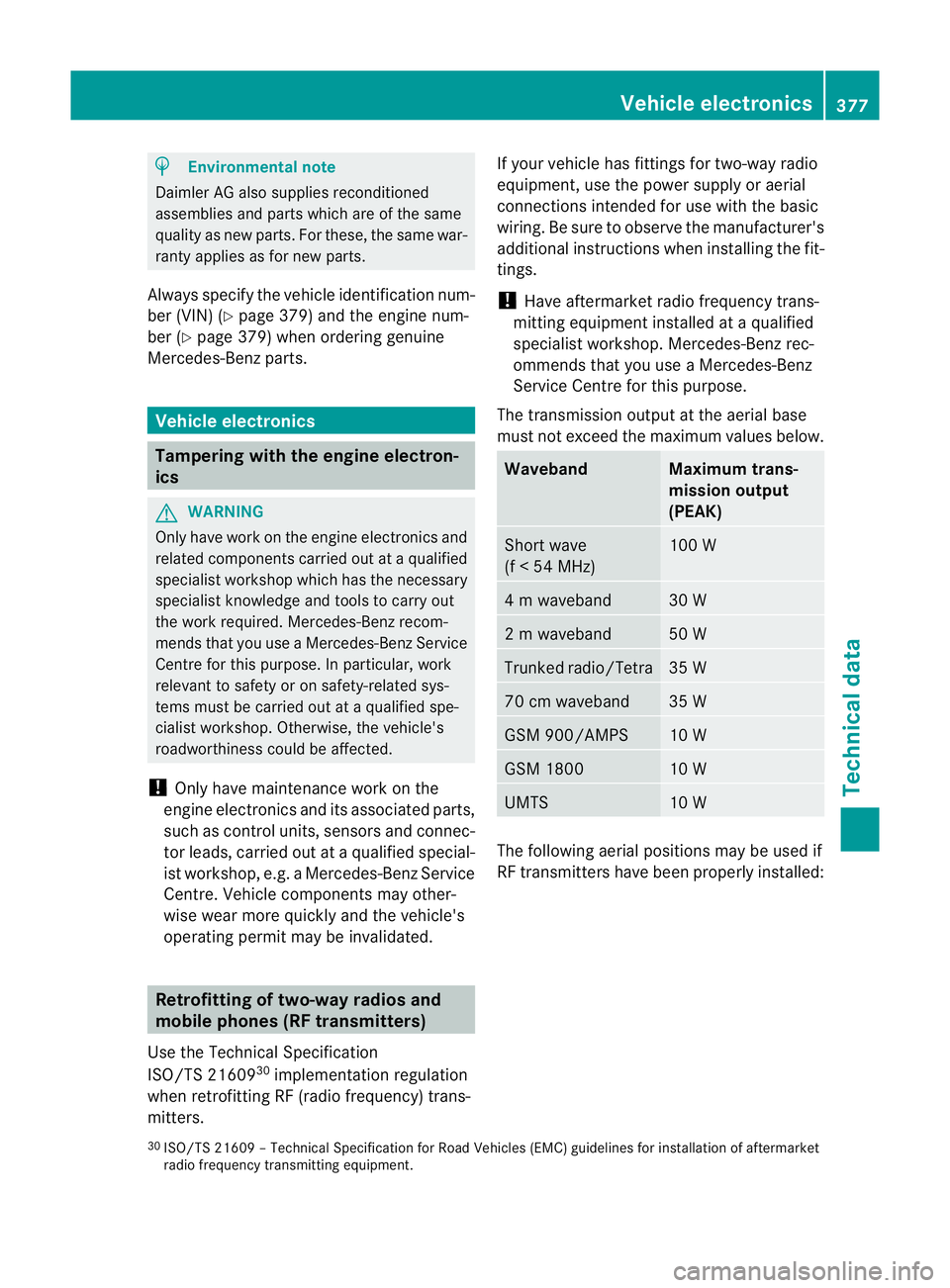
The transmission output at the aerial base
must not exceed the maximum values below. Waveband Maximum trans-
mission output
(PEAK)
Short wave
(f < 54 MHz) 100 W
4 m waveband 30 W
2 m waveband 50 W
Trunked radio/Tetra 35 W
70 cm waveband 35 W
GSM 900/AMPS 10 W
GSM 1800 10 W
UMTS 10 W
The following aerial positions may be used if
RF transmitters have been properly installed:
30 ISO/TS 2160 9–Technical Specification for Road Vehicles (EMC) guidelines for installation of aftermarket
radio frequency transmitting equipment. Vehicle electronics
377Technical data Z
Page 382 of 401
Vehicle identification plates
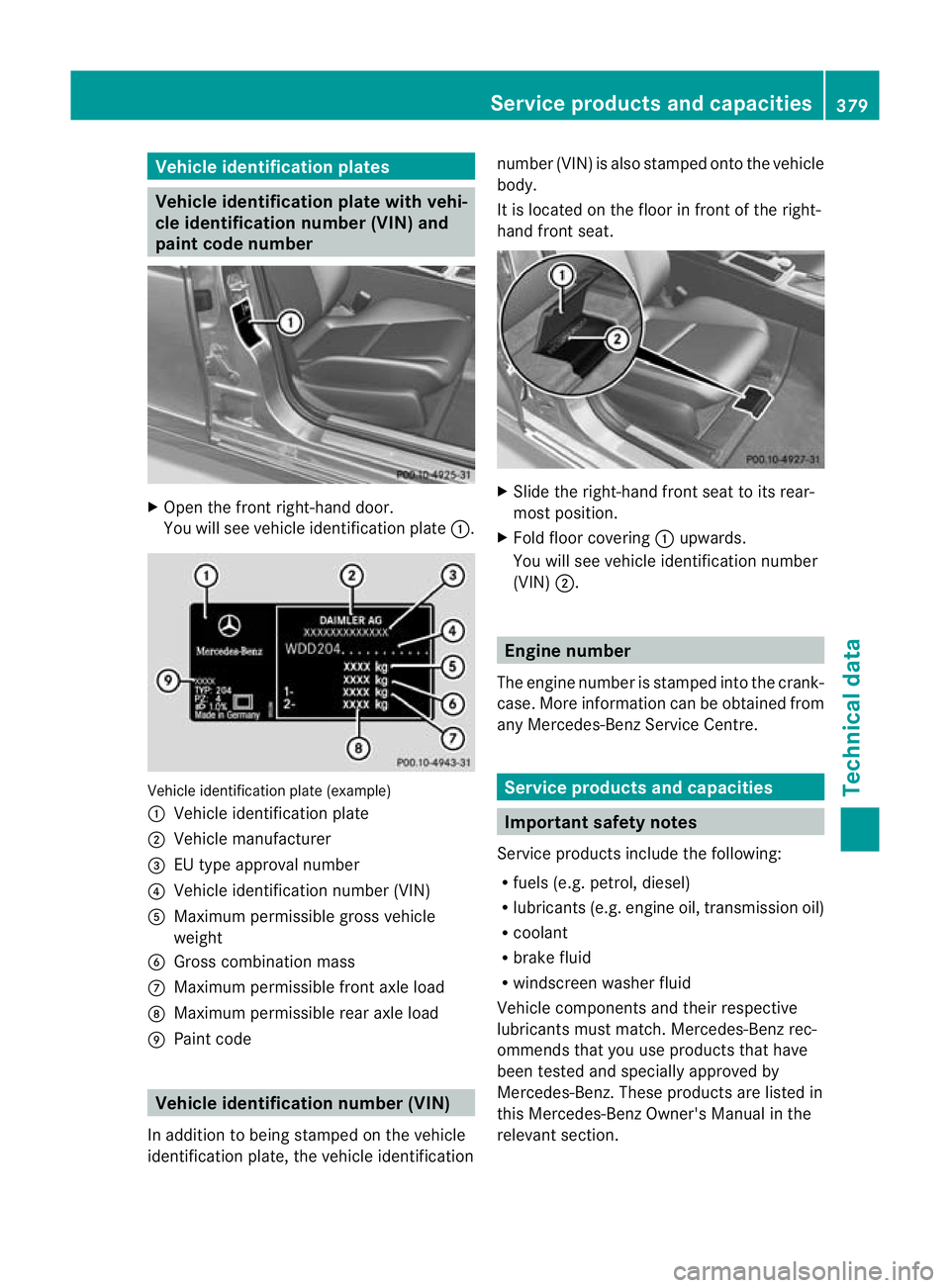
Vehicle identification plate with vehi-
cle identification number (VIN) and
pain tcode number X
Open the fron tright-hand door.
You will see vehicle identification plate :.Vehicle identification plate (example)
:
Vehicle identification plate
; Vehicle manufacturer
= EU type approval number
? Vehicle identification number (VIN)
A Maximum permissible gross vehicle
weight
B Gross combination mass
C Maximum permissible front axle load
D Maximum permissible rear axle load
E Paint code Vehicle identification number (VIN)
In additio nto being stamped on the vehicle
identification plate, the vehicle identification number (VIN) is also stamped onto the vehicle
body.
It is located on the floor in front of the right-
hand front seat.
X
Slide the right-hand front seat to its rear-
most position.
X Fold floor covering :upwards.
You will see vehicle identification number
(VIN) ;. Engine number
The engine number is stamped into the crank-
case. More information can be obtained from
any Mercedes-Benz Service Centre. Service products and capacities
Important safety notes
Service products include the following:
R fuels (e.g. petrol, diesel)
R lubricants (e.g. engine oil, transmission oil)
R coolant
R brake fluid
R windscreen washer fluid
Vehicle components and their respective
lubricants must match. Mercedes-Benz rec-
ommends that you use products that have
been tested and specially approved by
Mercedes-Benz. These products are listed in
this Mercedes-Benz Owner's Manual in the
relevant section. Service products and capacities
379Technical data Z
Page 383 of 401
You can recognise service products approved
by Mercedes-Ben
zby the following inscrip-
tion on the containers:
R MB-Freigabe (e.g. MB-Freigabe 229.51)
R MB Approval (e.g. MB Approval 229.51)
Other designations or recommendations
relate to a level of quality or a specification in
accordance with an MB Sheet number (such
as MB 229.5). They have no tnecessarily been
approved by Mercedes-Benz.
You can obtain further information from any
Mercedes-Benz Service Centre. G
WARNING
When handling, storing and disposing of any
service products, please observe the relevant
regulations, as you could otherwise endanger
yourself and others.
Keep service products away from children.
To protec tyour health, do not allow service
products to come into contact with your eyes
or open wounds. See a doctor immediately if
any service product is swallowed. H
Environmental note
Dispose of service products in an environ-
mentally-responsible manner. Fuel
Important safety notes G
WARNING
Fuel is highly flammable. Fire, naked flames
and smoking are therefore prohibited when
handling fuels.
Switch off the engine and the auxiliary heating
before refuelling. G
WARNING
Do not come into contact with fuels. It is hazardous to your health if your skin
comes into direct contact with fuels or you
breathe in fuel vapours.
Tank capacity Total capacity
C 180
34
C 200 34
C 250 34
C 180 CDI 34, 35
C 200 CDI 34
C 220 CDI 34
C 250 CDI 34
C 250 CDI 4MATIC 34 59 l
Total capacity
all other models
AMG vehicles
66 l
Reserve fuel in AMG vehi-
cles
Approx-
imately 14 l Reserve fuel in all other
models
Approx-
imately 8l !
Do not use petrol to refuel vehicles with a
diesel engine. Do not use diesel to refuel
vehicles with a petrol engine. Even small
amounts of the wrong fuel result in damage
to the fuel system and the engine.
Further information on refuelling and on fuels
(Y page 168).
Notes on fuel consumption The vehicle will use more fuel than usual in
the following situations:
R
at very low outside temperatures
R in urban traffic
R on short journeys
34 BlueEFFICIENCY
35 Only for certain countries. 380
Service products and capacitiesTechnical data
Page 384 of 401
R
when towing a trailer
R in mountainous terrain
i Only for certain countries: you can find
the curren tconsumption and emission val-
ues of your vehicle in the COC documents
(EU CERTIFICATE OF CONFORMITY). These
documents are delivered with your vehicle.
The consumption figures were in each case
based on the currently applicable version:
R for vehicles up to and including the EURO
4s tandard, in accordance with EU Direc-
tive 80/1268/ECC
R for vehicles above the EURO 5standard,
in accordance with Regulatio n(EC) No.
715/2007
Deviations fro mthese values may occur
under normal operating conditions.
! Do not use any fuel additives, as they can
cause malfunctions and engine damage. H
Environmental note
CO 2(carbon dioxide) is the gas which scien-
tists believe to be principally responsible for
global warming (the greenhouse effect). Your
vehicle's CO 2emissions are directly related
to fuel consumption and therefore depend on:
R efficient use of the fuel by the engine
R driving style
R other non-technical factors, such as envi-
ronmental influences or road conditions
You can minimise your vehicle's CO 2emis-
sions by driving carefully and having it serv-
iced regularly. Engine oil
Please bear the following in mind The quality of engine oils is decisive for the
function and service life of an engine. After
extensive tests, Mercedes-Ben zapproves engine oils that correspond to the current
technical standard.
Therefore, only Mercedes-Benz approved
engine oils may be used in Mercedes-Benz
engines.
Further information on tested and approved
engine oils can be obtained from any
Mercedes-Benz Service Centre. Mercedes-
Ben
zrecommends that you have the oil
change carried out at a Mercedes-Benz
Service Centre. Mercedes-Benza pproval is
indicated on the oil container by the inscrip-
tion "MB Approval" and the corresponding
designation, e.g. MB Approval 229.51.
The table shows which engine oils have been
approved for your vehicle. Petrol engines MB Approval
C 180
KOMPRESSOR
36, 37 229.3, 229.31,
229.5, 229.51
C 180
36
C 200 36
C 250 36 229.3, 229.5,
229.51
C 350 4MATIC
36
C 350 36 229.3, 229.5
C 63 AMG
38 229.5
Missing values were not available at time of
going to print.
Petrol engines MB Approval
C 250
37
C 300 4MATIC 36, 37
C 300 36, 37 36
BlueEFFICIENCY.
37 Only for certain countries.
38 Restriction: only SAE 0W-4 0/SAE 5W-40 engine oils may be used. Service products and capacities
381Technical data Z
Page 385 of 401
Diesel engines MB Approval
Vehicles wit
hadiesel particle filter C 180 CDI
36, 37
C 200 CDI 36
C 220 CDI 36
C 250 CDI 36
C 250 CDI 4MATIC 36
C 350 CDI 36
C 300 CDI 4MATIC 36 228.51,
229.31, 229.51
You can call up an overview of approved
engine oils on the Internet at
http://bevo.mercedes-benz.com by enter-
ing the designation, e.g. 229.5.
i If the engine oils listed in the table are not
available, you may add the following engine
oils until the nex toil change:
R vehicles with a petrol engine: MB
Approval 229.1 or ACEA A3
R vehicles with a diesel engine: MB
Approval 229.1 or ACEA C3
Engine oil may only be added once, and no
more than 1. 0lmay be added.
Capacities The following values refer to an oil change
including the oil filter. Model Capacity
C 180 KOMPRESSOR
36, 37
C 180 36
C 200 36
C 250 36 5.5 l
C 300
36, 37
C 300 4MATIC 36, 37
C 350 36
C 350 4MATIC 36
C 180 CDI 36, 37
C 200 CDI 36
C 220 CDI 36
C 250 CDI 36
C 250 CDI 4MATIC 36 6.5 l
C 250
37
C 350 CDI 36
C 300 CDI 4MATIC 36 8.0 l
C 63 AMG
39 8.5 l
Additives
!
Do not use additives in engine oil.T his
could damage the engine.
Engine oil viscosity Viscosity describes the flow characteristics
of a fluid. If an engine oil has a high viscosity
rating, it flows slowly; the lower the viscosity,
the faster it flows.
Engine oil selection is based on the respective
outside temperatures and in accordance with
the SAE classification (viscosity). The table
below shows you which SAE classifications
are to be used. The low-temperature proper-
ties of engine oils can be significantly
impaired during operation due to, for exam-
ple, ageing or soot and fuel accretion.Itis
36 BlueEFFICIENCY.
37 Only for certain countries.
39 Including external oil cooler. 382
Service products and capacitiesTechnical data
Page 386 of 401

therefore strongly recommended to observe
regular oil changes using an approved engine
oil with the appropriate SAE classification. Brake fluid
G
WARNING
Ove raperiod of time, the brake fluid absorbs
moisture from the air; This lowers its boiling
point.
If the boiling point of the brake fluid is too low,
vapour pockets may form in the brake system
when the brakes are applied hard (e.g. when
driving downhill). This impairs braking effi-
ciency.
You should have the brake fluid renewed at
regular intervals. The brake fluid change inter-
vals can be found in the Service Booklet.
Only use brake fluid approved by Mercedes-
Benz. Information about approved brake flu-
ids can be obtained from any Mercedes-Benz
Service Centre or on the Internet at
http://bevo.mercedes-benz.com
i There is usually a notice in the engine
compartment to remind you when the next
brake fluid change is due. Coolant
Important safety notes The coolant is a mixture of water and anti-
freeze/corrosion inhibitor. It performs the
following tasks:
R
anti-corrosion protection
R antifreeze protection
R raising the boiling point
i When the vehicle is first delivered, it is fil-
led with a coolant mixture that ensures
adequate antifreeze and corrosion protec-
tion.
! Only add coolant that has been premixed
with the desired antifreeze protection. The
engine could otherwise be damaged.
Further information on coolants and on fill-
ing can be found in the Mercedes-Benz
Specifications for Service Products, MB
Approval 310.1, e.g. on the Internet at
http://bevo.mercedes-benz.com .You can
also consult a Mercedes-Benz Service
Centre.
! Always use a suitable coolant mixture,
even in countries where high temperatures
prevail.
Otherwise, the engine cooling system is not
sufficiently protected from corrosion and
overheating.
If antifreeze/corrosion inhibitor is present in
the correc tconcentration, the boiling point of
the coolant during operation will be around
130 †.
The antifreeze/corrosion inhibitor concentra-
tion in the engine cooling system should:
R be at least 50%. This will protec tthe engine
cooling system against freezing down to
around -37 †.
R not exceed 55% (antifreeze protection
down to -45 †); otherwise, heat will not be
dissipated as effectively.
If the vehicle has lost coolant, top it up with
equal amounts of water and antifreeze/cor- Service products and capacities
383Technical data Z