warning MERCEDES-BENZ C-Class SEDAN 2015 W205 Owner's Guide
[x] Cancel search | Manufacturer: MERCEDES-BENZ, Model Year: 2015, Model line: C-Class SEDAN, Model: MERCEDES-BENZ C-Class SEDAN 2015 W205Pages: 406, PDF Size: 7.62 MB
Page 30 of 406
Data stored in the vehicle
Data recording
This vehicle is capable of recording diagnostic
information relating to vehicle operation, mal- functions, and user settings. This may include
information about the performance or status
of various systems, including but not limited
to, engine, throttle, steering or brake sys-
tems, that is stored and can be read out with suitable devices, particularly when the vehi-
cle is serviced. The data obtained is used to
properly diagnose and service your vehicle or
to further optimize and develop vehicle func-
tions. COMAND/mbrace
If the vehicle is equipped with COMAND or
mbrace, additional data about the vehicle’s
operation, the use of the vehicle in certain
situations, and the location of the vehicle may be compiled through COMAND or the mbrace system.
For additional information please refer to the
COMAND User Manual and/or the mbrace
Terms and Conditions. Event data recorders
This vehicle is equipped with an event data
recorder (EDR). The main purpose of an EDR
is to record data that will assist in under-
standing how a vehicle’s systems performed
in certain crash or near crash-like situations,
such as during air bag deployment or when
hitting a road obstacle. The EDR is designed
to record data related to vehicle dynamics
and safety systems for a short period of time, typically 30 seconds or less.
The EDR in this vehicle is designed to record
such data as:
R how various systems in your vehicle are
operating
R whether or not the driver and passenger
seat belts are fastened R
how far (if at all) the driver is depressing the
accelerator and/or brake pedal and
R how fast the vehicle is traveling
This data can help provide a better under-
standing of the circumstances in which
crashes and injuries occur. NOTE: EDR data is recorded by your vehicle only if a non-trivial
crash situation occurs; no data is recorded by
the EDR under normal driving conditions and no personal data (e.g., name, gender, age,
and crash location) are recorded. However,
other parties, such as law enforcement, can
combine the EDR data with the type of per-
sonal identification data routinely acquired
during a crash investigation.
To read data recorded by an EDR, special
equipment is required, and access to the vehi-
cle or the EDR is needed. In addition to the
vehicle manufacturer, other parties that have the special equipment, such as law enforce-
ment, can read the information by accessing
the vehicle or the EDR.
EDR data may be used in civil and criminal
matters as a tool in accident reconstruction,
accident claims, and vehicle safety. Since the Crash Data Retrieval CDR tool that is used to
extract data from the EDR is commercially
available, Mercedes-Benz USA, LLC
("MBUSA") expressly disclaims any and all lia- bility arising from the extraction of this infor-
mation by unauthorized Mercedes-Benz per-
sonnel.
MBUSA will not share EDR data with others
without the consent of the vehicle owners or,
if the vehicle is leased, without the consent of
the lessee. Exceptions to this representation
include responses to subpoenas by law
enforcement; by federal, state or local gov-
ernment; in connection with or arising out of
litigation involving MBUSA or its subsidiaries
and affiliates; or, as required by law.
Warning: The EDR is a component of the
Restraint System Module. Tampering with,
altering, modifying or removing the EDR com- ponent may result in a malfunction of the
Restraint System Module and other systems. 28
Int
roduction
Page 36 of 406
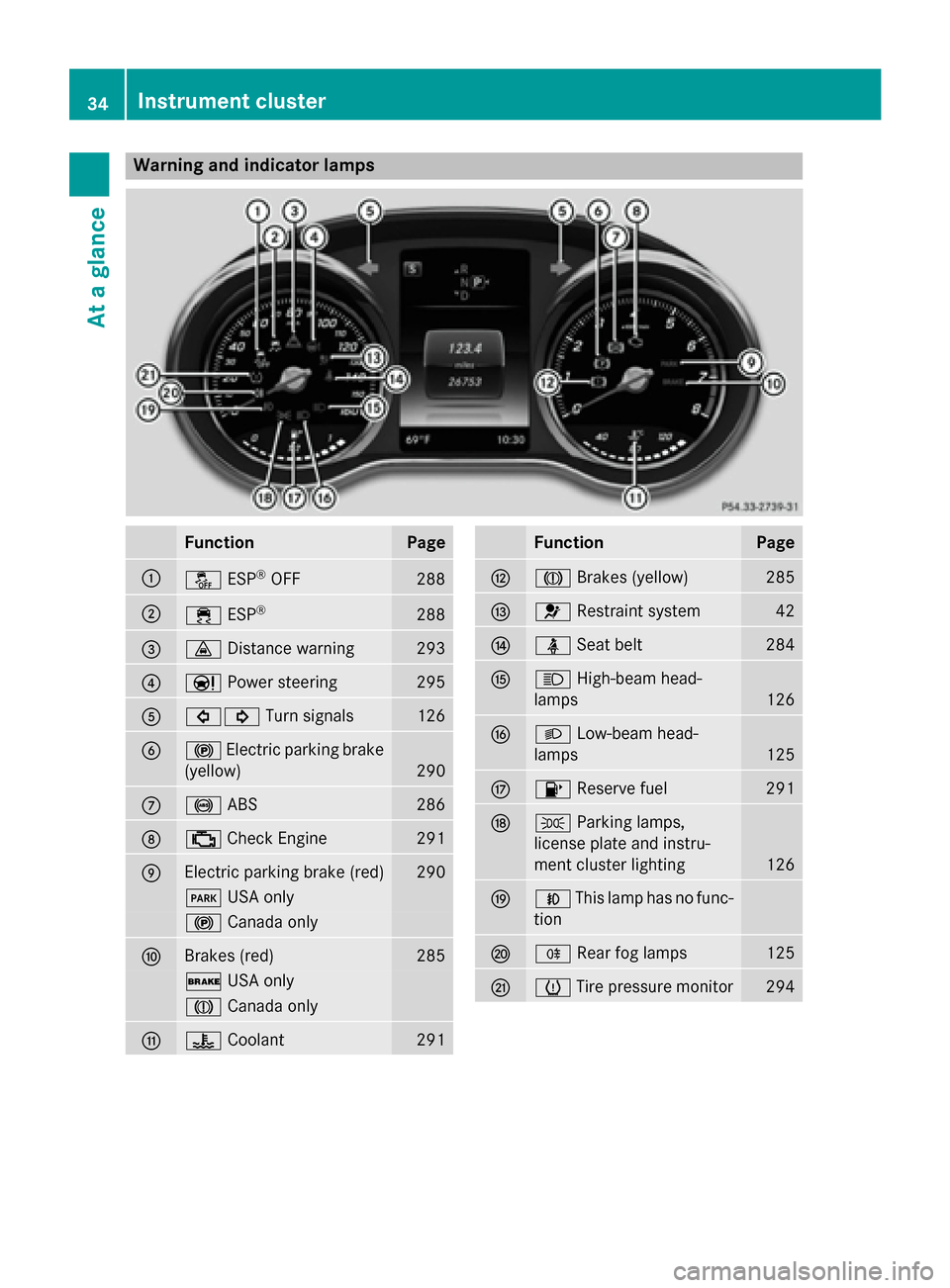
Warning and indicator lamps
Function Page
0043
00BB
ESP®
OFF 288
0044
00E5
ESP® 288
0087
00BA
Distance warning 293
0085
00CC
Power steering 295
0083
003E003D
Turn signals 126
0084
0024
Electric parking brake
(yellow) 290
006B
0025
ABS 286
006C
00B9
Check Engine 291
006D
Electric parking brake (red) 290
0049
USA only 0024
Canada only 006E
Brakes (red) 285
0027
USA only 004D
Canada only 006F
00AC
Coolant 291 Function Page
0070
004D
Brakes (yellow) 285
0071
0075
Restraint system 42
0072
00E9
Seat belt 284
0073
0057
High-beam head-
lamps 126
0074
0058
Low-beam head-
lamps 125
0075
00B6
Reserve fuel 291
0076
0060
Parking lamps,
license plate and instru-
ment cluster lighting 126
0077
005A
This lamp has no func-
tion 0078
005E
Rear fog lamps 125
0079
0077
Tire pressure monitor 29434
Instrument clusterAt a glance
Page 38 of 406

Center console
Center console, upper section
Function Page
0043
Climate control systems 138
0044
002F
Hazard warning
lamps 127
0087
Vehicle functions/system
settings button (see the
separate Operator's Man-
ual)
0085
Telephone button (see the
separate Operator's Man-
ual)
0083
PASSENGER AIR BAG indi-
cator lamp
43
ATA indicator lamp 76 Function Page
0084
Analog clock
006B
Media button (see the sep-
arate Operator's Manual)
006C
Radio button (see the sep-
arate Operator's Manual)
006D
Navigation button (see the
separate Operator's Man-
ual)
006E
00F8
Inserts/removes a
CD/DVD; see the separate
Operator's Manual) 36
Center consoleAt a glance
Page 45 of 406
For more information about children traveling
with you in the vehicle and on child restraint
systems, see "Children in the vehicle"
(Y page 59). Important safety notes
G
WARNING
Modifications to the restraint system may
cause it to no longer work as intended. The
restraint system may then not perform its
intended protective function and may fail in an accident or trigger unexpectedly, for example.
This poses an increased risk of injury or even fatal injury.
Never modify parts of the restraint system.
Never tamper with the wiring, the electronic
components or their software.
If it is necessary to modify an air bag system to
accommodate a person with disabilities, con- tact an authorized Mercedes-Benz Center for
details. USA only: for further information con- tact our Customer Assistance Center at
1-800-FOR-MERCede s (1‑800‑367 ‑6372). Restraint system warning lamp
The functions of the restraint system are
checked after the ignition is switched on and
at regular intervals while the engine is run-
ning. Therefore, malfunctions can be detec-
ted in good time.
The 0075 restraint system warning lamp in
the instrument cluster lights up when the igni- tion is switched on. It goes out no later than afew seconds after the engine is started. The
components of the restraint system are in
operational readiness.
A malfunction has occurred if the 0075
restraint system warning lamp:
R does not light up after the ignition is
switched on
R does not go out after a few seconds with
the engine running
R lights up again while the engine is running G
WARNING
If restraint system is malfunctioning, restraint system components may be triggered unin-
tentionally or might not be triggered at all in
the event of an accident with a high rate of
vehicle deceleration. This can affect the Emer- gency Tensioning Device or air bag, for exam-
ple. This poses an increased risk of injury or
even fatal injury.
Have the restraint system checked and
repaired in a qualified specialist workshop as
soon as possible. PASSENGER AIR BAG indicator lamp
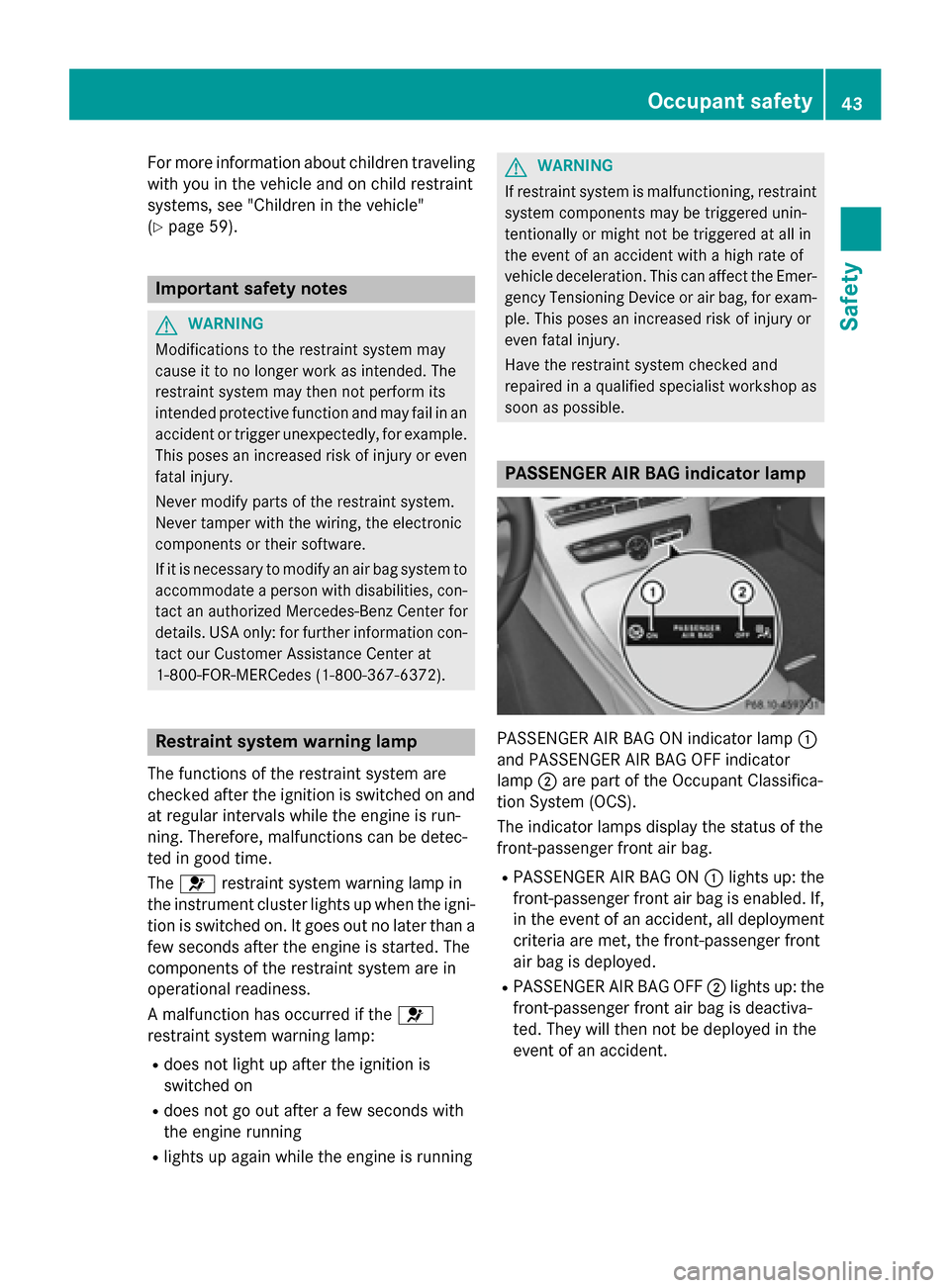
PASSENGER AIR BAG ON indicator lamp
0043
and PASSENGER AIR BAG OFF indicator
lamp 0044are part of the Occupant Classifica-
tion System (OCS).
The indicator lamps display the status of the
front-passenger front air bag.
R PASSENGER AIR BAG ON 0043lights up: the
front-passenger front air bag is enabled. If,
in the event of an accident, all deployment
criteria are met, the front-passenger front
air bag is deployed.
R PASSENGER AIR BAG OFF 0044lights up: the
front-passenger front air bag is deactiva-
ted. They will then not be deployed in the
event of an accident. Occupant safety
43Safety Z
Page 46 of 406

Depending on the person in the front-
passenger seat, the front-passenger front air
bag must either be disabled or enabled; see
the following points. You must make sure of
this both before and during a journey.
R Children in a child restraint system:
whether the front-passenger front air bag is
enabled or deactivated depends on the
installed child restraint system, and the age
and size of the child. Therefore, be sure to
observe the notes on the "Occupant clas-
sification system (OCS)" (Y page 51) and
on "Children in the vehicle" (Y page 59).
There you will also find instructions on
backwards- and forwards-facing child
restraint systems on the front-passenger
seat.
R All other persons: depending on the clas-
sification of the person in the front-
passenger seat, the front-passenger front
air bag is enabled or deactivated
(Y page 51). Be sure to observe the notes
on "Seat belts“ (Y page 44) and "Air bags"
(Y page 48). There you can also find infor-
mation on the correct seat position. Seat belts
Introduction A correctly fastened seat belt is the most
effective means of restraining the movement
of vehicle occupants in the event of an acci-
dent or overturn. This reduces the risk of
vehicle occupants coming into contact with
parts of the vehicle interior or being thrown
from the vehicle. Furthermore, the seat belt
helps to keep the vehicle occupants in the
best position in relation to the air bag.
The seat belt system consists of:
R Seat belts
R Emergency Tensioning Devices for the
front seat belts and the outer seat belts in
the rear compartment
R Belt force limiters for the front seat belts
and the outer seat belts in the rear If the seat belt is pulled quickly or suddenly
from the belt sash guide, the inertia reel
locks. The belt strap cannot be pulled out fur-
ther.
Emergency Tensioning Devices tighten the
seat belts in an accident, pulling them close
against the occupant's body. They do not,
however, pull vehicle occupants back
towards the backrest.
Emergency Tensioning Devices do not cor-
rect an incorrect seat position or incorrectly
worn seat belts.
When activated, the belt force limiters reduce
the force exerted by the seat belt on the vehi-
cle occupants.
The belt force limiters for the front seats are
synchronized with the front air bags, which
absorb part of the deceleration force. This
makes it possible to reduce the forces to
which vehicle occupants are subjected during an accident.
! If the front-passenger seat is unoccupied,
do not insert the belt tongue into the buckle of the front-passenger seat. This may oth-
erwise lead to the triggering of the Emer-
gency Tensioning Device in the event of anaccident, which will then need to be
replaced.
Important safety notes The use of seat belts and child restraint sys-
tems is required by law in:
R all 50 states
R the U.S. territories
R the District of Columbia
R all Canadian provinces
Even where this is not required by law, all
vehicle occupants should correctly fasten
their seat belts before starting the journey. G
WARNING
If the seat belt is incorrectly fastened, it can-
not protect as intended. Furthermore, an
incorrectly fastened seat belt can cause addi- tional injury, for example, in an accident, dur- 44
Occupant safetySafety
Page 47 of 406

ing braking or when abruptly changing direc-
tion. This poses an increased risk of injury or
even fatal injury.
Make sure that all vehicle occupants are
seated properly with a correctly fastened seat belt. G
WARNING
The seat belt does not offer the intended level of protection if you have not moved the back-
rest to an almost vertical position. When brak-
ing or in the event of an accident, you could
slide underneath the seat belt and sustain
abdomen or neck injuries, for example. This
poses an increased risk of injury or even fatal injury.
Adjust the seat properly before beginning
your journey. Always ensure that the backrest
is in an almost vertical position and that the
shoulder section of your seat belt is routed
across the center of your shoulder. G
WARNING
Persons under 5 ft (1.50 m) in height cannot
fasten the seat belt correctly without an addi- tional suitable restraint system. If the seat
belt is incorrectly fastened, it cannot protect
as intended. Furthermore, an incorrectly fas-
tened seat belt can cause additional injury, for
example, in an accident, during braking or an
abrupt change of direction. This poses an
increased risk of injury or even fatal injury.
For this reason, always secure persons under
5 ft (1.50 m) in height in suitable restraint
systems.
If a child younger than 12 years and under 5 ft
(1.50 m) in height is traveling in the vehicle:
R always secure the child in a child restraint
system suitable for this Mercedes-Benz
vehicle. The child restraint system must be
appropriate to the age, weight and size of
the child
R always observe the instructions and safety
notes in the "Children in the vehicle" sec-
tion of this Operator's Manual (Y
page 59) in addition to the child
restraint system manufacturer's installa-
tion instructions
R be sure to observe the instructions and
safety notes on the "Occupant classifica-
tion system (OCS)" (Y page 51) G
WARNING
The seat belts may not perform their intended protective function if:
R they are damaged, modified, extremely
dirty, bleach or dyed
R the seat belt buckle is damaged or
extremely dirty
R the Emergency Tensioning Devices, belt
anchorages or inertia reels have been modi-
fied
Seat belts may sustain non-visible damage in an accident, e.g. due to glass splinters. Modi-
fied or damaged seat belts may tear or fail,
e.g. in an accident. Modified Emergency Ten-
sioning Devices could accidentally trigger or
fail to deploy when necessary. This poses an
increased risk of injury or even fatal injury.
Never modify the seat belts, Emergency Ten-
sioning Devices, belt anchorages or inertia
reels. Make sure that the seat belts are
undamaged, not worn out and clean. Follow-
ing an accident, have the seat belts checked
immediately at a qualified specialist work-
shop.
Only use seat belts that have been approved
for your vehicle by Mercedes-Benz. Any such
modifications could invalidate the vehicle's
general operating permit.
Proper use of the seat belts Observe the safety notes on the seat belt
(Y
page 44).
All vehicle occupants must be wearing the
seat belt correctly before beginning the jour-
ney. Also make sure that all vehicle occu-
pants are always wearing the seat belt cor-
rectly while the vehicle is in motion. Occupant safety
45Safety Z
Page 50 of 406

Belt warning for the driver and front
passenger The
0076 seat belt warning lamp in the instru-
ment cluster is a reminder that all occupants
must fasten their seat belts. It may light up
continuously or flash. In addition, there may
be a warning tone.
Regardless of whether the driver's and front- passenger seat belts have already been fas-
tened, the 0076seat belt warning lamp lights
up for six seconds each time the engine is
started. If, after six seconds, the driver or
front-passenger seat belt has not been fas-
tened and the doors are closed, the 0076seat
belt warning lamp lights up. As soon as the
driver's and front-passenger seat belts are
fastened or a front door is opened again, the
0076 seat belt warning lamp goes out.
If the driver's seat belt is not fastened after
the engine is started, an additional warning
tone will sound. This warning tone stops after six seconds or when the driver's seat belt is
fastened.
If the vehicle's speed exceeds 15 mph
(25 km/h) once and the driver's and front-
passenger seat belts are not fastened, a
warning tone sounds. A warning tone also
sounds with increasing intensity for
60 seconds or until the driver or front
passenger have fastened their seat belts.
If the driver or front passenger unfasten their
seat belts during the journey, the seat belt
warning is activated again.
i For more information on the
0076seat
belt warning lamp, see "Warning and indi-
cator lamps in the instrument cluster, seat
belts" (Y page 284). Air bags
Introduction The installation point of an air bag can be rec-
ognized by the AIR BAG symbol.
An air bag complements the correctly fas-
tened seat belt. It is no substitute for the seat belt. The air bag provides additional protec-
tion in applicable accident situations.
Not all air bags are deployed in an accident.
The different air bag systems function inde-
pendently from one another (Y page 56).
However, no system available today can com- pletely eliminate injuries and fatalities.
It is also not possible to rule out a risk of injury
caused by an air bag due to the high speed at which the air bag must be deployed.
Important safety notes G
WARNING
If you do not sit in the correct seat position,
the air bag cannot protect as intended and
could even cause additional injury when
deployed. This poses an increased risk of
injury or even fatal injury.
To avoid hazardous situations, always make
sure that all of the vehicle's occupants:
R have fastened their seat belts correctly,
including pregnant women
R are sitting correctly and maintain the great-
est possible distance to the air bags
R follow the following instructions
Always make sure that there are no objects
between the air bag and the vehicle's occu-
pants.
R Adjust the seats properly before beginning
your journey. Always make sure that the
seat is in an almost upright position. The
center of the head restraint must support
the head at about eye level.
R Move the driver's and front-passenger
seats as far back as possible. The driver's
seat position must allow the vehicle to be
driven safely.
R Only hold the steering wheel on the out-
side. This allows the air bag to be fully
deployed.
R Always lean against the backrest while driv-
ing. Do not lean forwards or lean against
the door or side window. You may other- 48
Occupant safetySafety
Page 51 of 406

wise be in the deployment area of the air
bags.
R Always keep your feet in the footwell in
front of the seat. Do not put your feet on the
dashboard, for example. Your feet may oth-
erwise be in the deployment area of the air bag.
R For this reason, always secure persons less
than 5 ft (1.50 m) tall in suitable restraint
systems. Up to this height, the seat belt
cannot be worn correctly.
If a child is traveling in your vehicle, also
observe the following notes:
R Always secure children under 12 years of
age and less than 5 ft (1.50m)in height in
suitable child restraint systems.
R Child restraint systems should be installed
on the rear seats.
R Only secure a child in a rearward-facing
child restraint system to the front-
passenger seat when the front-passenger
front air bag is disabled. If the PASSENGER
AIR BAG OFF indicator lamp is permanently
lit, the front-passenger front air bag is dis-
abled (Y page 43).
R Always observe the instructions and safety
notes on the "Occupant Classification Sys-
tem (OCS)" (Y page 51) and on "Children
in the vehicle" (Y page 59) in addition to
the child restraint system manufacturer's
installation instructions.
Objects in the vehicle interior may pre-
vent the air bag from functioning cor-
rectly. Before starting your journey and to
avoid risks resulting from the speed of the air bag as it deploys, make sure that:
R there are no people, animals or objects
between the vehicle occupants and an air
bag.
R there are no objects between the seat, door
and B-pillar.
R no hard objects, e.g. coat hangers, hang on
the grab handles or coat hooks.
R no accessories, such as cup holders, are
attached to the vehicle within the deploy- ment area of an air bag, e.g. to doors, side
windows, rear side trim or side walls.
R no heavy, sharp-edged or fragile objects
are in the pockets of your clothing. Store
such objects in a suitable place. G
WARNING
If you modify the air bag cover or affix objects
such as stickers to it, the air bag can no longer function correctly. There is an increased risk
of injury.
Never modify an air bag cover or affix objectsto it. G
WARNING
Sensors to control the air bags are located in the doors. Modifications or work not per-
formed correctly to the doors or door panel-
ing, as well as damaged doors, can lead to the
function of the sensors being impaired. The air bags might therefore not function properly
any more. Consequently, the air bags cannot
protect vehicle occupants as they are
designed to do. There is an increased risk of
injury.
Never modify the doors or parts of the doors.
Always have work on the doors or door pan-
eling carried out at a qualified specialist work- shop.
Front air bags Driver's air bag
0043inflates in front of the
steering wheel; front-passenger front air
bag 0044inflates in front of and above the glove
box. Occupant safety
49Safety Z
Page 52 of 406
The front air bags for the front seats offer
additional protection for the head and thorax.
The PASSENGER AIR BAG OFF and
PASSENGER AIR BAG ON indicator lamps
inform you about the status of the front-
passenger front air bag (Y page 43).
Front-passenger front air bag 0044will only
deploy if:
R the system, based on the OCS weight sen-
sor readings, detects that the front-
passenger seat is occupied (Y page 51).
The PASSENGER AIR BAG ON indicator
lamp lights up (Y page 52)
R the restraint system predicts a high
severity of an accident
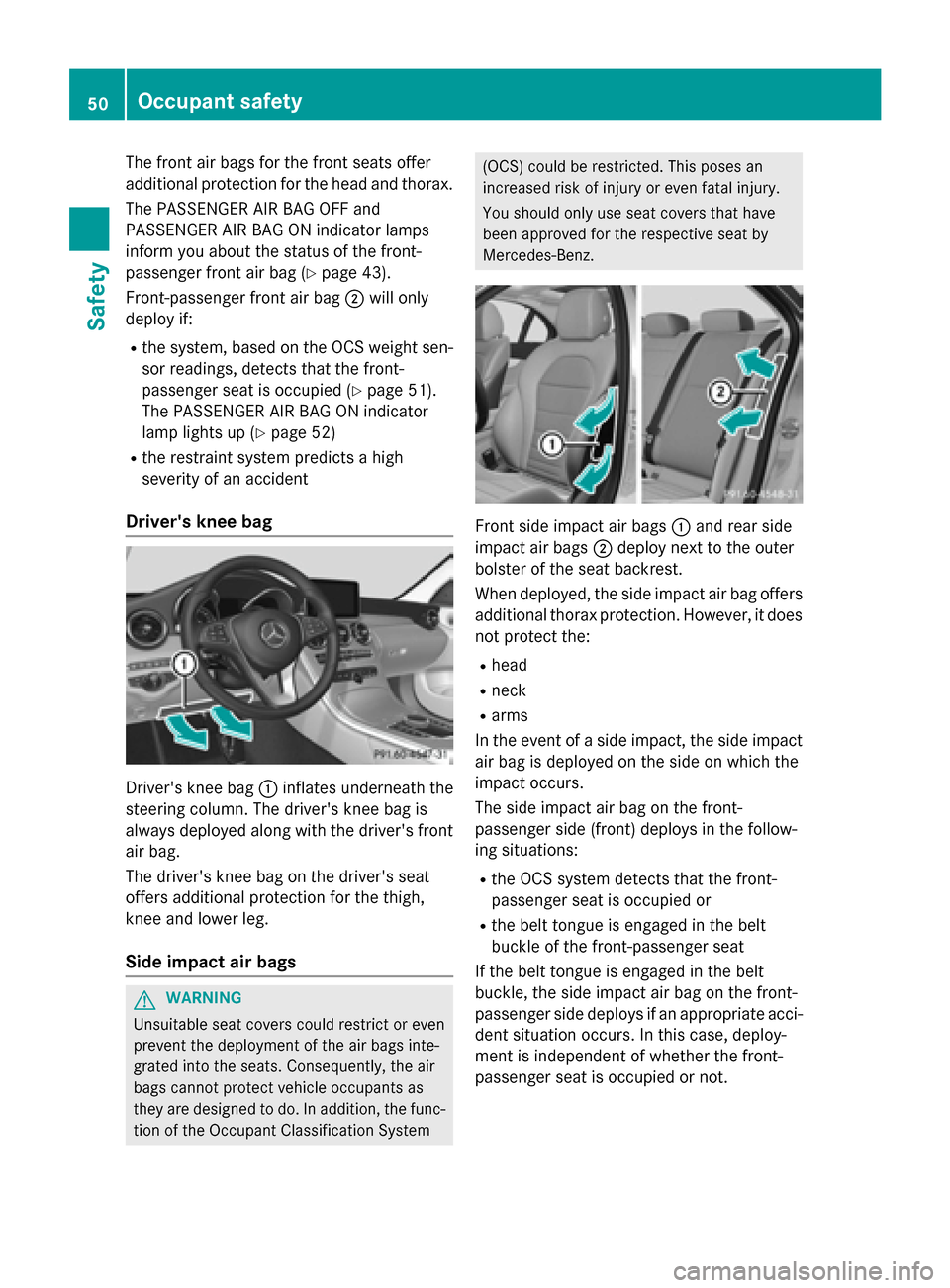
Driver's knee bag Driver's knee bag
0043inflates underneath the
steering column. The driver's knee bag is
always deployed along with the driver's front
air bag.
The driver's knee bag on the driver's seat
offers additional protection for the thigh,
knee and lower leg.
Side impact air bags G
WARNING
Unsuitable seat covers could restrict or even
prevent the deployment of the air bags inte-
grated into the seats. Consequently, the air
bags cannot protect vehicle occupants as
they are designed to do. In addition, the func- tion of the Occupant Classification System (OCS) could be restricted. This poses an
increased risk of injury or even fatal injury.
You should only use seat covers that have
been approved for the respective seat by
Mercedes-Benz.
Front side impact air bags
0043and rear side
impact air bags 0044deploy next to the outer
bolster of the seat backrest.
When deployed, the side impact air bag offers additional thorax protection. However, it doesnot protect the:
R head
R neck
R arms
In the event of a side impact, the side impact
air bag is deployed on the side on which the
impact occurs.
The side impact air bag on the front-
passenger side (front) deploys in the follow-
ing situations:
R the OCS system detects that the front-
passenger seat is occupied or
R the belt tongue is engaged in the belt
buckle of the front-passenger seat
If the belt tongue is engaged in the belt
buckle, the side impact air bag on the front-
passenger side deploys if an appropriate acci-
dent situation occurs. In this case, deploy-
ment is independent of whether the front-
passenger seat is occupied or not. 50
Occupant safetySafety
Page 54 of 406
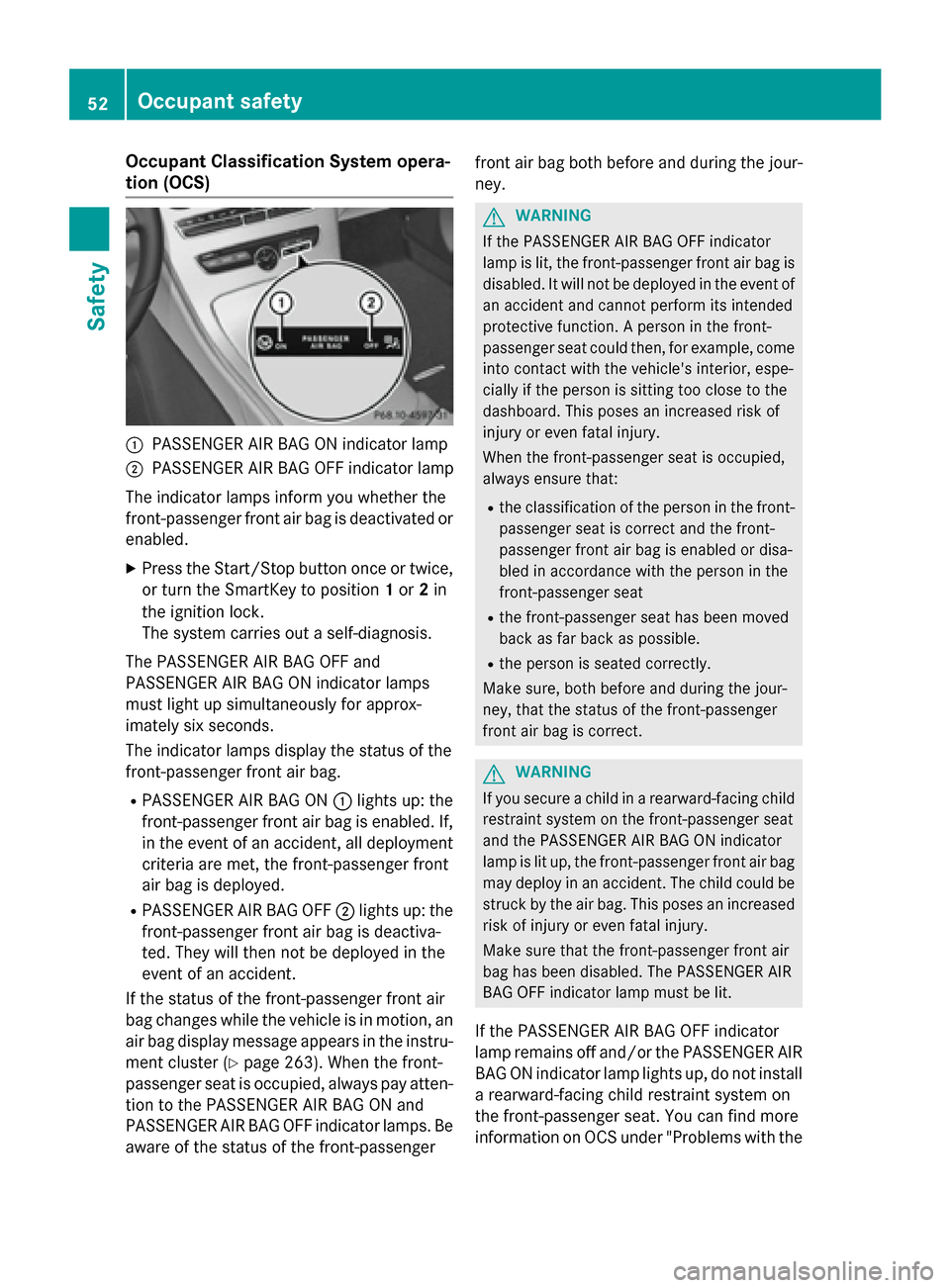
Occupant Classification System opera-
tion (OCS) 0043
PASSENGER AIR BAG ON indicator lamp
0044 PASSENGER AIR BAG OFF indicator lamp
The indicator lamps inform you whether the
front-passenger front air bag is deactivated or enabled.
X Press the Start/Stop button once or twice,
or turn the SmartKey to position 1or 2in
the ignition lock.
The system carries out a self-diagnosis.
The PASSENGER AIR BAG OFF and
PASSENGER AIR BAG ON indicator lamps
must light up simultaneously for approx-
imately six seconds.
The indicator lamps display the status of the
front-passenger front air bag.
R PASSENGER AIR BAG ON 0043lights up: the
front-passenger front air bag is enabled. If,
in the event of an accident, all deployment
criteria are met, the front-passenger front
air bag is deployed.
R PASSENGER AIR BAG OFF 0044lights up: the
front-passenger front air bag is deactiva-
ted. They will then not be deployed in the
event of an accident.
If the status of the front-passenger front air
bag changes while the vehicle is in motion, an
air bag display message appears in the instru-
ment cluster (Y page 263). When the front-
passenger seat is occupied, always pay atten-
tion to the PASSENGER AIR BAG ON and
PASSENGER AIR BAG OFF indicator lamps. Be aware of the status of the front-passenger front air bag both before and during the jour-
ney. G
WARNING
If the PASSENGER AIR BAG OFF indicator
lamp is lit, the front-passenger front air bag is disabled. It will not be deployed in the event of
an accident and cannot perform its intended
protective function. A person in the front-
passenger seat could then, for example, come
into contact with the vehicle's interior, espe-
cially if the person is sitting too close to the
dashboard. This poses an increased risk of
injury or even fatal injury.
When the front-passenger seat is occupied,
always ensure that:
R the classification of the person in the front-
passenger seat is correct and the front-
passenger front air bag is enabled or disa-
bled in accordance with the person in the
front-passenger seat
R the front-passenger seat has been moved
back as far back as possible.
R the person is seated correctly.
Make sure, both before and during the jour-
ney, that the status of the front-passenger
front air bag is correct. G
WARNING
If you secure a child in a rearward-facing child
restraint system on the front-passenger seat
and the PASSENGER AIR BAG ON indicator
lamp is lit up, the front-passenger front air bag may deploy in an accident. The child could be
struck by the air bag. This poses an increased risk of injury or even fatal injury.
Make sure that the front-passenger front air
bag has been disabled. The PASSENGER AIR
BAG OFF indicator lamp must be lit.
If the PASSENGER AIR BAG OFF indicator
lamp remains off and/or the PASSENGER AIR BAG ON indicator lamp lights up, do not install
a rearward-facing child restraint system on
the front-passenger seat. You can find more
information on OCS under "Problems with the 52
Occupant safetySafety