reset MERCEDES-BENZ C320 WAGON 2002 S203 Owner's Manual
[x] Cancel search | Manufacturer: MERCEDES-BENZ, Model Year: 2002, Model line: C320 WAGON, Model: MERCEDES-BENZ C320 WAGON 2002 S203Pages: 390
Page 64 of 390
61 Restraint systems
Te ch n i c a l
data Instruments
and controlsOperationDrivingInstrument
cluster displayPractical hints Car care Index Operation of seat belts
The inertia reel stops the belt from unwinding during
sudden stops or when quickly pulling on the belt.
The locking function of the reel may be checked by
quickly pulling out the belt.
Adjust seat belt so that shoulder portion is located as
close as possible to the middle of your shoulder (it
should not touch the neck).
Caution!
For safety reasons, avoid adjusting the seat or seat back
into positions which could affect the correct seat belt
positioning.
Unfastening of seat belts
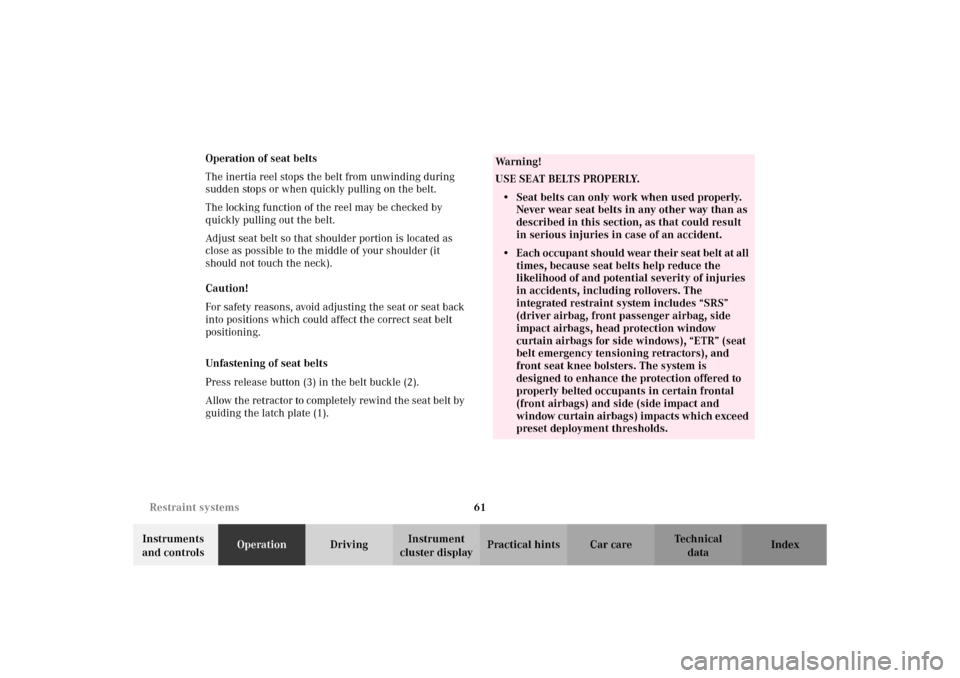
Press release button (3) in the belt buckle (2).
Allow the retractor to completely rewind the seat belt by
guiding the latch plate (1).
Wa r n i n g !
USE SEAT BELTS PROPERLY.• Seat belts can only work when used properly.
Never wear seat belts in any other way than as
described in this section, as that could result
in serious injuries in case of an accident.• Each occupant should wear their seat belt at all
times, because seat belts help reduce the
likelihood of and potential severity of injuries
in accidents, including rollovers. The
integrated restraint system includes “SRS”
(driver airbag, front passenger airbag, side
impact airbags, head protection window
curtain airbags for side windows), “ETR” (seat
belt emergency tensioning retractors), and
front seat knee bolsters. The system is
designed to enhance the protection offered to
properly belted occupants in certain frontal
(front airbags) and side (side impact and
window curtain airbags) impacts which exceed
preset deployment thresholds.
S203.book Seite 61 Freitag, 19. Oktober 2001 1:25 13
Page 68 of 390
65 Restraint systems
Te ch n i c a l
data Instruments
and controlsOperationDrivingInstrument
cluster displayPractical hints Car care Index Supplemental Restraint System (SRS)
Airbags are intended as a supplement to seat belts.
Airbags alone cannot protect as well as airbags plus
seat belts in impacts for which the airbags were
designed to operate, and do not afford any protection
whatsoever in crashes for which the airbags are not
designed to deploy.
The SRS uses two crash severity levels (thresholds) to
a c t ivate e it h e r t h e e m e rge n c y te n s io n in g r e t r a c to r ( E T R )
or front airbag or both. Activation depends on the
direction and severity of the impact exceeding the
preset thresholds and whether the seat belt is fastened.Seat belt fastened
•first threshold exceeded: ETR activates
•second threshold exceeded: airbag also activates
Seat belt not fastened
Front seats:
•first threshold exceeded: airbag activates, not ETR
Rear outer seats:
•first threshold exceeded: ETR activates
Driver and front passenger and rear outer seat systems
operate independently of each other.
S203.book Seite 65 Freitag, 19. Oktober 2001 1:25 13
Page 69 of 390
66 Restraint systems
Te ch n i c a l
data Instruments
and controlsOperationDrivingInstrument
cluster displayPractical hints Car care Index
Emergency tensioning retractor (ETR)
The seat belts for the front and rear outer seats are
equipped with emergency tensioning retractors. These
tensioning retractors are located in each belt’s inertia
reel and become operationally ready with the electronic
key in starter switch position 1 or 2.
The emergency tensioning retractors are designed to
activate only when the seat belts are fastened during
frontal impacts exceeding the first threshold of the SRS
and in rear impacts exceeding a preset severity level.They remove slack from the belts in such a way that the
seat b elts f it mor e s nugly again st t he b od y restricting its
forward movement as much as possible.
In cases of other frontal impacts, angled impacts, roll-
overs, certain side impacts, or other accidents without
sufficient frontal or rear impact forces, the emergency
tensioning retractors will not be activated. The driver
and passengers will then be protected by the fastened
seat belts and inertia reel in the usual manner.
Note:
The front passenger ETR activates only if the front
passenger seat is occupied.
Heavy objects on the front passenger seat can appear to
the “SRS” to indicate the presence of an occupant in
that seat which causes the passenger front airbag to
deploy and the ETR to activate in a crash exceeding the
appropriate threshold.
S203.book Seite 66 Freitag, 19. Oktober 2001 1:25 13
Page 70 of 390
67 Restraint systems
Te ch n i c a l
data Instruments
and controlsOperationDrivingInstrument
cluster displayPractical hints Car care Index Airbags
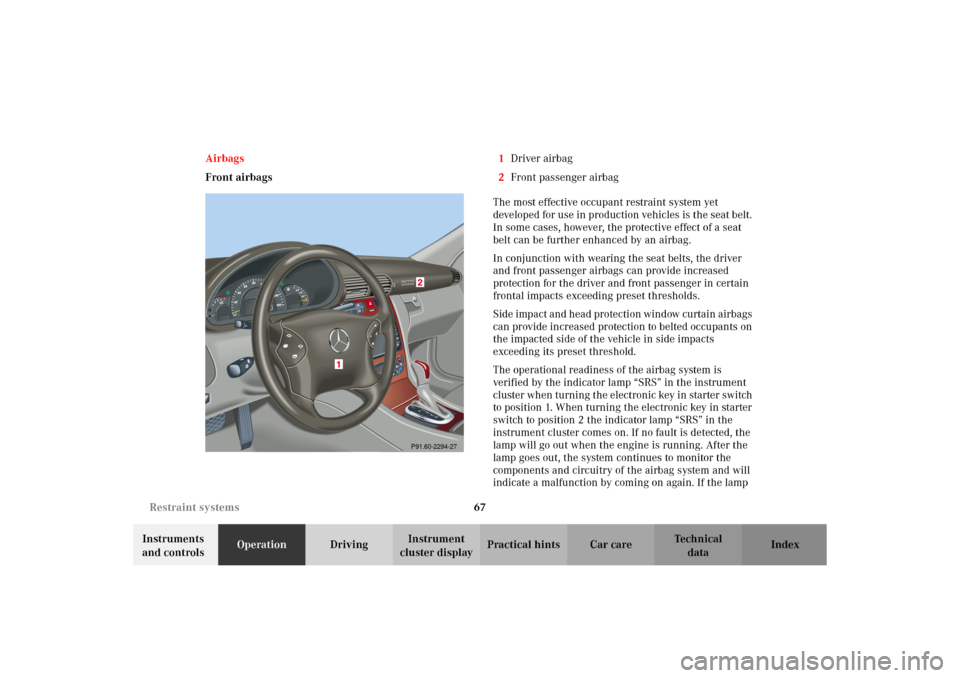
Front airbags1Driver airbag
2Front passenger airbag
The most effective occupant restraint system yet
developed for use in production vehicles is the seat belt.
In some cases, however, the protective effect of a seat
belt can be further enhanced by an airbag.
In conjunction with wearing the seat belts, the driver
and front passenger airbags can provide increased
protection for the driver and front passenger in certain
frontal impacts exceeding preset thresholds.
Side impact and head protection window curtain airbags
can provide increased protection to belted occupants on
the impacted side of the vehicle in side impacts
exceeding its preset threshold.
The operational readiness of the airbag system is
verified by the indicator lamp “SRS” in the instrument
cluster when turning the electronic key in starter switch
to position 1. When turning the electronic key in starter
switch to position 2 the indicator lamp “SRS” in the
instrument cluster comes on. If no fault is detected, the
lamp will go out when the engine is running. After the
lamp goes out, the system continues to monitor the
components and circuitry of the airbag system and will
indicate a malfunction by coming on again. If the lamp
P91.60-2294-27
S203.book Seite 67 Freitag, 19. Oktober 2001 1:25 13
Page 72 of 390
69 Restraint systems
Te ch n i c a l
data Instruments
and controlsOperationDrivingInstrument
cluster displayPractical hints Car care Index The driver and passenger front airbags are designed to
activate only in certain frontal impacts exceeding a
preset threshold. Note:
The front passenger airbag deploys only if the front
passenger seat is occupied and the ü indicator lamp
in the center console is not illuminated.
Heavy objects on the front passenger seat can appear to
the “SRS” to indicate the presence of an occupant in
that seat which causes the passenger front airbag to
deploy in a crash exceeding the appropriate threshold.
S203.book Seite 69 Freitag, 19. Oktober 2001 1:25 13
Page 73 of 390
70 Restraint systems
Te ch n i c a l
data Instruments
and controlsOperationDrivingInstrument
cluster displayPractical hints Car care Index
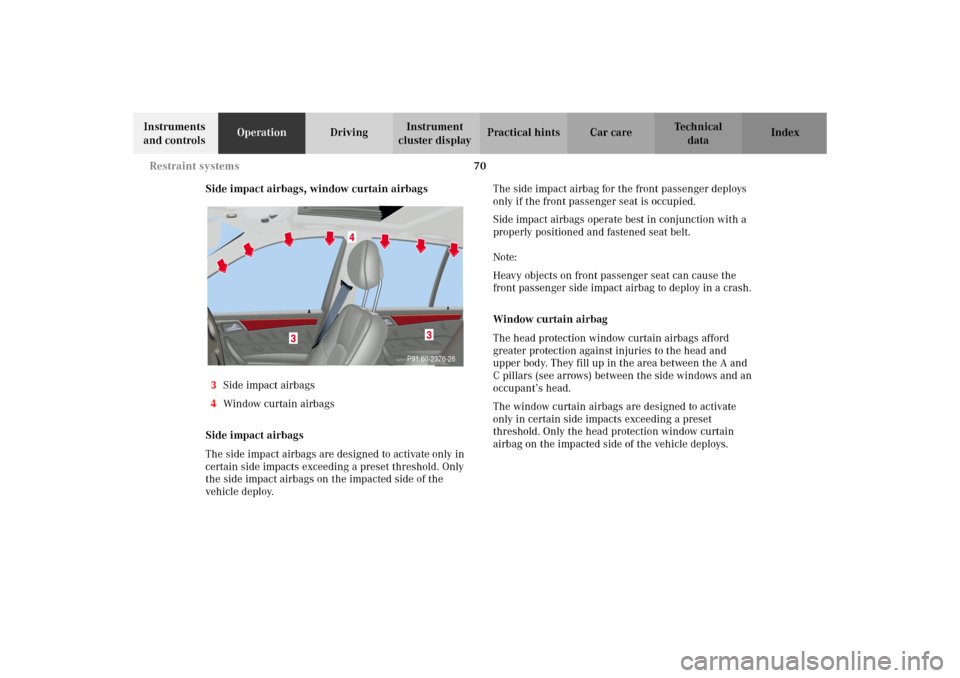
Side impact airbags, window curtain airbags
3Side impact airbags
4Window curtain airbags
Side impact airbags
The side impact airbags are designed to activate only in
certain side impacts exceeding a preset threshold. Only
the side impact airbags on the impacted side of the
vehicle deploy.The side impact airbag for the front passenger deploys
only if the front passenger seat is occupied.
Side impact airbags operate best in conjunction with a
properly positioned and fastened seat belt.
Note:
Heavy objects on front passenger seat can cause the
front passenger side impact airbag to deploy in a crash.
Window curtain airbag
The head protection window curtain airbags afford
greater protection against injuries to the head and
upper body. They fill up in the area between the A and
C pillars (see arrows) between the side windows and an
occupant’s head.
The window curtain airbags are designed to activate
only in certain side impacts exceeding a preset
threshold. Only the head protection window curtain
airbag on the impacted side of the vehicle deploys.
P91.60-2376-26
S203.book Seite 70 Freitag, 19. Oktober 2001 1:25 13
Page 74 of 390
71 Restraint systems
Te ch n i c a l
data Instruments
and controlsOperationDrivingInstrument
cluster displayPractical hints Car care Index Important!
Airbags are designed to activate only in certain
frontal (front airbags) impacts, or side (side impact
and head protection window curtain airbags)
impacts which exceed preset thresholds.
Only during these types of impacts, if of sufficient
severity to meet the deployment thresholds, will
they provide their supplemental protection.
The driver and passenger should always wear their
s eat bel ts , ot herw i se it i s n ot poss i bl e for t he a i rb ags
to provide their supplemental protection.
In cases of other frontal impacts, angled impacts,
roll-overs, other side impacts, rear collisions, or
other accidents, the airbags will not be activated.
The driver and passengers will then be protected by
the fastened seat belts.
We caution you not to rely on the presence of the
airbags in order to avoid wearing your seat belt.
Wa r n i n g !
Airbags are designed to reduce the potential of
injury in certain frontal (front airbags) impacts, or
side (side impact and head protection window
curtain airbags) impacts which may cause
significant injuries, however, no system available
today can totally eliminate injuries and fatalities.The activation of the “SRS” temporarily releases a
small amount of dust from the airbags. This dust,
however, is neither injurious to your health, nor
does it indicate a fire in the vehicle. The dust might
cause some temporary breathing difficulty for
people with asthma or other breathing trouble. To
avoid this, you may wish to get out of the vehicle as
soon as it is safe to do so. If you have any breathing
difficulty but cannot get out of the vehicle after the
airbag inflates, then get fresh air by opening a
window or door.
S203.book Seite 71 Freitag, 19. Oktober 2001 1:25 13
Page 75 of 390
72 Restraint systems
Te ch n i c a l
data Instruments
and controlsOperationDrivingInstrument
cluster displayPractical hints Car care Index
Your vehicle was originally equipped with airbags
which are designed to activate in certain impacts
exceeding a preset threshold to reduce the potential
and severity of injury. It is important to your safety
a nd tha t of your pas sen ger t hat you repl ac e d epl oyed
airbags and repair any malfunctioning airbags to
ensure the vehicle will continue to provide crash
protection for occupants.
Wa r n i n g !
To reduce the risk of injury when the front airbags
inflate, it is very important for the driver and front
passenger to always be in a properly seated
position and to wear your seat belt.For maximum protection in the event of a collision
always be in normal seated position with your back
against the backrest. Fasten your seat belt and
ensure that it is properly positioned on your body.Since the airbag inflates with considerable speed
and force, a proper seating and hands on steering
wheel position will help to keep you at a safe
distance from the airbag. Occupants who are
unbelted, out of position or too close to the airbag
can be seriously injured by an airbag as it inflates
with great force in the blink of an eye:
• Sit properly belted in an upright position with
your back against the backrest.• Adjust the driver seat as far as possible
rearward, still permitting proper operation of
vehicle controls. The distance from the center
of the driver’s breastbone to the center of the
airbag cover on the steering wheel must be at
least ten inches (25 cm) or more. You should be
able to accomplish this by a combination of
adjustments to the seat and steering wheel. If
you have any problems, please see your
authorized Mercedes-Benz Center.• Do not lean with your head or chest close to the
steering wheel or dashboard.• Keep hands on the outside of steering wheel
rim. Placing hands and arms inside the rim
can increase the risk and potential severity of
hand / arm injury when driver front airbag
inflates.• Adjust the front passenger seat as far as
possible rearward from the dashboard when
the seat is occupied.
S203.book Seite 72 Freitag, 19. Oktober 2001 1:25 13
Page 96 of 390
93 Instrument cluster
Te ch n i c a l
data Instruments
and controlsOperationDrivingInstrument
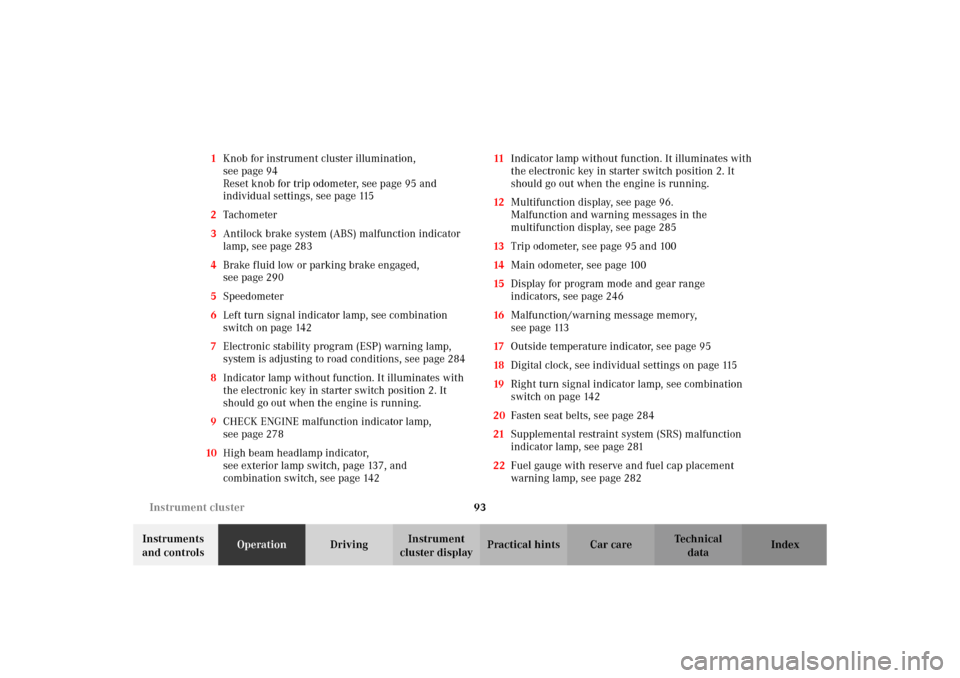
cluster displayPractical hints Car care Index 1Knob for instrument cluster illumination,
seepage94
Reset knob for trip odometer, see page 95 and
individual settings, see page 115
2Tachometer
3Antilock brake system (ABS) malfunction indicator
lamp, see page 283
4Brake fluid low or parking brake engaged,
seepage290
5Speedometer
6Left turn signal indicator lamp, see combination
switch on page 142
7Electronic stability program (ESP) warning lamp,
system is adjusting to road conditions, see page 284
8Indicator lamp without function. It illuminates with
the electronic key in starter switch position 2. It
should go out when the engine is running.
9CHECK ENGINE malfunction indicator lamp,
seepage278
10High beam headlamp indicator,
see exterior lamp switch, page 137, and
combination switch, see page 14211Indicator lamp without function. It illuminates with
the electronic key in starter switch position 2. It
should go out when the engine is running.
12Multifunction display, see page 96.
Malfunction and warning messages in the
multifunction display, see page 285
13Trip odometer, see page 95 and 100
14Main odometer, see page 100
15Display for program mode and gear range
indicators, see page 246
16Malfunction/warning message memory,
seepage113
17Outside temperature indicator, see page 95
18Digital clock, see individual settings on page 115
19Right turn signal indicator lamp, see combination
switch on page 142
20Fasten seat belts, see page 284
21S upplem ental restraint system (SRS) m alfunction
indicator lamp, see page 281
22Fuel gauge with reserve and fuel cap placement
warning lamp, see page 282
S203.book Seite 93 Freitag, 19. Oktober 2001 1:25 13
Page 98 of 390
95 Instrument cluster
Te ch n i c a l
data Instruments
and controlsOperationDrivingInstrument
cluster displayPractical hints Car care Index Outside temperature indicator (17)
The temperature sensor is located in the front bumper
area. Due to its location, the sensor can be affected by
road or engine heat during idling or slow driving. This
means that the accuracy of the displayed temperature
can only be verified by comparison to a thermometer
placed next to the sensor, not by comparison to external
displays (e.g. bank signs etc.).
Adaption to ambient temperature takes place in steps
and depends on the prevailing driving conditions (stop-
and-go or moderate, constant driving) and amount of
temperature change.
Note:
The unit for the temperature indicator display can be set
in the individual setting menu “INSTRUMENT
CLUSTER” – “TEMP. INDICATOR” on page 115.Trip odometer (13)
To reset to “0” miles / km:
Activate the instrument cluster if it is not already
activated, see page 94.
Press button è or ÿ on the multifunction
steering wheel repeatedly until the trip odometer
appears if it is not displayed. See page 100.
Press button (1) on the instrument cluster, see page 94.
Tachometer (2)
The red marking on the tachometer denotes excessive
engine speed.
Avoid this engine speed, as it may result in serious
engine damage that is not covered by the
Mercedes-Benz Limited Warranty.
To help protect the engine, the fuel supply is interrupted
if the engine is operated within the red marking.
Wa r n i n g !
The outside temperature indicator is not designed
to serve as an Ice-Warning Device and is therefore
unsuitable for that purpose. Indicated
temperatures just above the freezing point do not
guarantee that the road surface is free of ice.
S203.book Seite 95 Freitag, 19. Oktober 2001 1:25 13