child restraint MERCEDES-BENZ CL-CLASS 2000 User Guide
[x] Cancel search | Manufacturer: MERCEDES-BENZ, Model Year: 2000, Model line: CL-CLASS, Model: MERCEDES-BENZ CL-CLASS 2000Pages: 424, PDF Size: 26.09 MB
Page 105 of 424
102 Restraint systems
Te ch n ica l
data Instruments
and controlsOperationDrivingInstrument
cluster displayPractical hints Car care Index
Infant and child restraint systems
We recommend all infants and children be properly
restrained at all times while the vehicle is in motion.
All lap-shoulder belts except the driver seat belt have
special seat belt retractors for secure fastening of child
restraints.
To activate, pull shoulder belt out completely and let it
retract. During the seat belt retraction a ratcheting
sound can be heard to indicate that the special seat belt
retractor is activated. The belt is now locked.
To deactivate, release seat belt buckle and let seat belt
retract completely. The seat belt can again be used in
the usual manner.
Note:
For child seats with mounting fittings for tether
anchorages refer to page 104 (installation of infant and
child restra int systems).Important!
The use of infant or child restraints is required by law in
all 50 states and all Canadian provinces.
Infants and small children should be seated in an
appropriate infant or child restraint system properly
secured by a lap-shoulder belt, and that complies with
U.S. Federal Motor Vehicle Safety Standard 213 and
Canadian Motor Vehicle Safety Standard 213.
A statement by the child restraint manufacturer of
compliance with this standard can be found on the
instruction label on the restraint and in the instruction
manual provided with the restraint.
When using any infant or child restraint system, be sure
to carefully read and follow all manufacturer’s
instructions for installation and use.
Please read and observe warning labels affixed to inside
of vehicle and to infant or child restraints.
Wa r n i n g !
Never release the seat belt buckle while vehicle is
in motion, since the special seat belt retractor will
be deactivated.
ProCarManuals.com
Page 106 of 424
103 Restraint systems
Te ch n ica l
data Instruments
and controlsOperationDrivingInstrument
cluster displayPractical hints Car care Index
Wa r n i n g !
Children 12 years old and under must never ride in
the front seat, except in a Mercedes-Benz
authorized BabySmart
TM compatible child seat,
which operates with the BabySmart
TM system
installed in the vehicle to deactivate the passenger
front airbag when it is properly installed.
Otherwise they will be struck by the airbag when it
inflates in a crash. If this happens, serious or fatal
injury can result.
According to accident statistics, children are safer
when properly restrained in the rear seating
positions than in the front seating positions.
Infants and small children must ride in back seats
and be seated in an appropriate infant or child
restraint system, which is properly secured with
the vehicle’s seat belt, fully in accordance with the
child seat manufacturer’s instructions.Infants and small children should never share a
seat belt with another occupant. During an
accident, they could be crushed between the
occupant and seat belt.
Children too big for child restraint systems must
ride in back seats using regular seat belts. Position
shoulder belt across chest and shoulder, not face or
neck. A booster seat may be necessary to achieve
proper belt positioning for children from 41 lbs. to
the point where a lap/shoulder belt fits properly
without one.When the child restraint is not in use, remove it
from the vehicle or secure it with the seat belt to
prevent the child restraint from becoming a
projectile in the event of an accident.
ProCarManuals.com
Page 107 of 424
104 Restraint systems
Te ch n ica l
data Instruments
and controlsOperationDrivingInstrument
cluster displayPractical hints Car care Index
Installation of infant and child restraint systems
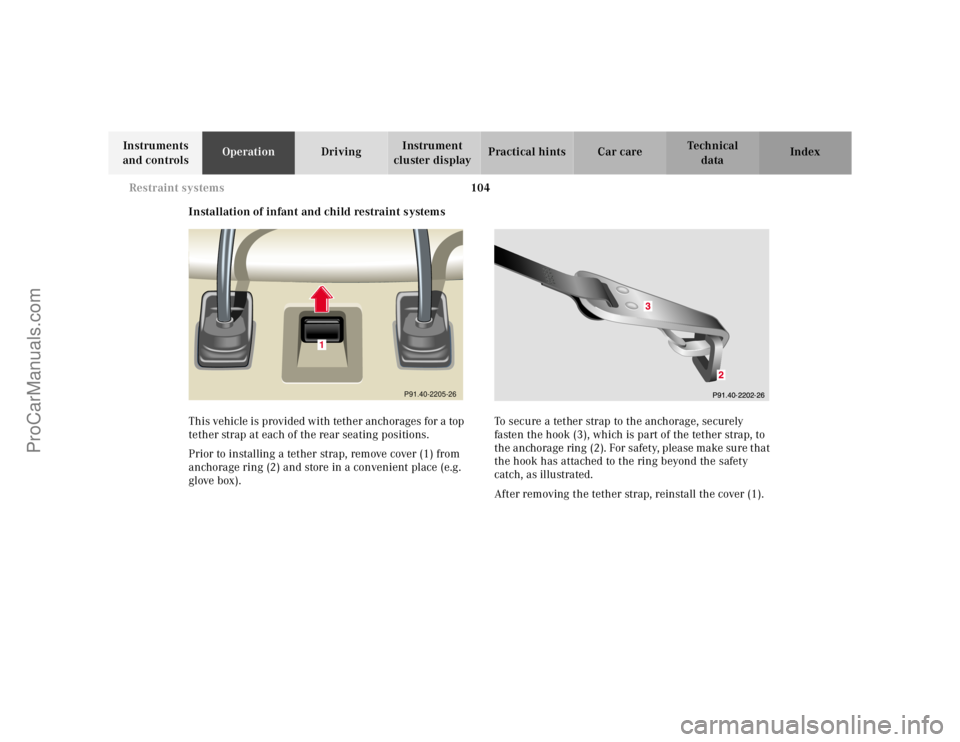
This vehicle is provided with tether anchorages for a top
tether strap at each of the rear seating positions.
Prior to installing a tether strap, remove cover (1) from
anchorage ring (2) and store in a convenient place (e.g.
glove box).To secure a tether strap to the anchorage, securely
fasten the hook (3), which is part of the tether strap, to
the anchorage ring (2). For safety, please make sure that
the hook has attached to the ring beyond the safety
catch, as illustrated.
After removing the tether strap, reinstall the cover (1).
1
P91.40-2205-26
ProCarManuals.com
Page 116 of 424
113 Memory function
Te ch n ica l
data Instruments
and controlsOperationDrivingInstrument
cluster displayPractical hints Car care Index Important!
Prior to operating the vehicle, the driver should check
and adjust if necessary the seat height, seat position
fore and aft, and backrest angle to insure adequate
control, reach and comfort. The head restraint should
also be adjusted for proper height. See also airbag
section for proper seat positioning.
In addition, also adjust the steering wheel to ensure
adequate control, reach, operation and comfort. Both the
inside and outside rear view mirrors should be adjusted
for adequate rearward vision.
Fasten seat belts. Infants and small children should be
seated in a properly secured restraint system that
complies with U.S. Federal Motor Vehicle Safety
Standard 213 and Canadian Motor Vehicle Safety
Standard 213.
All seat, head restraint, steering wheel, and rear view
mirror adjustments as well as fastening of seat belts
should be done before the vehicle is put into motion.
Wa r n i n g !
Children 12 years old and under must never ride in
the front seat, except in a Mercedes-Benz
authorized BabySmart
TM compatible child seat,
which operates with the BabySmart
TM system
installed in the vehicle to deactivate the passenger
front airbag when it is properly installed.
Otherwise they will be struck by the airbag when it
inflates in a crash. If this happens, serious or fatal
injury can result.
According to accident statistics, children are safer
when properly restrained in the rear seating
positions than in the front seating positions.
Infants and small children must ride in back seats
and be seated in an appropriate infant or child
restraint system, which is properly secured with
the vehicle’s seat belt, fully in accordance with the
child seat manufacturer’s instructions.A child’s risk of serious or fatal injuries is
significantly increased if the child restraints are
not properly secured in the vehicle and the child is
not properly secured in the child restraint.
ProCarManuals.com
Page 299 of 424
293 Malfunction and indicator lamps
Te ch n ica l
data Instruments
and controlsOperation DrivingInstrument
cluster displayPractical hints Car care Index Supplemental restraint system (SRS) indicator lamp
The operational readiness of the airbag
system is verified by the indicator lamp
“SRS” in the instrument cluster when
turning the electronic key in starter switch to position 1
or 2. If no fault is detected, the lamp will go out after
approximately 4 seconds; after the lamp goes out, the
system continues to monitor the components and
circuitry of the airbag system and will indicate a
malfunction by coming on again.
See page 92 for notes on airbags, see page 91 for belt
tensioners and page 102 for infant and child seat
restraint.Fuel reserve warning
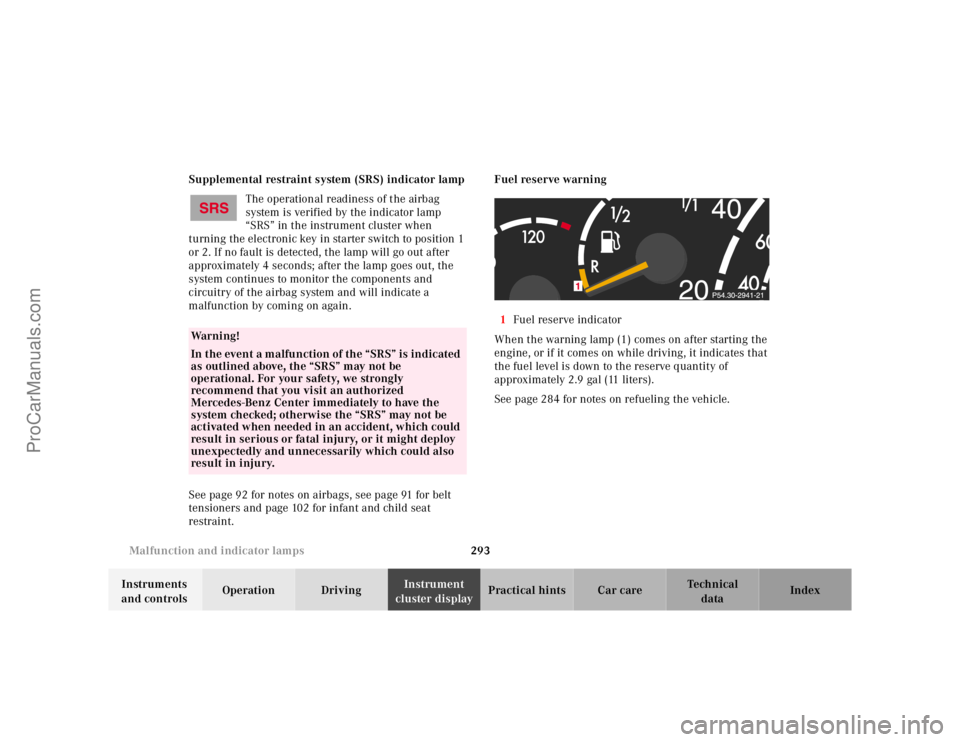
1Fuel reserve indicator
When the warning lamp (1) comes on after starting the
engine, or if it comes on while driving, it indicates that
the fuel level is down to the reserve quantity of
approximately 2.9 gal (11 liters).
See page 284 for notes on refueling the vehicle.
Wa r n i n g !
In the event a malfunction of the “SRS” is indicated
as outlined above, the “SRS” may not be
operational. For your safety, we strongly
recommend that you visit an authorized
Mercedes-Benz Center immediately to have the
system checked; otherwise the “SRS” may not be
activated when needed in an accident, which could
result in serious or fatal injury, or it might deploy
unexpectedly and unnecessarily which could also
result in injury.
ProCarManuals.com
Page 409 of 424
403 Index
Te ch n ica l
data Instruments
and controlsOperation DrivingInstrument
cluster displayPractical hints Car careIndex KEYLESS-GO-card ....................................................... 31
Locking and unlocking .............................................. 36
Locking and unlocking
with KEYLESS-GO-card ......................................... 40
Mechanical keys .......................................................... 47
Remote control ............................................................ 28
Simultaneous use of electronic main key
and KEYLESS-GO-card .......................................... 44
Summer opening/convenience feature ................... 45
Changing batteries in the KEYLESS-GO-card ...........366
Changing wheels ...........................................................340
CHECK ENGINE
malfunction indicator lamp .....................................290
Check regularly and before a long trip ......................287
Checking engine oil level
Via engine oil level indicator .................................. 154
Via oil dipstick ........................................................... 331
Child restraint ............................................ 70, 82, 88, 102
Cleaning and care of the vehicle ................................. 374
Coat hooks ...................................................................... 192
COMAND, radio and telephone ...................................208
Combination switch ...................................................... 160
Consumer information ..................................................399
Control and operation of radio transmitters .............208
COOLANT (coolant level) -
malfunction and warning messages ......................304COOLANT (coolant temperature) -
malfunction and warning messages ..................... 305
Coolant level
Adding ........................................................................ 333
Checking .................................................................... 333
Coolant temperature gauge .......................................... 117
Coolants .......................................................................... 397
Anticorrosion/antifreeze quantity ........................ 398
Courtesy lighting ........................................................... 185
Cruise control ................................................................ 250
CRUISE CONTROL -
malfunction and warning messages ..................... 309
Cup holder
Center console, front ................................................ 193
Rear bench armrest ................................................... 195
DDashboard ......................................................................... 22
Daytime running lamps ................................................ 158
Deep water
Driving instructions ................................................ 248
DISPLAY DEFECTIVE (engine control unit) -
malfunction and warning messages ..................... 298
DISPLAY DEFECTIVE (several systems) -
malfunction and warning messages ..................... 298
ProCarManuals.com
Page 412 of 424
406 Index
Te ch n ica l
data Instruments
and controlsOperation DrivingInstrument
cluster displayPractical hints Car careIndex
See CHECK ENGINE
malfunction indicator lamp ................................290
Fuel filler flap, manual release ...................................368
Fuel requirements .........................................................396
Fuel reserve warning ....................................................293
Fuels, coolants, lubricants etc. - capacities ...............393
Fuses, electrical .............................................................325
GGarage door opener .......................................................202
Gasoline
Additives ....................................................................397
Fuel requirements ....................................................396
Premium unleaded ...................................................396
General notes on the central locking system .............. 33
Glove box ......................................................................... 189HHazard warning flasher switch ................................... 163
Head restraints
Power head restraints, rear ....................................... 81
Head restraints, front seats
Removal and installation ........................................... 71Headlamp adjustment .................................................. 354
Headlamp cleaning system ........................................... 159
Headlamp mode (HEADLAMPS) .................................. 157
Headlights ....................................................................... 156
Heated seats ...................................................................... 76
Hood ................................................................................ 328
HOOD -
malfunction and warning messages ...................... 317
IIdentification labels ...................................................... 385
Illuminated vanity mirrors ........................................... 187
Indicator lamps in the instrument cluster ........ 114, 290
Individual settings ......................................................... 138
"INSTRUMENT CLUSTER" .......................................140
"LIGHTING" ................................................................ 142
"VEHICLE" .................................................................144
Infant and child restraint systems ..............................102
Installation .................................................................104
Information call
See Tele Aid ............................................................... 210
Infrared reflecting windshield .................................... 206
Inside rear view mirror .................................................106
INSTRUMENT CLUSTER
ProCarManuals.com