engine coolant MERCEDES-BENZ CL-CLASS 2000 User Guide
[x] Cancel search | Manufacturer: MERCEDES-BENZ, Model Year: 2000, Model line: CL-CLASS, Model: MERCEDES-BENZ CL-CLASS 2000Pages: 424, PDF Size: 26.09 MB
Page 311 of 424
305 Malfunction and warning messages
Te ch n ica l
data Instruments
and controlsOperation DrivingInstrument
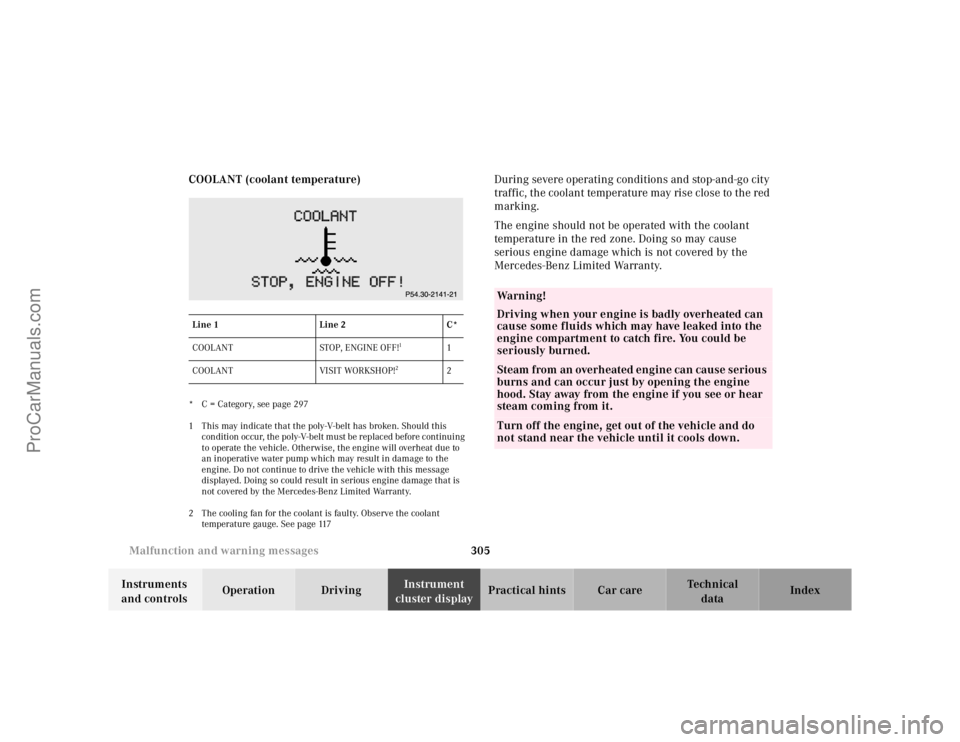
cluster displayPractical hints Car care Index COOLANT (coolant temperature)
* C = Category, see page 297
1 This may indicate that the poly-V-belt has broken. Should this
condition occur, the poly-V-belt must be replaced before continuing
to operate the vehicle. Otherwise, the engine will overheat due to
an inoperative water pump which may result in damage to the
engine. Do not continue to drive the vehicle with this message
displayed. Doing so could result in serious engine damage that is
not covered by the Mercedes-Benz Limited Warranty.
2 The cooling fan for the coolant is faulty. Observe the coolant
temperature gauge. See page 117
During severe operating conditions and stop-and-go city
traffic, the coolant temperature may rise close to the red
marking.
The engine should not be operated with the coolant
temperature in the red zone. Doing so may cause
serious engine damage which is not covered by the
Mercedes-Benz Limited Warranty.
Line 1Line 2C*
COOLANT STOP, ENGINE OFF!
1
1
COOLANT VISIT WORKSHOP!
2
2
Wa r n i n g !
Driving when your engine is badly overheated can
cause some fluids which may have leaked into the
engine compartment to catch fire. You could be
seriously burned.Steam from an overheated engine can cause serious
burns and can occur just by opening the engine
hood. Stay away from the engine if you see or hear
steam coming from it.Turn off the engine, get out of the vehicle and do
not stand near the vehicle until it cools down.
ProCarManuals.com
Page 329 of 424
323 Contents - Practical hints
Te ch n ica l
data Instruments
and controlsOperation DrivingInstrument
cluster displayPractical hintsCar care Index
Practical hintsFirst aid kit .....................................324
Fuses ................................................325
Shelf below rear window ..............327
Hood .................................................328
Checking engine oil level ............. 331
Automatic transmission
fluid level ...................................332
Active body control
(ABC) fluid level ........................332
Coolant level ...................................333
Adding coolant ...........................333
Windshield and headlamp
washer system ...........................334Windshield and headlamp
washer fluid mixing ratio ........ 334
Spare wheel, vehicle tools,
storage compartment ............... 335
Jack .................................................. 336
Wheels ............................................ 337
Tire Replacement ....................... 337
Rotating wheels ......................... 338
Spare wheel .................................... 338
Changing wheels ........................... 340
Tire inflation pressure ................. 345
Battery ............................................. 346
Jump starting ................................. 349
Towing the vehicle ........................ 351Exterior lamps ................................354
Headlamp assembly ...................355
Taillamp assemblies ..................358
Standby bulb function ................... 361
Changing batteries
in the electronic main key ......363
Synchronizing
remote control ............................365
Changing batteries
in the KEYLESS-GO-card .........366
Emergency engine
shut-down ..................................368
Fuel filler flap,
manual release ..........................368
Emergency operation of
sliding/pop-up roof ...................369
Replacing wiper blades .................370
Trunk lamp ..................................... 371
Roof rack .........................................372
ProCarManuals.com
Page 334 of 424
328 Engine compartment
Te ch n ica l
data Instruments
and controlsOperation DrivingInstrument
cluster displayPractical hintsCar care Index
Hood
Wa r n i n g !
To help prevent personal injury, stay clear of
moving parts when the hood is open and the engine
is running. Be sure the hood is properly closed
before driving. When closing hood, use extreme
caution not to catch hands or fingers.The radiator fan may continue to run for
approximately 30 seconds or even restart after the
engine has been turned off. Stay clear from fan
blades.If you see flames or smoke coming from the engine
compartment, or if the coolant temperature gauge
indicates that the engine is overheated, do not open
the hood. Move away from vehicle and do not open
the hood until the engine has cooled. If necessary,
call a fire department.
The engine is equipped with a transistorized
ignition system. Because of the high voltage it is
dangerous to touch any components (ignition coils,
spark plug sockets, diagnostic socket) of the
ignition system
• with the engine running,
• while starting the engine,
• if ignition is “on“ and the engine is turned
manually.
ProCarManuals.com
Page 339 of 424
333 Engine compartment
Te ch n ica l
data Instruments
and controlsOperation DrivingInstrument
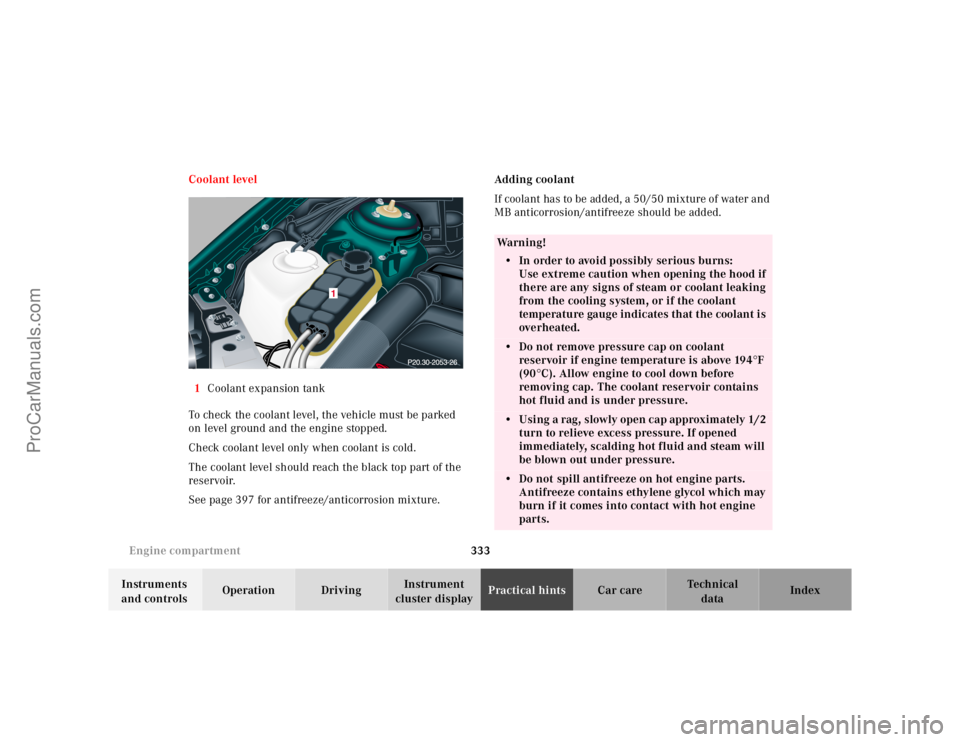
cluster displayPractical hintsCar care Index Coolant level
1Coolant expansion tank
To check the coolant level, the vehicle must be parked
on level ground and the engine stopped.
Check coolant level only when coolant is cold.
The coolant level should reach the black top part of the
reservoir.
See page 397 for antifreeze/anticorrosion mixture.Adding coolant
If coolant has to be added, a 50/50 mixture of water and
MB anticorrosion/antifreeze should be added.
1
Wa r n i n g !
• In order to avoid possibly serious burns:
Use extreme caution when opening the hood if
there are any signs of steam or coolant leaking
from the cooling system, or if the coolant
temperature gauge indicates that the coolant is
overheated.• Do not remove pressure cap on coolant
reservoir if engine temperature is above 194°F
(90°C). Allow engine to cool down before
removing cap. The coolant reservoir contains
hot fluid and is under pressure.• Using a rag, slowly open cap approximately 1/2
turn to relieve excess pressure. If opened
immediately, scalding hot fluid and steam will
be blown out under pressure.• Do not spill antifreeze on hot engine parts.
Antifreeze contains ethylene glycol which may
burn if it comes into contact with hot engine
parts.
ProCarManuals.com
Page 389 of 424

383 Contents - Technical data
Te ch n ica l
data Instruments
and controlsOperation DrivingInstrument
cluster displayPractical hints Car care Index
Technical dataSpare parts service ........................384
Warranty coverage .........................384
Identification labels .......................385
Layout of poly-V-belt drive ............387
Technical data ................................388
Fuels, coolants,
lubricants etc. - capacities .......393
Engine oils ......................................395Engine oil additives ...................... 395
Air conditioner
refrigerant ................................. 395
Brake fluid ...................................... 395
Premium unleaded
gasoline ...................................... 396
Fuel requirements ........................ 396
Gasoline additives ......................... 397
Coolants .......................................... 397
Consumer information ................. 399
ProCarManuals.com
Page 399 of 424
393 Fuels, coolants, lubricants etc. - capacities
Te ch n ica l
data Instruments
and controlsOperation DrivingInstrument
cluster displayPractical hints Car care Index Fuels, coolants, lubricants etc. - capacities
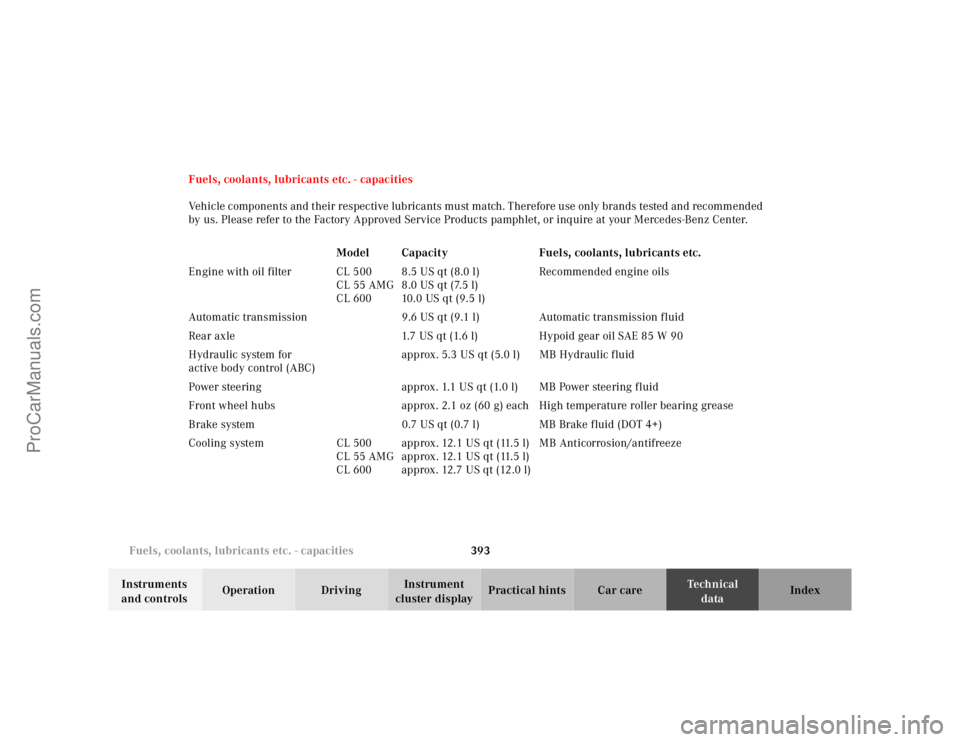
Vehicle components and their respective lubricants must match. Therefore use only brands tested and recommended
by us. Please refer to the Factory Approved Service Products pamphlet, or inquire at your Mercedes-Benz Center.
Model Capacity Fuels, coolants, lubricants etc.
Engine with oil filter CL 500
CL 55 AMG
CL 6008.5 US qt (8.0 l)
8.0 US qt (7.5 l)
10.0 US qt (9.5 l)Recommended engine oils
Automatic transmission 9.6 US qt (9.1 l) Automatic transmission fluid
Rear axle 1.7 US qt (1.6 l) Hypoid gear oil SAE 85 W 90
Hydraulic system for
active body control (ABC)approx. 5.3 US qt (5.0 l) MB Hydraulic fluid
Power steering approx. 1.1 US qt (1.0 l) MB Power steering fluid
Front wheel hubs approx. 2.1 oz (60 g) each High temperature roller bearing grease
Brake system 0.7 US qt (0.7 l) MB Brake fluid (DOT 4+)
Cooling system CL 500
CL 55 AMG
CL 600approx. 12.1 US qt (11.5 l)
approx. 12.1 US qt (11.5 l)
approx. 12.7 US qt (12.0 l)MB Anticorrosion/antifreeze
ProCarManuals.com
Page 401 of 424
395 Fuels, coolants, lubricants etc. - capacities
Te ch n ica l
data Instruments
and controlsOperation DrivingInstrument
cluster displayPractical hints Car care Index Engine oils
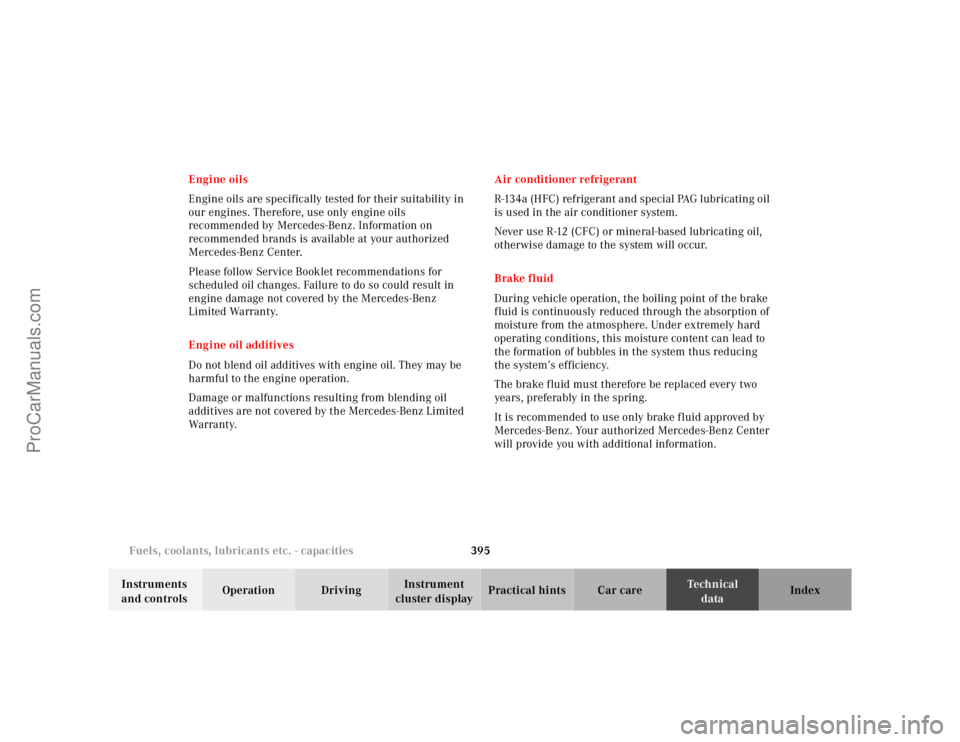
Engine oils are specifically tested for their suitability in
our engines. Therefore, use only engine oils
recommended by Mercedes-Benz. Information on
recommended brands is available at your authorized
Mercedes-Benz Center.
Please follow Service Booklet recommendations for
scheduled oil changes. Failure to do so could result in
engine damage not covered by the Mercedes-Benz
Limited Warranty.
Engine oil additives
Do not blend oil additives with engine oil. They may be
harmful to the engine operation.
Damage or malfunctions resulting from blending oil
additives are not covered by the Mercedes-Benz Limited
War ra nt y.Air conditioner refrigerant
R-134a (HFC) refrigerant and special PAG lubricating oil
is used in the air conditioner system.
Never use R-12 (CFC) or mineral-based lubricating oil,
otherwise damage to the system will occur.
Brake fluid
During vehicle operation, the boiling point of the brake
fluid is continuously reduced through the absorption of
moisture from the atmosphere. Under extremely hard
operating conditions, this moisture content can lead to
the formation of bubbles in the system thus reducing
the system’s efficiency.
The brake fluid must therefore be replaced every two
years, preferably in the spring.
It is recommended to use only brake fluid approved by
Mercedes-Benz. Your authorized Mercedes-Benz Center
will provide you with additional information.
ProCarManuals.com
Page 402 of 424
396 Fuels, coolants, lubricants etc. - capacities
Te ch n ica l
data Instruments
and controlsOperation DrivingInstrument
cluster displayPractical hints Car care Index
Premium unleaded gasoline
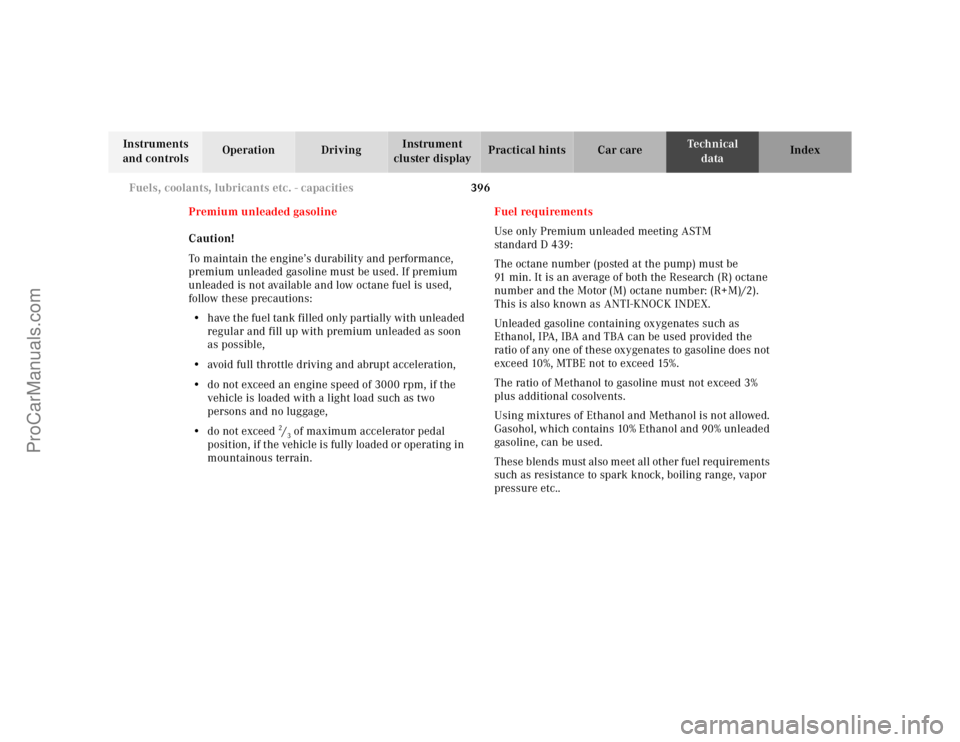
Caution!
To maintain the engine’s durability and performance,
premium unleaded gasoline must be used. If premium
unleaded is not available and low octane fuel is used,
follow these precautions:
•have the fuel tank filled only partially with unleaded
regular and fill up with premium unleaded as soon
as possible,
•avoid full throttle driving and abrupt acceleration,
•do not exceed an engine speed of 3000 rpm, if the
vehicle is loaded with a light load such as two
persons and no luggage,
•do not exceed
2/3 of maximum accelerator pedal
position, if the vehicle is fully loaded or operating in
mountainous terrain.Fuel requirements
Use only Premium unleaded meeting ASTM
standard D 439:
The octane number (posted at the pump) must be
91 min. It is an average of both the Research (R) octane
number and the Motor (M) octane number: (R+M)/2).
This is also known as ANTI-KNOCK INDEX.
Unleaded gasoline containing oxygenates such as
Ethanol, IPA, IBA and TBA can be used provided the
ratio of any one of these oxygenates to gasoline does not
exceed 10%, MTBE not to exceed 15%.
The ratio of Methanol to gasoline must not exceed 3%
plus additional cosolvents.
Using mixtures of Ethanol and Methanol is not allowed.
Gasohol, which contains 10% Ethanol and 90% unleaded
gasoline, can be used.
These blends must also meet all other fuel requirements
such as resistance to spark knock, boiling range, vapor
pressure etc..
ProCarManuals.com
Page 403 of 424
397 Fuels, coolants, lubricants etc. - capacities
Te ch n ica l
data Instruments
and controlsOperation DrivingInstrument
cluster displayPractical hints Car care Index Gasoline additives
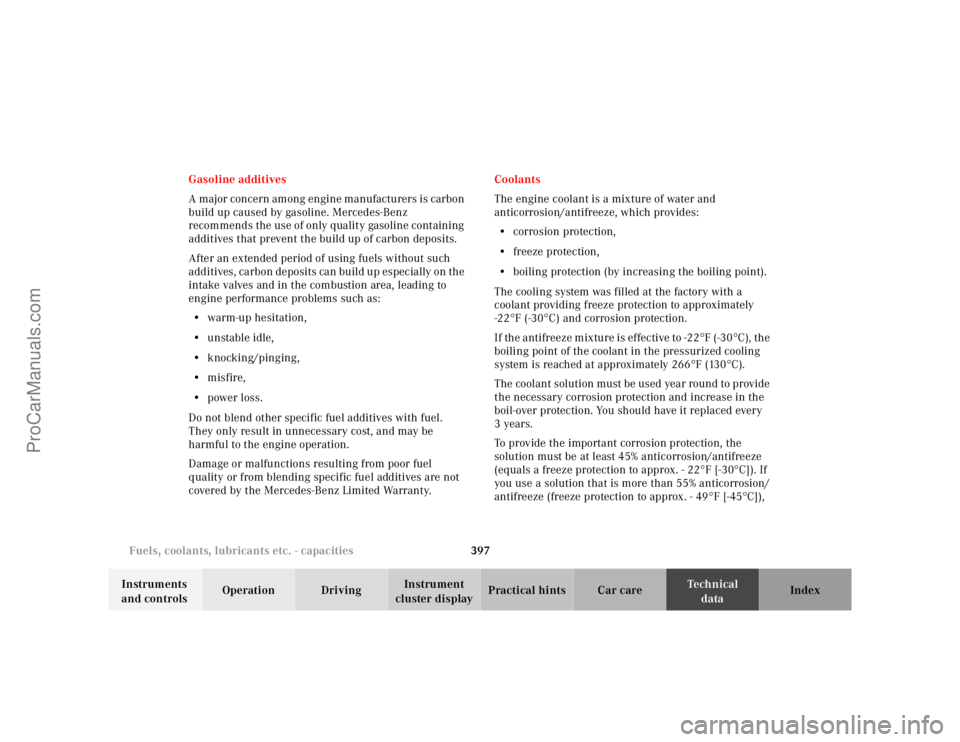
A major concern among engine manufacturers is carbon
build up caused by gasoline. Mercedes-Benz
recommends the use of only quality gasoline containing
additives that prevent the build up of carbon deposits.
After an extended period of using fuels without such
additives, carbon deposits can build up especially on the
intake valves and in the combustion area, leading to
engine performance problems such as:
•warm-up hesitation,
•unstable idle,
•knocking/pinging,
•misfire,
•power loss.
Do not blend other specific fuel additives with fuel.
They only result in unnecessary cost, and may be
harmful to the engine operation.
Damage or malfunctions resulting from poor fuel
quality or from blending specific fuel additives are not
covered by the Mercedes-Benz Limited Warranty.Coolants
The engine coolant is a mixture of water and
anticorrosion/antifreeze, which provides:
•corrosion protection,
•freeze protection,
•boiling protection (by increasing the boiling point).
The cooling system was filled at the factory with a
coolant providing freeze protection to approximately
-22°F (-30°C) and corrosion protection.
If the antifreeze mixture is effective to -22°F (-30°C), the
boiling point of the coolant in the pressurized cooling
system is reached at approximately 266°F (130°C).
The coolant solution must be used year round to provide
the necessary corrosion protection and increase in the
boil-over protection. You should have it replaced every
3years.
To provide the important corrosion protection, the
solution must be at least 45% anticorrosion/antifreeze
(equals a freeze protection to approx. - 22°F [-30°C]). If
you use a solution that is more than 55% anticorrosion/
antifreeze (freeze protection to approx. - 49°F [-45°C]),
ProCarManuals.com
Page 404 of 424
398 Fuels, coolants, lubricants etc. - capacities
Te ch n ica l
data Instruments
and controlsOperation DrivingInstrument
cluster displayPractical hints Car care Index
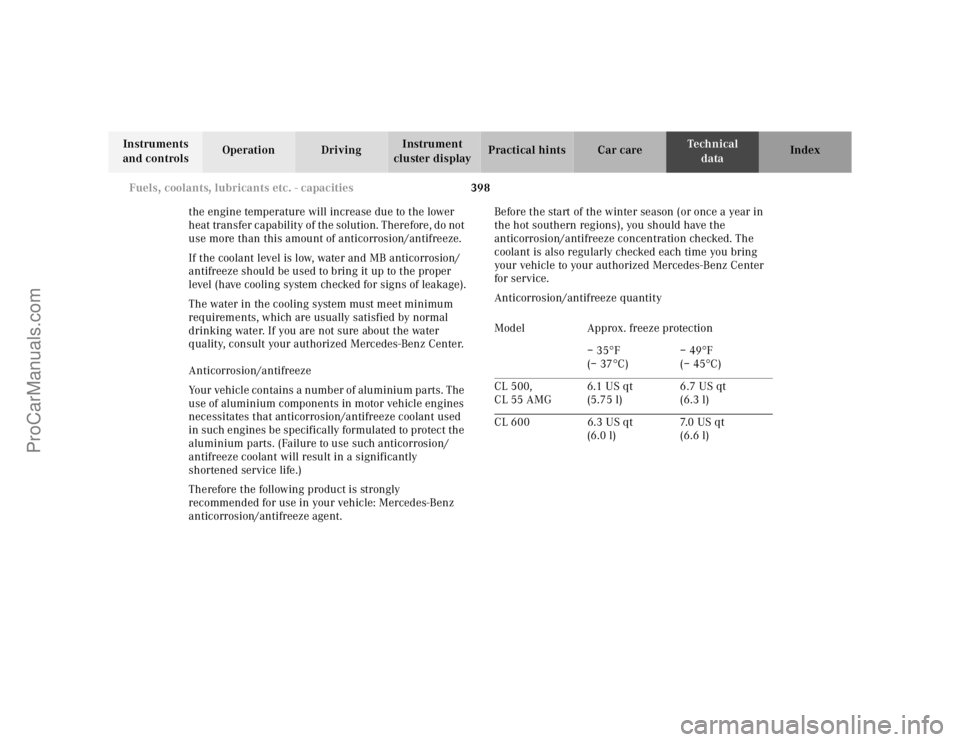
the engine temperature will increase due to the lower
heat transfer capability of the solution. Therefore, do not
use more than this amount of anticorrosion/antifreeze.
If the coolant level is low, water and MB anticorrosion/
antifreeze should be used to bring it up to the proper
level (have cooling system checked for signs of leakage).
The water in the cooling system must meet minimum
requirements, which are usually satisfied by normal
drinking water. If you are not sure about the water
quality, consult your authorized Mercedes-Benz Center.
Anticorrosion/antifreeze
Your vehicle contains a number of aluminium parts. The
use of aluminium components in motor vehicle engines
necessitates that anticorrosion/antifreeze coolant used
in such engines be specifically formulated to protect the
aluminium parts. (Failure to use such anticorrosion/
antifreeze coolant will result in a significantly
shortened service life.)
Therefore the following product is strongly
recommended for use in your vehicle: Mercedes-Benz
anticorrosion/antifreeze agent.Before the start of the winter season (or once a year in
the hot southern regions), you should have the
anticorrosion/antifreeze concentration checked. The
coolant is also regularly checked each time you bring
your vehicle to your authorized Mercedes-Benz Center
for service.
Anticorrosion/antifreeze quantity
Model Approx. freeze protection
– 35°F
(– 37°C)– 49°F
(– 45°C)
CL 500,
CL 55 AMG6.1 US qt
(5.75 l)6.7 US qt
(6.3 l)
CL 600 6.3 US qt
(6.0 l)7. 0 U S q t
(6.6 l)
ProCarManuals.com