window MERCEDES-BENZ CL-CLASS 2000 User Guide
[x] Cancel search | Manufacturer: MERCEDES-BENZ, Model Year: 2000, Model line: CL-CLASS, Model: MERCEDES-BENZ CL-CLASS 2000Pages: 424, PDF Size: 26.09 MB
Page 48 of 424
45 Central locking system
Te ch n ica l
data Instruments
and controlsOperationDrivingInstrument
cluster displayPractical hints Car care Index Opening and closing windows and
sliding/pop-up roof from outside
(summer opening/convenience feature)
Aim transmitter eye of remote control at a door receiver.
Summer opening:
(Operation with electronic main key)
The sliding/pop-up roof and all side windows can be
opened and the driver’s seat ventilation automatically
switches on. See page 79 for seat ventilation.
Continue to press transmit buttonΠafter unlocking
the vehicle.
The windows and sliding/pop-up roof begin to open
after approx. 1 second. The driver’s seat ventilation
automatically switches on. See page 79 for seat
ventilation.
To interrupt opening procedure, release transmit
button.
Convenience feature:
(Operation with electronic main key)
The sliding/pop-up roof and the side windows can be
closed.Continue to press transmit button‹ after locking
the vehicle.
The windows and sliding/pop-up roof begin to close
after approx. 1 second.
To interrupt closing procedure, release transmit button.
Ensure that all side windows and the sliding/pop-up
roof are properly closed before leaving the vehicle.
Wa r n i n g !
Never operate the windows or sliding/pop-up roof if
there is the possibility of anyone being harmed by
the opening or closing procedure.In case the procedure causes potential danger, the
procedure can be immediately halted by releasing
the remote control button. To reverse direction of
movement pressŒ for opening or‹ for
closing.
ProCarManuals.com
Page 49 of 424
46 Central locking system
Te ch n ica l
data Instruments
and controlsOperationDrivingInstrument
cluster displayPractical hints Car care Index
Note:
If the windows and sliding/pop-up roof cannot be
operated automatically by pressing the transmit button
of the remote control then it may be necessary to change
the batteries in the electronic main key (if ok, battery
check lamp in electronic main key will light briefly
when transmitting), or to synchronize the remote
control, see page 363 and 365.
Convenience feature
(Operation with KEYLESS-GO)
Continue to press lock button on door handle after
locking the vehicle.
The windows and sliding/pop-up roof begin to close
after approx. 1 second.
To interrupt closing procedure, release lock button. To
reverse direction (within 2 seconds after closing), pull
and hold door handle. Opening of windows starts and
continues for as long as the door handle is held but the
door not opened.
Ensure that all side windows and the sliding/pop-up
roof are properly closed before leaving the vehicle.
Wa r n i n g !
Never operate the windows or sliding/pop-up roof if
there is the possibility of anyone being harmed by
the closing procedure.In case the procedure causes potential danger, the
procedure can be immediately halted by releasing
the lock button. To reverse direction of movement
pull and hold outside door handle.
ProCarManuals.com
Page 52 of 424
49 Central locking system
Te ch n ica l
data Instruments
and controlsOperationDrivingInstrument
cluster displayPractical hints Car care Index If the vehicle has previously been locked from the
outside, opening a door from the inside will trigger the
alarm. When opening a door while the central locking
system is in the:
•selective unlocking mode, only that individual door
is unlocked. The remaining door, the trunk and fuel
filler f lap remain locked.
•global unlocking mode, both doors, the trunk and
fuel filler flap are unlocked.
Notes:
When opening a door, the door window and rear side
window lower slightly. After closing the door, the
windows close again.
In case of a malfunction in the central locking system
the doors can be locked and unlocked individually.
To lock, push down lock button or turn mechanical key
in driver’s door lock to position 3. In addition lock the
trunk.To unlock, pull inside door handles or turn mechanical
key in driver’s door lock to position 2.
When unlocking the driver’s door with the mechanical
key, the exterior lamps will flash and the alarm will
sound.
To cancel the alarm, insert the electronic key in the
starter switch or press buttonŒ or‹ on the
electronic main key.
ProCarManuals.com
Page 85 of 424
82 Restraint systems
Te ch n ica l
data Instruments
and controlsOperationDrivingInstrument
cluster displayPractical hints Car care Index
Seat belts and integrated restraint system
Your vehicle is equipped with seat belts for all seats,
emergency tensioning retractors, dual front airbags,
side impact airbags for driver, front and rear
passengers, and head protective window curtain
airbags. Their protective functions are designed to
complement one another.
Seat belts
Important!
Laws in most states and all Canadian provinces require
seat belt use.
All states and provinces require use of child restraints
that comply with U.S. Federal Motor Vehicle Safety
Standard 213 and Canadian Motor Vehicle Safety
Standard 213.
All child restraints systems are designed to be secured
in vehicle seats by lap belts or the lap belt portion of a
lap-shoulder belt.
For your safety and that of your passengers we strongly
recommend their use.
Wa r n i n g !
Children 12 years old and under must never ride in
the front seat, except in a Mercedes-Benz
authorized BabySmart
TM compatible child seat,
which operates with the BabySmart
TM system
installed in the vehicle to deactivate the passenger
side front airbag when it is properly installed.
Otherwise they will be struck by the airbag when it
inflates in a crash. If this happens, serious or fatal
injury will result.
According to accident statistics, children are safer
when properly restrained in the rear seating
positions than in the front seating positions.
Infants and small children must ride in back seats
and be seated in an appropriate infant or child
restraint system, which is properly secured with
the vehicle’s seat belt, fully in accordance with the
child seat manufacturer’s instructions.A child’s risk of serious or fatal injuries is
significantly increased if the child restraints are
not properly secured in the vehicle and the child is
not properly secured in the child restraint.
ProCarManuals.com
Page 89 of 424
86 Restraint systems
Te ch n ica l
data Instruments
and controlsOperationDrivingInstrument
cluster displayPractical hints Car care Index
Operation of seat belts
The inertia reel stops the belt from unwinding during
sudden stops or when quickly pulling on the belt.
The locking function of the reel may be checked by
quickly pulling out the belt.
Caution!
For safety reasons, avoid adjusting the seat or seat back
into positions which could affect the correct seat belt
positioning.
Unfastening of seat belts
Press release button (3) in the belt buckle (2).
Allow the retractor to completely rewind the seat belt by
guiding the latch plate (1).
Wa r n i n g !
USE SEAT BELTS PROPERLY.• Seat belts can only work when used properly.
Never wear seat belts in any other way than as
described in this section, as that could result
in serious injuries in case of an accident.• Each occupant should wear their seat belt at all
times, because seat belts help reduce the
likelihood of and potential severity of injuries
in accidents, including rollovers. The
integrated restraint system includes “SRS”
(driver airbag, front passenger airbag, side
impact airbags, head protection window
curtain airbags for side windows), “ETR” (seat
belt emergency tensioning retractors), and
front seat knee bolsters. The system is
designed to enhance the protection offered to
properly belted occupants in certain frontal
(front airbags) and side (side impact and
window curtain airbags) impacts which exceed
preset deployment thresholds.
ProCarManuals.com
Page 95 of 424
92 Restraint systems
Te ch n ica l
data Instruments
and controlsOperationDrivingInstrument
cluster displayPractical hints Car care Index
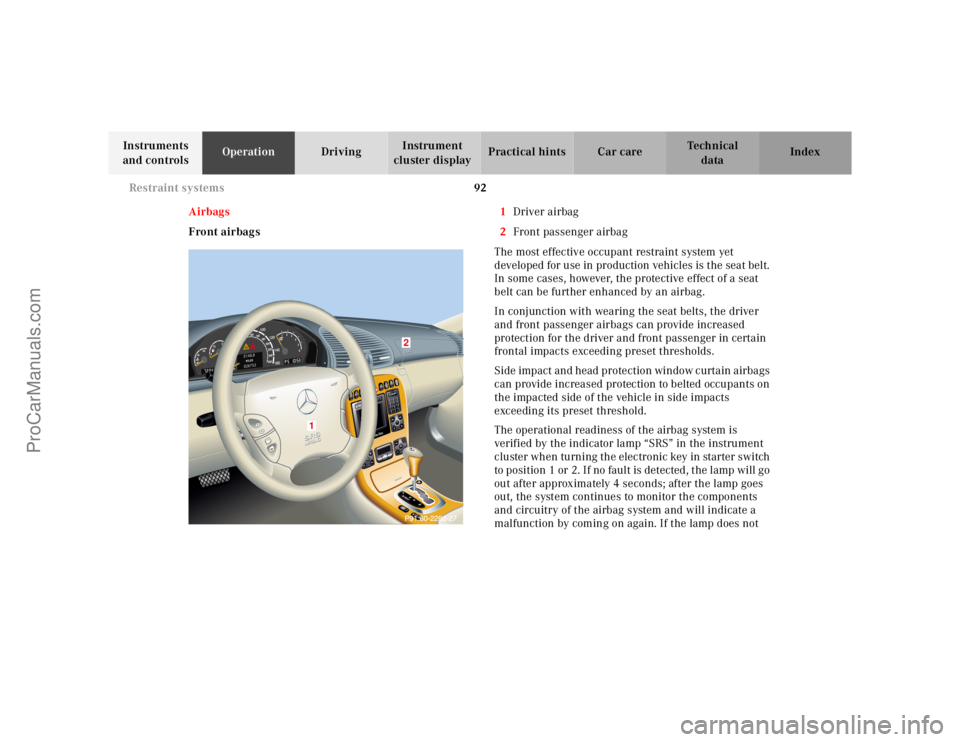
Airbags
Front airbags1Driver airbag
2Front passenger airbag
The most effective occupant restraint system yet
developed for use in production vehicles is the seat belt.
In some cases, however, the protective effect of a seat
belt can be further enhanced by an airbag.
In conjunction with wearing the seat belts, the driver
and front passenger airbags can provide increased
protection for the driver and front passenger in certain
frontal impacts exceeding preset thresholds.
Side impact and head protection window curtain airbags
can provide increased protection to belted occupants on
the impacted side of the vehicle in side impacts
exceeding its preset threshold.
The operational readiness of the airbag system is
verified by the indicator lamp “SRS” in the instrument
cluster when turning the electronic key in starter switch
to position 1 or 2. If no fault is detected, the lamp will go
out after approximately 4 seconds; after the lamp goes
out, the system continues to monitor the components
and circuitry of the airbag system and will indicate a
malfunction by coming on again. If the lamp does not
2
1
ProCarManuals.com
Page 98 of 424
95 Restraint systems
Te ch n ica l
data Instruments
and controlsOperationDrivingInstrument
cluster displayPractical hints Car care Index Side impact airbags, window curtain airbags
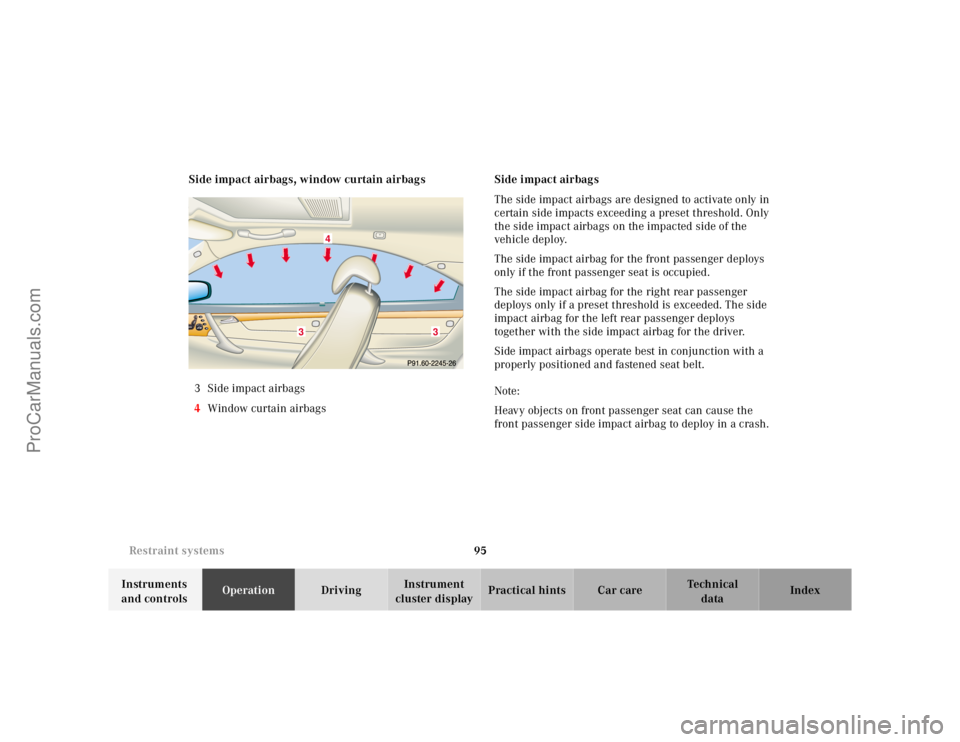
3 Side impact airbags
4Window curtain airbagsSide impact airbags
The side impact airbags are designed to activate only in
certain side impacts exceeding a preset threshold. Only
the side impact airbags on the impacted side of the
vehicle deploy.
The side impact airbag for the front passenger deploys
only if the front passenger seat is occupied.
The side impact airbag for the right rear passenger
deploys only if a preset threshold is exceeded. The side
impact airbag for the left rear passenger deploys
together with the side impact airbag for the driver.
Side impact airbags operate best in conjunction with a
properly positioned and fastened seat belt.
Note:
Heavy objects on front passenger seat can cause the
front passenger side impact airbag to deploy in a crash.
3
3
4
ProCarManuals.com
Page 99 of 424
96 Restraint systems
Te ch n ica l
data Instruments
and controlsOperationDrivingInstrument
cluster displayPractical hints Car care Index
Window curtain airbags
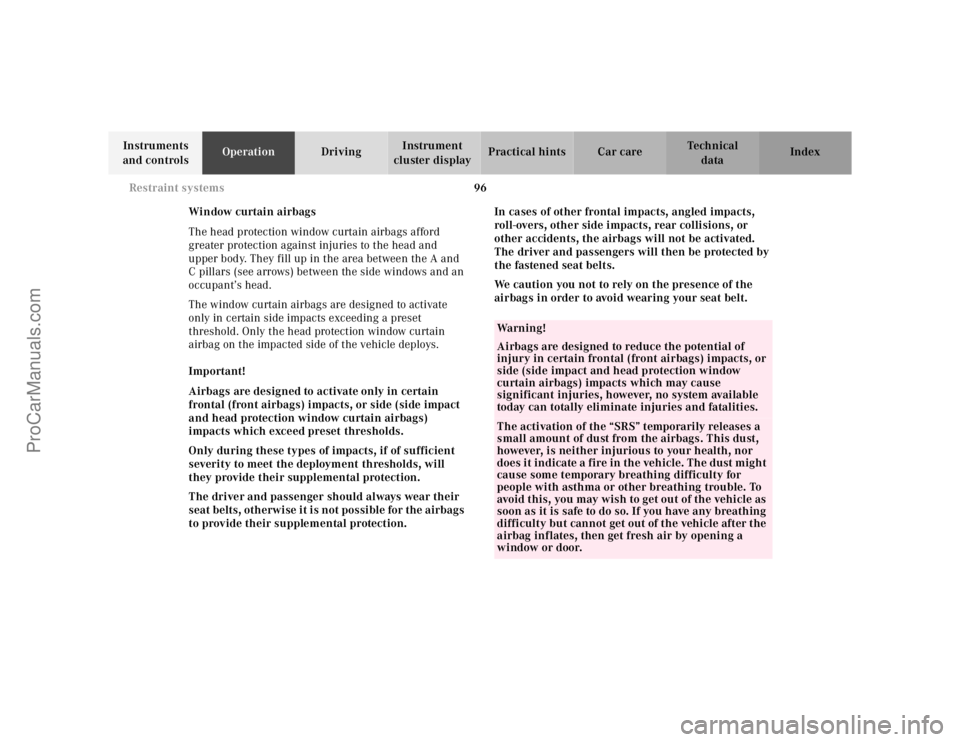
The head protection window curtain airbags afford
greater protection against injuries to the head and
upper body. They fill up in the area between the A and
C pillars (see arrows) between the side windows and an
occupant’s head.
The window curtain airbags are designed to activate
only in certain side impacts exceeding a preset
threshold. Only the head protection window curtain
airbag on the impacted side of the vehicle deploys.
Important!
Airbags are designed to activate only in certain
frontal (front airbags) impacts, or side (side impact
and head protection window curtain airbags)
impacts which exceed preset thresholds.
Only during these types of impacts, if of sufficient
severity to meet the deployment thresholds, will
they provide their supplemental protection.
The driver and passenger should always wear their
seat belts, otherwise it is not possible for the airbags
to provide their supplemental protection.In cases of other frontal impacts, angled impacts,
roll-overs, other side impacts, rear collisions, or
other accidents, the airbags will not be activated.
The driver and passengers will then be protected by
the fastened seat belts.
We caution you not to rely on the presence of the
airbags in order to avoid wearing your seat belt.
Wa r n i n g !
Airbags are designed to reduce the potential of
injury in certain frontal (front airbags) impacts, or
side (side impact and head protection window
curtain airbags) impacts which may cause
significant injuries, however, no system available
today can totally eliminate injuries and fatalities.The activation of the “SRS” temporarily releases a
small amount of dust from the airbags. This dust,
however, is neither injurious to your health, nor
does it indicate a fire in the vehicle. The dust might
cause some temporary breathing difficulty for
people with asthma or other breathing trouble. To
avoid this, you may wish to get out of the vehicle as
soon as it is safe to do so. If you have any breathing
difficulty but cannot get out of the vehicle after the
airbag inflates, then get fresh air by opening a
window or door.
ProCarManuals.com
Page 103 of 424
100 Restraint systems
Te ch n ica l
data Instruments
and controlsOperationDrivingInstrument
cluster displayPractical hints Car care Index
Safety guidelines for the seat belt, emergency
tensioning retractor and airbag
Wa r n i n g !
• Damaged seat belts or belts that were highly
stressed in an accident must be replaced and
their anchoring points must also be checked.
Use only belts installed or supplied by an
authorized Mercedes-Benz Center.• Airbags and “ETR’s” are designed to function
on a one-time-only basis. An airbag or
emergency tensioning retractor (ETR) that was
activated must be replaced.• No modifications of any kind may be made to
any components or wiring of the “SRS”. This
includes changing or removing any component
or part of the “SRS”, the installation of
additional trim material, badges etc. over the
steering wheel hub, front passenger airbag
cover, door trim panels, or door frame trims,
and installation of additional electrical/
electronic equipment on or near “SRS”
components and wiring. Keep area between
airbags and occupants free from objects (e.g.
packages, purses, umbrellas, etc.).
• Do not pass belts over sharp edges.• Do not make any modification that could
change the effectiveness of the belts.• Do not use handles or coat hooks above doors
and rear windows for placing such items as
coat hangers etc..• An airbag system component within the
steering wheel gets hot after the airbag has
inflated. Do not touch.• Improper work on the system, including
incorrect installation and removal, can lead to
possible injury through an unintended
activation of the “SRS”.• In addition, through improper work there is a
risk of rendering the “SRS” inoperative or
causing unintended airbag deployment. Work
on the “SRS” must therefore only be performed
by an authorized Mercedes-Benz Center.
ProCarManuals.com
Page 169 of 424
166 Automatic climate control
Te ch n ica l
data Instruments
and controlsOperationDrivingInstrument
cluster displayPractical hints Car care Index
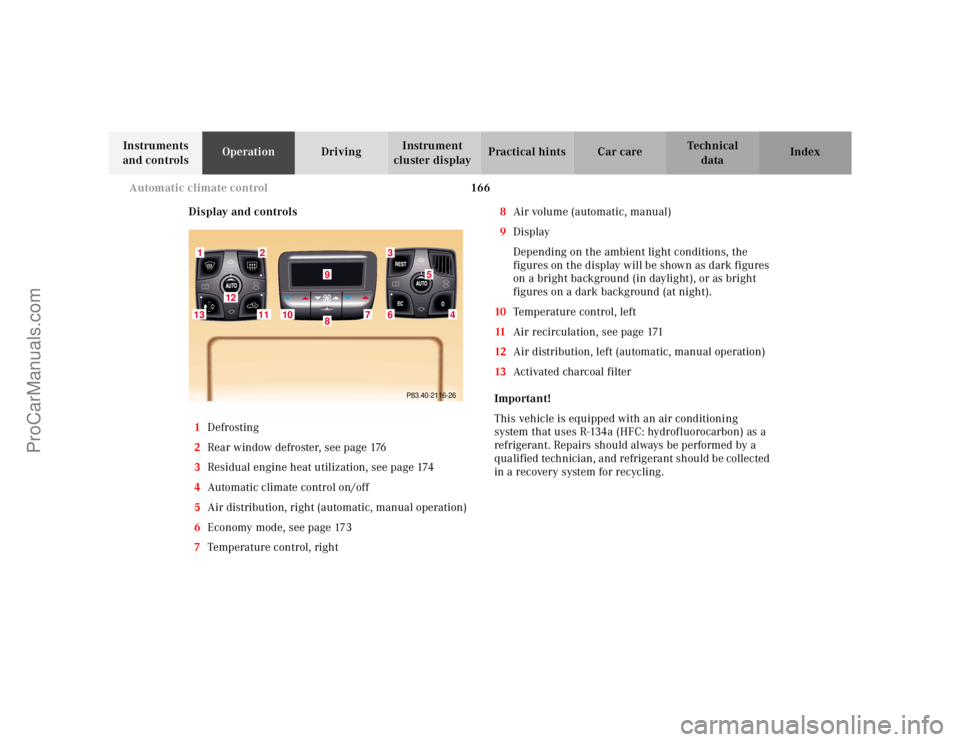
Display and controls
1Defrosting
2Rear window defroster, see page 176
3Residual engine heat utilization, see page 174
4Automatic climate control on/off
5Air distribution, right (automatic, manual operation)
6Economy mode, see page 173
7Temperature control, right8Air volume (automatic, manual)
9Display
Depending on the ambient light conditions, the
figures on the display will be shown as dark figures
on a bright background (in daylight), or as bright
figures on a dark background (at night).
10Temperature control, left
11Air recirculation, see page 171
12Air distribution, left (automatic, manual operation)
13Activated charcoal filter
Important!
This vehicle is equipped with an air conditioning
system that uses R-134a (HFC: hydrofluorocarbon) as a
refrigerant. Repairs should always be performed by a
qualified technician, and refrigerant should be collected
in a recovery system for recycling.
1
2
3
5
4
6
7
10
11
13
12
89
P83.40-2116-26
ProCarManuals.com