ESP MERCEDES-BENZ CL-CLASS 2000 Repair Manual
[x] Cancel search | Manufacturer: MERCEDES-BENZ, Model Year: 2000, Model line: CL-CLASS, Model: MERCEDES-BENZ CL-CLASS 2000Pages: 424, PDF Size: 26.09 MB
Page 321 of 424
315 Malfunction and warning messages
Te ch n ica l
data Instruments
and controlsOperation DrivingInstrument
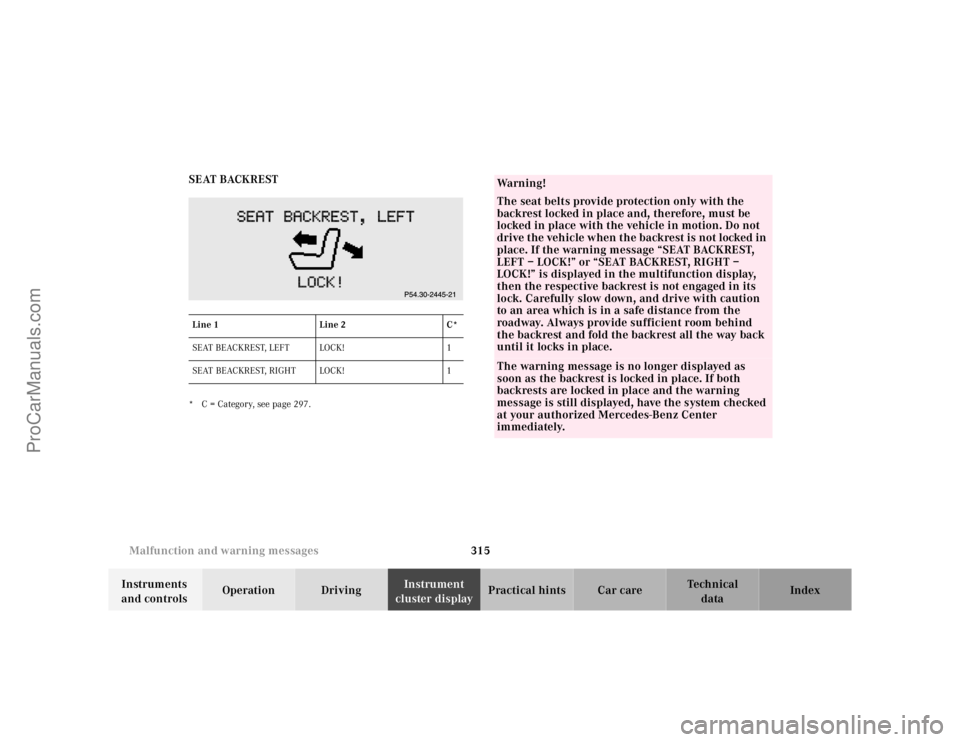
cluster displayPractical hints Car care Index SEAT BACKREST
* C = Category, see page 297.Line 1Line 2C*
SEAT BEACKREST, LEFT LOCK! 1
SEAT BEACKREST, RIGHT LOCK! 1
Wa r n i n g !
The seat belts provide protection only with the
backrest locked in place and, therefore, must be
locked in place with the vehicle in motion. Do not
drive the vehicle when the backrest is not locked in
place. If the warning message “SEAT BACKREST,
LEFT – LOCK!” or “SEAT BACKREST, RIGHT –
LOCK!” is displayed in the multifunction display,
then the respective backrest is not engaged in its
lock. Carefully slow down, and drive with caution
to an area which is in a safe distance from the
roadway. Always provide sufficient room behind
the backrest and fold the backrest all the way back
until it locks in place.The warning message is no longer displayed as
soon as the backrest is locked in place. If both
backrests are locked in place and the warning
message is still displayed, have the system checked
at your authorized Mercedes-Benz Center
immediately.
ProCarManuals.com
Page 323 of 424
317 Malfunction and warning messages
Te ch n ica l
data Instruments
and controlsOperation DrivingInstrument
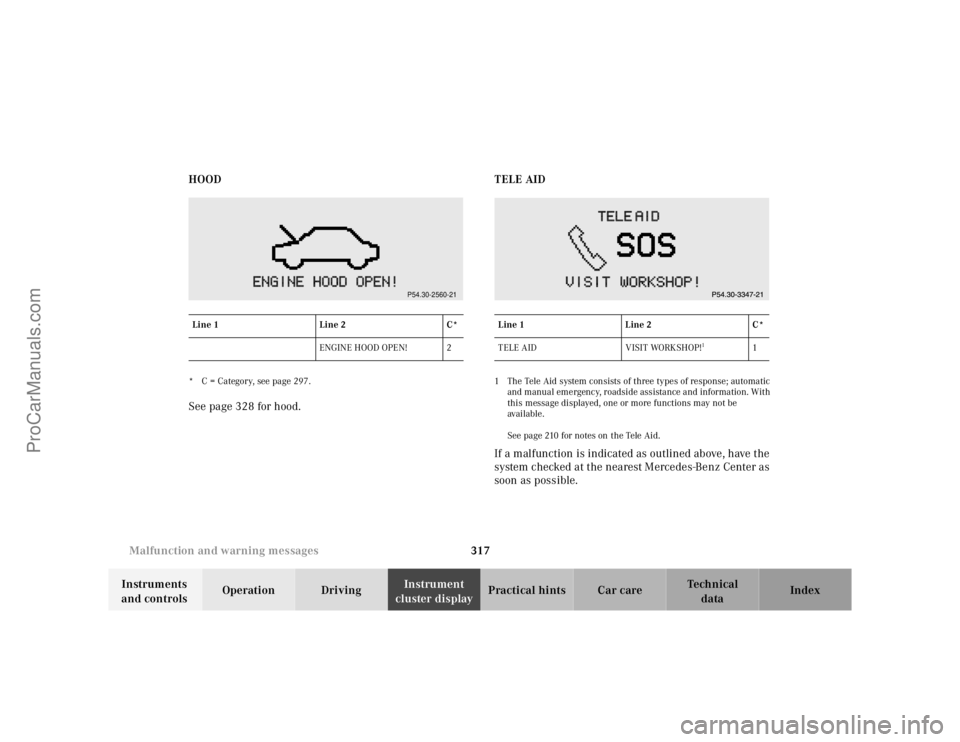
cluster displayPractical hints Car care Index HOOD
* C = Category, see page 297.See page 328 for hood.TELE AID
1 The Tele Aid system consists of three types of response; automatic
and manual emergency, roadside assistance and information. With
this message displayed, one or more functions may not be
av a i l a b l e .
See page 210 for notes on the Tele Aid.If a malfunction is indicated as outlined above, have the
system checked at the nearest Mercedes-Benz Center as
soon as possible.
Line 1Line 2C*
ENGINE HOOD OPEN! 2
P54.30-2560-21
Line 1Line 2C*
TELE AID VISIT WORKSHOP!
1
1
ProCarManuals.com
Page 342 of 424
336 Jack
Te ch n ica l
data Instruments
and controlsOperation DrivingInstrument
cluster displayPractical hintsCar care Index
Jack
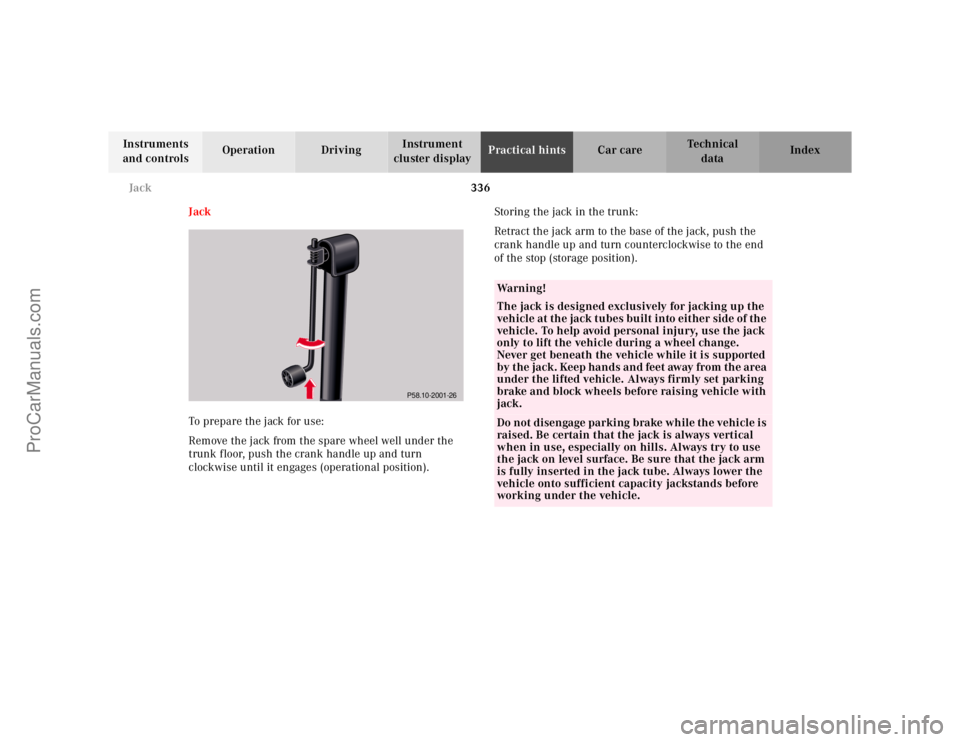
To prepare the jack for use:
Remove the jack from the spare wheel well under the
trunk floor, push the crank handle up and turn
clockwise until it engages (operational position).Storing the jack in the trunk:
Retract the jack arm to the base of the jack, push the
crank handle up and turn counterclockwise to the end
of the stop (storage position).
P58.10-2001-26
Wa r n i n g !
The jack is designed exclusively for jacking up the
vehicle at the jack tubes built into either side of the
vehicle. To help avoid personal injury, use the jack
only to lift the vehicle during a wheel change.
Never get beneath the vehicle while it is supported
by the jack. Keep hands and feet away from the area
under the lifted vehicle. Always firmly set parking
brake and block wheels before raising vehicle with
jack.Do not disengage parking brake while the vehicle is
raised. Be certain that the jack is always vertical
when in use, especially on hills. Always try to use
the jack on level surface. Be sure that the jack arm
is fully inserted in the jack tube. Always lower the
vehicle onto sufficient capacity jackstands before
working under the vehicle.
ProCarManuals.com
Page 346 of 424
340 Tires, Wheels
Te ch n ica l
data Instruments
and controlsOperation DrivingInstrument
cluster displayPractical hintsCar care Index
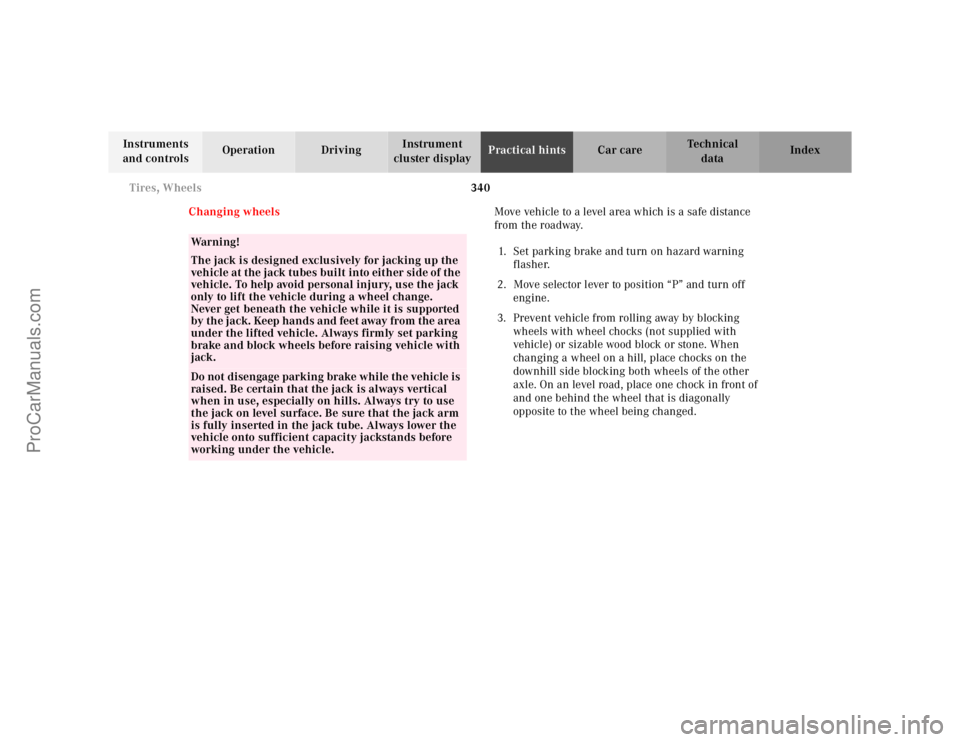
Changing wheelsMove vehicle to a level area which is a safe distance
from the roadway.
1. Set parking brake and turn on hazard warning
flasher.
2. Move selector lever to position “P” and turn off
engine.
3. Prevent vehicle from rolling away by blocking
wheels with wheel chocks (not supplied with
vehicle) or sizable wood block or stone. When
changing a wheel on a hill, place chocks on the
downhill side blocking both wheels of the other
axle. On an level road, place one chock in front of
and one behind the wheel that is diagonally
opposite to the wheel being changed.
Wa r n i n g !
The jack is designed exclusively for jacking up the
vehicle at the jack tubes built into either side of the
vehicle. To help avoid personal injury, use the jack
only to lift the vehicle during a wheel change.
Never get beneath the vehicle while it is supported
by the jack. Keep hands and feet away from the area
under the lifted vehicle. Always firmly set parking
brake and block wheels before raising vehicle with
jack.Do not disengage parking brake while the vehicle is
raised. Be certain that the jack is always vertical
when in use, especially on hills. Always try to use
the jack on level surface. Be sure that the jack arm
is fully inserted in the jack tube. Always lower the
vehicle onto sufficient capacity jackstands before
working under the vehicle.
ProCarManuals.com
Page 351 of 424
345 Tires, Wheels
Te ch n ica l
data Instruments
and controlsOperation DrivingInstrument
cluster displayPractical hintsCar care Index Tire inflation pressure
A table (see fuel filler flap) lists the tire inflation
pressures specified for Mercedes-Benz recommended
tires as well as for the varying operating conditions.
Important!
Tire pressure changes by approx. 1.5 psi (0.1 bar) per
18°F (10°C) of air temperature change. Keep this in
mind when checking tire pressure inside a garage –
especially in the winter.
Example:
If garage temperature = approx. +68°F (+20°C) and
ambient temperature = approx. +32°F (0°C) then the
adjusted air pressure = specified air pressure +3 psi
(+0.2 bar).Tire pressures listed for light loads are minimum values
offering high driving comfort. Increased inflation
pressures for heavy loads produce favorable handling
characteristics with lighter loads and are perfectly
permissible. The ride of the vehicle, however, will
become somewhat harder.
Tire temperature and pressure increase with the vehicle
speed. Tire pressure should therefore only be checked
and corrected on cold tires. Correct tire pressure in
warm tires only if pressure has dropped below the
pressure listed in the table and the respective operating
conditions are taken into consideration.
An underinf lated tire due to a slow leak (e.g. due to a
nail in the tire) may cause damage such as tread
separation, bulging etc.. Regular tire pressure checks
(including the spare tire) at intervals of no more than
14 days are therefore essential.
If a tire constantly loses air, it should be inspected for
damage.
ProCarManuals.com
Page 353 of 424
347 Battery
Te ch n ica l
data Instruments
and controlsOperation DrivingInstrument
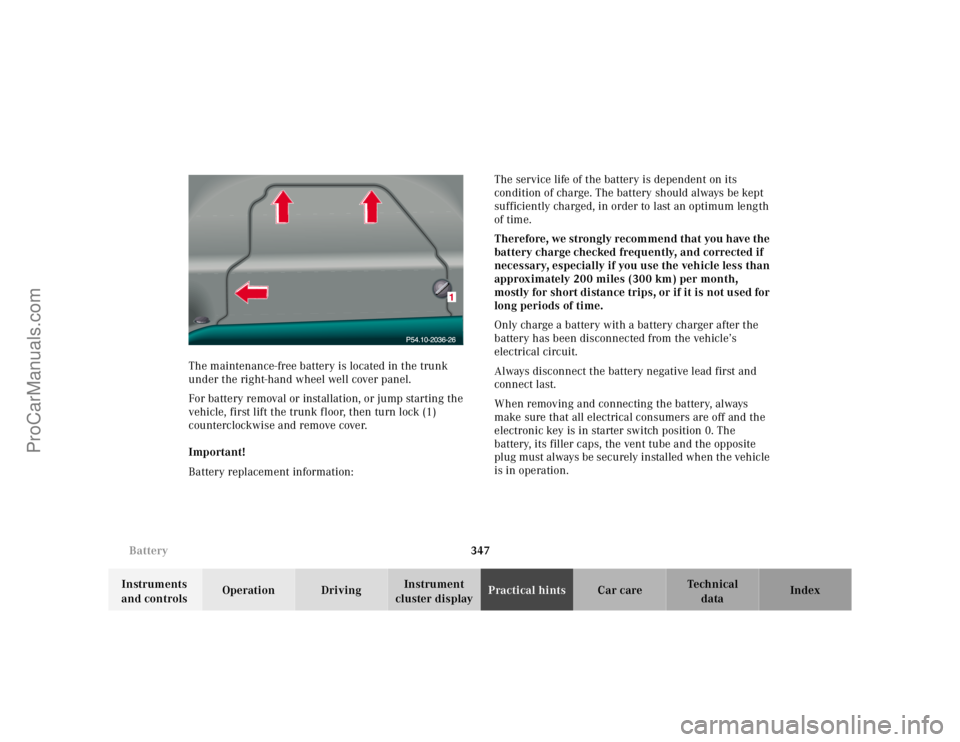
cluster displayPractical hintsCar care Index The maintenance-free battery is located in the trunk
under the right-hand wheel well cover panel.
For battery removal or installation, or jump starting the
vehicle, first lift the trunk f loor, then turn lock (1)
counterclockwise and remove cove r.
Important!
Battery replacement information:The service life of the battery is dependent on its
condition of charge. The battery should always be kept
sufficiently charged, in order to last an optimum length
of time.
Therefore, we strongly recommend that you have the
battery charge checked frequently, and corrected if
necessary, especially if you use the vehicle less than
approximately 200 miles (300 km) per month,
mostly for short distance trips, or if it is not used for
long periods of time.
Only charge a battery with a battery charger after the
battery has been disconnected from the vehicle’s
electrical circuit.
Always disconnect the battery negative lead first and
connect last.
When removing and connecting the battery, always
make sure that all electrical consumers are off and the
electronic key is in starter switch position 0. The
battery, its filler caps, the vent tube and the opposite
plug must always be securely installed when the vehicle
is in operation.
ProCarManuals.com
Page 359 of 424
353 Towing the vehicle
Te ch n ica l
data Instruments
and controlsOperation DrivingInstrument
cluster displayPractical hintsCar care Index We recommend that the vehicle be transported using
flat bed equipment. This method is preferable to other
types of towing.
Important!
To prevent damage during transport, do not tie down
vehicle by its chassis or suspension parts.
The vehicle may be towed with all wheels on the ground
and the selector lever in position “N” for distances up to
30 miles (50 km) and at a speed not to exceed 30 mph
(50 km/h). The electronic key must be in starter switch
position 2.
To be certain to avoid a possibility of damage to the
transmission, however, we recommend the drive shaft
be disconnected at the rear axle drive f lange for any
towing beyond a short tow to a nearby garage.
Do not tow with sling-type equipment. Towing with
sling-type equipment over bumpy roads will damage
radiator and supports.
Use wheel lift, dolly, or flat bed equipment, with
electronic key in starter switch turned to position 0.Note:
To signal turns while being towed with hazard warning
flasher in use, turn electronic key in starter switch to
position 2 and activate combination switch for left or
right turn signal in usual manner – only the selected
turn signal will operate.
Upon canceling the turn signal, the hazard warning
flasher will operate again.
Caution!
If the vehicle is towed with the front axle raised, the
engine must be shut off (electronic key in starter switch
position 0 or 1). Otherwise, the ESP will immediately be
engaged and will apply the rear wheel brakes.
Switch off the tow-away alarm (see “VEHICLE” under
“Individual settings” on page 144) as well as the ESP
(see page 273).
Wa r n i n g !
With the engine not running, there is no power
assistance for the braking and steering systems. In
this case, it is important to keep in mind that a
considerably higher degree of effort is necessary to
brake and steer the vehicle.
ProCarManuals.com
Page 368 of 424
362 Exterior lamps
Te ch n ica l
data Instruments
and controlsOperation DrivingInstrument
cluster displayPractical hintsCar care Index
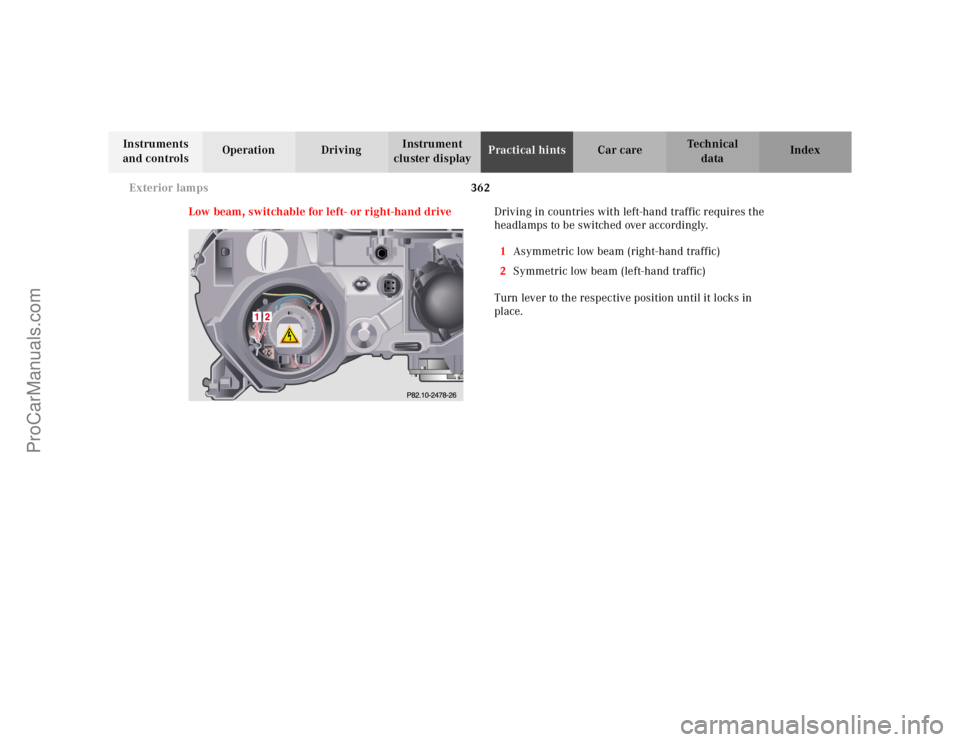
Low beam, switchable for left- or right-hand driveDriving in countries with left-hand traffic requires the
headlamps to be switched over accordingly.
1Asymmetric low beam (right-hand traffic)
2Symmetric low beam (left-hand traffic)
Turn lever to the respective position until it locks in
place.
ProCarManuals.com
Page 394 of 424

388 Technical data
Te ch n ica l
data Instruments
and controlsOperation DrivingInstrument
cluster displayPractical hints Car care Index
Te ch n ica l d a t a
Model CL 500 (215.375
1)CL 55 AMG (215.373
1)CL 600 (215.378
1)
E n g i n e 113 113 13 7
Mode of operation 4-stroke engine,
gasoline injection4-stroke engine,
gasoline injection4-stroke engine,
gasoline injection
No. of cylinders8812
Bore 3.82 in (97.00 mm) 3.82 in (97.00 mm) 3.31 in (84.00 mm)
Stroke 3.31 in (84.00 mm) 3.60 in (92.00 mm) 3.43 in (87.00 mm)
Total piston displacement 303.5 cu.in. (4966 cm
3) 332.0 cu.in. (5439 cm
3) 353.6 cu.in. (5786 cm
3)
Compression ratio 10:1 10.5:1 10:1
Output acc.
to SAE J 1349302 hp/5600 rpm
(225 kW/5600 rpm)355 hp/5500 rpm
(265 kW/5500 rpm)362 hp/5500 rpm
(270 kW/5500 rpm)
Maximum torque acc.
to SAE J 1349339 ft-lb/2700 rpm
(460 Nm/2700 rpm)390 ft.lb/3150 rpm
(530 Nm/3150 rpm)391 ft-lb/4100 rpm
(530 Nm/4100 rpm)
Maximum engine speed 6000 rpm 6000 rpm 6000 rpm
Firing order 1-5-4-2-6-3-7-8 1-5-4-2-6-3-7-8 1-12-5-8-3-10-6-7-2-11-4-9
Poly-V-belt 2390 mm 2390 mm 2345 mm
1 The quoted data apply only to the standard vehicle. See an authorized Mercedes-Benz Center for the
corresponding data of all special bodies and special equipment.
ProCarManuals.com
Page 399 of 424
393 Fuels, coolants, lubricants etc. - capacities
Te ch n ica l
data Instruments
and controlsOperation DrivingInstrument
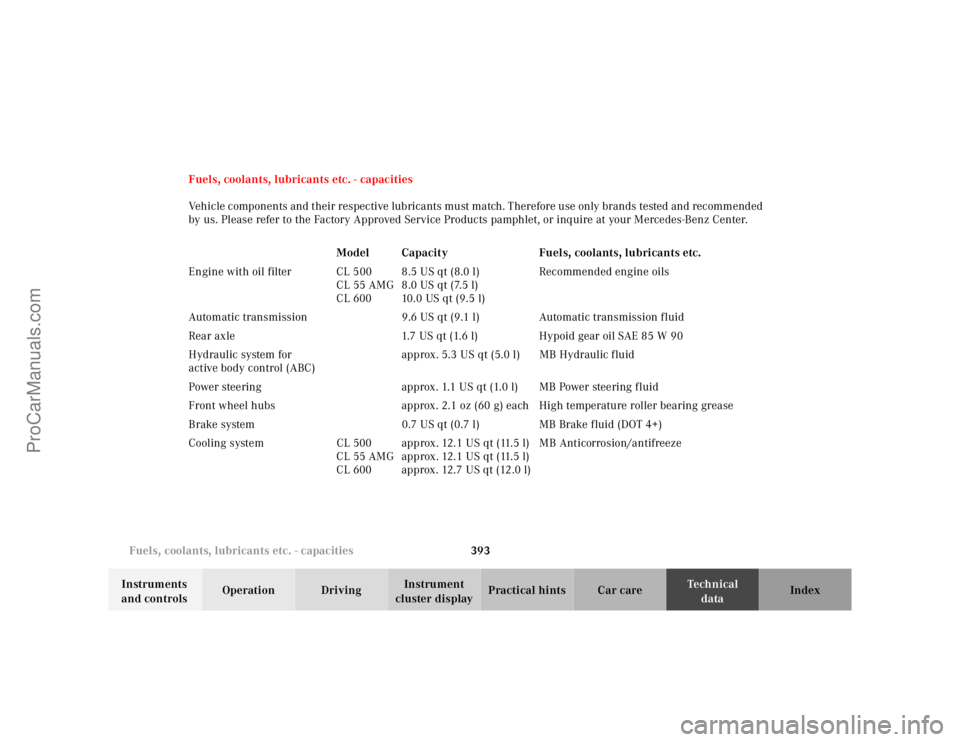
cluster displayPractical hints Car care Index Fuels, coolants, lubricants etc. - capacities
Vehicle components and their respective lubricants must match. Therefore use only brands tested and recommended
by us. Please refer to the Factory Approved Service Products pamphlet, or inquire at your Mercedes-Benz Center.
Model Capacity Fuels, coolants, lubricants etc.
Engine with oil filter CL 500
CL 55 AMG
CL 6008.5 US qt (8.0 l)
8.0 US qt (7.5 l)
10.0 US qt (9.5 l)Recommended engine oils
Automatic transmission 9.6 US qt (9.1 l) Automatic transmission fluid
Rear axle 1.7 US qt (1.6 l) Hypoid gear oil SAE 85 W 90
Hydraulic system for
active body control (ABC)approx. 5.3 US qt (5.0 l) MB Hydraulic fluid
Power steering approx. 1.1 US qt (1.0 l) MB Power steering fluid
Front wheel hubs approx. 2.1 oz (60 g) each High temperature roller bearing grease
Brake system 0.7 US qt (0.7 l) MB Brake fluid (DOT 4+)
Cooling system CL 500
CL 55 AMG
CL 600approx. 12.1 US qt (11.5 l)
approx. 12.1 US qt (11.5 l)
approx. 12.7 US qt (12.0 l)MB Anticorrosion/antifreeze
ProCarManuals.com