wheel MERCEDES-BENZ CL CLASS 2013 Owners Manual
[x] Cancel search | Manufacturer: MERCEDES-BENZ, Model Year: 2013, Model line: CL CLASS, Model: MERCEDES-BENZ CL CLASS 2013Pages: 496, PDF Size: 7.5 MB
Page 476 of 496
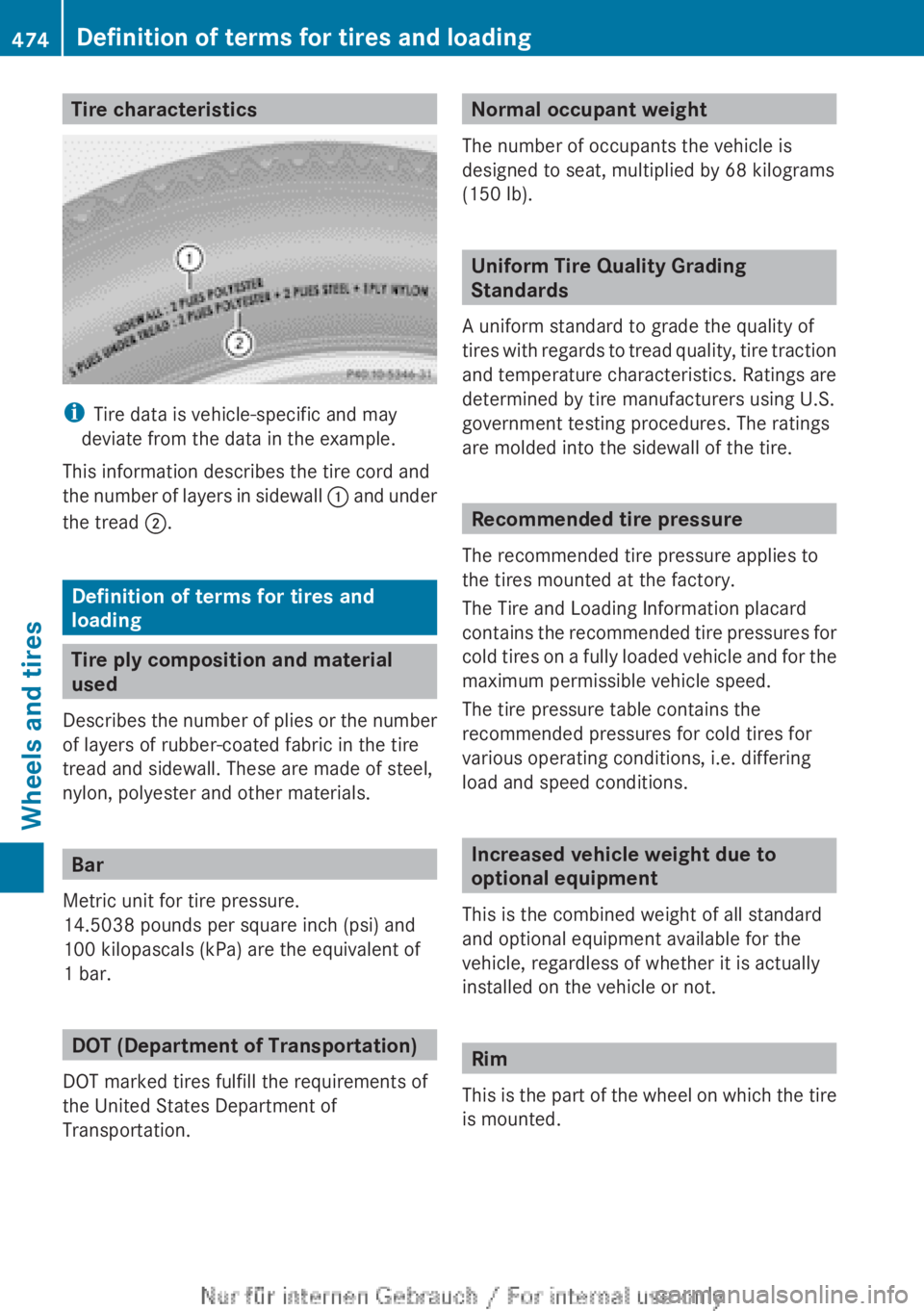
Tire characteristics
iTire data is vehicle-specific and may
deviate from the data in the example.
This information describes the tire cord and
the number of layers in sidewall : and under
the tread ;.
Definition of terms for tires and
loading
Tire ply composition and material
used
Describes the number of plies or the number
of layers of rubber-coated fabric in the tire
tread and sidewall. These are made of steel,
nylon, polyester and other materials.
Bar
Metric unit for tire pressure.
14.5038 pounds per square inch (psi) and
100 kilopascals (kPa) are the equivalent of
1 bar.
DOT (Department of Transportation)
DOT marked tires fulfill the requirements of
the United States Department of
Transportation.
Normal occupant weight
The number of occupants the vehicle is
designed to seat, multiplied by 68 kilograms
(150 lb).
Uniform Tire Quality Grading
Standards
A uniform standard to grade the quality of
tires with regards to tread quality, tire traction
and temperature characteristics. Ratings are
determined by tire manufacturers using U.S.
government testing procedures. The ratings
are molded into the sidewall of the tire.
Recommended tire pressure
The recommended tire pressure applies to
the tires mounted at the factory.
The Tire and Loading Information placard
contains the recommended tire pressures for
cold tires on a fully loaded vehicle and for the
maximum permissible vehicle speed.
The tire pressure table contains the
recommended pressures for cold tires for
various operating conditions, i.e. differing
load and speed conditions.
Increased vehicle weight due to
optional equipment
This is the combined weight of all standard
and optional equipment available for the
vehicle, regardless of whether it is actually
installed on the vehicle or not.
Rim
This is the part of the wheel on which the tire
is mounted.
474Definition of terms for tires and loadingWheels and tires
Page 477 of 496
GAWR (Gross Axle Weight Rating)
The GAWR is the maximum permissible axle
load. The actual load on an axle must never
exceed the gross axle weight rating. The
gross axle weight rating can be found on the
vehicle identification plate on the B-pillar on
the driver's side.
Speed rating
The speed rating is part of the tire
identification. It specifies the speed range for
which the tire is approved.
GVW (Gross Vehicle Weight)
The gross vehicle weight includes the weight
of the vehicle including fuel, tools, the spare
wheel, accessories installed, occupants,
luggage and the drawbar noseweight, if
applicable. The gross vehicle weight must not
exceed the gross vehicle weight rating GVWR
as specified on the vehicle identification plate
on the B-pillar on the driver's side.
GVWR (Gross Vehicle Weight Rating)
The GVWR is the maximum permissible gross
weight of a fully loaded vehicle (the weight of
the vehicle including all accessories,
occupants, fuel, luggage and the drawbar
noseweight, if applicable). The gross vehicle
weight rating is specified on the vehicle
identification plate on the B-pillar on the
driver's side.
Maximum loaded vehicle weight
The maximum weight is the sum of the curb
weight of the vehicle, the weight of the
accessories, the total load limit and the
weight of the optional equipment installed at
the factory.
Kilopascal (kPa)
Metric unit for tire pressure. 6.9 kPa
corresponds to 1 psi. Another unit for tire
pressure is bar. There are 100 kilopascals
(kPa) to 1 bar.
Load index
In addition to the load-bearing index, the load
index may also be imprinted on the sidewall
of the tire. This specifies the load-bearing
capacity more precisely.
Curb weight
The weight of a vehicle with standard
equipment including the maximum capacity
of fuel, oil and coolant. It also includes the air-
conditioning system and optional equipment
if these are installed in the vehicle, but does
not include passengers or luggage.
Maximum load rating
The maximum load rating in kilograms or
pounds is the maximum weight for which a
tire is approved.
Maximum permissible tire pressure
Maximum permissible tire pressure for one
tire.
Maximum load on one tire
Maximum load on one tire. This is calculated
by dividing the maximum axle load of one axle
by two.
PSI (pounds per square inch)
A standard unit of measure for tire pressure.
Definition of terms for tires and loading475Wheels and tiresZ
Page 478 of 496
Aspect ratio
Relationship between tire height and tire
width in percent.
Tire pressure
This is pressure inside the tire applying an
outward force to each square inch of the tire's
surface. The tire pressure is specified in
pounds per square inch (psi), in kilopascal
(kPa) or in bar. The tire pressure should only
be corrected when the tires are cold.
Tire pressure of cold tires
The tires are cold:
R if the vehicle has been parked without
direct sunlight on the tires for at least three
hours and
R if the vehicle has not been driven more than
1 mile (1.6 km).
Tread
The part of the tire that comes into contact
with the road.
Bead
The tire bead ensures that the tire sits
securely on the wheel. There are several steel
wires in the bead to prevent the tire from
coming loose from the wheel rim.
Sidewall
The part of the tire between the tread and the
bead.
Weight of optional extras
The combined weight of those optional extras
that weigh more than the replaced standard
part and more than 2.3 kg (5 lb). These
optional extras, such as high-performance
brakes, level control, a roof rack or a high-
performance battery, are not included in the
curb weight and the weight of the
accessories.
TIN (Tire Identification Number)
This is a unique identifier which can be used
by a tire manufacturer to identify tires, for
example for a product recall, and thus identify
the purchasers. The TIN is made up of the
manufacturer's identification code, tire size,
tire type code and the manufacturing date.
Load bearing index
The load bearing index (also load index) is a
code that contains the maximum load bearing
capacity of a tire.
Traction
Traction is the result of friction between the
tires and the road surface.
Treadwear indicators
Narrow bars (tread wear bars) that are
distributed over the tire tread. If the tire tread
is level with the bars, the wear limit of á in
(1.6 mm) has been reached.
Occupant distribution
The distribution of occupants in a vehicle at
their designated seating positions.
Total load limit
Rated cargo and luggage load plus
68 kilograms (150 lb), multiplied by the
vehicle's designated seating capacity.
476Definition of terms for tires and loadingWheels and tires
Page 479 of 496
Changing a wheel
Flat tire
The "Breakdown assistance" section
( Y page 437) contains information and notes
on how to deal with a flat tire. It also provides
instructions on changing a wheel or mounting
the spare wheel/emergency spare wheel.
Rotating the wheels
GWARNING
Interchanging the front and rear wheels may
severely impair the driving characteristics if
the wheels or tires have different dimensions.
The wheel brakes or suspension components
may also be damaged. There is a risk of
accident.
Rotate front and rear wheels only if the wheels
and tires are of the same dimensions.
Always pay attention to the instructions and
safety notices in the section on "Changing a
wheel and mounting the spare wheel"
( Y page 437).
The wear patterns on the front and rear tires
differ, depending on the operating conditions.
Rotate the wheels before a clear wear pattern
has formed on the tires. Front tires typically
wear more on the shoulders and the rear tires
in the center.
If your vehicle's tire configuration allows, you
can rotate the wheels according to the
intervals in the tire manufacturer's warranty
book in your vehicle documents. If no
warranty book is available, the tires should be
rotated every 3,000 to 6,000 miles (5,000 to
10,000 km), or earlier if tire wear requires. Do
not change the direction of wheel rotation.
Clean the contact surfaces of the wheel and
the brake disc thoroughly every time a wheel
is rotated. Check the tire pressures.
Information on changing tires and mounting
the spare wheel ( Y page 437).
!
On vehicles equipped with a tire pressure
monitor, electronic components are
located in the wheel.
Tire-mounting tools should not be used
near the valve. This could damage the
electronic components.
Only have tires changed at a qualified
specialist workshop.
Direction of rotation
Tires with a specified direction of rotation
have additional benefits, e.g. if there is a risk
of hydroplaning. You will only gain these
benefits if the correct direction of rotation is
maintained.
An arrow on the sidewall of the tire indicates
its correct direction of rotation.
You may mount a spare wheel/emergency
spare wheel against the direction of rotation.
Observe the time restriction on use as well as
the speed limit specified on the spare wheel/
emergency spare wheel
Storing wheels
Store wheels that are not being used in a cool,
dry and preferably dark place. Protect the
tires from oil, grease, gasoline and diesel.
Cleaning the wheels
GWARNING
Do not use power washers with circular-jet
nozzles (dirt grinders) to clean your vehicle, in
particular the tires. You could otherwise
damage the tires and cause an accident.
Wheel and tire combinations
Points to remember
! For safety reasons, Mercedes-Benz
recommends that you only use tires and
wheels which have been approved by
Wheel and tire combinations477Wheels and tiresZ
Page 480 of 496
Mercedes-Benz specifically for your
vehicle.
These tires have been specially adapted for
use with the control systems, such as ABS
or ESP ®
, and are marked as follows:
R MO = Mercedes-Benz Original
R MOE = Mercedes-Benz Original Extended
(tires featuring run-flat characteristics)
R MO1 = Mercedes-Benz Original (only
certain AMG tires)
Mercedes-Benz Original Extended tires
may only be used on wheels that have been
specifically approved by Mercedes-Benz.
Only use tires, wheels or accessories
tested and approved by Mercedes-Benz.
Certain characteristics, e.g. handling,
vehicle noise emissions or fuel
consumption, may otherwise be adversely
affected. In addition, when driving with a
load, tire dimension variations could cause
the tires to come into contact with the
bodywork and axle components. This could
result in damage to the tires or the vehicle.
Mercedes-Benz accepts no liability for
damage resulting from the use of tires,
wheels or accessories other than those
tested and approved.
Information on tires, wheels and approved
combinations can be obtained from any
qualified specialist workshop.
i The recommended pressures for various
operating conditions can be found:
R on the Tire and Loading Information
placard with the recommended tire
pressures on the B-pillar on the driver's
side
R in the tire pressure table on the inside of
the fuel filler flap
Observe the notes on recommended tire
pressures under various operating
conditions ( Y page 458).
Check tire pressures regularly, and only
when the tires are cold. Comply with the
maintenance recommendations of the tiremanufacturer in the vehicle document
wallet.
i Notes on the vehicle equipment – always
equip the vehicle with:
R tires of the same size on a given axle
(left/right)
R the same type of tires at a given time
(summer tires, winter tires, MOExtended
tires)
i On the following pages, you can find
information on approved wheel rims and
tire sizes for equipping your vehicle with
winter tires. Winter tires are not available
at the factory as standard equipment or
optional extras.
If you would like to equip your vehicle with
approved winter tires, you may also, in
certain circumstances, require rims of the
appropriate size. The size of the approved
winter tires may deviate from that of the
standard tires. This is dependent on the
model and the equipment installed at the
factory.
The tires and wheel rims, as well as further
information, can be obtained at a qualified
specialist workshop.
i Overview of abbreviations used in the
following tire tables:
R BA: both axles
R FA: front axle
R RA: rear axle
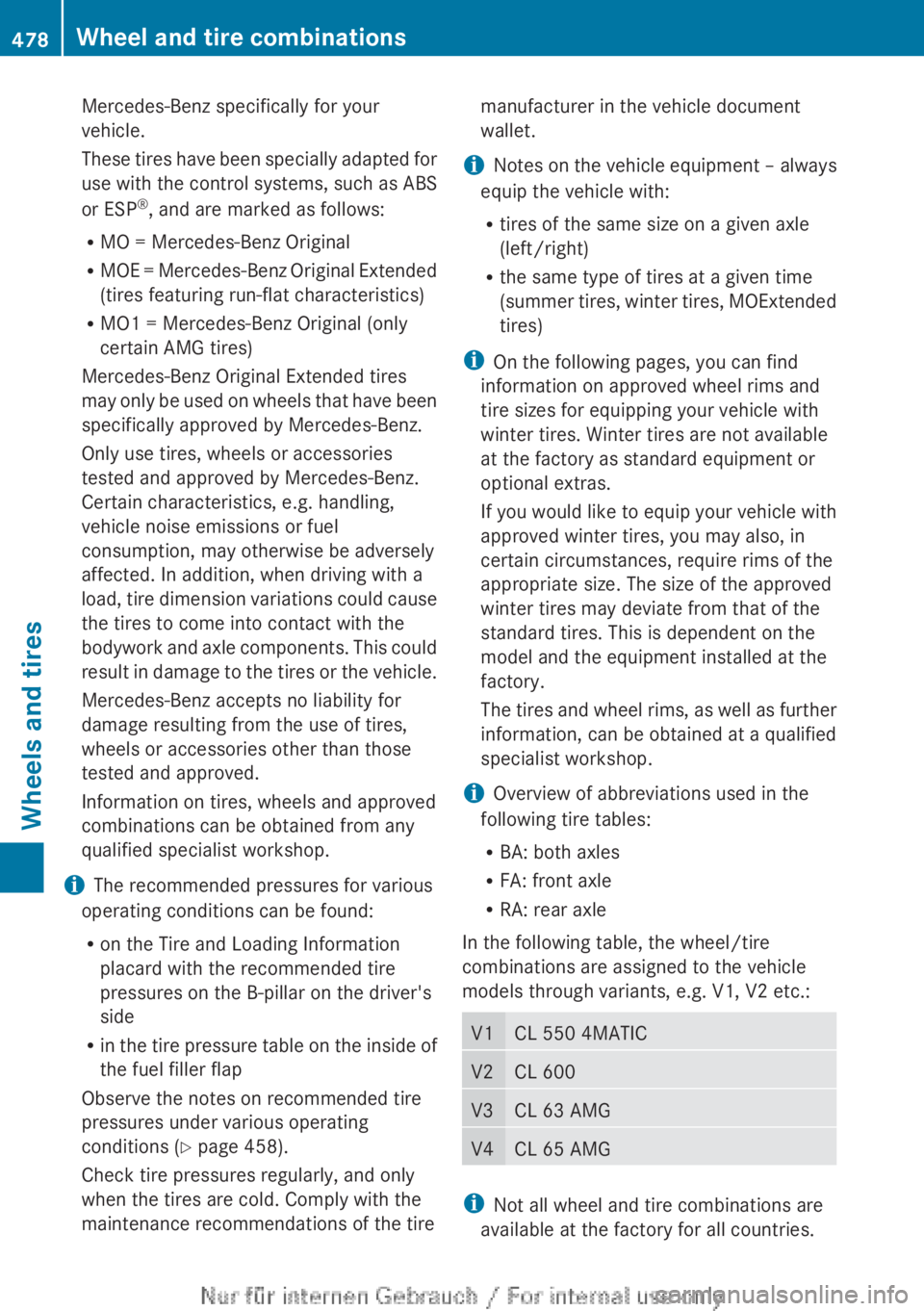
In the following table, the wheel/tire
combinations are assigned to the vehicle
models through variants, e.g. V1, V2 etc.:V1CL 550 4MATICV2CL 600V3CL 63 AMGV4CL 65 AMG
i Not all wheel and tire combinations are
available at the factory for all countries.
478Wheel and tire combinationsWheels and tires
Page 481 of 496
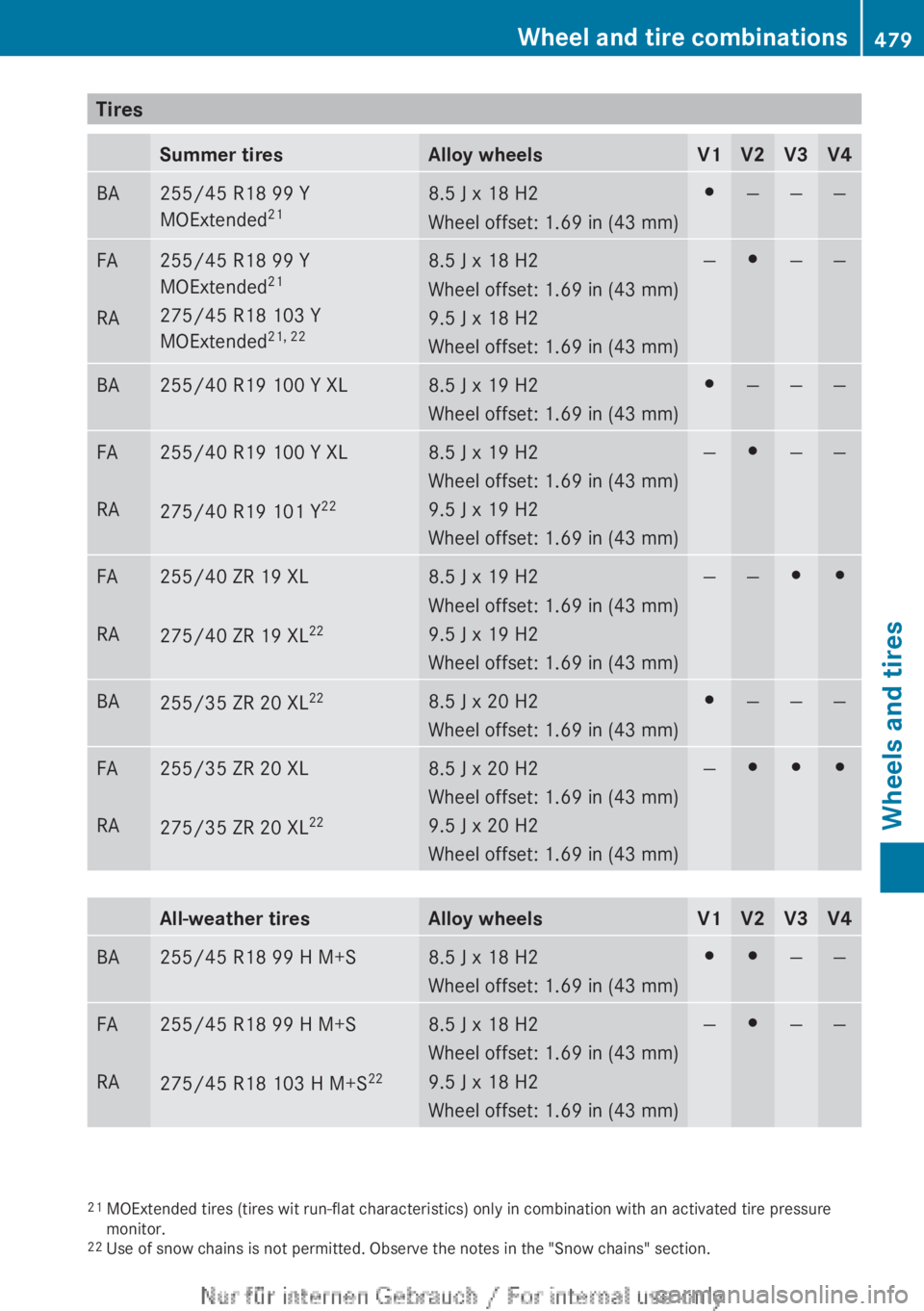
TiresSummer tiresAlloy wheelsV1V2V3V4BA255/45 R18 99 Y
MOExtended 218.5 J x 18 H2
Wheel offset: 1.69 in (43 mm)#———FA
RA255/45 R18 99 Y
MOExtended 21
275/45 R18 103 Y
MOExtended 21, 228.5 J x 18 H2
Wheel offset: 1.69 in (43 mm)
9.5 J x 18 H2
Wheel offset: 1.69 in (43 mm)—#——BA255/40 R19 100 Y XL8.5 J x 19 H2
Wheel offset: 1.69 in (43 mm)#———FA
RA255/40 R19 100 Y XL
275/40 R19 101 Y 228.5 J x 19 H2
Wheel offset: 1.69 in (43 mm)
9.5 J x 19 H2
Wheel offset: 1.69 in (43 mm)—#——FA
RA255/40 ZR 19 XL
275/40 ZR 19 XL 228.5 J x 19 H2
Wheel offset: 1.69 in (43 mm)
9.5 J x 19 H2
Wheel offset: 1.69 in (43 mm)——##BA255/35 ZR 20 XL 228.5 J x 20 H2
Wheel offset: 1.69 in (43 mm)#———FA
RA255/35 ZR 20 XL
275/35 ZR 20 XL 228.5 J x 20 H2
Wheel offset: 1.69 in (43 mm)
9.5 J x 20 H2
Wheel offset: 1.69 in (43 mm)—###All-weather tiresAlloy wheelsV1V2V3V4BA255/45 R18 99 H M+S8.5 J x 18 H2
Wheel offset: 1.69 in (43 mm)##——FA
RA255/45 R18 99 H M+S
275/45 R18 103 H M+S 228.5 J x 18 H2
Wheel offset: 1.69 in (43 mm)
9.5 J x 18 H2
Wheel offset: 1.69 in (43 mm)—#——21 MOExtended tires (tires wit run-flat characteristics) only in combination with an activated tire pressure
monitor.
22 Use of snow chains is not permitted. Observe the notes in the "Snow chains" section.Wheel and tire combinations479Wheels and tiresZ
Page 482 of 496
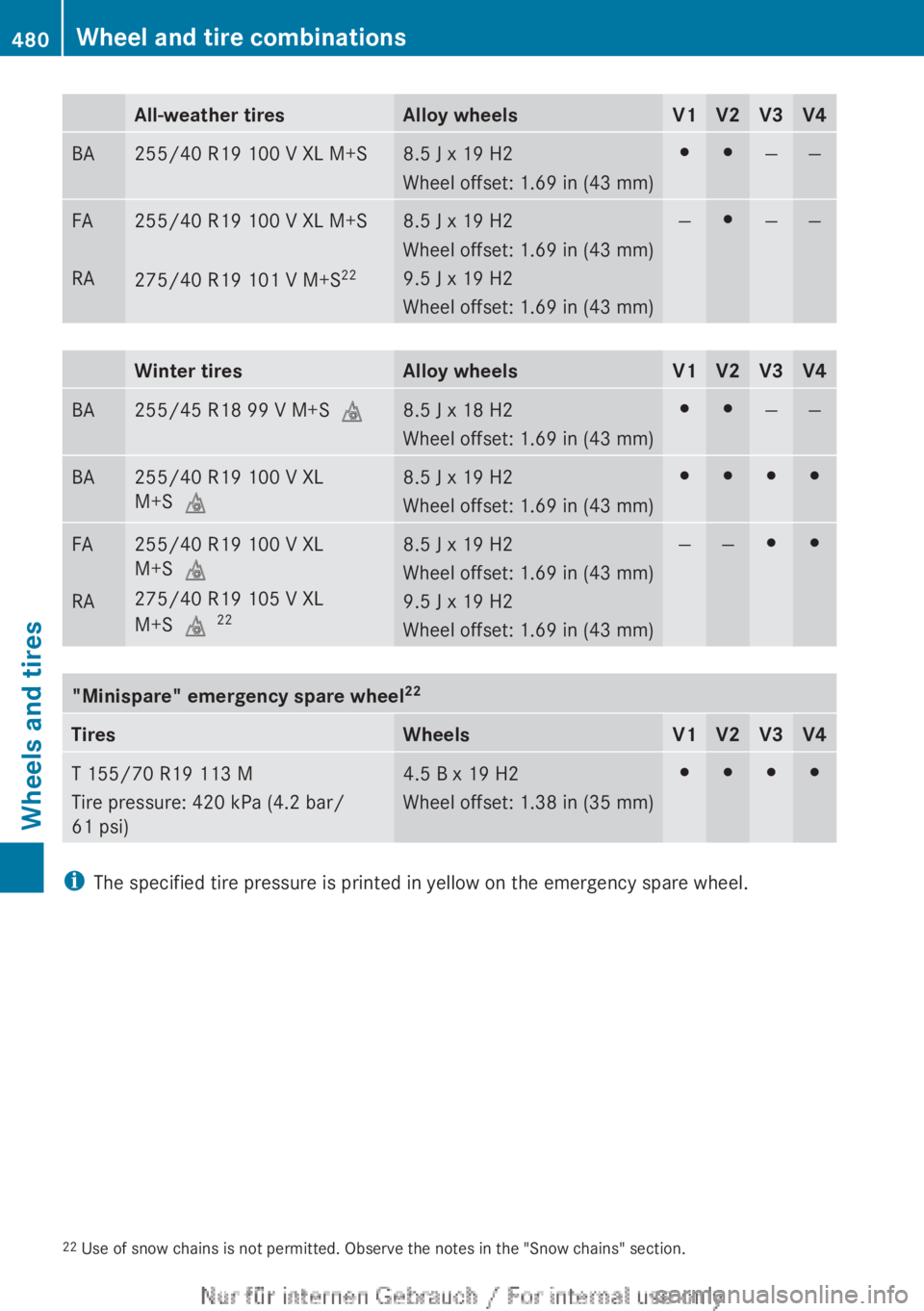
All-weather tiresAlloy wheelsV1V2V3V4BA255/40 R19 100 V XL M+S8.5 J x 19 H2
Wheel offset: 1.69 in (43 mm)##——FA
RA255/40 R19 100 V XL M+S
275/40 R19 101 V M+S 228.5 J x 19 H2
Wheel offset: 1.69 in (43 mm)
9.5 J x 19 H2
Wheel offset: 1.69 in (43 mm)—#——Winter tiresAlloy wheelsV1V2V3V4BA255/45 R18 99 V M+S i8.5 J x 18 H2
Wheel offset: 1.69 in (43 mm)##——BA255/40 R19 100 V XL
M+S i8.5 J x 19 H2
Wheel offset: 1.69 in (43 mm)####FA
RA255/40 R19 100 V XL
M+S i
275/40 R19 105 V XL
M+S i 228.5 J x 19 H2
Wheel offset: 1.69 in (43 mm)
9.5 J x 19 H2
Wheel offset: 1.69 in (43 mm)——##"Minispare" emergency spare wheel 22TiresWheelsV1V2V3V4T 155/70 R19 113 M
Tire pressure: 420 kPa (4.2 bar/
61 psi)4.5 B x 19 H2
Wheel offset: 1.38 in (35 mm)####
i The specified tire pressure is printed in yellow on the emergency spare wheel.
22
Use of snow chains is not permitted. Observe the notes in the "Snow chains" section.480Wheel and tire combinationsWheels and tires
Page 492 of 496
Vehicle data
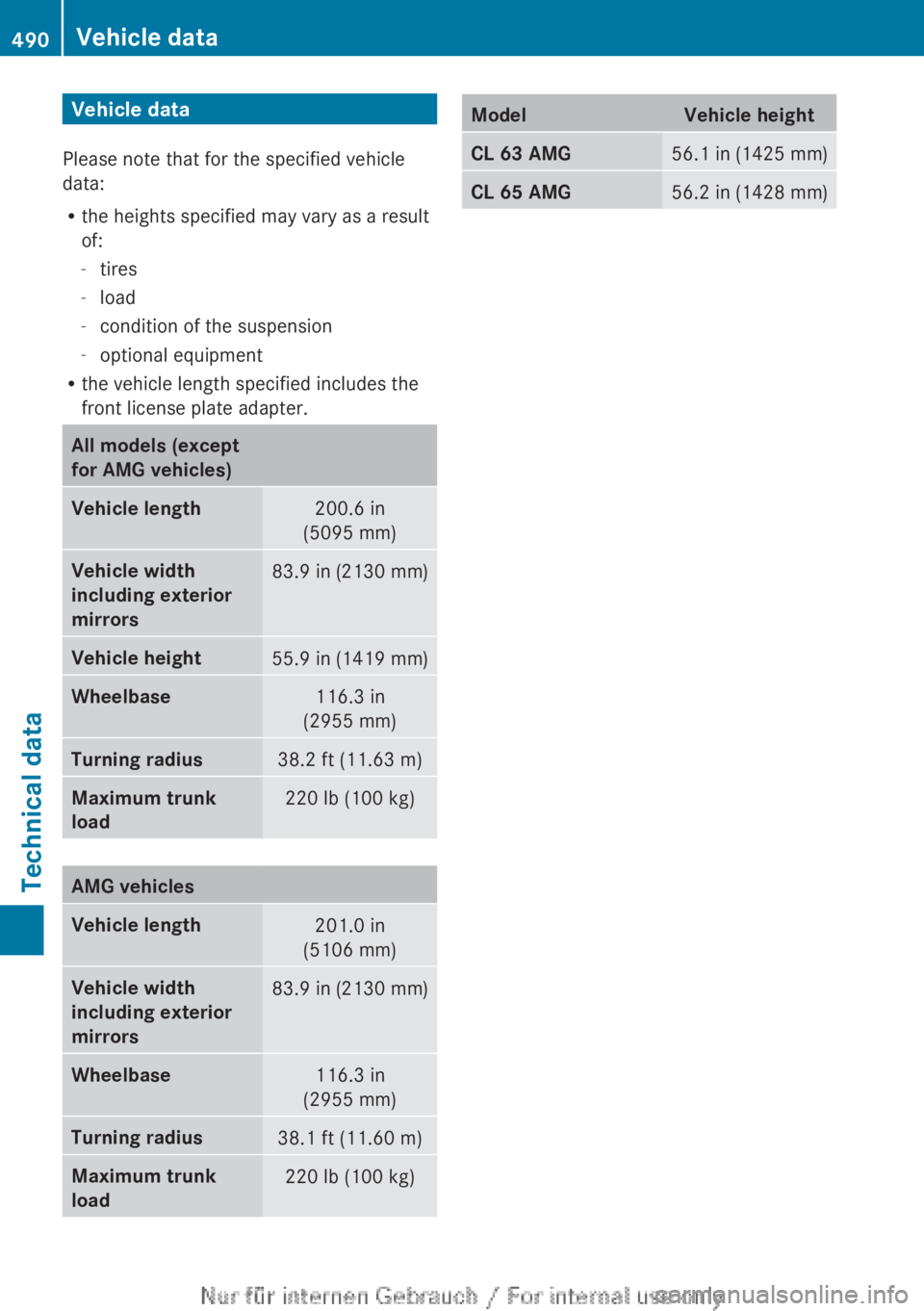
Please note that for the specified vehicle
data:
R the heights specified may vary as a result
of:
- tires
- load
- condition of the suspension
- optional equipment
R the vehicle length specified includes the
front license plate adapter.All models (except
for AMG vehicles)Vehicle length200.6 in
(5095 mm)Vehicle width
including exterior
mirrors83.9 in (2130 mm)Vehicle height55.9 in (1419 mm)Wheelbase116.3 in
(2955 mm)Turning radius38.2 ft (11.63 m)Maximum trunk
load220 lb (100 kg)AMG vehiclesVehicle length201.0 in
(5106 mm)Vehicle width
including exterior
mirrors83.9 in (2130 mm)Wheelbase116.3 in
(2955 mm)Turning radius38.1 ft (11.60 m)Maximum trunk
load220 lb (100 kg)ModelVehicle heightCL 63 AMG56.1 in (1425 mm)CL 65 AMG56.2 in (1428 mm)490Vehicle dataTechnical data