electronic parking brake MERCEDES-BENZ CL550 2010 W216 Service Manual
[x] Cancel search | Manufacturer: MERCEDES-BENZ, Model Year: 2010, Model line: CL550, Model: MERCEDES-BENZ CL550 2010 W216Pages: 500, PDF Size: 9.5 MB
Page 439 of 500
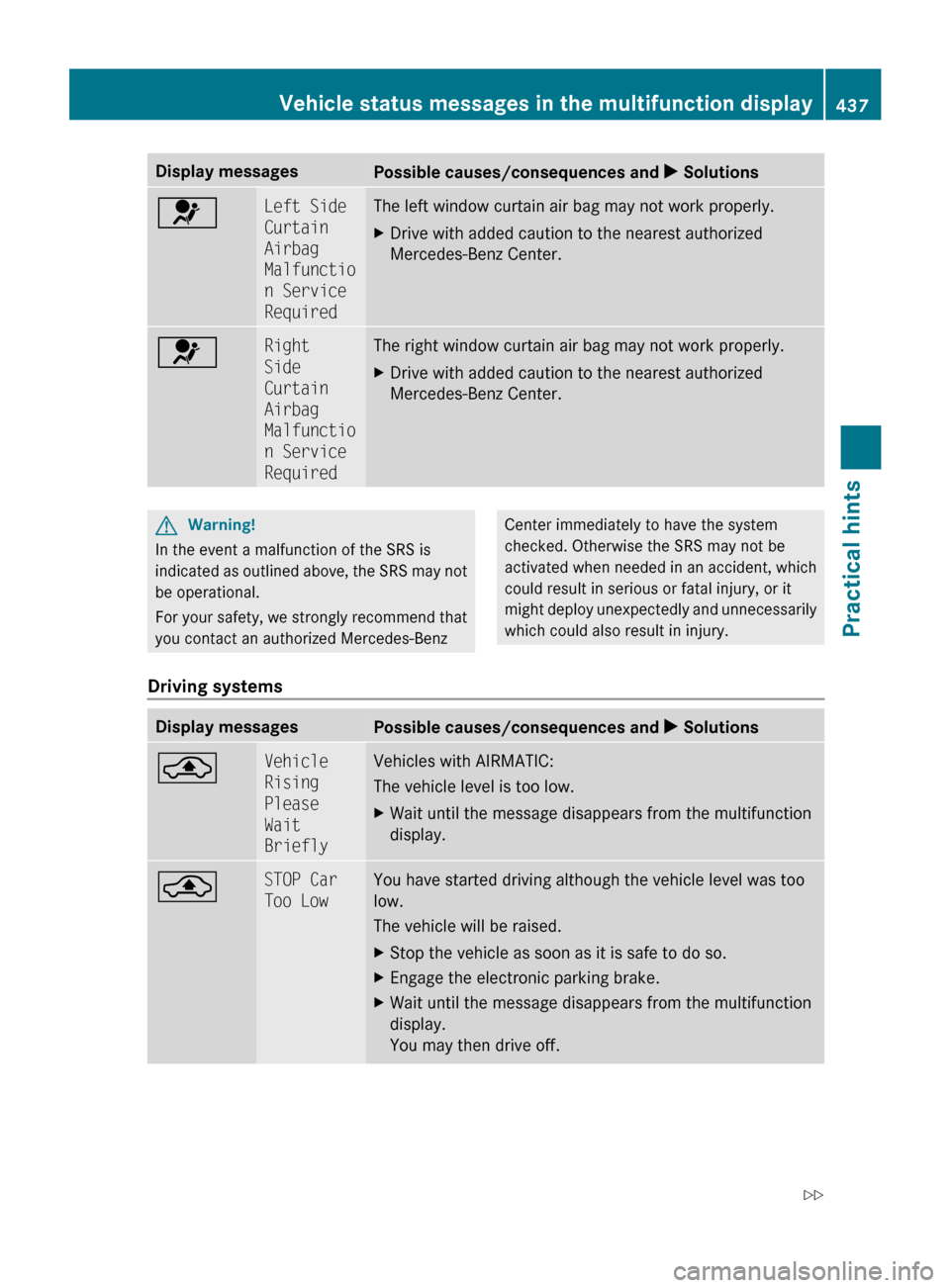
Display messages
Possible causes/consequences and
X Solutions6 Left Side
Curtain
Airbag
Malfunctio
n Service
Required The left window curtain air bag may not work properly.
X
Drive with added caution to the nearest authorized
Mercedes-Benz Center. 6 Right
Side
Curtain
Airbag
Malfunctio
n Service
Required The right window curtain air bag may not work properly.
X
Drive with added caution to the nearest authorized
Mercedes-Benz Center. G
Warning!
In the event a malfunction of the SRS is
indicated as
outlined above, the SRS may not
be operational.
For your safety, we strongly recommend that
you contact an authorized Mercedes-Benz Center immediately to have the system
checked. Otherwise the SRS may not be
activated
when
needed in an accident, which
could result in serious or fatal injury, or it
might deploy unexpectedly and unnecessarily
which could also result in injury.
Driving systems Display messages
Possible causes/consequences and
X Solutions¨ Vehicle
Rising
Please
Wait
Briefly Vehicles with AIRMATIC:
The vehicle level is too low.
X
Wait until the message disappears from the multifunction
display. ¨ STOP Car
Too Low You have started driving although the vehicle level was too
low.
The vehicle will be raised.
X
Stop the vehicle as soon as it is safe to do so.
X Engage the electronic parking brake.
X Wait until the message disappears from the multifunction
display.
You may then drive off. Vehicle status messages in the multifunction display
437
Practical hints
216_AKB; 3; 90, en-US
d2ureepe,Version: 2.11.8.1 2009-05-15T11:47:50+02:00 - Seite 437 Z
Page 443 of 500
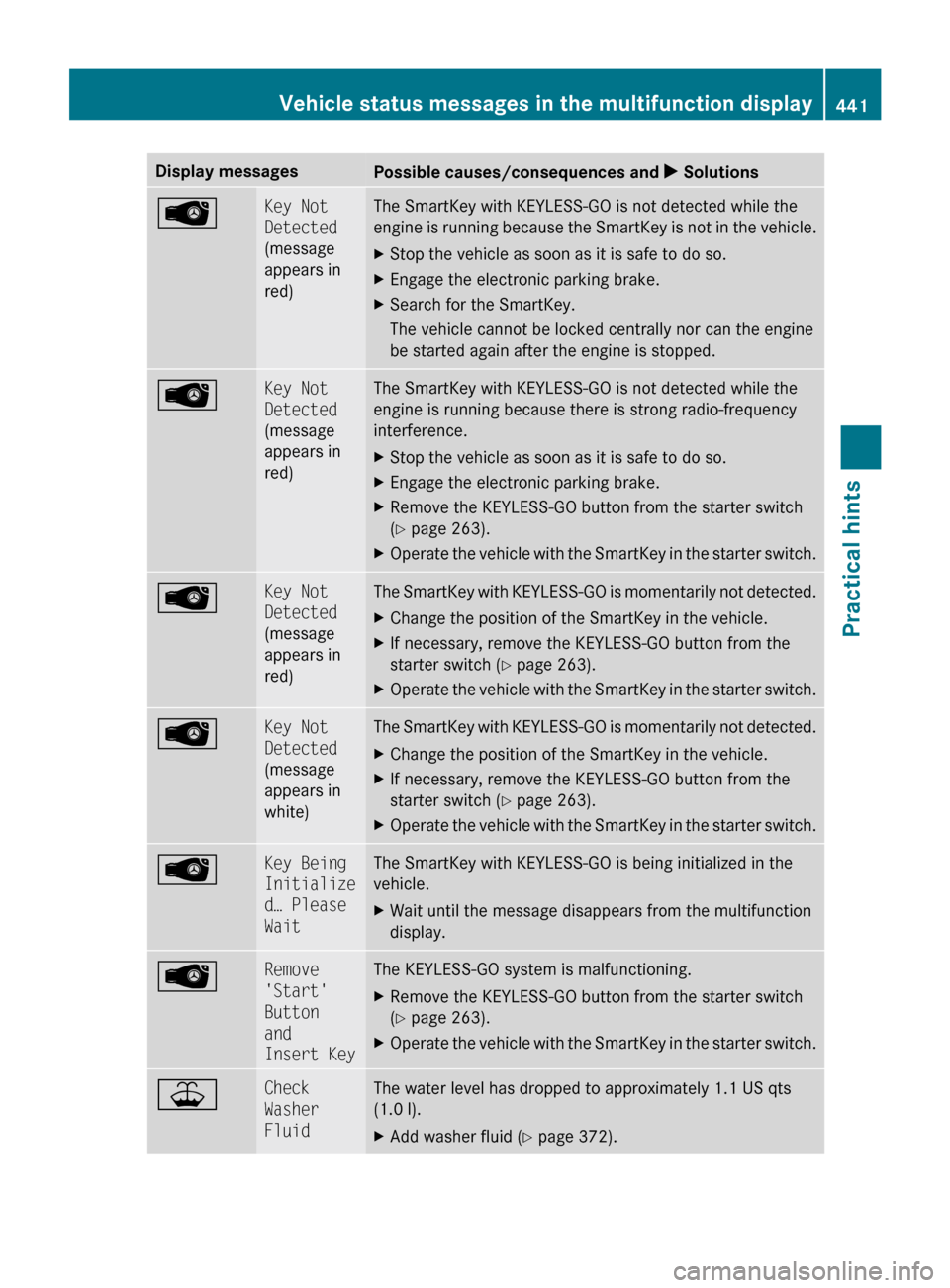
Display messages
Possible causes/consequences and
X Solutions Key Not
Detected
(message
appears in
red) The SmartKey with KEYLESS-GO is not detected while the
engine
is
running because the SmartKey is not in the vehicle.
X Stop the vehicle as soon as it is safe to do so.
X Engage the electronic parking brake.
X Search for the SmartKey.
The vehicle cannot be locked centrally nor can the engine
be started again after the engine is stopped. Â Key Not
Detected
(message
appears in
red) The SmartKey with KEYLESS-GO is not detected while the
engine is running because there is strong radio-frequency
interference.
X
Stop the vehicle as soon as it is safe to do so.
X Engage the electronic parking brake.
X Remove the KEYLESS-GO button from the starter switch
(Y page 263).
X Operate the vehicle with the SmartKey in the starter switch. Â Key Not
Detected
(message
appears in
red) The SmartKey with KEYLESS-GO is momentarily not detected.
X
Change the position of the SmartKey in the vehicle.
X If necessary, remove the KEYLESS-GO button from the
starter switch ( Y page 263).
X Operate the vehicle with the SmartKey in the starter switch. Â Key Not
Detected
(message
appears in
white) The SmartKey with KEYLESS-GO is momentarily not detected.
X
Change the position of the SmartKey in the vehicle.
X If necessary, remove the KEYLESS-GO button from the
starter switch ( Y page 263).
X Operate the vehicle with the SmartKey in the starter switch. Â Key Being
Initialize
d… Please
Wait The SmartKey with KEYLESS-GO is being initialized in the
vehicle.
X
Wait until the message disappears from the multifunction
display. Â Remove
'Start'
Button
and
Insert Key The KEYLESS-GO system is malfunctioning.
X
Remove the KEYLESS-GO button from the starter switch
(Y page 263).
X Operate the vehicle with the SmartKey in the starter switch. ¥ Check
Washer
Fluid The water level has dropped to approximately 1.1 US qts
(1.0 l).
X
Add washer fluid ( Y page 372). Vehicle status messages in the multifunction display
441
Practical hints
216_AKB; 3; 90, en-US
d2ureepe,Version: 2.11.8.1 2009-05-15T11:47:50+02:00 - Seite 441 Z
Page 455 of 500
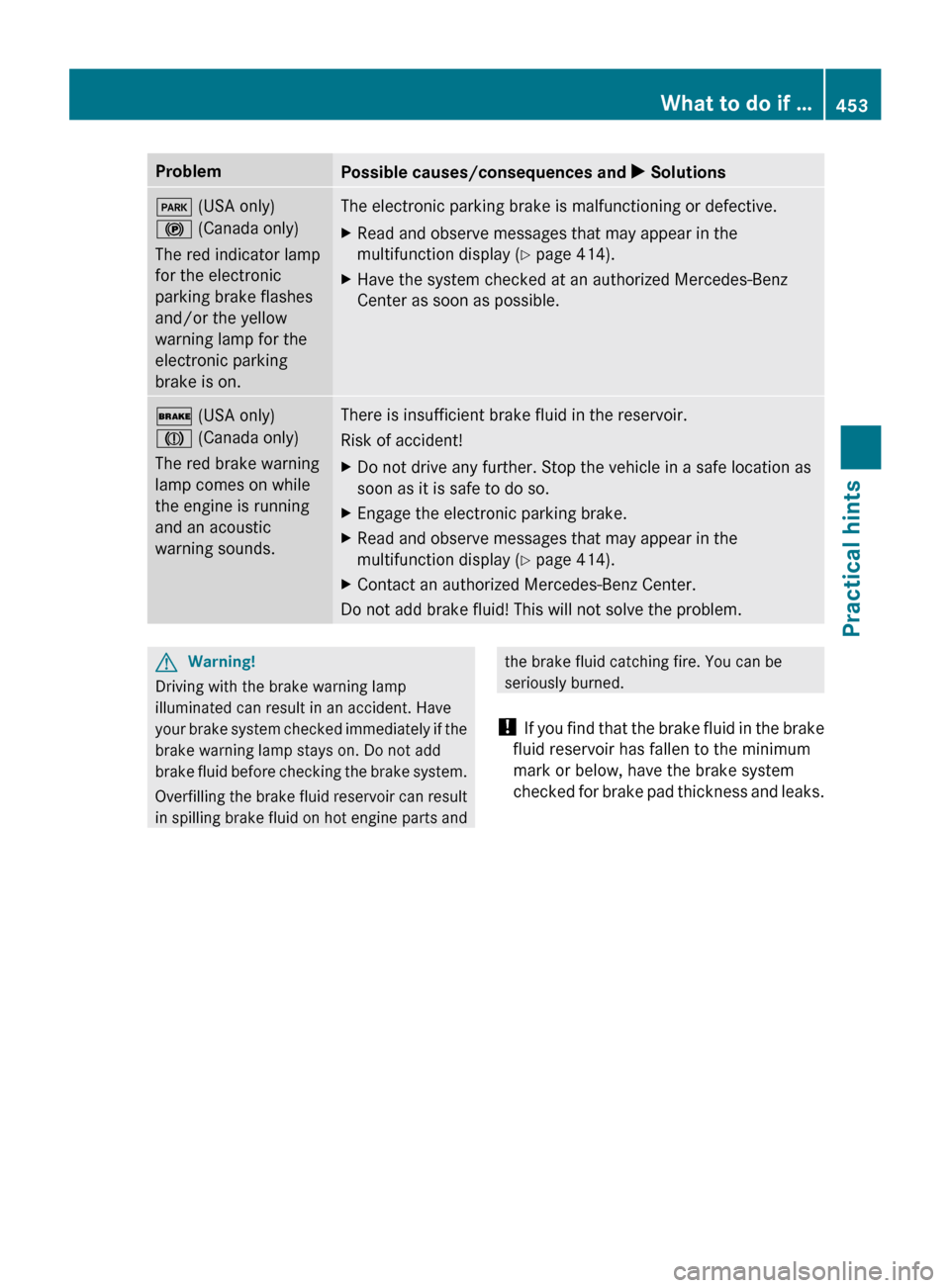
Problem
Possible causes/consequences and
X SolutionsF (USA only)
! (Canada only)
The red indicator lamp
for the electronic
parking brake flashes
and/or the yellow
warning lamp for the
electronic parking
brake is on. The electronic parking brake is malfunctioning or defective.
X
Read and observe messages that may appear in the
multifunction display (Y
page 414).
X Have the system checked at an authorized Mercedes-Benz
Center as soon as possible. $ (USA only)
J (Canada only)
The red brake warning
lamp comes on while
the engine is running
and an acoustic
warning sounds. There is insufficient brake fluid in the reservoir.
Risk of accident!
X
Do not drive any further. Stop the vehicle in a safe location as
soon as it is safe to do so.
X Engage the electronic parking brake.
X Read and observe messages that may appear in the
multifunction display (Y
page 414).
X Contact an authorized Mercedes-Benz Center.
Do not add brake fluid! This will not solve the problem. G
Warning!
Driving with the brake warning lamp
illuminated can result in an accident. Have
your brake
system checked immediately if the
brake warning lamp stays on. Do not add
brake fluid before checking the brake system.
Overfilling the brake fluid reservoir can result
in spilling brake fluid on hot engine parts and the brake fluid catching fire. You can be
seriously burned.
! If you
find that the brake fluid in the brake
fluid reservoir has fallen to the minimum
mark or below, have the brake system
checked for brake pad thickness and leaks. What to do if …
453
Practical hints
216_AKB; 3; 90, en-US
d2ureepe, Version: 2.11.8.1 2009-05-15T11:47:50+02:00 - Seite 453 Z
Page 467 of 500
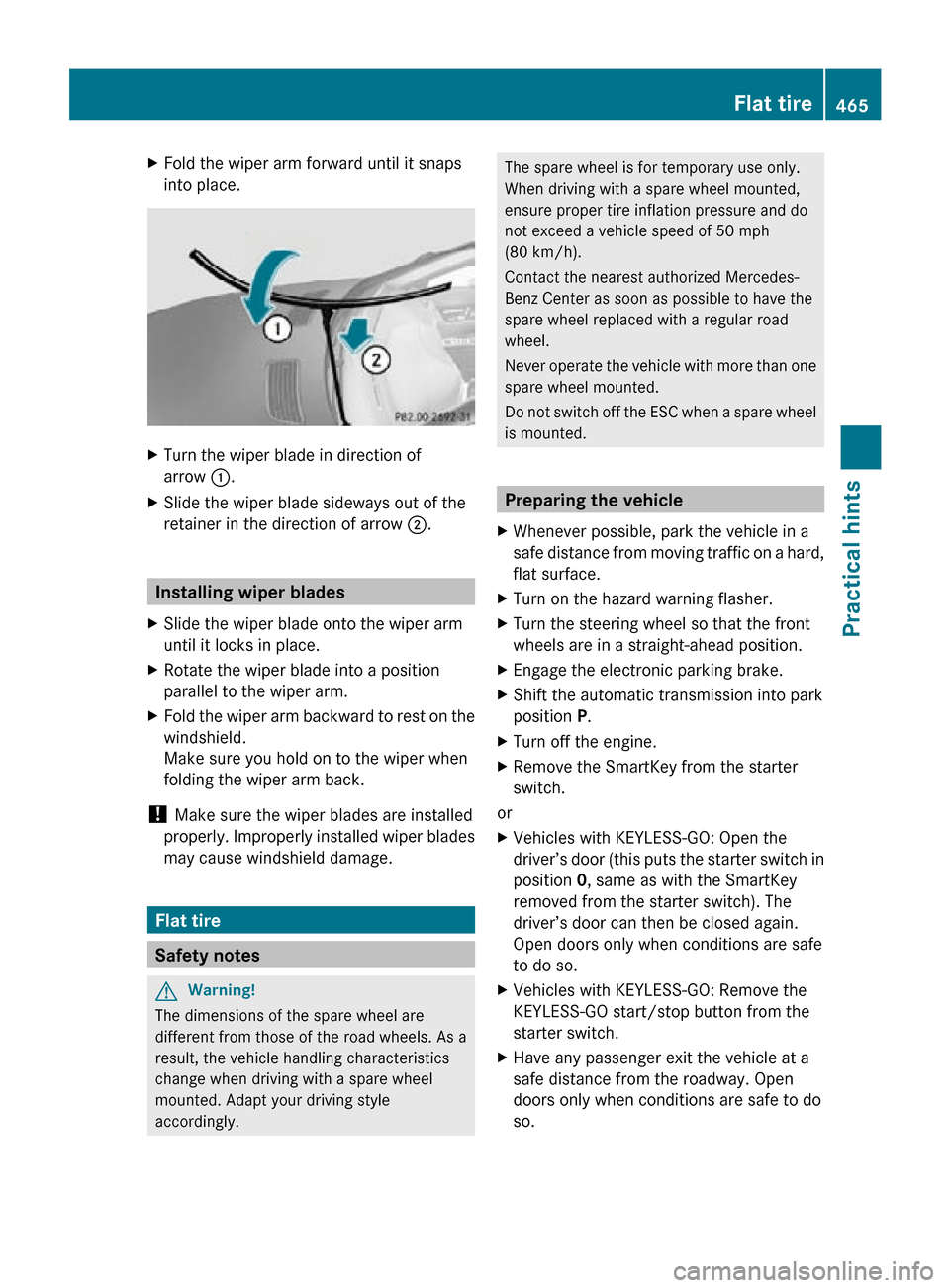
X
Fold the wiper arm forward until it snaps
into place. X
Turn the wiper blade in direction of
arrow :.
X Slide the wiper blade sideways out of the
retainer in the direction of arrow ;. Installing wiper blades
X Slide the wiper blade onto the wiper arm
until it locks in place.
X Rotate the wiper blade into a position
parallel to the wiper arm.
X Fold the wiper arm backward to rest on the
windshield.
Make sure you hold on to the wiper when
folding the wiper arm back.
! Make sure the wiper blades are installed
properly. Improperly installed wiper blades
may cause windshield damage. Flat tire
Safety notes
G
Warning!
The dimensions of the spare wheel are
different from those of the road wheels. As a
result, the vehicle handling characteristics
change when driving with a spare wheel
mounted. Adapt your driving style
accordingly. The spare wheel is for temporary use only.
When driving with a spare wheel mounted,
ensure proper tire inflation pressure and do
not exceed a vehicle speed of 50 mph
(80 km/h).
Contact the nearest authorized Mercedes-
Benz Center as soon as possible to have the
spare wheel replaced with a regular road
wheel.
Never operate the vehicle with more than one
spare wheel mounted.
Do not switch off the ESC when a spare wheel
is mounted.
Preparing the vehicle
X Whenever possible, park the vehicle in a
safe distance from moving traffic on a hard,
flat surface.
X Turn on the hazard warning flasher.
X Turn the steering wheel so that the front
wheels are in a straight-ahead position.
X Engage the electronic parking brake.
X Shift the automatic transmission into park
position P.
X Turn off the engine.
X Remove the SmartKey from the starter
switch.
or
X Vehicles with KEYLESS-GO: Open the
driver’s door (this puts the starter switch in
position 0, same as with the SmartKey
removed from the starter switch). The
driver’s door can then be closed again.
Open doors only when conditions are safe
to do so.
X Vehicles with KEYLESS-GO: Remove the
KEYLESS-GO start/stop button from the
starter switch.
X Have any passenger exit the vehicle at a
safe distance from the roadway. Open
doors only when conditions are safe to do
so. Flat tire
465Practical hints
216_AKB; 3; 90, en-US
d2ureepe, Version: 2.11.8.1 2009-05-15T11:47:50+02:00 - Seite 465 Z
Page 468 of 500
Mounting the spare wheel
Introduction X
Prepare the vehicle as described
(Y page 465).
X Take the following out of the vehicle:
R
spare wheel
R jack
R vehicle tool kit
R wheel bolts for spare wheel
For information on where to find the
respective items, see “Where will I find ...?”
(Y page 412) and ( Y page 413).
i Vehicles without spare wheel are not
factory-equipped with
the tools required for
a wheel change such as a jack or a wheel
wrench. Some tools required for a wheel
change are specific to your vehicle.
Contact an authorized Mercedes-Benz
Center to obtain the tools approved for
your vehicle. This section describes the
wheel change using the tools approved and
recommended for your vehicle.
Lifting the vehicle G
Warning!
When jacking up the vehicle, only use the jack
which has been specifically approved by
Mercedes-Benz for your vehicle.
The jack
is designed exclusively for jacking up
the vehicle at the jack take-up brackets built
into both sides of the vehicle. Make sure the
jack arm is fully seated in the jack take-up
bracket. The jack must always be vertical
when in use, especially on inclines or
declines.
The jack is intended only for lifting the vehicle
briefly for wheel changes. It is not suited for
performing maintenance work under the
vehicle. To help avoid personal injury, use the
jack only to lift the vehicle during a wheel
change. Never get beneath the vehicle while it is
supported by the jack. Keep hands and feet
away from the area under the lifted vehicle.
Always lower the vehicle onto sufficient
capacity
jackstands
before working under the
vehicle.
Always make sure the electronic parking
brake is engaged. In addition, block the
wheels with wheel chocks or other sizeable
objects before raising the vehicle with the
jack. Do not disengage the electronic parking
brake while the vehicle is raised.
Make sure that the ground on which the
vehicle is standing and where you place the
jack is solid, level and not slippery. If
necessary, use a large underlay. On slippery
surfaces, such as tiled floors, you should use
a non-slip underlay, for example a rubber mat.
Do not use wooden blocks or similar objects
to support the jack. Otherwise the jack may
not be able to achieve its load-bearing
capacity if it is not at its full height.
Never start the engine when the vehicle is
raised.
Also observe the notes on the jack.
X Prevent the vehicle from rolling away by
blocking wheels
with wheel chocks or other
sizeable objects.
When your vehicle is equipped with a wheel
chock, it is included with the vehicle tool kit
(Y page 412). For information on setting up
the collapsible wheel chock, see
(Y page 412).
When changing a wheel on a level surface:
X Place a wheel chock or other sizeable
object in
front of and another wheel chock
or other sizeable object behind the wheel
that is diagonally opposite to the wheel
being changed. 466
Flat tire
Practical hints
216_AKB; 3; 90, en-US
d2ureepe,
Version: 2.11.8.1 2009-05-15T11:47:50+02:00 - Seite 466
Page 474 of 500
If the battery is discharged, the engine can be
started with jumper cables and the fully
charged battery of another vehicle or an
equivalent starter pack. Observe the
following:
R
Access to the battery is not possible on all
vehicles. If you cannot access the battery
of the other vehicle, provide jump start
power by an external battery or starter
pack.
R Jump starting should only be performed
when the engine and catalytic converter
are cold.
R Do not jump start the engine or charge the
battery if the battery is frozen. Let the
battery thaw out first.
R Only jump start from batteries with the
same voltage rating (12 V). Jump starting
with a more powerful battery could damage
the vehicle’s electrical system. Such damage will not be covered by the
Mercedes-Benz Limited Warranty.
R Only use jumper cables with sufficient
cross-section and insulated terminal
clamps.
R Always make sure the jumper cables are
not on or near pulleys, fans or other parts
that move when an engine is started or
running.
R Should the battery be drained completely,
let the donating power source charge the
vehicle for several minutes before
reattempting the starting process.
X Make sure the two vehicles do not touch.
X Switch off all electrical consumers.
X Engage the electronic parking brake.
X Make sure the automatic transmission is in
park position P.
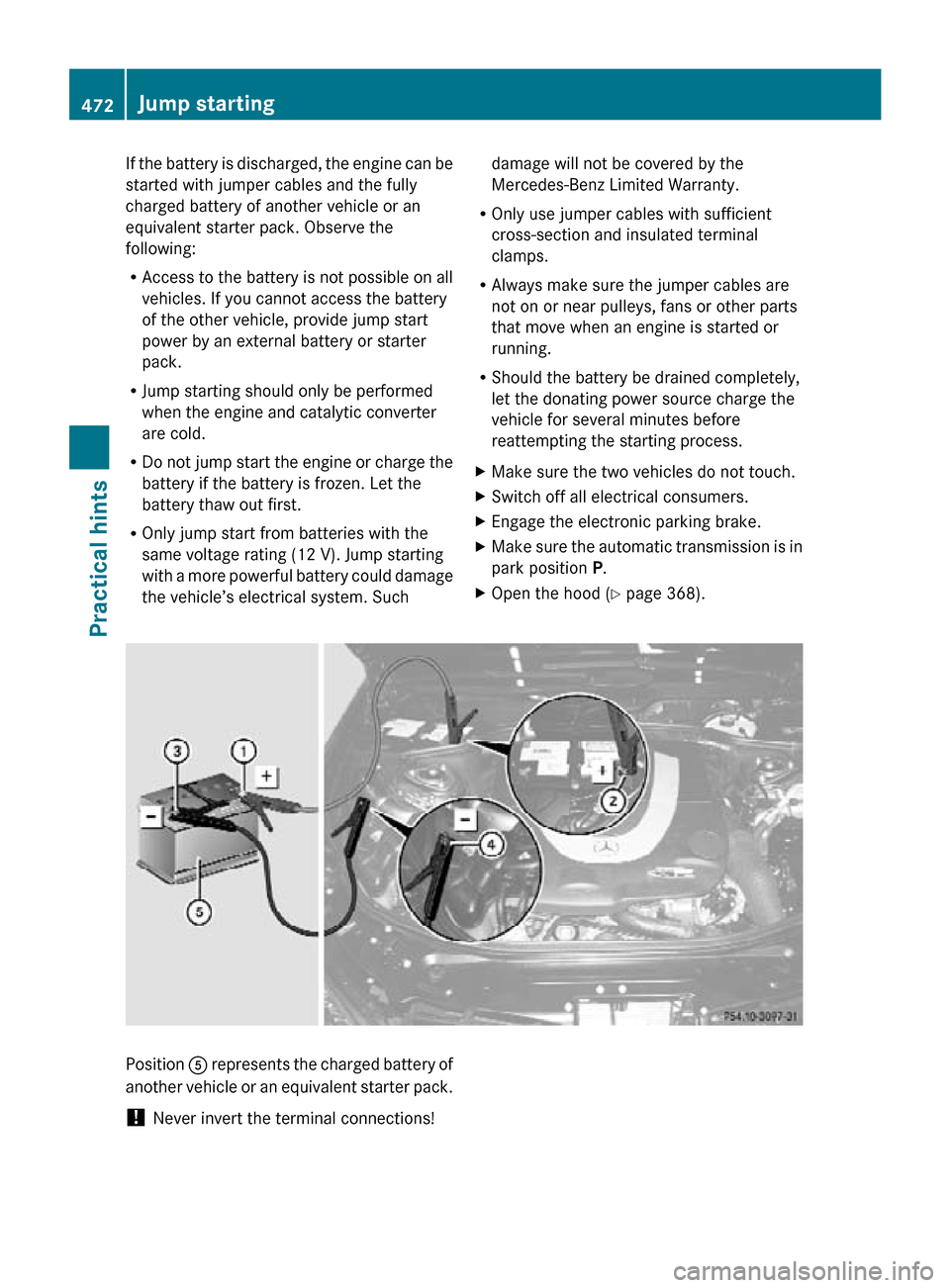
X Open the hood (Y page 368). Position
A represents the charged battery of
another vehicle or an equivalent starter pack.
! Never invert the terminal connections! 472
Jump startingPractical hints
216_AKB; 3; 90, en-US
d2ureepe,
Version: 2.11.8.1 2009-05-15T11:47:50+02:00 - Seite 472
Page 477 of 500
Removing towing eye bolt
X
Loosen towing eye bolt ; by turning it
counterclockwise.
X Unscrew towing eye bolt ;.
X Reinstalling cover: Fit cover :
(Y page 474) and snap it into place.
X Store the towing eye bolt ; and wheel
wrench back into the vehicle tool kit. Towing with all wheels on the ground
G
Warning!
If circumstances require towing the vehicle
with all
wheels on the ground, always tow with
a tow bar if:
R the engine will not run
R there is a malfunction in the brake system
R there is a malfunction in the power supply
or in the vehicle’s electrical system
This is necessary to adequately control the
towed vehicle.
Prior to towing the vehicle with all wheels on
the ground, make sure the SmartKey is in
starter switch position 2.G
Warning!
With the engine not running, there is no power
assistance for the brake and steering
systems. In this case, it is important to keep
in mind that a considerably higher degree of
effort is necessary to brake and steer the
vehicle. Adapt your driving accordingly.
X Make sure the ignition is switched on.
X With the vehicle at a standstill, depress the
brake pedal and keep it pressed.
X Shift the automatic transmission into
neutral position N.
X Release the brake pedal. X
If engaged, release the electronic parking
brake.
X Switch on the hazard warning flasher
(Y page 278).
! Keep in mind that it is important to have
the ignition switched on. Removing the
SmartKey from the starter switch or
opening a front door with the ignition
switched off will automatically shift the
automatic transmission into park position
P.
! The vehicle may be towed only for
distances up to 30 miles (50 km) and at a
speed not to exceed 30 mph (50 km/h).
i While being towed with the hazard
warning flasher
in use, use the combination
switch in the usual manner to signal turns.
Only the selected turn signal will operate.
Upon canceling the turn signal, the hazard
warning flasher will operate again. Towing with front axle raised
! The vehicle may be towed only for
distances up to 30 miles (50 km) and at a
speed not to exceed 30 mph (50 km/h).
! Vehicles with 4MATIC: Do not tow with
one axle
raised. Doing so could damage the
transfer case, which is not covered by the
Mercedes-Benz Limited Warranty.
All wheels must be on or off the ground.
Observe instructions for towing the vehicle
with all wheels on the ground.
X Switch off the automatic central locking
(Y page 193).
X Switch on the hazard warning flasher
(Y page 278).
X Make sure the automatic transmission
remains in neutral position N. Observe
instructions, see “Remaining in neutral
position N” (Y page 292). Towing the vehicle
475
Practical hints
216_AKB; 3; 90, en-US
d2ureepe, Version: 2.11.8.1 2009-05-15T11:47:50+02:00 - Seite 475 Z
Page 478 of 500
!
Vehicles without 4MATIC:
Because the ESC operates automatically,
the engine and ignition must be shut off
(SmartKey in starter switch position 0 or
1 or KEYLESS-GO start/stop button in
position 0 or 1) when the vehicle is being
towed with one axle raised.
Active braking action through the ESC may
otherwise seriously damage the brake
system which is not covered by the
Mercedes-Benz Limited Warranty.
! Keep in mind that it is important for the
SmartKey to be left in starter switch with
the ignition switched off. As soon as the
SmartKey is removed from the starter
switch the automatic transmission will shift
to park position P. Fuses
Introduction
The electrical fuses in your vehicle serve to
switch off malfunctioning power circuits.
If a fuse is blown, the components and
systems secured by that fuse will stop
operating. G
Warning!
Only use fuses approved by Mercedes-Benz
with the specified amperage for the system in
question and do not attempt to repair or
bridge a blown fuse. Using other than
approved fuses or using repaired or bridged
fuses may cause an overload leading to a fire,
and/or cause damage to electrical
components and/or systems. Have the cause
determined and remedied by an authorized
Mercedes-Benz Center.
! Switch off the vehicle’s internal electrical
functions when you are working on the
fuses.
A blown fuse must be replaced by an
appropriate spare fuse (recognizable by its
color or the fuse rating given on the fuse) of the amperage recommended in the fuse
chart. Any Mercedes-Benz Center will be glad
to advise you on this subject.
i
In case of a blown fuse contact Roadside
Assistance or an authorized Mercedes-
Benz Center.
If a newly inserted fuse blows again, have the
cause determined and rectified by an
authorized Mercedes-Benz Center.
The fuse chart is located in the trunk with the
vehicle tool kit (Y page 412). The fuse chart
explains the fuse allocation and fuse
amperages. Before replacing fuses
X Engage the electronic parking brake.
X Make sure the automatic transmission is in
park position P.
The transmission position indicator in the
multifunction display should be on P.
X Switch off all electrical consumers.
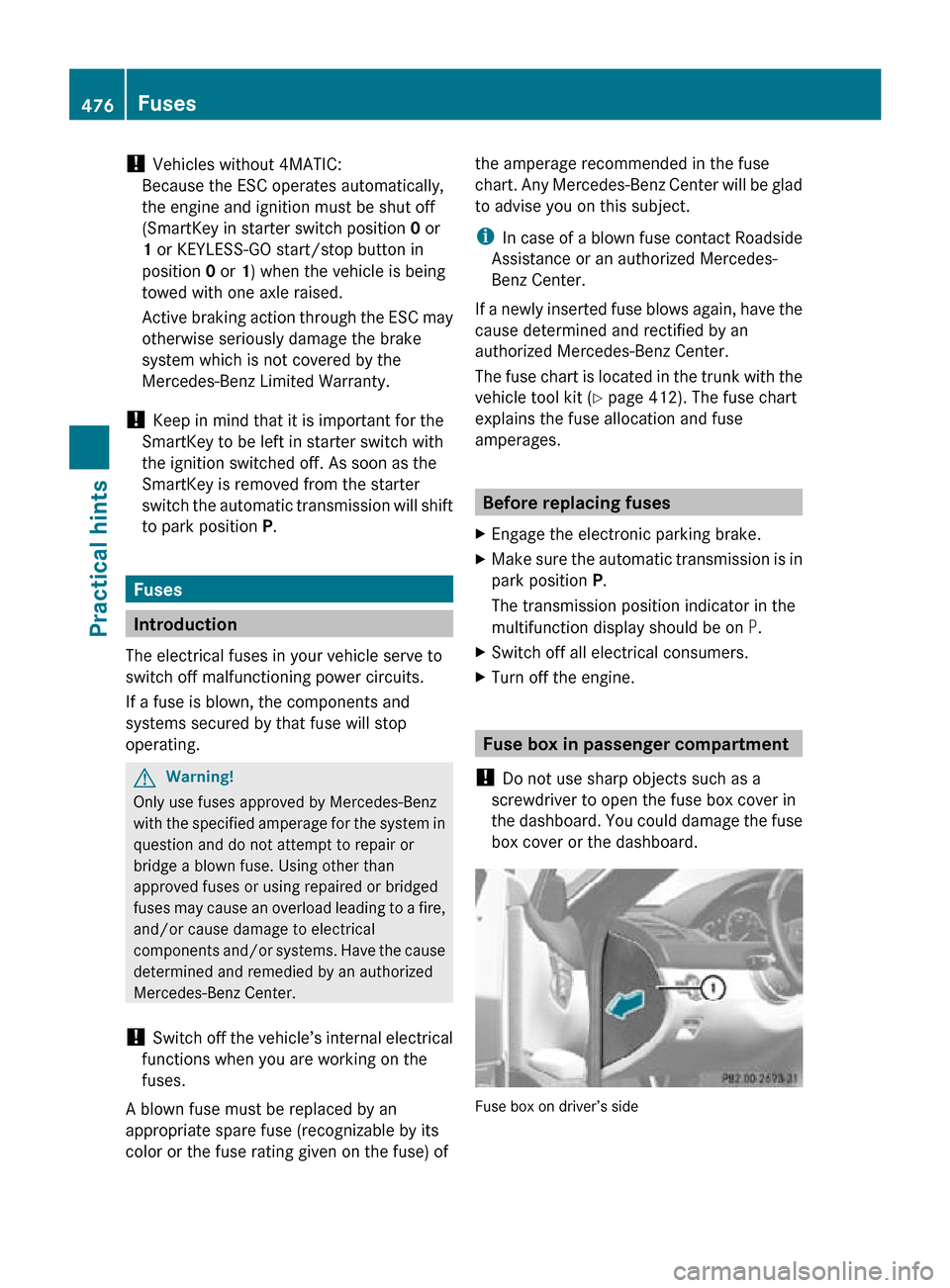
X Turn off the engine. Fuse box in passenger compartment
! Do not use sharp objects such as a
screwdriver to open the fuse box cover in
the dashboard. You could damage the fuse
box cover or the dashboard. Fuse box on driver’s side476
FusesPractical hints
216_AKB; 3; 90, en-US
d2ureepe,
Version: 2.11.8.1 2009-05-15T11:47:50+02:00 - Seite 476