parking brake MERCEDES-BENZ CL55AMG 2000 W140 Owner's Guide
[x] Cancel search | Manufacturer: MERCEDES-BENZ, Model Year: 2000, Model line: CL55AMG, Model: MERCEDES-BENZ CL55AMG 2000 W140Pages: 424, PDF Size: 25.71 MB
Page 298 of 424
292 Malfunction and indicator lamps
Te ch n ica l
data Instruments
and controlsOperation DrivingInstrument
cluster displayPractical hints Car care Index
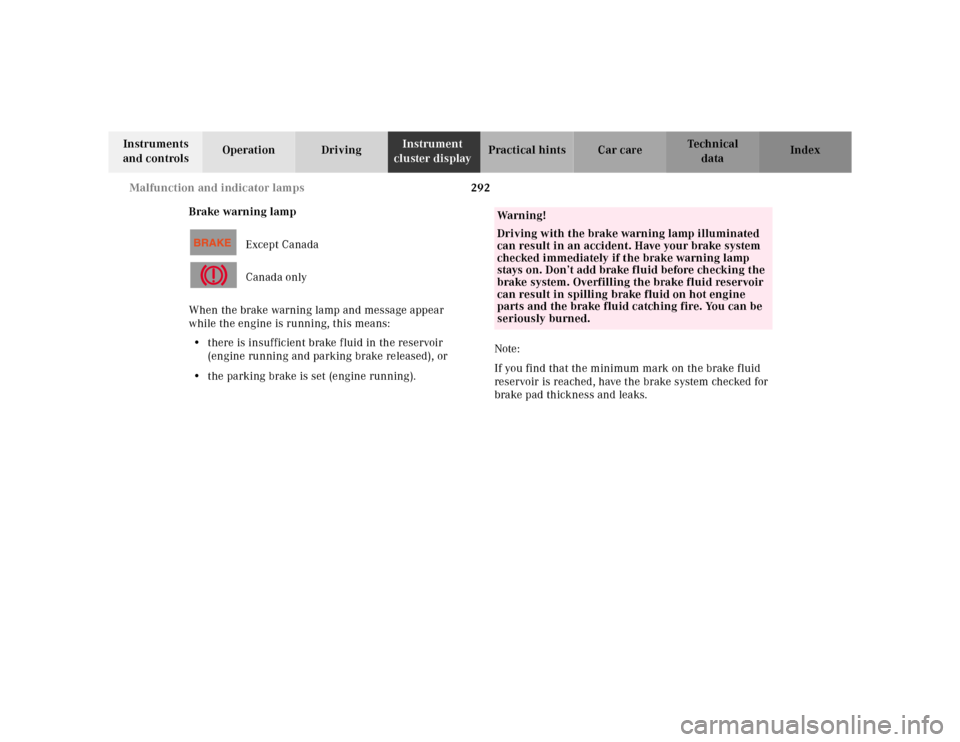
Brake warning lamp
Except Canada
Canada only
When the brake warning lamp and message appear
while the engine is running, this means:
•there is insufficient brake fluid in the reservoir
(engine running and parking brake released), or
•the parking brake is set (engine running).Note:
If you find that the minimum mark on the brake fluid
reservoir is reached, have the brake system checked for
brake pad thickness and leaks.
Wa r n i n g !
Driving with the brake warning lamp illuminated
can result in an accident. Have your brake system
checked immediately if the brake warning lamp
stays on. Don’t add brake fluid before checking the
brake system. Overfilling the brake fluid reservoir
can result in spilling brake fluid on hot engine
parts and the brake fluid catching fire. You can be
seriously burned.
Page 308 of 424
302 Malfunction and warning messages
Te ch n ica l
data Instruments
and controlsOperation DrivingInstrument
cluster displayPractical hints Car care Index
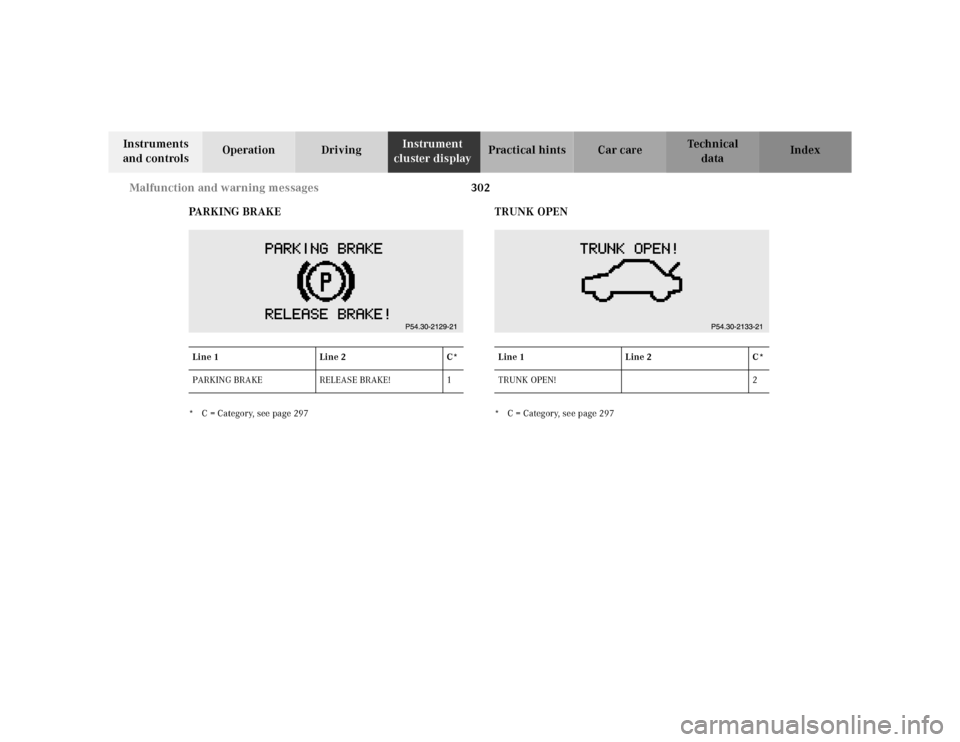
PA R K I N G B R A K E
* C = Category, see page 297
TRUNK OPEN* C = Category, see page 297 Line 1Line 2C*
PARKING BRAKE RELEASE BRAKE! 1Line 1Line 2C*
TRUNK OPEN! 2
Page 342 of 424
336 Jack
Te ch n ica l
data Instruments
and controlsOperation DrivingInstrument
cluster displayPractical hintsCar care Index
Jack
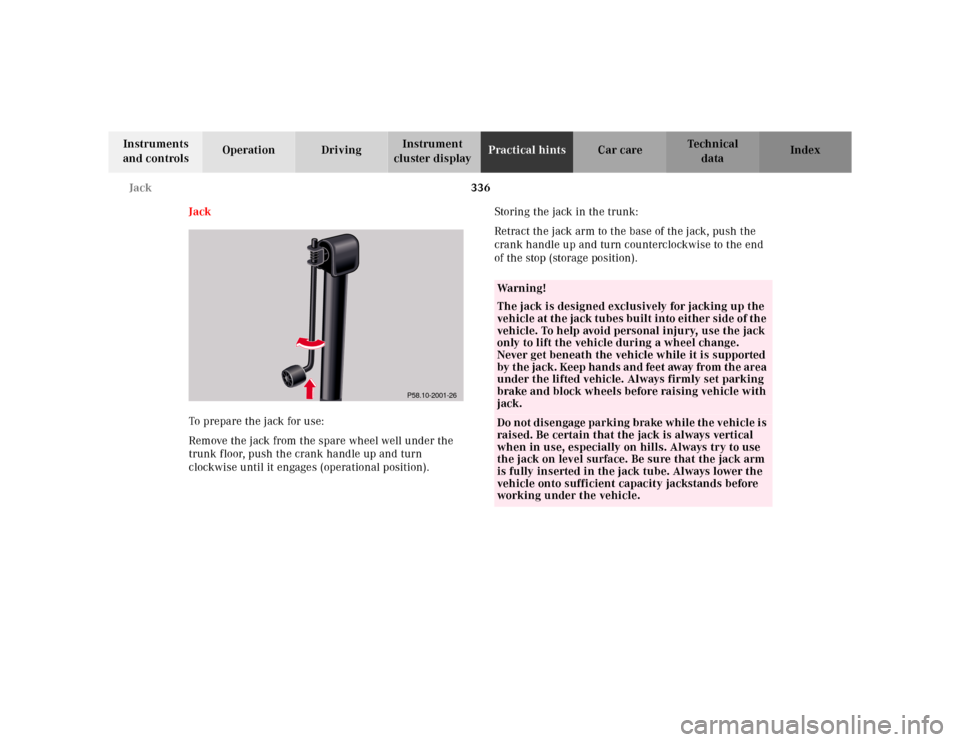
To prepare the jack for use:
Remove the jack from the spare wheel well under the
trunk floor, push the crank handle up and turn
clockwise until it engages (operational position).Storing the jack in the trunk:
Retract the jack arm to the base of the jack, push the
crank handle up and turn counterclockwise to the end
of the stop (storage position).
P58.10-2001-26
Wa r n i n g !
The jack is designed exclusively for jacking up the
vehicle at the jack tubes built into either side of the
vehicle. To help avoid personal injury, use the jack
only to lift the vehicle during a wheel change.
Never get beneath the vehicle while it is supported
by the jack. Keep hands and feet away from the area
under the lifted vehicle. Always firmly set parking
brake and block wheels before raising vehicle with
jack.Do not disengage parking brake while the vehicle is
raised. Be certain that the jack is always vertical
when in use, especially on hills. Always try to use
the jack on level surface. Be sure that the jack arm
is fully inserted in the jack tube. Always lower the
vehicle onto sufficient capacity jackstands before
working under the vehicle.
Page 346 of 424
340 Tires, Wheels
Te ch n ica l
data Instruments
and controlsOperation DrivingInstrument
cluster displayPractical hintsCar care Index
Changing wheelsMove vehicle to a level area which is a safe distance
from the roadway.
1. Set parking brake and turn on hazard warning
flasher.
2. Move selector lever to position “P” and turn off
engine.
3. Prevent vehicle from rolling away by blocking
wheels with wheel chocks (not supplied with
vehicle) or sizable wood block or stone. When
changing a wheel on a hill, place chocks on the
downhill side blocking both wheels of the other
axle. On an level road, place one chock in front of
and one behind the wheel that is diagonally
opposite to the wheel being changed.
Wa r n i n g !
The jack is designed exclusively for jacking up the
vehicle at the jack tubes built into either side of the
vehicle. To help avoid personal injury, use the jack
only to lift the vehicle during a wheel change.
Never get beneath the vehicle while it is supported
by the jack. Keep hands and feet away from the area
under the lifted vehicle. Always firmly set parking
brake and block wheels before raising vehicle with
jack.Do not disengage parking brake while the vehicle is
raised. Be certain that the jack is always vertical
when in use, especially on hills. Always try to use
the jack on level surface. Be sure that the jack arm
is fully inserted in the jack tube. Always lower the
vehicle onto sufficient capacity jackstands before
working under the vehicle.
Page 356 of 424
350 Jump starting
Te ch n ica l
data Instruments
and controlsOperation DrivingInstrument
cluster displayPractical hintsCar care Index
Proceed as follows:
1. Position the vehicle with the charged battery so that
the jumper cables will reach, but never let the
vehicles touch. Make sure the jumper cables do not
have loose or missing insulation.
2. On both vehicles:
•Turn off engine and all lights and accessories,
except hazard warning flashers or work lights.
•Apply parking brake and shift selector lever to
position “P”.
Important!
3. Clamp one end of the first jumper cable to the
positive (+) terminal of the discharged battery and
the other end to the positive (+) terminal of the
charged battery. Make sure the cable clamps do not
touch any other metal parts.
4. Clamp one end of the second jumper cable to the
grounded negative (–) terminal of the charged
battery and the final connection to the negative (–)
under hood terminal of the disabled vehicle.Important!
5. Start engine of the vehicle with the charged battery
and run at high idle. Make sure the cables are not
on or near pulleys, fans, or other parts that move
when the engine is started. Allow the discharged
battery to charge for a few minutes. Start engine of
the disabled vehicle in the usual manner.
6. After the engine has started, remove jumper cables
by exactly reversing the above installation
sequence, starting with the last connection made
first. When removing each clamp, make sure that it
does not touch any other metal while the other end
is still attached.
Notes:
If engine does not run after several unsuccessful
starting attempts, have it checked at the nearest
authorized Mercedes-Benz Center.
Excessive unburned fuel may damage the catalytic
converter.
Page 367 of 424
361 Exterior lamps
Te ch n ica l
data Instruments
and controlsOperation DrivingInstrument
cluster displayPractical hintsCar care Index Stop lamp,
High mounted stop lamp,
Additional turn signals on the exterior mirror
The stop lamps, the high mounted stop lamp (3rd brake
lamp), and the additional turn signals on the exterior
mirrors are equipped with LEDs.
Have the system checked at an authorized
Mercedes-Benz Center if a malfunction occurs.Standby bulb function
The rear fog lamp, dimmed, will act as a replacement
lamp, if the bulb in the inner left-hand taillamp stops
work ing.
The inner taillamp acts as a replacement for the right or
left-hand bulb of the outer taillamp, if it stops working
as a parking lamp.
Notes:
The multifunction display will indicate that a bulb has
failed. See malfunction and warning messages on
page 297.
Page 414 of 424
408 Index
Te ch n ica l
data Instruments
and controlsOperation DrivingInstrument
cluster displayPractical hints Car careIndex
Locking and unlocking ............................................ 36, 40
Low engine coolant level warning ..............................304
Lumbar support ............................................................... 74
MMaintenance ...................................................................209
Malfunction and indicator lamps
in the instrument cluster .........................................290
Malfunction and warning messages ...........................297
ACTIVE BODY CONTROL ......................................... 310
BATTERY/ALTERNATOR ..........................................299
BRAKE ASSIST ..........................................................300
BRAKE FLUID ............................................................ 301
BRAKE LINING WEAR ............................................. 301
COOLANT (coolant level) .........................................304
COOLANT (coolant temperature) ...........................305
CRUISE CONTROL ....................................................309
DISPLAY DEFECTIVE (engine control unit) .........298
DISPLAY DEFECTIVE (several systems) ...............298
DISTRONIC (DTR) ..................................................... 321
DOOR .......................................................................... 316
ELEC. STABIL. PROG. ...............................................303
ENGINE OIL LEVEL .......................................... 314, 318
ENTRANCE POSITION .............................................300HOOD .......................................................................... 317
KEY .............................................................................. 316
LIGHT SENSOR .................................................308, 320
LIGHTING SYSTEM .................................................. 306
PARKING BRAKE ..................................................... 302
SEAT BACKREST ....................................................... 315
SEAT BELT SYSTEM ................................................. 308
TELE AID .................................................................... 317
TELEPHONE - FUNCTION ....................................... 309
TIRE PRESSURE ........................................................ 312
TRUNK OPEN ........................................................... 302
WASHER FLUID ......................................................... 319
Malfunction/warning message memory .................... 136
Manual operation of sliding/pop-up roof .................. 369
Mechanical keys ............................................................... 47
Memory function ............................................................111
Mirror, exterior
Parking position ........................................................108
Mirror, exterior, adjusting ............................................107
Mirror, exterior, parking position,
front passenger side .................................................108
Mirror, exterior, rear view ............................................107
Mirror, inside, rear view ............................................... 106
Multicontour backrest ..................................................... 74
Multifunction display .................................................... 120
Audio systems ............................................................125
Page 415 of 424
409 Index
Te ch n ica l
data Instruments
and controlsOperation DrivingInstrument
cluster displayPractical hints Car careIndex Cassette player .......................................................... 127
CD Player .................................................................... 126
Distronic (DTR) .......................................................... 133
Engine oil level indicator ......................................... 124
FSS .............................................................................. 124
Individual settings .................................................... 138
Malfunction/warning message memory ............... 136
Radio ........................................................................... 125
Telephone ................................................................... 128
Telephone — Incoming call ...................................... 131
Telephone — Redialing ............................................. 130
Telephone book ......................................................... 128
Tire inflation pressure monitor .............................. 124
Trip and main odometer .......................................... 124
Trip computer ............................................................ 134
Multifunction steering wheel ...................................... 120
NNavigation system .......................................................... 132
Night security illumination ......................................... 158
OOn-board diagnostic system ........................................ 290
Operator’s Manual ............................................................. 8
Outside temperature indicator ..................................... 117
Overhead control panel ................................................... 21PPanic button ......................................................................47
Parcel net in front passenger footwell ....................... 200
Parcel net in trunk ......................................................... 199
Parking ........................................................................... 242
Parking assist (Parktronic) .......................................... 279
Parking brake .....................196, 227, 238, 242, 292, 340
PA R K I N G B R A K E - m a l f u n c t i o n
and warning messages ............................................ 302
Power assistance ........................................................... 240
Power closing assist
Doors and trunk lid .................................................... 50
Power head restraints, rear ............................................ 81
Power seats, front
Backrest ........................................................................72
Seat ventilation system ..............................................79
Power windows ...............................................................178
Blocking of rear side window operation ................ 180