seat adjustment MERCEDES-BENZ CL55AMG 2000 W140 Owner's Manual
[x] Cancel search | Manufacturer: MERCEDES-BENZ, Model Year: 2000, Model line: CL55AMG, Model: MERCEDES-BENZ CL55AMG 2000 W140Pages: 424, PDF Size: 25.71 MB
Page 4 of 424

1 Contents
IntroductionProduct information .......................... 7
Operator’s manual ............................. 8
Where to find it ................................ 13
Reporting Safety Defects ................ 15Instruments and controlsInstruments and controls ............... 18
Door control panel ....................... 20
Overhead control panel ............... 21
Dashboard ..................................... 22
Center console .............................. 24OperationVehicle keys ...................................... 28
Start lock-out .................................... 32
General notes on the
central locking system ............... 33Central locking system ................... 34
Radio frequency and
infrared remote control .............. 34
KEYLESS-GO ................................ 38
Opening and closing
windows and
sliding/pop-up roof
from outside ................................. 45
Panic button ................................. 47
Mechanical keys .......................... 47
Doors ................................................. 48
Power closing assist for
doors and trunk lid .................... 50
Central locking switch .................... 50
Automatic central locking .............. 52
Emergency unlocking
in case of accident ...................... 52
Trunk ................................................. 53
Trunk lid release switch ................ 57
Trunk lid release/close switch ...... 58
Trunk lid emergency release .........61
Antitheft alarm system ................... 62
Tow-away alarm ............................... 64
Easy-entry/exit feature .................. 66Front seat adjustment ..................... 67
Removal and installation
of front seat head restraints ...... 71
Backrest ............................................. 72
Lumbar support ............................... 74
Multicontour backrest ..................... 74
Seat heater ........................................ 76
Seat ventilation system ................... 79
Power head restraints, rear ............ 81
Seat belts and
integrated restraint system ....... 82
Seat belts ........................................... 82
Seat belt nonusage
warning system ............................ 83
BabySmart
TM airbag
deactivation system .................... 88
Self-test BabySmart
TM
without special child
seat installed ................................. 89
Supplemental restraint
system (SRS) ................................ 90
Emergency tensioning
retractor (ETR) ............................. 91
Airbags .............................................. 92
Page 5 of 424

2 Contents
Safety guidelines for the
seat belt, emergency
tensioning retractor
and airbag .................................. 100
Infant and child
restraint systems ....................... 102
Steering wheel adjustment .......... 105
Rear view mirrors .......................... 106
Rear view mirror,
automatic antiglare ................... 106
Memory function ............................111
Instrument cluster ..........................114
Multifunction steering wheel,
multifunction display ............... 120
Trip and main odometer,
FSS, tire inflation pressure
monitor and
engine oil level indicator ......... 124
Audio systems ................................ 125
Radio ............................................ 125
CD player ..................................... 126
Cassette player ........................... 127
Telephone ........................................ 128
Telephone book .......................... 128
Redialing ..................................... 130Incoming call ...............................131
Navigation system ..........................132
Distronic (DTR) ...............................133
Trip computer .................................134
Malfunction/warning
message memory ......................136
Individual settings .........................138
Setting the audio volume ............. 146
Flexible service system
(FSS) ........................................... 147
Tire inflation
pressure monitor .......................150
Engine oil level indicator ..............154
Engine oil consumption ................155
Exterior lamp switch ......................156
Headlamp mode ..............................157
Night security illumination ..........158
Headlamp cleaning system ...........159
Combination switch .......................160
Hazard warning flasher
switch ..........................................163
Automatic climate control .............164
Display and controls ..................166
Dust filter .....................................167Basic setting ............................... 168
Special settings .......................... 169
Air recirculation ......................... 171
Activated charcoal filter ............ 172
Economy mode ........................... 173
Residual engine heat
utilization .................................... 174
Switching the automatic
climate control on and off ......... 175
Front center console storage
compartment ventilation .......... 175
Rear window defroster .................. 176
Rear passenger compartment
adjustable air outlets ................ 177
Power windows ............................... 178
Sliding/pop-up roof ....................... 181
Interior lighting ............................. 184
Rear window sunshade ................. 186
Sun visors ....................................... 187
Vanity mirrors ................................ 187
Interior ............................................ 188
Storage compartments
and armrests .............................. 188
Glove box ..................................... 189
Page 23 of 424
20 Instruments and controls
Te ch n ica l
data Instruments
and controlsOperation DrivingInstrument
cluster displayPractical hints Car care Index
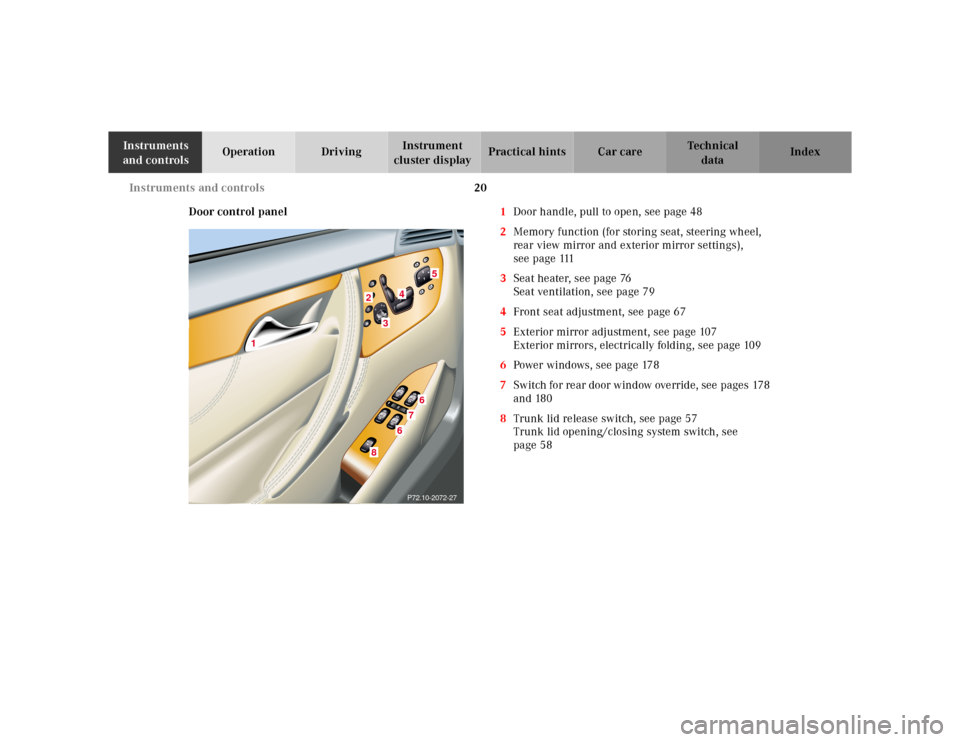
Door control panel1Door handle, pull to open, see page 48
2Memory function (for storing seat, steering wheel,
rear view mirror and exterior mirror settings),
seepage111
3Seat heater, see page 76
Seat ventilation, see page 79
4Front seat adjustment, see page 67
5Exterior mirror adjustment, see page 107
Exterior mirrors, electrically folding, see page 109
6Power wind ows, see pag e 178
7Switch for rear door window override, see pages 178
and 180
8Trunk lid release switch, see page 57
Trunk lid opening/closing system switch, see
page 58
P72.10-2072-27
1
4
2
5
38
76
6
Page 29 of 424
26 Contents - Operation
Te ch n ica l
data Instruments
and controlsOperationDrivingInstrument
cluster displayPractical hints Car care Index
OperationVehicle keys ...................................... 28
Start lock-out .................................... 32
General notes on the
central locking system ............... 33
Central locking system ................... 34
Radio frequency and infrared
remote control .............................. 34
KEYLESS-GO ................................. 38
Opening and closing
windows and
sliding/pop-up roof
from outside .................................. 45
Panic button .................................. 47
Mechanical keys ........................... 47
Doors .................................................. 48
Power closing assist for
doors and trunk lid ..................... 50
Central locking switch .................... 50
Automatic central locking .............. 52
Emergency unlocking
in case of accident ...................... 52
Trunk ................................................. 53
Trunk lid release switch ................. 57Trunk lid release/close switch ...... 58
Trunk lid emergency release .........61
Antitheft alarm system ................... 62
Tow-away alarm ............................... 64
Easy-entry/exit feature .................. 66
Front seat adjustment ..................... 67
Removal and installation
of front seat head restraints ......71
Backrest ............................................ 72
Lumbar support ................................74
Multicontour backrest .....................74
Seat heater ......................................... 76
Seat ventilation system .................. 79
Power head restraints, rear ............ 81
Seat belts and
integrated restraint system ....... 82
Seat belts .......................................... 82
Seat belt nonusage
warning system ............................ 83
BabySmart
TM airbag
deactivation system ................... 88
Self-test BabySmart
TM
without special child
seat installed ................................ 89Supplemental restraint
system (SRS) ................................ 90
Emergency tensioning
retractor (ETR) ............................. 91
Airbags .............................................. 92
Safety guidelines for the
seat belt, emergency
tensioning retractor
and airbag .................................. 100
Infant and child
restraint systems ....................... 102
Steering wheel adjustment .......... 105
Rear view mirrors .......................... 106
Rear view mirror,
automatic antiglare .................. 106
Memory function ............................ 111
Instrument cluster ..........................114
Multifunction steering wheel,
multifunction display ............... 120
Trip and main odometer,
FSS, tire inf lation pressure
monitor and
engine oil level indicator ......... 124
Audio systems ................................ 125
Radio ............................................ 125
Page 70 of 424
67 Seats
Te ch n ica l
data Instruments
and controlsOperationDrivingInstrument
cluster displayPractical hints Car care Index Front seat adjustment
To operate the front power seat adjustment switches,
turn the electronic key in starter switch to position 1
or 2 (with a front door open, the power seats can also be
operated with the electronic key removed or in starter
switch position 0).
Wa r n i n g !
Do not adjust the driver’s seat while driving.
Adjusting the seat while driving could cause the
driver to lose control of the vehicle.Never ride in a moving vehicle with the seat back
reclined. Sitting in an excessively reclined position
can be dangerous. You could slide under the seat
belt in a collision. If you slide under it, the belt
would apply force at the abdomen or neck. That
could cause serious or fatal injuries. The seat back
and seat belts provide the best restraint when the
wearer is in an upright position and belts are
properly positioned on the body.Never place hands under seat or near any moving
parts while a seat is being adjusted.
When leaving the vehicle always remove the
electronic key from the starter switch, take the
KEYLESS-GO-card (if so equipped) with you, and
lock your vehicle. The power seats can also be operated with the
driver’s or front passenger door open. Do not leave
children unattended in the vehicle, or with access
to an unlocked vehicle. Unsupervised use of vehicle
equipment may cause serious personal injury.
Page 71 of 424
68 Seats
Te ch n ica l
data Instruments
and controlsOperationDrivingInstrument
cluster displayPractical hints Car care Index
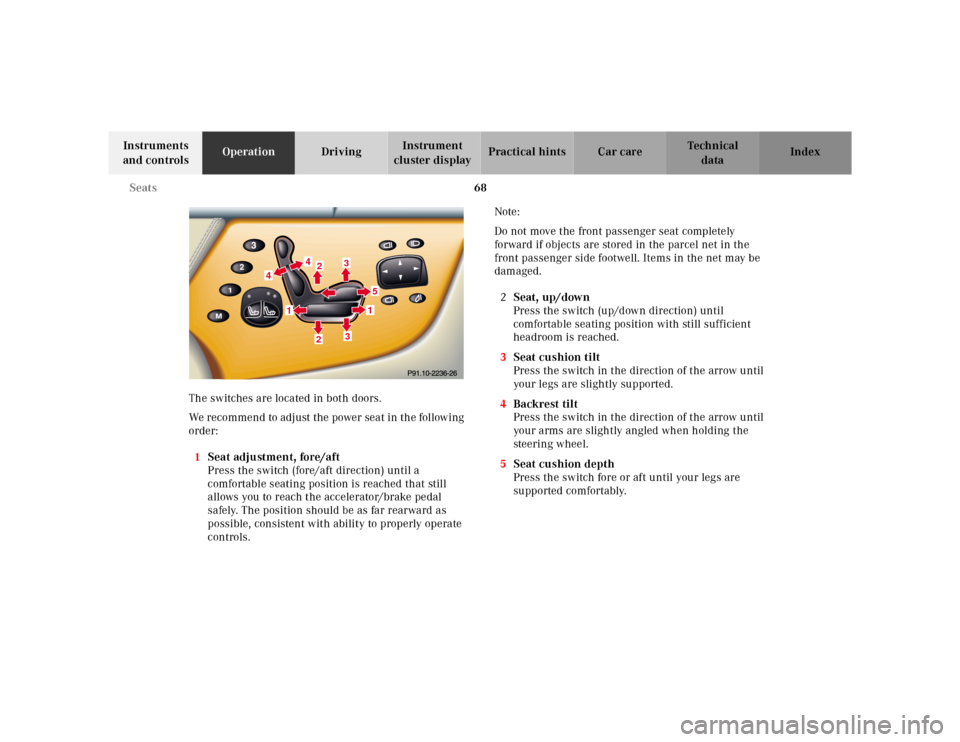
The switches are located in both doors.
We recommend to adjust the power seat in the following
order:
1Seat adjustment, fore/aft
Press the switch (fore/aft direction) until a
comfortable seating position is reached that still
allows you to reach the accelerator/brake pedal
safely. The position should be as far rearward as
possible, consistent with ability to properly operate
controls.Note:
Do not move the front passenger seat completely
forward if objects are stored in the parcel net in the
front passenger side footwell. Items in the net may be
damaged.
2Seat, up/down
Press the switch (up/down direction) until
comfortable seating position with still sufficient
headroom is reached.
3Seat cushion tilt
Press the switch in the direction of the arrow until
yo ur l egs a re sligh tly su p po rted.
4Backrest tilt
Press the switch in the direction of the arrow until
your arms are slightly angled when holding the
steering wheel.
5Seat cushion depth
Press the switch fore or aft until your legs are
supported comfortably.
422
3
51
3
1
4
Page 72 of 424
69 Seats
Te ch n ica l
data Instruments
and controlsOperationDrivingInstrument
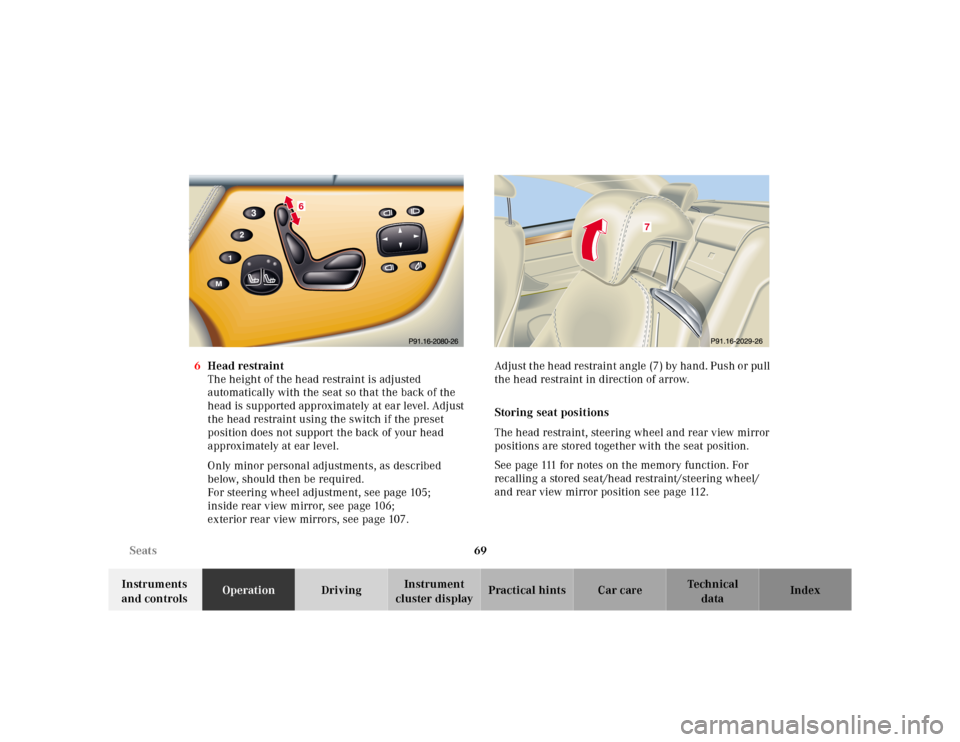
cluster displayPractical hints Car care Index 6Head restraint
The height of the head restraint is adjusted
automatically with the seat so that the back of the
head is supported approximately at ear level. Adjust
the head restraint using the switch if the preset
position does not support the back of your head
approximately at ear level.
Only minor personal adjustments, as described
below, should then be required.
For steering wheel adjustment, see page 105;
inside rear view mirror, see page 106;
exterior rear view mirrors, see page 107.Adjust the head restraint angle (7) by hand. Push or pull
the head restraint in direction of arrow.
Storing seat positions
The head restraint, steering wheel and rear view mirror
positions are stored together with the seat position.
See page 111 for notes on the memory function. For
recalling a stored seat/head restraint/steering wheel/
and rear view mirror position see page 112.
6
7
Page 73 of 424
70 Seats
Te ch n ica l
data Instruments
and controlsOperationDrivingInstrument
cluster displayPractical hints Car care Index
Important!
Prior to operating the vehicle, the driver should adjust
the seat height for proper vision as well as fore/aft
placement and backrest angle to insure adequate
control, reach, operation, and comfort. The head
restraint should also be adjusted for proper height. See
also airbag section on page 92 for proper seat
positioning.
In addition, also adjust the steering wheel to ensure
adequate control, reach, operation, and comfort.
Both the inside and outside rear view mirrors should be
adjusted for adequate rearward vision.
Fasten seat belts. Infants and small children should be
seated in a properly secured restraint system that
complies with U.S. Federal Motor Vehicle Safety
Standard 213 and Canadian Motor Vehicle Safety
Standard 213.
All seat, head restraint, steering wheel, and rear view
mirror adjustments as well as fastening of seat belts
should be done before the vehicle is put into motion.
Wa r n i n g !
Children 12 years old and under must never ride in
the front seat, except in a Mercedes-Benz
authorized BabySmart
TM compatible child seat,
which operates with the BabySmart
TM system
installed in the vehicle to deactivate the passenger
side front airbag when it is properly installed.
Otherwise they will be struck by the airbag when it
inflates in a crash. If this happens, serious or fatal
injury will result.
According to accident statistics, children are safer
when properly restrained in the rear seating
positions than in the front seating positions.
Infants and small children must ride in back seats
and be seated in an appropriate infant or child
restraint system, which is properly secured with
the vehicle’s seat belt, fully in accordance with the
child seat manufacturer’s instructions.A child’s risk of serious or fatal injuries is
significantly increased if the child restraints are
not properly secured in the vehicle and the child is
not properly secured in the child restraint.
Page 76 of 424
73 Seats
Te ch n ica l
data Instruments
and controlsOperationDrivingInstrument
cluster displayPractical hints Car care IndexNotes:
The automatic seat slide is provided with a safety
feature.
The automatic process is interrupted, if the backrest of
the sliding seat is pushed against an occupant or object.
The seat will slide forward and stop.
Investigate and correct the cause of interruption.
Now use memory button (page 112) or power seat switch
(page 68) to bring seat into desired position.
When folding the backrest forward from a reclined
position, and then folding it back, the backrest stops in a
more upright position for the safety of any rear-seat
passenger. Adjust the backrest until your arms are
slightly angled when holding the steering wheel, see
page 68.
When leaving the vehicle always remove the
electronic key from the starter switch, take the
KEYLESS-GO-card (if so equipped) with you, and
lock your vehicle.The power seats can also be operated with the
driver’s or passenger door open. Do not leave
children unattended in the vehicle or with access
to an unlocked vehicle. Unsupervised use of vehicle
equipment may cause serious personal injury.Never place hands under seat or near any moving
parts during a seat adjustment procedure.
Page 100 of 424
97 Restraint systems
Te ch n ica l
data Instruments
and controlsOperationDrivingInstrument
cluster displayPractical hints Car care Index Your vehicle was originally equipped with airbags
which are designed to activate in certain impacts
exceeding a preset threshold to reduce the potential
and severity of injury. It is important to your safety
and that of your passenger that you replace deployed
airbags and repair any malfunctioning airbags to
ensure the vehicle will continue to provide crash
protection for occupants.
Wa r n i n g !
To reduce the risk of injury when the front airbags
inflate, it is very important for the driver and front
passenger to always be in a properly seated
position and to wear your seat belt.For maximum protection in the event of a collision
always be in normal seated position w ith your back
against the backrest. Fasten your seat belt and
ensure that it is properly positioned on your body.Since the airbag inflates with considerable speed
and force, a proper seating and hands on steering
wheel position will help to keep you at a safe
distance from the airbag. Occupants who are
unbelted, out of position or too close to the airbag
can be seriously injured by an airbag as it inflates
with great force in the blink of an eye:
• Sit properly belted in an upright position with
your back against the backrest.• Adjust the driver seat as far as possible
rearward, still permitting proper operation of
vehicle controls. The distance from the center
of the driver’s breastbone to the center of the
airbag cover on the steering wheel must be at
least ten inches (25 cm) or more. You should be
able to accomplish this by a combination of
adjustments to the seat and steering wheel. If
you have any problems, please see your
authorized Mercedes-Benz Center.• Do not lean with your head or chest close to the
steering wheel or dashboard.• Keep hands on the outside of steering wheel
rim. Placing hands and arms inside the rim
can increase the risk and potential severity of
hand/arm injury when driver front airbag
inflates.• Adjust the front passenger seat as far as
possible rearward from the dashboard when
the seat is occupied.