window MERCEDES-BENZ CLA 2013 User Guide
[x] Cancel search | Manufacturer: MERCEDES-BENZ, Model Year: 2013, Model line: CLA, Model: MERCEDES-BENZ CLA 2013Pages: 352, PDF Size: 5.37 MB
Page 47 of 352
nition may also be impaired. There is an
increased risk of injury, possibly even fatal.
Use only seat covers which have been specif-
ically approved for the respective seat by
Mercedes-Benz.GWARNING
Sensors to control the airbags are located in
the doors. Modifications or work not per-
formed correctly to the doors or door panel-
ling, as well as damaged doors, can lead to
the function of the sensors being impaired.
The airbags might therefore not function
properly any more. Consequently, the airbags
cannot protect vehicle occupants as they are
designed to do. This poses an increased risk
of injury.
Never modify the doors or parts of the doors.
Always have work on the doors or door pan-
elling carried out at a qualified specialist
workshop.
You should only use seat cover that have been
approved for your vehicle by Mercedes-Benz.
The seat covers must have a special tear
seam for sidebags. Otherwise, the sidebags
cannot deploy correctly and therefore cannot
provide the intended protection in the event
of an accident.
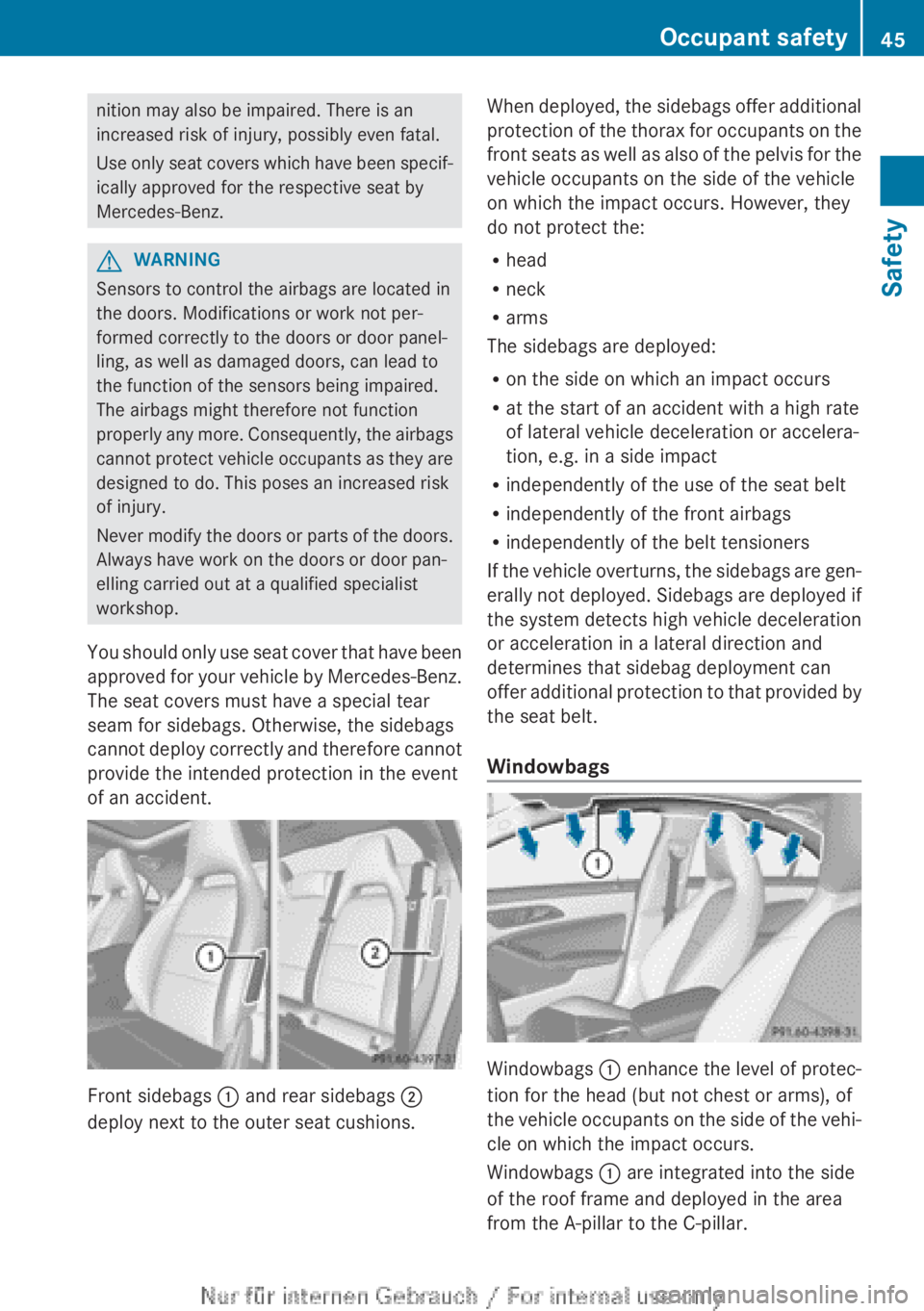
Front sidebags : and rear sidebags ;
deploy next to the outer seat cushions.
When deployed, the sidebags offer additional
protection of the thorax for occupants on the
front seats as well as also of the pelvis for the
vehicle occupants on the side of the vehicle
on which the impact occurs. However, they
do not protect the:
R head
R neck
R arms
The sidebags are deployed:
R on the side on which an impact occurs
R at the start of an accident with a high rate
of lateral vehicle deceleration or accelera-
tion, e.g. in a side impact
R independently of the use of the seat belt
R independently of the front airbags
R independently of the belt tensioners
If the vehicle overturns, the sidebags are gen-
erally not deployed. Sidebags are deployed if
the system detects high vehicle deceleration
or acceleration in a lateral direction and
determines that sidebag deployment can
offer additional protection to that provided by
the seat belt.
Windowbags
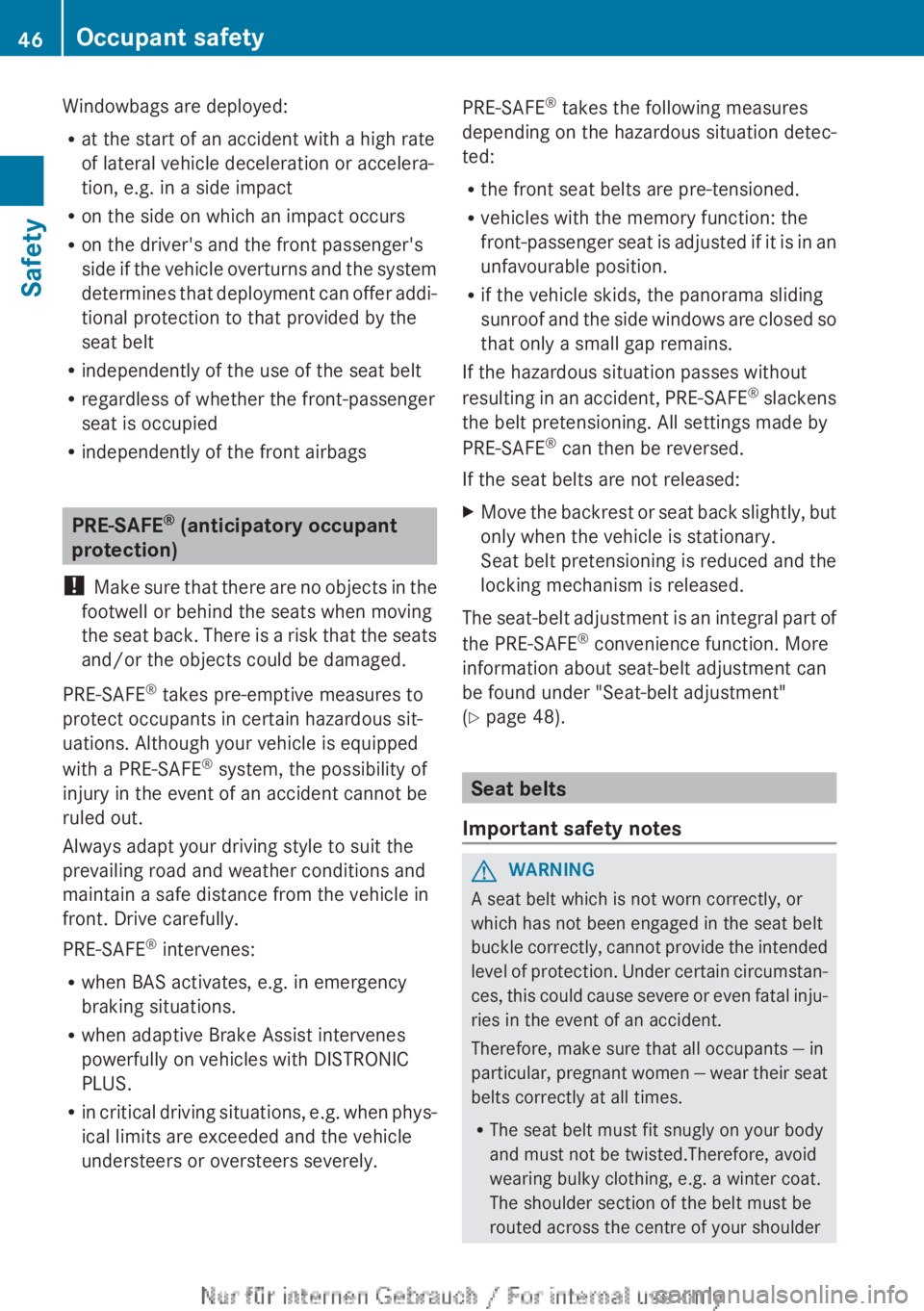
Windowbags : enhance the level of protec-
tion for the head (but not chest or arms), of
the vehicle occupants on the side of the vehi-
cle on which the impact occurs.
Windowbags : are integrated into the side
of the roof frame and deployed in the area
from the A-pillar to the C-pillar.
Occupant safety45SafetyZ
Page 48 of 352
Windowbags are deployed:
R at the start of an accident with a high rate
of lateral vehicle deceleration or accelera-
tion, e.g. in a side impact
R on the side on which an impact occurs
R on the driver's and the front passenger's
side if the vehicle overturns and the system
determines that deployment can offer addi-
tional protection to that provided by the
seat belt
R independently of the use of the seat belt
R regardless of whether the front-passenger
seat is occupied
R independently of the front airbags
PRE-SAFE ®
(anticipatory occupant
protection)
! Make sure that there are no objects in the
footwell or behind the seats when moving
the seat back. There is a risk that the seats
and/or the objects could be damaged.
PRE-SAFE ®
takes pre-emptive measures to
protect occupants in certain hazardous sit-
uations. Although your vehicle is equipped
with a PRE-SAFE ®
system, the possibility of
injury in the event of an accident cannot be
ruled out.
Always adapt your driving style to suit the
prevailing road and weather conditions and
maintain a safe distance from the vehicle in
front. Drive carefully.
PRE-SAFE ®
intervenes:
R when BAS activates, e.g. in emergency
braking situations.
R when adaptive Brake Assist intervenes
powerfully on vehicles with DISTRONIC
PLUS.
R in critical driving situations, e.g. when phys-
ical limits are exceeded and the vehicle
understeers or oversteers severely.
PRE-SAFE ®
takes the following measures
depending on the hazardous situation detec-
ted:
R the front seat belts are pre-tensioned.
R vehicles with the memory function: the
front-passenger seat is adjusted if it is in an
unfavourable position.
R if the vehicle skids, the panorama sliding
sunroof and the side windows are closed so
that only a small gap remains.
If the hazardous situation passes without
resulting in an accident, PRE-SAFE ®
slackens
the belt pretensioning. All settings made by
PRE-SAFE ®
can then be reversed.
If the seat belts are not released:XMove the backrest or seat back slightly, but
only when the vehicle is stationary.
Seat belt pretensioning is reduced and the
locking mechanism is released.
The seat-belt adjustment is an integral part of
the PRE-SAFE ®
convenience function. More
information about seat-belt adjustment can
be found under "Seat-belt adjustment"
( Y page 48).
Seat belts
Important safety notes
GWARNING
A seat belt which is not worn correctly, or
which has not been engaged in the seat belt
buckle correctly, cannot provide the intended
level of protection. Under certain circumstan-
ces, this could cause severe or even fatal inju-
ries in the event of an accident.
Therefore, make sure that all occupants — in
particular, pregnant women — wear their seat
belts correctly at all times.
R The seat belt must fit snugly on your body
and must not be twisted.Therefore, avoid
wearing bulky clothing, e.g. a winter coat.
The shoulder section of the belt must be
routed across the centre of your shoulder
46Occupant safetySafety
Page 52 of 352
Belt tensioners, belt force limitersGWARNING
Pyrotechnic seat belt tensioners that have
been deployed are no longer operational and
are unable to perform their intended protec-
tive function. This poses an increased risk of
injury or even fatal injury.
Therefore, have pyrotechnic belt tensioners
which have been triggered immediately
replaced at a qualified specialist workshop.
! If the front-passenger seat is not occu-
pied, do not engage the seat belt tongue in
the buckle on the front-passenger seat.
Otherwise, the belt tensioner could be trig-
gered in the event of an accident.
i Vehicles with PRE-SAFE ®
: belt tensioners
that are triggered by an electric motor can
be deployed as often as desired and do not
need to be replaced.
The front seat belts and the outer seat belts
in the rear are equipped with belt tensioners
and belt force limiters.
The belt tensioners tighten the seat belts in
an accident, pulling them close against the
body.
Belt tensioners do not correct incorrect seat
positions or incorrectly fastened seat belts.
Belt tensioners do not pull vehicle occupants
back towards the backrest.
The belt tensioners can only be activated
when:
R the ignition is switched on
R the restraint systems are operational; see
" 6 SRS warning lamp"( Y page 41)
R the belt tongue is engaged in the buckle on
each of the front seat belts.
The belt tensioners on the outside seats in the
rear compartment are triggered independ-
ently of the lock status of the seat belts.
The belt tensioners are triggered depending
on the type and severity of an accident:
R if, in the event of a head-on or rear-end col-
lision the vehicle decelerates or acceler-
ates rapidly in a longitudinal direction dur-
ing the initial stages of the impact
R if, in the event of a side impact, on the side
opposite the impact the vehicle deceler-
ates or accelerates rapidly in a lateral direc-
tion
R in certain situations where the vehicle over-
turns and the system determines that it can
provide additional protection
If the airbags are deployed, you will hear a
bang, and a small amount of powder may also
be released. Only in rare cases will the bang
affect your hearing. The powder that is
released generally does not constitute a
health hazard and does not indicate that there
is a fire in the vehicle. The powder may cause
short-term breathing difficulties to persons
suffering from asthma or other pulmonary
conditions. In order to prevent potential
breathing difficulties, you should leave the
vehicle as soon as it is safe to do so. You can
also open the window to allow fresh air to
enter the vehicle interior. The 6 SRS warn-
ing lamp lights up.
If the seat belt is also fitted with a belt force
limiter and this is triggered, the force exerted
by the seat belt on the vehicle occupant is
reduced.
The belt force limiters on the front seats are
synchronised with the front airbags, which
take on a part of the deceleration force. This
results in the load being distributed over a
greater area.
Children in the vehicle
Child restraint systems
Important safety notes
GWARNING
To reduce the risk of serious or even fatal
injury to the child in the event of a sudden
change in direction, braking or an accident:
R Children less than 1.50 m tall and under
twelve years of age must always be secured
50Children in the vehicleSafety
Page 56 of 352
GWARNING
Electronic devices on the front-passenger
seat can affect the function of the automatic
child seat recognition, for example:
R laptop
R mobile phone
R transponder cards such as ski passes or
access passes
The front-passenger front airbag could deploy
unintentionally or not function as intended
during an accident. This poses an increased
risk of injury or even fatal injury.
Do not place any of the devices mentioned
above or similar devices on the front-
passenger seat.
If the front-passenger seat of your vehicle
does not have automatic child seat recogni-
tion, this is indicated by a special sticker. The
sticker is affixed to the side of the dashboard
on the front-passenger side. The sticker is
visible when you open the front-passenger
door.
Vehicles without automatic child seat recog-
nition on the front-passenger seat: if you turn
the key to position 2 in the ignition lock, the
PASSENGER AIRBAG OFF indicator lamp
lights up briefly. However, the indicator lamp
has no function. It does not indicate that there
is automatic child seat recognition on the
front-passenger seat.
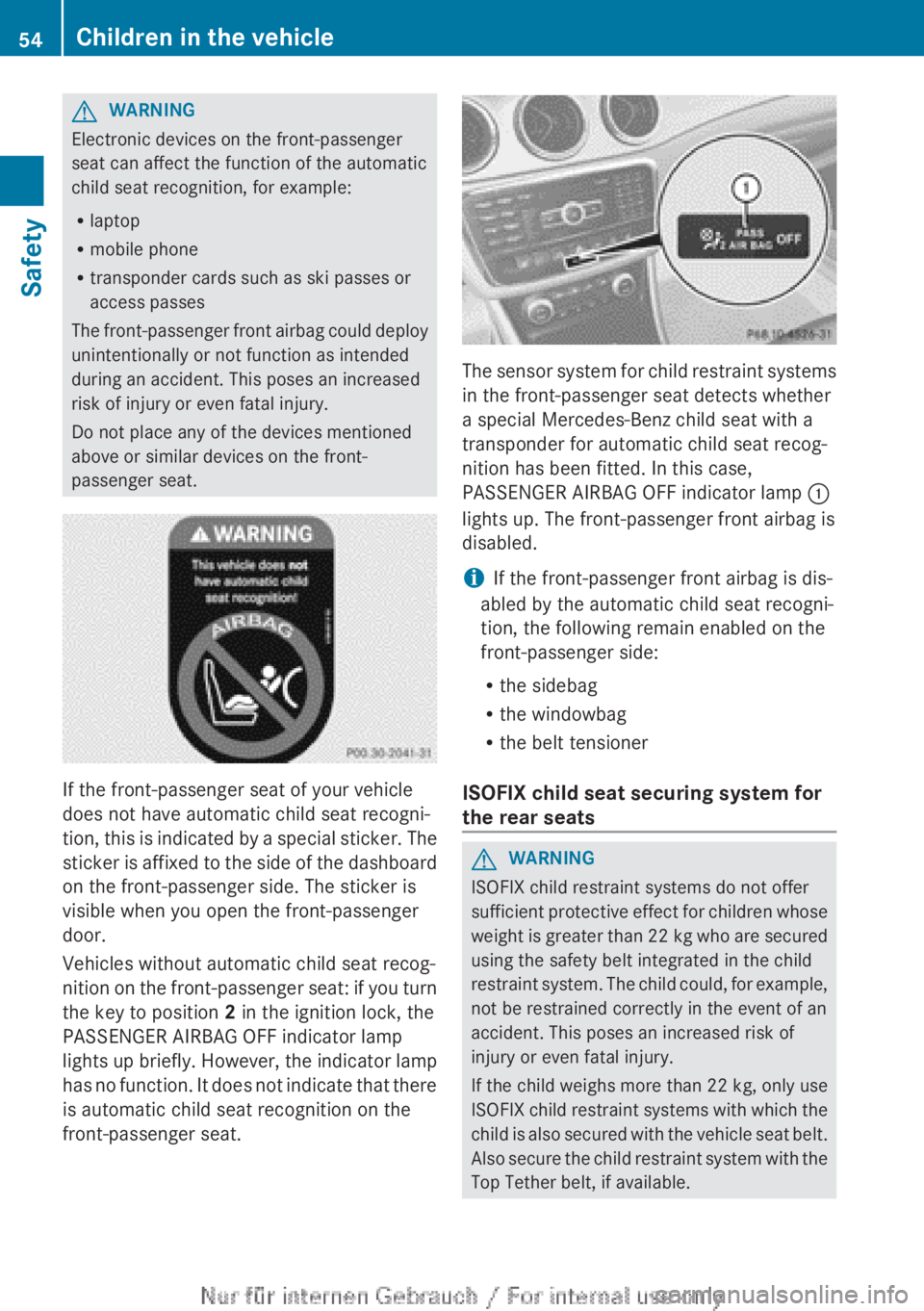
The sensor system for child restraint systems
in the front-passenger seat detects whether
a special Mercedes-Benz child seat with a
transponder for automatic child seat recog-
nition has been fitted. In this case,
PASSENGER AIRBAG OFF indicator lamp :
lights up. The front-passenger front airbag is
disabled.
i If the front-passenger front airbag is dis-
abled by the automatic child seat recogni-
tion, the following remain enabled on the
front-passenger side:
R the sidebag
R the windowbag
R the belt tensioner
ISOFIX child seat securing system for
the rear seats
GWARNING
ISOFIX child restraint systems do not offer
sufficient protective effect for children whose
weight is greater than 22 kg who are secured
using the safety belt integrated in the child
restraint system. The child could, for example,
not be restrained correctly in the event of an
accident. This poses an increased risk of
injury or even fatal injury.
If the child weighs more than 22 kg, only use
ISOFIX child restraint systems with which the
child is also secured with the vehicle seat belt.
Also secure the child restraint system with the
Top Tether belt, if available.
54Children in the vehicleSafety
Page 65 of 352
GWARNING
If children are travelling in the vehicle, they
could:
R open doors, thus endangering other people
or road users
R exit the vehicle and be caught by oncoming
traffic
R operate vehicle equipment and become
trapped, for example
There is a risk of an accident and injury.
Always activate the child-proof locks and
override feature if children are travelling in the
vehicle. When leaving the vehicle, always take
the key with you and lock the vehicle. Never
leave children unattended in the vehicle.
You can activate the following child-proof
locks:
R rear doors ( Y page 63)
R rear side windows ( Y page 63)
Child-proof locks for the rear doors
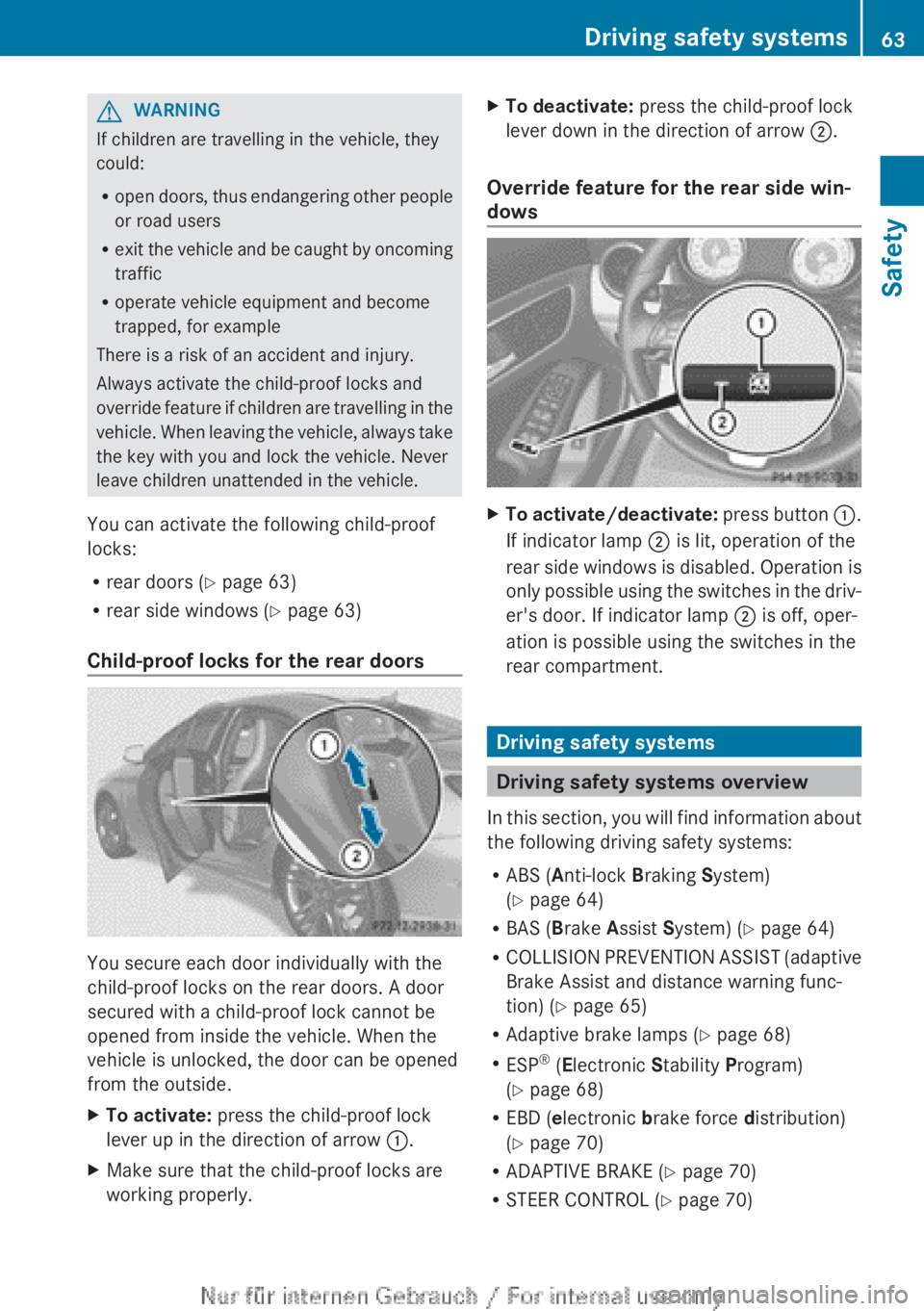
You secure each door individually with the
child-proof locks on the rear doors. A door
secured with a child-proof lock cannot be
opened from inside the vehicle. When the
vehicle is unlocked, the door can be opened
from the outside.
XTo activate: press the child-proof lock
lever up in the direction of arrow :.XMake sure that the child-proof locks are
working properly.XTo deactivate: press the child-proof lock
lever down in the direction of arrow ;.
Override feature for the rear side win-
dows
XTo activate/deactivate: press button :.
If indicator lamp ; is lit, operation of the
rear side windows is disabled. Operation is
only possible using the switches in the driv-
er's door. If indicator lamp ; is off, oper-
ation is possible using the switches in the
rear compartment.
Driving safety systems
Driving safety systems overview
In this section, you will find information about
the following driving safety systems:
R ABS ( Anti-lock Braking System)
( Y page 64)
R BAS ( Brake Assist System) ( Y page 64)
R COLLISION PREVENTION ASSIST (adaptive
Brake Assist and distance warning func-
tion) ( Y page 65)
R Adaptive brake lamps ( Y page 68)
R ESP ®
(E lectronic Stability Program)
( Y page 68)
R EBD ( electronic brake force distribution)
( Y page 70)
R ADAPTIVE BRAKE ( Y page 70)
R STEER CONTROL ( Y page 70)
Driving safety systems63SafetyZ
Page 74 of 352
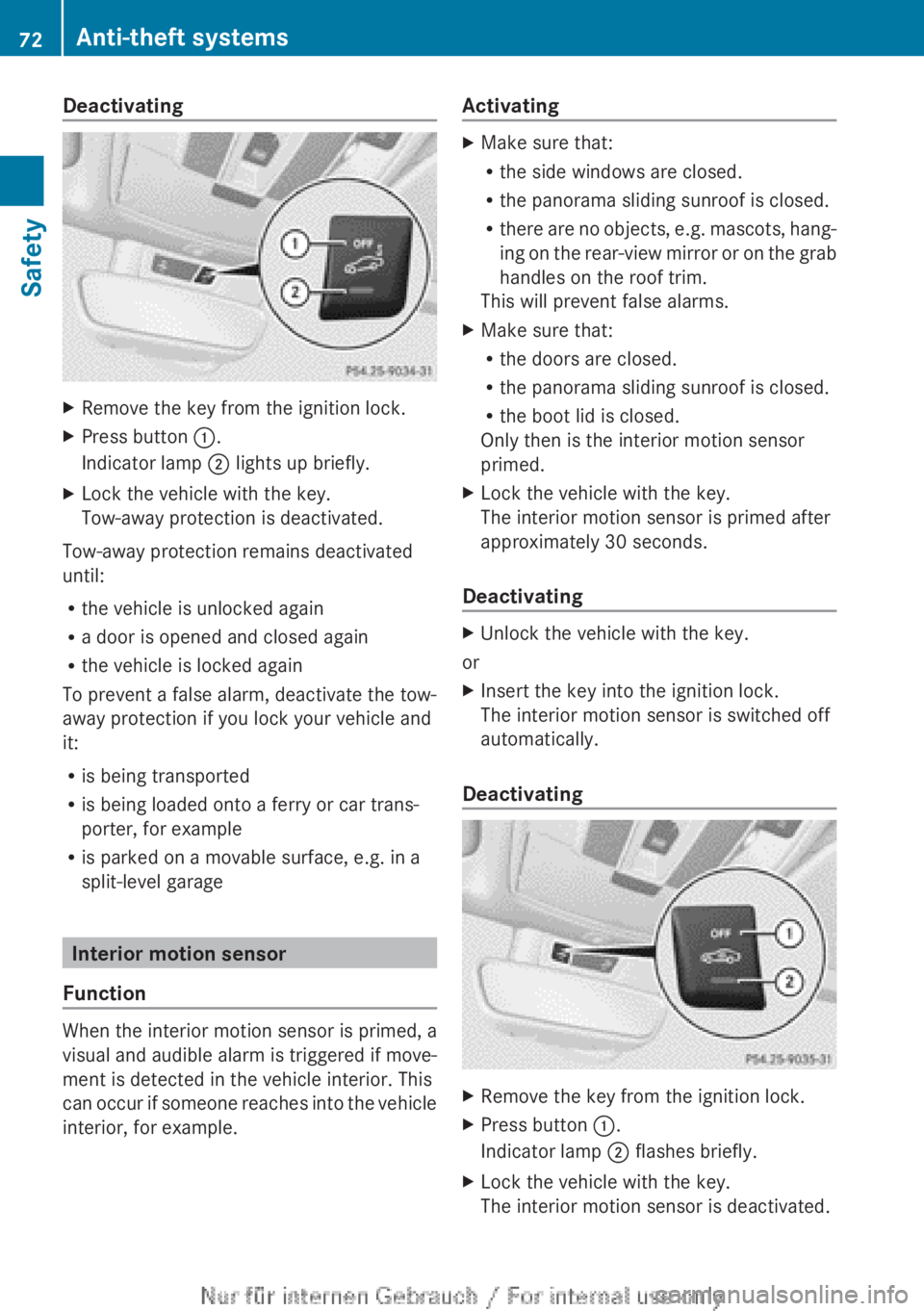
DeactivatingXRemove the key from the ignition lock.XPress button :.
Indicator lamp ; lights up briefly.XLock the vehicle with the key.
Tow-away protection is deactivated.
Tow-away protection remains deactivated
until:
R the vehicle is unlocked again
R a door is opened and closed again
R the vehicle is locked again
To prevent a false alarm, deactivate the tow-
away protection if you lock your vehicle and
it:
R is being transported
R is being loaded onto a ferry or car trans-
porter, for example
R is parked on a movable surface, e.g. in a
split-level garage
Interior motion sensor
Function
When the interior motion sensor is primed, a
visual and audible alarm is triggered if move-
ment is detected in the vehicle interior. This
can occur if someone reaches into the vehicle
interior, for example.
ActivatingXMake sure that:
R the side windows are closed.
R the panorama sliding sunroof is closed.
R there are no objects, e.g. mascots, hang-
ing on the rear-view mirror or on the grab
handles on the roof trim.
This will prevent false alarms.XMake sure that:
R the doors are closed.
R the panorama sliding sunroof is closed.
R the boot lid is closed.
Only then is the interior motion sensor
primed.XLock the vehicle with the key.
The interior motion sensor is primed after
approximately 30 seconds.
Deactivating
XUnlock the vehicle with the key.
or
XInsert the key into the ignition lock.
The interior motion sensor is switched off
automatically.
Deactivating
XRemove the key from the ignition lock.XPress button :.
Indicator lamp ; flashes briefly.XLock the vehicle with the key.
The interior motion sensor is deactivated.72Anti-theft systemsSafety
Page 75 of 352
The interior motion sensor remains deactiva-
ted until:
R the vehicle is unlocked again
R a door is opened and closed again
R the vehicle is locked again
To prevent a false alarm, deactivate the inte-
rior motion sensor if you lock your vehicle
and:
R people or animals remain in the vehicle.
R the panorama sliding sunroof remains
open.
R the side windows remain open.
i UK only: your vehicle is equipped with a
double lock function. The doors cannot be
opened from the inside if the vehicle has
been locked with the key ( Y page 82).
Deactivate the interior motion sensor
before you lock the vehicle with the key.
The doors can then be opened from the
inside after the vehicle has been locked
from the outside with the key. Observe the
"Important safety notes" ( Y page 81).Anti-theft systems73SafetyZ
Page 77 of 352
Useful information ..............................76
Key ....................................................... 76
Doors .................................................... 81
Boot ...................................................... 84
Side windows ...................................... 86
Panorama sliding sunroof ..................8975Opening and closing
Page 84 of 352
tivate the double lock function by deactivat-
ing the interior motion sensor ( Y page 72).
The doors can then be opened from the inside
after the vehicle has been locked from the
outside. You can open the rear doors from
inside the vehicle if they are not secured by
the child-proof locks ( Y page 63). The anti-
theft alarm system is triggered if the door is
opened from the inside. Switch off the alarm
( Y page 71).
Unlocking and opening the doors
from the inside
i When a door is opened, the side window
on that side opens slightly. When the door
is closed, the side window is raised again.
! The side windows will not open/close if
the battery is discharged or if the side win-
dows have iced up. It will then not be pos-
sible to close the door. Do not attempt to
force the door to close. You could other-
wise damage the door or the side window.
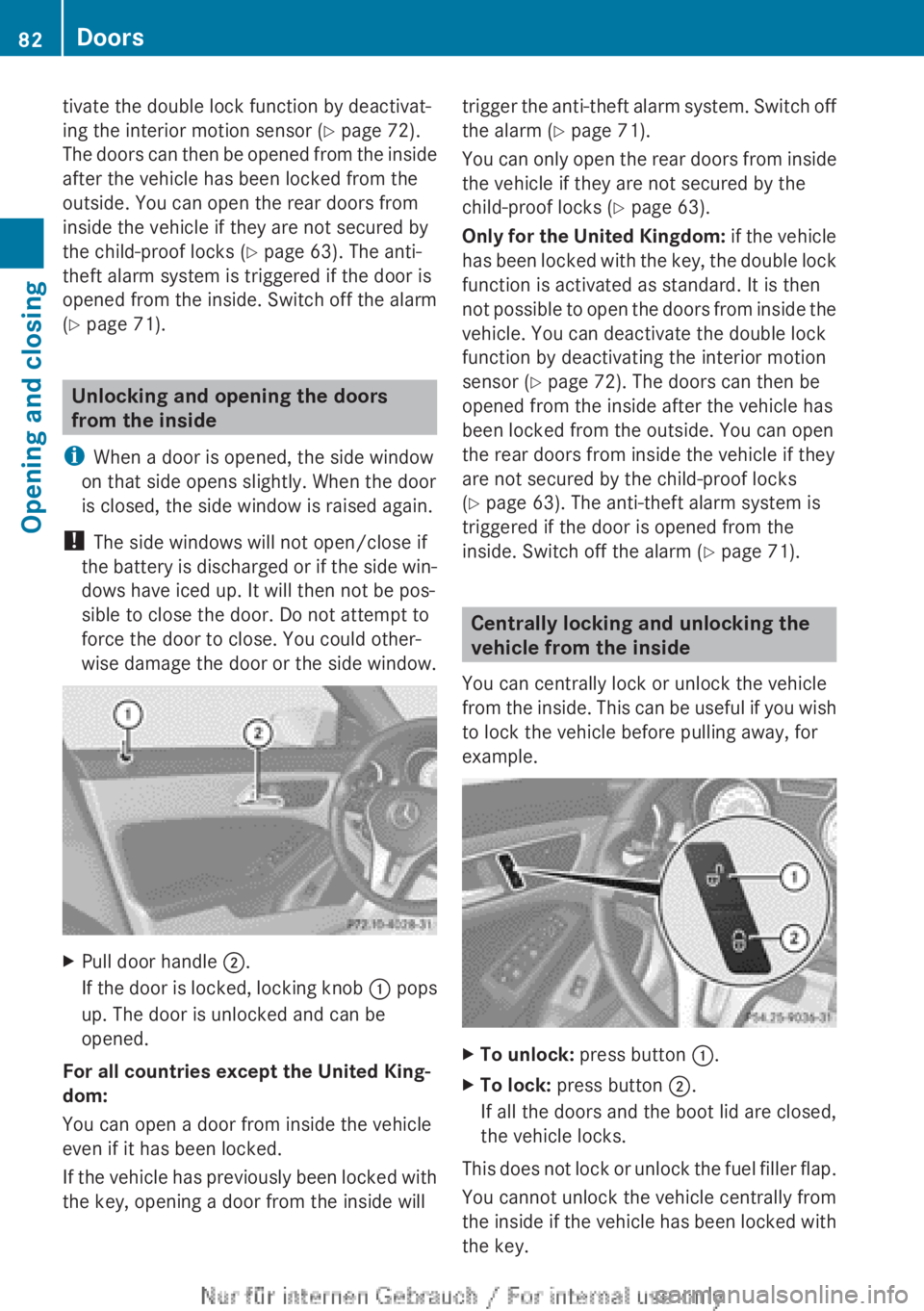
XPull door handle ;.
If the door is locked, locking knob : pops
up. The door is unlocked and can be
opened.
For all countries except the United King-
dom:
You can open a door from inside the vehicle
even if it has been locked.
If the vehicle has previously been locked with
the key, opening a door from the inside will
trigger the anti-theft alarm system. Switch off
the alarm ( Y page 71).
You can only open the rear doors from inside
the vehicle if they are not secured by the
child-proof locks ( Y page 63).
Only for the United Kingdom: if the vehicle
has been locked with the key, the double lock
function is activated as standard. It is then
not possible to open the doors from inside the
vehicle. You can deactivate the double lock
function by deactivating the interior motion
sensor ( Y page 72). The doors can then be
opened from the inside after the vehicle has
been locked from the outside. You can open
the rear doors from inside the vehicle if they
are not secured by the child-proof locks
( Y page 63). The anti-theft alarm system is
triggered if the door is opened from the
inside. Switch off the alarm ( Y page 71).
Centrally locking and unlocking the
vehicle from the inside
You can centrally lock or unlock the vehicle
from the inside. This can be useful if you wish
to lock the vehicle before pulling away, for
example.
XTo unlock: press button :.XTo lock: press button ;.
If all the doors and the boot lid are closed,
the vehicle locks.
This does not lock or unlock the fuel filler flap.
You cannot unlock the vehicle centrally from
the inside if the vehicle has been locked with
the key.
82DoorsOpening and closing
Page 88 of 352
iOpening dimensions of the boot lid
( Y page 343).
Opening
You can open the boot lid from the driver's
seat when the vehicle is stationary and
unlocked.
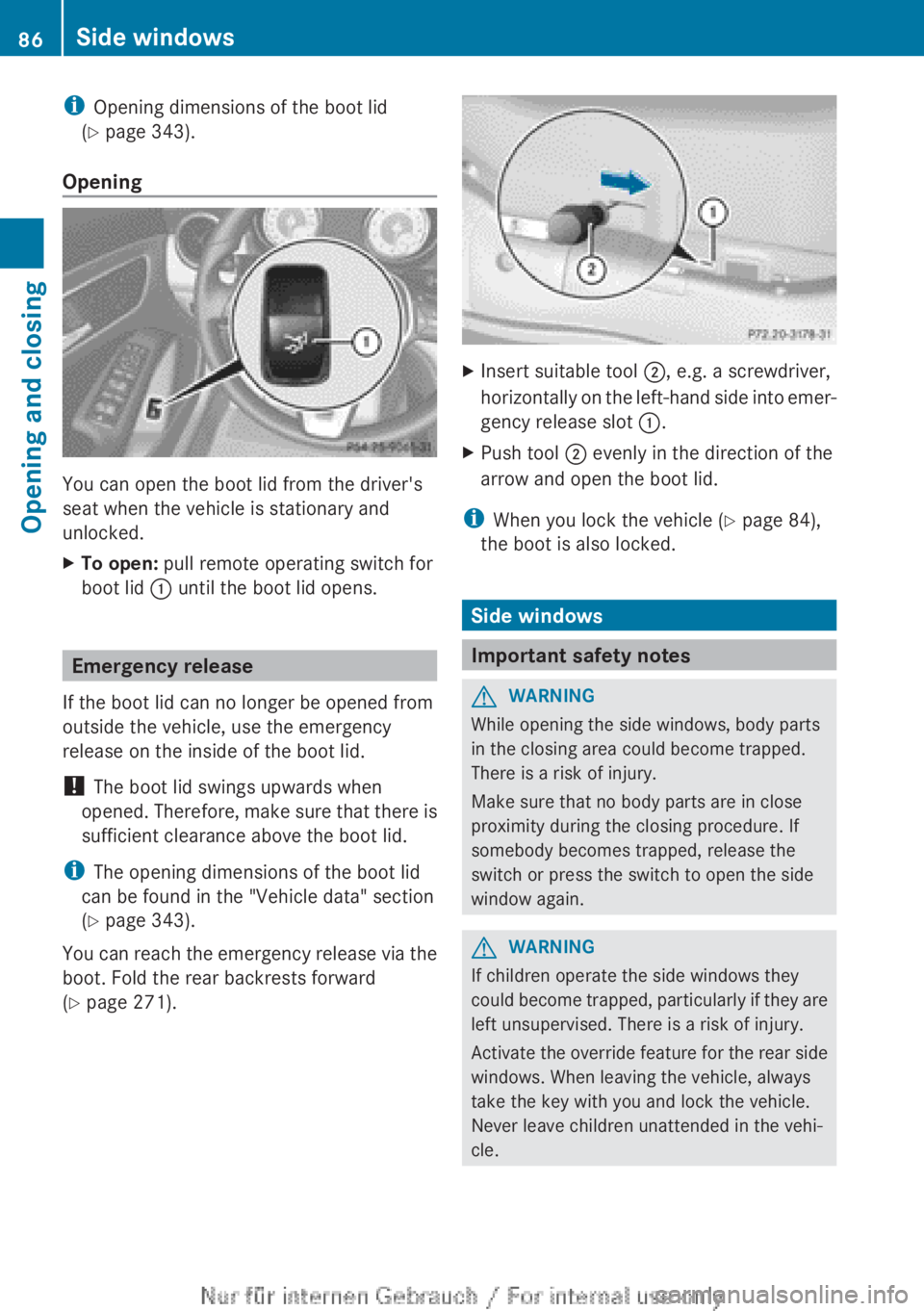
XTo open: pull remote operating switch for
boot lid : until the boot lid opens.
Emergency release
If the boot lid can no longer be opened from
outside the vehicle, use the emergency
release on the inside of the boot lid.
! The boot lid swings upwards when
opened. Therefore, make sure that there is
sufficient clearance above the boot lid.
i The opening dimensions of the boot lid
can be found in the "Vehicle data" section
( Y page 343).
You can reach the emergency release via the
boot. Fold the rear backrests forward
( Y page 271).
XInsert suitable tool ;, e.g. a screwdriver,
horizontally on the left-hand side into emer-
gency release slot :.XPush tool ; evenly in the direction of the
arrow and open the boot lid.
i When you lock the vehicle ( Y page 84),
the boot is also locked.
Side windows
Important safety notes
GWARNING
While opening the side windows, body parts
in the closing area could become trapped.
There is a risk of injury.
Make sure that no body parts are in close
proximity during the closing procedure. If
somebody becomes trapped, release the
switch or press the switch to open the side
window again.
GWARNING
If children operate the side windows they
could become trapped, particularly if they are
left unsupervised. There is a risk of injury.
Activate the override feature for the rear side
windows. When leaving the vehicle, always
take the key with you and lock the vehicle.
Never leave children unattended in the vehi-
cle.
86Side windowsOpening and closing