lock MERCEDES-BENZ CLA-Class 2014 C117 User Guide
[x] Cancel search | Manufacturer: MERCEDES-BENZ, Model Year: 2014, Model line: CLA-Class, Model: MERCEDES-BENZ CLA-Class 2014 C117Pages: 358, PDF Size: 6.6 MB
Page 39 of 358
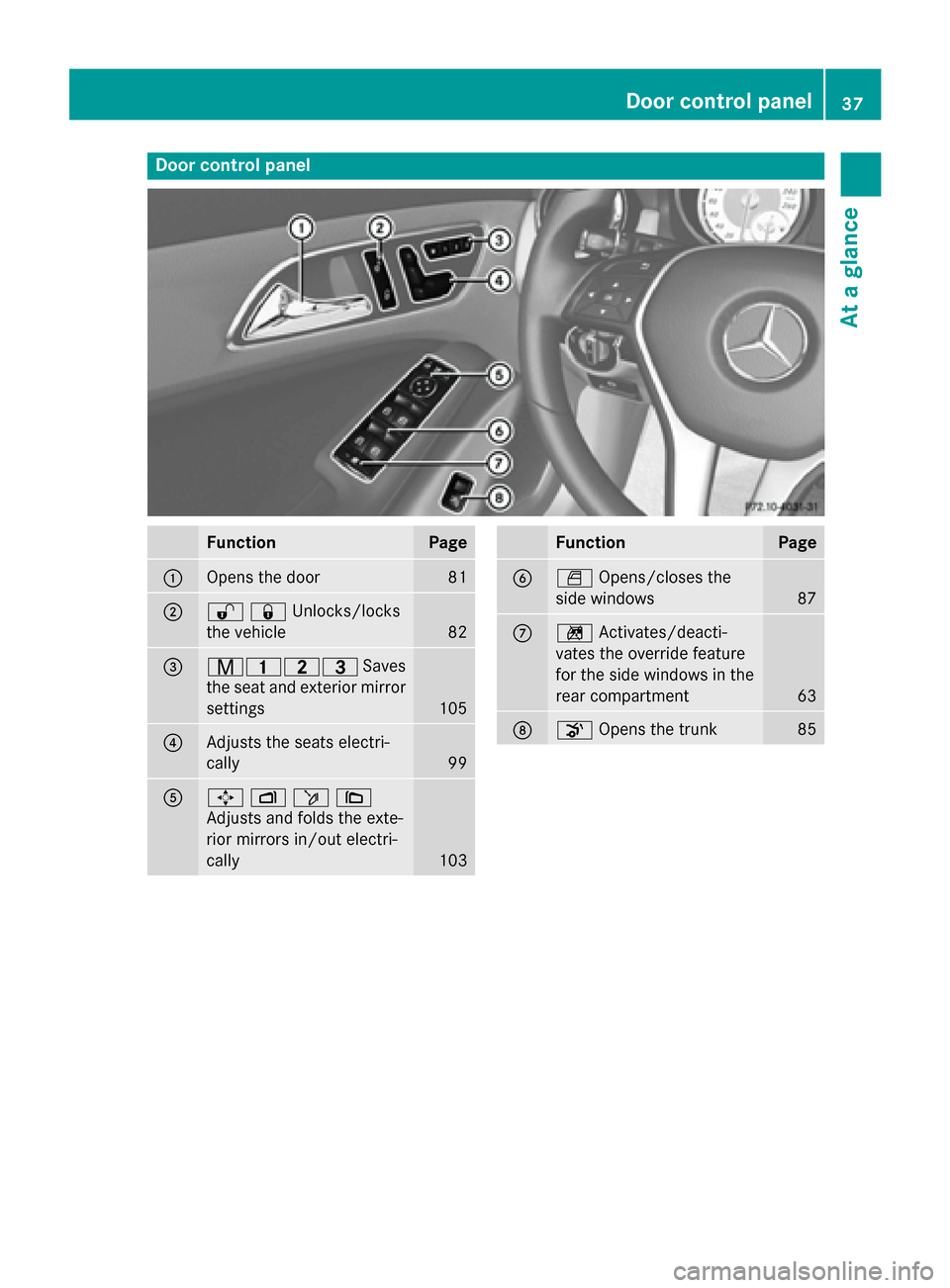
Door control panel
Function Page
0043
Opens the door 81
0044
00360037Unlocks/locks
the vehicle
82
0087
008D003700380040
Saves
the seat and exterior mirror settings 105
0085
Adjusts the seats electri-
cally
99
0083
0062
007000F50071
Adjusts and folds the exte-
rior mirrors in/out electri-
cally 103 Function Page
0084
0062
Opens/closes the
side windows 87
006B
0089
Activates/deacti-
vates the override feature
for the side windows in the
rear compartment 63
006C
008A
Opens the trunk 85Door control panel
37At a glance
Page 41 of 358
Useful information
..............................40
Panic alarm .......................................... 40
Occupant safety .................................. 40
Children in the vehicle ........................56
Driving safety systems .......................63
Theft deterrent locking system .........72 39Safety
Page 42 of 358
Useful information
i This Operator's manual describes all
models and all standard and optional equip- ment of your vehicle available at the time of
publication of the Operator's manual.
Country-specific differences are possible.
Please note that your vehicle may not be
equipped with all features described. This
also applies to safety-related systems and
functions.
i Read the information on qualified special-
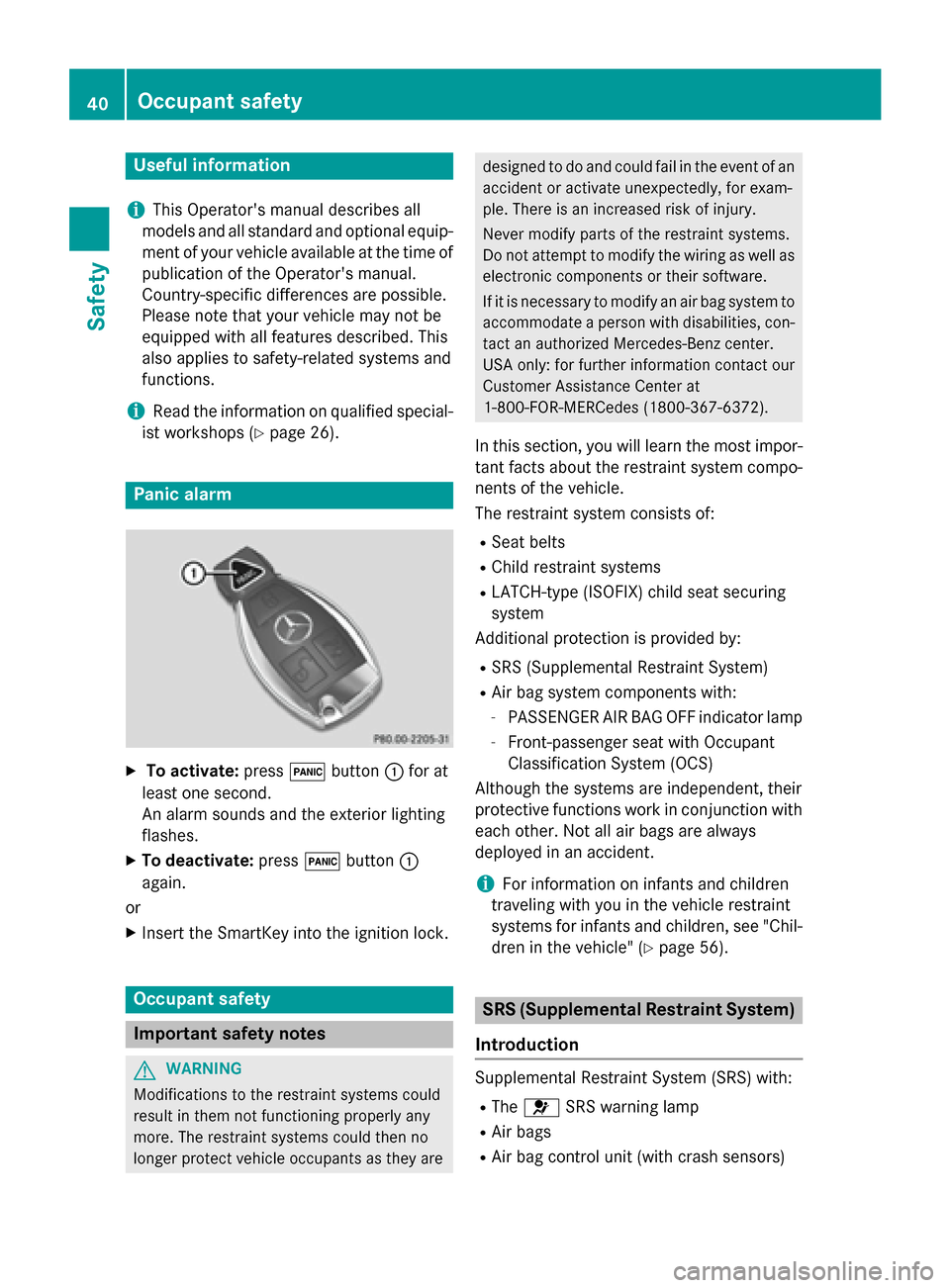
ist workshops (Y page 26). Panic alarm
X
To activate: press0033button 0043for at
least one second.
An alarm sounds and the exterior lighting
flashes.
X To deactivate: press0033button 0043
again.
or
X Insert the SmartKey into the ignition lock. Occupant safety
Important safety notes
G
WARNING
Modifications to the restraint systems could
result in them not functioning properly any
more. The restraint systems could then no
longer protect vehicle occupants as they are designed to do and could fail in the event of an
accident or activate unexpectedly, for exam-
ple. There is an increased risk of injury.
Never modify parts of the restraint systems.
Do not attempt to modify the wiring as well as
electronic components or their software.
If it is necessary to modify an air bag system to accommodate a person with disabilities, con-tact an authorized Mercedes-Benz center.
USA only: for further information contact our
Customer Assistance Center at
1-800-FOR-MERCedes (1800-367-6372).
In this section, you will learn the most impor- tant facts about the restraint system compo-
nents of the vehicle.
The restraint system consists of:
R Seat belts
R Child restraint systems
R LATCH-type (ISOFIX) child seat securing
system
Additional protection is provided by:
R SRS (Supplemental Restraint System)
R Air bag system components with:
- PASSENGER AIR BAG OFF indicator lamp
- Front-passenger seat with Occupant
Classification System (OCS)
Although the systems are independent, their
protective functions work in conjunction with each other. Not all air bags are always
deployed in an accident.
i For information on infants and children
traveling with you in the vehicle restraint
systems for infants and children, see "Chil-
dren in the vehicle" (Y page 56). SRS (Supplemental Restraint System)
Introduction Supplemental Restraint System (SRS) with:
R The 0075 SRS warning lamp
R Air bags
R Air bag control unit (with crash sensors) 40
Occupant safetySafety
Page 51 of 358
indicator lamp not illuminate or go out while
the restraint is installed, please check
installation. Periodically check the
00730074 indicator lamp while driving to
make sure that the 00730074indicator
lamp is illuminated. If the 00730074indi-
cator lamp goes out or remains out, do not transport a child on the front-passenger
seat until the system has been repaired.
A child in a rear-facing child restraint on the
front-passenger seat will be seriously
injured or even killed if the front-passenger front air bag inflates.
R If you place a child in a forward-facing child
restraint on the front-passenger seat:
- move the seat as far back as possible
- use the proper child restraint recommen-
ded for the age, size and weight of the
child
- secure child restraint with the vehicle's
seat belt according to the child seat man-
ufacturer's instructions
R For children larger than the typical 12-
month-old child, the front-passenger front
air bag may or may not be activated. G
WARNING
If the red 0075SRS warning lamp in the
instrument cluster and the 00730074indica-
tor lamp light up simultaneously, the OCS is
malfunctioning. The front passenger front air
bag will be deactivated in this case. Have the system checked by qualified technicians as
soon as possible. Contact an authorized
Mercedes-Benz Center.
Only have the seat repaired or replaced at an
authorized Mercedes-Benz Center.
In order to ensure proper operation of the air
bag system and OCS:
R Sit with the seat belt properly fastened in a
position that is as upright as possible with
your back against the seat backrest.
R When seated, a passenger should not posi-
tion him/herself in such a way as to cause the passenger's weight to be lifted from the seat cushion as this may result in the OCS
being unable to correctly approximate the
passenger's weight category.
R Read and observe all warnings in this chap-
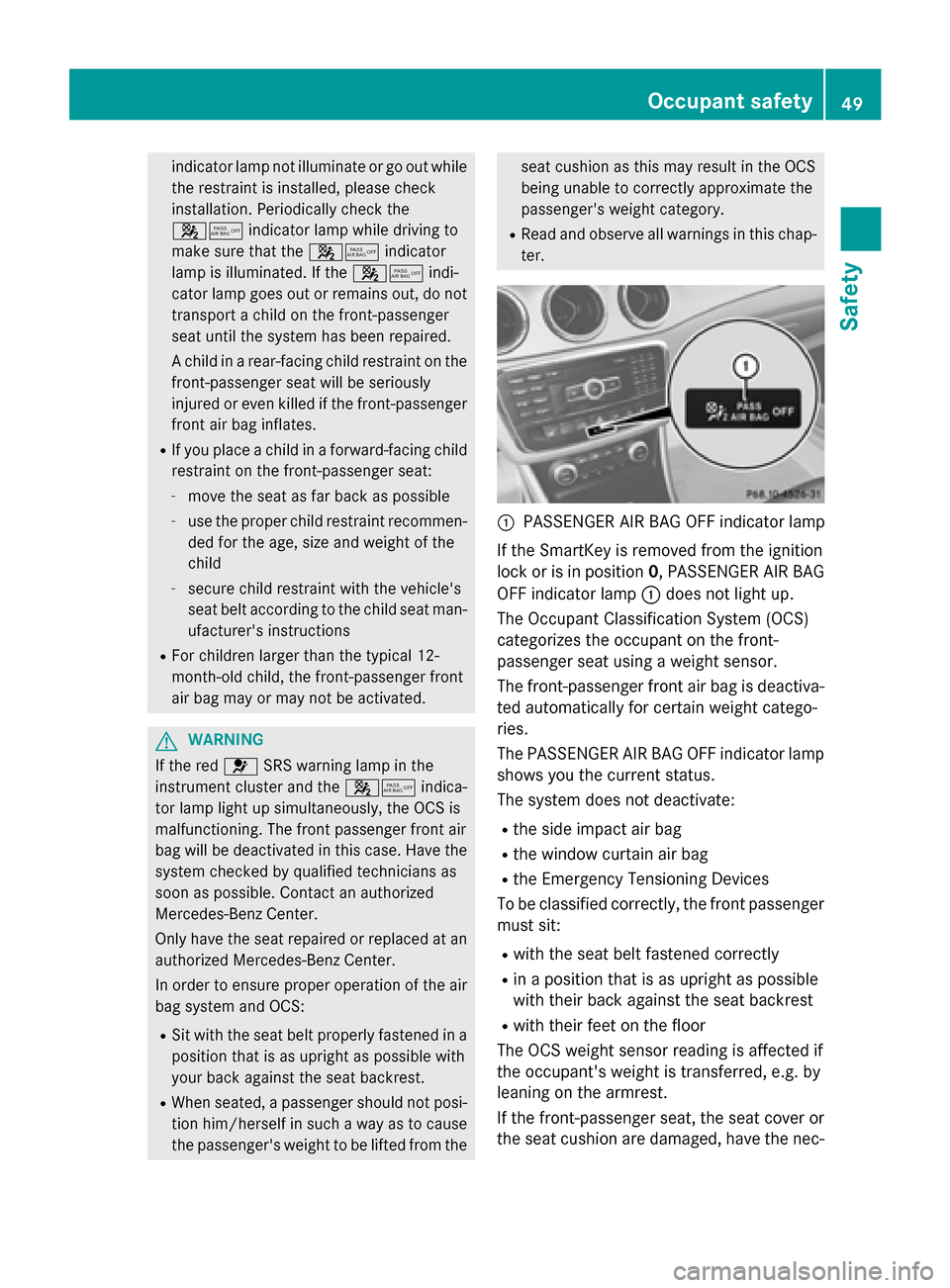
ter. 0043
PASSENGER AIR BAG OFF indicator lamp
If the SmartKey is removed from the ignition
lock or is in position 0, PASSENGER AIR BAG
OFF indicator lamp 0043does not light up.
The Occupant Classification System (OCS)
categorizes the occupant on the front-
passenger seat using a weight sensor.
The front-passenger front air bag is deactiva-
ted automatically for certain weight catego-
ries.
The PASSENGER AIR BAG OFF indicator lamp
shows you the current status.
The system does not deactivate:
R the side impact air bag
R the window curtain air bag
R the Emergency Tensioning Devices
To be classified correctly, the front passenger
must sit:
R with the seat belt fastened correctly
R in a position that is as upright as possible
with their back against the seat backrest
R with their feet on the floor
The OCS weight sensor reading is affected if
the occupant's weight is transferred, e.g. by
leaning on the armrest.
If the front-passenger seat, the seat cover or the seat cushion are damaged, have the nec- Occupant safety
49Safety Z
Page 52 of 358
essary repair work carried out at a qualified
specialist workshop.
For safety reasons, Mercedes-Benz recom-
mends that you only use seat accessories
that have been approved by Mercedes-Benz.
Both the driver and the front passenger
should always observe the PASSENGER AIR
BAG OFF indicator lamp as an indication of
whether or not the front passenger is posi-
tioned correctly. Observe also the air bag dis- play messages that can be displayed in the
instrument cluster (Y page 225).
If the driver's air bag deploys, this does not
mean that the front-passenger front air bag
will also deploy.
The OCS may have detected that the seat:
R is empty or occupied by the weight of a
typical child up to twelve months old,
seated in a child restraint system.
R is occupied by a small individual, such as a
young teenager or a small adult.
R is occupied by a child in a child restraint
system whose weight is greater than that of
a typical twelve month old child.
These are examples of when the OCS deacti- vates the front-passenger front air bag. Deac-
tivation takes place although the collision ful- fills the criteria for deploying the driver's air
bag.
For further information, see "Air bag display
messages" (Y page 225).
System self-test G
WARNING
If the 00730074indicator lamp does not illu-
minate, the system is not functioning. You
must contact an authorized Mercedes-Benz
Center before seating any child on the front
passenger seat. G
WARNING
Never place anything between seat cushion
and child seat (e.g. a pillow), since it reduces the effectiveness of the OCS. The underside
and rear side child restraint system must be placed entirely on the seat cushion and the
backrest of the front-passenger seat back-
rest.
If necessary, adjust the tilt of the passenger
seat backrest.
An incorrectly mounted child seat could cause injuries to the child in case of an accident,
instead of increasing protection for the child.
Follow the manufacturer's instructions for
installation of child restraint systems.
The PASSENGER AIR BAG OFF indicator lamp
lights up:
R if you turn the SmartKey in the ignition lock
to position 1or 2
R if an adult is seated properly on the front-
passenger seat and the OCS classifies the
occupant as an adult
The PASSENGER AIR BAG OFF indicator lamp
goes out again after approximately six sec-
onds.
If the seat is not occupied and the OCS
detects that the front-passenger seat is
empty, the PASSENGER AIR BAG OFF indica- tor lamp will continue to light up. The
PASSENGER AIR BAG OFF indicator lamp will
not go out.
For further information, see "Problems with
the Occupant Classification System"
(Y page 51). 50
Occupant safetySafety
Page 58 of 358
The front seat belts and the outer seat belts in
the rear are equipped with Emergency Ten-
sioning Devices and seat belt force limiters.
The ETDs tighten the seat belts in an accident, pulling them close against the body.
The ETDs do not correct incorrect seat posi-
tions or incorrectly fastened seat belts.
The ETDs do not pull vehicle occupants back
towards the backrest.
The ETDs can only be activated when:
R the ignition is switched on
R the restraint systems are operational; see
"0075 SRS warning lamp" (Y page 41)
R the belt tongue has engaged in the belt
buckle of the respective front seat
The ETDs on the outside seats in the rear
compartment are triggered independently of
the lock status of the seat belts.
The ETDs are triggered depending on the type
and severity of an accident:
R in the event of a head-on or rear-end colli-
sion if the vehicle decelerates or acceler-
ates rapidly in a longitudinal direction dur-
ing the initial stages of the impact.
R in the event of a side impact if the vehicle
decelerates or accelerates rapidly in a lat-
eral direction on the side opposite to the
impact.
R in certain situations where the vehicle rolls
over if the system determines that it can
provide additional protection.
If the ETDs are deployed, you will hear a bang,
and a small amount of powder may also be
released. Only in rare cases will the bang
affect your hearing. The powder that is
released generally does not constitute a
health hazard and does not indicate that there is a fire in the vehicle. The dust might cause
some temporary breathing difficulty for peo-
ple with asthma or other breathing trouble. To avoid this, you may wish to get out of the
vehicle as soon as it is safe to do so. You can
also open the window to allow fresh air to
enter the vehicle interior. The 0075SRS warn-
ing lamp lights up. If the seat belt is also equipped with a seat
belt force limiter and this is triggered, the
force exerted by the seat belt on the vehicle
occupant is reduced.
The seat belt force limiters for the front seats
are synchronized with the front air bags,
which absorb part of the deceleration force.
This results in the force exerted on the occu- pant being distributed over a greater area. Children in the vehicle
Child restraint systems
Important safety notes G
WARNING
According to accident statistics, children are
safer when properly restrained in the rear
seating positions than in the front seating
position. Thus, we strongly recommend that
children be placed in the rear seats whenever possible. Regardless of seating position, chil- dren 12 years old and under must be seated
and properly secured in an appropriate infant
restraint, toddler restraint, or booster seat
recommended for the size and weight of the
child.
The infant or child restraint must be properly
secured with the vehicle's seat belt, the seat
belt and top tether strap, or lower anchors and
top tether strap, fully in accordance with the
child seat manufacturer's instructions.
Occupants, especially children, should always
sit as upright as possible, wear the seat belt
properly and use an appropriately sized infant
restraint, toddler restraint, or booster seat
recommended for the size and weight of the
child.
Children can be killed or seriously injured by
an inflating air bag. Note the following impor-
tant information when circumstances require you to place a child in the front passenger
seat:
R Your vehicle is equipped with air bag tech-
nology designed to deactivate the front 56
Children in the vehicleSafety
Page 60 of 358
Replace child restraint systems which have
been damaged or subjected to a load in an
accident as soon as possible. Have the secur- ing systems on the child restraint system
checked at a qualified specialist workshop,
before you install a child restraint system
again. G
WARNING
Infants and small children should never share a seat belt with another occupant. In the event
of an accident, they could be crushed
between the occupant and seat belt.
A child's risk of serious or fatal injuries is sig- nificantly increased if the child restraints are
not properly secured in the vehicle and/or thechild is not properly secured in the child
restraint.
Children that are too large for a child restraint
must travel in seats using normal seat belts.
Position the shoulder belt across the chest
and shoulder, not the face or neck. A booster seat may be necessary to achieve proper seat
belt positioning for children over 41 lbs
(18 kg) until they reach a height where a lap/
shoulder belt fits properly without a booster
seat.
When the child restraint is not in use, remove it from the vehicle or secure it with the seat
belt to prevent the child restraint from becom-
ing a projectile in the event of an accident. G
WARNING
If children are left unsupervised in the vehicle, they could:
R open the doors, thus endangering other
people or road users.
R get out and disrupt traffic.
R operate the vehicle's equipment.
Additionally, children could set the vehicle in
motion if, for example, they:
R release the parking brake.
R shifting the automatic transmission out of
park position P
R Start the engine. There is a risk of an accident and injury.
When leaving the vehicle, always take the
SmartKey with you and lock the vehicle. Never
leave children or animals unattended in the
vehicle. Always keep the SmartKey out of
reach of children. G
WARNING
If persons, particularly children are subjected to prolonged exposure to extreme heat or
cold, there is a risk of injury, possibly even
fatal. Never leave children unattended in the
vehicle. G
WARNING
If the child restraint system is subjected to
direct sunlight, parts may get very hot. Chil-
dren may burn themselves on these parts,
particularly on the metal parts of the child
restraint system. There is a risk of injury.
If you leave the vehicle, taking the child with
you, always ensure that the child restraint
system is not exposed to direct sunlight. Pro- tect it with a blanket, for example. If the childrestraint system has been exposed to direct
sunlight, let it cool down before securing the
child in it. Never leave children unattended in the vehicle.
If an infant or child is traveling in the vehicle:
R Secure the child with a child or infant seat
restraint system appropriate to the age and
weight of the child.
R Make sure that the infant or child is prop-
erly secured at all times while the vehicle is
in motion.
Mercedes-Benz recommends that you always
properly secure all infants and children with a
child or infant seat restraint system for the
trip.
The use of seat belts and infant and child
restraint systems is required by law in:
R all 50 states
R the U.S. territories 58
Children in the vehicleSafety
Page 63 of 358
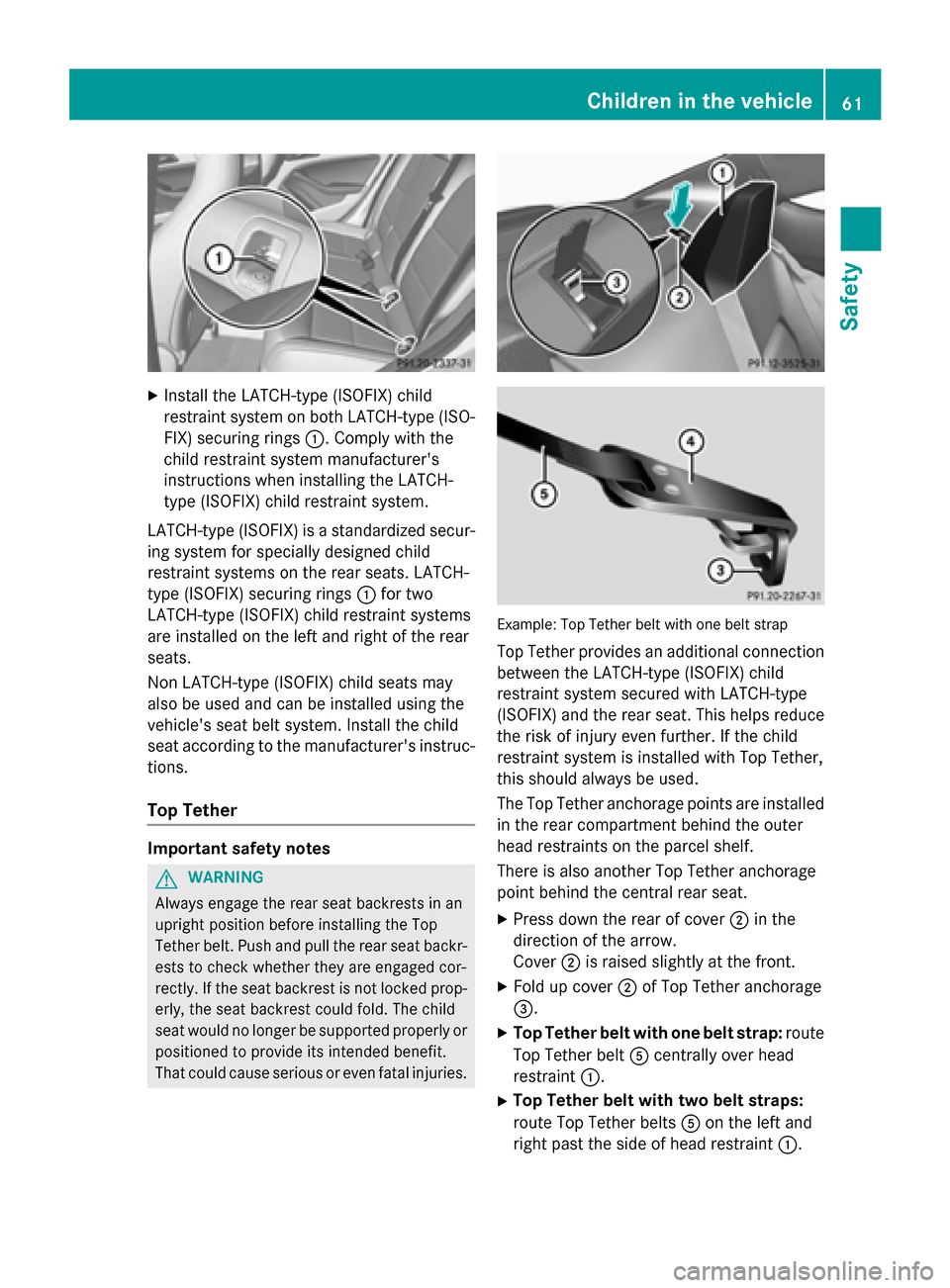
X
Install the LATCH-type (ISOFIX) child
restraint system on both LATCH-type (ISO-
FIX) securing rings 0043. Comply with the
child restraint system manufacturer's
instructions when installing the LATCH-
type (ISOFIX) child restraint system.
LATCH-type (ISOFIX) is a standardized secur- ing system for specially designed child
restraint systems on the rear seats. LATCH-
type (ISOFIX) securing rings 0043for two
LATCH-type (ISOFIX) child restraint systems
are installed on the left and right of the rear
seats.
Non LATCH-type (ISOFIX) child seats may
also be used and can be installed using the
vehicle's seat belt system. Install the child
seat according to the manufacturer's instruc-
tions.
Top Tether Important safety notes
G
WARNING
Always engage the rear seat backrests in an
upright position before installing the Top
Tether belt. Push and pull the rear seat backr- ests to check whether they are engaged cor-
rectly. If the seat backrest is not locked prop-
erly, the seat backrest could fold. The child
seat would no longer be supported properly or
positioned to provide its intended benefit.
That could cause serious or even fatal injuries. Example: Top Tether belt with one belt strap
Top Tether provides an additional connection
between the LATCH-type (ISOFIX) child
restraint system secured with LATCH-type
(ISOFIX) and the rear seat. This helps reduce the risk of injury even further. If the child
restraint system is installed with Top Tether,
this should always be used.
The Top Tether anchorage points are installed
in the rear compartment behind the outer
head restraints on the parcel shelf.
There is also another Top Tether anchorage
point behind the central rear seat.
X Press down the rear of cover 0044in the
direction of the arrow.
Cover 0044is raised slightly at the front.
X Fold up cover 0044of Top Tether anchorage
0087.
X Top Tether belt with one belt strap: route
Top Tether belt 0083centrally over head
restraint 0043.
X Top Tether belt with two belt straps:
route Top Tether belts 0083on the left and
right past the side of head restraint 0043. Children in the vehicle
61Safety Z
Page 64 of 358
X
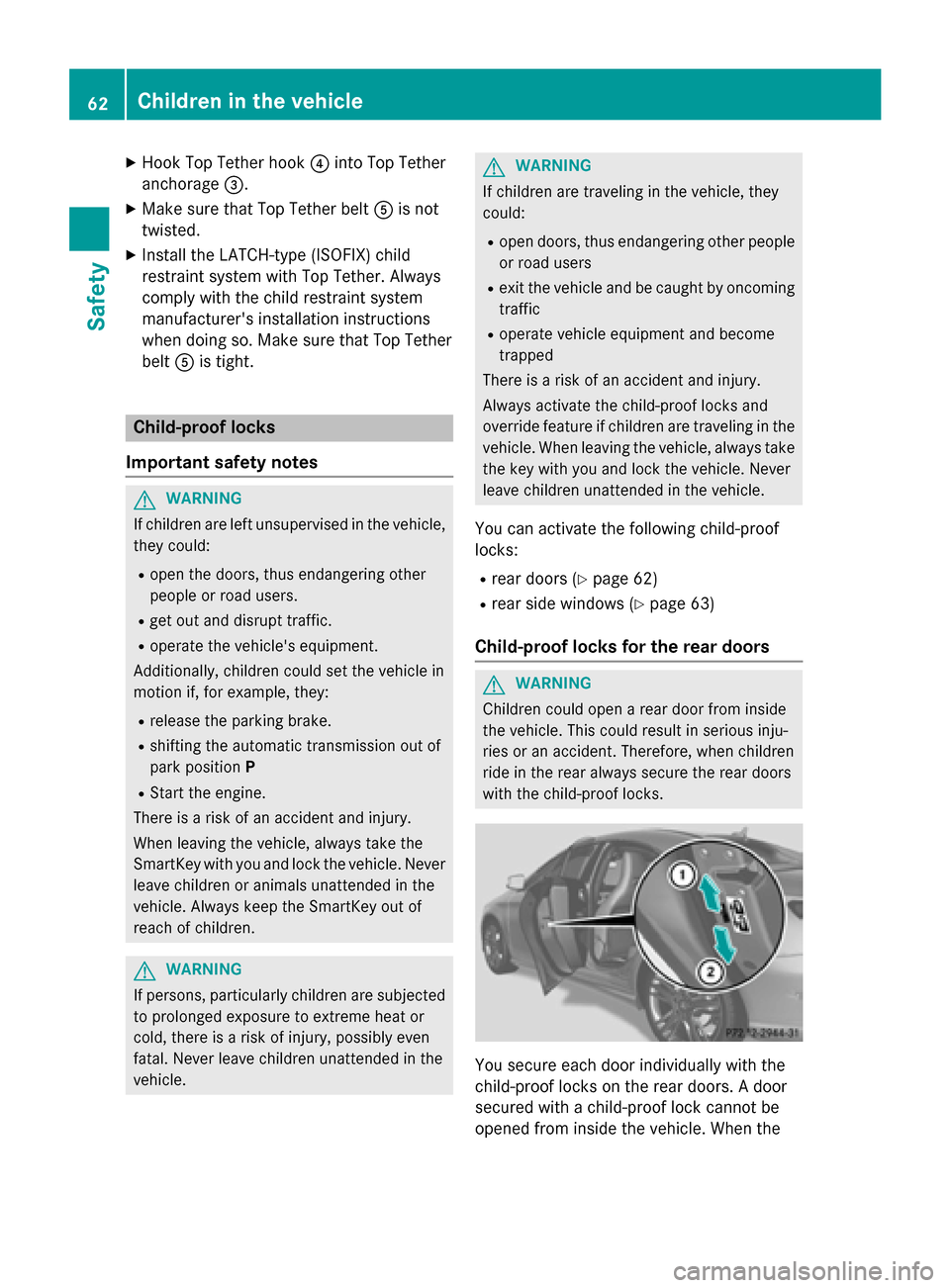
Hook Top Tether hook 0085into Top Tether
anchorage 0087.
X Make sure that Top Tether belt 0083is not
twisted.
X Install the LATCH-type (ISOFIX) child
restraint system with Top Tether. Always
comply with the child restraint system
manufacturer's installation instructions
when doing so. Make sure that Top Tether
belt 0083is tight. Child-proof locks
Important safety notes G
WARNING
If children are left unsupervised in the vehicle, they could:
R open the doors, thus endangering other
people or road users.
R get out and disrupt traffic.
R operate the vehicle's equipment.
Additionally, children could set the vehicle in
motion if, for example, they:
R release the parking brake.
R shifting the automatic transmission out of
park position P
R Start the engine.
There is a risk of an accident and injury.
When leaving the vehicle, always take the
SmartKey with you and lock the vehicle. Never
leave children or animals unattended in the
vehicle. Always keep the SmartKey out of
reach of children. G
WARNING
If persons, particularly children are subjected to prolonged exposure to extreme heat or
cold, there is a risk of injury, possibly even
fatal. Never leave children unattended in the
vehicle. G
WARNING
If children are traveling in the vehicle, they
could:
R open doors, thus endangering other people
or road users
R exit the vehicle and be caught by oncoming
traffic
R operate vehicle equipment and become
trapped
There is a risk of an accident and injury.
Always activate the child-proof locks and
override feature if children are traveling in the vehicle. When leaving the vehicle, always take
the key with you and lock the vehicle. Never
leave children unattended in the vehicle.
You can activate the following child-proof
locks: R rear doors (Y page 62)
R rear side windows (Y page 63)
Child-proof locks for the rear doors G
WARNING
Children could open a rear door from inside
the vehicle. This could result in serious inju-
ries or an accident. Therefore, when children
ride in the rear always secure the rear doors
with the child-proof locks. You secure each door individually with the
child-proof locks on the rear doors. A door
secured with a child-proof lock cannot be
opened from inside the vehicle. When the 62
Children in the vehicleSafety
Page 65 of 358
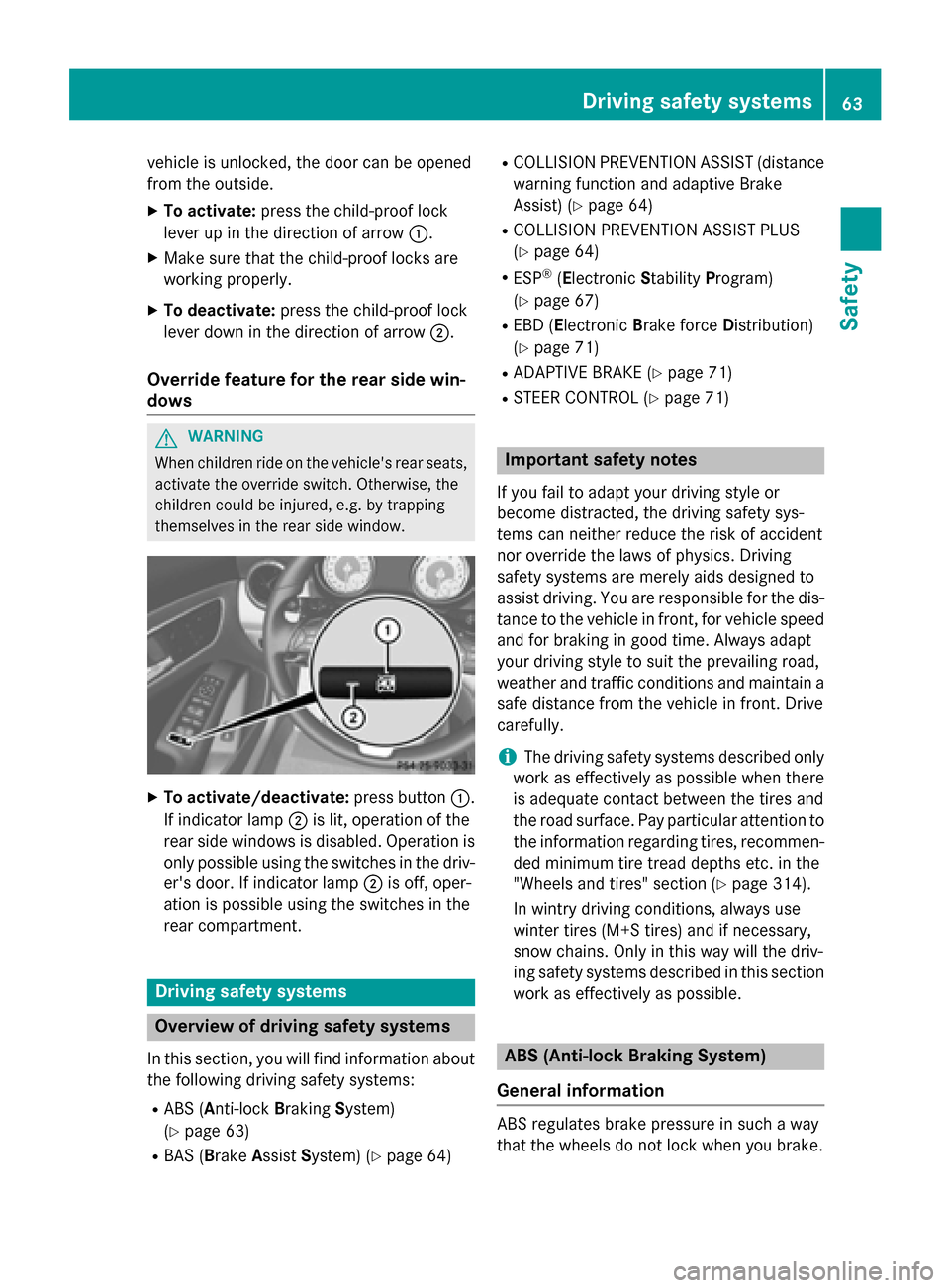
vehicle is unlocked, the door can be opened
from the outside.
X To activate: press the child-proof lock
lever up in the direction of arrow 0043.
X Make sure that the child-proof locks are
working properly.
X To deactivate: press the child-proof lock
lever down in the direction of arrow 0044.
Override feature for the rear side win-
dows G
WARNING
When children ride on the vehicle's rear seats, activate the override switch. Otherwise, the
children could be injured, e.g. by trapping
themselves in the rear side window. X
To activate/deactivate: press button0043.
If indicator lamp 0044is lit, operation of the
rear side windows is disabled. Operation is
only possible using the switches in the driv- er's door. If indicator lamp 0044is off, oper-
ation is possible using the switches in the
rear compartment. Driving safety systems
Overview of driving safety systems
In this section, you will find information about the following driving safety systems:
R ABS ( Anti-lock BrakingSystem)
(Y page 63)
R BAS ( Brake Assist System) (Y page 64) R
COLLISION PREVENTION ASSIST (distance
warning function and adaptive Brake
Assist) (Y page 64)
R COLLISION PREVENTION ASSIST PLUS
(Y page 64)
R ESP ®
(Electronic StabilityProgram)
(Y page 67)
R EBD ( Electronic Brake force Distribution)
(Y page 71)
R ADAPTIVE BRAKE (Y page 71)
R STEER CONTROL (Y page 71) Important safety notes
If you fail to adapt your driving style or
become distracted, the driving safety sys-
tems can neither reduce the risk of accident
nor override the laws of physics. Driving
safety systems are merely aids designed to
assist driving. You are responsible for the dis- tance to the vehicle in front, for vehicle speedand for braking in good time. Always adapt
your driving style to suit the prevailing road,
weather and traffic conditions and maintain a
safe distance from the vehicle in front. Drive
carefully.
i The driving safety systems described only
work as effectively as possible when there
is adequate contact between the tires and
the road surface. Pay particular attention to the information regarding tires, recommen-
ded minimum tire tread depths etc. in the
"Wheels and tires" section (Y page 314).
In wintry driving conditions, always use
winter tires (M+S tires) and if necessary,
snow chains. Only in this way will the driv-
ing safety systems described in this section
work as effectively as possible. ABS (Anti-lock Braking System)
General information ABS regulates brake pressure in such a way
that the wheels do not lock when you brake. Driving safety systems
63Safety Z