child restraint MERCEDES-BENZ CLA COUPE 2013 User Guide
[x] Cancel search | Manufacturer: MERCEDES-BENZ, Model Year: 2013, Model line: CLA COUPE, Model: MERCEDES-BENZ CLA COUPE 2013Pages: 373, PDF Size: 11.47 MB
Page 58 of 373
When installing a child restraint system, be
sure to observe the manufacturer's installa-
tion instructions and the instructions for cor- rect use of the child restraint system. G
WARNING
The child restraint system cannot perform its protective function if it is not correctly fitted
to a suitable vehicle seat. The child cannot berestrained in the event of an accident, heavy
braking or sudden changes of direction. The
child could be seriously or even fatally injured.
For this reason, when securing a child
restraint system, always observe the manu-
facturer's installation instructions and the
correct use of the child restraint system.
For safety reasons, on the rear seats use only child restraint systems with an ISOFIX child
seat securing system which have been tested
and approved for Mercedes-Benz vehicles.
An incorrectly fitted child restraint system
could come loose and seriously or even fatally injure the child or other vehicle occupants.
When fitting the child restraint system, always
make sure that it is engaged correctly in the
ISOFIX securing rings on both sides.
! When fitting the ISOFIX child restraint
system, make sure that the seat belt for the
centre seat does not get trapped. Other-
wise, the seat belt could be damaged. X
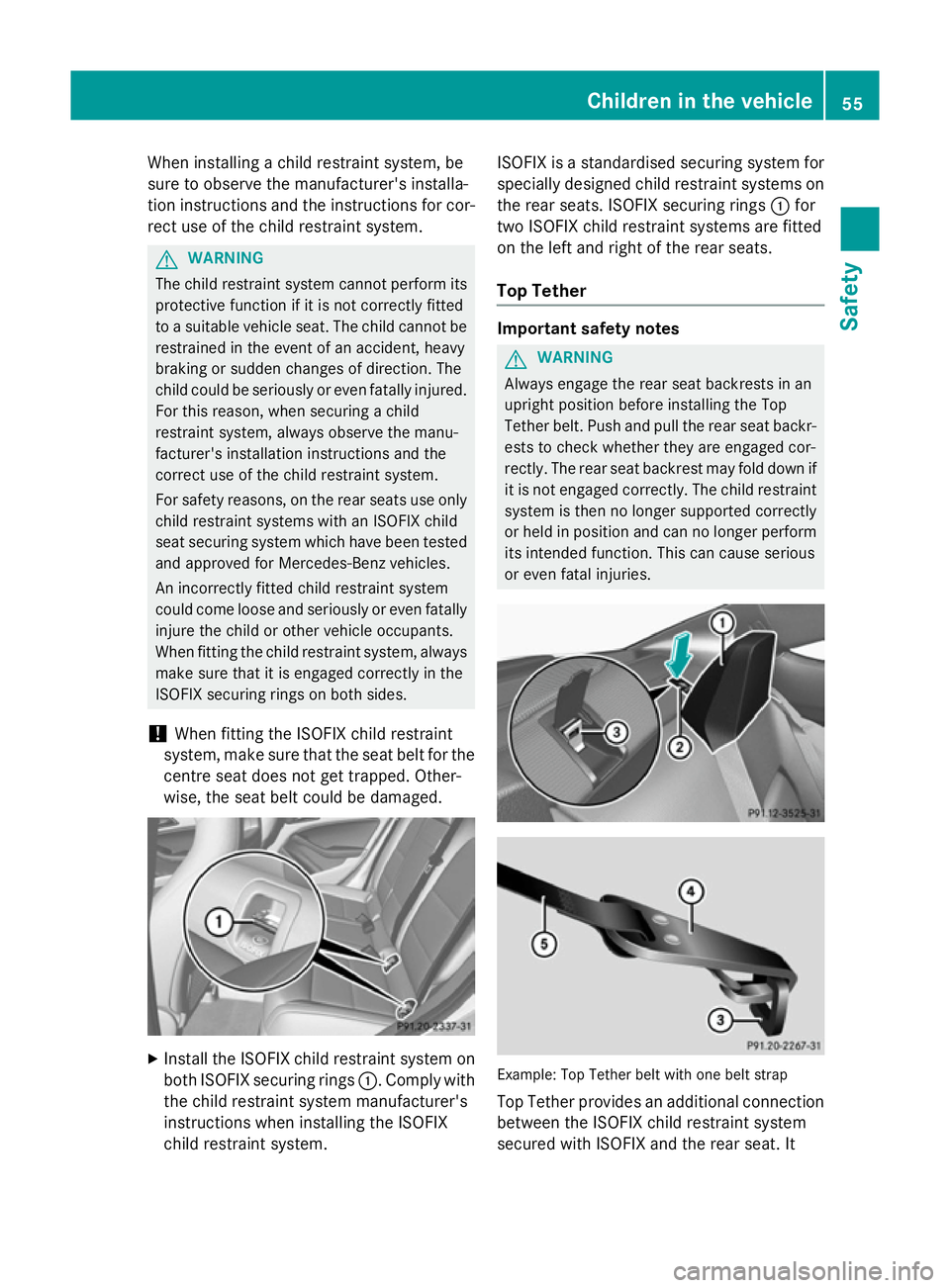
Install the ISOFIX child restraint system on
both ISOFIX securing rings :. Comply with
the child restraint system manufacturer's
instructions when installing the ISOFIX
child restraint system. ISOFIX is a standardised securing system for
specially designed child restraint systems on
the rear seats. ISOFIX securing rings :for
two ISOFIX child restraint systems are fitted
on the left and right of the rear seats.
Top Tether Important safety notes
G
WARNING
Always engage the rear seat backrests in an
upright position before installing the Top
Tether belt. Push and pull the rear seat backr- ests to check whether they are engaged cor-
rectly. The rear seat backrest may fold down if
it is not engaged correctly. The child restraint
system is then no longer supported correctly
or held in position and can no longer perform
its intended function. This can cause serious
or even fatal injuries. Example: Top Tether belt with one belt strap
Top Tether provides an additional connection
between the ISOFIX child restraint system
secured with ISOFIX and the rear seat. It Children in the vehicle
55Safety Z
Page 59 of 373
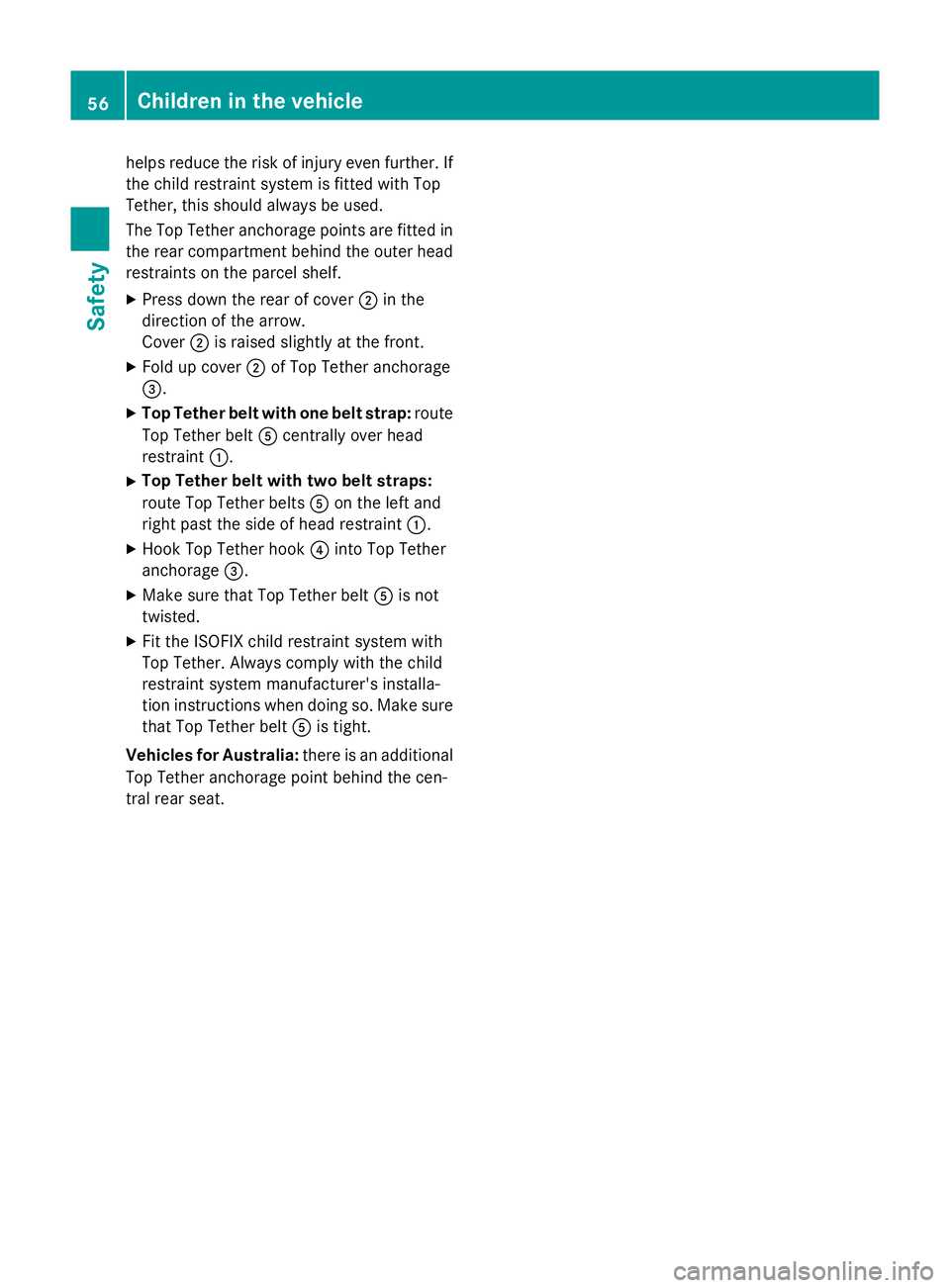
helps reduce the risk of injury even further. If
the child restraint system is fitted with Top
Tether, this should always be used.
The Top Tether anchorage points are fitted in the rear compartment behind the outer head
restraints on the parcel shelf.
X Press down the rear of cover ;in the
direction of the arrow.
Cover ;is raised slightly at the front.
X Fold up cover ;of Top Tether anchorage
=.
X Top Tether belt with one belt strap: route
Top Tether belt Acentrally over head
restraint :.
X Top Tether belt with two belt straps:
route Top Tether belts Aon the left and
right past the side of head restraint :.
X Hook Top Tether hook ?into Top Tether
anchorage =.
X Make sure that Top Tether belt Ais not
twisted.
X Fit the ISOFIX child restraint system with
Top Tether. Always comply with the child
restraint system manufacturer's installa-
tion instructions when doing so. Make sure
that Top Tether belt Ais tight.
Vehicles for Australia: there is an additional
Top Tether anchorage point behind the cen-
tral rear seat. 56
Children in the vehicleSafety
Page 60 of 373
Suitable positioning of the child restraint systems
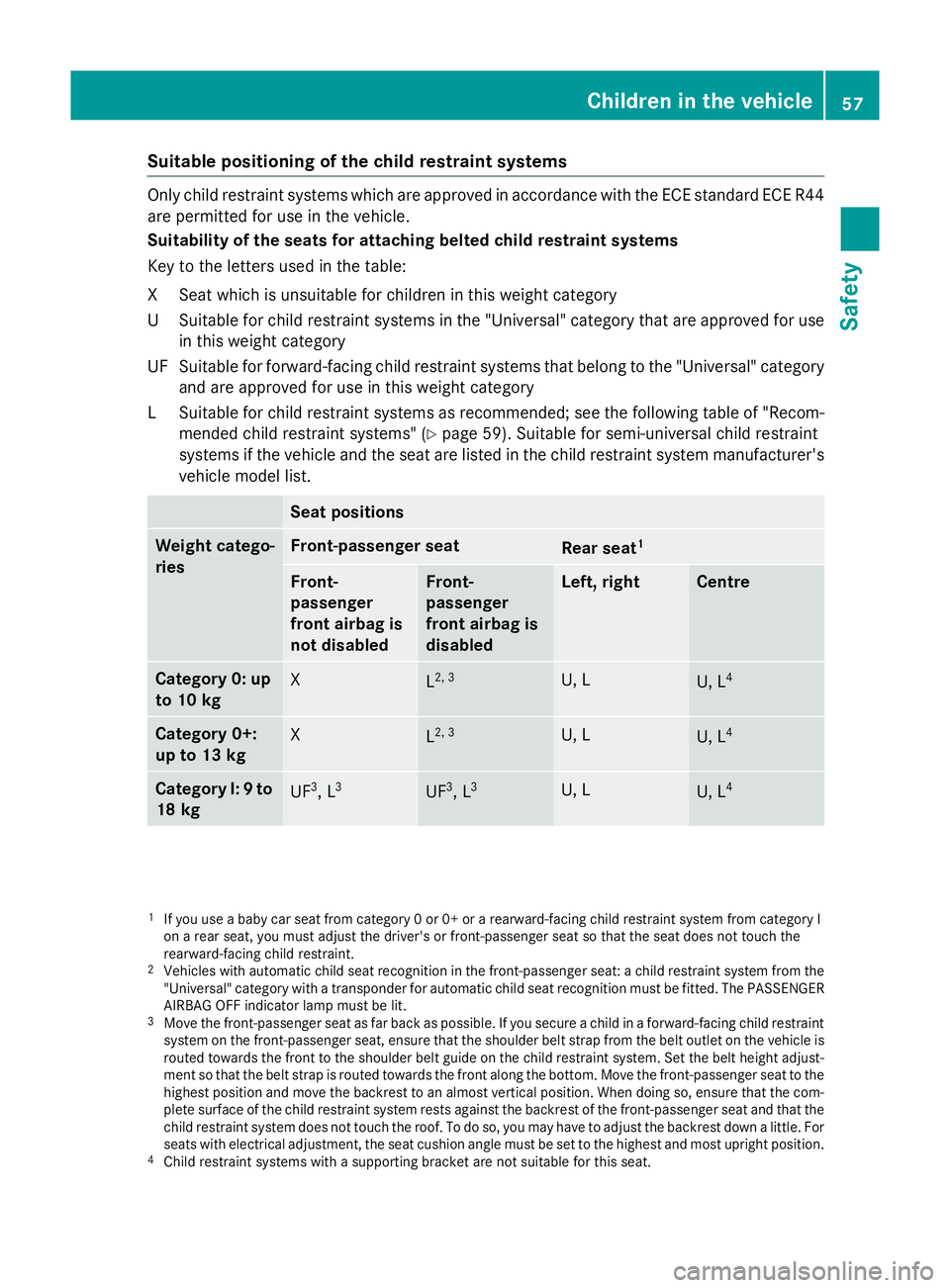
Only child restraint systems which are approved in accordance with the ECE standard ECE R44
are permitted for use in the vehicle.
Suitability of the seats for attaching belted child restraint systems
Key to the letters used in the table:
XS eat which is unsuitable for children in this weight category
US uitable for child restraint systems in the "Universal" category that are approved for use
in this weight category
UF Suitable for forward-facing child restraint systems that belong to the "Universal" category and are approved for use in this weight category
LS uitable for child restraint systems as recommended; see the following table of "Recom-
mended child restraint systems" (Y page 59). Suitable for semi-universal child restraint
systems if the vehicle and the seat are listed in the child restraint system manufacturer's
vehicle model list. Seat positions
Weight catego-
ries Front-passenger seat
Rear seat
1 Front-
passenger
front airbag is
not disabled Front-
passenger
front airbag is
disabled Left, right Centre
Category 0: up
to 10 kg X
L
2, 3 U, L
U, L
4 Category 0+:
up to 13 kg
X
L
2, 3 U, L
U, L
4 Category I:
9to
18 kg UF
3
, L 3 UF
3
, L 3 U, L
U, L
4 1
If you use a baby car seat from category 0 or 0+ or a rearward-facing child restraint system from category I
on a rear seat, you must adjust the driver's or front-passenger seat so that the seat does not touch the
rearward-facing child restraint.
2 Vehicles with automatic child seat recognition in the front-passenger seat: a child restraint system from the
"Universal" category with a transponder for automatic child seat recognition must be fitted. The PASSENGER AIRBAG OFF indicator lamp must be lit.
3 Move the front-passenger seat as far back as possible. If you secure a child in a forward-facing child restraint
system on the front-passenger seat, ensure that the shoulder belt strap from the belt outlet on the vehicle is
routed towards the front to the shoulder belt guide on the child restraint system. Set the belt height adjust-
ment so that the belt strap is routed towards the front along the bottom. Move the front-passenger seat to the highest position and move the backrest to an almost vertical position. When doing so, ensure that the com-plete surface of the child restraint system rests against the backrest of the front-passenger seat and that the
child restraint system does not touch the roof. To do so, you may have to adjust the backrest down a little. For seats with electrical adjustment, the seat cushion angle must be set to the highest and most upright position.
4 Child restraint systems with a supporting bracket are not suitable for this seat. Children in the vehicle
57Safety Z
Page 61 of 373
Seat positions
Weight catego-
ries Front-passenger seat
Rear seat
1 Front-
passenger
front airbag is
not disabled Front-
passenger
front airbag is
disabled Left, right Centre
Category II: 15
to 25 kg UF
3
, L 3 U
3
, L 3 U, L X
Category III:
22 to 36 kg
UF
3, 5
, L3, 5 UF
3, 5
, L3, 5 U, L
5 X
Example: approval label on the child restraint system
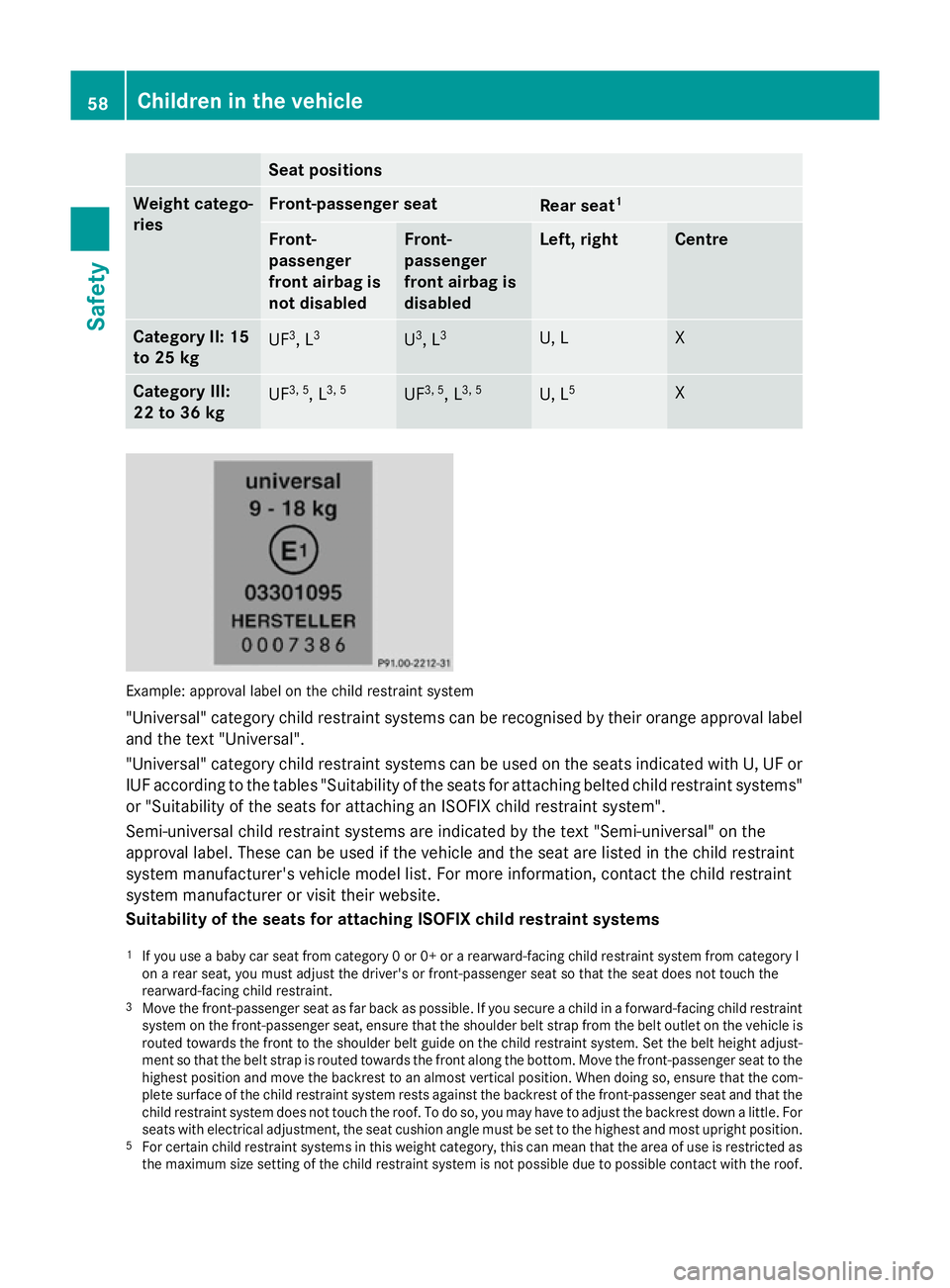
"Universal" category child restraint systems can be recognised by their orange approval label and the text "Universal".
"Universal" category child restraint systems can be used on the seats indicated with U, UF or
IUF according to the tables "Suitability of the seats for attaching belted child restraint systems"
or "Suitability of the seats for attaching an ISOFIX child restraint system".
Semi-universal child restraint systems are indicated by the text "Semi-universal" on the
approval label. These can be used if the vehicle and the seat are listed in the child restraint
system manufacturer's vehicle model list. For more information, contact the child restraint
system manufacturer or visit their website.
Suitability of the seats for attaching ISOFIX child restraint systems
1 If you use a baby car seat from category 0 or 0+ or a rearward-facing child restraint system from category I
on a rear seat, you must adjust the driver's or front-passenger seat so that the seat does not touch the
rearward-facing child restraint.
3 Move the front-passenger seat as far back as possible. If you secure a child in a forward-facing child restraint
system on the front-passenger seat, ensure that the shoulder belt strap from the belt outlet on the vehicle is routed towards the front to the shoulder belt guide on the child restraint system. Set the belt height adjust-
ment so that the belt strap is routed towards the front along the bottom. Move the front-passenger seat to the
highest position and move the backrest to an almost vertical position. When doing so, ensure that the com- plete surface of the child restraint system rests against the backrest of the front-passenger seat and that thechild restraint system does not touch the roof. To do so, you may have to adjust the backrest down a little. For seats with electrical adjustment, the seat cushion angle must be set to the highest and most upright position.
5 For certain child restraint systems in this weight category, this can mean that the area of use is restricted as
the maximum size setting of the child restraint system is not possible due to possible contact with the roof. 58
Children in the vehicleSafety
Page 62 of 373
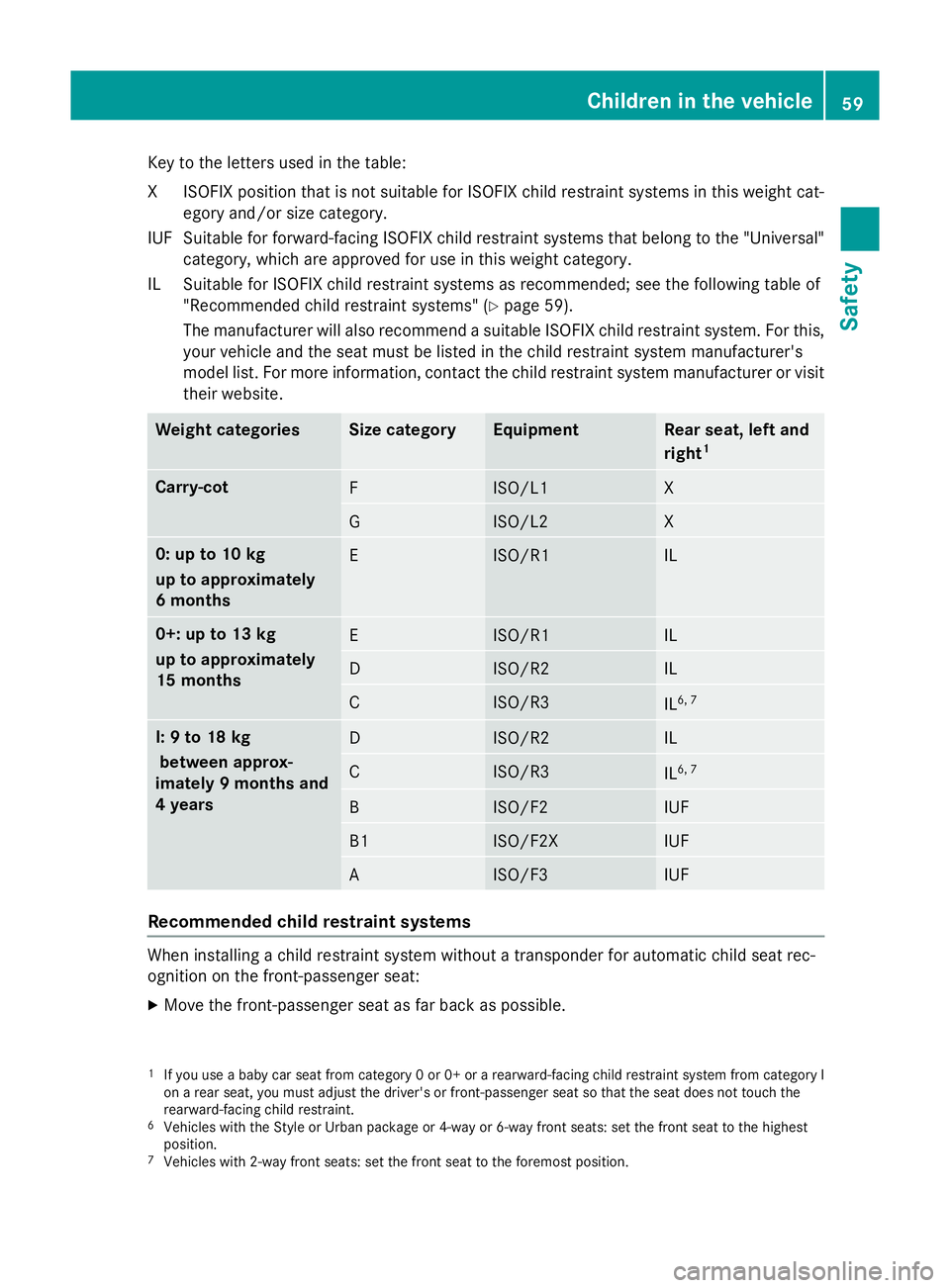
Key to the letters used in the table:
XI SOFIX position that is not suitable for ISOFIX child restraint systems in this weight cat-
egory and/or size category.
IUF Suitable for forward-facing ISOFIX child restraint systems that belong to the "Universal" category, which are approved for use in this weight category.
IL Suitable for ISOFIX child restraint systems as recommended; see the following table of "Recommended child restraint systems" (Y page 59).
The manufacturer will also recommend a suitable ISOFIX child restraint system. For this,
your vehicle and the seat must be listed in the child restraint system manufacturer's
model list. For more information, contact the child restraint system manufacturer or visit
their website. Weight categories Size category Equipment Rear seat, left and
right
1 Carry-cot
F ISO/L1 X
G ISO/L2 X
0: up to 10 kg
up to approximately
6 months
E ISO/R1 IL
0+: up to 13 kg
up to approximately
15 months
E ISO/R1 IL
D ISO/R2 IL
C ISO/R3
IL
6, 7 I: 9 to 18 kg
between approx-
imately 9 months and
4 years D ISO/R2 IL
C ISO/R3
IL
6, 7 B ISO/F2 IUF
B1 ISO/F2X IUF
A ISO/F3 IUF
Recommended child restraint systems
When installing a child restraint system without a transponder for automatic child seat rec-
ognition on the front-passenger seat:
X Move the front-passenger seat as far back as possible.
1 If you use a baby car seat from category 0 or 0+ or a rearward-facing child restraint system from category I
on a rear seat, you must adjust the driver's or front-passenger seat so that the seat does not touch the
rearward-facing child restraint.
6 Vehicles with the Style or Urban package or 4-way or 6-way front seats: set the front seat to the highest
position.
7 Vehicles with 2-way front seats: set the front seat to the foremost position. Children in the vehicle
59Safety Z
Page 63 of 373
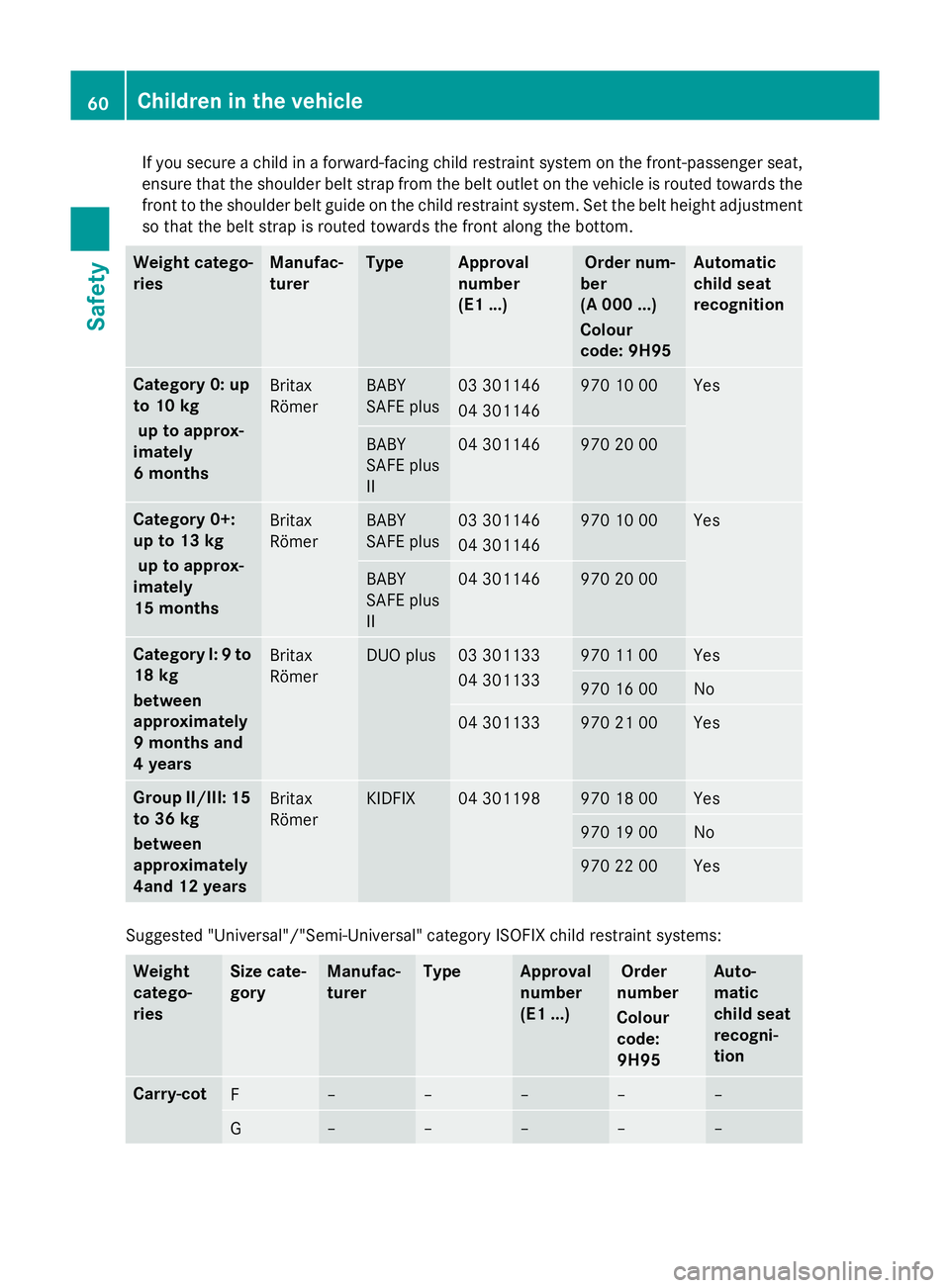
If you secure a child in a forward-facing child restraint system on the front-passenger seat,
ensure that the shoulder belt strap from the belt outlet on the vehicle is routed towards the front to the shoulder belt guide on the child restraint system. Set the belt height adjustment
so that the belt strap is routed towards the front along the bottom. Weight catego-
ries Manufac-
turer Type Approval
number
(E1 ...) Order num-
ber
(A 000 ...)
Colour
code: 9H95 Automatic
child seat
recognition
Category 0: up
to 10 kg
up to approx-
imately
6 months Britax
Römer BABY
SAFE plus 03 301146
04 301146 970 10 00 Yes
BABY
SAFE plus
II 04 301146 970 20 00
Category 0+:
up to 13 kg
up to approx-
imately
15 months Britax
Römer BABY
SAFE plus 03 301146
04 301146 970 10 00 Yes
BABY
SAFE plus
II 04 301146 970 20 00
Category I:
9to
18 kg
between
approximately
9 months and
4 years Britax
Römer DUO plus 03 301133
04 301133 970 11 00 Yes
970 16 00 No
04 301133 970 21 00 Yes
Group II/III: 15
to 36 kg
between
approximately
4and 12 years Britax
Römer KIDFIX 04 301198 970 18 00 Yes
970 19 00 No
970 22 00 Yes
Suggested "Universal"/"Semi-Universal" category ISOFIX child restraint systems:
Weight
catego-
ries Size cate-
gory Manufac-
turer Type Approval
number
(E1 ...) Order
number
Colour
code:
9H95 Auto-
matic
child seat
recogni-
tion Carry-cot
F – – – – –
G – – – – –60
Children in the vehicleSafety
Page 65 of 373
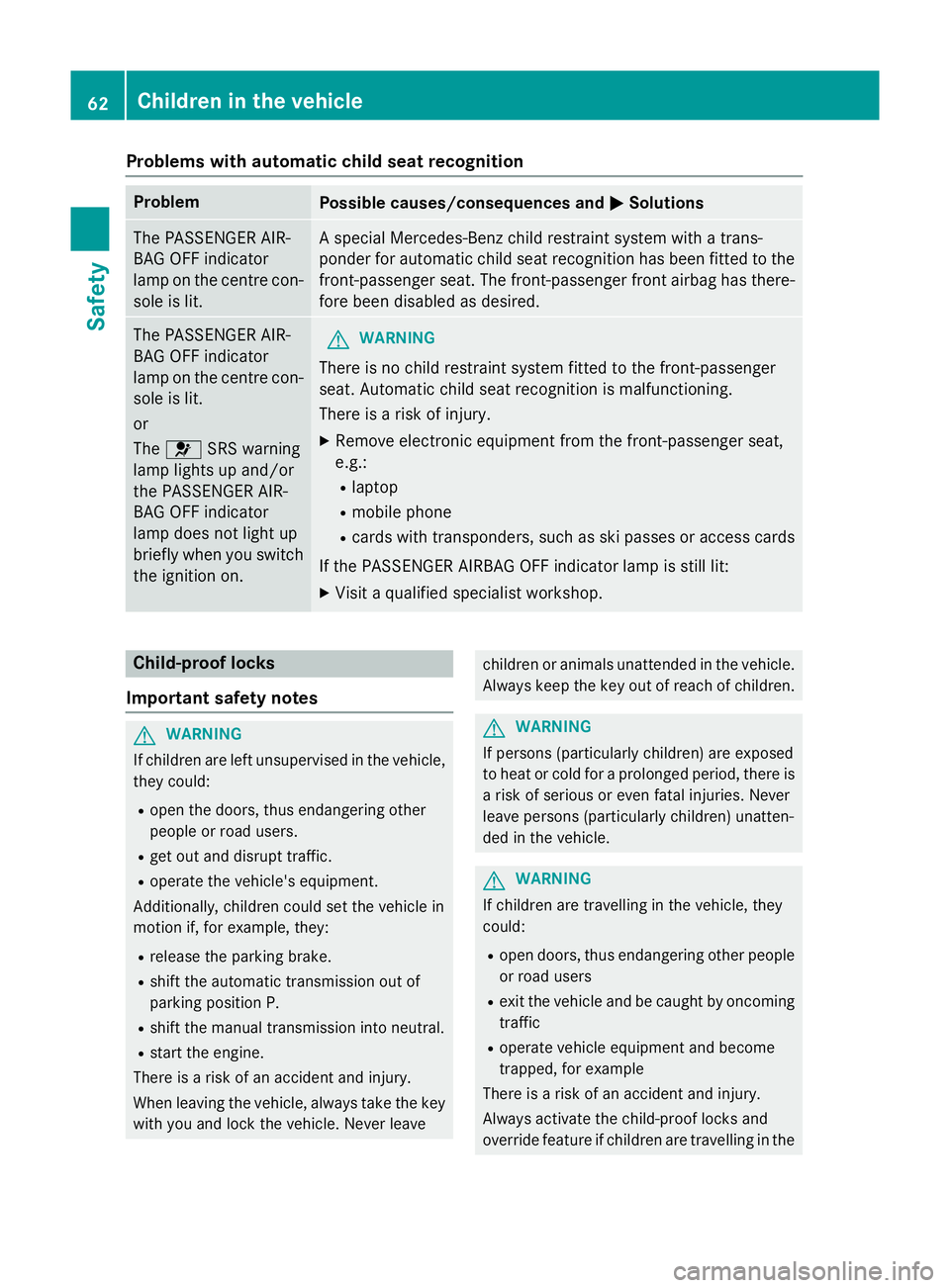
Problems with automatic child seat recognition
Problem
Possible causes/consequences and
M
MSolutions The PASSENGER AIR-
BAG OFF indicator
lamp on the centre con-
sole is lit. A special Mercedes-Benz child restraint system with a trans-
ponder for automatic child seat recognition has been fitted to the
front-passenger seat. The front-passenger front airbag has there- fore been disabled as desired. The PASSENGER AIR-
BAG OFF indicator
lamp on the centre con-
sole is lit.
or
The 6 SRS warning
lamp lights up and/or
the PASSENGER AIR-
BAG OFF indicator
lamp does not light up
briefly when you switch the ignition on. G
WARNING
There is no child restraint system fitted to the front-passenger
seat. Automatic child seat recognition is malfunctioning.
There is a risk of injury. X Remove electronic equipment from the front-passenger seat,
e.g.:
R laptop
R mobile phone
R cards with transponders, such as ski passes or access cards
If the PASSENGER AIRBAG OFF indicator lamp is still lit:
X Visit a qualified specialist workshop. Child-proof locks
Important safety notes G
WARNING
If children are left unsupervised in the vehicle, they could:
R open the doors, thus endangering other
people or road users.
R get out and disrupt traffic.
R operate the vehicle's equipment.
Additionally, children could set the vehicle in
motion if, for example, they:
R release the parking brake.
R shift the automatic transmission out of
parking position P.
R shift the manual transmission into neutral.
R start the engine.
There is a risk of an accident and injury.
When leaving the vehicle, always take the key with you and lock the vehicle. Never leave children or animals unattended in the vehicle.
Always keep the key out of reach of children. G
WARNING
If persons (particularly children) are exposed
to heat or cold for a prolonged period, there is a risk of serious or even fatal injuries. Never
leave persons (particularly children) unatten-
ded in the vehicle. G
WARNING
If children are travelling in the vehicle, they
could:
R open doors, thus endangering other people
or road users
R exit the vehicle and be caught by oncoming
traffic
R operate vehicle equipment and become
trapped, for example
There is a risk of an accident and injury.
Always activate the child-proof locks and
override feature if children are travelling in the 62
Children in the vehicleSafety
Page 102 of 373
The seat belt should:
R fit snugly across your body.
R be routed across the middle of your
shoulder.
R be routed across your hips in the pelvic
area.
X Before starting off, adjust the rear-view mir-
ror and the exterior mirrors (Y page 105)
so that you have a good view of road and
traffic conditions.
X Vehicles with a memory function: save
the seat and exterior mirror settings
(Y page 107). Seats
Important safety notes
G
WARNING
If children adjust the seats, they could
become trapped, especially if they are unat-
tended. There is a risk of injury.
When leaving the vehicle, always take the key with you and lock the vehicle. Never leave
children unattended in the vehicle. G
WARNING
You could lose control of the vehicle while
driving if you:
R adjust the driver's seat, steering wheel or
mirrors
R fasten the seat belt
There is a risk of an accident.
Adjust the driver's seat, head restraint, steer-
ing wheel and mirrors and fasten your seat
belt before starting the engine. G
WARNING
If you adjust the seat height carelessly, you or other vehicle occupants could be trapped andthereby injured. Children in particular could
accidentally press the electrical seat adjust-
ment buttons and become trapped. There is a
risk of injury. While moving the seats, make sure that your
hands or other body parts do not get under the
lever assembly of the seat adjustment sys-
tem. G
WARNING
When adjusting a seat, you or another vehicle occupant could become trapped by the guiderail of the seat, for instance. There is a risk of
injury.
Make sure that no one has any part of their
body within the sweep of the seat when
adjusting it. G
WARNING
The seat belt does not offer the intended level of protection if you have not moved the back-
rest to an almost vertical position. When brak-
ing or in the event of an accident, you could
slide underneath the seat belt and sustain
abdomen or neck injuries, for example. This
poses an increased risk of injury or even fatal injury.
Adjust the seat properly before beginning
your journey. Always ensure that the backrest
is in an almost vertical position and that the
shoulder section of your seatbelt is routed
across the centre of your shoulder. G
WARNING
The head restraints cannot provide the inten-
ded protection unless they are fitted and
adjusted correctly. There is an increased risk of injury to the head and neck in the event of
an accident or sudden braking, for example.
Always drive with the head restraints fitted.
Ensure that the centre of the head restraints
support the back of each vehicle occupant's
head at eye level before driving off. Seats
99Seats, steering wheel and mirrors Z
Page 103 of 373
!
To avoid damage to the seats and the seat
heating, observe the following information:
R do not spill any liquids on the seats. If
liquid is spilled on the seats, dry them as soon as possible.
R if the seat covers are damp or wet, do not
switch on the seat heating. The seat
heating should also not be used to dry
the seats.
R clean the seat covers as recommended;
see the "Interior care" section.
R do not transport heavy loads on the
seats. Do not place sharp objects on the seat cushions, e.g. knives, nails or tools.
The seats should only be occupied by
passengers, if possible.
R when the seat heating is in operation, do
not cover the seats with insulating mate- rials, e.g. blankets, coats, bags, seat cov-
ers, child seats or booster seats.
! Make sure that there are no objects in the
footwell under or behind the seats when
moving the seats back. There is a risk that
the seats and/or the objects could be dam-
aged.
i Further related subjects:
R Luggage compartment enlargement
(folding down the rear seats)
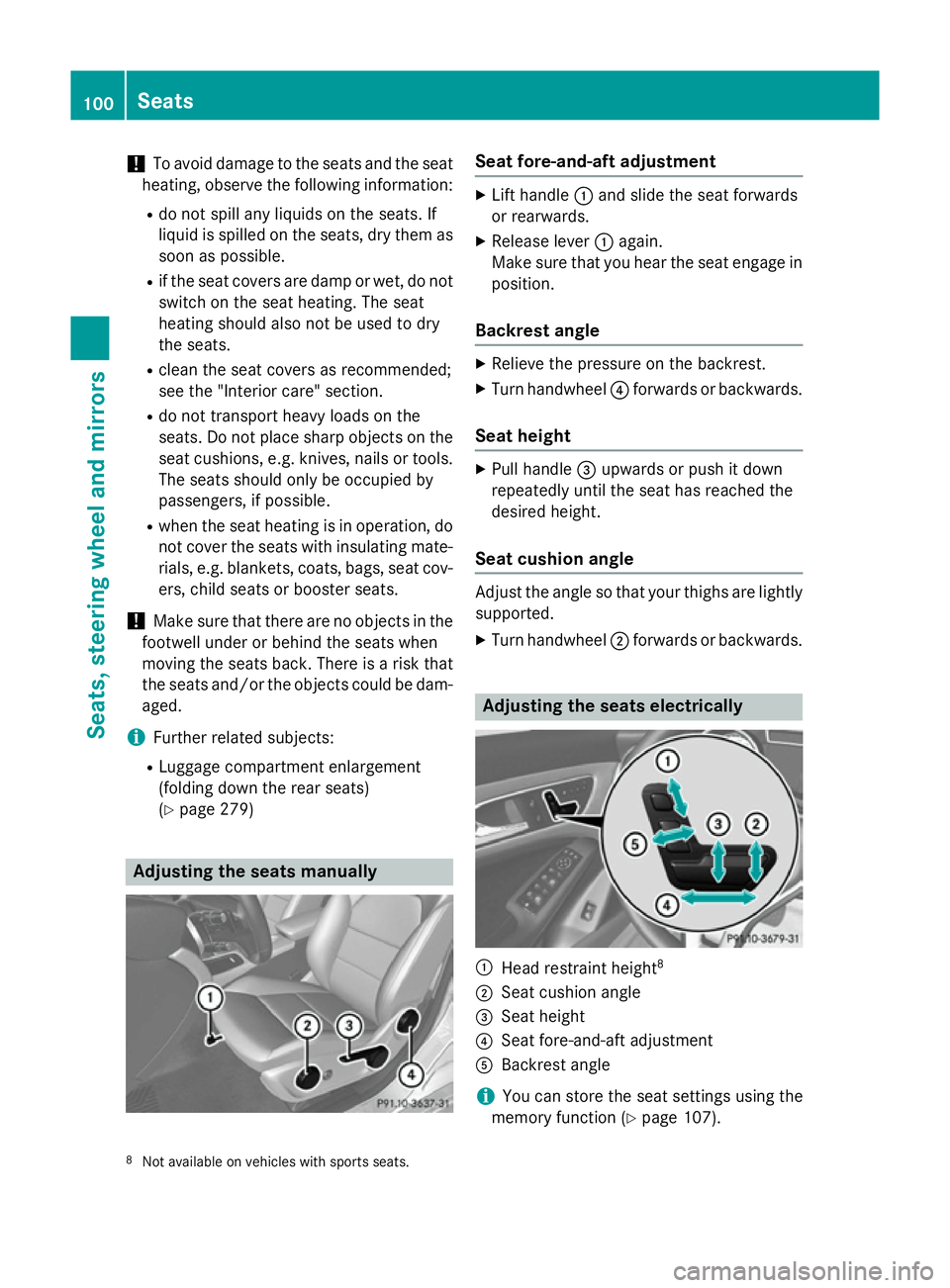
(Y page 279) Adjusting the seats manually Seat fore-and-aft adjustment
X
Lift handle :and slide the seat forwards
or rearwards.
X Release lever :again.
Make sure that you hear the seat engage in
position.
Backrest angle X
Relieve the pressure on the backrest.
X Turn handwheel ?forwards or backwards.
Seat height X
Pull handle =upwards or push it down
repeatedly until the seat has reached the
desired height.
Seat cushion angle Adjust the angle so that your thighs are lightly
supported.
X Turn handwheel ;forwards or backwards. Adjusting the seats electrically
:
Head restraint height 8
; Seat cushion angle
= Seat height
? Seat fore-and-aft adjustment
A Backrest angle
i You can store the seat settings using the
memory function (Y page 107).
8 Not available on vehicles with sports seats. 100
SeatsSeats, steering wheel and mirrors
Page 107 of 373
Problems with the seat heating
Problem
Possible causes/consequences and
M
MSolutions The seat heating has
switched off prema-
turely or cannot be
switched on. The on-board voltage is too low because too many electrical con-
sumers are switched on.
X Switch off electrical consumers that you do not need, such as
the rear window heating or interior lighting.
Once the battery is sufficiently charged, the seat heating will
switch back on automatically. Steering wheel
Important safety notes
G
WARNING
You could lose control of the vehicle while
driving if you:
R adjust the driver's seat, steering wheel or
mirrors
R fasten the seat belt
There is a risk of an accident.
Adjust the driver's seat, head restraint, steer-
ing wheel and mirrors and fasten your seat
belt before starting the engine. G
WARNING
Children could become trapped by the steer-
ing wheel if they adjust it. There is a risk of
injury.
When leaving the vehicle, always take the key with you and lock the vehicle. Never leave
children unattended in the vehicle. Adjusting the steering wheel
G
WARNING
The steering wheel may move unexpectedly if you adjust it while driving. This could cause
you to lose control of the vehicle. There is a
risk of an accident.
Make sure that the steering wheel is locked
before driving off. Never unlock the steering
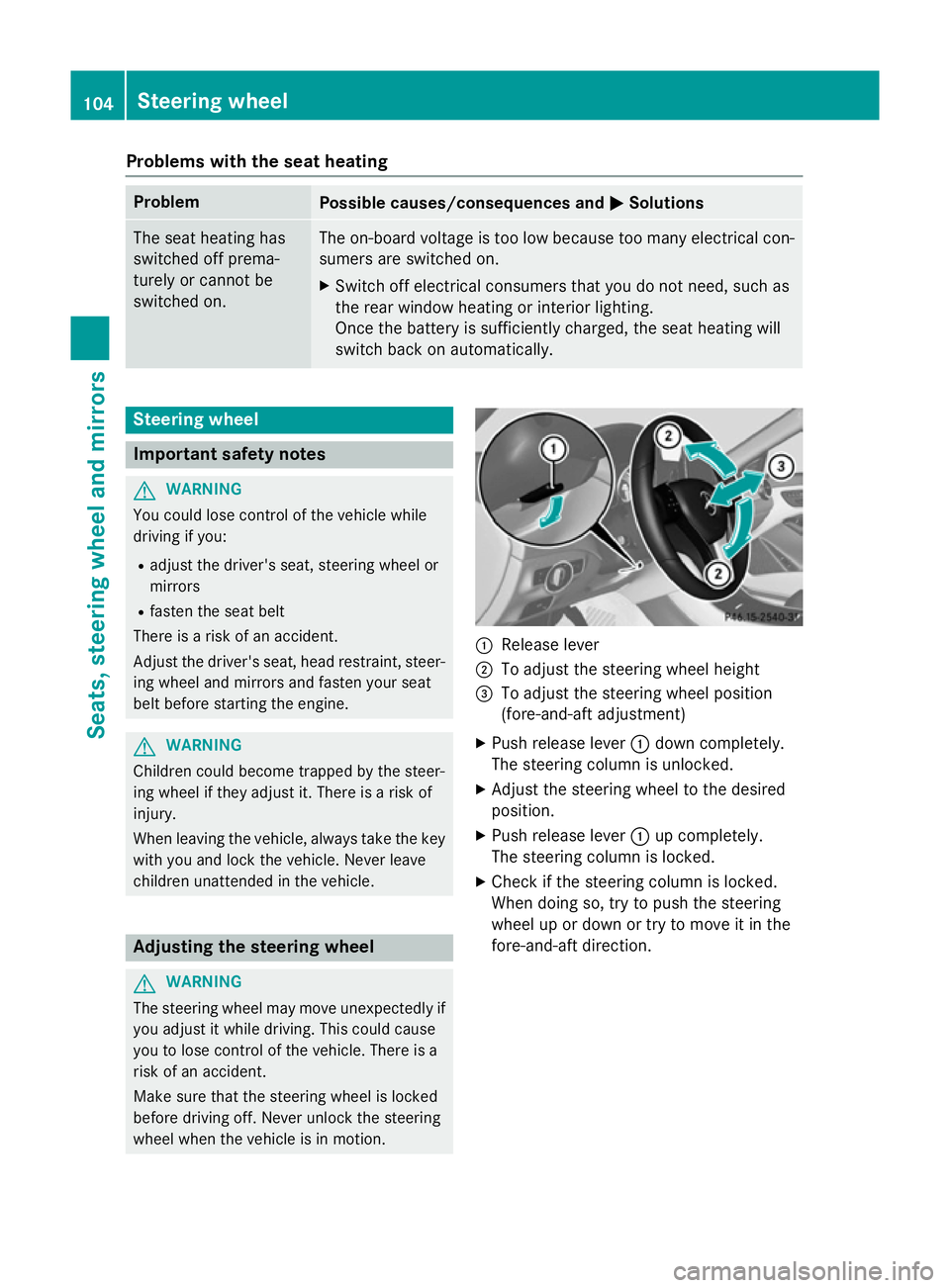
wheel when the vehicle is in motion. :
Release lever
; To adjust the steering wheel height
= To adjust the steering wheel position
(fore-and-aft adjustment)
X Push release lever :down completely.
The steering column is unlocked.
X Adjust the steering wheel to the desired
position.
X Push release lever :up completely.
The steering column is locked.
X Check if the steering column is locked.
When doing so, try to push the steering
wheel up or down or try to move it in the
fore-and-aft direction. 104
Steering wheelSeats, steering wheel and mirrors