key MERCEDES-BENZ CLA COUPE 2013 User Guide
[x] Cancel search | Manufacturer: MERCEDES-BENZ, Model Year: 2013, Model line: CLA COUPE, Model: MERCEDES-BENZ CLA COUPE 2013Pages: 373, PDF Size: 11.47 MB
Page 55 of 373
G
WARNING
If children are left unsupervised in the vehicle, they could:
R open the doors, thus endangering other
people or road users.
R get out and disrupt traffic.
R operate the vehicle's equipment.
Additionally, children could set the vehicle in
motion if, for example, they:
R release the parking brake.
R shift the automatic transmission out of
parking position P.
R shift the manual transmission into neutral.
R start the engine.
There is a risk of an accident and injury.
When leaving the vehicle, always take the key with you and lock the vehicle. Never leave
children or animals unattended in the vehicle.Always keep the key out of reach of children. G
WARNING
If persons (particularly children) are exposed
to heat or cold for a prolonged period, there is a risk of serious or even fatal injuries. Never
leave persons (particularly children) unatten-
ded in the vehicle. G
WARNING
If the child restraint system is placed in direct sunlight, the parts could become very hot.
Children could be suffer burns by touching
these parts, in particular on the metallic parts
of the child restraint system. There is a risk of injury.
If you and your child leave the vehicle, always
make sure that the child restraint system is
not in direct sunlight. Cover it with a blanket, for example. If the child restraint system has
been exposed to direct sunlight, leave it to
cool down before securing the child in it.
Never leave children unattended in the vehi-
cle.
If a child is travelling in your vehicle, secure
the child using a child restraint system which is appropriate to the size, age and weight of
the child. In order to correctly secure the child
in the child restraint system, always comply
with the child restraint system manufactur-
er's installation instructions. You should pref- erably fit the restraint system to a suitable
rear seat. Make sure that the child is securedfor the trip.
Mercedes-Benz recommends that you use
the listed child restraint systems
(Y page 59). You can obtain further infor-
mation about the correct child restraint sys-
tem from any Mercedes-Benz Service Centre.
i It is advisable to use Mercedes-Benz care
products to clean child restraint systems.
You can obtain information about this at
any Mercedes-Benz Service Centre.
Child restraint system on the front-
passenger seat G
WARNING
If the front-passenger front airbag is not dis-
abled:
R a child secured in a child restraint system
on the front-passenger seat could be seri-
ously or even fatally injured by the front-
passenger airbag deploying. This is espe-
cially a risk if the child is in the immediate
vicinity of the front-passenger front airbag
when it deploys.
R never secure a child on the front-passenger
seat in a rearward-facing child restraint sys- tem. Only secure a rearward-facing child
restraint system on a suitable rear seat.
R and you secure a forward-facing child
restraint system to the front-passenger
seat, you must move the front-passenger
seat as far back as possible. When doing so,
ensure that the shoulder belt strap from the
belt outlet on the vehicle is routed towards
the front to the shoulder belt guide on the
child restraint system. Set the belt height
adjustment so that the belt strap is routed
towards the front along the bottom. 52
Children in the vehicleSafety
Page 57 of 373
G
WARNING
Electronic devices on the front-passenger
seat can affect the function of the automatic
child seat recognition, for example:
R laptop
R mobile phone
R transponder cards such as ski passes or
access passes
The front-passenger front airbag could deploy unintentionally or not function as intended
during an accident. This poses an increased
risk of injury or even fatal injury.
Do not place any of the devices mentioned
above or similar devices on the front-
passenger seat. If the front-passenger seat of your vehicle is
not equipped with automatic child seat rec-
ognition, this is indicated by a special sticker. The sticker is affixed to the side of the dash-
board on the front-passenger side. The
sticker is visible when you open the front-
passenger door.
Vehicles without automatic child seat recog-
nition on the front-passenger seat: if you turn
the key to position 2in the ignition lock, the
PASSENGER AIRBAG OFF indicator lamp
lights up briefly. However, the indicator lamp
has no function. It does not indicate that there is automatic child seat recognition on the
front-passenger seat. :
PASSENGER AIRBAG OFF indicator lamp
The sensor system for child restraint systems
in the front-passenger seat detects whether a special Mercedes-Benz child seat with a
transponder for automatic child seat recog-
nition has been fitted. In this case,
PASSENGER AIRBAG OFF indicator lamp :
lights up. The front-passenger front airbag is
disabled.
i If the front-passenger front airbag is dis-
abled by the automatic child seat recogni-
tion, the following remain enabled on the
front-passenger side:
R the sidebag
R the windowbag
R the belt tensioner
ISOFIX child seat securing system for
the rear seats G
WARNING
ISOFIX child restraint systems do not offer
sufficient protective effect for children whose weight is greater than 22 kg who are securedusing the safety belt integrated in the child
restraint system. The child could, for example,not be restrained correctly in the event of an
accident. This poses an increased risk of
injury or even fatal injury.
If the child weighs more than 22 kg, only use
ISOFIX child restraint systems with which the child is also secured with the vehicle seat belt. Also secure the child restraint system with the
Top Tether belt, if available. 54
Children in the vehicleSafety
Page 60 of 373
Suitable positioning of the child restraint systems
Only child restraint systems which are approved in accordance with the ECE standard ECE R44
are permitted for use in the vehicle.
Suitability of the seats for attaching belted child restraint systems
Key to the letters used in the table:
XS eat which is unsuitable for children in this weight category
US uitable for child restraint systems in the "Universal" category that are approved for use
in this weight category
UF Suitable for forward-facing child restraint systems that belong to the "Universal" category and are approved for use in this weight category
LS uitable for child restraint systems as recommended; see the following table of "Recom-
mended child restraint systems" (Y page 59). Suitable for semi-universal child restraint
systems if the vehicle and the seat are listed in the child restraint system manufacturer's
vehicle model list. Seat positions
Weight catego-
ries Front-passenger seat
Rear seat
1 Front-
passenger
front airbag is
not disabled Front-
passenger
front airbag is
disabled Left, right Centre
Category 0: up
to 10 kg X
L
2, 3 U, L
U, L
4 Category 0+:
up to 13 kg
X
L
2, 3 U, L
U, L
4 Category I:
9to
18 kg UF
3
, L 3 UF
3
, L 3 U, L
U, L
4 1
If you use a baby car seat from category 0 or 0+ or a rearward-facing child restraint system from category I
on a rear seat, you must adjust the driver's or front-passenger seat so that the seat does not touch the
rearward-facing child restraint.
2 Vehicles with automatic child seat recognition in the front-passenger seat: a child restraint system from the
"Universal" category with a transponder for automatic child seat recognition must be fitted. The PASSENGER AIRBAG OFF indicator lamp must be lit.
3 Move the front-passenger seat as far back as possible. If you secure a child in a forward-facing child restraint
system on the front-passenger seat, ensure that the shoulder belt strap from the belt outlet on the vehicle is
routed towards the front to the shoulder belt guide on the child restraint system. Set the belt height adjust-
ment so that the belt strap is routed towards the front along the bottom. Move the front-passenger seat to the highest position and move the backrest to an almost vertical position. When doing so, ensure that the com-plete surface of the child restraint system rests against the backrest of the front-passenger seat and that the
child restraint system does not touch the roof. To do so, you may have to adjust the backrest down a little. For seats with electrical adjustment, the seat cushion angle must be set to the highest and most upright position.
4 Child restraint systems with a supporting bracket are not suitable for this seat. Children in the vehicle
57Safety Z
Page 62 of 373
Key to the letters used in the table:
XI SOFIX position that is not suitable for ISOFIX child restraint systems in this weight cat-
egory and/or size category.
IUF Suitable for forward-facing ISOFIX child restraint systems that belong to the "Universal" category, which are approved for use in this weight category.
IL Suitable for ISOFIX child restraint systems as recommended; see the following table of "Recommended child restraint systems" (Y page 59).
The manufacturer will also recommend a suitable ISOFIX child restraint system. For this,
your vehicle and the seat must be listed in the child restraint system manufacturer's
model list. For more information, contact the child restraint system manufacturer or visit
their website. Weight categories Size category Equipment Rear seat, left and
right
1 Carry-cot
F ISO/L1 X
G ISO/L2 X
0: up to 10 kg
up to approximately
6 months
E ISO/R1 IL
0+: up to 13 kg
up to approximately
15 months
E ISO/R1 IL
D ISO/R2 IL
C ISO/R3
IL
6, 7 I: 9 to 18 kg
between approx-
imately 9 months and
4 years D ISO/R2 IL
C ISO/R3
IL
6, 7 B ISO/F2 IUF
B1 ISO/F2X IUF
A ISO/F3 IUF
Recommended child restraint systems
When installing a child restraint system without a transponder for automatic child seat rec-
ognition on the front-passenger seat:
X Move the front-passenger seat as far back as possible.
1 If you use a baby car seat from category 0 or 0+ or a rearward-facing child restraint system from category I
on a rear seat, you must adjust the driver's or front-passenger seat so that the seat does not touch the
rearward-facing child restraint.
6 Vehicles with the Style or Urban package or 4-way or 6-way front seats: set the front seat to the highest
position.
7 Vehicles with 2-way front seats: set the front seat to the foremost position. Children in the vehicle
59Safety Z
Page 65 of 373
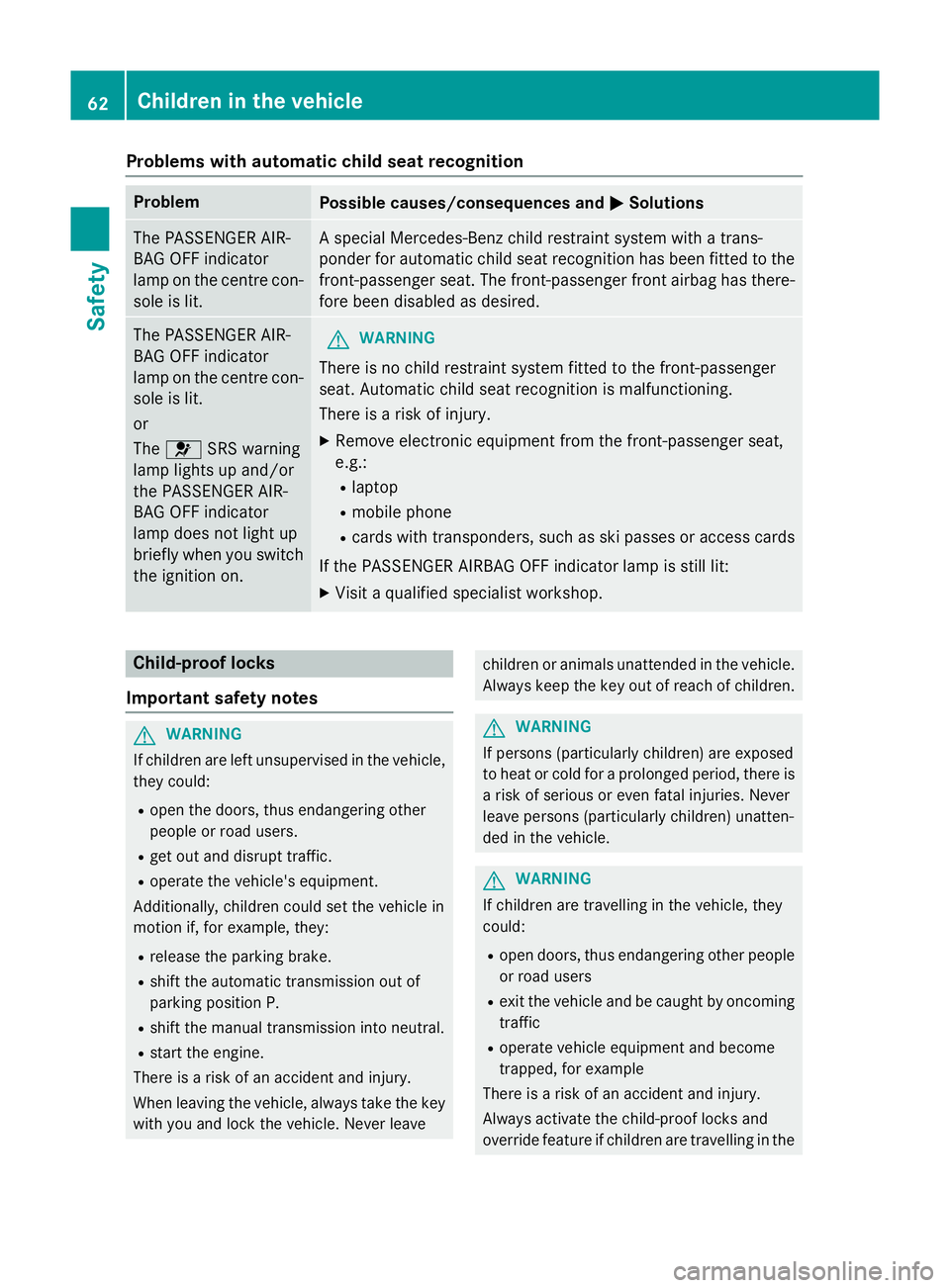
Problems with automatic child seat recognition
Problem
Possible causes/consequences and
M
MSolutions The PASSENGER AIR-
BAG OFF indicator
lamp on the centre con-
sole is lit. A special Mercedes-Benz child restraint system with a trans-
ponder for automatic child seat recognition has been fitted to the
front-passenger seat. The front-passenger front airbag has there- fore been disabled as desired. The PASSENGER AIR-
BAG OFF indicator
lamp on the centre con-
sole is lit.
or
The 6 SRS warning
lamp lights up and/or
the PASSENGER AIR-
BAG OFF indicator
lamp does not light up
briefly when you switch the ignition on. G
WARNING
There is no child restraint system fitted to the front-passenger
seat. Automatic child seat recognition is malfunctioning.
There is a risk of injury. X Remove electronic equipment from the front-passenger seat,
e.g.:
R laptop
R mobile phone
R cards with transponders, such as ski passes or access cards
If the PASSENGER AIRBAG OFF indicator lamp is still lit:
X Visit a qualified specialist workshop. Child-proof locks
Important safety notes G
WARNING
If children are left unsupervised in the vehicle, they could:
R open the doors, thus endangering other
people or road users.
R get out and disrupt traffic.
R operate the vehicle's equipment.
Additionally, children could set the vehicle in
motion if, for example, they:
R release the parking brake.
R shift the automatic transmission out of
parking position P.
R shift the manual transmission into neutral.
R start the engine.
There is a risk of an accident and injury.
When leaving the vehicle, always take the key with you and lock the vehicle. Never leave children or animals unattended in the vehicle.
Always keep the key out of reach of children. G
WARNING
If persons (particularly children) are exposed
to heat or cold for a prolonged period, there is a risk of serious or even fatal injuries. Never
leave persons (particularly children) unatten-
ded in the vehicle. G
WARNING
If children are travelling in the vehicle, they
could:
R open doors, thus endangering other people
or road users
R exit the vehicle and be caught by oncoming
traffic
R operate vehicle equipment and become
trapped, for example
There is a risk of an accident and injury.
Always activate the child-proof locks and
override feature if children are travelling in the 62
Children in the vehicleSafety
Page 66 of 373
vehicle. When leaving the vehicle, always take
the key with you and lock the vehicle. Never
leave children unattended in the vehicle.
You can activate the following child-proof
locks:
R rear doors (Y page 63)
R rear side windows (Y page 63)
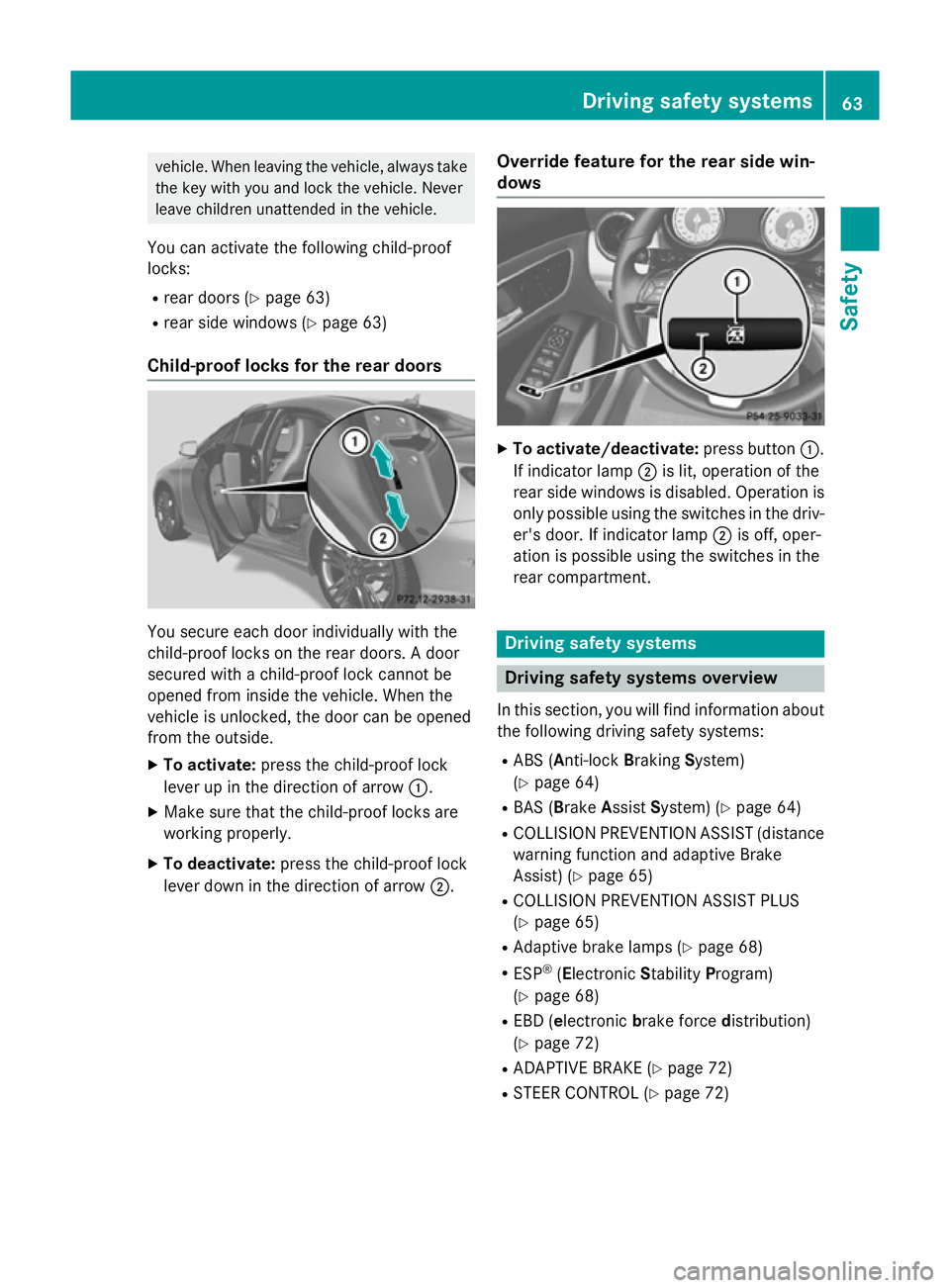
Child-proof locks for the rear doors You secure each door individually with the
child-proof locks on the rear doors. A door
secured with a child-proof lock cannot be
opened from inside the vehicle. When the
vehicle is unlocked, the door can be opened
from the outside.
X To activate: press the child-proof lock
lever up in the direction of arrow :.
X Make sure that the child-proof locks are
working properly.
X To deactivate: press the child-proof lock
lever down in the direction of arrow ;.Override feature for the rear side win-
dows X
To activate/deactivate: press button:.
If indicator lamp ;is lit, operation of the
rear side windows is disabled. Operation is
only possible using the switches in the driv- er's door. If indicator lamp ;is off, oper-
ation is possible using the switches in the
rear compartment. Driving safety systems
Driving safety systems overview
In this section, you will find information about the following driving safety systems:
R ABS ( Anti-lock BrakingSystem)
(Y page 64)
R BAS ( Brake Assist System) (Y page 64)
R COLLISION PREVENTION ASSIST (distance
warning function and adaptive Brake
Assist) (Y page 65)
R COLLISION PREVENTION ASSIST PLUS
(Y page 65)
R Adaptive brake lamps (Y page 68)
R ESP ®
(Electronic StabilityProgram)
(Y page 68)
R EBD ( electronic brake force distribution)
(Y page 72)
R ADAPTIVE BRAKE (Y page 72)
R STEER CONTROL (Y page 72) Driving safety systems
63Safety Z
Page 75 of 373
the vehicle/trailer combination from swerv-
ing. Trailers with a high centre of gravity can
tip over before ESP ®
can detect this. There is
a risk of an accident.
Always adapt your driving style to the prevail- ing road and weather conditions.
If your vehicle/trailer combination begins to
lurch, you can only stabilise the vehicle/
trailer combination by depressing the brake
firmly.
ESP ®
trailer stabilisation is active above
speeds of about 65 km/h.
ESP ®
trailer stabilisation does not work if
ESP ®
is deactivated or disabled because of a
malfunction. EBD (electronic brake force distribu-
tion)
General notes EBD monitors and controls the brake pres-
sure on the rear wheels to improve driving
stability while braking.
Important safety notes i
Observe the "Important safety notes" sec-
tion for driving safety systems (Y page 64).G
WARNING
If EBD has malfunctioned, the rear wheels can still lock, e.g. under full braking. This increa-
ses the risk of skidding and an accident.
You should therefore adapt your driving style
to the different handling characteristics. Have the brake system checked at a qualified spe-
cialist workshop.
Observe information regarding indicator and
warning lamps (Y page 265) as well as dis-
play messages (Y page 237). ADAPTIVE BRAKE
ADAPTIVE BRAKE enhances braking safety
and offers increased braking comfort. In addi-
tion to the braking function, ADAPTIVE BRAKE
also has the HOLD function (Y page 186)and
hill start assist (Y page 149). For further
information, see Driving tips (Y page 171). STEER CONTROL
General notes STEER CONTROL helps you by transmitting a
noticeable steering force to the steering
wheel in the direction required for vehicle
stabilisation.
This steering support is provided in particular
if:
R both right wheels or both left wheels are on
a wet or slippery road surface when you
brake.
R the vehicle starts to skid.
Important safety notes No steering support is provided from STEER
CONTROL, if
R ESP ®
is malfunctioning.
R the steering is faulty.
Power steering will, however, continue to
function. Anti-theft systems
Immobiliser
The immobiliser prevents your vehicle from
being started without the correct key.
X To activate: remove the key from the igni-
tion lock.
X To deactivate: switch on the ignition.
When leaving the vehicle, always take the key with you and lock the vehicle. The engine can
be started by anyone with a valid key that is
left inside the vehicle. 72
Anti-theft systemsSafety
Page 76 of 373
i
The immobiliser is always deactivated
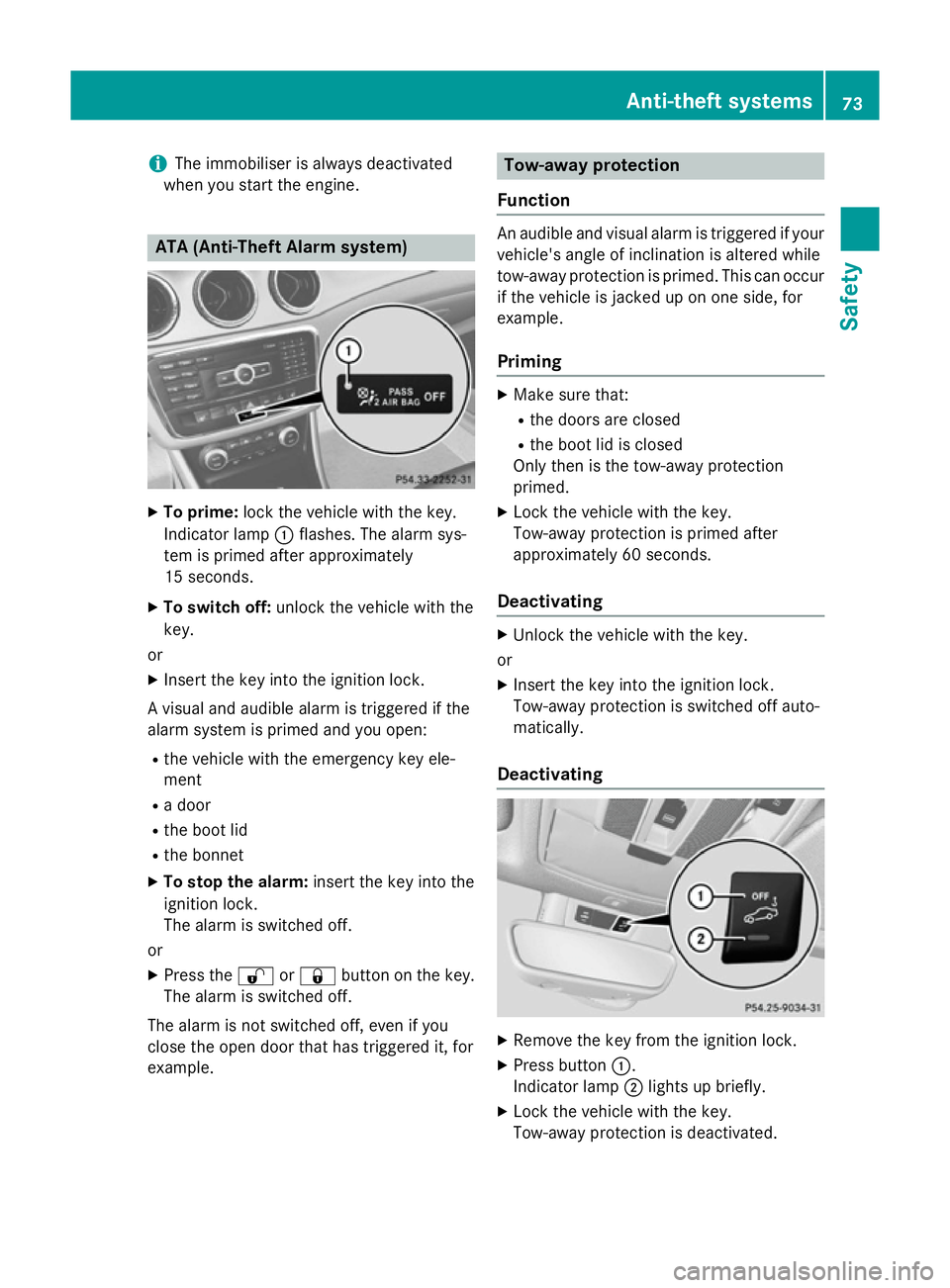
when you start the engine. ATA (Anti-Theft Alarm system)
X
To prime: lock the vehicle with the key.
Indicator lamp :flashes. The alarm sys-
tem is primed after approximately
15 seconds.
X To switch off: unlock the vehicle with the
key.
or
X Insert the key into the ignition lock.
A visual and audible alarm is triggered if the
alarm system is primed and you open:
R the vehicle with the emergency key ele-
ment
R a door
R the boot lid
R the bonnet
X To stop the alarm: insert the key into the
ignition lock.
The alarm is switched off.
or
X Press the %or& button on the key.
The alarm is switched off.
The alarm is not switched off, even if you
close the open door that has triggered it, for
example. Tow-away protection
Function An audible and visual alarm is triggered if your
vehicle's angle of inclination is altered while
tow-away protection is primed. This can occur
if the vehicle is jacked up on one side, for
example.
Priming X
Make sure that:
R the doors are closed
R the boot lid is closed
Only then is the tow-away protection
primed.
X Lock the vehicle with the key.
Tow-away protection is primed after
approximately 60 seconds.
Deactivating X
Unlock the vehicle with the key.
or X Insert the key into the ignition lock.
Tow-away protection is switched off auto-
matically.
Deactivating X
Remove the key from the ignition lock.
X Press button :.
Indicator lamp ;lights up briefly.
X Lock the vehicle with the key.
Tow-away protection is deactivated. Anti-theft systems
73Safety Z
Page 77 of 373
Tow-away protection remains deactivated
until:
R the vehicle is unlocked again
R a door is opened and closed again
R the vehicle is locked again
To prevent a false alarm, deactivate the tow-
away protection if you lock your vehicle and it:
R is being transported
R is being loaded onto a ferry or car trans-
porter, for example
R is parked on a movable surface, e.g. in a
split-level garage Interior motion sensor
Function When the interior motion sensor is primed, a
visual and audible alarm is triggered if move- ment is detected in the vehicle interior. This
can occur if someone reaches into the vehicle
interior, for example.
Priming X
Make sure that:
R the side windows are closed
R the panorama sliding sunroof is closed
R there are no objects, e.g. mascots, hang-
ing on the rear-view mirror or on the grab handles on the roof trim
This will prevent false alarms.
X Make sure that:
R the doors are closed
R the panorama sliding sunroof is closed
R the boot lid is closed
Only then is the interior motion sensor
primed.
X Lock the vehicle with the key.
The interior motion sensor is primed after
approximately 30 seconds. Deactivating X
Unlock the vehicle with the key.
or X Insert the key into the ignition lock.
The interior motion sensor is automatically
deactivated.
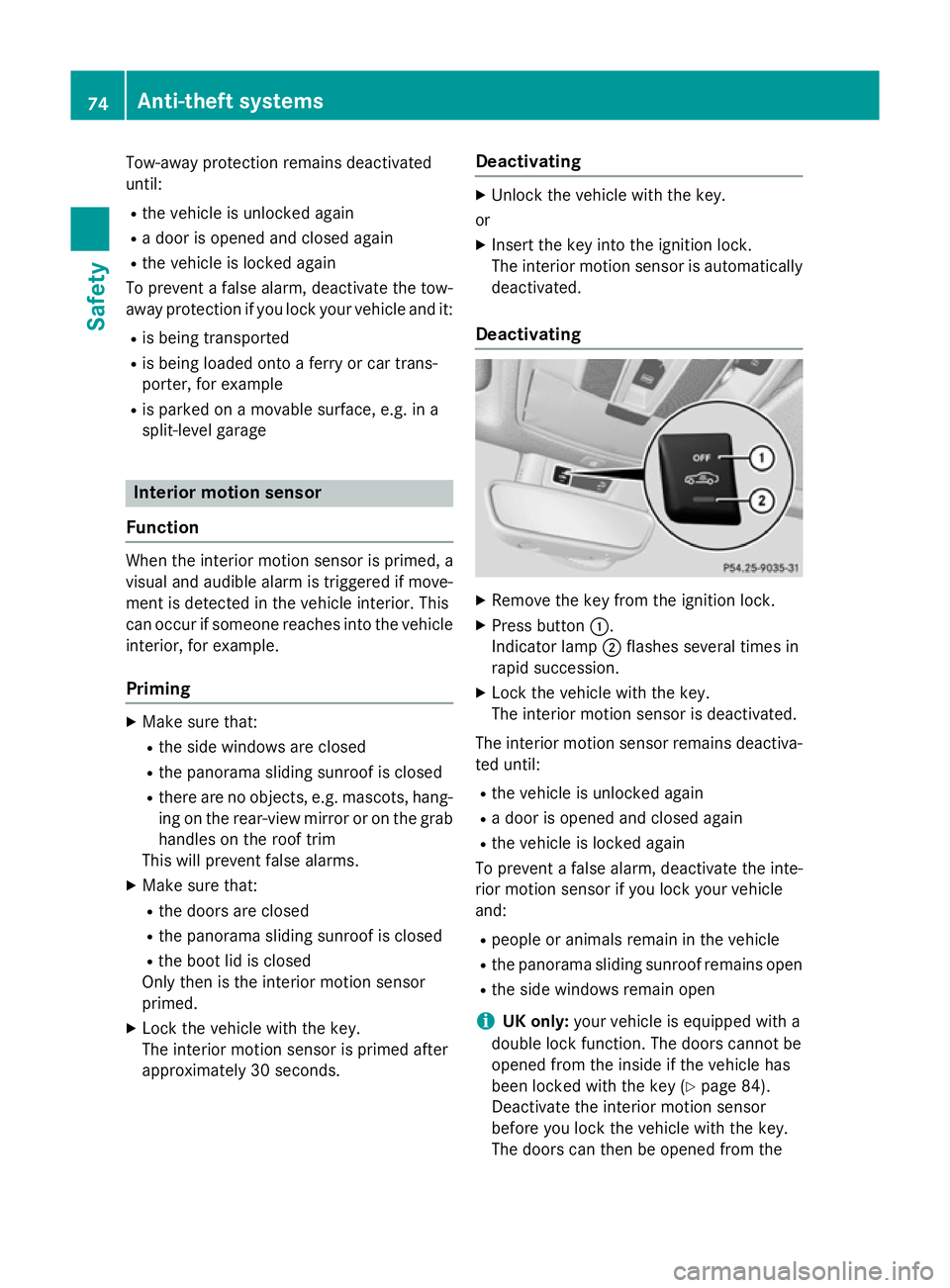
Deactivating X
Remove the key from the ignition lock.
X Press button :.
Indicator lamp ;flashes several times in
rapid succession.
X Lock the vehicle with the key.
The interior motion sensor is deactivated.
The interior motion sensor remains deactiva-
ted until:
R the vehicle is unlocked again
R a door is opened and closed again
R the vehicle is locked again
To prevent a false alarm, deactivate the inte-
rior motion sensor if you lock your vehicle
and:
R people or animals remain in the vehicle
R the panorama sliding sunroof remains open
R the side windows remain open
i UK only:
your vehicle is equipped with a
double lock function. The doors cannot be
opened from the inside if the vehicle has
been locked with the key (Y page 84).
Deactivate the interior motion sensor
before you lock the vehicle with the key.
The doors can then be opened from the 74
Anti-theft systemsSafety
Page 78 of 373

inside after the vehicle has been locked
from the outside with the key. Observe the
"Important safety notes" (Y page 83). Anti-theft systems
75Safety Z