jump start MERCEDES-BENZ CLA COUPE 2013 Owners Manual
[x] Cancel search | Manufacturer: MERCEDES-BENZ, Model Year: 2013, Model line: CLA COUPE, Model: MERCEDES-BENZ CLA COUPE 2013Pages: 373, PDF Size: 11.47 MB
Page 8 of 373
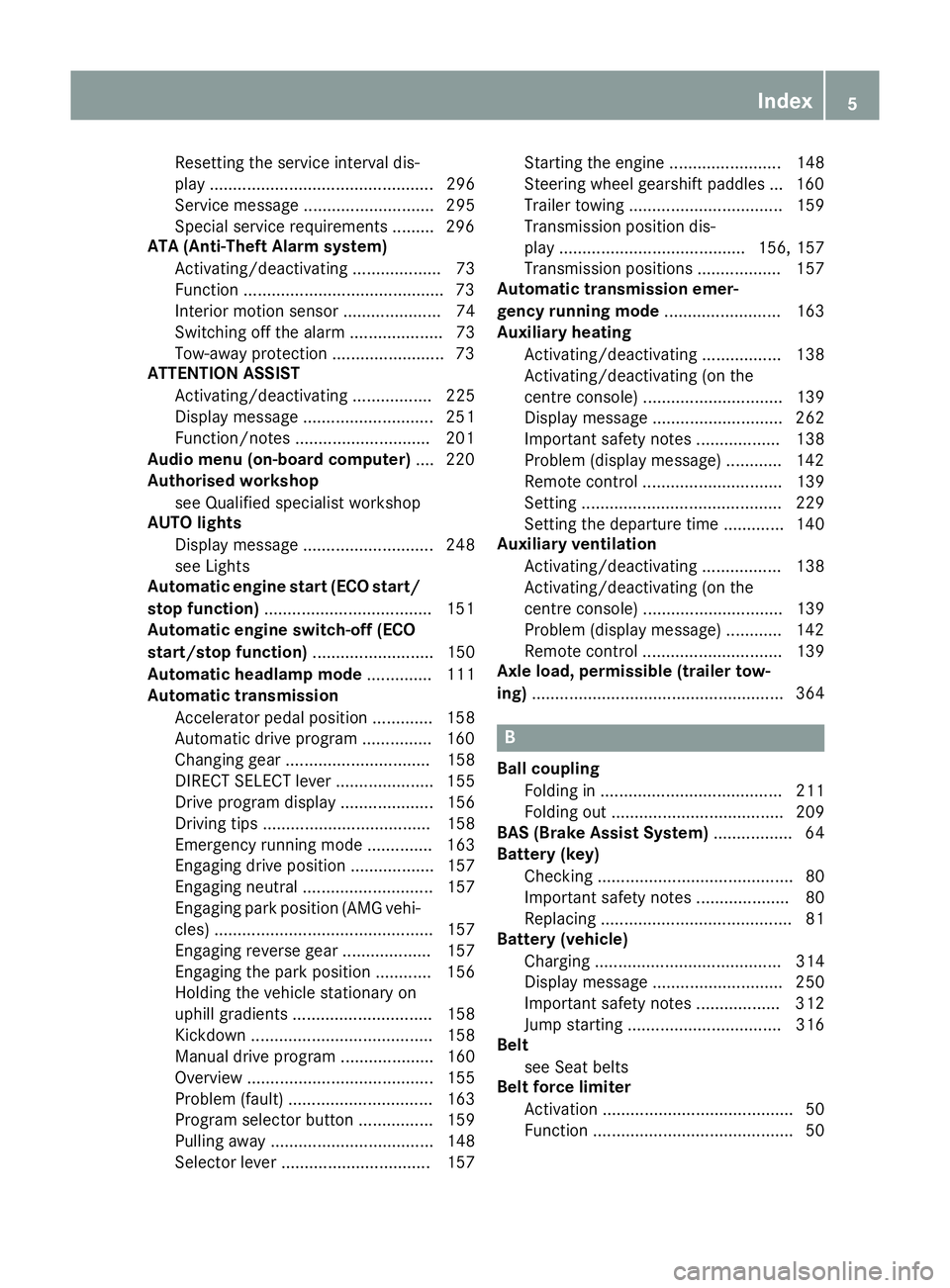
Resetting the service interval dis-
play ................................................ 296
Service message ............................ 295
Special service requirements ........ .296
ATA (Anti-Theft Alarm system)
Activating/deactivating ................... 73
Function .......................................... .73
Interior motion sensor .....................74
Switching off the alarm .................... 73
Tow-away protectio n ........................73
ATTENTION ASSIST
Activating/deactivating ................. 225
Display message ............................ 251
Function/notes ............................ .201
Audio menu (on-board computer) .... 220
Authorised workshop
see Qualified specialist workshop
AUTO lights
Display message ............................ 248
see Lights
Automatic engine start (ECO start/
stop function) ................................... .151
Automatic engine switch-off (ECO
start/stop function) .......................... 150
Automatic headlamp mode .............. 111
Automatic transmission
Accelerator pedal position ............. 158
Automatic drive program .............. .160
Changing gear ............................... 158
DIRECT SELECT lever ..................... 155
Drive program displa y.................... 156
Driving tips .................................... 158
Emergency running mode .............. 163
Engaging drive position .................. 157
Engaging neutral ............................ 157
Engaging park position (AMG vehi-
cles) ............................................... 157
Engaging reverse gear ................... 157
Engaging the park position ............ 156
Holding the vehicle stationary on
uphill gradients .............................. 158
Kickdown ....................................... 158
Manual drive progra m.................... 160
Overview ........................................ 155
Problem (fault) ............................... 163
Program selector button ................ 159
Pulling away ................................... 148
Selector lever ................................ 157 Starting the engine ........................ 148
Steering wheel gearshift paddle
s... 160
Trailer towing ................................. 159
Transmission position dis-
play ........................................ 156, 157
Transmission positions .................. 157
Automatic transmission emer-
gency running mode ......................... 163
Auxiliary heating
Activating/deactivating ................. 138
Activating/deactivating (on the
centre console ).............................. 139
Display message ............................ 262
Important safety notes .................. 138
Problem (display message) ............ 142
Remote control .............................. 139
Setting ........................................... 229
Setting the departure time ............. 140
Auxiliary ventilation
Activating/deactivating ................. 138
Activating/deactivating (on the
centre console ).............................. 139
Problem (display message) ............ 142
Remote control .............................. 139
Axle load, permissible (trailer tow-
ing) ...................................................... 364 B
Ball coupling Folding in ....................................... 211
Folding out ..................................... 209
BAS (Brake Assist System) ................. 64
Battery (key)
Checking .......................................... 80
Important safety notes .................... 80
Replacing ......................................... 81
Battery (vehicle)
Charging ........................................ 314
Display message ............................ 250
Important safety notes .................. 312
Jump starting ................................. 316
Belt
see Seat belts
Belt force limiter
Activation ......................................... 50
Function ........................................... 50 Index
5
Page 13 of 373
Emergency key
Unlocking the driver's door .............. 85
Emergency key element
Function/notes ................................ 79
Inserting .......................................... 79
Locking vehicle ................................ 86
Emergency release
Driver's door .................................... 85
Emergency spare wheel
General notes ................................ 349
Important safety notes .................. 349
Removing ...................................... .350
Technical data ............................... 350
Emergency unlocking
Boot ................................................. 88
Vehicle ............................................. 85
Engine
Display message ............................ 249
ECO start/stop function ................ 150
Engine number ............................... 354
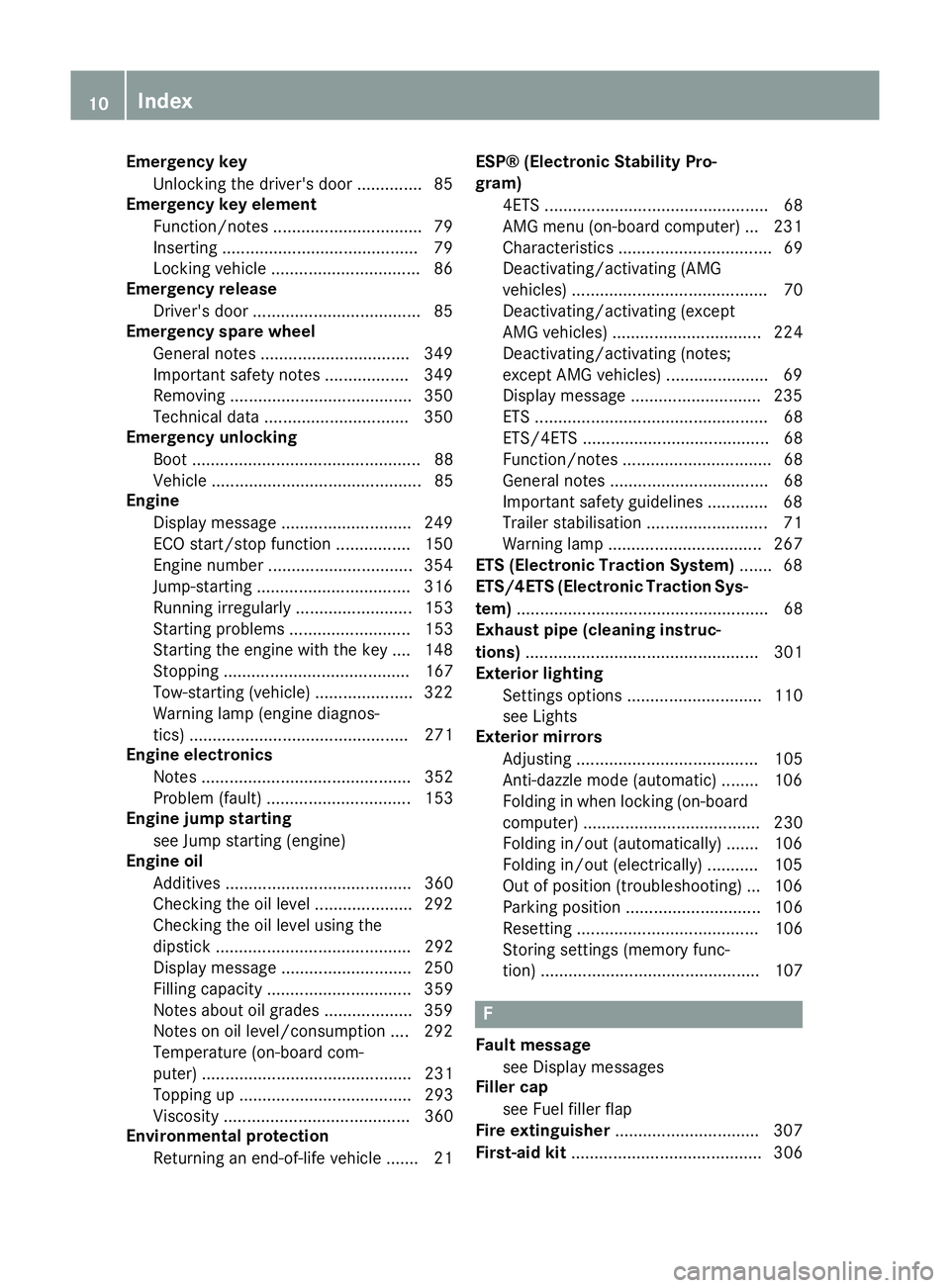
Jump-starting ................................. 316
Running irregularl y......................... 153
Starting problems .......................... 153
Starting the engine with the key .... 148
Stopping ........................................ 167
Tow-starting (vehicle) ..................... 322
Warning lamp (engine diagnos-
tics) ............................................... 271
Engine electronics
Notes ............................................. 352
Problem (fault) ............................... 153
Engine jump starting
see Jump starting (engine)
Engine oil
Additives ........................................ 360
Checking the oil level ..................... 292
Checking the oil level using the
dipstick .......................................... 292
Display message ............................ 250
Filling capacity ............................... 359
Notes about oil grade s................... 359
Notes on oil level/consumption .... 292
Temperature (on-board com-
puter) ............................................. 231
Topping up ..................................... 293
Viscosity ........................................ 360
Environmental protection
Returning an end-of-life vehicle ....... 21 ESP® (Electronic Stability Pro-
gram)
4ETS ................................................ 68
AMG menu (on-board computer) ... 231
Characteristics ................................. 69
Deactivating/activating (AMG
vehicles) .......................................... 70
Deactivating/activating (except
AMG vehicles) ................................ 224
Deactivating/activating (notes;
except AMG vehicles) ...................... 69
Display message ............................ 235
ETS .................................................. 68
ETS/4ETS ........................................ 68
Function/note s................................ 68
General notes .................................. 68
Important safety guidelines ............. 68
Trailer stabilisation .......................... 71
Warning lamp ................................. 267
ETS (Electronic Traction System) ....... 68
ETS/4ETS (Electronic Traction Sys-
tem) ...................................................... 68
Exhaust pipe (cleaning instruc-
tions) .................................................. 301
Exterior lighting
Settings options ............................. 110
see Lights
Exterior mirrors
Adjusting ....................................... 105
Anti-dazzle mode (automatic) ........ 106
Folding in when locking (on-board computer) ...................................... 230
Folding in/out (automatically )....... 106
Folding in/out (electrically) ........... 105
Out of position (troubleshooting) ... 106
Parking position ............................. 106
Resetting ....................................... 106
Storing settings (memory func-
tion) ............................................... 107 F
Fault message see Display messages
Filler cap
see Fuel filler flap
Fire extinguisher ............................... 307
First-aid kit ......................................... 30610
Index
Page 15 of 373
Deactivating ................................... 186
Display message ............................ 251
Function/note
s............................. 186 I
Ignition lock see Key positions
Immobiliser .......................................... 72
Indicator and warning lamps
Coolant .......................................... 271
DISTRONIC PLUS ........................... 273
Engine diagnostics ......................... 271
SPORT handling mode ................... 268
Indicator lamps
Display message ............................ 246
see Warning and indicator lamps
Indicators
see Turn signals
Inspection
see ASSYST PLUS
Instrument cluster
Overview .......................................... 30
Setting s......................................... 226
Warning and indicator lamps ........... 32
Instrument cluster lighting .............. 214
Intelligent Light System
Activating/deactivating ................. 227
Display message ............................ 248
Overview ........................................ 114
Setting the dipped-beam head-
lamps for driving on the right/left .. 227
Interior lighting ................................. 116
Automatic control system .............. 117
Delayed switch-off (on-board
computer) ...................................... 228
Emergency lighting ........................ 117
Manual control ............................... 117
Overview ........................................ 116
Reading lamp ................................. 116
Setting the ambient lighting
brightness (on-board computer) .... 227
Interior motion sensor
Deactivating ..................................... 74
Function ........................................... 74
Priming ............................................ 74
Switching off .................................... 74
ISOFIX child seat securing system .... 54 J
Jack Storage location ............................ 307
Using ............................................. 337
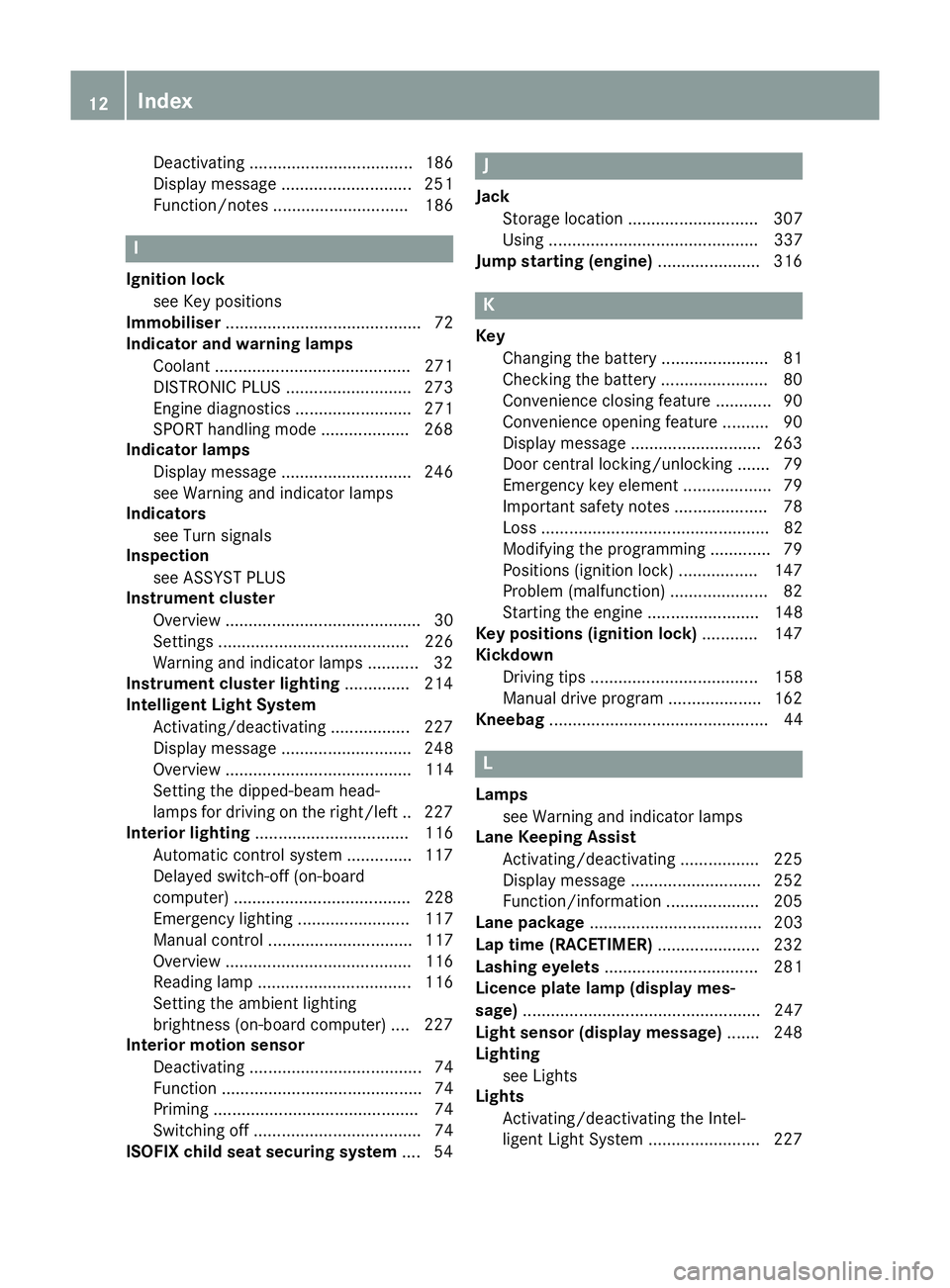
Jump starting (engine) ...................... 316 K
Key Changing the battery ....................... 81
Checking the battery ....................... 80
Convenience closing feature ............ 90
Convenience opening feature .......... 90
Display message ............................ 263
Door central locking/unlocking ....... 79
Emergency key element ................... 79
Important safety notes .................... 78
Loss ................................................. 82
Modifying the programming ............. 79
Positions (ignition lock) ................. 147
Problem (malfunction) ..................... 82
Starting the engine ........................ 148
Key positions (ignition lock) ............ 147
Kickdown
Driving tips .................................... 158
Manual drive progra m.................... 162
Kneebag ............................................... 44 L
Lamps see Warning and indicator lamps
Lane Keeping Assist
Activating/deactivating ................. 225
Display message ............................ 252
Function/information .................... 205
Lane package ..................................... 203
Lap time (RACETIMER) ...................... 232
Lashing eyelets ................................. 281
Licence plate lamp (display mes-
sage) ................................................... 247
Light sensor (display message) ....... 248
Lighting
see Lights
Lights
Activating/deactivating the Intel-
ligent Light System ........................ 227 12
Index
Page 86 of 373
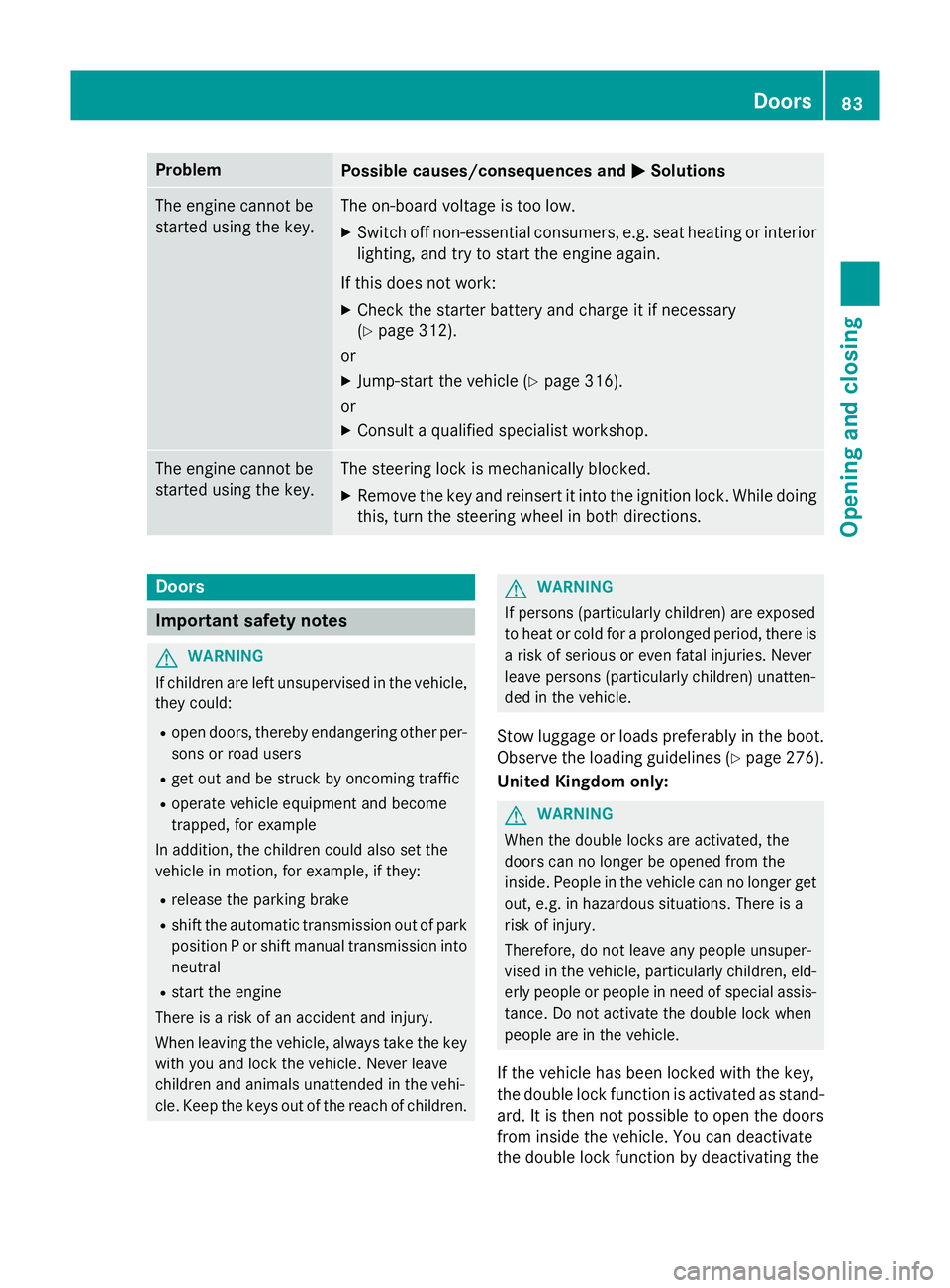
Problem
Possible causes/consequences and
M
MSolutions The engine cannot be
started using the key. The on-board voltage is too low.
X Switch off non-essential consumers, e.g. seat heating or interior
lighting, and try to start the engine again.
If this does not work:
X Check the starter battery and charge it if necessary
(Y page 312).
or
X Jump-start the vehicle (Y page 316).
or
X Consult a qualified specialist workshop. The engine cannot be
started using the key. The steering lock is mechanically blocked.
X Remove the key and reinsert it into the ignition lock. While doing
this, turn the steering wheel in both directions. Doors
Important safety notes
G
WARNING
If children are left unsupervised in the vehicle, they could:
R open doors, thereby endangering other per-
sons or road users
R get out and be struck by oncoming traffic
R operate vehicle equipment and become
trapped, for example
In addition, the children could also set the
vehicle in motion, for example, if they:
R release the parking brake
R shift the automatic transmission out of park
position P or shift manual transmission into
neutral
R start the engine
There is a risk of an accident and injury.
When leaving the vehicle, always take the key with you and lock the vehicle. Never leave
children and animals unattended in the vehi-
cle. Keep the keys out of the reach of children. G
WARNING
If persons (particularly children) are exposed
to heat or cold for a prolonged period, there is a risk of serious or even fatal injuries. Never
leave persons (particularly children) unatten-
ded in the vehicle.
Stow luggage or loads preferably in the boot. Observe the loading guidelines (Y page 276).
United Kingdom only: G
WARNING
When the double locks are activated, the
doors can no longer be opened from the
inside. People in the vehicle can no longer get out, e.g. in hazardous situations. There is a
risk of injury.
Therefore, do not leave any people unsuper-
vised in the vehicle, particularly children, eld-
erly people or people in need of special assis-
tance. Do not activate the double lock when
people are in the vehicle.
If the vehicle has been locked with the key,
the double lock function is activated as stand-
ard. It is then not possible to open the doors
from inside the vehicle. You can deactivate
the double lock function by deactivating the Doors
83Opening and closing Z
Page 156 of 373
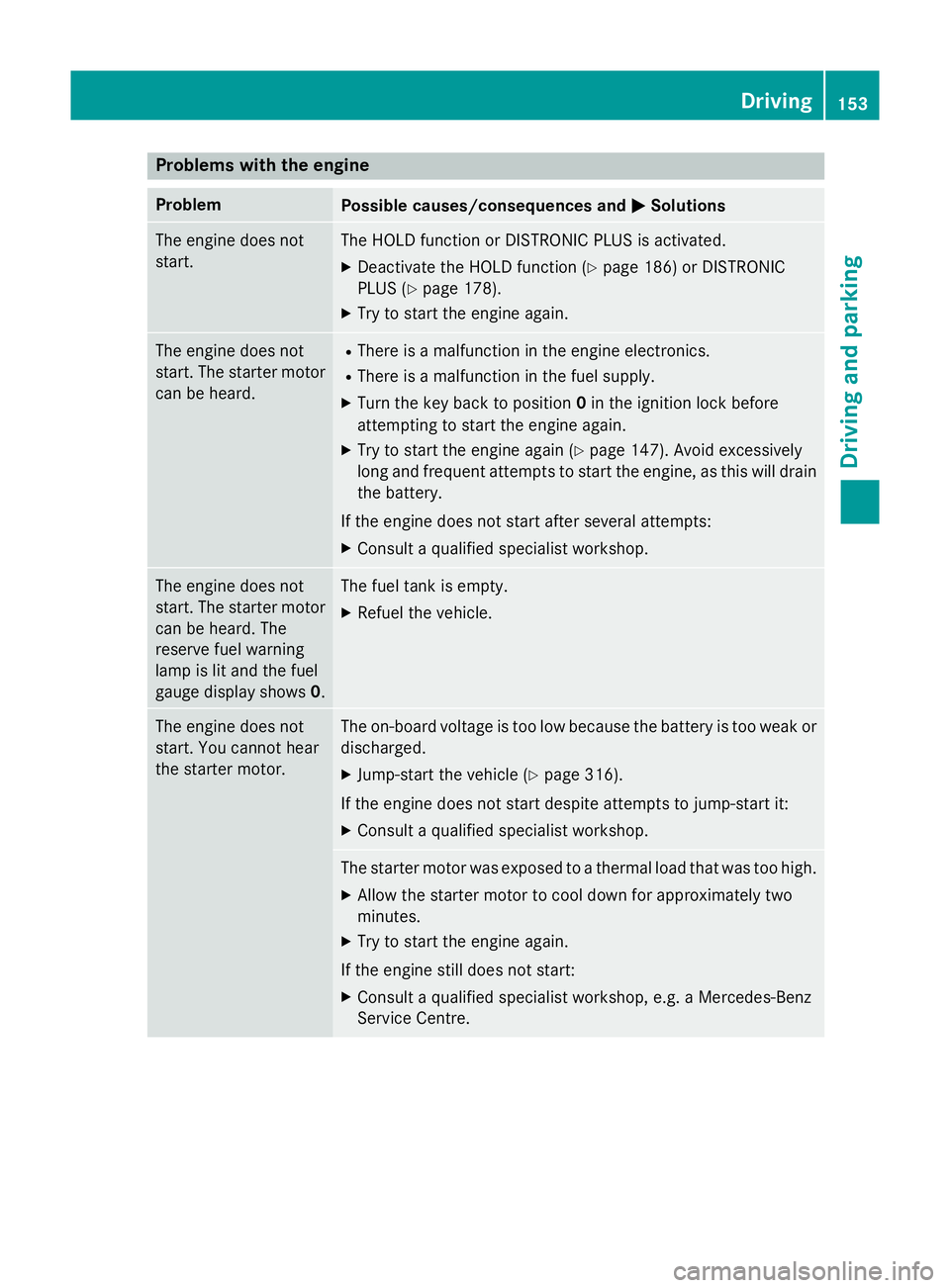
Problems with the engine
Problem
Possible causes/consequences and
M
MSolutions The engine does not
start. The HOLD function or DISTRONIC PLUS is activated.
X Deactivate the HOLD function (Y page 186) or DISTRONIC
PLUS (Y page 178).
X Try to start the engine again. The engine does not
start. The starter motor
can be heard. R
There is a malfunction in the engine electronics.
R There is a malfunction in the fuel supply.
X Turn the key back to position 0in the ignition lock before
attempting to start the engine again.
X Try to start the engine again (Y page 147). Avoid excessively
long and frequent attempts to start the engine, as this will drain the battery.
If the engine does not start after several attempts:
X Consult a qualified specialist workshop. The engine does not
start. The starter motor
can be heard. The
reserve fuel warning
lamp is lit and the fuel
gauge display shows 0. The fuel tank is empty.
X Refuel the vehicle. The engine does not
start. You cannot hear
the starter motor. The on-board voltage is too low because the battery is too weak or
discharged.
X Jump-start the vehicle (Y page 316).
If the engine does not start despite attempts to jump-start it:
X Consult a qualified specialist workshop. The starter motor was exposed to a thermal load that was too high.
X Allow the starter motor to cool down for approximately two
minutes.
X Try to start the engine again.
If the engine still does not start:
X Consult a qualified specialist workshop, e.g. a Mercedes-Benz
Service Centre. Driving
153Driving and parking Z
Page 308 of 373
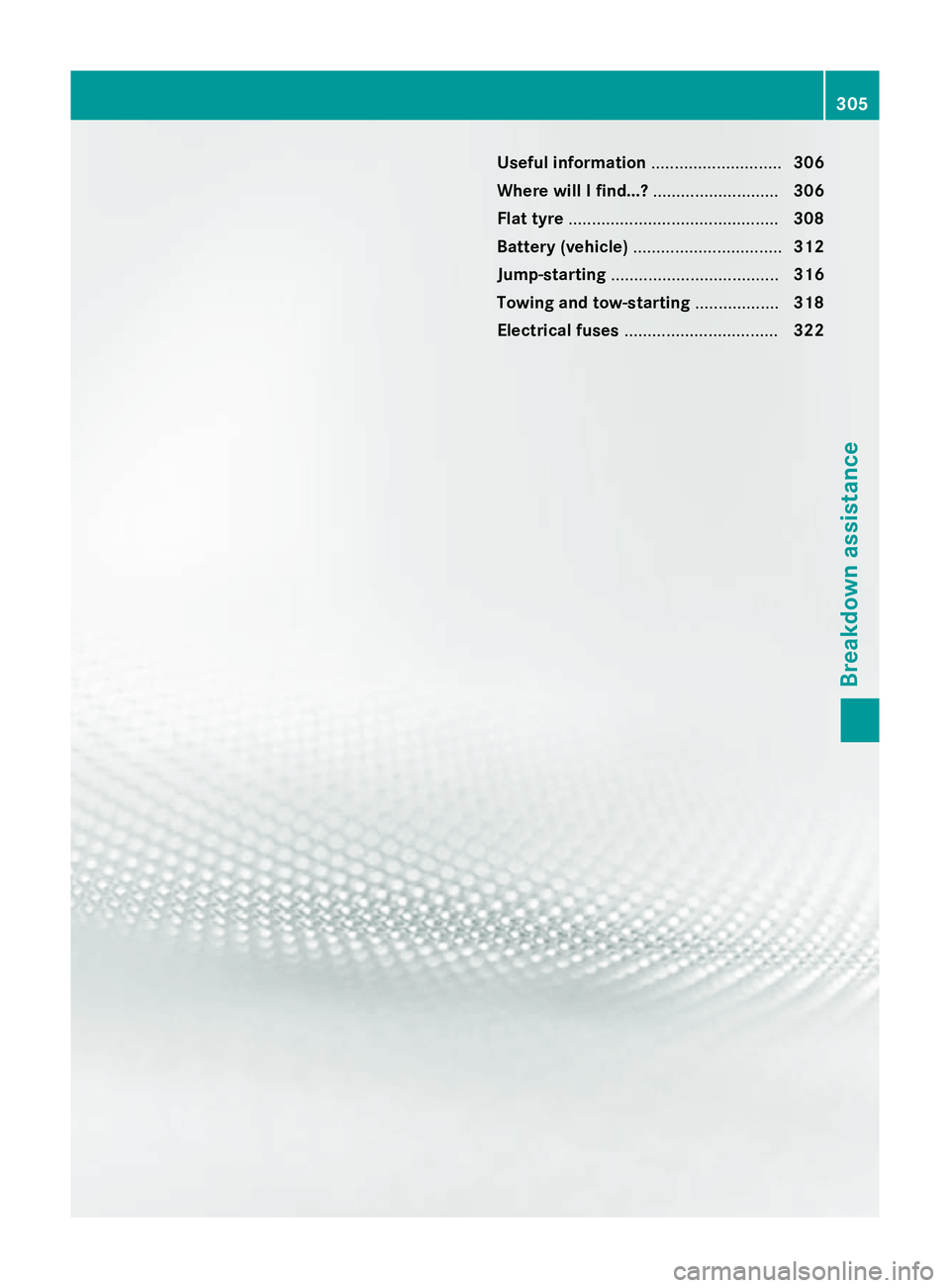
Useful information
............................306
Where will I find...? ...........................306
Flat tyre ............................................. 308
Battery (vehicle) ................................ 312
Jump-starting .................................... 316
Towing and tow-starting ..................318
Electrical fuses ................................. 322 305Breakdown assistance
Page 316 of 373
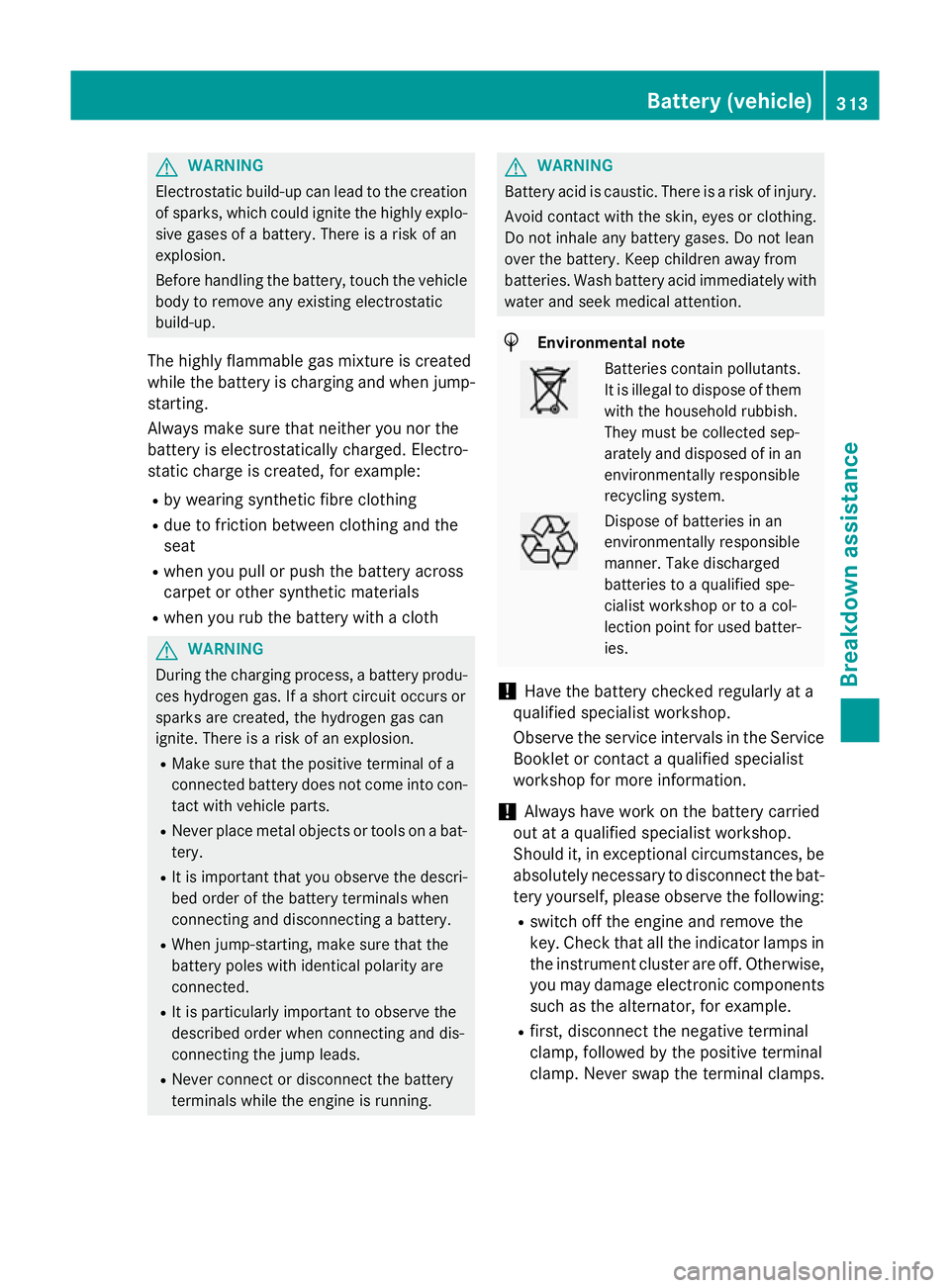
G
WARNING
Electrostatic build-up can lead to the creation of sparks, which could ignite the highly explo-
sive gases of a battery. There is a risk of an
explosion.
Before handling the battery, touch the vehicle body to remove any existing electrostatic
build-up.
The highly flammable gas mixture is created
while the battery is charging and when jump-
starting.
Always make sure that neither you nor the
battery is electrostatically charged. Electro-
static charge is created, for example:
R by wearing synthetic fibre clothing
R due to friction between clothing and the
seat
R when you pull or push the battery across
carpet or other synthetic materials
R when you rub the battery with a cloth G
WARNING
During the charging process, a battery produ- ces hydrogen gas. If a short circuit occurs or
sparks are created, the hydrogen gas can
ignite. There is a risk of an explosion.
R Make sure that the positive terminal of a
connected battery does not come into con- tact with vehicle parts.
R Never place metal objects or tools on a bat-
tery.
R It is important that you observe the descri-
bed order of the battery terminals when
connecting and disconnecting a battery.
R When jump-starting, make sure that the
battery poles with identical polarity are
connected.
R It is particularly important to observe the
described order when connecting and dis-
connecting the jump leads.
R Never connect or disconnect the battery
terminals while the engine is running. G
WARNING
Battery acid is caustic. There is a risk of injury. Avoid contact with the skin, eyes or clothing.
Do not inhale any battery gases. Do not lean
over the battery. Keep children away from
batteries. Wash battery acid immediately with water and seek medical attention. H
Environmental note Batteries contain pollutants.
It is illegal to dispose of them
with the household rubbish.
They must be collected sep-
arately and disposed of in anenvironmentally responsible
recycling system. Dispose of batteries in an
environmentally responsible
manner. Take discharged
batteries to a qualified spe-
cialist workshop or to a col-
lection point for used batter-
ies.
! Have the battery checked regularly at a
qualified specialist workshop.
Observe the service intervals in the Service
Booklet or contact a qualified specialist
workshop for more information.
! Always have work on the battery carried
out at a qualified specialist workshop.
Should it, in exceptional circumstances, be
absolutely necessary to disconnect the bat-
tery yourself, please observe the following:
R switch off the engine and remove the
key. Check that all the indicator lamps in the instrument cluster are off. Otherwise,
you may damage electronic components such as the alternator, for example.
R first, disconnect the negative terminal
clamp, followed by the positive terminal
clamp. Never swap the terminal clamps. Battery (vehicle)
313Breakdown assistance Z
Page 317 of 373
The vehicle electronics may otherwise be
damaged.
R on vehicles with automatic transmission,
the transmission is locked in position P
after disconnecting the battery. The vehi-
cle is secured against rolling away. You
can then no longer move the vehicle.
The battery and the cover of the positive
terminal clamp must be fitted securely dur- ing operation.
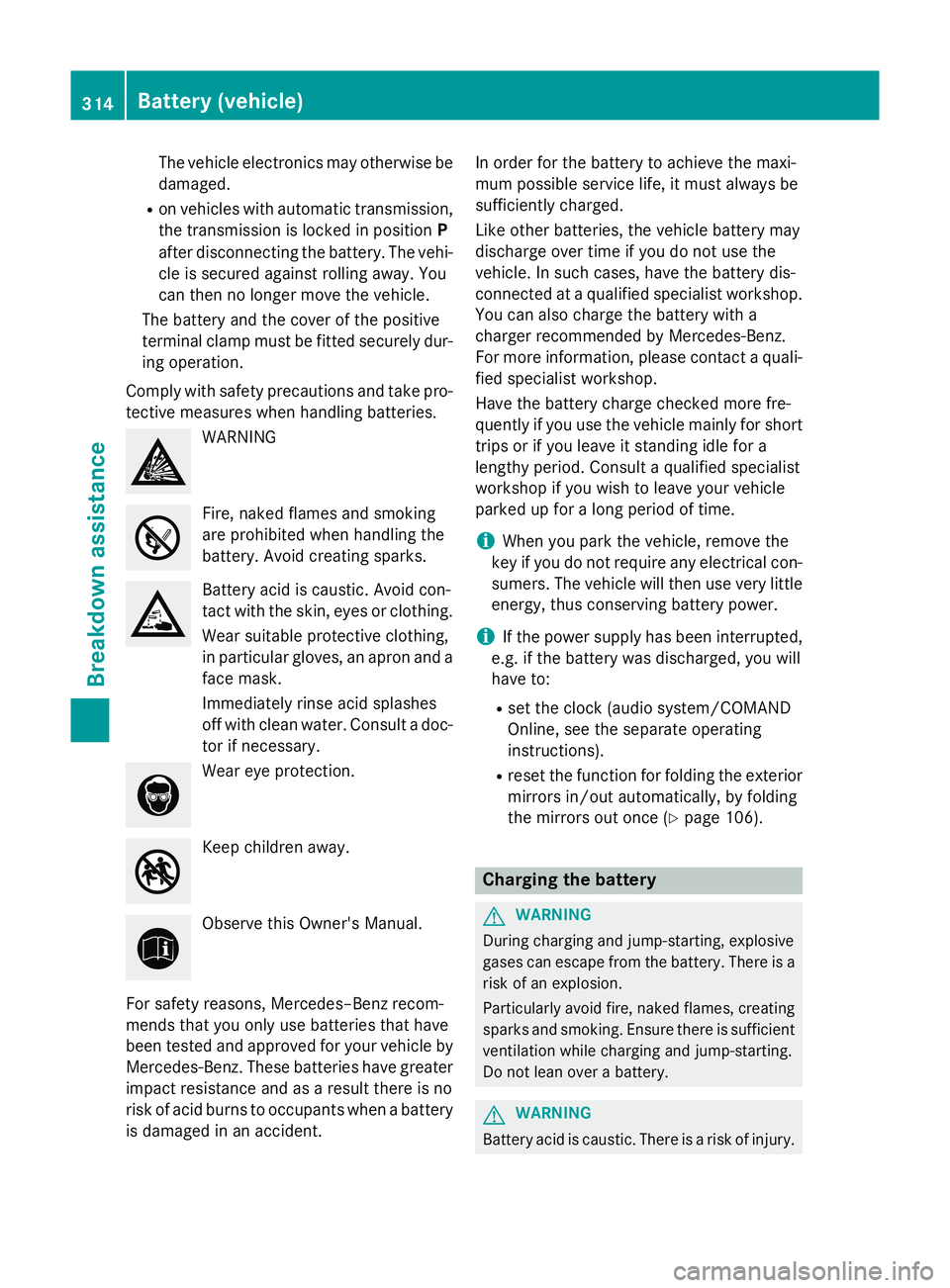
Comply with safety precautions and take pro-
tective measures when handling batteries. WARNING
Fire, naked flames and smoking
are prohibited when handling the
battery. Avoid creating sparks. Battery acid is caustic. Avoid con-
tact with the skin, eyes or clothing.
Wear suitable protective clothing,
in particular gloves, an apron and a
face mask.
Immediately rinse acid splashes
off with clean water. Consult a doc-
tor if necessary. Wear eye protection.
Keep children away.
Observe this Owner's Manual.
For safety reasons, Mercedes–Benz recom-
mends that you only use batteries that have
been tested and approved for your vehicle by
Mercedes-Benz. These batteries have greater impact resistance and as a result there is no
risk of acid burns to occupants when a batteryis damaged in an accident. In order for the battery to achieve the maxi-
mum possible service life, it must always be
sufficiently charged.
Like other batteries, the vehicle battery may
discharge over time if you do not use the
vehicle. In such cases, have the battery dis-
connected at a qualified specialist workshop.
You can also charge the battery with a
charger recommended by Mercedes-Benz.
For more information, please contact a quali-
fied specialist workshop.
Have the battery charge checked more fre-
quently if you use the vehicle mainly for short
trips or if you leave it standing idle for a
lengthy period. Consult a qualified specialist
workshop if you wish to leave your vehicle
parked up for a long period of time.
i When you park the vehicle, remove the
key if you do not require any electrical con-
sumers. The vehicle will then use very little energy, thus conserving battery power.
i If the power supply has been interrupted,
e.g. if the battery was discharged, you will
have to:
R set the clock (audio system/COMAND
Online, see the separate operating
instructions).
R reset the function for folding the exterior
mirrors in/out automatically, by folding
the mirrors out once (Y page 106). Charging the battery
G
WARNING
During charging and jump-starting, explosive
gases can escape from the battery. There is a risk of an explosion.
Particularly avoid fire, naked flames, creating
sparks and smoking. Ensure there is sufficient
ventilation while charging and jump-starting.
Do not lean over a battery. G
WARNING
Battery acid is caustic. There is a risk of injury. 314
Battery (vehicle)Breakdown assistance
Page 318 of 373
Avoid contact with the skin, eyes or clothing.
Do not inhale any battery gases. Do not lean
over the battery. Keep children away from
batteries. Wash battery acid immediately with
water and seek medical attention. G
WARNING
A discharged battery can freeze at tempera-
tures below freezing point. When jump-start-
ing the vehicle or charging the battery, gases can escape from the battery. There is a risk of
an explosion.
Allow the frozen battery to thaw out before
charging it or jump-starting.
! Only use battery chargers with a maxi-
mum charging voltage of 14.8 V.
! Only
charge the battery using the jump-
start connection point.
The jump-starting connection point is in the
engine compartment (Y page 316).
X Open the bonnet.
X Connect the battery charger to the positive
terminal and earth point in the same order
as when connecting the donor battery in
the jump-starting procedure (Y page 316).
If the indicator/warning lamps do not light up at low temperatures, it is very likely that the
discharged battery has frozen. In this case
you may neither jump-start the vehicle nor
charge the battery. The service life of a bat-
tery that has been thawed may be reduced.
The starting characteristics may be impaired,
especially at low temperatures. Have the
thawed battery checked at a qualified spe-
cialist workshop.
Only charge the installed battery with a bat-
tery charger which has been tested and
approved by Mercedes-Benz. A battery
charger unit specially adapted for Mercedes-
Benz vehicles and tested and approved by
Mercedes-Benz is available as an accessory.
It permits the charging of the battery in its
installed position. Contact a Mercedes-Benz
Service Centre for information and availabil- ity. Read the battery charger's operating
instructions before charging the battery. Battery (vehicle)
315Breakdown assistance Z
Page 319 of 373
Jump-starting
For the jump-starting procedure, use only the jump-starting connection point, consisting of a positive terminal and an earth point, in the engine compartment. G
WARNING
Battery acid is caustic. There is a risk of injury.
Avoid contact with the skin, eyes or clothing. Do not inhale any battery gases. Do not lean over the battery. Keep children away from batteries. Wash battery acid immediately with water and seek
medical attention. G
WARNING
During charging and jump-starting, explosive gases can escape from the battery. There is a risk of an explosion.
Particularly avoid fire, naked flames, creating sparks and smoking. Ensure there is sufficient
ventilation while charging and jump-starting. Do not lean over a battery. G
WARNING
During the charging process, a battery produces hydrogen gas. If a short circuit occurs or sparks
are created, the hydrogen gas can ignite. There is a risk of an explosion.
R Make sure that the positive terminal of a connected battery does not come into contact with
vehicle parts.
R Never place metal objects or tools on a battery.
R It is important that you observe the described order of the battery terminals when connecting
and disconnecting a battery.
R When jump-starting, make sure that the battery poles with identical polarity are connected.
R It is particularly important to observe the described order when connecting and disconnecting
the jump leads.
R Never connect or disconnect the battery terminals while the engine is running. G
WARNING
A discharged battery can freeze at temperatures below freezing point. When jump-starting the
vehicle or charging the battery, gases can escape from the battery. There is a risk of an explosion.
Allow the frozen battery to thaw out before charging it or jump-starting.
! Vehicles with a petrol engine:
avoid repeated and lengthy starting attempts. Otherwise,
the non-combusted fuel may damage the catalytic converter.
If the indicator/warning lamps do not light up at low temperatures, it is very likely that the
discharged battery has frozen. In this case you may neither jump-start the vehicle nor charge
the battery. The service life of a battery that has been thawed may be reduced. The starting
characteristics may be impaired, especially at low temperatures. Have the thawed battery
checked at a qualified specialist workshop. 316
Jump-startingBreakdown assistance