lock MERCEDES-BENZ CLA COUPE 2016 Owner's Manual
[x] Cancel search | Manufacturer: MERCEDES-BENZ, Model Year: 2016, Model line: CLA COUPE, Model: MERCEDES-BENZ CLA COUPE 2016Pages: 345, PDF Size: 12.41 MB
Page 59 of 345
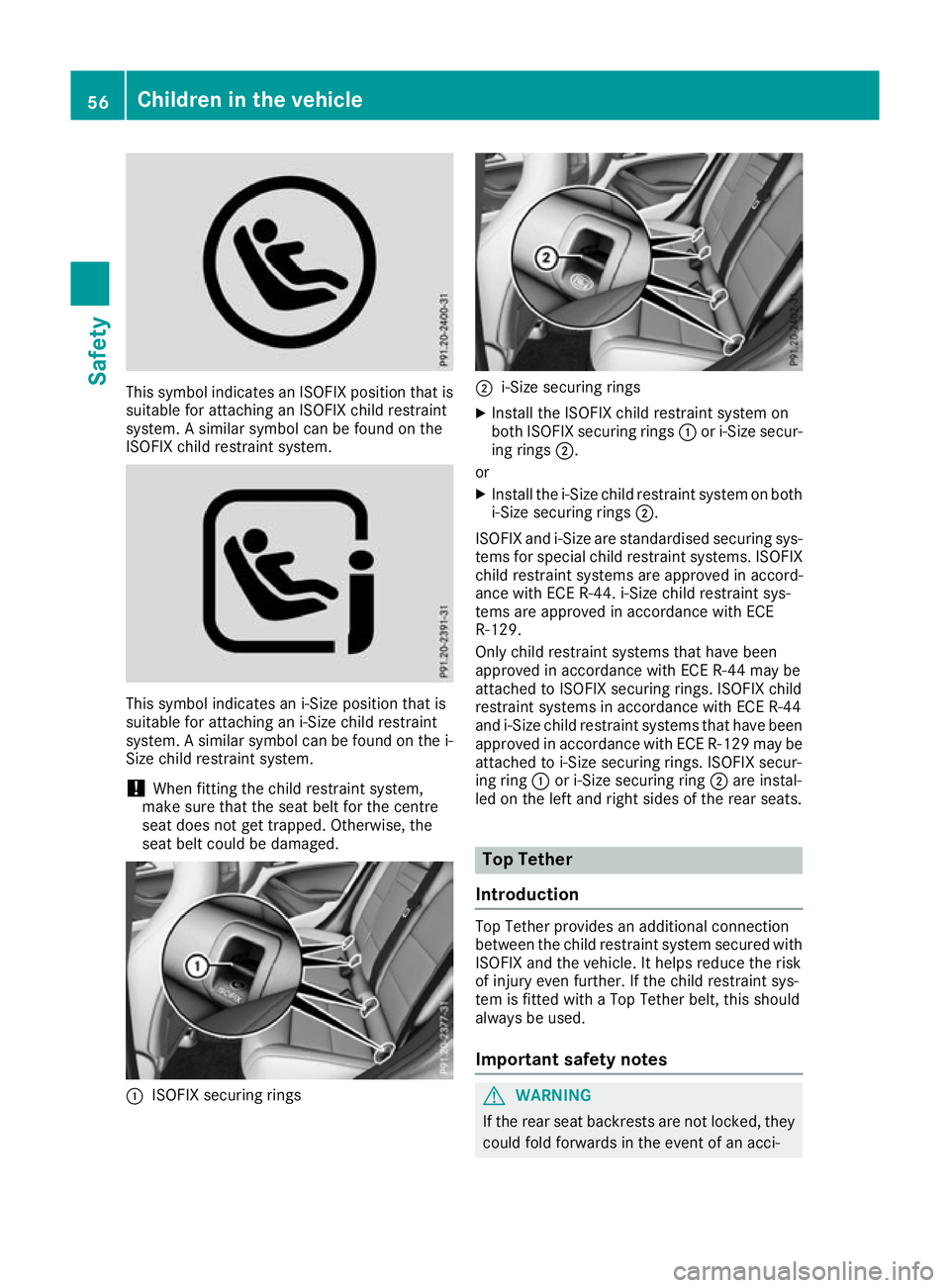
This symbol indicates an ISOFIX position that is
suitable for attaching an ISOFIX child restraint
system. A similar symbol can be found on the
ISOFIX child restraint system. This symbol indicates an i
‑Size position that is
suitable for attaching an i-Size child restraint
system. A similar symbol can be found on the i- Size child restraint system.
! When fitting the child restraint system,
make sure that the seat belt for the centre
seat does not get trapped. Otherwise, the
seat belt could be damaged. :
ISOFIX securing rings ;
i-Size securing rings
X Install the ISOFIX child restraint system on
both ISOFIX securing rings :or i-Size secur-
ing rings ;.
or
X Install the i-Size child restraint system on both
i-Size securing rings ;.
ISOFIX and i-Size are standardised securing sys-
tems for special child restraint systems. ISOFIX child restraint systems are approved in accord-
ance with ECE R-44. i-Size child restraint sys-
tems are approved in accordance with ECE
R-129.
Only child restraint systems that have been
approved in accordance with ECE R-44 may be
attached to ISOFIX securing rings. ISOFIX child
restraint systems in accordance with ECE R-44
and i ‑Size child restraint systems that have been
approved in accordance with ECE R-129 may be attached to i-Size securing rings. ISOFIX secur-
ing ring :or i-Size securing ring ;are instal-
led on the left and right sides of the rear seats. Top Tether
Introduction Top Tether provides an additional connection
between the child restraint system secured with
ISOFIX and the vehicle. It helps reduce the risk
of injury even further. If the child restraint sys-
tem is fitted with a Top Tether belt, this should
always be used.
Important safety notes G
WARNING
If the rear seat backrests are not locked, they
could fold forwards in the event of an acci- 56
Children in the vehicleSafety
Page 60 of 345
dent, heavy braking or sudden changes of
direction. As a result, child restraint systems
cannot perform their intended protective
function. Rear seat backrests that are not
locked can also cause additional injuries, e.g. in the event of an accident. This poses an
increased risk of injury or even fatal injury.
Always lock rear seat backrests after fitting a Top Tether belt. Observe the lock verificationindicator. Adjust the rear seat backrests so
that they are in an upright position.
If the rear backrest is not engaged and locked,
the red lock verification indicator will be visible
(Y page 271).
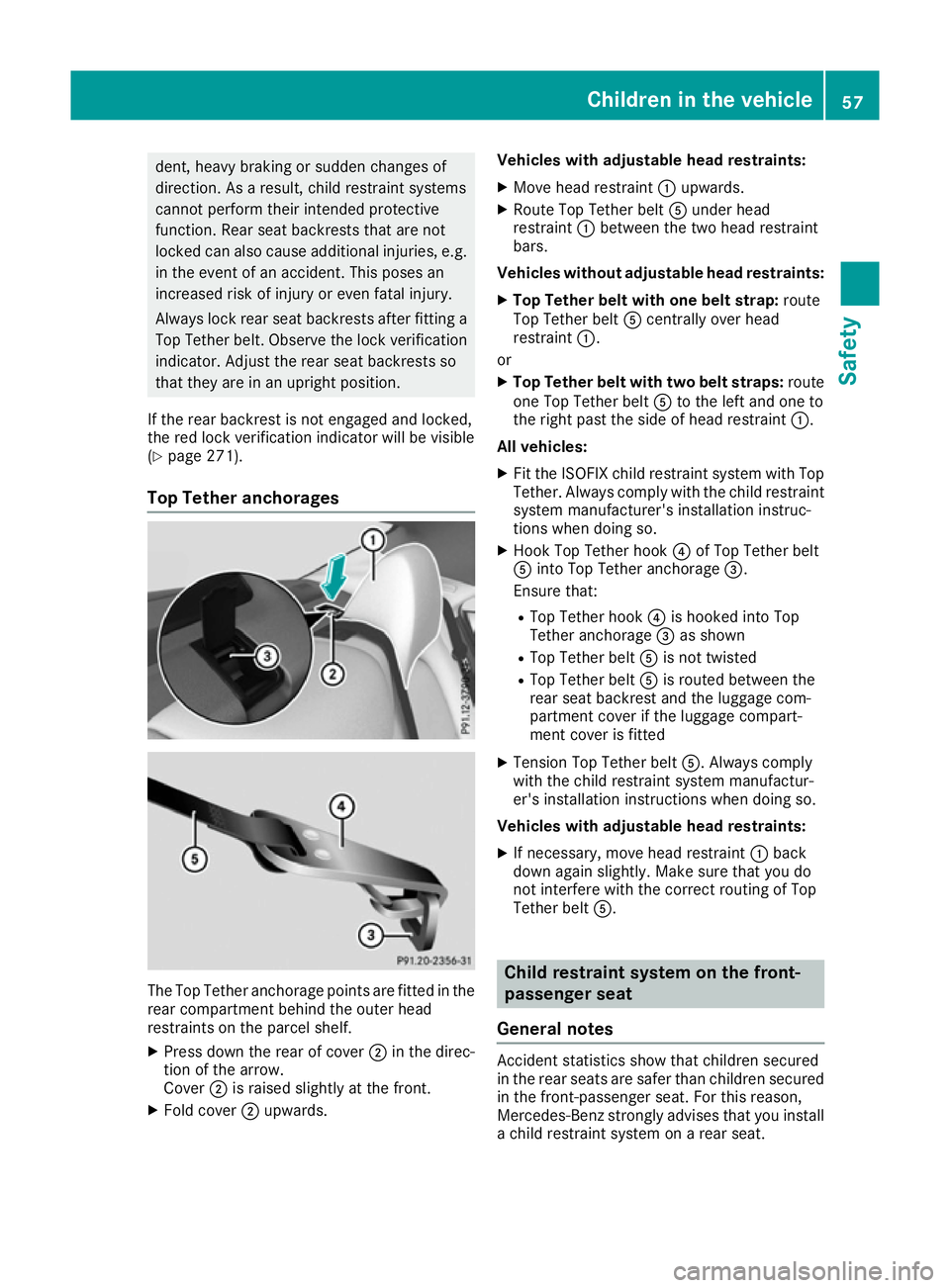
Top Tether anchorages The Top Tether anchorage points are fitted in the
rear compartment behind the outer head
restraints on the parcel shelf.
X Press down the rear of cover ;in the direc-
tion of the arrow.
Cover ;is raised slightly at the front.
X Fold cover ;upwards. Vehicles with adjustable head restraints:
X Move head restraint :upwards.
X Route Top Tether belt Aunder head
restraint :between the two head restraint
bars.
Vehicles without adjustable head restraints:
X Top Tether belt with one belt strap: route
Top Tether belt Acentrally over head
restraint :.
or
X Top Tether belt with two belt straps: route
one Top Tether belt Ato the left and one to
the right past the side of head restraint :.
All vehicles:
X Fit the ISOFIX child restraint system with Top
Tether. Always comply with the child restraint
system manufacturer's installation instruc-
tions when doing so.
X Hook Top Tether hook ?of Top Tether belt
A into Top Tether anchorage =.
Ensure that:
R Top Tether hook ?is hooked into Top
Tether anchorage =as shown
R Top Tether belt Ais not twisted
R Top Tether belt Ais routed between the
rear seat backrest and the luggage com-
partment cover if the luggage compart-
ment cover is fitted
X Tension Top Tether belt A. Always comply
with the child restraint system manufactur-
er's installation instructions when doing so.
Vehicles with adjustable head restraints:
X If necessary, move head restraint :back
down again slightly. Make sure that you do
not interfere with the correct routing of Top
Tether belt A. Child restraint system on the front-
passenger seat
General notes Accident statistics show that children secured
in the rear seats are safer than children secured
in the front-passenger seat. For this reason,
Mercedes-Benz strongly advises that you install a child restraint system on a rear seat. Children in the vehicle
57Safety Z
Page 61 of 345
Vehicles with the automatic front-passenger
front airbag deactivation system: if it is abso-
lutely necessary to fit a child restraint system to the front-passenger seat, always observe the
information on the "Automatic front-passenger
front airbag deactivation system" (Y page 47).
You can thus avoid the risks that could arise as
a result of:
R a child restraint system that is not detected
by the automatic front-passenger front airbag
deactivation system
R unintentional disabling of the front-passenger
front airbag
R unsuitable positioning of the child restraint
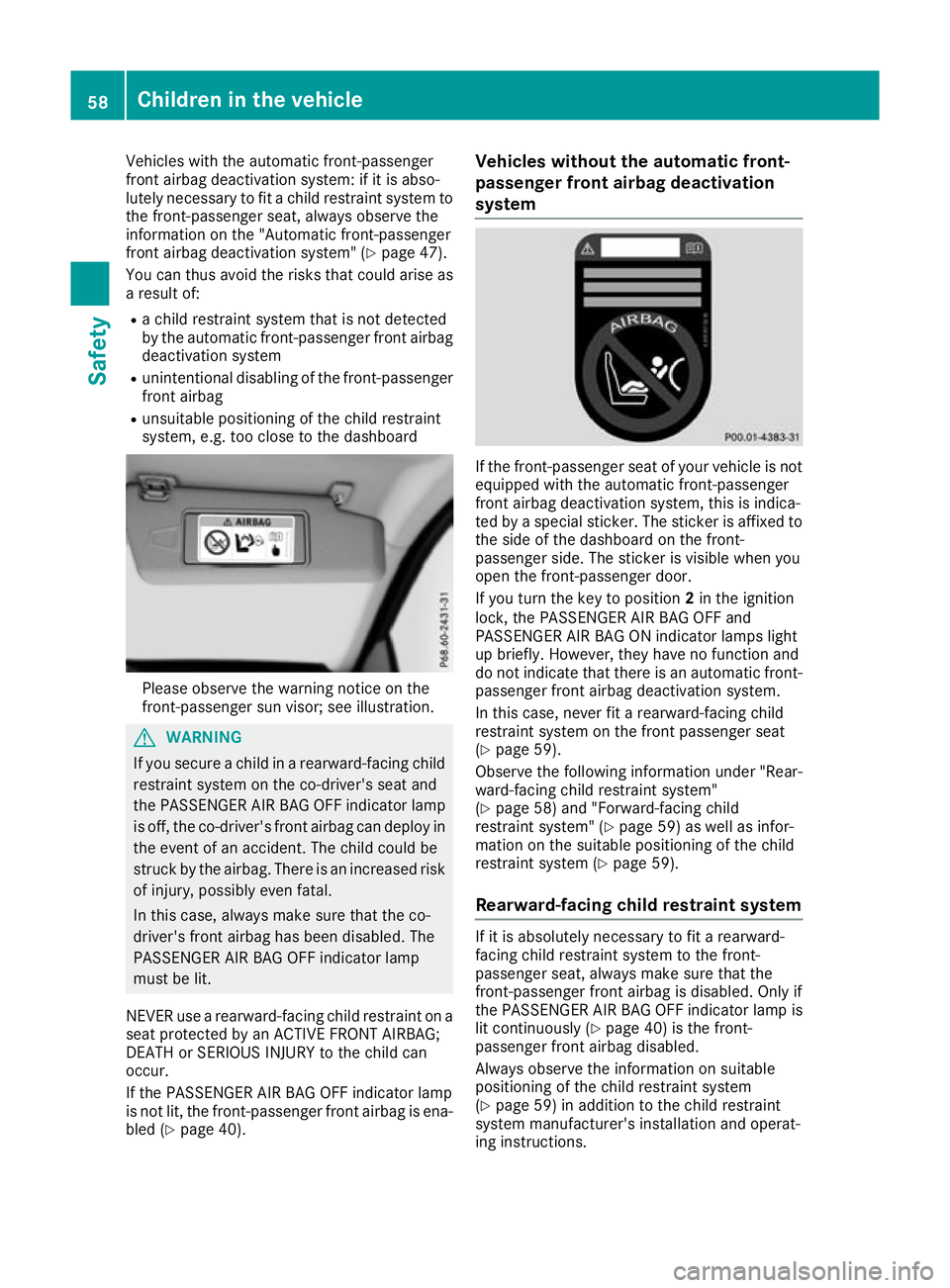
system, e.g. too close to the dashboard Please observe the warning notice on the
front-passenger sun visor; see illustration. G
WARNING
If you secure a child in a rearward-facing child
restraint system on the co-driver's seat and
the PASSENGER AIR BAG OFF indicator lamp
is off, the co-driver's front airbag can deploy in the event of an accident. The child could be
struck by the airbag. There is an increased risk
of injury, possibly even fatal.
In this case, always make sure that the co-
driver's front airbag has been disabled. The
PASSENGER AIR BAG OFF indicator lamp
must be lit.
NEVER use a rearward-facing child restraint on a
seat protected by an ACTIVE FRONT AIRBAG;
DEATH or SERIOUS INJURY to the child can
occur.
If the PASSENGER AIR BAG OFF indicator lamp
is not lit, the front-passenger front airbag is ena- bled (Y page 40). Vehicles without the automatic front-
passenger front airbag deactivation
system If the front-passenger seat of your vehicle is not
equipped with the automatic front-passenger
front airbag deactivation system, this is indica-
ted by a special sticker. The sticker is affixed to
the side of the dashboard on the front-
passenger side. The sticker is visible when you
open the front-passenger door.
If you turn the key to position 2in the ignition
lock, the PASSENGER AIR BAG OFF and
PASSENGER AIR BAG ON indicator lamps light
up briefly. However, they have no function and
do not indicate that there is an automatic front- passenger front airbag deactivation system.
In this case, never fit a rearward-facing child
restraint system on the front passenger seat
(Y page 59).
Observe the following information under "Rear-
ward-facing child restraint system"
(Y page 58) and "Forward-facing child
restraint system" (Y page 59) as well as infor-
mation on the suitable positioning of the child
restraint system (Y page 59).
Rearward-facing child restraint system If it is absolutely necessary to fit a rearward-
facing child restraint system to the front-
passenger seat, always make sure that the
front-passenger front airbag is disabled. Only if
the PASSENGER AIR BAG OFF indicator lamp is lit continuously (Y page 40) is the front-
passenger front airbag disabled.
Always observe the information on suitable
positioning of the child restraint system
(Y page 59) in addition to the child restraint
system manufacturer's installation and operat-
ing instructions. 58
Children in the vehicleSafety
Page 67 of 345
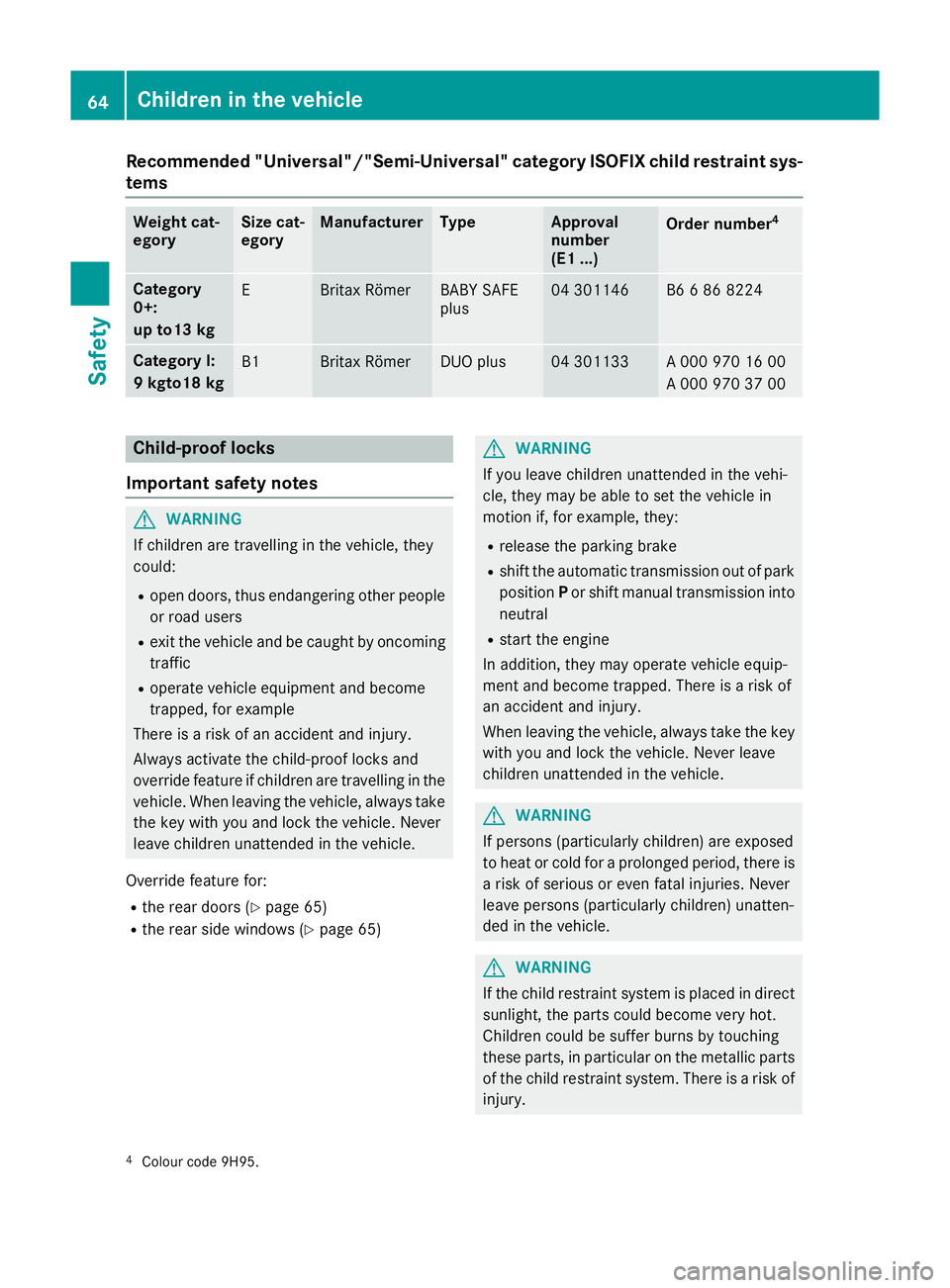
Recommended "Universal"/"Semi-Universal" category ISOFIX child restraint sys-
tems Weight cat-
egory Size cat-
egory Manufacturer Type Approval
number
(E1 ...)
Order number
4 Category
0+:
up to13 kg
E Britax Römer BABY SAFE
plus 04 301146 B6 6 86 8224
Category I:
9 kgto18 kg
B1 Britax Römer DUO plus 04 301133 A 000 970 16 00
A 000 970 37 00
Child-proof locks
Important safety notes G
WARNING
If children are travelling in the vehicle, they
could:
R open doors, thus endangering other people
or road users
R exit the vehicle and be caught by oncoming
traffic
R operate vehicle equipment and become
trapped, for example
There is a risk of an accident and injury.
Always activate the child-proof locks and
override feature if children are travelling in the vehicle. When leaving the vehicle, always take the key with you and lock the vehicle. Never
leave children unattended in the vehicle.
Override feature for:
R the rear doors (Y page 65)
R the rear side windows (Y page 65) G
WARNING
If you leave children unattended in the vehi-
cle, they may be able to set the vehicle in
motion if, for example, they:
R release the parking brake
R shift the automatic transmission out of park
position Por shift manual transmission into
neutral
R start the engine
In addition, they may operate vehicle equip-
ment and become trapped. There is a risk of
an accident and injury.
When leaving the vehicle, always take the key with you and lock the vehicle. Never leave
children unattended in the vehicle. G
WARNING
If persons (particularly children) are exposed
to heat or cold for a prolonged period, there is a risk of serious or even fatal injuries. Never
leave persons (particularly children) unatten-
ded in the vehicle. G
WARNING
If the child restraint system is placed in direct sunlight, the parts could become very hot.
Children could be suffer burns by touching
these parts, in particular on the metallic parts
of the child restraint system. There is a risk of injury.
4 Colour code 9H95. 64
Children in the vehicleSafety
Page 68 of 345
If you and your child leave the vehicle, always
make sure that the child restraint system is
not in direct sunlight. Cover it with a blanket, for example. If the child restraint system has
been exposed to direct sunlight, leave it to
cool down before securing the child in it.
Never leave children unattended in the vehi-
cle.
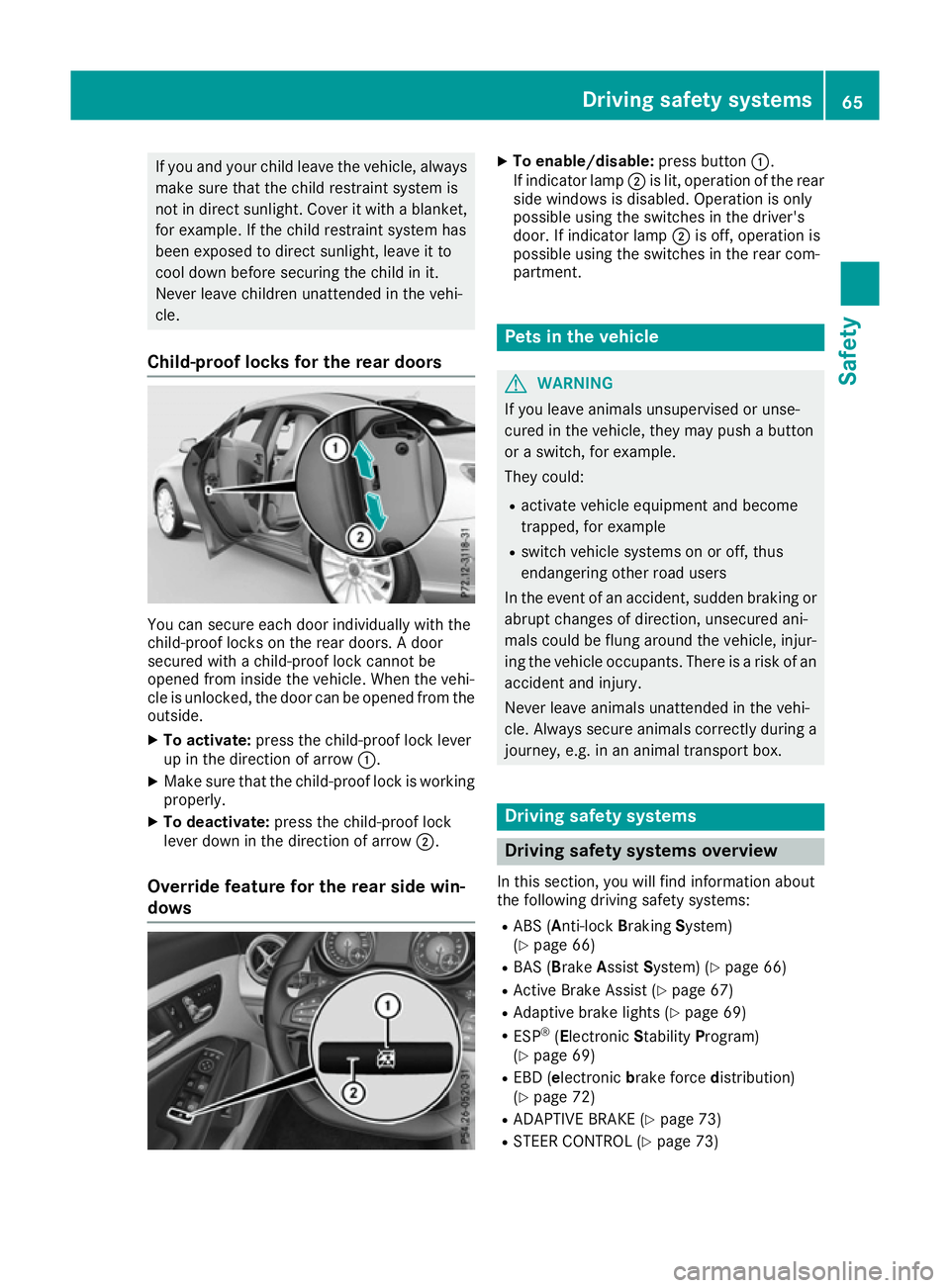
Child-proof locks for the rear doors You can secure each door individually with the
child-proof locks on the rear doors. A door
secured with a child-proof lock cannot be
opened from inside the vehicle. When the vehi-
cle is unlocked, the door can be opened from the
outside.
X To activate: press the child-proof lock lever
up in the direction of arrow :.
X Make sure that the child-proof lock is working
properly.
X To deactivate: press the child-proof lock
lever down in the direction of arrow ;.
Override feature for the rear side win-
dows X
To enable/disable: press button:.
If indicator lamp ;is lit, operation of the rear
side windows is disabled. Operation is only
possible using the switches in the driver's
door. If indicator lamp ;is off, operation is
possible using the switches in the rear com-
partment. Pets in the vehicle
G
WARNING
If you leave animals unsupervised or unse-
cured in the vehicle, they may push a button
or a switch, for example.
They could:
R activate vehicle equipment and become
trapped, for example
R switch vehicle systems on or off, thus
endangering other road users
In the event of an accident, sudden braking or
abrupt changes of direction, unsecured ani-
mals could be flung around the vehicle, injur-
ing the vehicle occupants. There is a risk of an accident and injury.
Never leave animals unattended in the vehi-
cle. Always secure animals correctly during a
journey, e.g. in an animal transport box. Driving safety systems
Driving safety systems overview
In this section, you will find information about
the following driving safety systems: R ABS (Anti-lock BrakingSystem)
(Y page 66)
R BAS ( Brake Assist System) (Y page 66)
R Active Brake Assist (Y page 67)
R Adaptive brake lights (Y page 69)
R ESP ®
(Electronic StabilityProgram)
(Y page 69)
R EBD ( electronic brake force distribution)
(Y page 72)
R ADAPTIVE BRAKE (Y page 73)
R STEER CONTROL (Y page 73) Driving safety systems
65Safety Z
Page 69 of 345
Important safety notes
If you fail to adapt your driving style or if you are
inattentive, the driving safety systems can nei-
ther reduce the risk of an accident nor override the laws of physics. Driving safety systems are
merely aids designed to assist driving. You are
responsible for maintaining the distance to the
vehicle in front, for vehicle speed, for braking in
good time and for staying in lane. Always adapt your driving style to suit the prevailing road and
weather conditions and maintain a safe distance from the vehicle in front. Drive carefully.
The driving safety systems described work as
effectively as possible only when there is ade-
quate contact between the tyres and the road
surface. Please pay special attention to the
notes on tyres, recommended minimum tyre
tread depths etc. (Y page 310).
In wintry driving conditions, always use winter
tyres (M+S tyres) and, if necessary, snow
chains. Only in this way will the driving safety
systems described in this section work as effec-
tively as possible. ABS (Anti-lock Braking System)
General notes ABS regulates brake pressure in such a way that
the wheels do not lock when you brake. This
allows you to continue steering the vehicle when braking.
The ! ABS warning lamp in the instrument
cluster lights up when the ignition is switched
on. It goes out when the engine is running.
ABS works from a speed of about 8 km/h,
regardless of road-surface conditions. ABS
works on slippery surfaces, even when you only
brake gently.
Important safety notes i
Observe the "Important safety notes" sec-
tion (Y page 66). G
WARNING
If ABS is faulty, the wheels could lock when
braking. The steerability and braking charac-
teristics may be severely impaired. Addition-
ally, further driving safety systems are deac- tivated. There is an increased danger of skid-
ding and accidents.
Drive on carefully. Have ABS checked imme-
diately at a qualified specialist workshop.
If ABS is malfunctioning, other systems, includ-
ing driving safety systems, will also become
inoperative. Observe the information on the ABS warning lamp (Y page 250) and display mes-
sages which may be shown in the instrument
cluster (Y page 217).
Braking X
If ABS intervenes: continue to depress the
brake pedal with force until the braking sit-
uation is over.
X To make a full brake application: depress
the brake pedal with full force.
If ABS intervenes when braking, you will feel a
pulsing in the brake pedal.
The pulsating brake pedal can be an indication
of hazardous road conditions; this serves as a
reminder to take extra care while driving. BAS (Brake Assist)
General notes BAS operates in emergency braking situations.
If you depress the brake pedal quickly, BAS
automatically boosts the braking force, thus
shortening the stopping distance.
Important safety notes i
Read the "Important safety notes" section
(Y page 66). G
WARNING
If BAS is malfunctioning, the braking distance
in an emergency braking situation is
increased. There is a risk of accident.
In an emergency braking situation, depress
the brake pedal with full force. ABS prevents
the wheels from locking. 66
Driving safety systemsSafety
Page 70 of 345
Braking
X
Keep the brake pedal depressed firmly until
the emergency braking situation is over.
ABS prevents the wheels from locking.
The brakes will function as usual once you
release the brake pedal. BAS is deactivated. Active Brake Assist
General information i
Read the "Important safety notes" section
(Y page 66).
Active Brake Assist consists of a distance warn-
ing function with an autonomous braking func-
tion and braking assistance appropriate to the
situation.
Active Brake Assist can help you to minimise the risk of a collision with the vehicle travelling in
front or reduce the effects of such a collision.
If Active Brake Assist detects that there is a risk
of collision, you will be warned visually and
acoustically. If you do not react to the visual and audible collision warning, autonomous braking
can be initiated in critical situations. If you apply
the brake yourself in a critical situation, Adap-
tive Brake Assist supports you with braking
assistance appropriate to the situation.
Important safety notes Detection of hazardous situations can be par-
ticularly impaired by:
R
dirt on the sensors or obscured sensors
R snow or heavy rain
R interference by other radar sources
R strong radar reflections, for example, in multi-
storey car parks
R a narrow vehicle travelling in front, e.g. a
motorcycle
R a vehicle travelling in front on a different line
R new vehicles or after servicing is carried out
on the Active Brake Assist system
Read the important safety notes in the "Run-
ning-in notes" section (Y page 132).
Following damage to the front end of the vehicle, have the configuration and operation of the
radar sensor checked at a qualified specialist
workshop. This also applies to collisions at low speeds where no visible damage to the front of
the vehicle is apparent.
Activating/deactivating Active Brake Assist is active after every ignition
cycle.
You can activate or deactivate Active Brake
Assist (Y page 209) in the on-board computer.
When the system is deactivated, the distance
warning function and the autonomous braking
function are also deactivated.
If Active Brake Assist is deactivated, the æ
symbol appears in the assistance graphic dis-
play.
Distance warning function General information
The distance warning function can help you to
minimise the risk of collision with the vehicle in
front or reduce the effects of such a collision. If the distance warning function detects a risk of
collision with the vehicle in front, you will be
warned visually and audibly.
Important safety notes
i Observe the "Important safety notes" sec-
tion for driving safety systems (Y page 66). G
WARNING
The distance warning function does not react:
R to people or animals
R to oncoming vehicles
R to crossing traffic
R when cornering
Thus, the distance warning function cannot
provide a warning in all critical situations.
There is a risk of an accident.
Always pay careful attention to the traffic sit-
uation and be ready to brake. G
WARNING
The distance warning function cannot always
clearly identify objects and complex traffic
situations. Driving safety systems
67Safety
Z
Page 72 of 345
Braking assistance appropriate to the situation
can also detect stationary objects, up to vehicle
speeds of around 70 km/h.
If braking assistance appropriate to the situa-
tion demands particularly high brake pressure,
preventative passenger protection measures
(PRE-SAFE ®
) are triggered simultaneously
(Y page 53).
X Keep the brake pedal depressed until the
emergency braking situation is over.
ABS prevents the wheels from locking.
The brakes will work normally again if: R you release the brake pedal
R a danger of collision with the vehicle in front
no longer exists
R no obstacle is detected in front of your vehicle
Braking assistance appropriate to the situation
is then deactivated.
Important safety notes i Observe the "Important safety notes" sec-
tion for driving safety systems (Y page 66).G
WARNING
Adaptive Brake Assist does not react:
R to people or animals
R to oncoming vehicles
R to crossing traffic
R when cornering
As a result, Adaptive Brake Assist may not
intervene in all critical conditions. The risk of
an accident remains.
Always pay careful attention to the traffic sit- uation and be ready to brake. G
WARNING
Adaptive Brake Assist cannot always clearly
identify objects and complex traffic situa-
tions.
In such cases, Adaptive Brake Assist might:
R intervene unnecessarily
R not intervene
The risk of an accident remains.
Always pay careful attention to the traffic sit- uation and be ready to brake. Terminate the
intervention in a non-critical driving situation. Due to the nature of the system, complex but
non-critical driving conditions may also cause
Active Brake Assist to intervene.
Even if Active Brake Assist is not available due to a malfunction in the radar sensor system, the
brake system is still available with full brake
boosting effect and BAS. Adaptive brake lights
The adaptive brake lights warn following traffic
in an emergency braking situation by: R flashing brake lamps
R the hazard warning lamps are activated
If you brake sharply from a speed of more than
50 km/h or if braking is assisted by BAS or BAS
PLUS, the brake lamps flash rapidly. In this way,
traffic travelling behind you is warned in an even more noticeable manner.
If you brake sharply from a speed of more than
70 km/h to a standstill, the hazard warning
lamps are activated automatically. If the brakes
are applied again, the brake lamps light up con-
tinuously. The hazard warning lamps switch off
automatically if you travel faster than 10 km/h. You can also switch off the hazard warning
lamps using the hazard warning button
(Y page 109). ESP
®
(Electronic Stability Program)
General notes i
Observe the "Important safety notes" sec-
tion (Y page 66).
ESP ®
monitors driving stability and traction, i.e.
power transmission between the tyres and the
road surface.
If ESP ®
detects that the vehicle is deviating from
the direction desired by the driver, one or more
wheels are braked to stabilise the vehicle. The
engine output is also modified to keep the vehi- cle on the desired course within physical limits.
ESP ®
assists the driver when pulling away on
wet or slippery roads. ESP ®
can also stabilise
the vehicle during braking. Driving safety systems
69Safety Z
Page 76 of 345
Important safety notes
i
Read the "Important safety notes" section
(Y page 66). G
WARNING
If EBD is malfunctioning, the rear wheels can
lock, e.g. under full braking. This increases the risk of skidding and an accident.
You should therefore adapt your driving style
to the different handling characteristics. Have the brake system checked at a qualified spe-
cialist workshop.
Observe information regarding indicator and
warning lamps (Y page 250) as well as display
messages (Y page 219). ADAPTIVE BRAKE
ADAPTIVE BRAKE enhances braking safety and
offers increased braking comfort. In addition to
the braking function, ADAPTIVE BRAKE also has the HOLD function (Y page 172) and hill start
assist (Y page 136). STEER CONTROL
General information STEER CONTROL helps you by transmitting a
noticeable steering force to the steering wheel
in the direction required for vehicle stabilisation.
This steering support is provided in particular if:
R both right wheels or both left wheels are on a
wet or slippery road surface when you brake
R the vehicle begins to skid
Important safety notes i
Read the "Important safety notes" section
(Y page 66).
No steering support is provided from STEER
CONTROL, if: R ESP ®
is malfunctioning
R the steering is malfunctioning
If ESP ®
is malfunctioning, you will be assisted
further by the electrical power steering. Protection against theft
Immobiliser
The immobiliser prevents your vehicle from
being started without the correct key.
X To activate with the key: remove the key
from the ignition lock.
X To activate with KEYLESS-GO start func-
tion or KEYLESS-GO:
switch the ignition off
and open the driver's door.
X To deactivate: switch on the ignition.
When leaving the vehicle, always take the key
with you and lock the vehicle. Anyone can start
the engine if a valid key has been left inside the
vehicle.
i The immobiliser is always deactivated when
you start the engine. ATA (Anti-Theft Alarm system)
X
To prime: lock the vehicle with the key or
KEYLESS-GO.
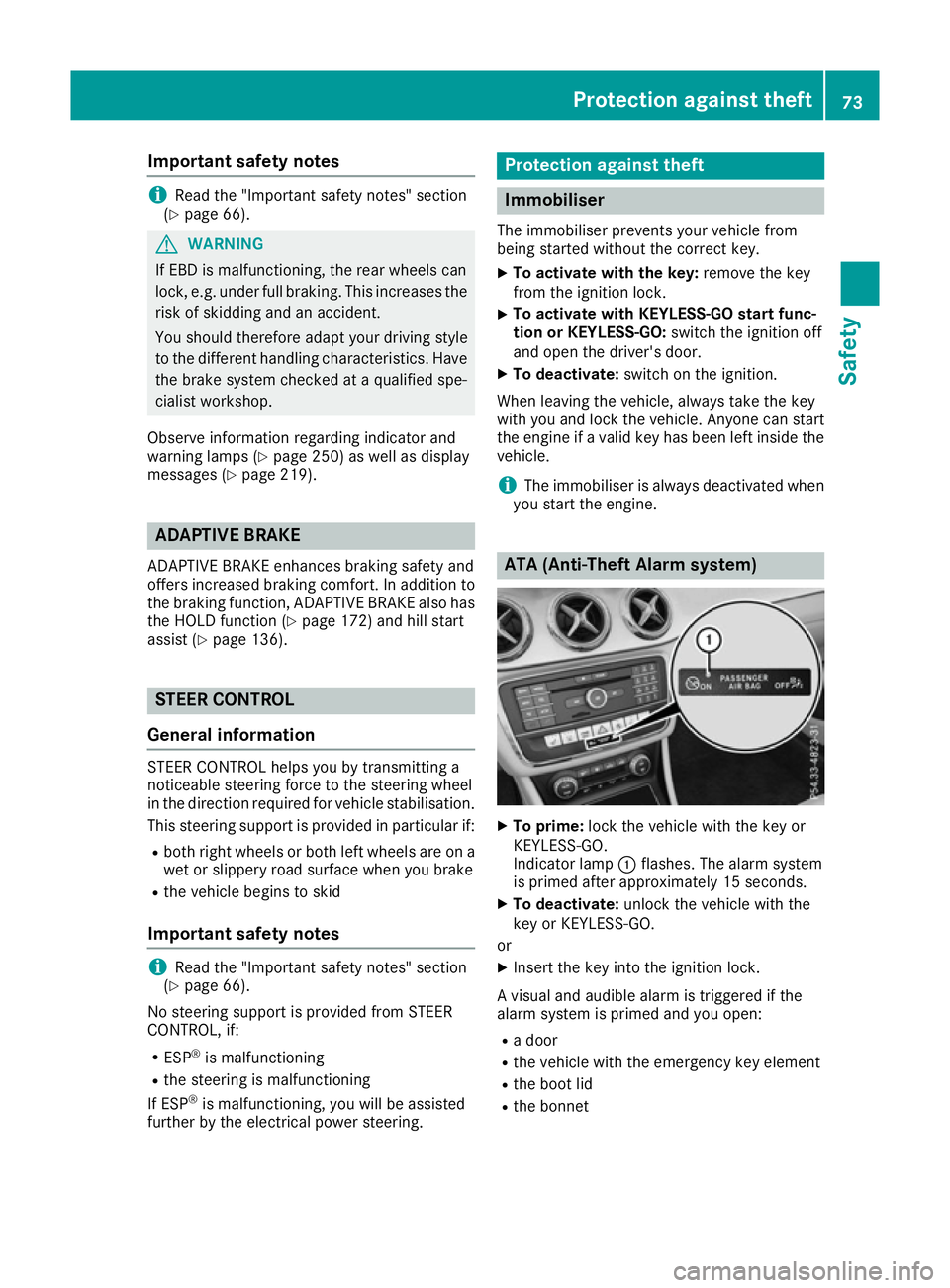
Indicator lamp :flashes. The alarm system
is primed after approximately 15 seconds.
X To deactivate: unlock the vehicle with the
key or KEYLESS-GO.
or X Insert the key into the ignition lock.
A visual and audible alarm is triggered if the
alarm system is primed and you open: R a door
R the vehicle with the emergency key element
R the boot lid
R the bonnet Protection against theft
73Safety Z
Page 77 of 345
X
To stop the alarm with the key: press the
% or& button on the key.
The alarm stops.
or X Vehicles with KEYLESS-GO start function
or KEYLESS-GO: remove the Start/Stop but-
ton from the ignition lock (Y page 133).
X Insert the key into the ignition lock.
The alarm stops.
X To stop the alarm using KEYLESS-GO:
grasp the outside door handle. The key must
be outside the vehicle.
The alarm stops.
or X Press the Start/Stop button on the dash-
board. The key must be inside the vehicle.
The alarm stops.
The alarm does not switch off, even if you close the open door that has triggered it, for example.
i If the alarm stays on for more than
30 seconds, the Mercedes‑Benz emergency
call system automatically sends a message to
the Customer Centre. This is done by means
of a text message or a data connection.
The emergency call system sends a message or establishes a data connection provided
that:
R you have subscribed to the Mercedes‑Benz
emergency call system
R the Mercedes‑Benz emergency call system
has been activated properly
R the necessary mobile phone network is
available Tow-away protection
Function An audible and visual alarm is triggered if your
vehicle's angle of inclination is altered while
tow-away protection is primed. This can occur if
the vehicle is jacked up on one side, for exam-
ple.
Switching on X
Make sure that: R
the doors are closed
R the boot lid is closed
Only then is tow-away protection activated.
X Lock the vehicle with the key or KEYLESS-GO.
Tow-away protection is activated after
approximately 60 seconds.
Switching off X
Unlock the vehicle with the key or KEYLESS-
GO.
or X Insert the key into the ignition lock.
Tow-away protection is switched off automat-
ically.
Deactivating X
Remove the key from the ignition lock.
or X Vehicles with KEYLESS-GO start function
or KEYLESS-GO: switch off the engine using
the Start/Stop button and open the driver's
door.
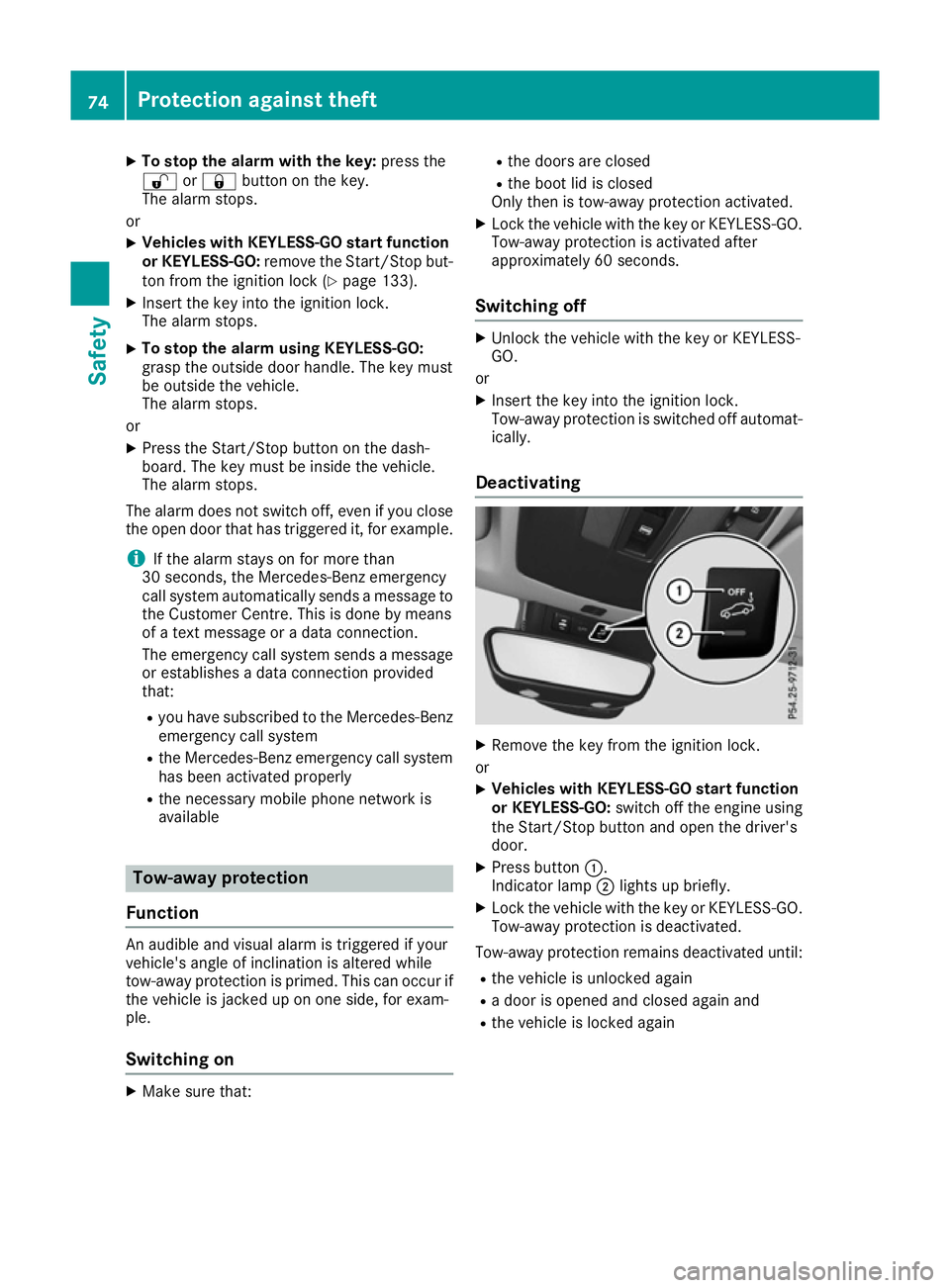
X Press button :.
Indicator lamp ;lights up briefly.
X Lock the vehicle with the key or KEYLESS-GO.
Tow-away protection is deactivated.
Tow-away protection remains deactivated until: R the vehicle is unlocked again
R a door is opened and closed again and
R the vehicle is locked again 74
Protection against theftSafety