warning MERCEDES-BENZ CLA COUPE 2019 User Guide
[x] Cancel search | Manufacturer: MERCEDES-BENZ, Model Year: 2019, Model line: CLA COUPE, Model: MERCEDES-BENZ CLA COUPE 2019Pages: 330, PDF Size: 52.4 MB
Page 44 of 330
occupant
inthe best position inrelation tothe
air bag.
The seat beltsystem comprises:
R Seat belts
R Emergen cyTensionin gDevices forthe front
seat belts andtheouter seatbelts inthe rear
R Seat beltforce limiters forthe front seatbelts
and theouter seatbelts inthe rear
If the seat beltispulled outofthe belt outlet
quickly orwith ajerk ymovement ,the belt
retract orlocks. Thebelt strap cannotbe extr ac-
ted any further.
The Emergen cyTensionin gDevice tightensthe
seat beltinan accident ,pulling thebelt close
against thebody. However itdoes notpull the
vehicle occupant backinthe direction ofthe
backrest .
The Emergen cyTensionin gDevice doesnotcor-
rect anincorr ectseat position orthe routing of
an incorr ectlyfastened seatbelt.
When triggered, aseat beltforce limiter helpsto
reduce theforce exertedbythe seat beltonthe
vehicle occupant .
The seat beltforce limiters forthe front seats are
synchron izedwith thefront airbags, which
absorb partofthe deceleration force.Thiscan
reduce theforce exertedon the vehicle occu-
pants during anaccident .
! If
the front -passenger seatisnot occupied,
do not engage theseat belttongue inthe
buckle onthe front -passenger seat.Other-
wise, inthe event ofan accident theEmer-
gency Tensionin gDevice andtheside impact
air bag, inaddition toother systems, maybe
triggered andhave tobe replaced.
Import antsafety notes The
useofseat belts andchild restraint systems
is required bylaw in:
R all 50 states
R the U.S. territ ories
R the Distr ictofColumbia
R all Canadian provinces
Even where thisisnot required bylaw, allvehicle
occupant sshould correctlyfasten theirseat
belts before startingthe journey. G
WARNING
If the seat beltisnot worn correc tly,itcann ot
perform itsinten dedprotect ivefunct ion.An incorr
ectlyfastened seatbeltcanalso cause
injuries, forexample, inthe event ofan acci-
dent orwhen braking orchanging direction
abruptly. Thisposes anincreased riskofinjury
or even fatalinjury.
Always ensurethatallvehicle occupant shave
their seatbelts fastened correctlyand aresit-
ting properly.
The componen tsof the restraint systemworkin
conj unct ionwith each other. Theycanonly
deploy theirprotect ivefunct ionif,at all times, all
vehicle occupant s:
R have fastened theirseatbelts correc tly
(Y page 43)
R have theseat andhead restraint adjusted
properly (Ypage 91) G
WARNING
The seat beltdoes notoffer theinten dedlevel
of protect ionifyou have notmoved theback-
rest toan almost verticalposition. Whenbrak-
ing orinthe event ofan accident ,you could
slide underneath theseat beltandsustain
abdomen orneck injuries, forexample. This
poses anincreased riskofinjury oreven fatal
injury.
Adjust theseat properly beforebeginning
your journey. Alwaysensurethatthebackrest
is in an almost verticalposition andthat the
shoulder sectionofyour seatbeltisrouted
across thecent erofyour shoulder. G
WARNING
Persons lessthan 5ft (1.50 m)tall cann ot
wear theseat beltcorrec tlywithout anaddi-
tional andsuitable restraint system.Ifthe
seat beltisnot worn correc tly,itcann otper-
form itsinten dedprotect ivefunct ion.An
incorr ectlyfastened seatbeltcanalso cause
injuries, forexample, inthe event ofan acci-
dent orwhen braking orchanging direction
abruptly. Thisposes anincreased riskofinjury
or even fatalinjury.
For this reason, alwayssecure persons under
5 ft (1.50 m)tall insuitable additional restraint
systems. 42
Occupant
safetySafety
Page 46 of 330
Infants
andchildre nmust never travel sitting
on the lapofavehicle occupant. Inthe event
of an accident, theycould becrushed
betwee nthe vehicle occupant andseat belt.
R objects arenever secured withaseat beltif
the seat beltisalso being usedbyone ofthe
vehicle 'soccupants
Also ensure thatthere arenever objects
betwee naperson andtheseat, e.g.cushio ns.
Seat belts areonly intended tosecure and
restrain vehicleoccupants. Alwaysobserve the
"Loa ding guidelines" forsecuring objects,lug-
gage orload s(Y page 239).
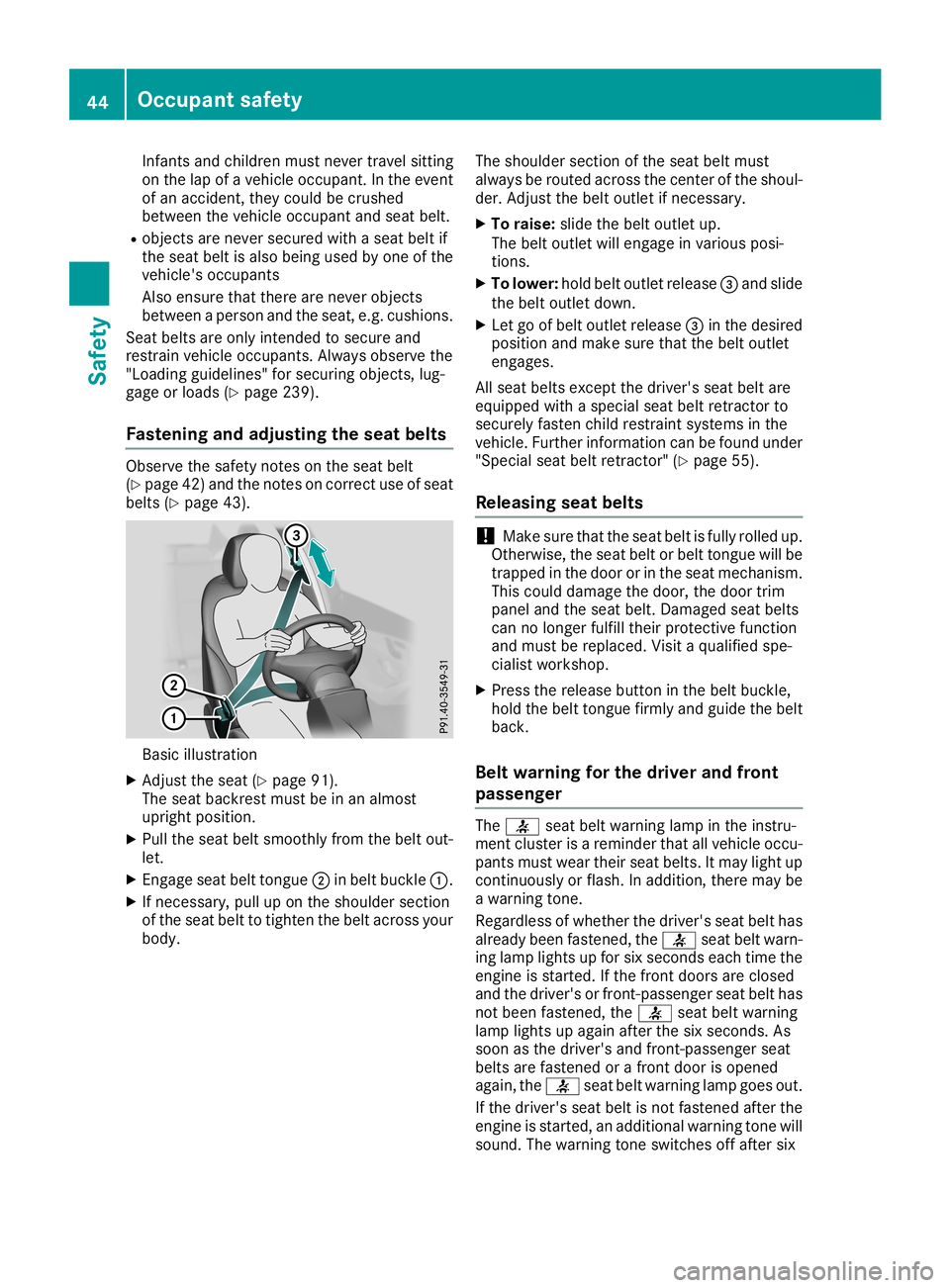
Fasteni ngand adjusting theseat belts Observe
thesafety notesonthe seat belt
(Y page 42)and thenotes oncorrect useofseat
belts (Ypage 43). Basic
illustration
X Adjust theseat (Ypage 91).
The seat backrest mustbeinan almos t
upri ghtpositio n.
X Pul lthe seat beltsmoothly fromthebelt out-
let.
X Engage seatbelttongue 0044inbelt buckle 0043.
X Ifnecessary ,pul lup on the shoul dersection
of the seat belttotighten thebelt across your
body . The
shoul dersection ofthe seat beltmust
alw ays berouted across thecenter ofthe shoul -
der. Adjust thebelt outlet ifnecessary .
X To raise: slidethe belt outlet up.
The belt outlet willengage invariou sposi-
tions.
X To low er:hold beltoutlet release0087 and slide
the belt outlet down.
X Let goofbelt outlet release0087 inthe desire d
positio nand make surethatthebelt outlet
engages .
All seat belts except thedriver's seatbeltare
equi pped withaspecia lseat beltretractor to
securel yfasten childrestraint systemsinthe
vehicle .Further information canbefound under
"Specia lseat beltretractor" (Ypage 55).
Releas ingseat belts !
Make
surethattheseat beltisfull yrolle dup.
Otherwise ,the seat beltorbelt tongue willbe
trapped inthe door orinthe seat mechanism.
This could damagethe door, thedoor trim
panel andtheseat belt. Damaged seatbelts
can nolonger fulfilltheir protective function
and must berepla ced.Visit aqua lifiedspe-
ciali stworkshop.
X Press therelea sebutton inthe belt buckle,
hold thebelt tongue firmlyandguide the belt
back.
Belt warning forthe driver andfront
passeng er The
0076 seatbeltwarning lampinthe instru-
ment cluster isareminder thatallvehicle occu-
pants mustweartheir seatbelts. Itmay light up
continuously orflash. Inaddi tion, there maybe
a warning tone.
Rega rdless ofwhether thedriver's seatbelthas
alrea dybeen fastened, the0076 seatbeltwarn-
ing lamp lights upfor sixseconds eachtimethe
engine isstarted. Ifthe front doors areclosed
and thedriver's orfront-passenger seatbelthas
not been fastened, the0076 seatbeltwarning
lamp lightsup aga inafter thesixseconds. As
soon asthe driver's andfront-passenger seat
belts arefastened orafront doorisopened
aga in,the 0076 seatbeltwarning lampgoesout.
If the driver's seatbeltisnot fastened afterthe
engine isstarted, anaddi tional warning tonewill
sound. Thewarning toneswitches offafter six 44
Occ
upant safetySafety
Page 47 of 330
seconds
oronce thedriver's seatbeltisfas-
tened.
If the vehicle's speedexceeds 15mph
(25 km/h) onceandthedriver's andfront -
passenger seatbelts arenot fastened, awarning
tone sounds. Awarning tonealsosounds with
increasing intensityfor 60seconds oruntil the
driver orfront passenger havefastened their
seat belts.
If the driver orfront passenger unfastentheir
seat belts during thejourney, theseat beltwarn-
ing isactivated again. Air
bags
Introduction The
installation pointofan air bag canberec-
ognized bythe AIRBAG marking.
An airbag complements thecorrect lyfastened
seat belt. Itis no substitute forthe seat belt. The
air bag provides additional protection inappli -
cable accident situations.
Not allair bags aredeploy edinan accident. The
different airbag systems functionindepend-
ently fromoneanother (Ypage 52).
However, nosystem available today cancom-
pletely eliminate injuriesandfatalities.
It is also notpossible torule outarisk ofinjury
caused byan air bag due tothe high speed at
which theairbag must bedeploy ed.
Importa ntsafety notes G
WARNING
If you donot sitinthe correct seatposition,
the airbag cannot protect asintended and
could evencause additional injurywhen
deploy ed.This poses anincreased riskof
injury oreven fatalinjury.
To avoid hazardous situations, alwaysmake
sure thatallofthe vehicle's occupants:
R have fastened theirseatbelts correct ly,
including pregnantwomen
R are sitting correct lyand maintain thegreat-
est possible distance tothe airbags
R follow thefollowi nginstruct ions Always
makesurethatthere arenoobjects
between theairbag and thevehicle's occu-
pants.
R Adjust theseats properly beforebeginning
your journey. Alwaysmakesurethattheseat
is in an almost upright position. Thecenter of
the head restraint mustsupport thehead at
about eyelevel.
R Move thedriver's andfront -passenger seats
as far back aspossible .The driver's seatposi-
tion must allow thevehicle tobe driven safely.
R Only holdthesteering wheelonthe outside.
This allow sthe airbag tobe fully deploy ed.
R Always leanagainstthe backrest whiledriv-
ing. Donot lean forward orlean againstthe
door orside window. Youmay otherwise bein
the deploy mentareaofthe airbags.
R Always keepyourfeetinthe footwell infront
of the seat. Donot putyour feetonthe dash-
board, forexample. Yourfeetmay otherwise
be inthe deploy mentareaofthe airbag.
R For this reason, alwayssecure persons less
than 5ft (1.50 m)tall insuitable restraint sys-
tems. Uptothis height, theseat beltcannot
be worn correct ly.
If achild istra veling inyour vehicle ,also
observe thefollow ingnotes:
R Always securechildren undertwelve yearsof
age and less than 5ft (1.50 m)tallin suita ble
chi ldres traint syste ms.
R Ch ild res traint syste ms sho uldbe installedon
the rearse ats .
R Onl yse cur eachi ldinarea rward-fa cing child
res traint syste mon the front-pa ssenge rse at
wh en the front-pa ssenge rfro ntairba gis
de acti vated .If the PASSEN GERAIRBAG OFF
ind icator lamp ispe rma nentl ylit, the front-
pa sse nge rfro ntairba gis de acti vated
(Y page 41) .
R Alw aysob serve the instructio nsand safety
note son the "Occu pantClas sific ati on Sys tem
(O CS) "(Y page 47) and on"Child ren inthe
veh icle" (Y page 54)in ad ditio nto the child
res traint syste mma nuf actu rer'sins tallatio n
and opera ting instructio ns. Oc
cupant safety
45Safety Z
Page 53 of 330
G
WARNING
Objects betweenthe seat surfa ceand the
child restrai ntsystem couldaffect OCSoper-
ation. Thiscouldresu ltin the front-passenge r
air bag notfunctioning asintended duringan
accide nt.This poses anincreas edrisk of
injury oreven fatalinjury .
Do not placeany objects betweenthe seat
surfa ceand thechild restrai ntsystem. The
entire baseofthe child restrai ntsystem must
alw aysrest onthe seat cushi onofthe front-
pass enger seat.Thebackrest ofthe forwa rd-
facing childrestrai ntsystem must,asfar as
possi ble,be resting onthe backrest ofthe
front-passenge rseat. Alwayscomply withthe
child restrai ntsystem manufacturer's instal-
lati on instructions. After
theself-test, thePASSENGER AIRBAG OFF
or the PASSENGER AIRBAG ONindica torlamp
disp laysthe status ofthe front-passenge rfront
air bag (Ypag e48). Ifthe front-passenge rfront
air bag isenabl ed,the PASSENGER AIRBAG ON
indica torlamp lights upfor 60seconds andthen
goes out.
If the PASSENGER AIRBAG ONindica torlamp is
off, only thePASSENGER AIRBAG OFFindica tor
lamp displaysthe status ofthe front-passenge r
front airbag .The PASSENGER AIRBAG OFF
indica torlamp maybelitcontinuou slyorbe off.
For more informati onabo utthe OCS, see"Pro b-
lems withtheOccupa ntCla ssifi cation System"
(Y pag e51).
Probl emswith the Occupant Classificatio nSystem (OCS) Be
sure toobser vethe notes on"Sys tem self-test" (Ypag e50). Occ
upant safety
51Safety Z
Page 54 of 330
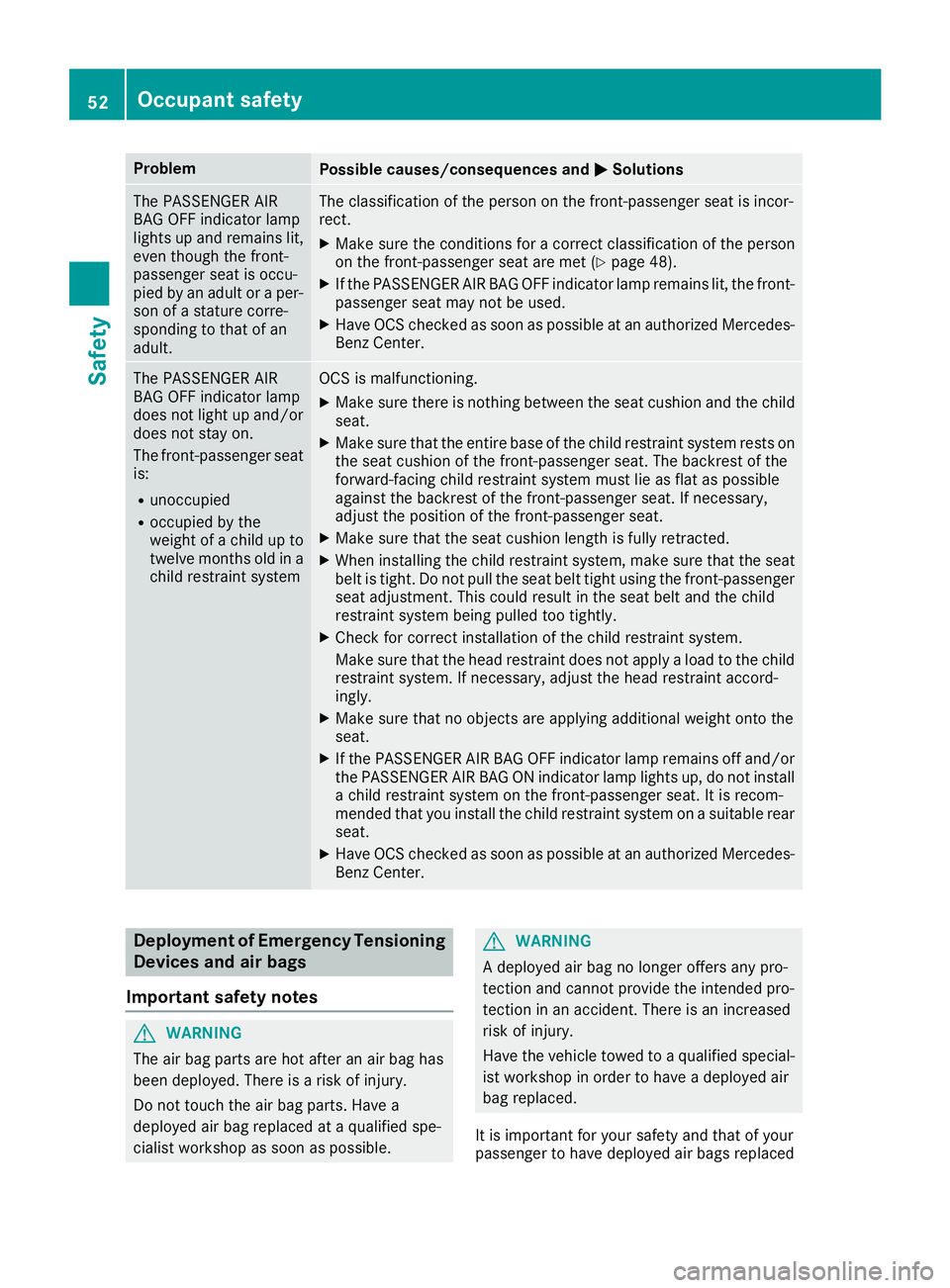
Problem
Possible
causes/co nsequences and0050 0050
Solutions The
PASS ENGER AIR
BAG OFFindicator lamp
lights upand remains lit,
even though thefront -
passenger seatisoccu-
pied byan adult oraper-
son ofastature corre-
sponding tothat ofan
adult. The
classification ofthe person onthe front -passenger seatisincor-
rect.
X Make surethecondition sfor acorrect classification ofthe person
on the front -passenger seataremet (Ypage 48).
X Ifthe PASS ENGER AIRBAG OFFindicator lampremains lit,the front -
passenger seatmaynotbeused.
X Have OCScheck edassoon aspossible atan authorized Mercedes-
Benz Center. The
PASS ENGER AIR
BAG OFFindicator lamp
does notlight upand/or
does notstay on.
The front -passenger seat
is:
R unoccupied
R occupied bythe
weight ofachild upto
twelve monthsold ina
child restraint system OCS
ismalfunctionin g.
X Make surethere isnothin gbetween theseat cushion andthechild
seat.
X Make surethattheentire baseofthe child restraint systemrestson
the seat cushion ofthe front -passenger seat.Thebackrest ofthe
forward-facing childrestraint systemmustlieasflat aspossible
against thebackrest ofthe front -passenger seat.Ifnecessary,
adjust theposition ofthe front -passenger seat.
X Make surethattheseat cushion lengthisfully retract ed.
X When installing thechild restraint system,makesurethattheseat
belt istight. Donot pull theseat belttight using thefront -passenger
seat adjustment .This could result inthe seat beltandthechild
restraint systembeingpulled tootightly.
X Check forcorrect installation ofthe child restraint system.
Make surethatthehead restraint doesnotapply aload tothe child
restraint system.Ifnecessary, adjustthehead restraint accord-
ingly.
X Make surethatnoobject sare apply ingadditional weightontothe
seat.
X Ifthe PASS ENGER AIRBAG OFFindicator lampremains offand/or
the PASS ENGER AIRBAG ONindicator lamplights up,donot install
a child restraint systemonthe front -passenger seat.Itis recom-
mended thatyouinstall thechild restraint systemonasuitable rear
seat.
X Have OCScheck edassoon aspossible atan authorized Mercedes-
Benz Center. Deployment
ofEmergency Tensioning
Devic esand airbags
Import antsafety notes G
WARNING
The airbag parts arehot after anair bag has
been deploye d.There isarisk ofinjury.
Do not touch theairbag parts. Havea
deploye dair bag replaced ataquali fiedspe-
cialist workshop assoon aspossible. G
WARNING
A deploye dair bag nolonger offersanypro-
tect ionand cannot provide theinten dedpro-
tect ioninan accident. Thereisan increased
risk ofinjury.
Have thevehicle towedtoaquali fiedspecial-
ist workshop inorder tohave adeploye dair
bag replaced.
It is important foryour safety andthat ofyour
passenger tohave deploye dair bags replaced 52
Occ
upantsafetySafety
Page 56 of 330
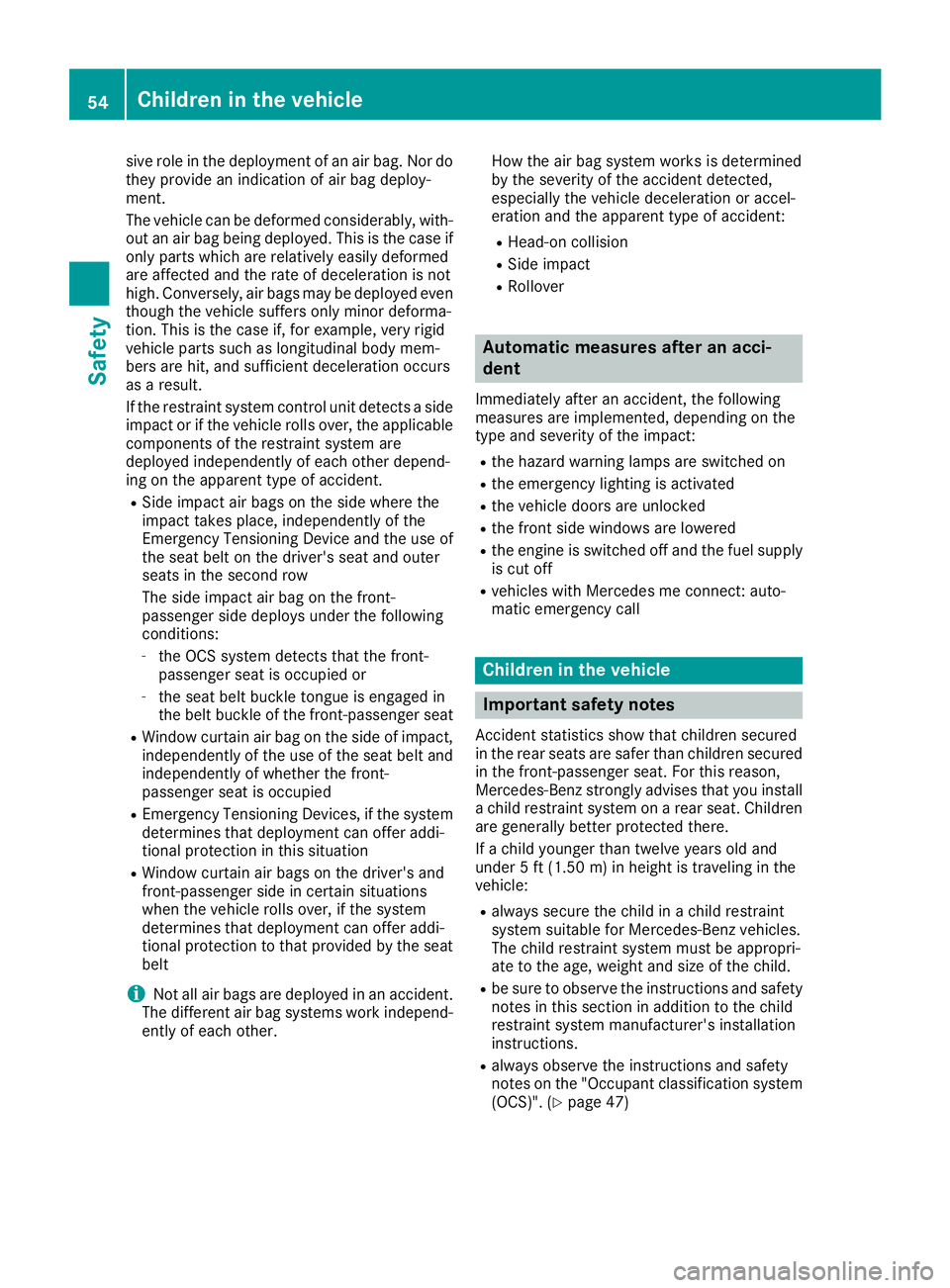
sive
roleinthe deploy mentofan air bag. Nordo
they provide anindication ofair bag deploy -
ment.
The vehicle canbedeformed considerably, with-
out anair bag being deploy ed.This isthe case if
only parts which arerelatively easilydeformed
are affected andtherate ofdeceleration isnot
high. Conversely, airbags maybedeploy edeven
though thevehicle suffersonlyminor deforma-
tion. Thisisthe case if,for example, veryrigid
vehicle partssuchaslongitudinal bodymem-
bers arehit,and sufficient deceleration occurs
as aresult.
If the restraint systemcontrolunit detects aside
impact orifthe vehicle rollsover, theappli cable
component sof the restraint systemare
deploy edindependently ofeach other depend-
ing onthe appa renttype ofaccident.
R Side impact airbags onthe side where the
impact takesplace, independently ofthe
Emergenc yTensioning Deviceandtheuse of
the seat beltonthe driver's seatandouter
seats inthe second row
The side impact airbag onthe front -
passenger sidedeploy sunder thefollowi ng
conditions:
- the OCS system detects thatthefront -
passenger seatisoccupied or
- the seat beltbuckle tongue isengaged in
the belt buckle ofthe front -passenger seat
R Window curtainairbag onthe side ofimpact,
independently ofthe use ofthe seat beltand
independently ofwhether thefront -
passenger seatisoccupied
R Emergenc yTensioning Devices,ifthe system
determines thatdeploy mentcanoffer addi-
tional protection inthis situation
R Window curtainairbags onthe driver's and
front -passenger sideincertain situations
when thevehicle rollsover, ifthe system
determines thatdeploy mentcanoffer addi-
tional protection tothat provided bythe seat
belt
i Not
allair bags aredeploy edinan accident.
The different airbag systems workindepend-
ently ofeach other. How
theairbag system worksisdetermined
by the severity ofthe accident detected,
especial lythe vehicle deceleration oraccel-
eration andtheappa renttype ofaccident:
R Head-on collision
R Side impact
R Roll over Automatic
measuresafteranacci-
dent
Immediately afteranaccident, thefollowi ng
measures areimplemented, dependingonthe
type andseverity ofthe impact:
R the hazard warning lampsareswitched on
R the emergency lightingisactivated
R the vehicle doorsareunlocked
R the front sidewindows arelowered
R the engine isswitched offand thefuel supply
is cut off
R vehicles withMercedes meconn ect:auto-
matic emergency call Children
inthe vehicl e Importa
ntsafety notes
Acc ident statistics showthatchildren secured
in the rear seats aresafer thanchildren secured
in the front -passenger seat.Forthis reason,
Mercedes-Benz stronglyadvisesthatyouinstall
a child restraint systemonarear seat. Children
are generally betterprotected there.
If achild younger thantwelve yearsoldand
under 5ft (1.50 m)inheight istraveling inthe
vehicle:
R alwa yssecure thechild inachild restraint
system suitable forMercedes-Benz vehicles.
The child restraint systemmustbeappropri-
ate tothe age, weight andsize ofthe child.
R be sure toobserve theinstruct ionsandsafety
notes inthis section inaddition tothe child
restraint systemmanufacturer's installation
instruct ions.
R alwa ysobserve theinstruct ionsandsafety
notes onthe "Occupant classification system
(OCS)". (Ypage 47) 54
Children
inthe vehicl eSafety
Page 57 of 330
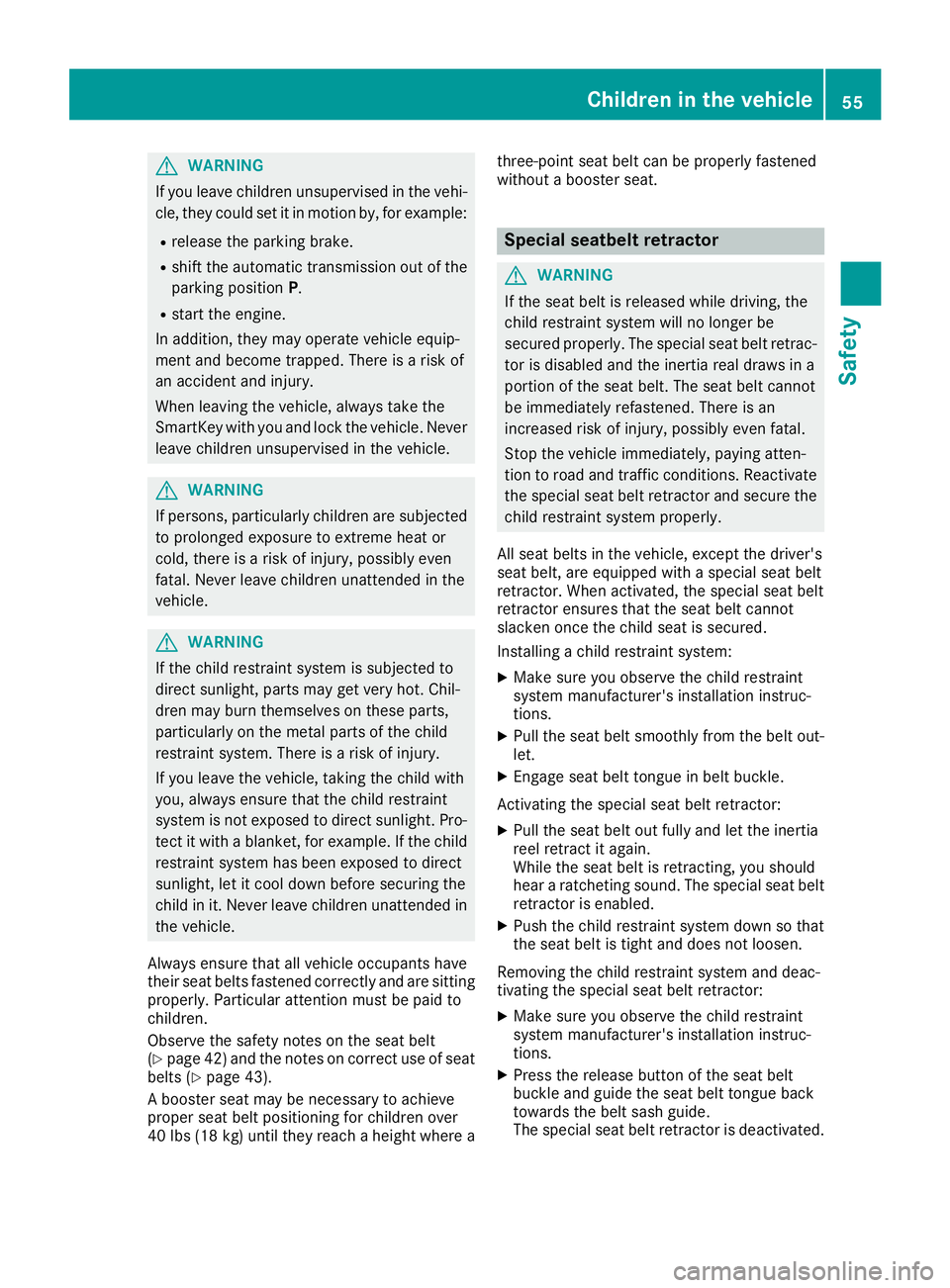
G
WARNING
If you leavechild renunsu pervi sedinthe vehi-
cle, they couldset itin motion by,forexampl e:
R rele ase theparki ngbrake.
R shift theautomatic transmissi onout ofthe
parki ngposi tion P.
R start theengine.
In add ition, theymayopera tevehicl eequ ip-
ment andbecome trapped.There isarisk of
an accide ntand injury .
When leaving thevehicl e,alw aystake the
SmartKey withyouand lock thevehicl e.Never
lea vechild renunsu pervi sedinthe vehicl e. G
WARNING
If perso ns,particu larlychild renaresubjected
to prolo nged exposu reto extreme heator
cold, there isarisk ofinjury ,possi blyeven
fatal .Never leavechild renunattended inthe
vehicl e. G
WARNING
If the child restrai ntsystem issub jected to
dire ctsunli ght,parts maygetvery hot.Chil-
dren mayburn themsel vesonthese parts,
particu larlyon the metal partsofthe child
restrai ntsystem. Thereisarisk ofinjury .
If you leavethe vehicl e,taking thechild with
you ,alw aysensure thatthechild restrai nt
system isnot expose dto dire ctsunli ght.Pro-
tect itwith abla nket, forexampl e.Ifthe child
restrai ntsystem hasbeen expose dto dire ct
sunli ght,letitcool downbefore securingthe
child init. Never leavechild renunattended in
the vehicl e.
Alwa ysensure thatallvehicl eoccupa ntshave
their seatbeltsfastened correctly andaresitting
prope rly.Particu larattention mustbepaidto
child ren.
Observe thesafety notesonthe seat belt
(Y pag e42) and thenotes oncorrect useofseat
bel ts(Y pag e43).
A booster seatmaybenecessa ryto achie ve
prope rseat beltposi tioning forchild renover
40 lbs (18 kg)until theyreach aheig htwhere athree-poi
ntseat beltcan beprope rlyfastened
witho utabooster seat. Spec
ialseatbe ltretractor G
WARNING
If the seat beltis rele ased whiledrivi ng,the
child restrai ntsystem willno longer be
secure dprope rly.The speci alseat beltretrac-
tor isdisa bledand theinertia realdraw sin a
portion ofthe seat belt.The seat beltcannot
be immed iatelyrefastene d.There isan
increas edrisk ofinjury ,possi blyeven fatal.
Stop thevehicl eimmed iately,pay ing atten-
tion toroad andtraffic conditions. Reactivate
the speci alseat beltretractor andsecure the
child restrai ntsystem properly.
All seat beltsinthe vehicl e,except thedrive r's
seat belt,are equipped with aspeci alseat belt
retractor. Whenactivated,thespeci alseat belt
retractor ensuresthat theseat beltcannot
sla cken once thechild seatissecure d.
Install ingachild restrai ntsystem:
X Make sureyouobser vethe child restrai nt
system manufacturer's installationinstruc-
tions.
X Pul lthe seat beltsmoothly fromthebeltout-
let.
X Engage seatbelttongue inbel tbuckle .
Activating thespeci alseat beltretractor:
X Pul lthe seat beltout fullyand letthe inertia
reel retract itaga in.
Whil ethe seat beltis retracting, youshou ld
hear aratcheting sound.The speci alseat belt
retractor isenabl ed.
X Push thechild restrai ntsystem downso that
the seat beltis tight anddoes notloos en.
Remo vingthechild restrai ntsystem anddeac-
tivating thespeci alseat beltretractor:
X Make sureyouobser vethe child restrai nt
system manufacturer's installationinstruc-
tions.
X Press therelease button ofthe seat belt
buckle andguide the seat belttongue back
toward sthe beltsash guide.
The speci alseat beltretractor isdea ctivated. Chi
ldren inthe vehi cle
55Safety Z
Page 62 of 330
G
WARNING
If the child restrai ntsystem issub jected to
dire ctsunli ght,parts maygetvery hot.Chil-
dren mayburn themsel vesonthese parts,
particu larlyon the metal partsofthe child
restrai ntsystem. Thereisarisk ofinjury .
If you leavethe vehicl e,taking thechild with
you ,alw aysensure thatthechild restrai nt
system isnot expose dto dire ctsunli ght.Pro-
tect itwith abla nket, forexampl e.Ifthe child
restrai ntsystem hasbeen expose dto dire ct
sunli ght,letitcool downbefore securingthe
child init. Never leavechild renunattended in
the vehicl e.
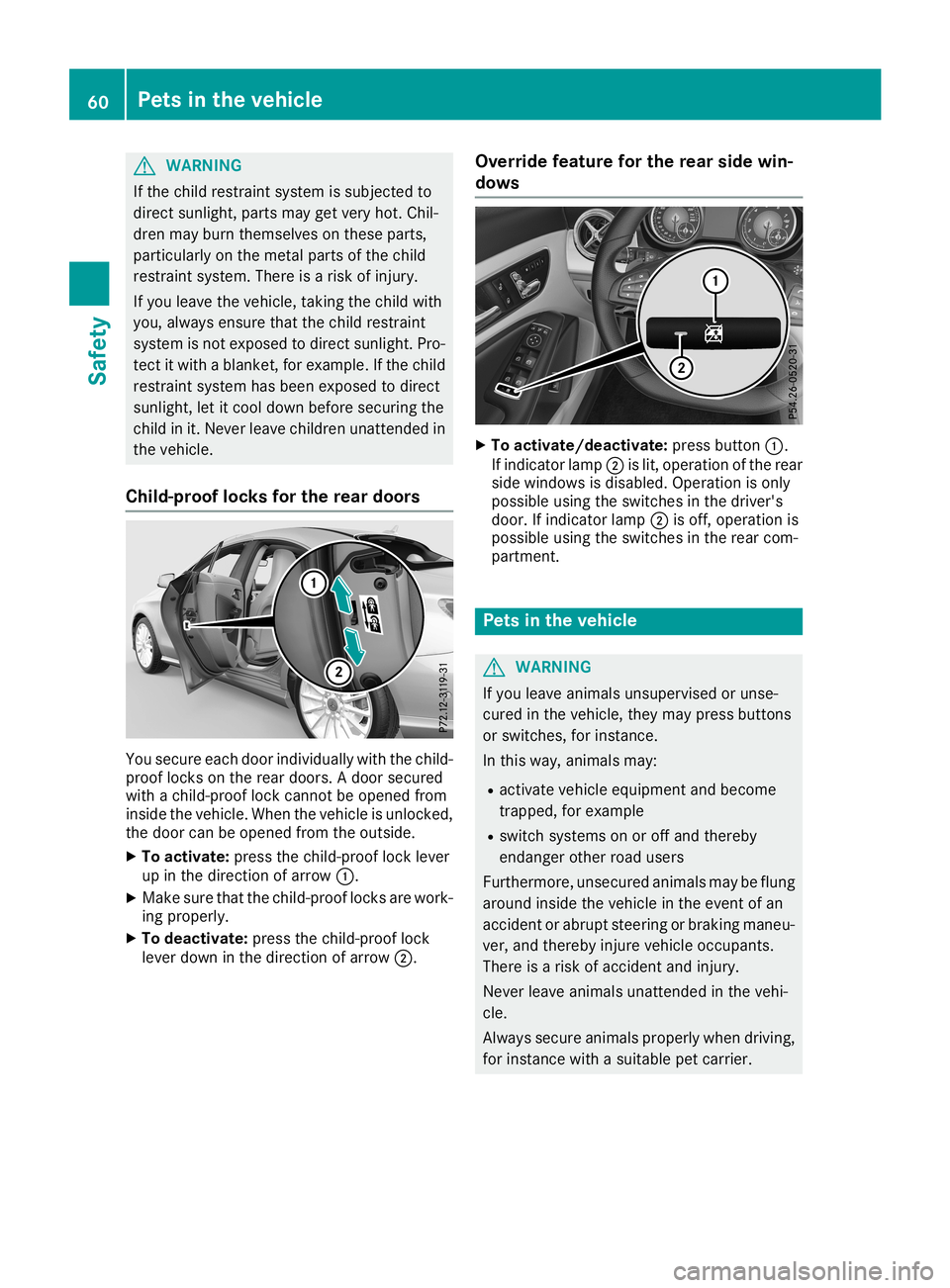
Chil d-proof locksfor the rear doors You
secure eachdoorindivi duallywith thechild -
proof locksonthe rear doors. Adoor secure d
with achild -proof lockcannot beopened from
insid ethe vehicl e.When thevehicl eis unlocked ,
the door canbeopened fromtheoutsi de.
X To activate: pressthechild -proof locklever
up inthe direction ofarrow 0043.
X Make surethatthechild -proof locksarework-
ing prope rly.
X To deactiv ate:press thechild -proof lock
leve rdow nin the direction ofarrow 0044. Override
featureforthe rear side win-
dows X
To activate/ deactivate:press button 0043.
If indica torlamp 0044islit, opera tionofthe rear
side windo wsisdisa bled.Opera tionisonly
possi bleusing the switches inthe drive r's
door. Ifindica torlamp 0044isoff, opera tionis
possi bleusing the switches inthe rear com-
partment. Pets
inthe vehi cle G
WARNING
If you leaveanima lsunsu pervi sedorunse-
cured inthe vehicl e,they maypress buttons
or swi tches, forinstance.
In this way,anima lsmay :
R activa tevehicl eequ ipme ntand become
trappe d,for exampl e
R swi tch systems onoroff and thereby
endange rother roadusers
Furthermore ,unsecu redanima lsmay beflung
arou ndinsid ethe vehicl ein the event ofan
accide ntor abru ptsteering orbraki ngmaneu -
ver, and thereby injurevehicleoccupa nts.
There isarisk ofaccide ntand injury .
Never leaveanima lsunattended inthe vehi-
cle.
Alwa yssecure animalsprope rlywhen driving,
for instance withasui table petcarrie r. 60
Pets
inthe vehi cleSafety
Page 63 of 330
Dri
vin gsa fet ysys tems Over
view ofdrivin gsa fet ysys tems
In this sec tion ,you willfindinfo rm ation about
th efo llow ing dri vin gsaf etysys tems :
R AB S(An ti-loc kBrak ing Syst em)
(Y page 61)
R BA S(Brak eAss istSyst em) (Ypage 61)
R Ac tive Brak eAs sis t(Y page 62)
R ES P®
(E lec tron icStabili tyProgr am)
(Y page 64)
R EB D(Elect ronicBrak efo rc eDist ribution )
(Y page 67)
R AD APTIV EBRA KE(Ypage 68)
R ST EERCON TROL (Ypage 68) Im
por tant safet ynot es
If you failtoadapt yourdrivin gst yle orifyou are
in at te nt ive ,th edri vin gsaf etysys tems can nei-
th er red uce theris kof an acc iden tno rov err ide
th elaws ofphys ics. Dr iving safetysys tems are
mer elyaids designed toass istdrivin g.
You arerespon sibleformain tainingth edis tanc e
to theveh icle in fron t,forveh icle spe ed, for
bra king ingoo dtime, andforst ayin gin lan e.
Al ways adapt yourdrivin gst yle tosuit thepre -
vail ing ro ad and weat hercond ition sand main -
ta in asaf edis tanc efrom theveh icle in fron t.
Dr ive carefully.
The drivin gsaf etysys tems described onlywor k
as effect ive lyas pos siblewhen there isade-
quat eco ntact between thetires and thero ad
sur face.Plea sepay special atte nt ion tothe
no teson tires ,rec ommen dedminimum tire
tr ead dept hs,etc. (Y page 291).
In win try dri vin gco nd ition s,always usewinter
ti res (M+ Stires )and ifnece ssary,snow chains.
Onl yin thi swa ywi llthe driving safety system s
de scri bedin thi ssecti onworkas effe ctive lyas
po ssi ble. ABS
(Anti -lock Brakin gSys tem)
Gen eral informati on ABS
regulate sbra kepre ssu reinsu ch awa ytha t
the wheelsdo not lock when youbra ke. This
al lo ws youto conti nuestee ringthevehiclewh en
bra king . The
0025 ABSwarning lamp inthe instrum ent
clu ster lights upwhen the igniti onissw itch ed
on. Itgoe sou twh en the engi neisrunning .
ABS works from aspe edofabou t5 mph
(8 km/h ),reg ard less ofroa d-su rface cond itions.
ABS works onslip pe rysurfa ces, evenwh en you
onl ybra kegentl y.
Impo rtant safetynotes i
Obs
erve the"Impo rtant safety notes "sec-
tio n(Y page 61). G
WAR
NING
If ABS isma lfunctio ning,the wheelscou ld
lo ck when bra king .The stee rability and brak-
ing characteri stic swo uld be sev erelyaff ec-
ted .The reisan incre ased danger ofski dding
and accidents.
Driv eon car efully. Hav eABS checked imme-
di ate lyat aqu alifi ed spe cialist wo rksh op.
Whe nABS isma lfunctio ning,othe rsy stem s,
incl uding driving safety system s,willal so
be come inoperati ve. Obs erve theinforma tion
on the ABS warning lamp (Ypage 222 )and dis-
pl ay mes sages which maybe sho wninthe
ins trum entcluster (Ypage 194 ).
Brakin g X
IfABS interv enes:conti nuetodepre ssthe
bra kepedalvig oro uslyunti lthe braking sit-
ua tio nis ove r.
X To make aful lbrake application:de pre ss
the brakepedalwi th fullforce .
If ABS intervene swh en bra king ,yo uwi llfee la
pu lsing inthe brakepedal.
The pulsati ng bra kepedalcan beanind ication
of ha zard ousroa dcond itions, andfunc tions asa
rem inderto take extra carewh ile dri ving . BAS
(Brak eAs sist Sys tem)
Gen eral informati on BAS
opera tes ineme rgency braking situa tions.
If yo ude pre ssthe brakepedalqu ickl y,BAS
au toma tically bo osts thebraking force ,thu s
sho rteni ngthe stop ping dista nce. Dri
ving safe tysys tems
61Safety Z
Page 64 of 330
Imp
ortant safety notes i
Obs
erveth e"Im portantsaf etyno tes" sec -
ti on (Ypage 61). G
WAR
NING
If BA Sis malf unction ing ,th ebrak ingdist ance
in an eme rgencybrak ingsituati onis
inc reas ed.Ther eis aris kof an acc iden t.
In an eme rgencybrak ingsituati on,depr ess
th ebrak epedal withfull force.AB Spre ven ts
th ewhee lsfrom lockin g.
Br ak ing X
Kee pth ebrak epedal firmly depr essedunt il
th eeme rgencybrak ingsituati onisove r.
AB Spre ven tsthewhee lsfrom lockin g.
The brak eswill function asusual once you
rele ase thebrak epedal .BA Sis deac tivat ed. Acti
veBrak eAssis t
Gener alinfo rmation i
Obs
erveth e"Im portantsaf etyno tes" sec -
ti on (Ypage 61).
Ac tive Brake Assist consist sof adist ancewarn -
ing function withan auto nomous brakingfunc-
ti on and asit uati on-depen dentbrak eboos ting
eff ect.
Ac tive Brake Assist can help youtomin imiz eth e
ris kof aco llisi onwithth eveh icletravel ingin
fr on tor red uce theeff ects of suc haco llisi on.
If Ac tive Brake Assist detects that there isaris k
of collisi on,you willbewarn edvisually and
aco ustical ly.Ifyou donotreac tto thevis ual
co llisi onwarn ingorthewarn ingtone ,auto no-
mous brakingcan beinitiate din critical situa-
ti on s.Ifyou apply thebrak eyours elfinacr itical
sit uati on,Ac tive Brake Assist suppo rts you with
a sit uati on-depen dentbrak eboos ting effect.
Imp ortant safety notes De
tection ofhaz ardo ussituati onscan bepar-
ti cular lyimpa iredif:
R Ther eis dirt onthesen sorsor anyt hingelse
co ver ing thesen sors
R Ther eis sn ow orheav yrain
R Ther eis int erf ere nceby other radar sources R
Ther eare stron gradar reflec tion s,for exam-
ple inpark inggara ges
R Anar row vehicleis travel inginfron t,e.g. a
mot orcycle
R Aveh icleis travel inginfron ton adif fer entlin e
R You aredrivingane wveh icleor ser vicing on
th eAc tive Brake Assist systemhas justbeen
car riedout
Obs erveth eimpo rtant safetyno tesin the
"Br eak ing-in notes" sec tion (Ypage 122).
Fo llowin gdamag eto thefron ten dof theveh icle,
have theco nfigur ation and oper ation ofthe
radar sensor checke dat aqualif iedspec ialist
wor kshop. Thisalso applie sto collisi onsat low
spee dswher eno visible damag eto thefron tof
th eveh icleis appar ent.
Acti vating/d eactivating Ac
tive Brake Assist isact ive aftereve ryign ition
cyc le.
You canactivat eor deac tivat eAc tive Brake
As sist (Ypage 187)intheon -board comput er.
When deactivat ed, thedist ancewarn ingfunc-
ti on and theauto nomous brakingfunction are
also deac tivat ed.
If Ac tive Brake Assist isdeac tivat ed, the00D4
symb olappear sin theassi stanc egrap hicdis-
play.
Dist ance warning funct ion Gene
ralinf orm ation
The distancewarn ingfunction can help youto
min imiz eth eris kof afron t-en dco llisi onwitha
veh icleahead orred uce theeff ects of suc ha
co llisi on.If th edist ancewarn ingfunction
det ects that there isaris kof aco llisi on,you will
be warn edvisually andacoustical ly.
Imp ortant safety notes
i Obs
erveth e"Im portantsaf etyno tes" sec -
ti on for driv ingsafetysyst ems (Ypage 61). G
WAR
NING
The distancewarn ingfunction does notreac t:
R to peop leor ani mals
R to oncomin gveh icles
R to cross ing traff ic
R when corneri ng 62
Driv
ingsafety syst emsSafet y