warning MERCEDES-BENZ CLA COUPE 2019 User Guide
[x] Cancel search | Manufacturer: MERCEDES-BENZ, Model Year: 2019, Model line: CLA COUPE, Model: MERCEDES-BENZ CLA COUPE 2019Pages: 645, PDF Size: 10.94 MB
Page 33 of 645
ship.
You can do this at a Mercedes-Benz service
centre, forex ample. Cor
rect use of theve hicle
If yo ure mo veany warning sticke rs,yo u or others
could failto recognise cer tain dangers. Lea ve
wa rning sticke rs in position.
Obser vethefo llowing information in particular
when driving your vehicle:
R the saf ety no tes in this manual
R tech nical da taforth eve hicle
R traf fic ru les and regulations
R laws and saf etyst andards per taining to
mo torve hicles Information on
the REACH regulation
EU and EFTA countries onl y:
The REA CHRegulation (Regulation (EC) No.
19 07 /2006, Article 33) stipulates an informa‐
tion obligation for subs tances of very high con‐
cern (SVHC). Daimler
AGis acting tothe best of its know ledge
to av oidthe use and application of these SVHCs
and toenable the cus tomer tohandle theses
subs tances sa fely.Ac cording tosupplier infor‐
mation and internal product information of
Daimler AG,SV HCs are known whi chare more
th an 0.1 percent byweight in individual products
of this vehicle.
Fu rther information can be found at:
R http://www.daimler.com/ reach
R http://www.daimler.com/ reach/en Implied
warranty
* NO
TEDama getotheve hicle arising
from violation of these operating instruc‐
tions. Damage
totheve hicle can arise from viola‐
tion of these operating instructions.
This damage is not co vered either bythe
Mercedes-Benz implied warranty or bythe
New‑ or Used- Vehicle Warrant y. #
Follow the instructions in these operat‐
ing instructions on proper operation of
yo ur vehicle as well as on possible vehi‐
cle damage. QR code
forre scue card
The QR code is secured in the fuel filler flap and
on the opposite side on the B-pillar. In theeve nt
of an accident, rescue services can use the QR
code toquickly find the appropriate rescue card
fo ryo ur vehicle. The cur rent rescue card con‐
ta ins the most impor tant information about your
ve hicle in a compact form , e.g. thero uting of the
electric lines.
Fu rther information can be obtained at http://
www.mercedes-benz.de/qr-code. Data
storage Electronic control units
Elect
ronic control units are fitted in your vehicle.
Some of these are necessary forth e safe opera‐
tion of your vehicle, while some assist you when 30
General no tes
Page 37 of 645
Re
stra int sy stem Pr
otection bythere stra int sy stem The
restra int sy stem includes thefo llowing com‐
ponents:
R Seat belt sy stem
R Airbags
R Child restra int sy stem
R Child seat securing sy stems
The restra int sy stem can help pr eventtheve hi‐
cle occupants from coming into contact with
parts of theve hicle interior in theev ent of an
accident. In theev ent of an accident, the
re stra int sy stem can also reduce thefo rc es to
which theve hicle occupants are subjected.
A seat belt can only pr ovide the best le vel of pro‐
te ction if it is worncor rectl y.Depending on the
de tected accident situation, seat belt tensioners
and/or airbags supplement the pr otection
of fere dby a cor rectly wornseat belt. Seat belt
te nsioners and/or airbags are not depl oyed in
eve ryaccident. In order
forth ere stra int sy stem toprov ide the
intended le vel of pr otection, each vehicle occu‐
pant must obser vethefo llowing information:
R Fasten seat belts cor rectl y.
R Sit in an almost up right seat position with
th eir back against the seat backrest.
R Sit with their feet resting on thefloor, if pos‐
sible.
R Alw ays secure persons under 1.50 m tall in
an additional restra int sy stem suitable for
Mercedes-Benz vehicles.
Ho wever,no sy stem available today can com‐
ple tely elimin ate injuries and fata lities in every
accident situation. In particular, the seat belt
and airbag generally do not pr otect against
objects penetrating theve hicle from the outside.
It is also not possible tocompl etely rule out the
ri sk of injury caused bythe airbag deploying. Limited pr
otection from there stra int sy stem &
WARNING Risk of inju ryor death from
modifications tothere stra int sy stem
The restra int sy stem can no longer function
cor rectly af ter alterations ha vebeen made.
The restra int sy stem may then not pr otect
th eve hicle occupants as intended byfailing
in an accident or triggering unexpec tedly, for
ex ample #
Never alter the parts of there stra int
sy stem. #
Neverta mp er with the wiring or any
electronic component parts or their
software. If it is necessary
toadjust theve hicle toaccom‐
modate a person with disabilities, con tact a
qu alified specialist workshop.
Mercedes-Benz recommends that you on lyuse
driving aids which ha vebeen appr oved specifi‐
cally foryo ur vehicle byMercedes-Benz. 34
Occupant saf ety
Page 38 of 645
Re
stra int sy stem functionality When
the ignition is switched on, a self-test is
per form ed, during which the6 restra int sys‐
te m wa rning lamp lights up. It goes out no later
th an a few seconds af terth eve hicle is star ted.
The components of there stra int sy stem are then
functional. Malfunctioning
restra int sy stem A malfunction has occur
red in there stra int sys‐
te m if:
R the6 restra int sy stem warning lamp does
not light up when the ignition is switched on
R the6 restra int sy stem warning lamp
lights up continuously or repeatedly during a
journey &
WARNING Risk of inju rydue tomalfunc‐
tions in there stra int sy stem
If th ere stra int sy stem is malfunctioning,
re stra int sy stem components may be trig‐
ge red unintentionally or may not deploy as intended during an accident. This may af
fect
th e seat belt tensioner or airbag, forex am‐
ple. #
Have there stra int sy stem checked and
re paired immediately at a qualified spe‐
cialist workshop. Fu
nction of there stra int sy stem in an acci‐
dent How
there stra int sy stem works is de term ined by
th e se verity of the impact de tected and the type
of accident anticipated:
R Frontal impact
R Rear impact
R Side impact
R Onlyfor cer tain countries: rollo ver
The activation thre sholds forth e components of
th ere stra int sy stem are de term ined based on
th eev aluation of the sensor values measured at
va rious points in theve hicle. This process is pre-
em ptive in nature. The triggering/deployment of
th e components of there stra int sy stem must ta
ke place in good time at thest art of the colli‐
sion.
Fa ctors whi chcan only be seen and measu red
af te r a collision has occur red do not play a deci‐
sive role in the deployment of an airbag. Nordo
th ey prov ide an indication of airbag deployment.
The vehicle may be deformed significantly with‐
out an airbag being deplo yed. This is the case if
only parts which are relatively easily deformed
are af fected and thera te ofvehicle deceleration
is not high. Con versely, an airbag may be
deplo yedev en though theve hicle suf fers only
minor deformation. If very rigid vehicle parts
such as longitudinal members are hit, forex am‐
ple, this may result in suf ficiently high le vels of
ve hicle deceleration. Occupant saf
ety35
Page 39 of 645
The co
mponents of there stra int sy stem can
be activated or deplo yed independently of
each other: Component De
tected deploy‐
ment situation
Seat belt tensioner sFrontal impact, rear
impact, side impact,
ro llo ver 1) Driver's airbag, front
passenger front air‐
bag
Fr
ontal impact Knee airbag
Frontal impact Side impact airbag Side impact
Wi ndow airba gS ide impact,roll‐
over 1)
, frontal impact 1)
Only for cer tain countries.
The front passen ger front airbag can only be
depl oyed in an accident if thePA SSENGER AIR
BA G OFF indicator lamp is off. If the front
passenger seat is occupied, make sure, bo thbefore and during
the journe y,that thest atus of
th e front passenger front airbag is cor rect
(/ page 46). &
WARNING Rick of burns from hot airbag
components
The airbag parts are hot af ter an airbag has
been depl oyed. #
Do not touch the airbag parts. #
Have a deplo yed airbag replaced at a
qu alified specialist workshop as soon
as possible. Mercedes-Benz
recommends that you ha vethe
ve hicle towe dto aqu alified specialist workshop
af te r an accident. Take this into account, partic‐
ularly if a seat belt tensioner is trig gered or an
airbag deplo yed.
If th e seat belt tensioners are trig gered or an air‐
bag is deplo yed, you will hear a bang, and a
small amount of powder may also be released:
R The bang will not generally af fect your hear‐
ing. R
Ingeneral, the powder released is not haz‐
ardous tohealth but may cause short-term
breathing dif ficulties topersons suf fering
from as thma or other pulmonary conditions.
Pr ov ided it is safe todo so, lea vetheve hicle
immediately or open the window in order to
pr eve nt brea thing dif ficulties. Seat belts
Pr
otection pr ovided bythe seat belt Alw
aysfast enyour seat belt co rrectly before
st arting a journe y.A seat belt can only pr ovide
th e best le vel of pr otection if it is worncor rectly. &
WARNING Risk of inju ryor death due to
incor rectly fastened seat belt
If th e seat belt is not worncor rectly, it can‐
not per form its intended pr otective function.
In addition, an incor rectly fastened seat belt
can also cause injuries, forex ample, in the
ev ent of an accident or when braking or
ch anging direction sudden ly.36
Occupant saf ety
Page 40 of 645
#
Alw ays ensure that all vehicle occu‐
pants ha vetheir seat belts fastened
cor rectly and are sitting prope rly. Alw
ays obser vethe instructions about the cor‐
re ct driver's seat position and adjusting the
seats (/ page100).
In order forth e cor rectly wornseat belt topro‐
vide the intended le vel of pr otection, each vehi‐
cle occupant must obser vethefo llowing infor‐
mation:
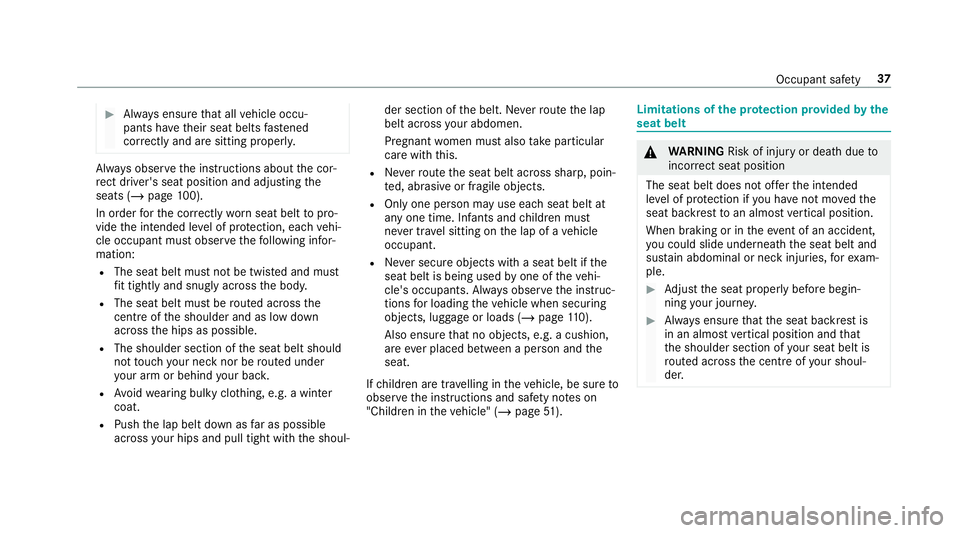
R The seat belt must not be twis ted and must
fi t tightly and snu gly across the body.
R The seat belt must be routed across the
centre of the shoulder and as low down
across the hips as possible.
R The shoulder section of the seat belt should
not touch your ne cknor be routed under
yo ur arm or behind your bac k.
R Avoid wearing bulky clo thing, e.g. a winter
coat.
R Push the lap belt down as far as possible
across your hips and pull tight with the shoul‐ der section of
the belt. Ne verro ute the lap
belt across your abdomen.
Pregnant women must also take particular
care with this.
R Neverro ute the seat belt across sharp, poin‐
te d, abrasive or fragile objects.
R Only one person may use each seat belt at
any one time. Infants and children must
ne ver tr ave l sitting on the lap of a vehicle
occupant.
R Never secure objects with a seat belt if the
seat belt is being used byone of theve hi‐
cle's occupants. Alw ays obser vethe instruc‐
tions for loading theve hicle when securing
objects, luggage or loads (/ page110).
Also ensure that no objects, e.g. a cushion,
are ever placed between a person and the
seat.
If ch ildren are tra velling in theve hicle, be sure to
obser vethe instructions and saf ety no tes on
"Children in theve hicle" (/ page51). Limitations of
the pr otection pr ovided bythe
seat belt &
WARNING Risk of inju ryor death due to
incor rect seat position
The seat belt does not of ferth e intended
le ve l of pr otection if you ha venot mo vedthe
seat backrest toan almost vertical position.
When braking or in theeve nt of an accident,
yo u could slide underneath the seat belt and
sus tain abdominal or neck injuries, forex am‐
ple. #
Adjust the seat proper lybefore begin‐
ning your journe y. #
Alw ays ensure that the seat backrest is
in an almost vertical position and that
th e shoulder section of your seat belt is
ro uted across the cent reofyour shoul‐
der. Occupant saf
ety37
Page 41 of 645
&
WARNING Risk of inju ryor death when
additional restra int sy stems are not used
fo r persons with a smaller build
Pe rsons under 1.50 m tall cannot wearthe
seat belt cor rectly wi thout a suitable addi‐
tional restra int sy stem.
If th e seat belt is not worncor rectly, it can‐
not per form its intended pr otective function.
In addition, an incor rectly fastened seat belt
can also cause injuries, forex ample, in the
ev ent of an accident or when braking or
ch anging direction sudden ly.#
Alw ays secure persons under 1.50 m
ta ll in a suitable restra int sy stem. &
WARNING Risk of inju ryor death due to
damaged or modified seat belts
Seat belts cann otprov ide pr otection in the
fo llowing situations:
R the seat belt is damaged, has been modi‐
fi ed, is extremely di rty, bleached or dyed R
the seat belt buckle is damaged or
ex treme lydirty
R modifications ha vebeen made tothe seat
belt tensioner, seat belt anchorage or
seat belt retractor
Seat belts may su stain non-visible damage in
an accident, e.g. due toglass splin ters.
Modified or damaged seat belts could tear or
fa il in theev ent of an accident, forex ample.
Modified belt tensioners may be depl oyed
unintentionally or not function as intended. #
Never modify the seat belts, seat belt
te nsioners, seat belt anchorages or
seat belt retractors. #
Makesure that the seat belts are not
damaged, are not wornand are clean. #
Alw ays ha vethe seat belts checked
immediately af ter an accident at a
qu alified specialist workshop. Mercedes-Benz
recommends that you on lyuse
seat belts that ha vebeen appr ovedfo ryo ur vehi‐
cle byMercedes-Benz. The sport seat is designed
forth est andard
th re e-point seat belt. If youfit a di fferent multi‐
point seat belt, e.g. sport or racing seat belt, the
re stra int sy stem cann otprov ide the intended
le ve l of pr otection.
Depending on the type of seat, there may be
openings in the seat backrest. These openings
ha ve no function. &
WARNING Risk of inju ryor fata l injury
due tomodified seat belt sy stems
If yo ufe ed seat belts thro ugh the opening in
th e seat backrest, the seat backrest may be
damaged or may even break in theeve nt of
an accident. #
Only use thest andard thre e-point seat
belt. #
Never modify the seat belt sy stem. 38
Occupant saf ety
Page 42 of 645
&
WARNING Risk of inju ryor death from
deplo yedpy rotech nic seat belt tension‐
ers
Py rotech nic seat belt tensioners that ha ve
been deplo yed are no longer operational and
are unable toper form their intended pr otec‐
tive function. #
Therefore, ha vedeplo yedpy rotech nic
seat belt tensioners immedia tely
re placed at a qualified specialist work‐
shop. Mercedes-Benz
recommends that you ha vethe
ve hicle towe dto aqu alified specialist workshop
af te r an accident.
* NO
TEDama gecaused bytrapping the
seat belt If an unused seat belt is not fully
retracted, it
may become trapped in the door or in the
seat mechanism. #
Alw ays ensure that an unused seat belt
is fully retracted. Fa
stening seat belts If
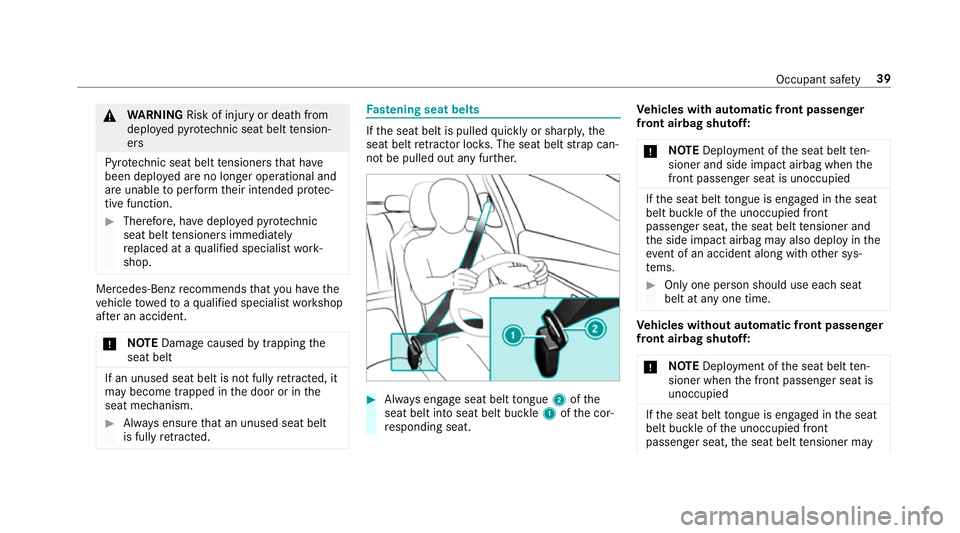
th e seat belt is pulled quickly or sharpl y,the
seat belt retractor lo cks. The seat belt stra p can‐
not be pulled out any fur ther. #
Alw ays engage seat belt tongue 2ofthe
seat belt into seat belt buckle 1ofthe cor‐
re sponding seat. Ve
hicles with automatic front passen ger
front airbag shu toff:
* NO
TEDeployment of the seat belt ten‐
sioner and side impact airbag when the
front passenger seat is unoccupied If
th e seat belt tongue is engaged in the seat
belt buckle of the unoccupied front
passenger seat, the seat belt tensioner and
th e side impact airbag may also deploy in the
ev ent of an accident along with other sys‐
te ms. #
Only one person should use each seat
belt at any one time. Ve
hicles without automatic front passen ger
front airbag shu toff:
* NO
TEDeployment of the seat belt ten‐
sioner when the front passenger seat is
unoccupied If
th e seat belt tongue is engaged in the seat
belt buckle of the unoccupied front
passenger seat, the seat belt tensioner may Occupant sa
fety 39
Page 43 of 645
also deploy in
theev ent of an accident along
with other sy stems. #
Only one person should use each seat
belt at any one time. Seat belt adjustment function
Ve
hicles with PRE-SAFE ®
:if th e front seat belt
is not pulled tight across your body, the seat belt
adjustment may automatically apply a cer tain
tigh tening forc e. Do not hold the seat belt tightly
while it is adjusting.
Yo u can activate and deactivate the seat belt
adjustment function using the multimedia sys‐
te m (/ page 40). Re
leasing a seat belt #
Press there lease button in the seat belt
buckle and guide the seat belt back with the
seat belt tongue. Ac
tivating/deactivating seat belt adjustment
via the multimedia sy stem Multimedia sy
stem:
4 © 5
Settings 5
Vehicle #
Activate or deacti vate Belt adjustment. Seat belt
warning function for the driver and
front passen ger The
ü seat belt warning lamp in the instru‐
ment display is a reminder that all vehicle occu‐
pants must weartheir seat belts cor rectly.
In addition, a warning tone may sound.
As soon as the driver and front passenger fasten
th eir seat belts, the seat belt warning goes out. Fu
nction of there ar seat belt status display The
rear seat belt status display is on lyavailable
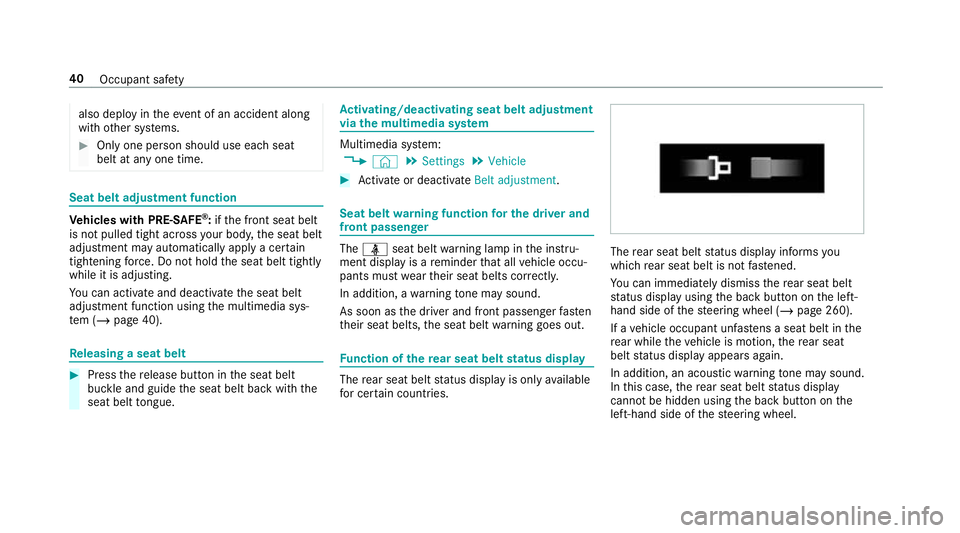
fo r cer tain countries. The
rear seat belt status display informs you
which rear seat belt is not fastened.
Yo u can immediately dismiss there ar seat belt
st atus display using the back button on the left-
hand side of thesteering wheel (/ page 260).
If a vehicle occupant unfas tens a seat belt in the
re ar while theve hicle is motion, there ar seat
belt status display appears again.
In addition, an acoustic warning tone may sound.
In this case, there ar seat belt status display
cannot be hidden using the back button on the
left-hand side of thesteering wheel. 40
Occupant saf ety
Page 44 of 645
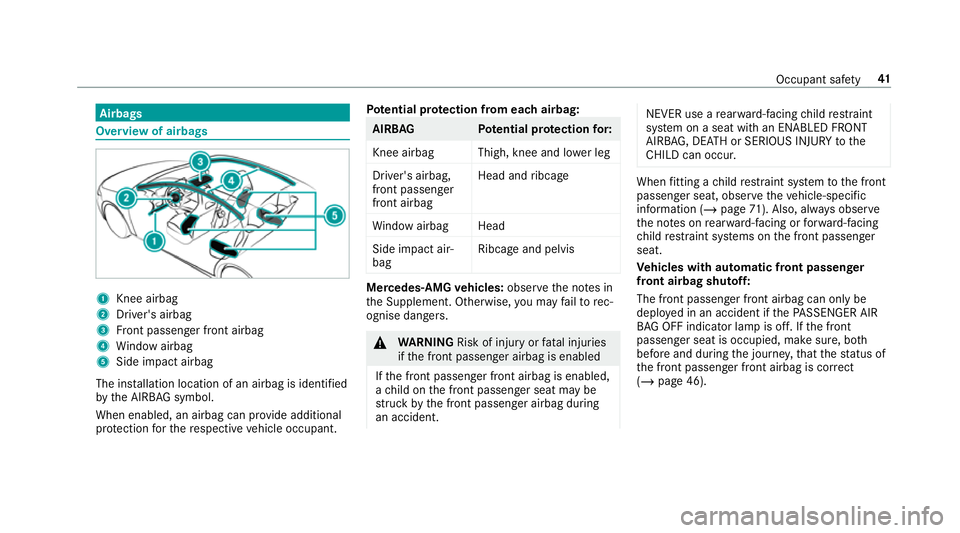
Airbags
Overview of airbags
1
Knee airbag
2 Driver's airbag
3 Front passenger front airbag
4 Window airbag
5 Side impact airbag
The ins tallation location of an airbag is identified
by the AIRB AGsymbol.
When enabled, an airbag can pr ovide additional
pr otection forth ere spective vehicle occupant. Pot
ential pr otection from each airbag: AIRB
AG Potential pr otection for:
Knee airbag Thigh, knee and lo wer leg
Driver's airbag,
front passenger
front airbag Head and
ribcage
Wi ndow airba gHead
Side impact air‐
bag Ribcage and pelvis Mercedes-AMG
vehicles: observeth e no tes in
th e Supplement. Otherwise, you may failto rec‐
ognise dangers. &
WARNING Risk of inju ryor fata l injuries
if th e front passenger airbag is enabled
If th e front passenger front airbag is enabled,
a ch ild on the front passenger seat may be
st ru ck bythe front passenger airbag during
an accident. NEVER use a
rear wa rd-facing child restra int
sy stem on a seat with an ENABLED FRONT
AIRB AG, DEAT H or SERIOUS INJU RYtothe
CH ILD can occur. When
fitting a child restra int sy stem tothe front
passenger seat, obser vetheve hicle-specific
information (/ page71). Also, alw ays obser ve
th e no tes on rear wa rd-facing or forw ard-facing
ch ild restra int sy stems on the front passenger
seat.
Ve hicles with automatic front passen ger
front airbag shu toff:
The front passenger front airbag can only be
deplo yed in an accident if thePA SSENGER AIR
BA G OFF indicator lamp is off. If the front
passenger seat is occupied, make sure, bo th
before and during the journe y,that thest atus of
th e front passenger front airbag is cor rect
(/ page 46). Occupant saf
ety41
Page 45 of 645
*
NO
TEImpo rtant points toremember if
th e front passenger seat is unoccupied In an accident,
the components of the
re stra int sy stem may deploy unnecessarily
on the front passenger side if:
R There are heavy objects on the front
passenger seat.
R The seat belt tongue is engaged in the
seat belt buckle of the front passenger
seat and the front passenger seat is
unoccupied. #
Stow objects in a suitable place. #
Only one person should use each seat
belt at any one time. Depending on
the de tected accident situation,
th e window airbag on the front passenger side
may deplo y.The airbag is deplo yedre ga rdless of
whe ther the front passenger seat is occupied. Pr
otection bythe airbags Depending on
the accident situation, an airbag
may supplement the pr otection of fere dby a cor‐
re ctly fastened seat belt. &
WARNING Risk of inju ryor death due to
incor rect seat position
If yo u deviate from the cor rect seat position,
th e airbag cann otper form its intended pro‐
te ctive function and deployment may even
cause fur ther injuries.
In order toavo idrisks, each vehicle occupant
must alw ays make sure of thefo llowing:
R Fasten seat belts cor rectly. Pregnant
wo men must take particular care to
ensure that the lap belt ne ver lies across
th e abdomen.
R Adopt the cor rect seat position and keep
as faraw ay as possible from the airbags.
R Obser vethefo llowing information. #
Alw ays make sure that there are no
objects between the airbag and vehicle
occupant. To
avo idtherisks resulting from the deployment
of an airbag, each vehicle occupant must
obser vethefo llowing information in particular:
R Before starting your journe y,adjust your seat
co rrectly; the driver's seat and front
passenger seat should be mo ved as far back
as possible.
When doing so, alw ays obser vethe informa‐
tion on the cor rect driver's seat position
(/ page 100).
R Onlyhold thesteering wheel bythesteering
wheel rim. This allow sth e airbag tobe fully
deplo yed.
R Alw ays lean against the seat backrest when
th eve hicle is in motion. Do not lean forw ards
or against the door or side windo w.You may
ot herwise be in the deployment area of the
airbags.
R Alw ayske ep your feet on thefloor. Do not
put your feet on the cockpit, forex ample. 42
Occupant saf ety