engine MERCEDES-BENZ CLK-CLASS 2000 Owners Manual
[x] Cancel search | Manufacturer: MERCEDES-BENZ, Model Year: 2000, Model line: CLK-CLASS, Model: MERCEDES-BENZ CLK-CLASS 2000Pages: 299, PDF Size: 7.58 MB
Page 268 of 299
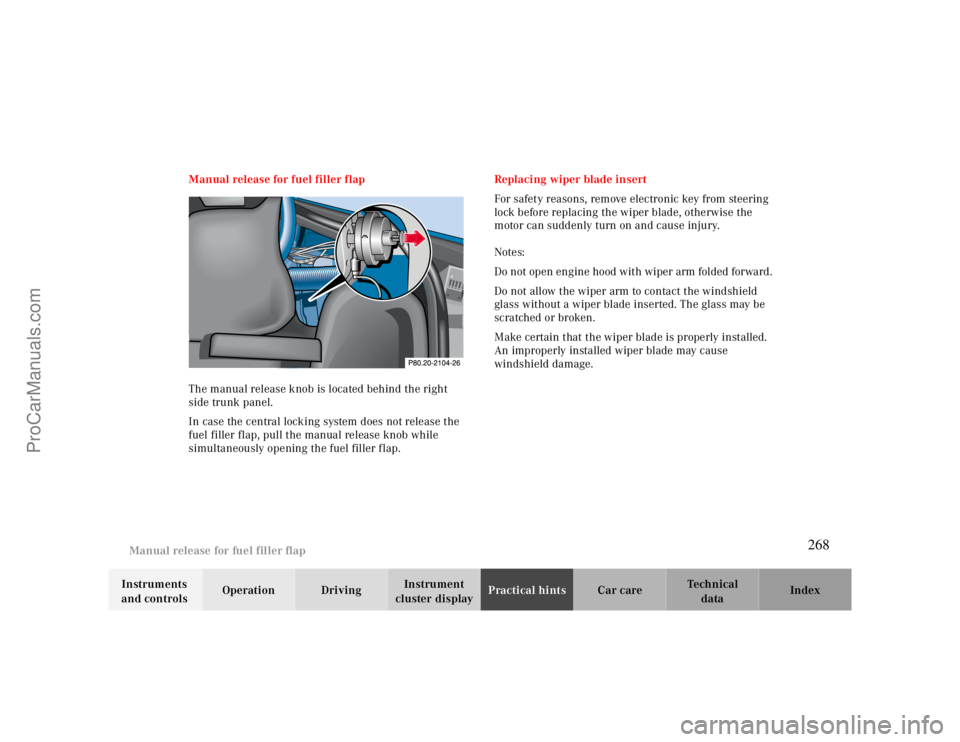
Manual release for fuel filler flap
Te ch n ica l
data Instruments
and controlsOperation DrivingInstrument
cluster displayPractical hintsCar care Index Manual release for fuel filler flap
The manual release knob is located behind the right
side trunk panel.
In case the central locking system does not release the
fuel filler flap, pull the manual release knob while
simultaneously opening the fuel filler flap.Replacing wiper blade insert
For safety reasons, remove electronic key from steering
lock before replacing the wiper blade, otherwise the
motor can suddenly turn on and cause injury.
Notes:
Do not open engine hood with wiper arm folded forward.
Do not allow the wiper arm to contact the windshield
glass without a wiper blade inserted. The glass may be
scratched or broken.
Make certain that the wiper blade is properly installed.
An improperly installed wiper blade may cause
windshield damage.
268
ProCarManuals.com
Page 271 of 299

Vehicle careCleaning and care of the vehicle 272
Engine cleaning 273
Vehicle washing 273
Plastic and rubber parts 273
Tar stains 274
Window cleaning 274
Headlamps, taillamps, turn signal lenses 274
Wiper blade 274
Seat belts 274
Headliner and shelf below rear window 275
Instrument cluster 275
Steering wheel and gear selector lever 275
Hard plastic trim items 275
Upholstery 275
Paintwork, painted body components 276
Light alloy wheels 276
Ornamental Moldings 276
271
ProCarManuals.com
Page 273 of 299
Cleaning and care of the vehicle
Te ch n ica l
data Instruments
and controlsOperation DrivingInstrument
cluster displayPractical hintsCar careIndex Scratches, corrosive deposits, corrosion or damage due
to negligent or incorrect care cannot always be removed
or repaired with the car-care products recommended
here. In such cases it is best to seek aid at your
authorized Mercedes-Benz Center.
The following topics deal with the cleaning and care of
your vehicle and give important “how-to” information as
well as references to Mercedes-Benz approved car-care
products.
Additional information can be found in the booklet titled
“Vehicle Care Guide”.
Engine cleaning
Prior to cleaning the engine compartment make sure to
protect electrical components and connectors from the
intrusion of water and cleaning agents.
Corrosion protection, such as MB Anticorrosion Wax
should be applied to the engine compartment after
every engine cleaning. Before applying, all control
linkage bushings and joints should be lubricated. The
poly-V-belt and all pulleys should be protected from any
wax.Vehicle washing
Do not use hot water or wash your vehicle in direct
sunlight. Use only a mild car wash detergent, such as
Mercedes-Benz approved Car Shampoo.
Thoroughly spray the vehicle with a diffused jet of
water. Direct only a very weak spray towards the
ventilation intake. Use plenty of water and rinse the
sponge and chamois frequently.
Rinse with clear water and thoroughly wipe dry with a
chamois. Do not allow cleaning agents to dry on the
finish.
In the winter, thoroughly remove all traces of road salt
as soon as possible.
When washing the underbody, do not forget to clean the
inner sides of the wheels.
Plastic and rubber parts
Do not use oil or wax on these parts.
273
ProCarManuals.com
Page 277 of 299

Technical data
Spare parts service 278
Warranty coverage 278
Identification labels 279
Layout of poly-V-belt drive 280
Technical data 281
Fuels, coolants, lubricants etc. – capacities 284
Engine oils additives 285
Engine oil 285
Air conditioner refrigerant 285
Brake fluid 285
Premium unleaded gasoline 286
Fuel requirements 286
Gasoline additives 287
Coolants 287
Consumer information 289
Uniform tire quality grading 289
Index291
277
ProCarManuals.com
Page 279 of 299
Technical data
Te ch n ica l
data Instruments
and controlsOperation DrivingInstrument
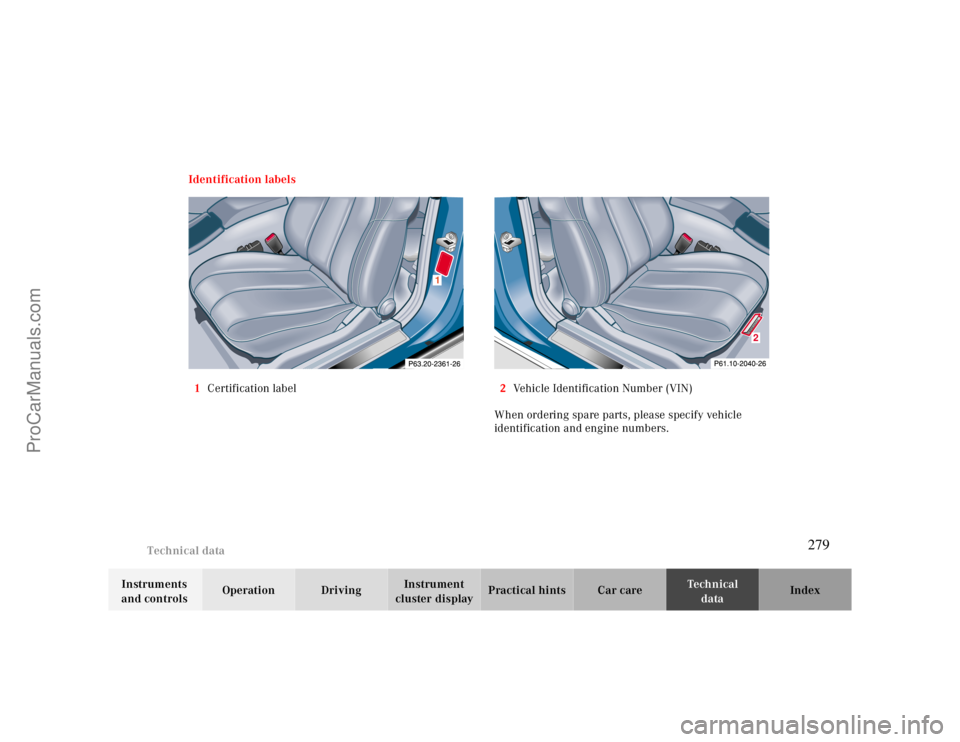
cluster displayPractical hints Car care Index Identification labels
1Certification label2Vehicle Identification Number (VIN)
When ordering spare parts, please specify vehicle
identification and engine numbers.
1
X
X
X
X
X
X
X
X
X2
279
ProCarManuals.com
Page 280 of 299
Technical data
Te ch n ica l
data Instruments
and controlsOperation DrivingInstrument
cluster displayPractical hints Car care Index
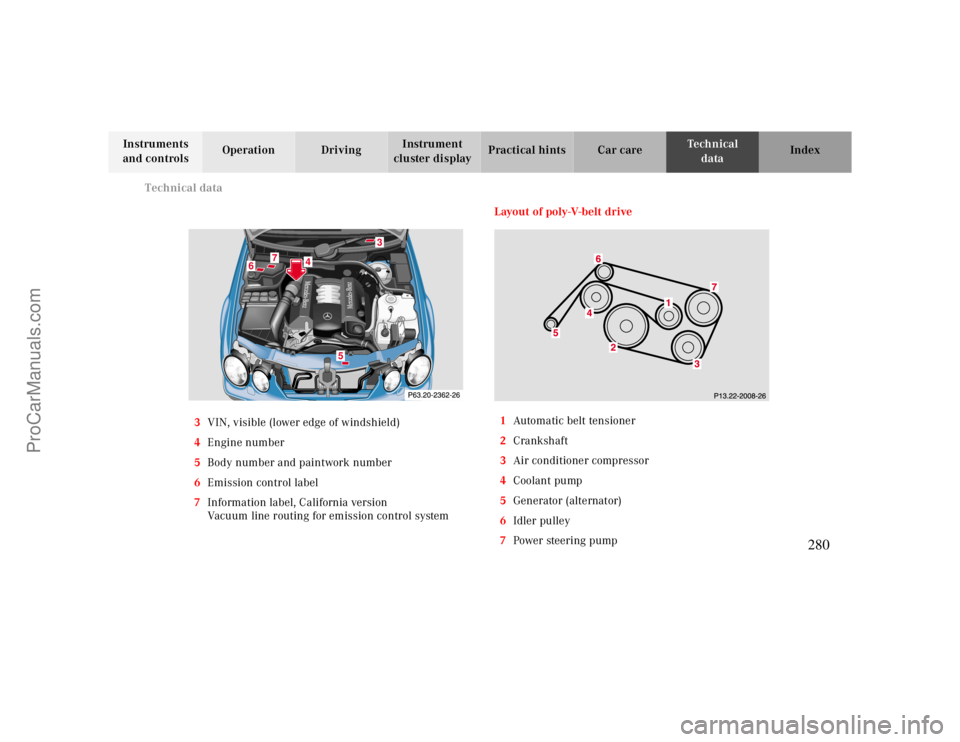
3VIN, visible (lower edge of windshield)
4Engine number
5Body number and paintwork number
6Emission control label
7Information label, California version
Vacuum line routing for emission control systemLayout of poly-V-belt drive
1Automatic belt tensioner
2Crankshaft
3Air conditioner compressor
4Coolant pump
5Generator (alternator)
6Idler pulley
7Power steering pump
6
5
7
3
4
280
ProCarManuals.com
Page 281 of 299
Technical data
Te ch n ica l
data Instruments
and controlsOperation DrivingInstrument
cluster displayPractical hints Car care Index Te ch n ica l d a t a
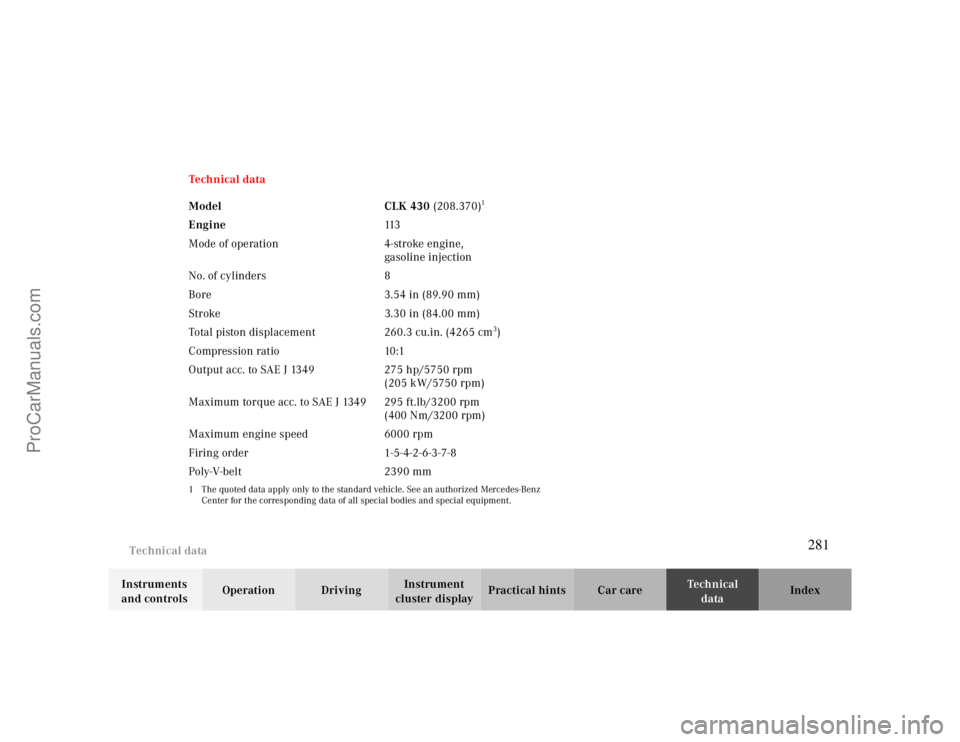
Model CLK 430 (208.370)
1
Engine113
Mode of operation 4-stroke engine,
gasoline injection
No. of cylinders 8
Bore 3.54 in (89.90 mm)
Stroke 3.30 in (84.00 mm)
Total piston displacement 260.3 cu.in. (4265 cm
3)
Compression ratio 10:1
Output acc. to SAE J 1349 275 hp/5750 rpm
(205 kW/5750 rpm)
Maximum torque acc. to SAE J 1349 295 ft.lb/3200 rpm
(400 Nm/3200 rpm)
Maximum engine speed 6000 rpm
Firing order 1-5-4-2-6-3-7-8
Poly-V-belt 2390 mm
1 The quoted data apply only to the standard vehicle. See an authorized Mercedes-Benz
Center for the corresponding data of all special bodies and special equipment.
281
ProCarManuals.com
Page 284 of 299
Fuels, coolants, lubricants etc. - capacities
Te ch n ica l
data Instruments
and controlsOperation DrivingInstrument
cluster displayPractical hints Car care Index
Fuels, coolants, lubricants etc. – capacities
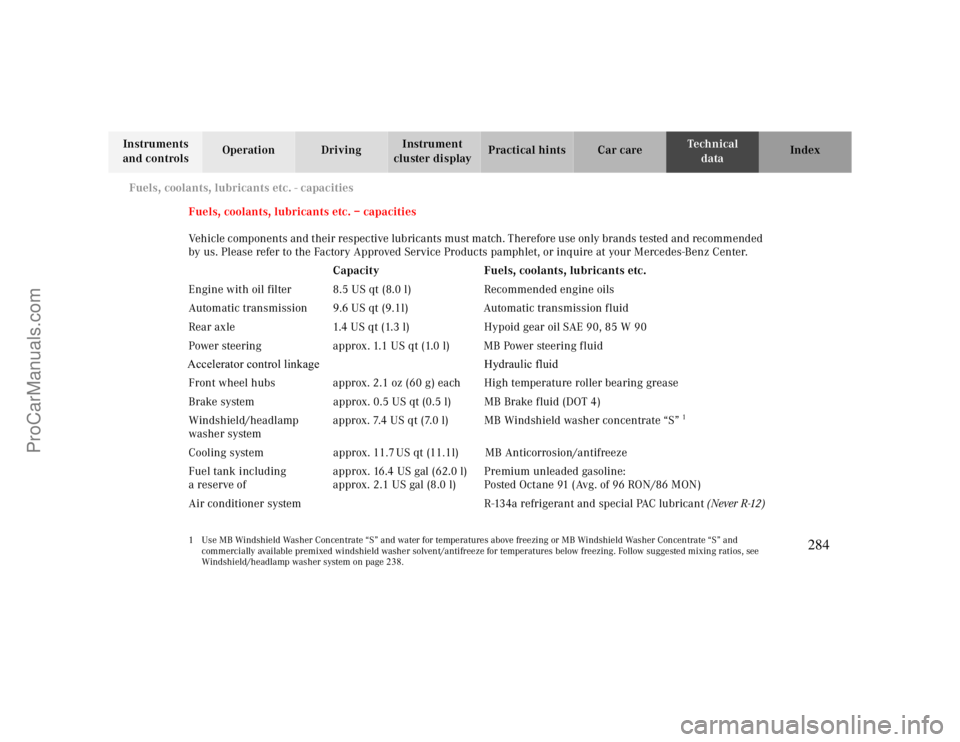
Vehicle components and their respective lubricants must match. Therefore use only brands tested and recommended
by us. Please refer to the Factory Approved Service Products pamphlet, or inquire at your Mercedes-Benz Center.
Capacity Fuels, coolants, lubricants etc.
Engine with oil filter 8.5 US qt (8.0 l) Recommended engine oils
Automatic transmission9.6US qt (9.1l) Automatic transmission fluid
Rear axle 1.4 US qt (1.3 l) Hypoid gear oil SAE 90, 85 W 90
Power steering
Accelerator control linkage Hydraulic fluidapprox. 1.1 US qt (1.0 l) MB Power steering fluid
Front wheel hubs approx. 2.1 oz (60 g) each High temperature roller bearing grease
Brake system approx. 0.5 US qt (0.5 l) MB Brake fluid (DOT 4)
Windshield/headlamp
washer systemapprox. 7.4 US qt (7.0 l) MB Windshield washer concentrate “S” 1
Cooling system approx. 11.7 US qt (11.1 l) MB Anticorrosion/antifreeze
Fuel tank including
a reserve ofapprox. 16.4 US gal (62.0 l)
approx. 2.1 US gal (8.0 l)Premium unleaded gasoline:
Posted Octane 91 (Avg. of 96 RON/86 MON)
Air conditioner system R-134a refrigerant and special PAC lubricant (Never R-12)1 Use MB Windshield Washer Concentrate “S” and water for temperatures above freezing or MB Windshield Washer Concentrate “S” and
commercially available premixed windshield washer solvent/antifreeze for temperatures below freezing. Follow suggested mixing ratios, see
Windshield/headlamp washer system on page238.
284
ProCarManuals.com
Page 285 of 299
Fuels, coolants, lubricants etc.
Te ch n ica l
data Instruments
and controlsOperation DrivingInstrument
cluster displayPractical hints Car care Index Engine oil additives
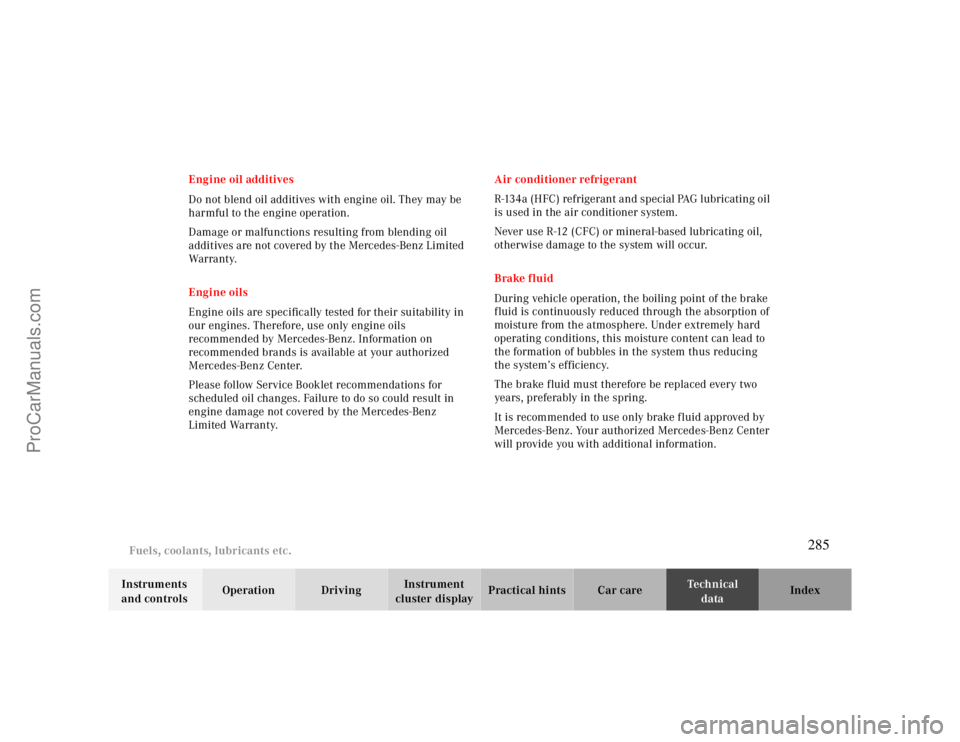
Do not blend oil additives with engine oil. They may be
harmful to the engine operation.
Damage or malfunctions resulting from blending oil
additives are not covered by the Mercedes-Benz Limited
War ra nt y.
Engine oils
Engine oils are specifically tested for their suitability in
our engines. Therefore, use only engine oils
recommended by Mercedes-Benz. Information on
recommended brands is available at your authorized
Mercedes-Benz Center.
Please follow Service Booklet recommendations for
scheduled oil changes. Failure to do so could result in
engine damage not covered by the Mercedes-Benz
Limited Warranty.Air conditioner refrigerant
R-134a (HFC) refrigerant and special PAG lubricating oil
is used in the air conditioner system.
Never use R-12 (CFC) or mineral-based lubricating oil,
otherwise damage to the system will occur.
Brake fluid
During vehicle operation, the boiling point of the brake
fluid is continuously reduced through the absorption of
moisture from the atmosphere. Under extremely hard
operating conditions, this moisture content can lead to
the formation of bubbles in the system thus reducing
the system’s efficiency.
The brake fluid must therefore be replaced every two
years, preferably in the spring.
It is recommended to use only brake fluid approved by
Mercedes-Benz. Your authorized Mercedes-Benz Center
will provide you with additional information.
285
ProCarManuals.com
Page 286 of 299
Fuels, coolants, lubricants etc.
Te ch n ica l
data Instruments
and controlsOperation DrivingInstrument
cluster displayPractical hints Car care Index
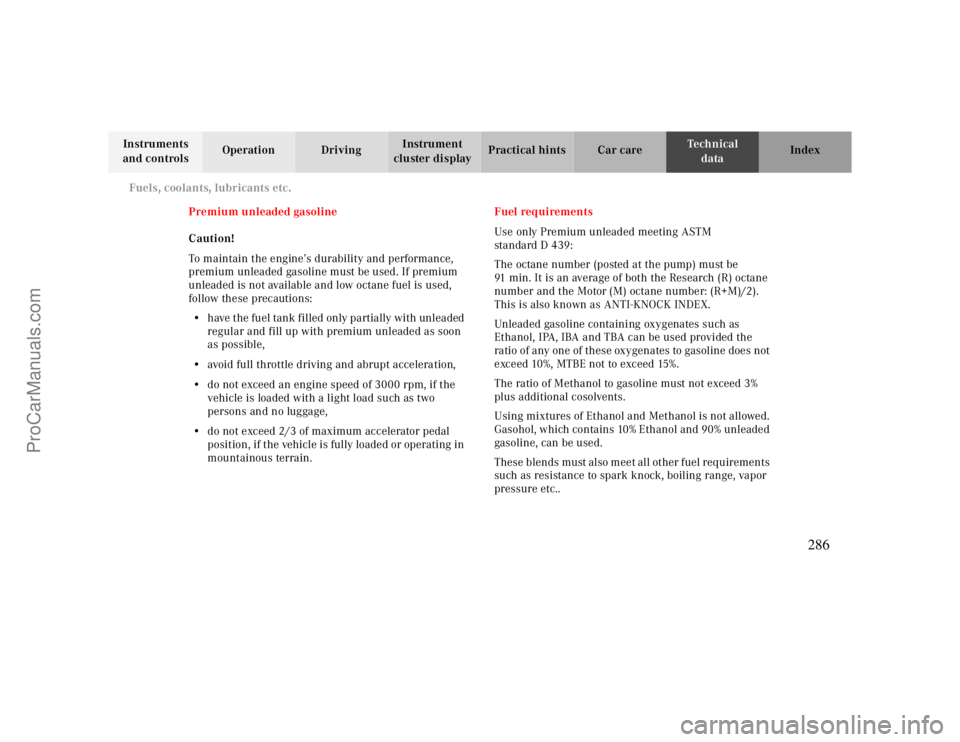
Premium unleaded gasoline
Caution!
To maintain the engine’s durability and performance,
premium unleaded gasoline must be used. If premium
unleaded is not available and low octane fuel is used,
follow these precautions:
•have the fuel tank filled only partially with unleaded
regular and fill up with premium unleaded as soon
as possible,
•avoid full throttle driving and abrupt acceleration,
•do not exceed an engine speed of 3000 rpm, if the
vehicle is loaded with a light load such as two
persons and no luggage,
•do not exceed 2/3 of maximum accelerator pedal
position, if the vehicle is fully loaded or operating in
mountainous terrain.Fuel requirements
Use only Premium unleaded meeting ASTM
standard D 439:
The octane number (posted at the pump) must be
91 min. It is an average of both the Research (R) octane
number and the Motor (M) octane number: (R+M)/2).
This is also known as ANTI-KNOCK INDEX.
Unleaded gasoline containing oxygenates such as
Ethanol, IPA, IBA and TBA can be used provided the
ratio of any one of these oxygenates to gasoline does not
exceed 10%, MTBE not to exceed 15%.
The ratio of Methanol to gasoline must not exceed 3%
plus additional cosolvents.
Using mixtures of Ethanol and Methanol is not allowed.
Gasohol, which contains 10% Ethanol and 90% unleaded
gasoline, can be used.
These blends must also meet all other fuel requirements
such as resistance to spark knock, boiling range, vapor
pressure etc..
286
ProCarManuals.com