seats MERCEDES-BENZ CLK-CLASS 2002 User Guide
[x] Cancel search | Manufacturer: MERCEDES-BENZ, Model Year: 2002, Model line: CLK-CLASS, Model: MERCEDES-BENZ CLK-CLASS 2002Pages: 341, PDF Size: 10.67 MB
Page 52 of 341
49 Seats
Te ch n i c a l
data Instruments
and controlsOperationDrivingInstrument
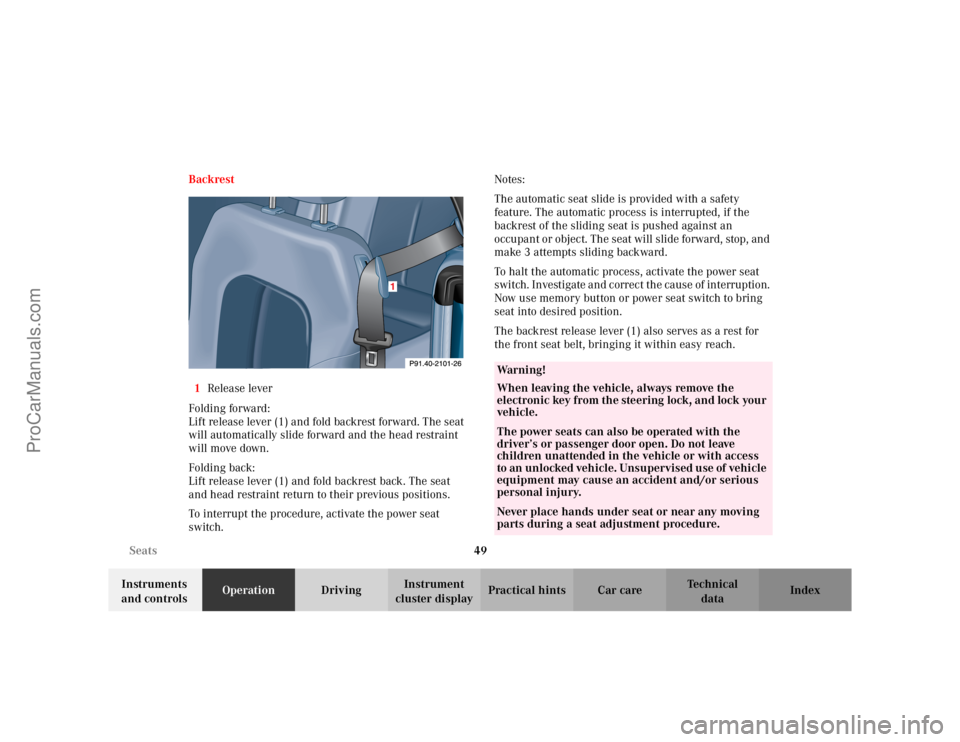
cluster displayPractical hints Car care Index Backrest
1Release lever
Folding forward:
Lift release lever (1) and fold backrest forward. The seat
will automatically slide forward and the head restraint
will move down.
Folding back:
Lift release lever (1) and fold backrest back. The seat
and head restraint return to their previous positions.
To interrupt the procedure, activate the power seat
switch.Notes:
The automatic seat slide is provided with a safety
feature. The automatic process is interrupted, if the
backrest of the sliding seat is pushed against an
occupant or object. The seat will slide forward, stop, and
make 3 attempts sliding backward.
To halt the automatic process, activate the power seat
switch. Investigate and correct the cause of interruption.
Now use memory button or power seat switch to bring
seat into desired position.
The backrest release lever (1) also serves as a rest for
the front seat belt, bringing it within easy reach.
Wa r n i n g !
When leaving the vehicle, always remove the
electronic key from the steering lock, and lock your
vehicle.The power seats can also be operated with the
driver’s or passenger door open. Do not leave
children unattended in the vehicle or with access
to an unlocked vehicle. Unsupervised use of vehicle
equipment may cause an accident and/or serious
personal injury.Never place hands under seat or near any moving
parts during a seat adjustment procedure.
ProCarManuals.com
Page 53 of 341
50 Seats
Te ch n i c a l
data Instruments
and controlsOperationDrivingInstrument
cluster displayPractical hints Car care Index
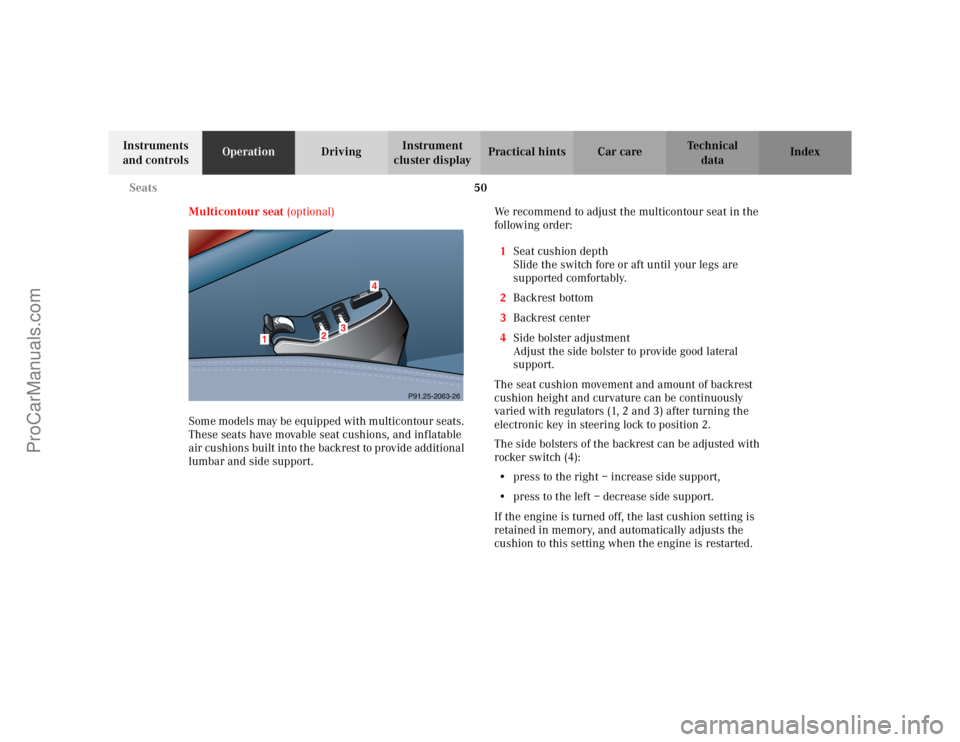
Multicontour seat (optional)
Some models may be equipped with multicontour seats.
These seats have movable seat cushions, and inflatable
air cushions built into the backrest to provide additional
lumbar and side support.We recommend to adjust the multicontour seat in the
following order:
1Seat cushion depth
Slide the switch fore or aft until your legs are
supported comfortably.
2Backrest bottom
3Backrest center
4Side bolster adjustment
Adjust the side bolster to provide good lateral
support.
The seat cushion movement and amount of backrest
cushion height and curvature can be continuously
varied with regulators (1, 2 and 3) after turning the
electronic key in steering lock to position 2.
The side bolsters of the backrest can be adjusted with
rocker switch (4):
•press to the right – increase side support,
•press to the left – decrease side support.
If the engine is turned off, the last cushion setting is
retained in memory, and automatically adjusts the
cushion to this setting when the engine is restarted.
1
2
3
4
P91.25-2063-26
ProCarManuals.com
Page 54 of 341
51 Seats
Te ch n i c a l
data Instruments
and controlsOperationDrivingInstrument
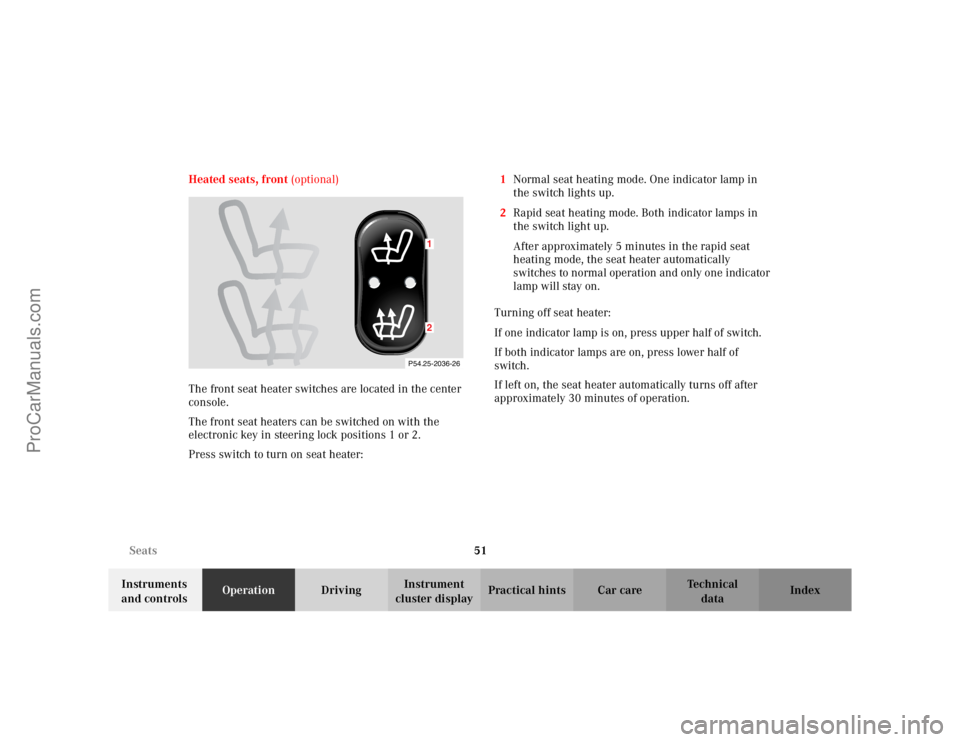
cluster displayPractical hints Car care Index Heated seats, front (optional)
The front seat heater switches are located in the center
console.
The front seat heaters can be switched on with the
electronic key in steering lock positions 1 or 2.
Press switch to turn on seat heater:1Normal seat heating mode. One indicator lamp in
the switch lights up.
2Rapid seat heating mode. Both indicator lamps in
the switch light up.
After approximately 5 minutes in the rapid seat
heating mode, the seat heater automatically
switches to normal operation and only one indicator
lamp will stay on.
Turning off seat heater:
If one indicator lamp is on, press upper half of switch.
If both indicator lamps are on, press lower half of
switch.
If left on, the seat heater automatically turns off after
approximately 30 minutes of operation.
P54.25-2036-26
12
ProCarManuals.com
Page 55 of 341
52 Restraint systems
Te ch n i c a l
data Instruments
and controlsOperationDrivingInstrument
cluster displayPractical hints Car care Index
Notes:
When in operation, the seat heater consumes a large
amount of electrical power. It is not advisable to use the
seat heater longer than necessary.
The seat heaters may automatically switch off if too
many power consumers are switched on at the same
time, or if the battery charge is low. When this occurs,
the indicator lamp in the switch will blink (both
indicator lamps blink during rapid seat heating mode).
The seat heaters will switch on again automatically as
soon as sufficient voltage is available.
If the blinking of the indicator lamps is distracting to
you, the seat heaters can be switched off.Seat belts and integrated restraint system
Your vehicle is equipped with seat belts for all seats,
emergency tensioning devices for the front seat belts,
dual front airbags, door mounted side impact airbags
and knee bolsters for driver and front passenger. Their
protective functions are designed to complement one
another.
ProCarManuals.com
Page 56 of 341
53 Restraint systems
Te ch n i c a l
data Instruments
and controlsOperationDrivingInstrument
cluster displayPractical hints Car care Index Seat belts
Important!
Laws i n mo st states and all Canadi an provi nc es require
seat belt use.
All U.S. states, the District of Columbia, the U.S.
territories and all Canadian provinces require the use of
child restraints that comply with U.S. Fedral Motor
Vehicle Safety Standards 213 and 225 and Canadian
Motor Vehicle Safety Standards 213 and 210.2.
For your safety and that of your passengers we strongly
recommend their use.
Wa r n i n g !
Children 12 years old and under must never ride in
the front seat, except in a Mercedes-Benz
authorized BabySmart
TM compatible child seat,
which operates with the BabySmart
TM system
installed in the vehicle to deactivate the passenger
side front airbag when it is properly installed.
Otherwise they will be struck by the airbag when it
inflates in a crash. If this happens, serious or fatal
injury will result.
According to accident statistics, children are safer
when properly restrained in the rear seating
positions than in the front seating positions.
Infants and small children must ride in back seats
and be seated in an appropriate infant or child
restraint system, which is properly secured with
the vehicle's seat belt or lower anchors, fully in
accordance with the child seat manufacturer’s
instructions.A child’s risk of serious or fatal injuries is
significantly increased if the child restraints are
not properly secured in the vehicle and the child is
not properly secured in the child restraint.
ProCarManuals.com
Page 61 of 341
58 Restraint systems
Te ch n i c a l
data Instruments
and controlsOperationDrivingInstrument
cluster displayPractical hints Car care Index
• Pregnant women should also use a lap-
shoulder belt. The lap belt portion should be
positioned as low as possible on the hips to
avoid any possible pressure on the abdomen.• Never place your feet on the instrument panel
or on the seat. Always keep both feet on the
floor in front of the seat.Wa r n i n g !
USE CHILD RESTRAINTS PROPERLY.Children 12 years old and under must never ride in
the front seat, except in a Mercedes-Benz
authorized BabySmart
TM compatible child seat,
which operates with the BabySmart
TM system
installed in the vehicle to deactivate the passenger
front airbag when it is properly installed.
Otherwise they will be struck by the airbag when it
inflates in a crash. If this happens, serious or fatal
injury will result.
According to accident statistics, children are safer
when properly restrained in the rear seating
positions than in the front seating positions.
Infants and small children must ride in back seats
and be seated in an appropriate infant or child
restraint system, which is properly secured with
the vehicle's seat belt or lower anchors, fully in
accordance with the child seat manufacturer’s
instructions.A child’s risk of serious or fatal injuries is
significantly increased if the child restraints are
not properly secured in the vehicle and the child is
not properly secured in the child restraint.Children too big for child restraint systems must
ride in back seats using regular seat belts. Position
shoulder belt across chest and shoulder, not face or
neck. A booster seat may be necessary to achieve
proper belt positioning.
ProCarManuals.com
Page 62 of 341
59 Restraint systems
Te ch n i c a l
data Instruments
and controlsOperationDrivingInstrument
cluster displayPractical hints Car care Index BabySmart
TM airbag deactivation system
Special BabySmart
TM compatible child seats, designed
for use with the Mercedes-Benz system and available at
any authorized Mercedes-Benz Center are required for
use with the BabySmart
TM airbag deactivation system.
With the special child seat properly installed, the
passenger front airbag will not deploy. The 7
indicator lamp located on the center console will be
illuminated, except with electronic key removed or in
steering lock position 0. The system does not deactivate
the door mounted side impact airbag.
BabySmart
TM is a trademark of Siemens Automotive Corp.
Self-test BabySmart
TM
without special child seat installed
After turning electronic key in steering lock to
position 1 or 2, the 7 indicator lamp located on the
center console comes on for approx. 6 seconds and then
extinguishes.
If the indicator lamp should not come on or is
continuously lit, the system is not functioning. You must
see an authorized Mercedes-Benz Center before seating
any child on the front passenger seat.
Wa r n i n g !
The BabySmart
TM airbag deactivation system will
ONLY work with a special child seat designed to
operate with it. It will not work with child seats
which are not BabySmart
TM compatible.
Never place anything between seat cushion and
child seat (e.g. pillow), since it reduces the
effectiveness of the deactivation system. The
bottom of the child seat must make full contact
with the passenger seat cushion. An incorrectly
mounted child seat could cause injuries to the
child in case of an accident instead of protecting
the child.
Follow the manufacturer’s instructions for
installation of special child seats.When using a BabySmart
TM compatible child seat
on the front passenger seat, the front passenger
airbag will not deploy only if the 7 indicator
lamp remains illuminated.
Please be sure to check the indicator every time
you use the special system child seat.Should the light go out while the restraint is
installed, please check installation. If the light
remains out, do not use the BabySmart
TM restraint
to transport children on the front passenger seat
until the system has been repaired.
ProCarManuals.com
Page 63 of 341
60 Restraint systems
Te ch n i c a l
data Instruments
and controlsOperationDrivingInstrument
cluster displayPractical hints Car care Index
Supplemental restraint system (SRS)
Airbags are intended as a supplement to seat belts.
Airbags alone cannot protect as well as airbags plus
seat belts in impacts for which the airbags were
designed to operate, and do not afford any protection
whatsoever in crashes for which the airbags are not
designed to deploy.
The SRS uses two crash severity levels (thresholds) to
activate either the Emergency tensioning device or front
airbag or both. Activation depends on the direction and
severity of the impact exceeding the preset thresholds
and whether the seat belt is fastened.
Seat belt fastened
•first threshold exceeded: ETD activates
•second threshold exceeded: airbag also activates
Seat belt not fastened
•first threshold exceeded:
airbag activates, but not ETD
Driver and front passenger systems operate
independently of each other.Emergency tensioning device (ETD)
The seat belts for the front seats are equipped with
Emergency tensioning devices. These tensioning
devices are located in each belt’s inertia reel and
become operationally ready with the electronic key in
steering lock position 1 or 2.
The Emergency tensioning devices are designed to
activate only when the seat belts are fastened during
frontal impacts exceeding the first threshold of the SRS
and in rear impacts exceeding a preset severity level.
They remove slack from the belts in such a way that the
seat belts fit more snugly against the body restricting its
forward Emergency tensioning device movement as
much as possible.
In cases of other frontal impacts, angled impacts,
roll-overs, certain side impacts, or other accidents
without sufficient frontal or rear impact forces, the
Emergency tensioning device will not be activated. The
driver and passengers will then be protected by the
fastened seat belts and inertia reel in the usual manner.
For seat belt and Emergency tensioning device safety
guidelines see page 67.
ProCarManuals.com
Page 73 of 341
70 Restraint systems
Te ch n i c a l
data Instruments
and controlsOperationDrivingInstrument
cluster displayPractical hints Car care Index
Wa r n i n g !
Children 12 years old and under must never ride in
the front seat, except in a Mercedes-Benz
authorized BabySmart
TM compatible child seat,
which operates with the BabySmart
TM system
installed in the vehicle to deactivate the passenger
front airbag when it is properly installed.
Otherwise they will be struck by the airbag when it
inflates in a crash. If this happens, serious or fatal
injury can result.
According to accident statistics, children are safer
when properly restrained in the rear seating
positions than in the front seating positions.
Infants and small children must ride in back seats
and be seated in an appropriate infant or child
restraint system, which is properly secured with
the vehicle’s seat belt or lower anchors, fully in
accordance with the child seat manufacturer’s
instructions.Infants and small children should never share a
seat belt with another occupant. During an
accident, they could be crushed between the
occupant and seat belt.
Children too big for child restraint systems must
ride in back seats using regular seat belts. Position
shoulder belt across chest and shoulder, not face or
neck. A booster seat may be necessary to achieve
proper belt positioning for children from 41 lbs.
until they reach a height where a lap/shoulder belt
fits properly without a booster.When the child restraint is not in use, remove it
from the vehicle or secure it with the seat belt to
prevent the child restraint from becoming a
projectile in the event of an accident.Do not leave children unattended in the vehicle;
even if the children are secured in a child restraint
system. Unsupervised children in a child restraint
system may use vehicle equipment and may cause
an accident and/or serious personal injury.
ProCarManuals.com
Page 74 of 341
71 Restraint systems
Te ch n i c a l
data Instruments
and controlsOperationDrivingInstrument
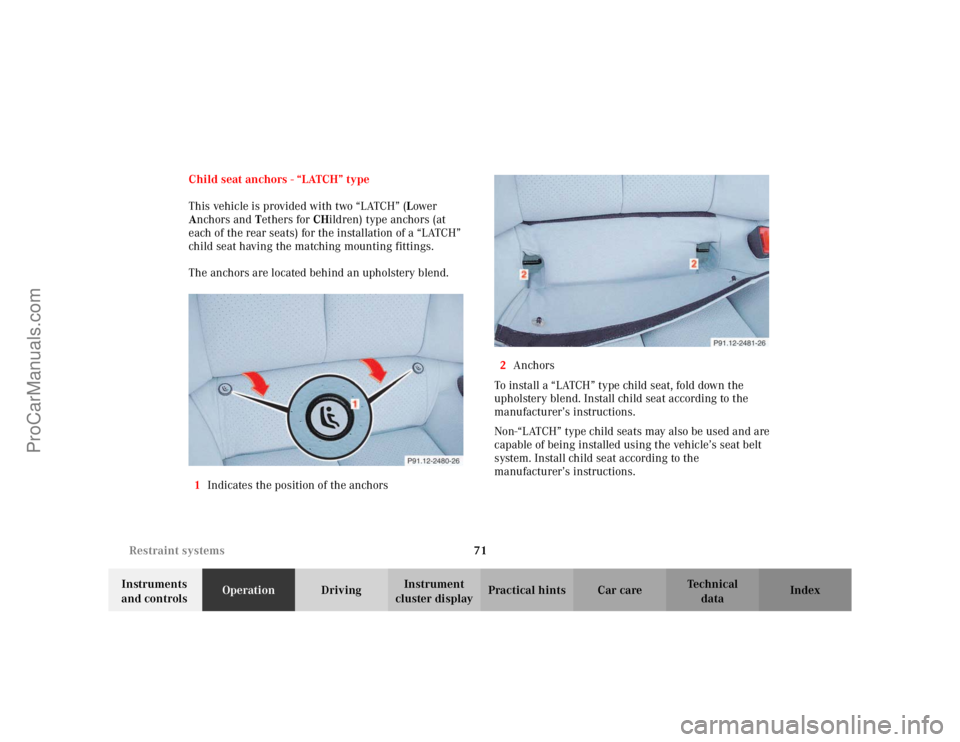
cluster displayPractical hints Car care Index Child seat anchors - “LATCH” type
This vehicle is provided with two “LATCH” (Lower
Anchors and Tethers for CHildren) type anchors (at
each of the rear seats) for the installation of a “LATCH”
child seat having the matching mounting fittings.
The anchors are located behind an upholstery blend.
1Indicates the position of the anchors2Anchors
To install a “LATCH” type child seat, fold down the
upholstery blend. Install child seat according to the
manufacturer’s instructions.
Non-“LATCH” type child seats may also be used and are
capable of being installed using the vehicle’s seat belt
system. Install child seat according to the
manufacturer’s instructions.
ProCarManuals.com