fuel MERCEDES-BENZ CLK-CLASS 2003 Owner's Manual
[x] Cancel search | Manufacturer: MERCEDES-BENZ, Model Year: 2003, Model line: CLK-CLASS, Model: MERCEDES-BENZ CLK-CLASS 2003Pages: 330, PDF Size: 15.73 MB
Page 181 of 330

178 Catalytic converter
Technical
data Instruments
and controlsOperationDrivingInstrument
cluster displayPractical hints Car care Index
Catalytic converter
Your Mercedes-Benz is equipped with monolithic type
catalytic converters, an important element in
conjunction with the oxygen sensors to achieve
substantial control of the pollutants in the exhaust
emissions. Keep your vehicle in proper operating
condition by following our recommended maintenance
instructions as outlined in your Service Booklet.Caution!
To prevent damage to the catalytic converters, use only
premium unleaded gasoline in this vehicle.
Any noticeable irregularities in engine operation should
be repaired promptly. Otherwise, excessive unburned
fuel may reach the catalytic converter causing it to
overheat, which could start a fire.
Wa r n i n g !
As with any vehicle, do not idle, park or operate
this vehicle in areas where combustible materials
such as grass, hay or leaves can come into contact
with the hot exhaust system, as these materials
could be ignited and cause a vehicle fire.
J_C208_II.book Seite 178 Donnerstag, 31. Mai 2001 10:13 10
ProCarManuals.com
Page 187 of 330
184 Tele Aid
Technical
data Instruments
and controlsOperationDrivingInstrument
cluster displayPractical hints Car care Index
Roadside Assistance button
Located below the center armrest cover is the Roadside
Assistance button. Pressing and holding the
button (for longer than 2 seconds) will initiate a call to a
Mercedes-Benz Roadside Assistance dispatcher. The
button will flash while the call is in progress. The
message “ROADSIDE ASSISTANCE – CONNECTING
CALL” will appear in the multifunction display. When
the connection is established, the message “ROADSIDE
ASSISTANCE – CALL CONNECTED” appears in the
multifunction display. The Tele Aid system will transmit
data generating the vehicle identification number,
model, color and location (subject to availability of
cellular and GPS signals).
A voice connection between the Roadside Assistance
dispatcher and the occupants of the vehicle will be
established. When a voice connection is established the
audio system mutes and the message “TELE AID –
ROADSIDE ASSISTANCE CALL ACTIVE” appears in the
multifunction display. The nature of the need for
assistance can then be described. The Mercedes-Benz
Roadside assistance dispatcher will either dispatch a
qualified Mercedes-Benz technician or arrange to tow
your vehicle to the nearest Mercedes-Benz Center. For services such as labor and/or towing charges may apply.
Refer to the Roadside Assistance manual for more
information.
These programs are only available in the USA:
•S ign an d Drive s erv ices : Ser vi ces such as jump start,
a few gallons of fuel or the replacement of a flat tire
with the vehicle spare tire are obtainable,
•Remote Vehicle Diagnostics: This function permits
the Mercedes-Benz Roadside Assistance dispatcher
to download malfunction codes and actual vehicle
data.
Notes:
The indicator lamp in the Roadside Assistance
button remains illuminated in red for approx.
10 seconds during the system self-check after turning
electronic key in starter switch to position 2 (together
with the “SOS” button and the Information
button¡).
See system self-check on page 180 when the indicator
lamp does not light up in red or stays on longer than
approximately 10 seconds.
J_C208_II.book Seite 184 Donnerstag, 31. Mai 2001 10:13 10
ProCarManuals.com
Page 206 of 330

203 Driving instructions
Technical
data Instruments
and controlsOperationDrivingInstrument
cluster displayPractical hints Car care Index Driving instructions
Drive sensibly – save fuel
Fuel consumption, to a great extent, depends on driving
habits and operating conditions.
To save fuel you should:
•keep tires at the recommended inflation pressures,
•remove unnecessary loads,
•remove roof rack when not in use,
•allow engine to warm up under low load use,
•avoid frequent acceleration and deceleration,
•have all maintenance work performed at regular
intervals by an authorized Mercedes-Benz Center.
Fuel consumption is also increased by driving in cold
weat her, i n stop -and -go traf f ic, on short trip s an d i n hilly
country.Drinking and driving
Ped al s
Wa r n i n g !
Drinking or taking drugs and driving can be a very
dangerous combination. Even a small amount of
alcohol or drugs can affect your reflexes,
perceptions and judgement.The possibility of a serious or even fatal accident is
sharply increased when you drink or take drugs
and drive.Please don’t drink or take drugs and drive or allow
anyone to drive after drinking or taking drugs.Wa r n i n g !
Keep driver’s foot area clear at all times. Objects
stored in this area may impair pedal movement.
J_C208_II.book Seite 203 Donnerstag, 31. Mai 2001 10:13 10
ProCarManuals.com
Page 225 of 330

222 What you should know at the gas station
Technical
data Instruments
and controlsOperationDrivingInstrument
cluster displayPractical hints Car care Index
What you should know at the gas station
Fuel supplyOpen flap by pushing near front (arrow). Turn fuel cap
to the left and hold on to it until possible pressure in
tank has been released, then remove cap. Failure to
remove slowly could result in personal injury.
Manual release of fuel filler flap, see page 287.
Fuel
To prevent fuel vapors from escaping into open air, fully
insert filler nozzle unit. Only fill fuel tank until the filler
nozzle unit cuts out – do not top up or overfill.
Leaving the engine running and the fuel cap open can
cause the “CHECK ENGINE” lamp to illuminate.
Fuel tank capacity approx. 16.4 US gal (62.0 l).
This includes approx. 2.1 US gal (8.0 l) reserve. Use
premium unleaded gasoline: Posted Octane Index 91
(Average of 96 RON/86 MON).
Wa r n i n g !
Gasoline is highly flammable and poisonous. It
burns violently and can cause serious injury.
Whenever you are around gasoline, avoid inhaling
fumes and skin contact, extinguish all smoking
materials. Never allow sparks, flame or smoking
materials near gasoline!
Wa r n i n g !
Overfilling of fuel tank may result in creating
pressure in the system which could cause a gas
discharge such as the gas spraying back out upon
removing the filler nozzle which could cause
personal injury.
J_C208_II.book Seite 222 Donnerstag, 31. Mai 2001 10:13 10
ProCarManuals.com
Page 226 of 330

223 What you should know at the gas station
Technical
data Instruments
and controlsOperationDrivingInstrument
cluster displayPractical hints Car care Index •Engine oil
Engine oil level check, see page 114 and page 253.
Fill quantity between upper and lower dipstick
marking level: 2.1 US qt. (2.0 l).
Recommended engine oils, see Approved Service
Products sheet.
• Coolant
For normal replenishing, use water (potable water
quality).
For further information (e.g. anticorrosion/
antifreeze), see page 305.
• Spark plugs
Approved spark plugs, see page 303.
• Tire pressure
For tire pressure, refer to tire pressure label inside
the fuel filler flap. See page 267 for further details.•Air conditioner
R-134a refrigerant and special PAG lubricant, see
page 305.
•Bulbs
High and low beams: H7 (55 W),
low beam: Xenon (optional)
fog lamps: H1 (55 W),
turn signal lamps,
front 1156 NA (26.9/5 W/32/4 cp),
parking and standing lamps, front: H 6W (6 W),
side marker lamps, front: 5 W/4 cp,
turn signal lamps, rear: 21 W/24 cp,
stop, tail, parking and side marker lamps: 21/4 W,
tail and parking lamp: 5 W/4 cp,
rear fog lamp, driver’s side: 21 W/32 cp,
backup lamps: 21 W/32 cp,
license plate lamps: 5 W/4 cp.
J_C208_II.book Seite 223 Donnerstag, 31. Mai 2001 10:13 10
ProCarManuals.com
Page 228 of 330

225 Contents – Instrument cluster display
Technical
data Instruments
and controlsOperation DrivingInstrument
cluster displayPractical hints Car care Index
Instrument cluster displayMalfunction and
indicator lamps in the
instrument cluster ....................226
On-board diagnostic system
Check engine malfunction
indicator lamp .............................226
Brake warning lamp ..................227
Supplemental restraint system
(SRS) indicator lamp ..................228
Fuel reserve and fuel cap
placement warning ....................228
Electronic stability program
(ESP) — warning lamp ...............229
BAS/ESP malfunction
indicator lamp .............................229
ABS malfunction
indicator lamp .............................229
Telescoping steering column –
indicator lamp .............................230
Seat belt warning lamp .............230Malfunction and
indicator lamps in the
center console ........................... 231
AIRBAG OFF indicator lamp .... 231
Malfunction and
warning messages in the
multifunction display .............. 232
DISPLAY DEFECTIVE
(engine control unit) ................. 233
DISPLAY DEFECTIVE
(several systems) ....................... 233
BATTERY/ALTERNATOR .......... 234
ABS-SYSTEM .............................. 235
BRAKE ASSIST ........................... 235
BRAKE LINING WEAR .............. 236
BRAKE FLUID ............................ 236
PARKING BRAKE ....................... 237
ENGINE FAN ............................... 237
COOLANT
(coolant level) ............................. 238
COOLANT TEMP.
(coolant temperature) ............... 239LIGHTING SYSTEM ....................240
LIGHT SENSOR ........................... 241
STEER. WHEEL ADJUST. ........... 241
ENGINE OIL LEVEL ...................242
ELEC. STABIL. PROGRAM.
(Electronic stability
program) ......................................243
REMOVE KEY .............................243
WASHER FLUID .........................244
TELE AID .....................................245
J_C208_II.book Seite 225 Donnerstag, 31. Mai 2001 10:13 10
ProCarManuals.com
Page 229 of 330
226 Malfunction and indicator lamps
Technical
data Instruments
and controlsOperation DrivingInstrument
cluster displayPractical hints Car care Index
Malfunction and indicator lamps
in the instrument cluster
General information:
If a bulb in the instrument cluster fails to light up
during the bulb self-check when turning the electronic
key in steering lock to position 2, have it checked and
replaced if necessary.
On-board diagnostic system
Check engine malfunction indicator lamp
Engine malfunction indicator lamp. If the
“CHECK ENGINE” malfunction indicator
lamp comes on when the engine is running,
it indicates a malfunction of the fuel management
system, emission control system, systems which impact
emissions, or the fuel cap is not closed tight (check the
fuel cap). If the “CHECK ENGINE” lamp is illuminated
continuously and the vehicle is driving normally, you
may still drive the vehicle, however, in all cases, we
recommend that you have the system checked at your
authorized Mercedes-Benz Center as soon as possible.
If the “CHECK ENGINE” lamp comes on continuously
and / or the vehicle is not driving normally (e.g.
malfunction of the fuel management system or running out of fuel), serious damage can occur to the emission
system. Please contact your authorized Mercedes-Benz
Center immediately.
The Sequential Multiport Fuel Injection (SFI) control
module monitors emission control components that
either provide input signals to or receive output signals
from the control module. Malfunctions resulting from
interruptions or failure of any of these components are
indicated by the “CHECK ENGINE” malfunction
indicator lamp in the instrument cluster and are
simultaneously stored in the SFI control module.
If the “CHECK ENGINE” malfunction indicator lamp
comes on, have the system checked at your authorized
Mercedes-Benz Center as soon as possible.
With some exceptions, the control module switches off
the “CHECK ENGINE” malfunction indicator lamp if the
condition, causing the lamp to come on, no longer exists
during three consecutive cycles. See also page 228 for
fuel cap placement warning.
An on-board diagnostic connector is located in the
passenger compartment near to the parking brake
pedal, allowing the accurate identification of system
malfunctions through the readout of diagnostic trouble
codes.
CHECK
ENGINE
J_C208_II.book Seite 226 Donnerstag, 31. Mai 2001 10:13 10
ProCarManuals.com
Page 231 of 330
228 Malfunction and indicator lamps
Technical
data Instruments
and controlsOperation DrivingInstrument
cluster displayPractical hints Car care Index
Supplemental restraint system (SRS) indicator lamp
The operational readiness of the airbag
system is verified by the indicator lamp
“SRS” in the instrument cluster when
turning the electronic key in steering lock to position 1
or 2. If no malfunction is detected, the lamp will go out
after approximately 4 seconds; after the lamp goes out,
the system continues to monitor the components and
circuitry of the airbag system and will indicate a
malfunction by coming on again.
See page 68 for notes on airbags, see page 67 for belt
tensioners and page 76 for infant and child seat
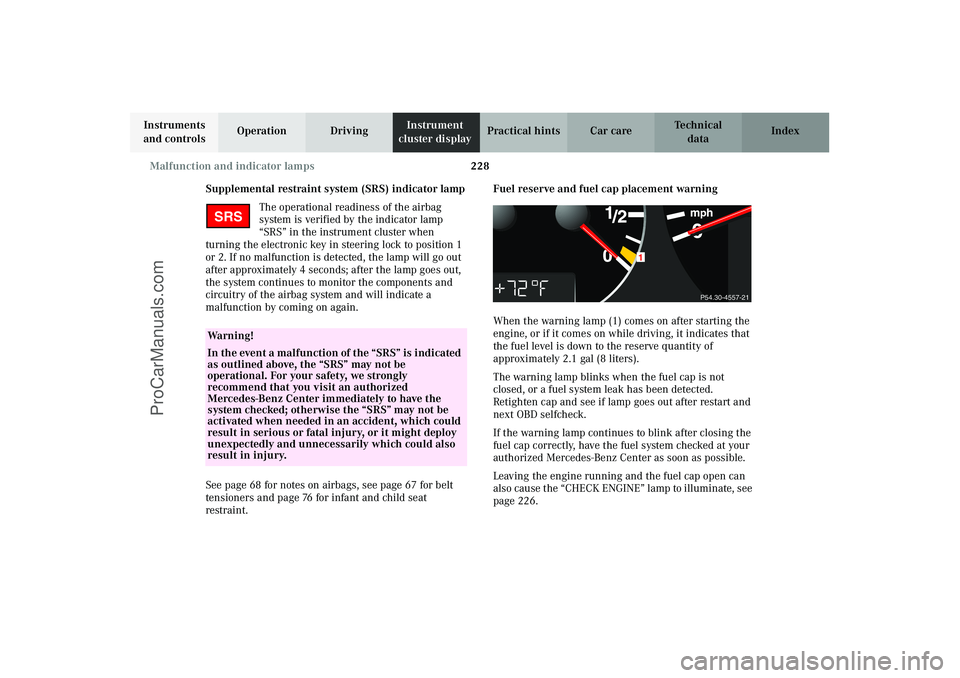
restraint.Fuel reserve and fuel cap placement warning
When the warning lamp (1) comes on after starting the
engine, or if it comes on while driving, it indicates that
the fuel level is down to the reserve quantity of
approximately 2.1 gal (8 liters).
The warning lamp blinks when the fuel cap is not
closed, or a fuel system leak has been detected.
Retighten cap and see if lamp goes out after restart and
next OBD selfcheck.
If the warning lamp continues to blink after closing the
fuel cap correctly, have the fuel system checked at your
authorized Mercedes-Benz Center as soon as possible.
Leaving the engine running and the fuel cap open can
also cause the “CHECK ENGINE” lamp to illuminate, see
page 226.
Wa r n i n g !
In the event a malfunction of the “SRS” is indicated
as outlined above, the “SRS” may not be
operational. For your safety, we strongly
recommend that you visit an authorized
Mercedes-Benz Center immediately to have the
system checked; otherwise the “SRS” may not be
activated when needed in an accident, which could
result in serious or fatal injury, or it might deploy
unexpectedly and unnecessarily which could also
result in injury.SRS
1
P54.30-4557-21
J_C208_II.book Seite 228 Donnerstag, 31. Mai 2001 10:13 10
ProCarManuals.com
Page 250 of 330

247 Contents – Practical hints
Technical
data Instruments
and controlsOperation DrivingInstrument
cluster displayPractical hintsCar care Index
Practical hintsFirst aid kit .....................................248
Shelf below rear window ..............248
Stowing things in
the vehicle ..................................248
Fuses ................................................249
Hood ................................................. 251
Checking engine oil level .............253
Automatic transmission
fluid level ...................................254
Coolant level ...................................254
Adding coolant ...........................255
Windshield washer / headlamp
cleaning system .........................256
Windshield and headlamp
washer fluid mixing ratio .........256Spare wheel, vehicle tools,
storage compartment ............... 257
Vehicle jack .................................... 258
Wheels ............................................ 259
Tire replacement ....................... 259
Rotating wheels ......................... 260
Spare wheel .................................... 261
Changing wheels ........................... 262
Tire inflation pressure ................. 267
Battery ............................................. 268
Jump starting ................................. 270
Towing the vehicle ........................ 272
Transmission selector lever,
manually unlocking ...................274
Exterior lamps ............................... 275
Headlamp assembly ...................276
Taillamp assemblies .................. 278Adjusting headlamp aim ...............280
Changing batteries in
the electronic key .....................283
Synchronizing remote
control ..........................................285
Emergency operation of
sliding/pop-up roof ...................286
Manual release for
fuel filler flap .............................287
Replacing wiper
blade insert ................................287
Roof rack .........................................289
J_C208_II.book Seite 247 Donnerstag, 31. Mai 2001 10:13 10
ProCarManuals.com
Page 263 of 330

260 Tires, Wheels
Technical
data Instruments
and controlsOperation DrivingInstrument
cluster displayPractical hintsCar care Index
Rotating wheels
Wheel rotation applies only when winter tires are
mounted on all four wheels.
The wheels can be rotated according to the degree of
tire wear while retaining the same direction of travel.
Rotating, however, should be carried out as
recommended by the tire manufacturer, before the
characteristic tire wear pattern (shoulder wear on front
wheels and tread center wear on rear wheels) becomes
visible, as otherwise the driving properties deteriorate.
Important!
Unidirectional tires must always be mounted with arrow
on tire sidewall pointing in direction of vehicle forward
movement.Notes:
Thoroughly clean the inner side of the wheels any time
you rotate the wheels or wash the vehicle underside.
The use of retread tires is not recommended. Retread
tires may adversely affect the handling characteristics
and safety of the vehicle.
Dented or bent rims can cause tire pressure loss and
damage to the tire beads. For this reason, check rims for
damage at regular intervals. The rim flanges must be
checked for wear before a tire is mounted. Remove
burrs, if any.
Check and ensure proper tire inflation pressure after
rotating the wheels. For tire inflation pressure see
inside of fuel filler flap and also page 267.
J_C208_II.book Seite 260 Donnerstag, 31. Mai 2001 10:13 10
ProCarManuals.com