Fuel door MERCEDES-BENZ CLK430 2001 C208 Owner's Manual
[x] Cancel search | Manufacturer: MERCEDES-BENZ, Model Year: 2001, Model line: CLK430, Model: MERCEDES-BENZ CLK430 2001 C208Pages: 329, PDF Size: 11.53 MB
Page 31 of 329
28 Central locking system
Te ch n ica l
data Instruments
and controlsOperationDrivingInstrument
cluster displayPractical hints Car care Index
Central locking system
Radio frequency and infrared remote control
The electronic main key has an integrated radio
frequency and infrared remote control.
Due to the extended operational range of the remote
control, it could be possible to unintentionally lock or
unlock the vehicle by pressing the transmit button. If
one of the transmit buttons is pressed, the battery check
lamp lights up briefly – indicating that the batteries are
in order. See page 283 for checking batteries.
The vehicle doors, trunk and fuel filler flap can be
centrally locked and unlocked via remote control.
Opening and closing the windows and sliding/pop-up
roof remotely can only be done with the infrared portion
of the remote control. Aim transmitter eye at a
receiver (6 or 7), press and hold transmit button Œ
or ‹.
With vehicle centrally locked, the trunk can also be
opened by using the remote control.
If the electronic key is inserted in steering lock, the
vehicle cannot be locked or unlocked, and the trunk lid
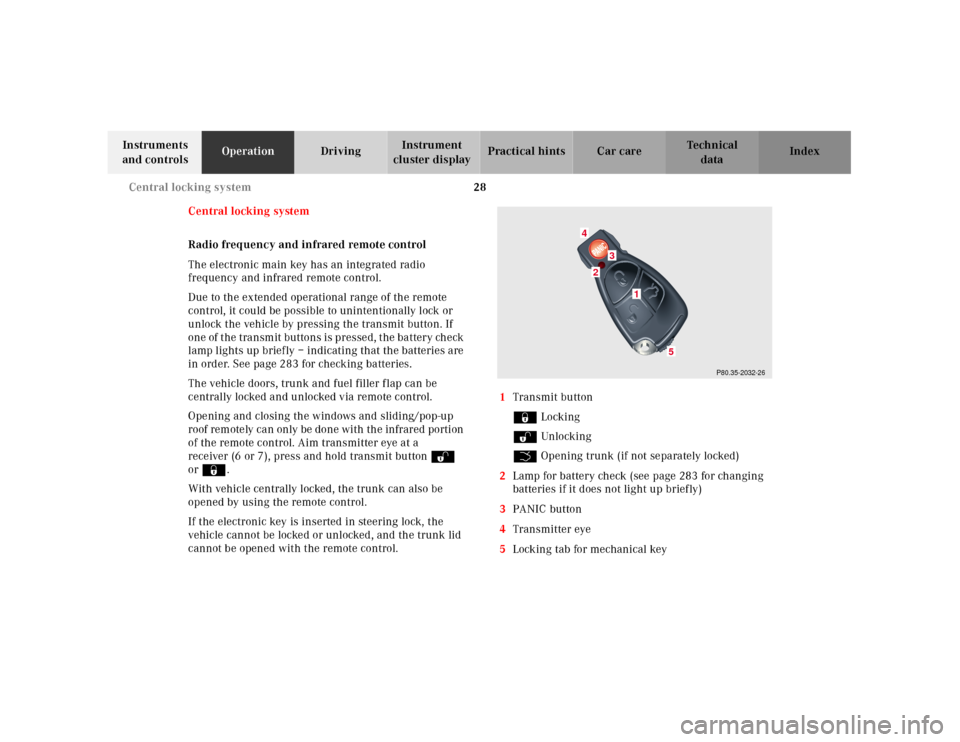
cannot be opened with the remote control.1Transmit button
‹ Locking
ΠUnlocking
Š Opening trunk (if not separately locked)
2Lamp for battery check (see page 283 for changing
batteries if it does not light up brief ly)
3PANIC button
4Transmitter eye
5Locking tab for mechanical key
P80.35-2032-26
24
3
5
1
Page 33 of 329
30 Central locking system
Te ch n ica l
data Instruments
and controlsOperationDrivingInstrument
cluster displayPractical hints Car care Index
Locking and unlocking with remote control
Unlocking:
Press transmit button Œ. All turn signal lamps blink
once to indicate that the vehicle is unlocked.
The remote control can be programmed for two kinds of
unlocking modes (see below):
Selective unlocking mode –
Press transmit button Œ once to unl ock d river’s d oor
and fuel filler flap.
Press transmit button Πtwice to unlock both doors,
fuel filler flap, and trunk.
Global unlocking mode –
Press transmit button Πonce to unlock both doors,
fuel filler flap, and trunk.
Notes:
If the trunk was previously locked separately, it will
remain locked, see page 38.
The presently active unlocking mode (selective or
global) can only be determined by unlocking the vehicle
with the remote control (see below for changing mode).If within 40 seconds of unlocking with the remote
control, neither door or trunk is opened, the electronic
key is not inserted in the steering lock, or the central
locking switch is not activated, the vehicle will
automatically lock.
Locking:
Press transmit button ‹ once. All turn signal lamps
blink three times to indicate that the vehicle is locked.
If they do not blink three times, a door or trunk is not
properly closed.
Note:
If the vehicle cannot be locked or unlocked by pressing
the transmit button, then it may be necessary to change
the batteries in the electronic main key (if ok, battery
check lamp in electronic main key will light briefly
when pressing transmit button) or to synchronize the
remote control, see page 283 and 285.
Page 36 of 329
33 Central locking system
Te ch n ica l
data Instruments
and controlsOperationDrivingInstrument
cluster displayPractical hints Car care Index Panic button
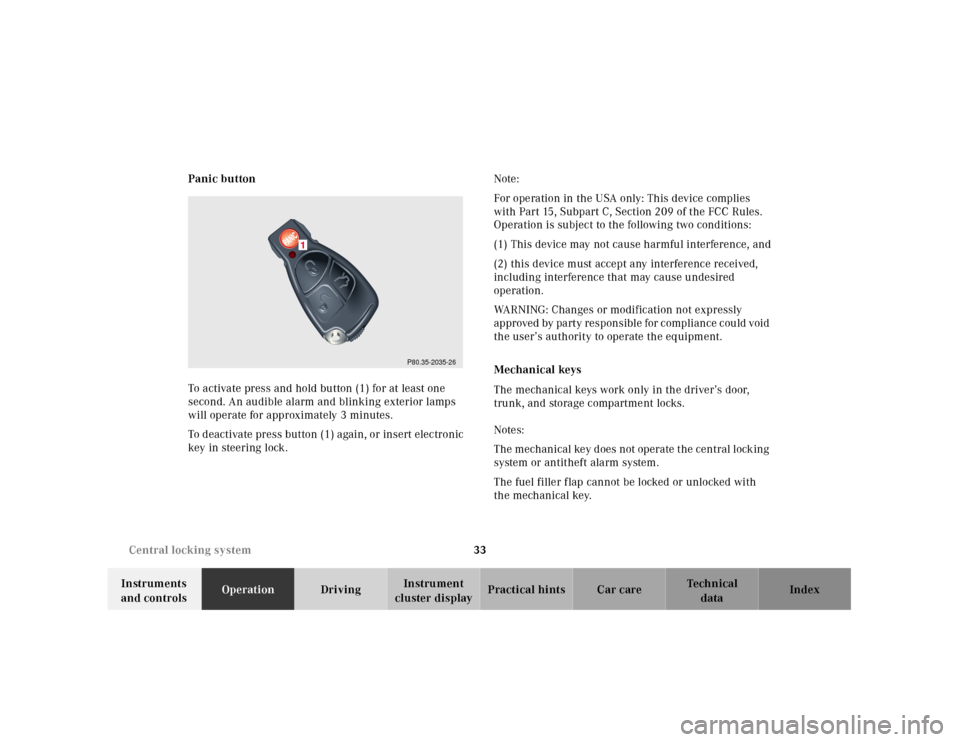
To activate press and hold button (1) for at least one
second. An audible alarm and blinking exterior lamps
will operate for approximately 3 minutes.
To deactivate press button (1) again, or insert electronic
key in steering lock.Note:
For operation in the USA only: This device complies
with Part 15, Subpart C, Section 209 of the FCC Rules.
Operation is subject to the following two conditions:
(1) This device may not cause harmful interference, and
(2) this device must accept any interference received,
including interference that may cause undesired
operation.
WARNING: Changes or modification not expressly
approved by party responsible for compliance could void
the user’s authority to operate the equipment.
Mechanical keys
The mechanical keys work only in the driver’s door,
trunk, and storage compartment locks.
Notes:
The mechanical key does not operate the central locking
system or antitheft alarm system.
The fuel filler flap cannot be locked or unlocked with
the mechanical key.
P80.35-2035-26
1
Page 38 of 329
35 Central locking system
Te ch n ica l
data Instruments
and controlsOperationDrivingInstrument
cluster displayPractical hints Car care Index If the vehicle has previously been locked from the
outside, opening a door from the inside will trigger the
alarm. When opening a door while the central locking
system is in the:
•selective unlocking mode, only that individual door
is unlocked. The remaining door, the trunk and fuel
filler f lap remain locked,
•global unlocking mode, both doors, the trunk and
fuel filler flap are unlocked.
Notes:
When opening a door, the door window lowers slightly.
After closing the door, the window closes again.
In case of a malfunction in the central locking system
the doors can be locked and unlocked individually.
To lock, pu sh down l ock button a nd turn mech anical key
in driver’s door lock to position 3. In addition lock the
trunk.To unlock, pull inside door handle and turn mechanical
key in driver’s door lock to position 2.
When unlocking the driver’s door with the mechanical
key, the exterior lamps will flash and the alarm will
sound.
To cancel the alarm, insert the electronic key in the
steering lock or press buttonŒ or‹ on the
electronic main key.
Page 39 of 329
36 Central locking system
Te ch n ica l
data Instruments
and controlsOperationDrivingInstrument
cluster displayPractical hints Car care Index
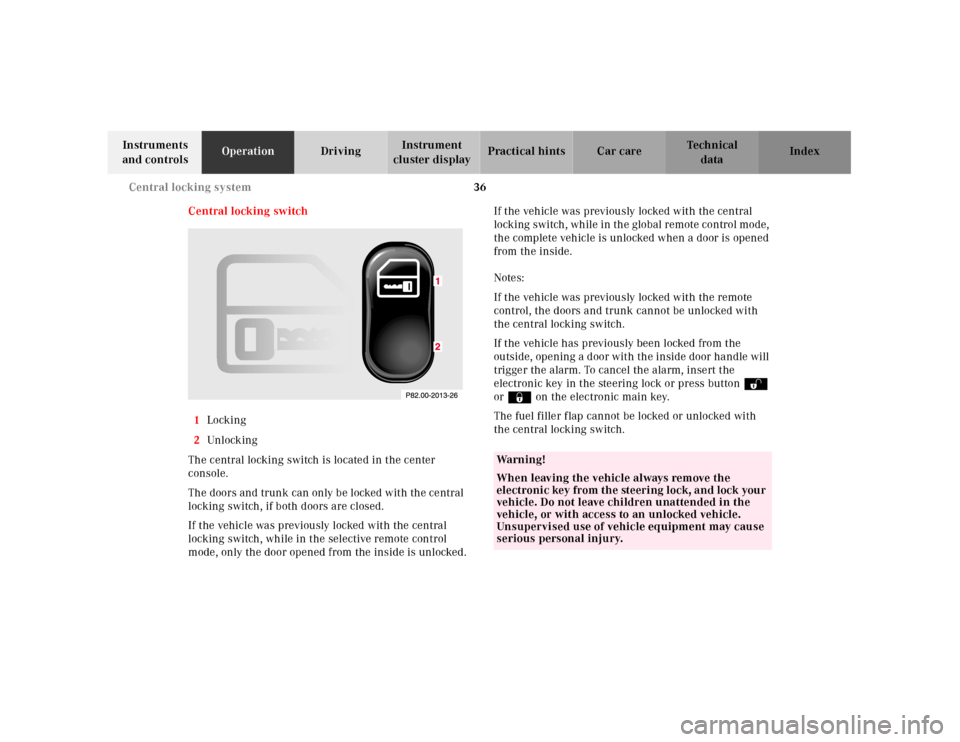
Central locking switch
1Locking
2Unl ock ing
The central locking switch is located in the center
console.
The doors and trunk can only be locked with the central
locking switch, if both doors are closed.
If the vehicle was previously locked with the central
locking switch, while in the selective remote control
mode, only the door opened from the inside is unlocked.If the vehicle was previously locked with the central
locking switch, while in the global remote control mode,
the complete vehicle is unlocked when a door is opened
from the inside.
Notes:
If the vehicle was previously locked with the remote
control, the doors and trunk cannot be unlocked with
the central locking switch.
If the vehicle has previously been locked from the
outside, opening a door with the inside door handle will
trigger the alarm. To cancel the alarm, insert the
electronic key in the steering lock or press buttonŒ
or‹ on the electronic main key.
The fuel filler flap cannot be locked or unlocked with
the central locking switch.
Wa r n i n g !
When leaving the vehicle always remove the
electronic key from the steering lock, and lock your
vehicle. Do not leave children unattended in the
vehicle, or with access to an unlocked vehicle.
Unsupervised use of vehicle equipment may cause
serious personal injury.
Page 40 of 329
37 Central locking system
Te ch n ica l
data Instruments
and controlsOperationDrivingInstrument
cluster displayPractical hints Car care Index Automatic central locking
The central locking switch also operates the automatic
central locking.
Wit h th e automa tic central locking system activated, t he
doors and trunk are locked at vehicle speeds of approx.
9 mph (15 km/h) or more. The fuel filler f lap remains
unlocked.
To a ctiva te:
With electronic key in steering lock position 2 hold
upper portion of switch (1) for a minimum of 5 seconds.
To dea cti vate :
With electronic key in steering lock position 2 hold
lower portion of switch (2) for a minimum of 5 seconds.
Notes:
If doors are unlocked with the central locking switch
after activating the automatic central locking, and
neither door is opened, then the doors remain unlocked
even at vehicle speeds of approx. 9 mph (15 km/h) or
more.If a door is opened from the inside at speeds of approx.
9 mph (15 km/h) or less with the automatic central
locking activated, the door will again be automatically
locked at speeds of approx. 9 mph (15 km/h) or more.
Important!
When towing the vehicle, or with the vehicle on a
dynamometer test stand, please, note the following:
With the automatic central locking activated and the
electronic key in steering lock position 2, the vehicle
doors will lock if the left front wheel as well as the right
rear wheel spin at vehicle speeds of approx. 9 mph
(15 km/h) or more.
To prevent the vehicle door locks from locking,
deactivate the automatic central locking.
Emergency unlocking in case of accident
The doors unlock automatically a short time after a
strong deceleration is detected, such as in a collision
(this is intended to aid rescue and exit).
Driv ing on rou gh road s m ay cau se t he vehicle to u nl ock.
If necessary, the vehicle can be locked again with the
central locking switch, see page 36.
Page 44 of 329
41 Central locking system
Te ch n ica l
data Instruments
and controlsOperationDrivingInstrument
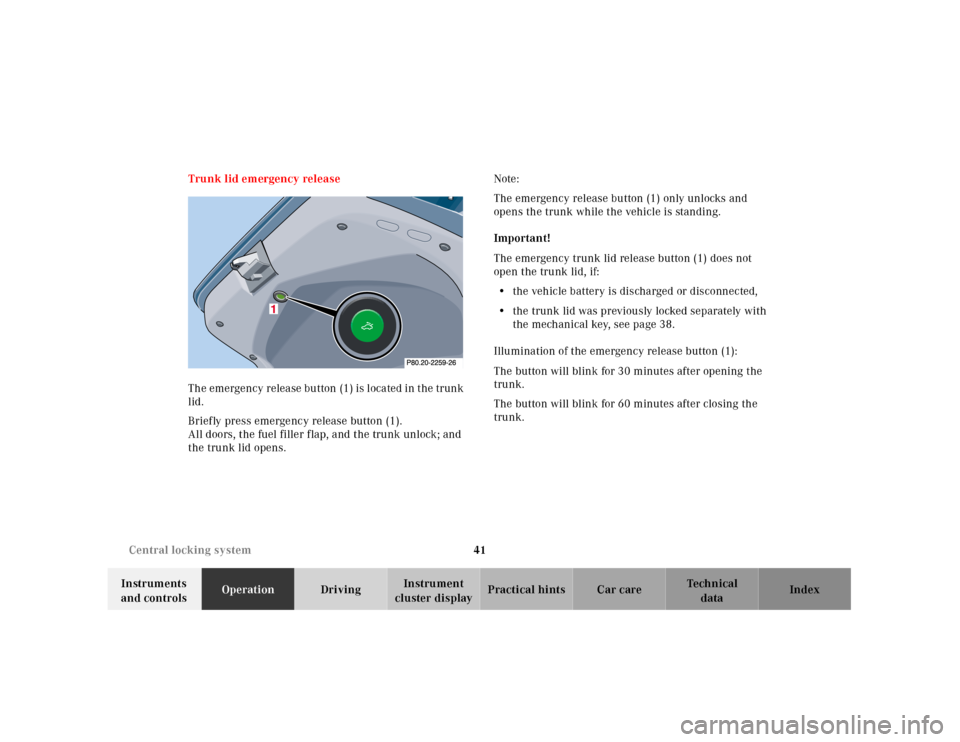
cluster displayPractical hints Car care Index Trunk lid emergency release
The emergency release button (1) is located in the trunk
lid.
Briefly press emergency release button (1).
All doors, the fuel filler flap, and the trunk unlock; and
the trunk lid opens.Note:
The emergency release button (1) only unlocks and
opens the trunk while the vehicle is standing.
Important!
The emergency trunk lid release button (1) does not
open the trunk lid, if:
•the vehicle battery is discharged or disconnected,
•the trunk lid was previously locked separately with
the mechanical key, see page 38.
Illumination of the emergency release button (1):
The button will blink for 30 minutes after opening the
trunk.
The button will blink for 60 minutes after closing the
trunk.
1
Page 295 of 329

292 Cleaning and care of the vehicle
Te ch n ica l
data Instruments
and controlsOperation DrivingInstrument
cluster displayPractical hintsCar careIndex
Cleaning and care of the vehicle
In operation, your vehicle is subjected to varying
external influences which, if gone unchecked, can
attack the paintwork as well as the underbody and
cause lasting damage.
Such damage is caused not only by extreme and varying
climatic conditions, but also by air polution, road salt,
tar, gravel and stone chipping. Grease and oil, fuel,
coolant, brake fluid, bird droppings, insects, tree resins
etc. should be removed immediately to avoid paint
damage. Frequent washing reduces and/or eliminates
the aggressiveness and potency of the above adverse
influences.More frequent washings are necessary to deal with
unfavorable conditions; for example, near the ocean, in
industrial areas (smoke, exhaust emissions), or during
winter operation.
You should check your vehicle from time to time for
stone chipping or other damage. Any damage should be
repaired as soon as possible to prevent the start of
corrosion.
In doing so, do not neglect the underside of the vehicle.
A prerequisite for a thorough check is a washing of the
underbody followed by a thorough inspection. Damaged
areas need to be reundercoated.
Your vehicle has been treated at the factory with a wax-
base ru stproof ing in th e body cavities which will la st for
the lifetime of the vehicle. Post-production treatment is
neither necessary nor recommended by Mercedes-Benz
because of the possibility of incompatibility between
materials used in the production process and others
applied later.
We have selected car-care products and compiled
recommendations which are specially matched to our
vehicles and which always reflect the latest technology.
You can obtain Mercedes-Benz approved car-care
products at your authorized Mercedes-Benz Center.
Wa r n i n g !
Many cleaning products can be hazardous. Some
are poisonous, others are flammable. Always follow
the instructions on the particular container.
Always open your vehicle’s doors or windows when
cleaning the inside.Never use fluids or solvents that are not designed
for cleaning your vehicle.
Page 319 of 329
316 Index
Te ch n ica l
data Instruments
and controlsOperation DrivingInstrument
cluster displayPractical hints Car careIndex
Doors .................................................................................. 34
Drinking and driving ....................................................203
Drive sensibly - save fuel ..............................................203
Driving instructions ......................................................203
Driving off .......................................................................205
EELEC. STABIL. PROGR. -
malfunction and warning messages ......................244
Electronic main key ......................................................... 25
Changing batteries ...................................................283
Synchronizing remote control ................................285
Electronic stability program (ESP) ..................... 209, 273
Control switch ........................................................... 221
Malfunction and warning message ........................244
Malfunction indicator lamp ..................................... 231
Synchronizing ...........................................................220
Warning lamp ............................................................ 231
Emergency call
See Tele Aid ............................................................... 180
Emergency tensioning retractor (ETR) ......................... 66
Emergency trunk lid release button ............................. 41
Emergency unlocking in case of accident ................... 37
Emission control ............................................................ 179Emission control label .................................................. 300
Engine compartment .....................................................251
ENGINE FAN - malfunction
and warning messages ............................................ 238
Engine malfunction
CHECK ENGINE malfunction
indicator lamp ...................................................... 228
Engine oil additives ...................................................... 307
Engine oil consumption ................................................ 115
Engine oil level
Checking ............................................................ 114, 253
Warning ..................................................................... 243
ENGINE OIL LEVEL - malfunction
and warning messages ............................................ 243
Engine oil level indicator .............................................. 114
ENGINE OIL LEVEL NOT WHEN ENGINE ON
(measuring) - multifunction indicator ................... 115
Engine oils ..................................................................... 307
Capacities .................................................................. 305
Enlarged cargo area ....................................................... 160
ESP (Electronic stability program) ............ 209, 219, 273
Control switch ...........................................................221
Malfunction and warning message ....................... 244
Malfunction indicator lamp .....................................231
Synchronizing .......................................................... 220
Warning lamp ............................................................231
Page 320 of 329
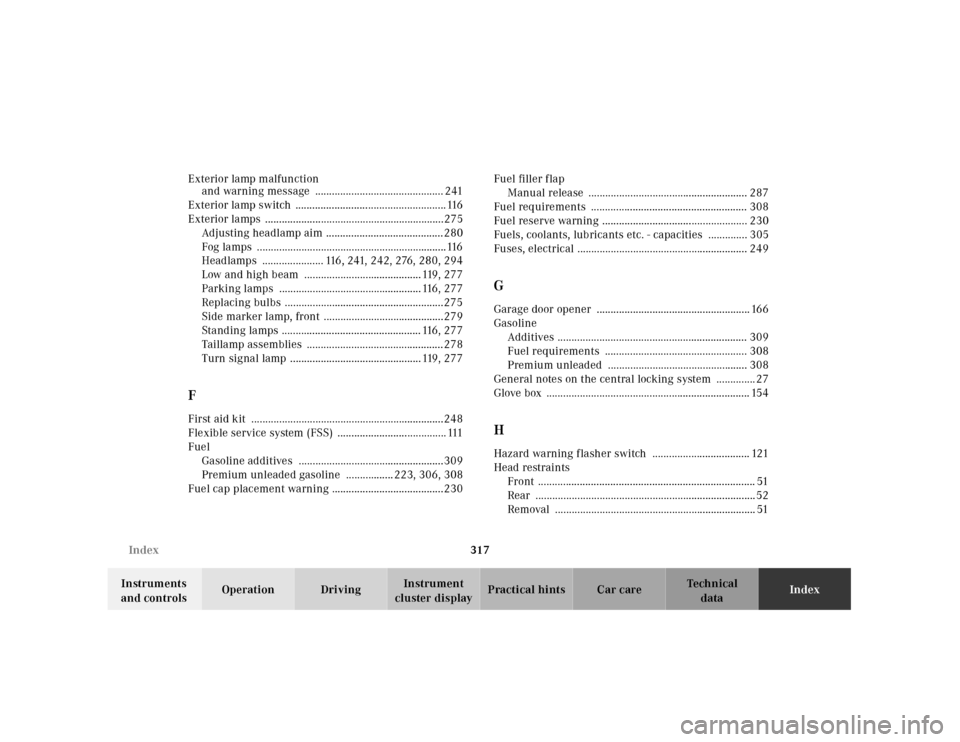
317 Index
Te ch n ica l
data Instruments
and controlsOperation DrivingInstrument
cluster displayPractical hints Car careIndex Exterior lamp malfunction
and warning message .............................................. 241
Exterior lamp switch ......................................................116
Exterior lamps ................................................................275
Adjusting headlamp aim ..........................................280
Fog lamps ....................................................................116
Headlamps ...................... 116, 241, 242, 276, 280, 294
Low and high beam ..........................................119, 277
Parking lamps ...................................................116, 277
Replacing bulbs .........................................................275
Side marker lamp, front ...........................................279
Standing lamps .................................................. 116, 277
Taillamp assemblies .................................................278
Turn signal lamp ...............................................119, 277
FFirst aid kit .....................................................................248
Flexible service system (FSS) ....................................... 111
Fuel
Gasoline additives ....................................................309
Premium unleaded gasoline ................. 223, 306, 308
Fuel cap placement warning ........................................230Fuel filler f lap
Manual release ......................................................... 287
Fuel requirements ........................................................ 308
Fuel reserve warning .................................................... 230
Fuels, coolants, lubricants etc. - capacities .............. 305
Fuses, electrical ............................................................. 249
GGarage door opener ....................................................... 166
Gasoline
Additives .................................................................... 309
Fuel requirements ................................................... 308
Premium unleaded .................................................. 308
General notes on the central locking system .............. 27
Glove box ......................................................................... 154HHazard warning flasher switch ................................... 121
Head restraints
Front .............................................................................. 51
Rear ...............................................................................52
Removal ........................................................................ 51