engine coolant MERCEDES-BENZ CLS 2010 User Guide
[x] Cancel search | Manufacturer: MERCEDES-BENZ, Model Year: 2010, Model line: CLS, Model: MERCEDES-BENZ CLS 2010Pages: 308, PDF Size: 5.71 MB
Page 180 of 308
R
Washer system and headlamp cleaning
system (Y page 181)
R Brake fluid ( Y page 182) Engine compartment
Hood
G
Warning!
Do not pull the release lever while the vehicle
is in motion. Otherwise the hood could be
forced open by passing air flow.
This could cause the hood to come loose and
injure you and/or others.
Opening G
Warning!
If you see flames or smoke coming from the
engine compartment, or if the coolant
temperature indicator indicates that the
engine is overheated, do not open the hood.
Move away from vehicle and do not open the
hood until the engine has cooled. If necessary,
call the fire department. G
Warning!
You could be injured when the hood is open –
even when the engine is turned off.
Parts of the engine can become very hot. To
prevent burns, let the engine cool completely
before touching any components on the
vehicle. Comply with all relevant safety
precautions. G
Warning!
To help prevent personal injury, stay clear of
moving parts when the hood is open and the
engine is running.
The radiator fan may continue to run for
approximately 30 seconds or may even
restart after the engine has been turned off.
Stay clear of fan blades. G
Warning!
The engine is equipped with a transistorized
ignition system. Because of the high voltage
it is dangerous to touch any components
(ignition coils, spark plug sockets, diagnostic
socket) of the ignition system
R with the engine running
R while starting the engine
R when the ignition is switched on and the
engine is turned manually X
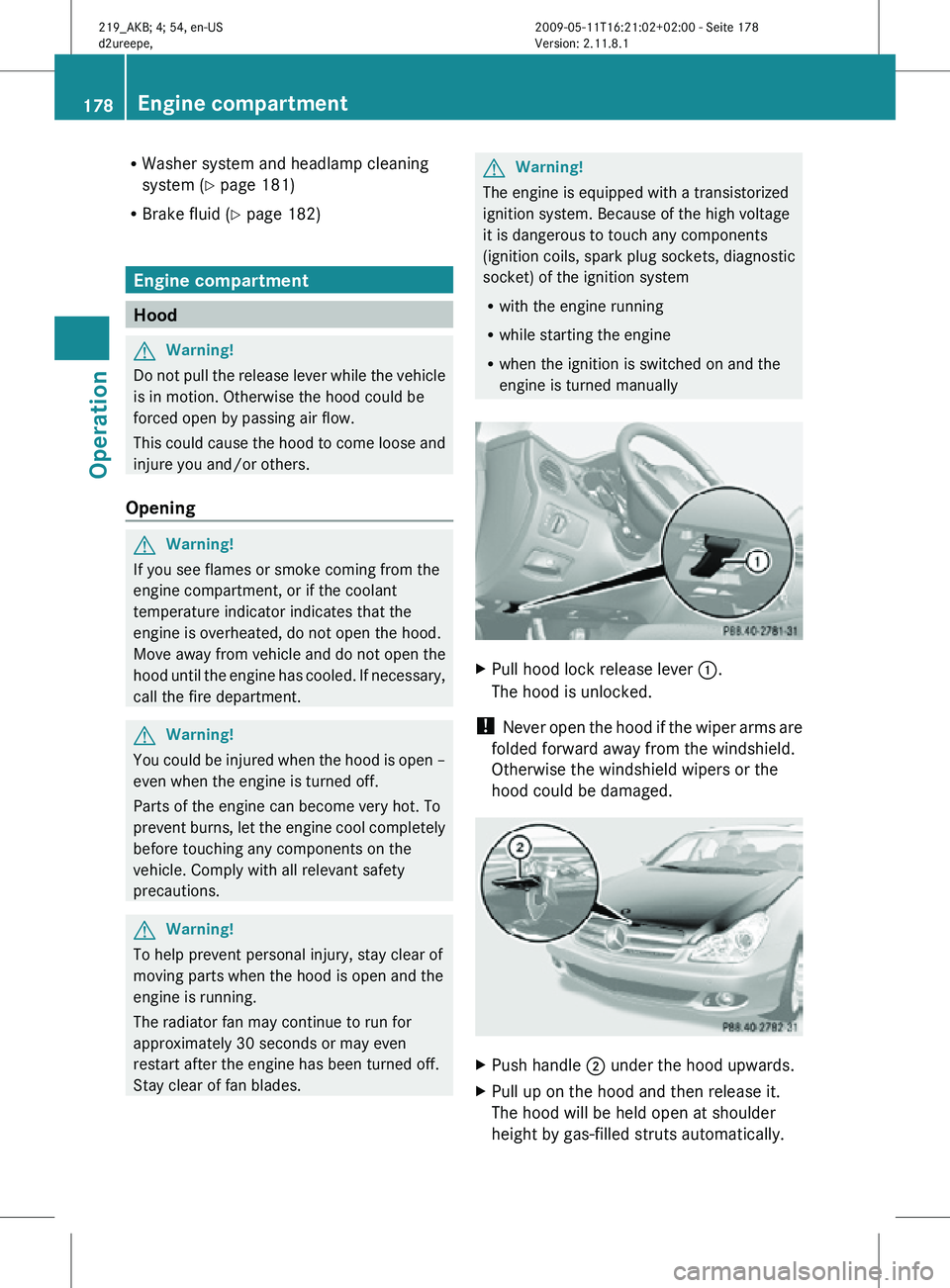
Pull hood lock release lever :.
The hood is unlocked.
! Never open the hood if the wiper arms are
folded forward away from the windshield.
Otherwise the windshield wipers or the
hood could be damaged. X
Push handle ; under the hood upwards.
X Pull up on the hood and then release it.
The hood will be held open at shoulder
height by gas-filled struts automatically. 178
Engine compartmentOperation
219_AKB; 4; 54, en-US
d2ureepe,
Version: 2.11.8.1 2009-05-11T16:21:02+02:00 - Seite 178
Page 181 of 308
Closing
G
Warning!
When closing the hood, use extreme caution
not to catch hands or fingers. Be careful that
you do not close the hood on anyone.
Make sure the hood is securely engaged
before driving off. Do not continue driving if
the hood can no longer engage after an
accident, for example. The hood could
otherwise come loose while the vehicle is in
motion and injure you and/or others.
X Let the hood drop from a height of
approximately 8 in (20 cm).
X Check to make sure the hood is fully
closed.
If you can raise the hood at a point above
the headlamps, then it is not properly
closed. Open it again and let it drop with
somewhat greater force. Engine oil
The amount of oil your engine consumes will
depend on a number of factors, including
driving style. Increased oil consumption can
occur when the vehicle is new or the vehicle
is driven frequently at higher engine speeds.
Engine oil consumption checks should only
be made after the vehicle break-in period.
! Do not use any special lubricant additives,
as these may damage the drive assemblies.
Using special additives not approved by
Mercedes-Benz may cause damage not
covered by the Mercedes-Benz Limited
Warranty.
For further information contact an
authorized Mercedes-Benz Center.
Notes on checking engine oil level When checking the oil level
R
the vehicle must be parked on level ground
R with the engine at operating temperature,
the vehicle must have been stationary for at least 5 minutes with the engine turned
off
R with the engine not at operating
temperature, the vehicle must have been
stationary for at least 30 minutes with the
engine turned off
Checking engine oil level X
Open the hood (Y page 178). X
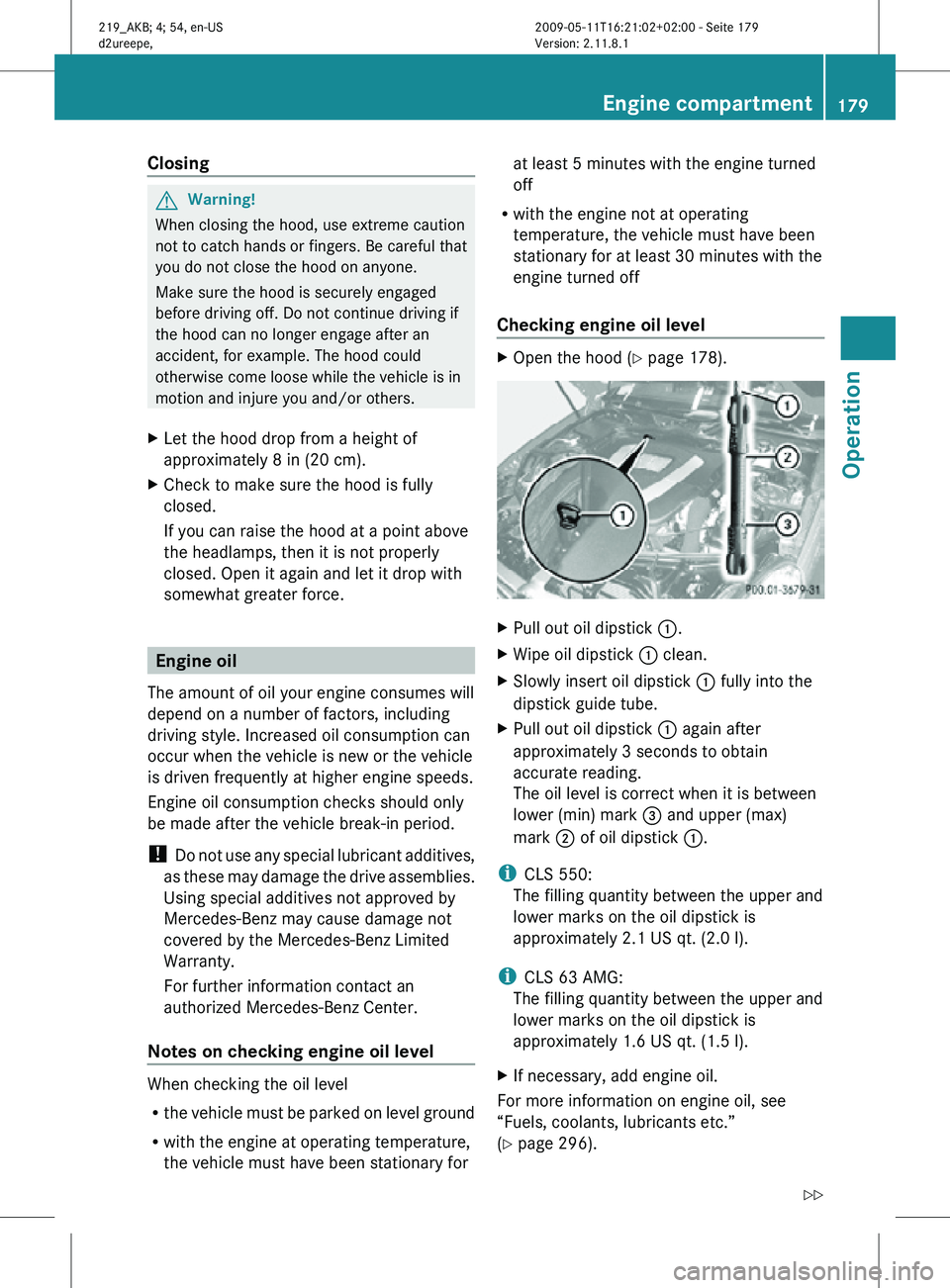
Pull out oil dipstick :.
X Wipe oil dipstick : clean.
X Slowly insert oil dipstick : fully into the
dipstick guide tube.
X Pull out oil dipstick : again after
approximately 3 seconds to obtain
accurate reading.
The oil level is correct when it is between
lower (min) mark = and upper (max)
mark ; of oil dipstick :.
i CLS 550:
The filling quantity between the upper and
lower marks on the oil dipstick is
approximately 2.1 US qt. (2.0 l).
i CLS 63 AMG:
The filling quantity between the upper and
lower marks on the oil dipstick is
approximately 1.6 US qt. (1.5 l).
X If necessary, add engine oil.
For more information on engine oil, see
“Fuels, coolants, lubricants etc.”
(Y page 296). Engine compartment
179Operation
219_AKB; 4; 54, en-US
d2ureepe, Version: 2.11.8.1 2009-05-11T16:21:02+02:00 - Seite 179 Z
Page 182 of 308
For information on messages in the
multifunction display concerning engine oil,
see the “Practical hints” section
(Y page 246).
Adding engine oil
!
Only use approved engine oils and oil
filters required for vehicles with
Maintenance System. For a listing of
approved engine oils and oil filters, contact
an authorized Mercedes-Benz Center or
visit www.mbusa.com (USA only).
The following will result in engine or
emission control system damage not
covered by the Mercedes-Benz Limited
Warranty:
R Using engine oils and oil filters of
specification other than those expressly
required for the Maintenance System.
R Changing of oil and oil filter at change
intervals longer than those called for by
the Maintenance System.
R Using any oil additives. CLS 550 CLS 63 AMG
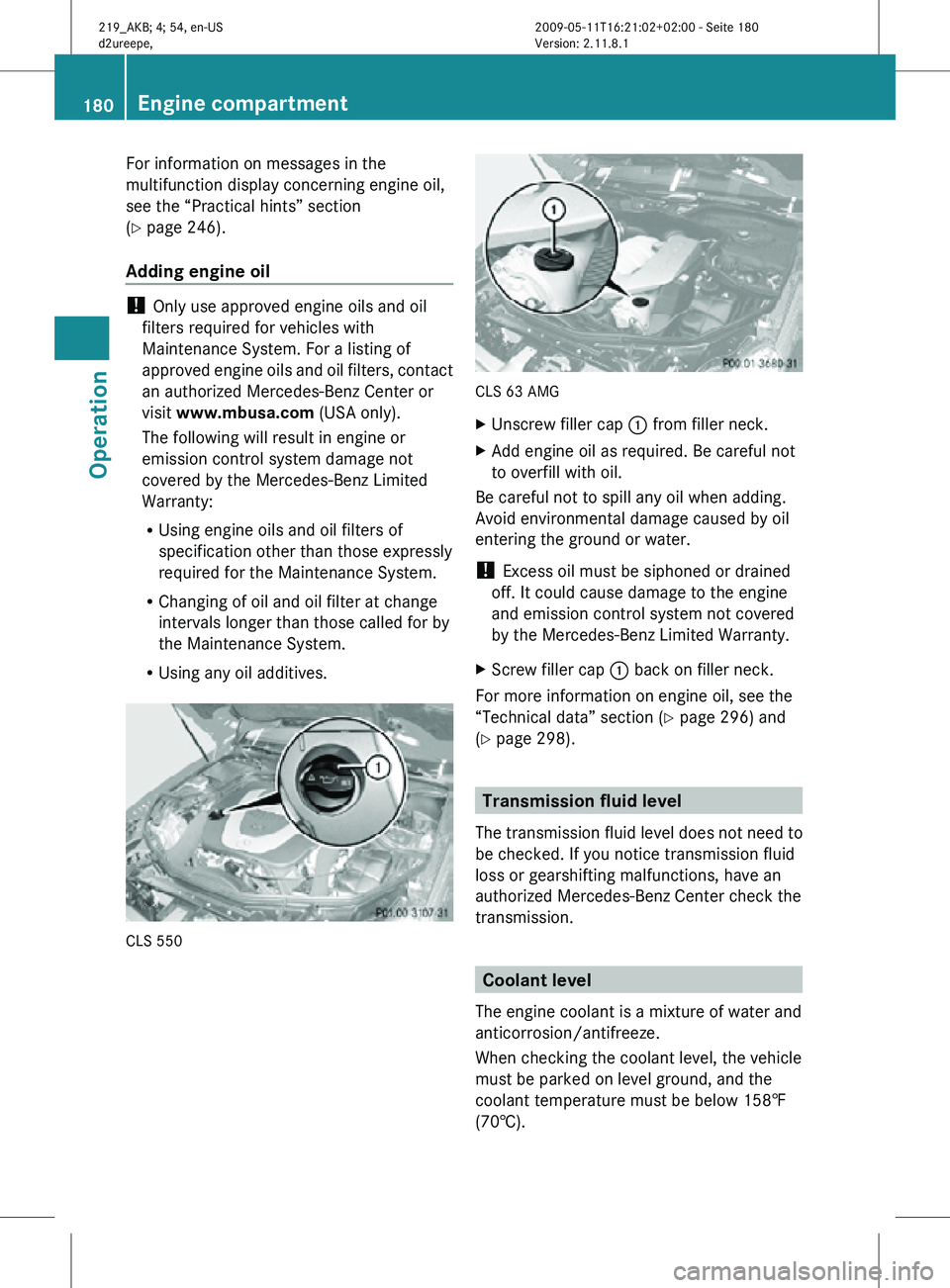
X
Unscrew filler cap : from filler neck.
X Add engine oil as required. Be careful not
to overfill with oil.
Be careful not to spill any oil when adding.
Avoid environmental damage caused by oil
entering the ground or water.
! Excess oil must be siphoned or drained
off. It could cause damage to the engine
and emission control system not covered
by the Mercedes-Benz Limited Warranty.
X Screw filler cap : back on filler neck.
For more information on engine oil, see the
“Technical data” section ( Y page 296) and
(Y page 298). Transmission fluid level
The transmission fluid level does not need to
be checked. If you notice transmission fluid
loss or gearshifting malfunctions, have an
authorized Mercedes-Benz Center check the
transmission. Coolant level
The engine coolant is a mixture of water and
anticorrosion/antifreeze.
When checking the coolant level, the vehicle
must be parked on level ground, and the
coolant temperature must be below 158‡
(70†). 180
Engine compartmentOperation
219_AKB; 4; 54, en-US
d2ureepe,
Version: 2.11.8.1 2009-05-11T16:21:02+02:00 - Seite 180
Page 183 of 308
G
Warning!
In order to avoid any potentially serious burns:
R Use extreme caution when opening the
hood if there are any signs of steam or
coolant leaking from the cooling system, or
if the coolant temperature indicator
indicates that the coolant is overheated.
R Do not remove the cap on the coolant
expansion tank if the coolant temperature
is above 158‡ (70†). Allow the engine to
cool down before removing the cap. The
coolant expansion tank contains hot fluid
and is under pressure.
R Using a rag, slowly open the cap
approximately 1
/ 2 turn counterclockwise
to relieve excess pressure. If opened
immediately, scalding hot fluid and steam
will be blown out under pressure.
R Do not spill antifreeze on hot engine parts.
Antifreeze contains ethylene glycol which
may burn if it comes into contact with hot
engine parts. X
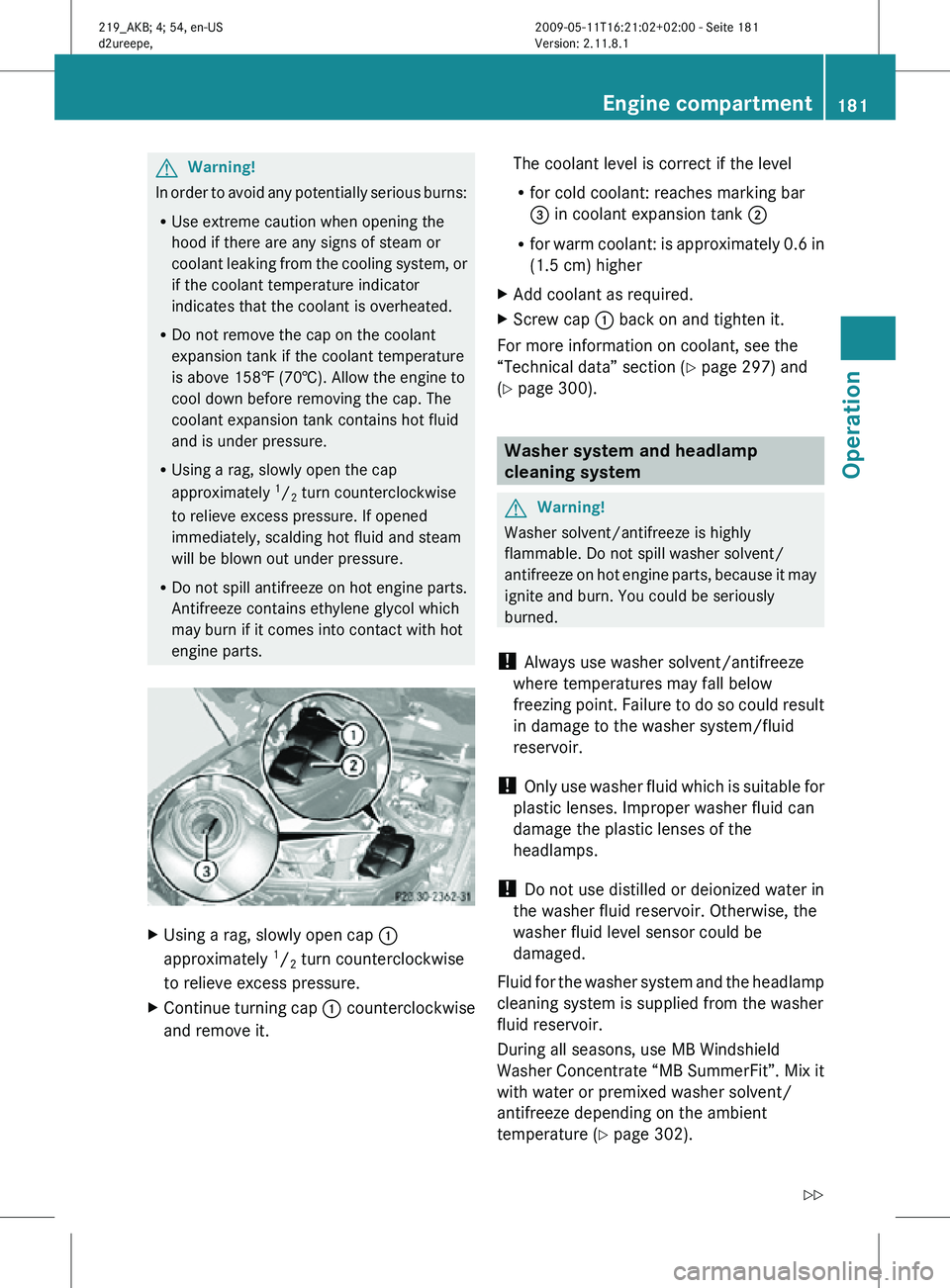
Using a rag, slowly open cap :
approximately 1
/ 2 turn counterclockwise
to relieve excess pressure.
X Continue turning cap : counterclockwise
and remove it. The coolant level is correct if the level
R
for cold coolant: reaches marking bar
= in coolant expansion tank ;
R for warm coolant: is approximately 0.6 in
(1.5 cm) higher
X Add coolant as required.
X Screw cap : back on and tighten it.
For more information on coolant, see the
“Technical data” section ( Y page 297) and
(Y page 300). Washer system and headlamp
cleaning system
G
Warning!
Washer solvent/antifreeze is highly
flammable. Do not spill washer solvent/
antifreeze on hot engine parts, because it may
ignite and burn. You could be seriously
burned.
! Always use washer solvent/antifreeze
where temperatures may fall below
freezing point. Failure to do so could result
in damage to the washer system/fluid
reservoir.
! Only use washer fluid which is suitable for
plastic lenses. Improper washer fluid can
damage the plastic lenses of the
headlamps.
! Do not use distilled or deionized water in
the washer fluid reservoir. Otherwise, the
washer fluid level sensor could be
damaged.
Fluid for the washer system and the headlamp
cleaning system is supplied from the washer
fluid reservoir.
During all seasons, use MB Windshield
Washer Concentrate “MB SummerFit”. Mix it
with water or premixed washer solvent/
antifreeze depending on the ambient
temperature ( Y page 302). Engine compartment
181Operation
219_AKB; 4; 54, en-US
d2ureepe, Version: 2.11.8.1 2009-05-11T16:21:02+02:00 - Seite 181 Z
Page 245 of 308
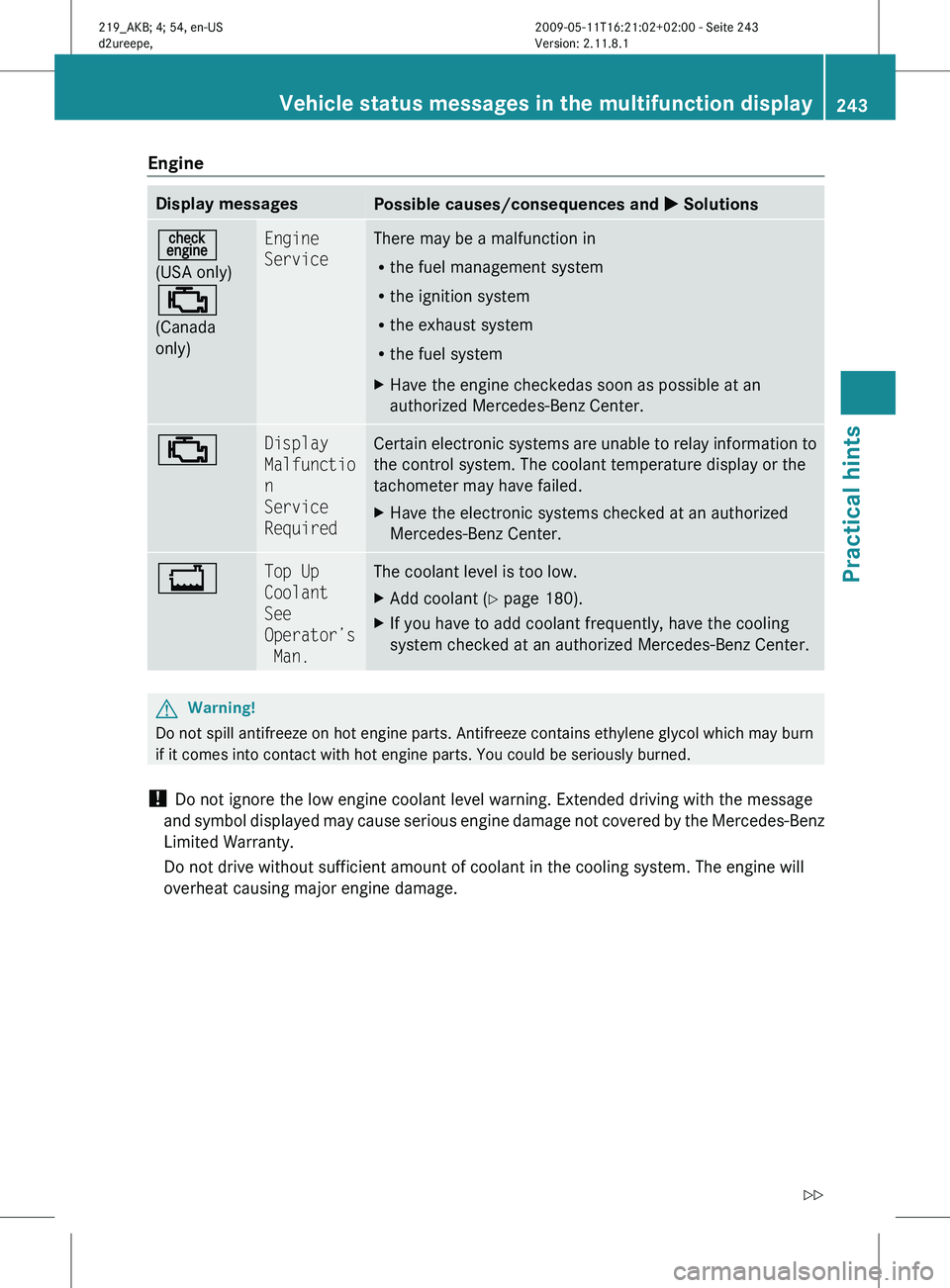
Engine
Display messages
Possible causes/consequences and
X Solutions=
(USA only)
;
(Canada
only) Engine
Service There may be a malfunction in
R
the fuel management system
R the ignition system
R the exhaust system
R the fuel system
X Have the engine checkedas soon as possible at an
authorized Mercedes-Benz Center. ; Display
Malfunctio
n
Service
Required Certain electronic systems are unable to relay information to
the control system. The coolant temperature display or the
tachometer may have failed.
X
Have the electronic systems checked at an authorized
Mercedes-Benz Center. + Top Up
Coolant
See
Operator’s
Man. The coolant level is too low.
X
Add coolant (Y page 180).
X If you have to add coolant frequently, have the cooling
system checked at an authorized Mercedes-Benz Center. G
Warning!
Do not spill antifreeze on hot engine parts. Antifreeze contains ethylene glycol which may burn
if it comes into contact with hot engine parts. You could be seriously burned.
! Do not ignore the low engine coolant level warning. Extended driving with the message
and
symbol displayed may cause serious engine damage not covered by the Mercedes-Benz
Limited Warranty.
Do not drive without sufficient amount of coolant in the cooling system. The engine will
overheat causing major engine damage. Vehicle status messages in the multifunction display
243
Practical hints
219_AKB; 4; 54, en-US
d2ureepe,Version: 2.11.8.1 2009-05-11T16:21:02+02:00 - Seite 243 Z
Page 246 of 308
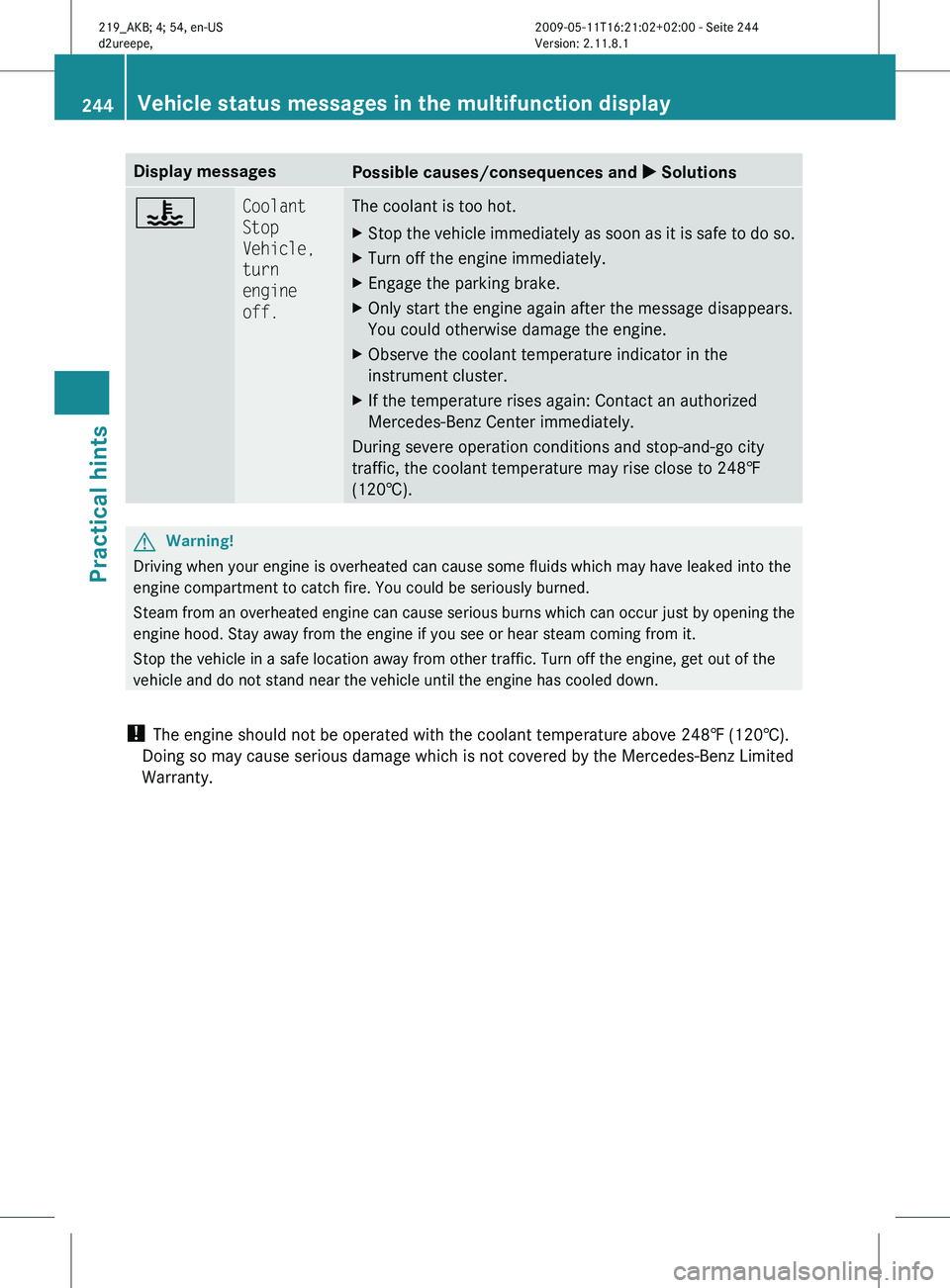
Display messages
Possible causes/consequences and
X Solutions? Coolant
Stop
Vehicle,
turn
engine
off. The coolant is too hot.
X
Stop the vehicle immediately as soon as it is safe to do so.
X Turn off the engine immediately.
X Engage the parking brake.
X Only start the engine again after the message disappears.
You could otherwise damage the engine.
X Observe the coolant temperature indicator in the
instrument cluster.
X If the temperature rises again: Contact an authorized
Mercedes-Benz Center immediately.
During severe operation conditions and stop-and-go city
traffic, the coolant temperature may rise close to 248‡
(120†). G
Warning!
Driving when your engine is overheated can cause some fluids which may have leaked into the
engine compartment to catch fire. You could be seriously burned.
Steam
from an overheated engine can cause serious burns which can occur just by opening the
engine hood. Stay away from the engine if you see or hear steam coming from it.
Stop the vehicle in a safe location away from other traffic. Turn off the engine, get out of the
vehicle and do not stand near the vehicle until the engine has cooled down.
! The engine should not be operated with the coolant temperature above 248‡ (120†).
Doing so may cause serious damage which is not covered by the Mercedes-Benz Limited
Warranty. 244
Vehicle status messages in the multifunction displayPractical hints
219_AKB; 4; 54, en-US
d2ureepe,
Version: 2.11.8.1 2009-05-11T16:21:02+02:00 - Seite 244
Page 247 of 308
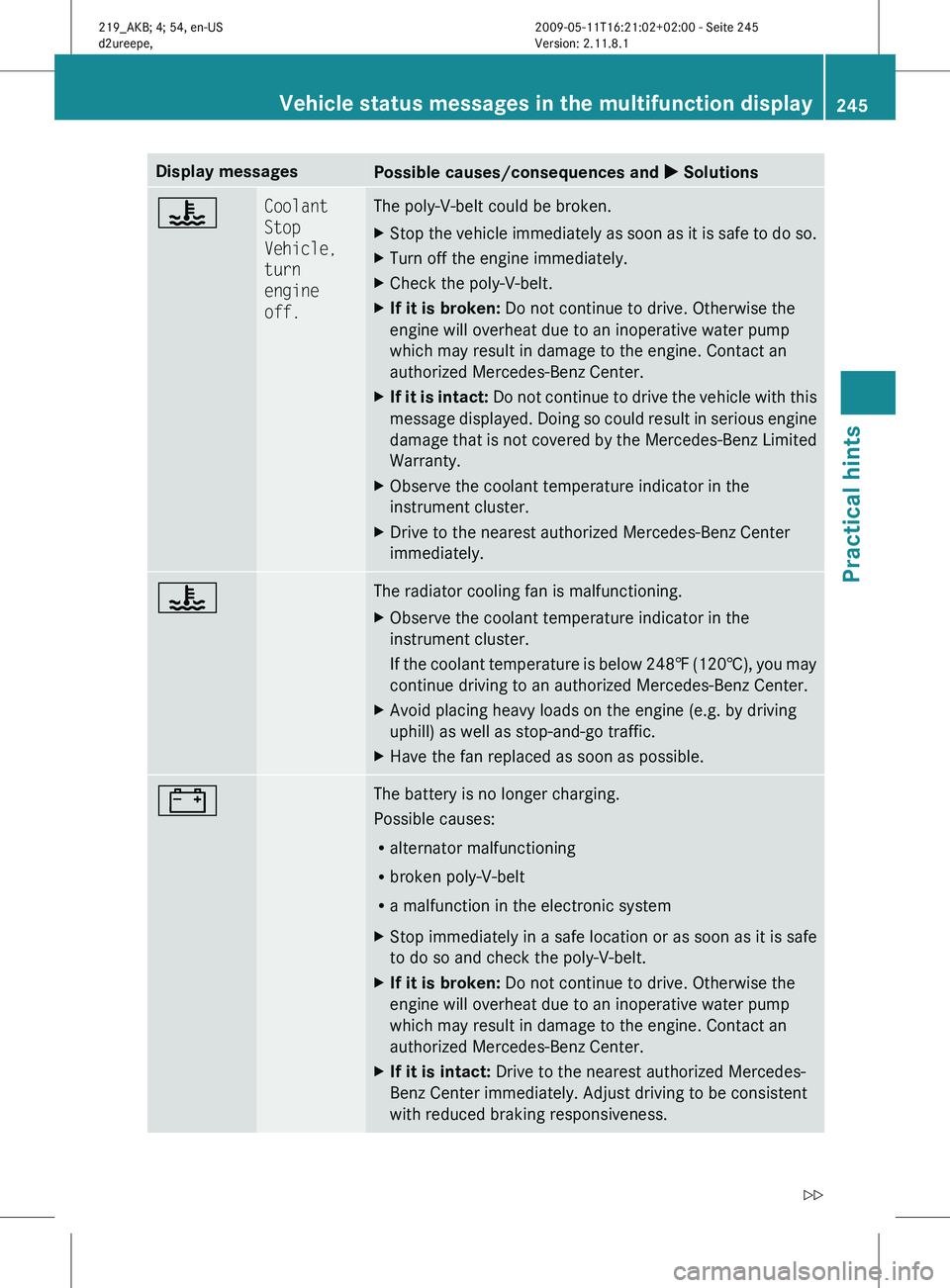
Display messages
Possible causes/consequences and
X Solutions? Coolant
Stop
Vehicle,
turn
engine
off. The poly-V-belt could be broken.
X
Stop the vehicle immediately as soon as it is safe to do so.
X Turn off the engine immediately.
X Check the poly-V-belt.
X If it is broken: Do not continue to drive. Otherwise the
engine will overheat due to an inoperative water pump
which may result in damage to the engine. Contact an
authorized Mercedes-Benz Center.
X If it is intact: Do not continue to drive the vehicle with this
message displayed. Doing so could result in serious engine
damage that is not covered by the Mercedes-Benz Limited
Warranty.
X Observe the coolant temperature indicator in the
instrument cluster.
X Drive to the nearest authorized Mercedes-Benz Center
immediately. ? The radiator cooling fan is malfunctioning.
X
Observe the coolant temperature indicator in the
instrument cluster.
If
the coolant temperature is below 248‡ (120†), you may
continue driving to an authorized Mercedes-Benz Center.
X Avoid placing heavy loads on the engine (e.g. by driving
uphill) as well as stop-and-go traffic.
X Have the fan replaced as soon as possible. # The battery is no longer charging.
Possible causes:
R
alternator malfunctioning
R broken poly-V-belt
R a malfunction in the electronic system
X Stop immediately in a safe location or as soon as it is safe
to do so and check the poly-V-belt.
X If it is broken: Do not continue to drive. Otherwise the
engine will overheat due to an inoperative water pump
which may result in damage to the engine. Contact an
authorized Mercedes-Benz Center.
X If it is intact: Drive to the nearest authorized Mercedes-
Benz Center immediately. Adjust driving to be consistent
with reduced braking responsiveness. Vehicle status messages in the multifunction display
245
Practical hints
219_AKB; 4; 54, en-US
d2ureepe,Version: 2.11.8.1 2009-05-11T16:21:02+02:00 - Seite 245 Z
Page 259 of 308
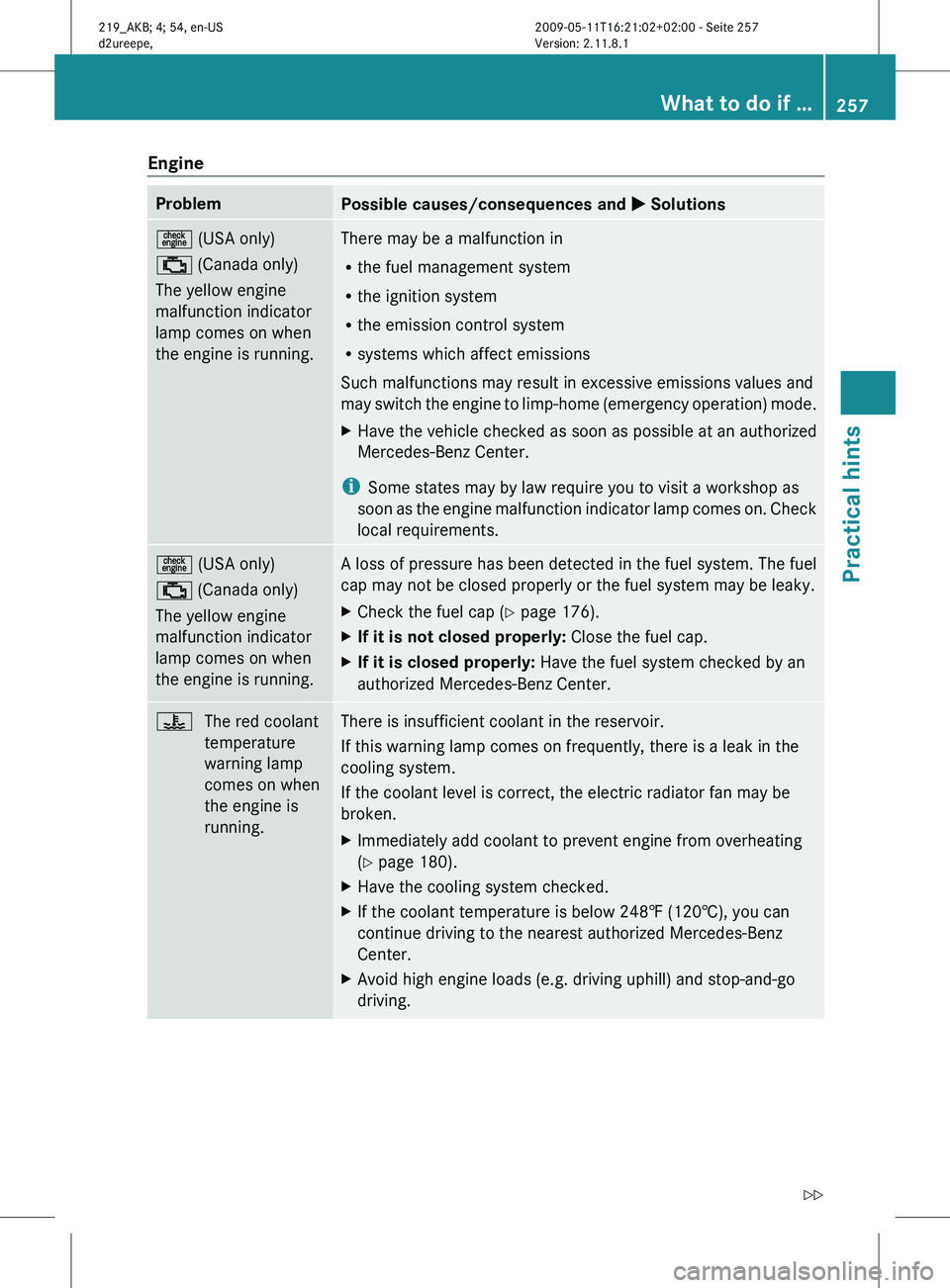
Engine
Problem
Possible causes/consequences and
X Solutions= (USA only)
; (Canada only)
The yellow engine
malfunction indicator
lamp comes on when
the engine is running. There may be a malfunction in
R
the fuel management system
R the ignition system
R the emission control system
R systems which affect emissions
Such malfunctions may result in excessive emissions values and
may
switch the engine to limp-home (emergency operation) mode.
X Have the vehicle checked as soon as possible at an authorized
Mercedes-Benz Center.
i Some states may by law require you to visit a workshop as
soon
as the engine malfunction indicator lamp comes on. Check
local requirements. = (USA only)
; (Canada only)
The yellow engine
malfunction indicator
lamp comes on when
the engine is running. A loss of pressure has been detected in the fuel system. The fuel
cap may not be closed properly or the fuel system may be leaky.
X
Check the fuel cap ( Y page 176).
X If it is not closed properly: Close the fuel cap.
X If it is closed properly: Have the fuel system checked by an
authorized Mercedes-Benz Center. ?
The red coolant
temperature
warning lamp
comes on when
the engine is
running. There is insufficient coolant in the reservoir.
If this warning lamp comes on frequently, there is a leak in the
cooling system.
If the coolant level is correct, the electric radiator fan may be
broken.
X
Immediately add coolant to prevent engine from overheating
(Y page 180).
X Have the cooling system checked.
X If the coolant temperature is below 248‡ (120†), you can
continue driving to the nearest authorized Mercedes-Benz
Center.
X Avoid high engine loads (e.g. driving uphill) and stop-and-go
driving. What to do if …
257
Practical hints
219_AKB; 4; 54, en-US
d2ureepe, Version: 2.11.8.1 2009-05-11T16:21:02+02:00 - Seite 257 Z
Page 260 of 308
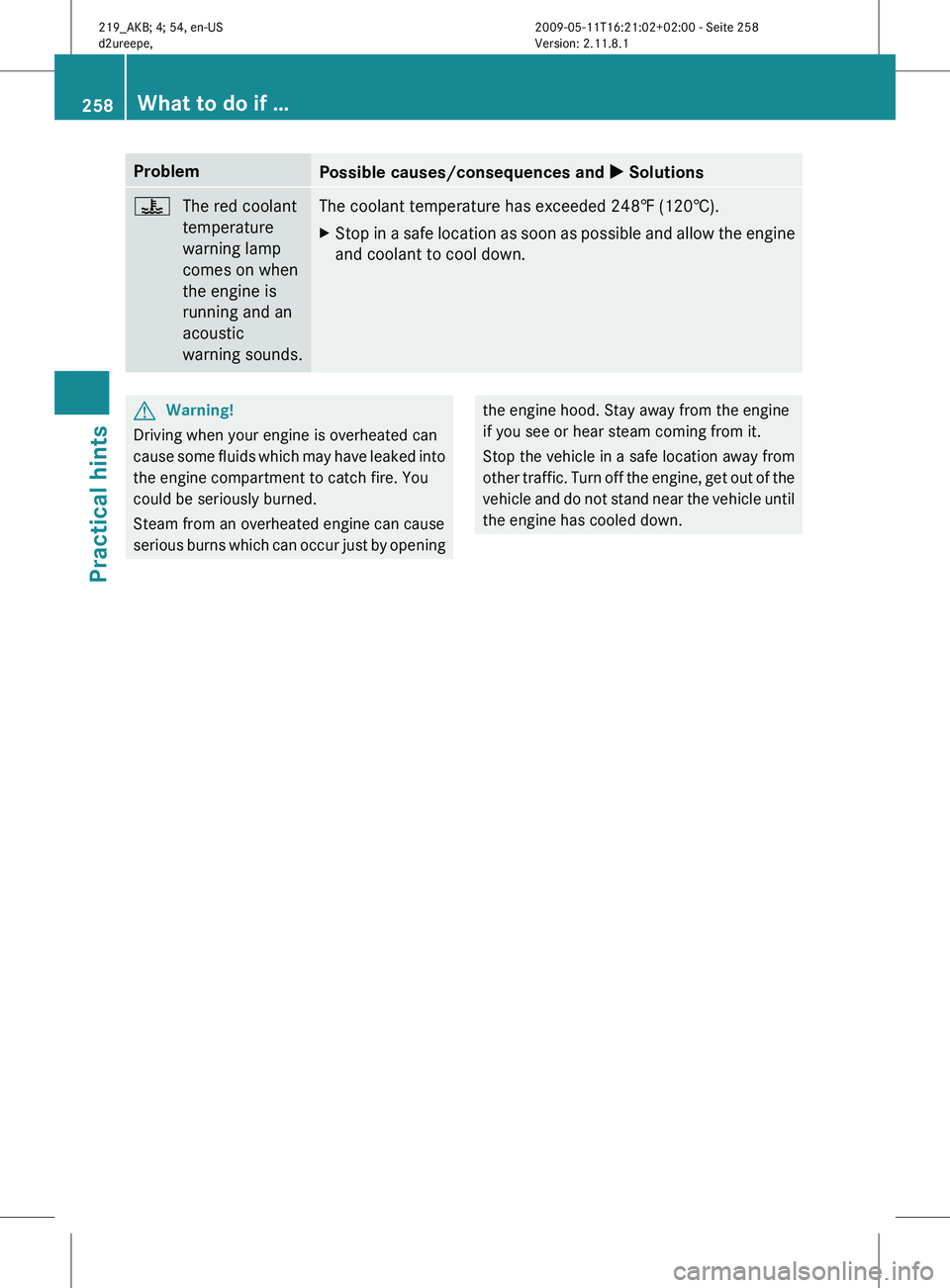
Problem
Possible causes/consequences and
X Solutions?
The red coolant
temperature
warning lamp
comes on when
the engine is
running and an
acoustic
warning sounds. The coolant temperature has exceeded 248‡ (120†).
X
Stop in a safe location as soon as possible and allow the engine
and coolant to cool down. G
Warning!
Driving when your engine is overheated can
cause some fluids which may have leaked into
the engine compartment to catch fire. You
could be seriously burned.
Steam from an overheated engine can cause
serious burns which can occur just by opening the engine hood. Stay away from the engine
if you see or hear steam coming from it.
Stop the vehicle in a safe location away from
other
traffic. Turn off the engine, get out of the
vehicle and do not stand near the vehicle until
the engine has cooled down. 258
What to do if …
Practical hints
219_AKB; 4; 54, en-US
d2ureepe,
Version: 2.11.8.1 2009-05-11T16:21:02+02:00 - Seite 258
Page 299 of 308
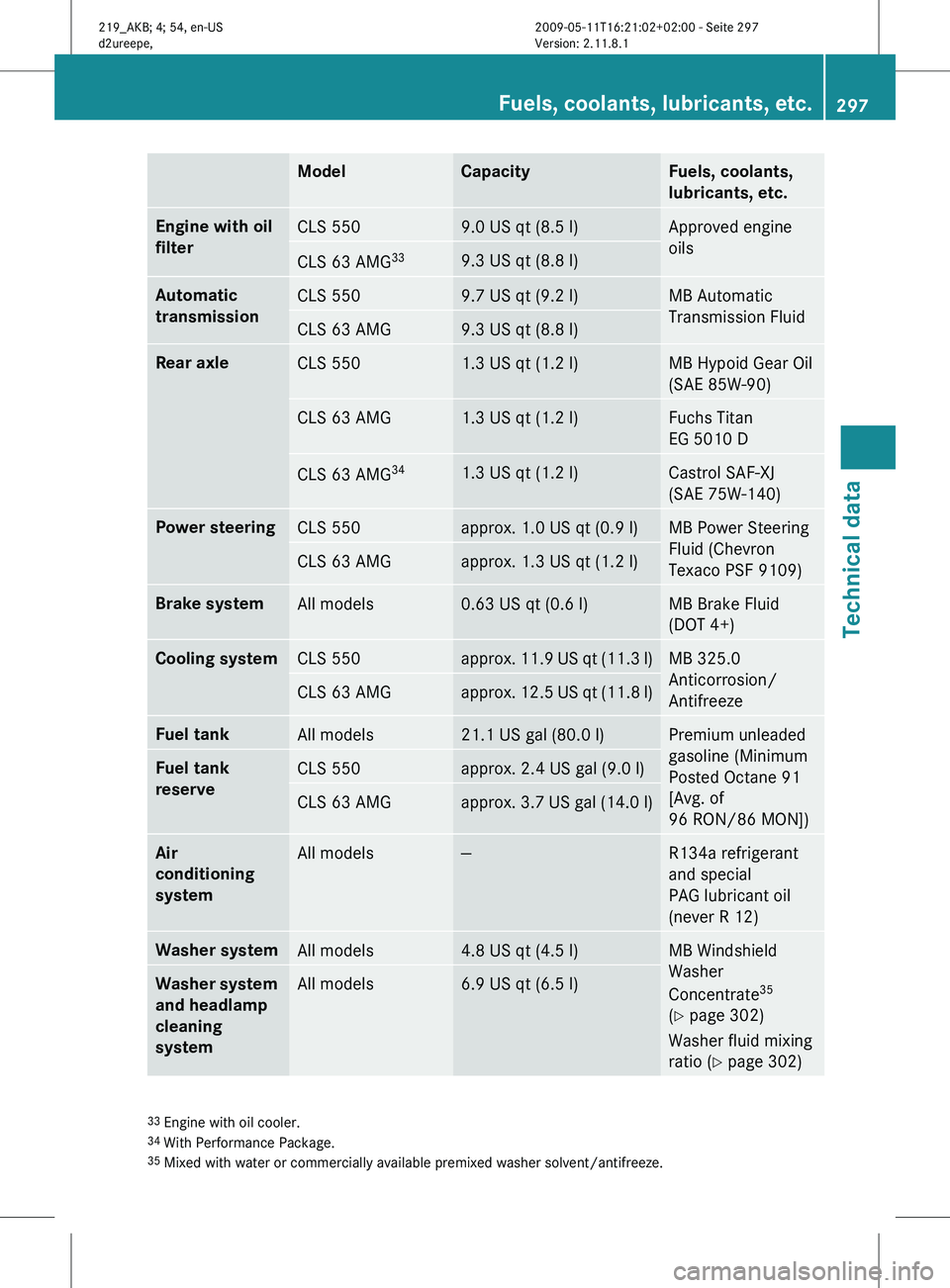
Model Capacity Fuels, coolants,
lubricants, etc.
Engine with oil
filter
CLS 550 9.0 US qt (8.5 l) Approved engine
oils
CLS 63 AMG
33 9.3 US qt (8.8 l)
Automatic
transmission
CLS 550 9.7 US qt (9.2 l) MB Automatic
Transmission Fluid
CLS 63 AMG 9.3 US qt (8.8 l)
Rear axle
CLS 550 1.3 US qt (1.2 l) MB Hypoid Gear Oil
(SAE 85W-90)
CLS 63 AMG 1.3 US qt (1.2 l) Fuchs Titan
EG 5010 D
CLS 63 AMG
34 1.3 US qt (1.2 l) Castrol SAF-XJ
(SAE 75W-140)
Power steering
CLS 550 approx. 1.0 US qt (0.9 l) MB Power Steering
Fluid (Chevron
Texaco PSF 9109)
CLS 63 AMG approx. 1.3 US qt (1.2 l)
Brake system
All models 0.63 US qt (0.6 l) MB Brake Fluid
(DOT 4+)
Cooling system
CLS 550 approx. 11.9 US qt (11.3 l) MB 325.0
Anticorrosion/
Antifreeze
CLS 63 AMG approx. 12.5 US qt (11.8 l)
Fuel tank
All models 21.1 US gal (80.0 l) Premium unleaded
gasoline (Minimum
Posted Octane 91
[Avg. of
96 RON/86 MON])
Fuel tank
reserve
CLS 550 approx. 2.4 US gal (9.0 l)
CLS 63 AMG approx. 3.7 US gal (14.0 l)
Air
conditioning
system
All models — R134a refrigerant
and special
PAG lubricant oil
(never R 12)
Washer system
All models 4.8 US qt (4.5 l) MB Windshield
Washer
Concentrate
35
(Y page 302)
Washer fluid mixing
ratio ( Y page 302) Washer system
and headlamp
cleaning
system
All models 6.9 US qt (6.5 l)
33
Engine with oil cooler.
34 With Performance Package.
35 Mixed with water or commercially available premixed washer solvent/antifreeze. Fuels, coolants, lubricants, etc.
297Technical data
219_AKB; 4; 54, en-US
d2ureepe, Version: 2.11.8.1 2009-05-11T16:21:02+02:00 - Seite 297 Z