coolant temperature MERCEDES-BENZ CLS 2012 User Guide
[x] Cancel search | Manufacturer: MERCEDES-BENZ, Model Year: 2012, Model line: CLS, Model: MERCEDES-BENZ CLS 2012Pages: 356, PDF Size: 14.25 MB
Page 230 of 356
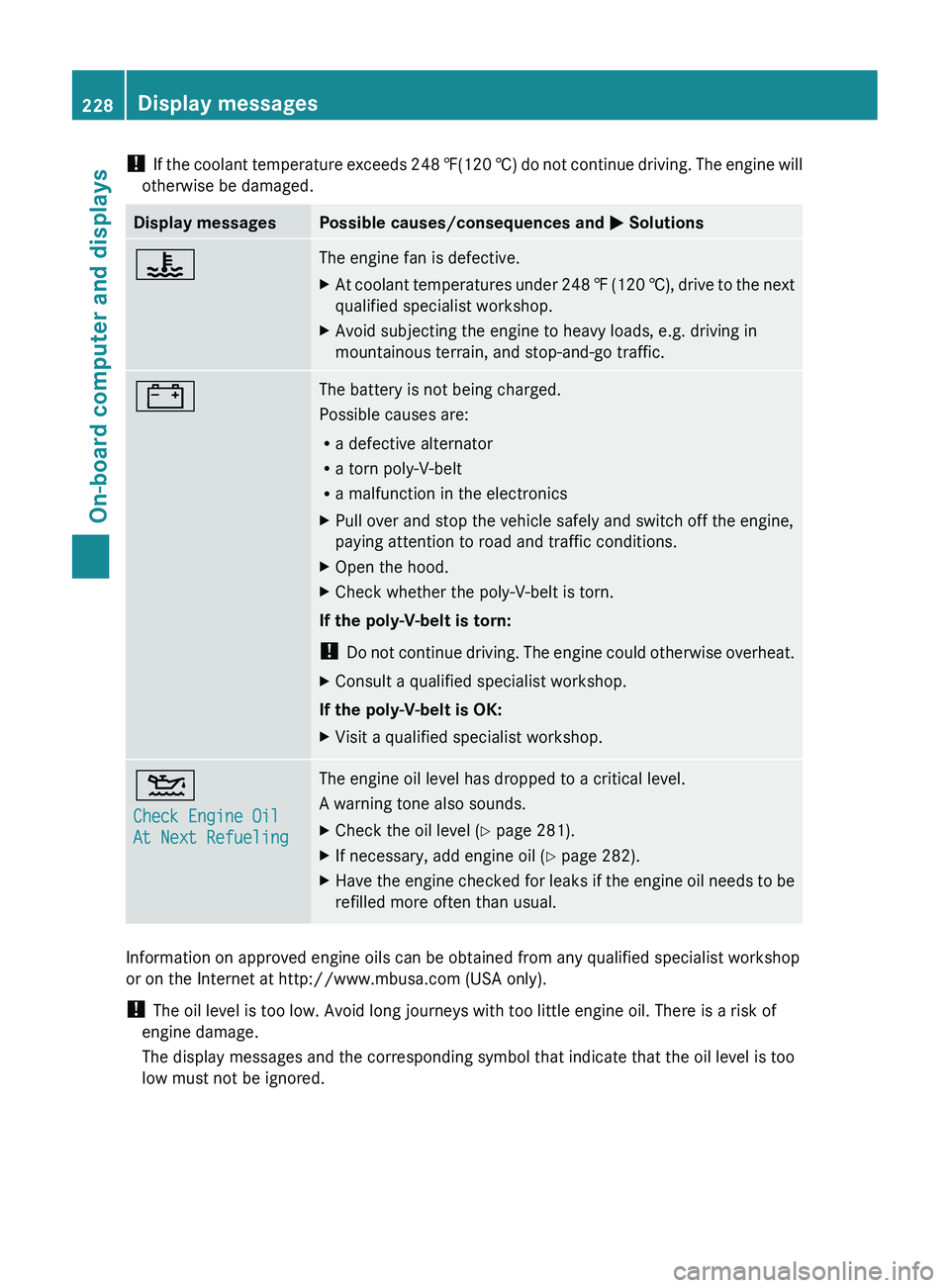
! If the coolant temperature exceeds 248 ‡(120 †) do not continue driving. The engine will
otherwise be damaged.Display messagesPossible causes/consequences and M Solutions?The engine fan is defective.XAt coolant temperatures under 248 ‡ (120 †), drive to the next
qualified specialist workshop.XAvoid subjecting the engine to heavy loads, e.g. driving in
mountainous terrain, and stop-and-go traffic.#The battery is not being charged.
Possible causes are:
R a defective alternator
R a torn poly-V-belt
R a malfunction in the electronicsXPull over and stop the vehicle safely and switch off the engine,
paying attention to road and traffic conditions.XOpen the hood.XCheck whether the poly-V-belt is torn.
If the poly-V-belt is torn:
! Do not continue driving. The engine could otherwise overheat.
XConsult a qualified specialist workshop.
If the poly-V-belt is OK:
XVisit a qualified specialist workshop.4
Check Engine Oil
At Next RefuelingThe engine oil level has dropped to a critical level.
A warning tone also sounds.XCheck the oil level ( Y page 281).XIf necessary, add engine oil ( Y page 282).XHave the engine checked for leaks if the engine oil needs to be
refilled more often than usual.
Information on approved engine oils can be obtained from any qualified specialist workshop
or on the Internet at http://www.mbusa.com (USA only).
! The oil level is too low. Avoid long journeys with too little engine oil. There is a risk of
engine damage.
The display messages and the corresponding symbol that indicate that the oil level is too
low must not be ignored.
228Display messagesOn-board computer and displays
Page 251 of 356
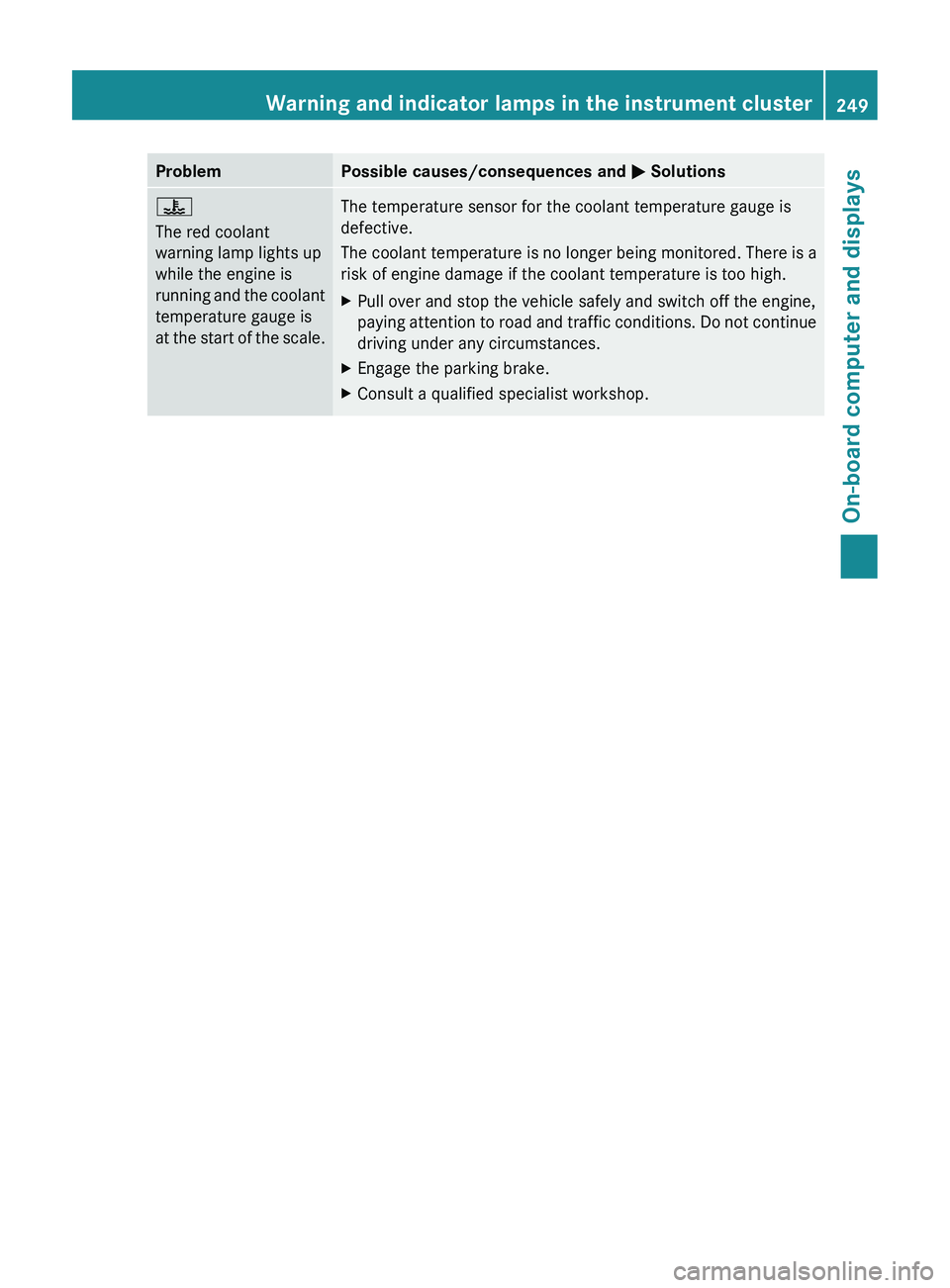
ProblemPossible causes/consequences and M Solutions?
The red coolant
warning lamp lights up
while the engine is
running and the coolant
temperature gauge is
at the start of the scale.The temperature sensor for the coolant temperature gauge is
defective.
The coolant temperature is no longer being monitored. There is a
risk of engine damage if the coolant temperature is too high.XPull over and stop the vehicle safely and switch off the engine,
paying attention to road and traffic conditions. Do not continue
driving under any circumstances.XEngage the parking brake.XConsult a qualified specialist workshop.Warning and indicator lamps in the instrument cluster249On-board computer and displaysZ
Page 252 of 356
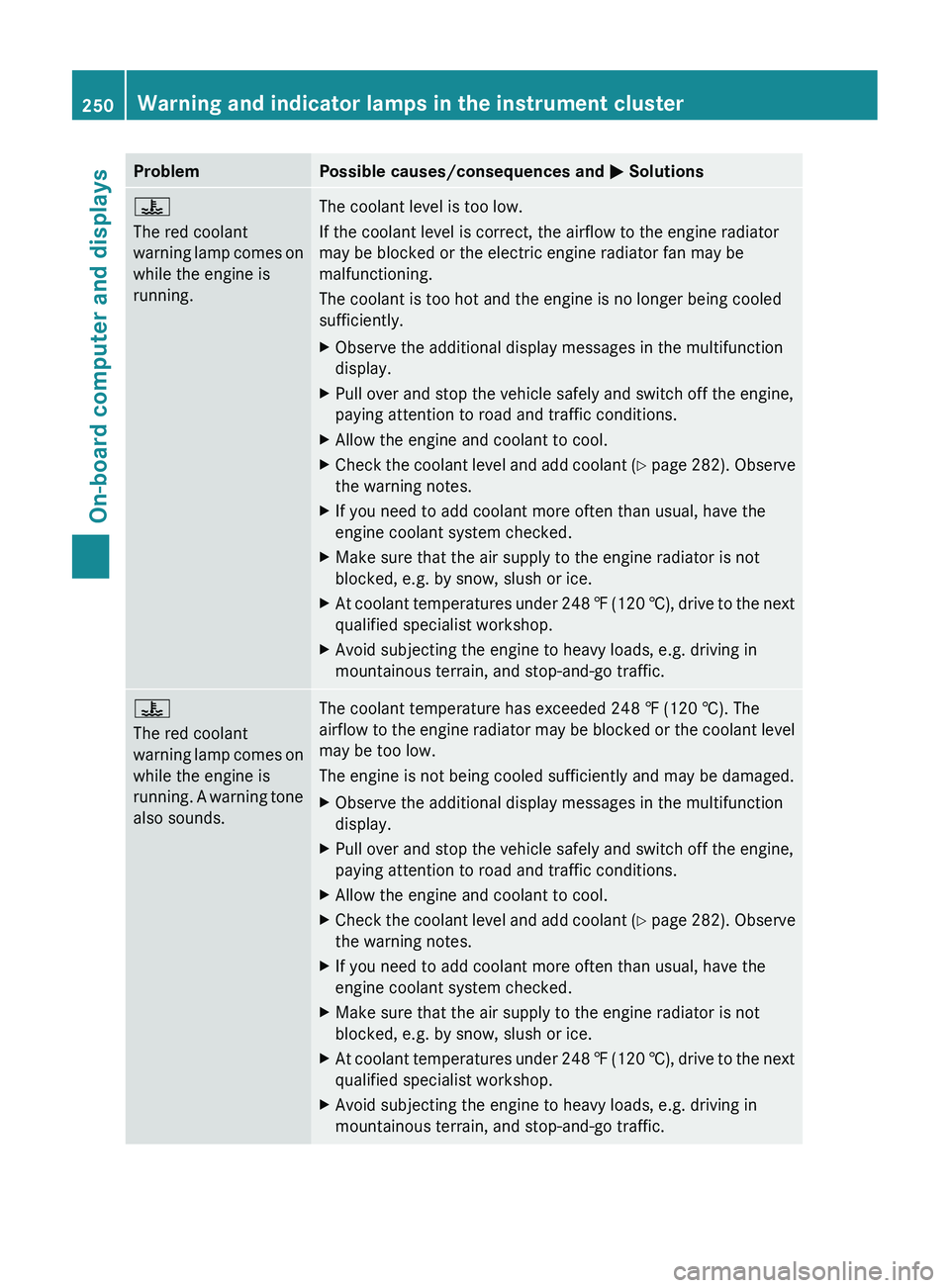
ProblemPossible causes/consequences and M Solutions?
The red coolant
warning lamp comes on
while the engine is
running.The coolant level is too low.
If the coolant level is correct, the airflow to the engine radiator
may be blocked or the electric engine radiator fan may be
malfunctioning.
The coolant is too hot and the engine is no longer being cooled
sufficiently.XObserve the additional display messages in the multifunction
display.XPull over and stop the vehicle safely and switch off the engine,
paying attention to road and traffic conditions.XAllow the engine and coolant to cool.XCheck the coolant level and add coolant (Y page 282). Observe
the warning notes.XIf you need to add coolant more often than usual, have the
engine coolant system checked.XMake sure that the air supply to the engine radiator is not
blocked, e.g. by snow, slush or ice.XAt coolant temperatures under 248 ‡ (120 †), drive to the next
qualified specialist workshop.XAvoid subjecting the engine to heavy loads, e.g. driving in
mountainous terrain, and stop-and-go traffic.?
The red coolant
warning lamp comes on
while the engine is
running. A warning tone
also sounds.The coolant temperature has exceeded 248 ‡ (120 †). The
airflow to the engine radiator may be blocked or the coolant level
may be too low.
The engine is not being cooled sufficiently and may be damaged.XObserve the additional display messages in the multifunction
display.XPull over and stop the vehicle safely and switch off the engine,
paying attention to road and traffic conditions.XAllow the engine and coolant to cool.XCheck the coolant level and add coolant (Y page 282). Observe
the warning notes.XIf you need to add coolant more often than usual, have the
engine coolant system checked.XMake sure that the air supply to the engine radiator is not
blocked, e.g. by snow, slush or ice.XAt coolant temperatures under 248 ‡ (120 †), drive to the next
qualified specialist workshop.XAvoid subjecting the engine to heavy loads, e.g. driving in
mountainous terrain, and stop-and-go traffic.250Warning and indicator lamps in the instrument clusterOn-board computer and displays
Page 253 of 356
GWARNING
Driving when your engine is overheated can cause some fluids which may have leaked into the
engine compartment to catch fire. You could be seriously burned.
Steam from an overheated engine can cause serious burns which can occur just by opening the
engine hood. Stay away from the engine if you see or hear steam coming from it.
Stop the vehicle in a safe location away from other traffic. Turn off the engine, get out of the
vehicle and do not stand near the vehicle until the engine has cooled down.
! If the coolant temperature exceeds 248 ‡(120 †) do not continue driving. The engine will
otherwise be damaged.
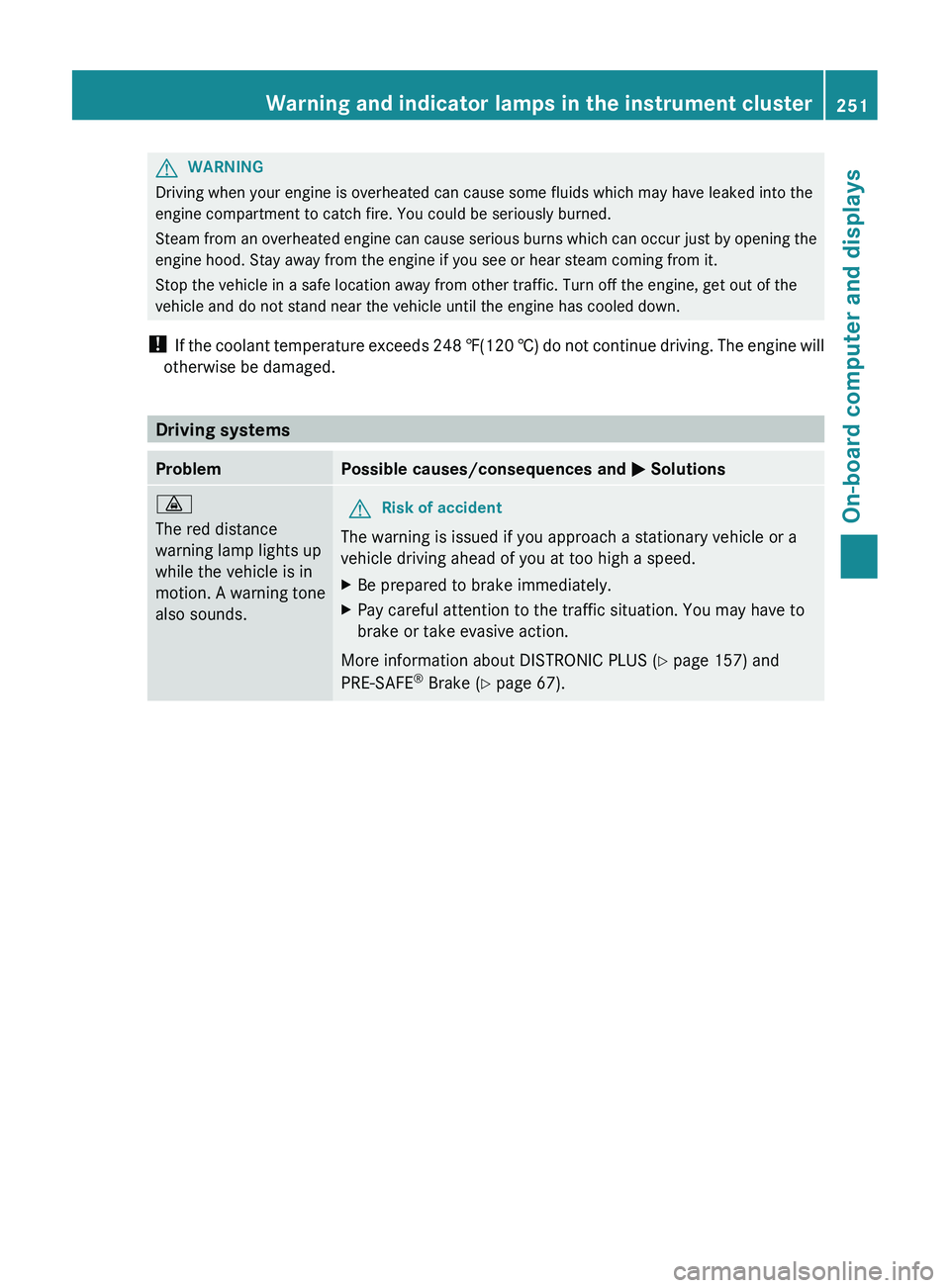
Driving systems
ProblemPossible causes/consequences and M Solutions·
The red distance
warning lamp lights up
while the vehicle is in
motion. A warning tone
also sounds.GRisk of accident
The warning is issued if you approach a stationary vehicle or a
vehicle driving ahead of you at too high a speed.
XBe prepared to brake immediately.XPay careful attention to the traffic situation. You may have to
brake or take evasive action.
More information about DISTRONIC PLUS ( Y page 157) and
PRE-SAFE ®
Brake ( Y page 67).
Warning and indicator lamps in the instrument cluster251On-board computer and displaysZ
Page 282 of 356

Useful information
i This Operator's Manual describes all
models and all standard and optional
equipment of your vehicle available at the
time of publication of the Operator's
Manual. Country-specific differences are
possible. Please note that your vehicle may
not be equipped with all features
described. This also applies to safety-
related systems and functions.
i Please read the information on qualified
specialist workshops ( Y page 22).
Engine compartment
Hood
Opening the hood
GWARNING
Do not pull the release lever while the vehicle
is in motion. Otherwise, the hood could be
forced open by passing air flow.
This could cause the hood to come loose and
injure you and/or others.
GWARNING
Do not open the hood when the engine is
overheated. You could be seriously injured.
Observe the coolant temperature gauge to
determine whether the engine may be
overheated. If you see flames or smoke
coming from the engine compartment, move
away from the vehicle. Wait until the engine
has cooled. If necessary, call the fire
department.
GWARNING
There is a risk of injury if the hood is open,
even if the engine is not running.
Some engine components can become very
hot.
To avoid the risk of burns, only touch those
components described in the Operator's
Manual and observe the relevant safety notes.
GWARNING
To help prevent personal injury, stay clear of
moving parts when the hood is open and the
engine is running.
The radiator fan may continue to run for
approximately 30 seconds or may even
restart after the engine has been turned off.
Stay clear of fan blades.
GWARNING
The engine is equipped with a transistorized
ignition system. Because of the high voltage,
it is dangerous to touch any components
(ignition coils, spark plug sockets, diagnostic
socket) of the ignition system:
R with the engine running
R while starting the engine
R when the ignition is switched on and the
engine is turned manually
XMake sure that the windshield wipers are
switched off.GWARNING
The windshield wipers and wiper linkage
could be set in motion.
When the hood is open, you or others could
be injured by the wiper linkage.
Make sure that the windshield wipers are
switched off. Remove the SmartKey or make
sure that no ignition position has been
selected with KEYLESS-GO. All indicator
lamps must be off in the instrument cluster.
280Engine compartmentMaintenance and care
Page 284 of 356
Adding engine oilHEnvironmental note
When adding oil, take care not to spill any. If
oil enters the soil or waterways, it is harmful
to the environment.
GWARNING
If engine oil comes into contact with hot
engine parts, it may ignite and you could burn
yourself. Do not spill any engine oil on hot
engine parts.
! Use only engine oils and oil filters that
have been approved for vehicles equipped
with a service system. A list of the engine
oils and oil filters tested and approved in
accordance with the Mercedes-Benz
Specifications for Service Products can be
called up by visiting http://
www.mbusa.com (USA only). More
information about tested and approved
engine oils and oil filters is available from
any authorized Mercedes-Benz Center.
Damage to the engine or exhaust system is
caused by the following:
R using engine oils and oil filters which
have not been specifically approved for
the service system.
R replacing the engine oil or oil filter after
the replacement interval required by the
service system has elapsed
R using engine oil additives.
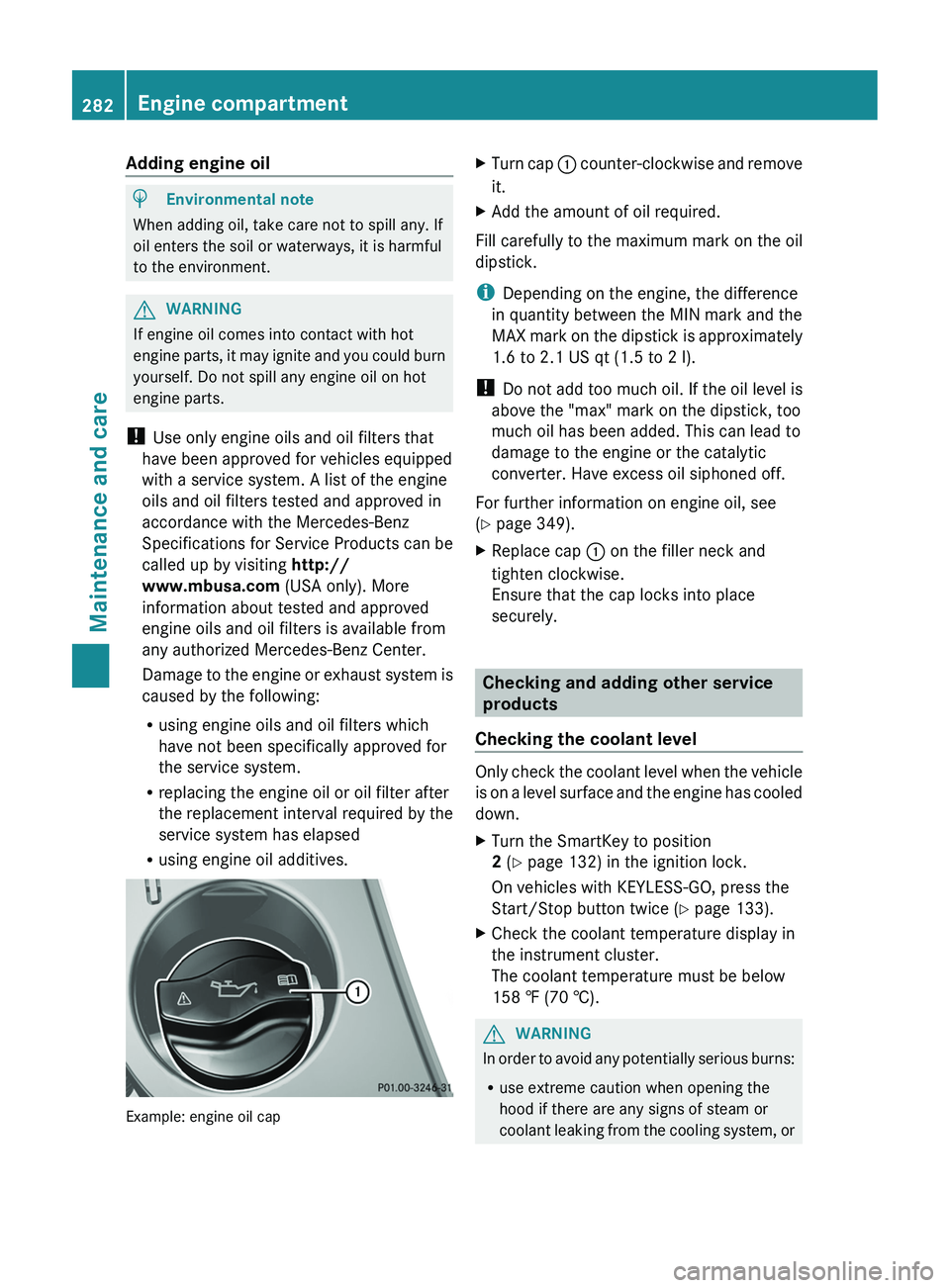
Example: engine oil cap
XTurn cap : counter-clockwise and remove
it.XAdd the amount of oil required.
Fill carefully to the maximum mark on the oil
dipstick.
i Depending on the engine, the difference
in quantity between the MIN mark and the
MAX mark on the dipstick is approximately
1.6 to 2.1 US qt (1.5 to 2 l).
! Do not add too much oil. If the oil level is
above the "max" mark on the dipstick, too
much oil has been added. This can lead to
damage to the engine or the catalytic
converter. Have excess oil siphoned off.
For further information on engine oil, see
( Y page 349).
XReplace cap : on the filler neck and
tighten clockwise.
Ensure that the cap locks into place
securely.
Checking and adding other service
products
Checking the coolant level
Only check the coolant level when the vehicle
is on a level surface and the engine has cooled
down.
XTurn the SmartKey to position
2 (Y page 132) in the ignition lock.
On vehicles with KEYLESS-GO, press the
Start/Stop button twice ( Y page 133).XCheck the coolant temperature display in
the instrument cluster.
The coolant temperature must be below
158 ‡ (70 †).GWARNING
In order to avoid any potentially serious burns:
R use extreme caution when opening the
hood if there are any signs of steam or
coolant leaking from the cooling system, or
282Engine compartmentMaintenance and care
Page 285 of 356
if the coolant temperature display indicates
that the coolant is overheated.
R do not remove the pressure cap on the
coolant reservoir if the coolant temperature
is above 158 ‡ (70 †). Allow the engine to
cool down before removing the cap. The
coolant reservoir contains hot fluid and is
under pressure.
R using a rag, slowly turn the cap
approximately 1
/ 2 turn to relieve excess
pressure. If opened immediately, scalding
hot fluid and steam will be blown out under
pressure.
R do not spill antifreeze on hot engine parts.
Antifreeze contains ethylene glycol which
may burn if it comes into contact with hot
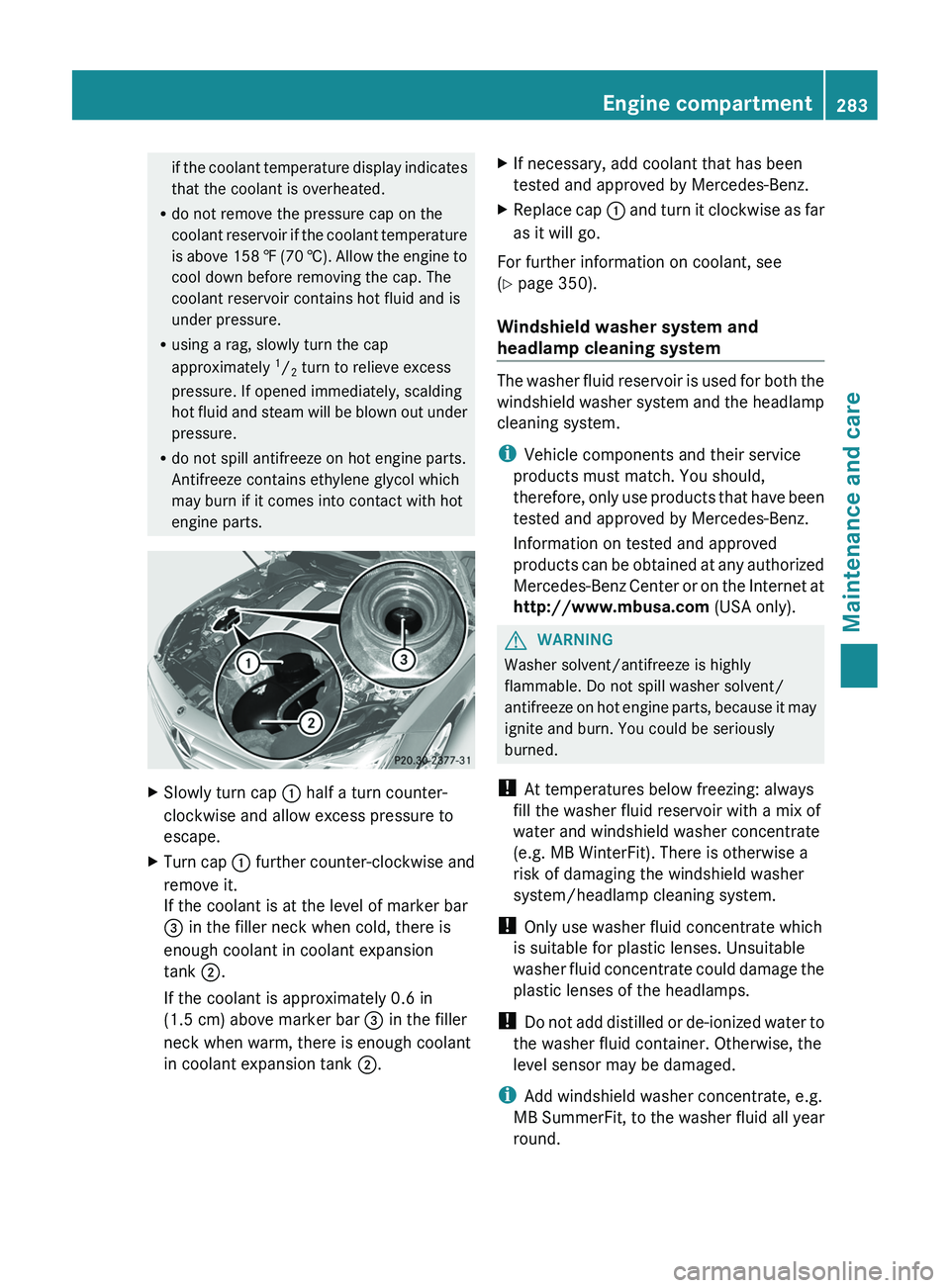
engine parts.XSlowly turn cap : half a turn counter-
clockwise and allow excess pressure to
escape.XTurn cap : further counter-clockwise and
remove it.
If the coolant is at the level of marker bar
= in the filler neck when cold, there is
enough coolant in coolant expansion
tank ;.
If the coolant is approximately 0.6 in
(1.5 cm) above marker bar = in the filler
neck when warm, there is enough coolant
in coolant expansion tank ;.XIf necessary, add coolant that has been
tested and approved by Mercedes-Benz.XReplace cap : and turn it clockwise as far
as it will go.
For further information on coolant, see
( Y page 350).
Windshield washer system and
headlamp cleaning system
The washer fluid reservoir is used for both the
windshield washer system and the headlamp
cleaning system.
i Vehicle components and their service
products must match. You should,
therefore, only use products that have been
tested and approved by Mercedes-Benz.
Information on tested and approved
products can be obtained at any authorized
Mercedes-Benz Center or on the Internet at
http://www.mbusa.com (USA only).
GWARNING
Washer solvent/antifreeze is highly
flammable. Do not spill washer solvent/
antifreeze on hot engine parts, because it may
ignite and burn. You could be seriously
burned.
! At temperatures below freezing: always
fill the washer fluid reservoir with a mix of
water and windshield washer concentrate
(e.g. MB WinterFit). There is otherwise a
risk of damaging the windshield washer
system/headlamp cleaning system.
! Only use washer fluid concentrate which
is suitable for plastic lenses. Unsuitable
washer fluid concentrate could damage the
plastic lenses of the headlamps.
! Do not add distilled or de-ionized water to
the washer fluid container. Otherwise, the
level sensor may be damaged.
i Add windshield washer concentrate, e.g.
MB SummerFit, to the washer fluid all year
round.
Engine compartment283Maintenance and careZ
Page 352 of 356
Refrigerant of the air-conditioning
system
The air-conditioning system is filled with
R134a refrigerant and a special PAG
lubricant.
! Never use refrigerant R 12 (CFC) or
mineral lubricants. Otherwise, you could
damage the air-conditioning system.
Brake fluid
GWARNING
The brake fluid constantly absorbs moisture
from the air; this lowers its boiling point.
If the boiling point of the brake fluid is too low,
vapor pockets may form in the brake system
when the brakes are applied hard (e.g. when
driving downhill). This would impair braking
efficiency.
You should have the brake fluid renewed at
regular intervals. The brake fluid change
intervals can be found in the Service Booklet.
Only use brake fluid approved by Mercedes-
Benz. Information about approved brake
fluids can be obtained from any authorized
Mercedes-Benz Center.
Coolant
Important safety notes
The coolant is a mixture of water and
antifreeze/corrosion inhibitor. It performs
the following tasks:
R anti-corrosion protection
R antifreeze protection
R raising the boiling point
The engine cooling system is filled at the
factory with coolant which contains an
antifreeze/corrosion inhibitor that ensures
protection down to approximately -35 ‡
(-37 † ).
! Only add coolant that has been premixed
with the desired antifreeze protection.
Otherwise, the engine could be damaged.
Further information on coolants and on
filling can be found in the Mercedes-Benz
Specifications for Service Products, MB
Approval 310.1, e.g. on the Internet at
http://bevo.mercedes-benz.com . You can
also consult an authorized Mercedes-Benz
Center.
! Always use a suitable coolant mixture,
even in countries where high temperatures
prevail.
Otherwise, the cooling system will not be
sufficiently protected from corrosion, and
the boiling point will be too low.
If the coolant has antifreeze protection down
to -35 ‡ (-37 † ), the boiling point of the
coolant in the pressurized system is
approximately 266 ‡ (130 † ).
Your vehicle has a range of aluminum
components. Use of aluminum components
in the engine make it necessary to specifically
match the antifreeze/corrosion inhibitor in
these systems in order to protect the
aluminum parts. Using other antifreeze/
corrosion inhibitors without these
characteristics affects the service life.
The coolant must be used throughout the year
in order to maintain the necessary corrosion
protection and provide protection from
overheating. In the Service Booklet, you can
find information on the intervals for renewal.
The renewal interval is determined by the
coolant type and the engine cooling system
design. The renewal interval in the Service
Booklet is only valid if the coolant is renewed
or replenished with Mercedes-Benz approved
products. Therefore, only use MB 326.0
antifreeze/corrosion inhibitor or another
Mercedes-Benz approved product of the
same specification.
Information on other products with the same
specifications that are approved by
Mercedes-Benz can be obtained at an
authorized Mercedes-Benz Center or on the350Service products and capacitiesTechnical data
Page 353 of 356
Internet at
http://bevo.mercedes-benz.com .
The coolant is checked at every maintenance
interval at an authorized Mercedes-Benz
Center.
The antifreeze/corrosion inhibitor
concentration in the engine cooling system
should:
R be at least 50%. This will protect the engine
cooling system against freezing down to
approximately -35 ‡ (-37 † ).
R not exceed 55% (antifreeze protection to
-49 ‡ [-45 † ]); otherwise, heat will not
dissipate as effectively.
If the coolant level is too low, MB 326.0
antifreeze/corrosion inhibitor should be
added. Have the engine cooling system
checked for possible leaks.
Windshield/headlamp cleaning
system
GWARNING
Washer solvent/antifreeze is highly
flammable. Do not spill washer solvent/
antifreeze on hot engine parts, because it may
ignite and burn. You could be seriously
burned.
Use MB SummerFit windshield washer
concentrate at temperatures above freezing:
XMix 1 part MB SummerFit with 100 parts
water.
Use MB WinterFit windshield washer
concentrate at temperatures below freezing:
XAt temperatures down to 14 ‡(Ò 10 †): mix
1 part MB WinterFit with 2 parts water.XAt temperatures down to Ò 4 ‡( Ò 20 †): mix
1 part MB WinterFit with 1 part water.XAt temperatures down to
Ò 20.2 ‡(Ò 29 †): mix 2 parts MB WinterFit
with 1 part water.! Only SummerFit and WinterFit can be
mixed. Otherwise, the jets could become
blocked.
Vehicle data
Vehicle data, CLS 550
BlueEFFICIENCY
The data stated here refers specifically to a
vehicle with standard equipment. Consult an
authorized Mercedes-Benz Center for the
data for all vehicle variants and trim levels.
Vehicle dimensionsVehicle length194.6 in (4942 mm)Vehicle width
including exterior
mirrors81.7 in (2075 mm)Vehicle height55.3 in (1404 mm)Wheelbase113.2 in (2874 mm)Front track62.9 in (1598 mm)Rear track64.1 in (1629 mm)Turning circle37.1 ft (11.27 m)Vehicle weight 34Maximum roof
loadMaximum trunk
load
Vehicle data, CLS 550 4MATIC
BlueEFFICIENCY
The data stated here refers specifically to a
vehicle with standard equipment. Consult an
authorized Mercedes-Benz Center for the
data for all vehicle variants and trim levels.
34 Missing values not available at time of going to print.Vehicle data351Technical dataZ