ECU MERCEDES-BENZ CLS 2018 User Guide
[x] Cancel search | Manufacturer: MERCEDES-BENZ, Model Year: 2018, Model line: CLS, Model: MERCEDES-BENZ CLS 2018Pages: 334, PDF Size: 7.87 MB
Page 60 of 334
Aut oma tic measures after an acci-
dent Immediately after an accident, th e followin g
measures are implemented, depending on th e
typ e and severity of th e impact :R
th e hazard warning lamp s are activatedR
th e emergenc y lighting is activatedR
th e vehicl e door s are unlocke dR
th e fron t side windows are loweredR
vehicles wit h a memory function : th e electri-
call y adjustable steering whee l is raisedR
th e engin e is switched off and th e fuel supply
is cut off R
vehicles wit h mbrace : automatic emergenc y
call
Children in the vehicle
Import ant safety notesAcciden t statistics sho w that children secured
in th e rear seat s are safer than children secured
in th e front-passenger seat . Fo r this reason ,
Mercedes-Benz strongly advises that you instal l
a child restrain t system on a rear seat . Children
are generally bette r protected there .
If a child younger than twelve years old and
under 5 ft (1.5 0 m) in height is traveling in the
vehicle: R
always secure the child in a child restraint
system suitable for Mercedes-Benz vehicles.
The child restraint system must be appropri-
ate to the age, weight and size of the child R
be sure to observe the instructions and safety
notes in this section in addition to the child
restraint system manufacturer's installation
instructions R
be sure to observe the instructions and safety
notes on the "Occupant classification system
(OCS)" ( Y
page 49)
G WARNING
If you leave children unsupervised in the vehi-
cle, they could set it in motion by, for example: R
release the parking brake. R
shift the automatic transmission out of the
parking position P .R
start the engine. In addition, they may operate vehicle equip-
ment and become trapped. There is a risk of
an accident and injury.
When leaving the vehicle, always take the
SmartKey with you and lock the vehicle. Never
leave children unsupervised in the vehicle.
G WARNING
If persons, particularly children are subjected
to prolonged exposure to extreme heat or
cold, there is a risk of injury, possibly even
fatal. Never leave children unattended in the
vehicle.
G WARNING
If the child restraint system is subjected to
direct sunlight, parts may get very hot. Chil-
dren may burn themselves on these parts,
particularly on the metal parts of the child
restraint system. There is a risk of injury.
If you leave the vehicle, taking the child with
you, always ensure that the child restraint
system is not exposed to direct sunlight. Pro-
tect it with a blanket, for example. If the child
restraint system has been exposed to direct
sunlight, let it cool down before securing the
child in it. Never leave children unattended in
the vehicle.
Always ensure that all vehicle occupants have
their seat belts fastened correctly and are sitting
properly. Particular attention must be paid to
children.
Observe the safety notes on the seat belt
( Y
page 43) and the notes on correct use of seat
belts ( Y
page 44).
A booster seat may be necessary to achieve
proper seat belt positioning for children over
41 lbs (18 kg) until they reach a height where a
three-point seat belt can be properly fastened
without a booster seat.
Special seat belt retractor
G WARNING
If the seat belt is released while driving, the
child restraint system will no longer be58
Children in the vehicle
Safety
Page 61 of 334
secured properly. The special seat belt retrac-
tor is disabled and the inertia real draws in a
portion of the seat belt. The seat belt cannot
be immediately refastened. There is an
increased risk of injury, possibly even fatal.
Stop the vehicle immediately, paying atten-
tion to road and traffic conditions. Reactivate
the special seat belt retractor and secure the
child restraint system properly.
All seat belts except the driver's seat belt are
equipped with a special seat belt retractor.
When activated, the special seat belt retractor
ensures that the seat belt will not slacken once
the child restraint system has been secured.
Installing a child restraint system: X
Always comply with the child restraint system
manufacturer's installation instructions. X
Pull the seat belt smoothly from the belt out-
let. X
Engage the seat belt tongue in the belt buckle.
Activating the special seat belt retractor: X
Pull the seat belt out fully and let the inertia
reel retract it again.
While the seat belt is retracting, you should
hear a ratcheting sound. The special seat belt
retractor is activated. X
Push the child seat restraint system down so
that the seat belt is tight and does not loosen.
Removing a child restraint system and deacti-
vating the special seat belt retractor: X
Always comply with the child restraint system
manufacturer's installation instructions. X
Press the release button of the belt buckle,
hold the belt tongue firmly and guide it back
towards the belt outlet.
The special seat belt retractor is deactivated.
Child restraint system
The use of seat belts and child restraint systems
is required by law in: R
all 50 states R
the U.S. territories R
the District of Columbia R
all Canadian provinces You can obtain further information about the
correct child restraint system from any author-
ized Mercedes-Benz Center.
G WARNING
If the child restraint system is installed incor-
rectly on a suitable seat, it cannot protect as
intended. The child cannot then be restrained
in the event of an accident, heavy braking or
sudden changes of direction. There is an
increased risk of injury, possibly even fatal.
Make sure that you observe the child restraint
system manufacturer's installation instruc-
tions and the notes on use. Please ensure,
that the base of the child restraint system is
always resting completely on the seat cush-
ion. Never place objects, e.g. cushions, under
or behind the child restraint system. Only use
child restraint systems with the original cover
designed for them. Only replace damaged
covers with genuine covers.
G WARNING
If the child restraint system is installed incor-
rectly or is not secured, it can come loose in
the event of an accident, heavy braking or a
sudden change in direction. The child
restraint system could be thrown about, strik-
ing vehicle occupants. There is an increased
risk of injury, possibly even fatal.
Always install child restraint systems prop-
erly, even if they are not being used. Make
sure that you observe the child restraint sys-
tem manufacturer's installation instructions.
You will find further information on stowing
objects, luggage or loads under "Loading guide-
lines" ( Y
page 242).
G WARNING
Child restraint systems or their securing sys-
tems which have been damaged or subjected
to a load in an accident can no longer protect
as intended. The child cannot then be
restrained in the event of an accident, heavy
braking or sudden changes of direction. There
is an increased risk of injury, possibly even
fatal.Children in the vehicle 59
Safety Z
Page 62 of 334
Replac e child restrain t systems whic h hav e
been damaged or subjecte d to a load in an
acciden t as soo n as possible. Hav e th e secur-
ing systems on th e child restrain t system
checke d at a qualified specialist workshop,
before you instal l a child restrain t system
again .
The securin g systems of child restrain t systems
are: R
th e seat belt systemR
th e LATCH-type (ISOFIX) securin g ringsR
th e Top Tether anchorages
If it is absolutely necessar y to carry a child on
th e front-passenger seat , be sur e to observ e th e
information on th e "Occupant Classification
Syste m (OCS)" ( Y
page 49). There you will also
fin d information on deactivating th e front-
passenger fron t air bag.
All child restrain t systems mus t mee t th e fol -
lowin g standards :R
U.S. Federal Motor Vehicl e Safet y Standards
21 3 and 22 5R
Canadian Motor Vehicl e Safet y Standards
21 3 and 210. 2
Confirmation that th e child restrain t system cor-
responds to th e standards can be foun d on an
instruction label on th e child restrain t system.
This confirmation can also be foun d in th e instal -
lation instruction s that are included wit h th e
child restrain t system.
Observ e th e warning labels in th e vehicl e inte-
rio r and on th e ch ild re strain t s
ystem.
LATCH-type (ISOFIX) child seat secur-
ing system
G WARNIN G
LATCH-type (ISOFIX) child restrain t systems
do no t offer sufficien t protective effec t for
children whos e weigh t is greate r than 48 lbs
(22 kg ) who are secured usin g th e safet y belt
integrate d in th e child restrain t system. In th e
event of an accident, a child might no t be
restrained correctly. This poses an increased
ris k of injury or eve n fatal injury.
If th e child weigh s mor e than 48 lbs (22 kg),
only use LATCH-type (ISOFIX) child restrain t systems wit h whic h th e child is also secured
wit h th e vehicl e seat belt . Als o secure th e
child restrain t system wit h th e Top Tether
belt , if available.
Always comply wit h th e manufacturer' s instal -
lation and operating instruction s for th e child
restrain t system used .
Before every trip, mak e sur e that th e LATCH -
typ e (ISOFIX) child restrain t system is engage d
correctl y in bot h LATCH-type (ISOFIX) securin g
rings
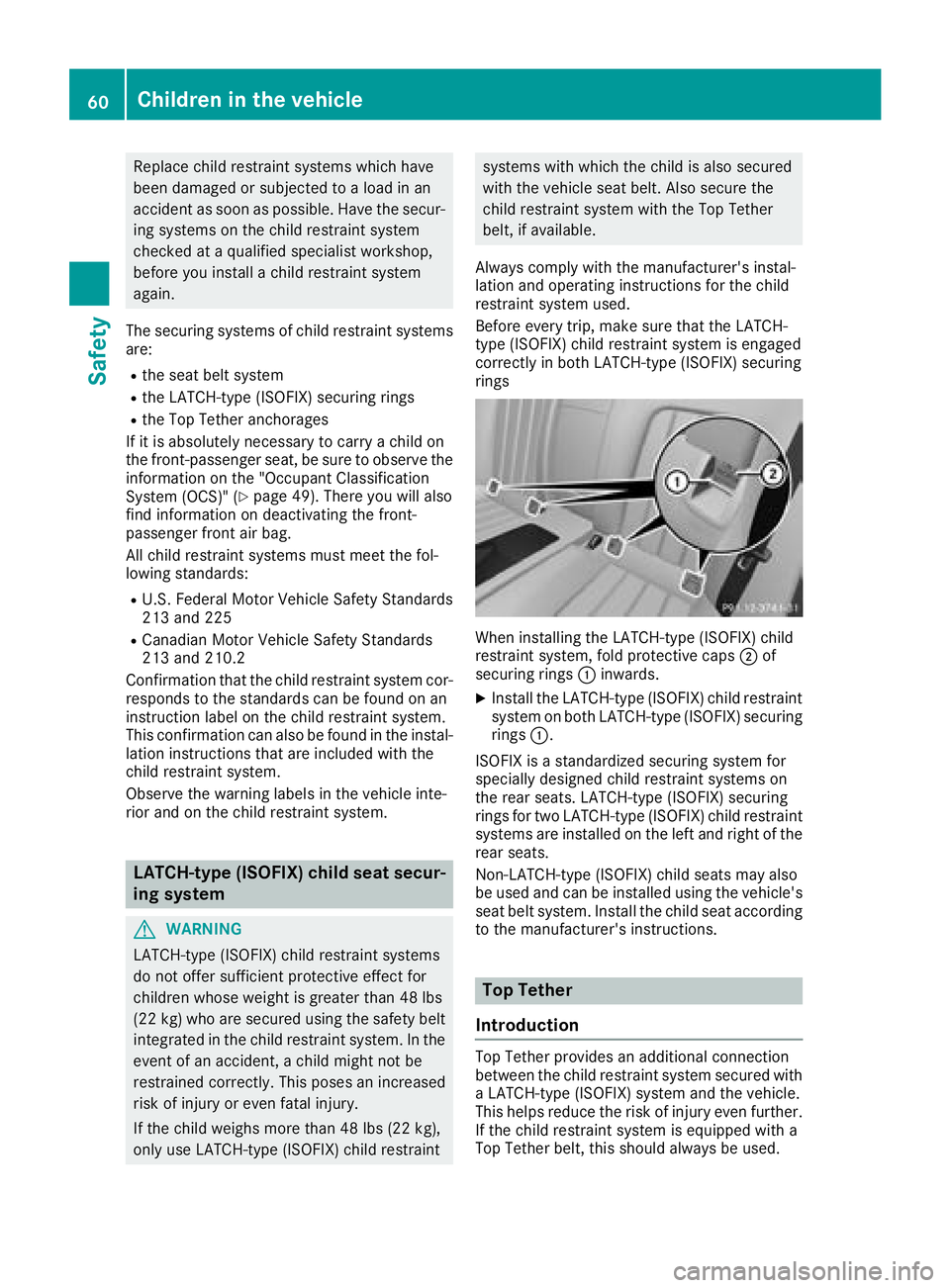
When installin g th e LATCH-type (ISOFIX) child
restrain t system, fol d protective cap s D of
securin g rings C inwards .X
Install th e LATCH-type (ISOFIX) child restrain t
system on bot h LATCH-type (ISOFIX) securin g
rings C .
ISOFIX is a standardize d securin g system for
specially designed child restrain t systems on
th e rear seats. LATCH-type (ISOFIX) securin g
rings for two LATCH-type (ISOFIX) child restrain t
systems are installed on th e lef t and right of th e
rear seats.
Non-LATCH-typ e (ISOFIX) child seat s may also
be used and can be installed usin g th e vehicle's
seat belt system. Install th e child seat according
to th e manufacturer' s instructions.
Top Tether
Introduction
Top Tether provide s an additional connection
between th e child restrain t system secured wit h
a LATCH-type (ISOFIX) system and th e vehicle.
This help s reduce th e ris k of injury eve n further.
If th e child restrain t system is equipped wit h a
Top Tether belt , this should always be used .60
Children in the vehicle
Safety
Page 65 of 334

G WARNING
If the child restraint system is subjected to
direct sunlight, parts may get very hot. Chil-
dren may burn themselves on these parts,
particularly on the metal parts of the child
restraint system. There is a risk of injury.
If you leave the vehicle, taking the child with
you, always ensure that the child restraint
system is not exposed to direct sunlight. Pro-
tect it with a blanket, for example. If the child
restraint system has been exposed to direct
sunlight, let it cool down before securing the
child in it. Never leave children unattended in
the vehicle.
Child-proof locks for the rear doors
You secure each door individually with the child-
proof locks on the rear doors. A door secured
with a child-proof lock cannot be opened from
inside the vehicle. When the vehicle is unlocked,
the door can be opened from the outside. X
To activate: press the child-proof lock lever
up in the direction of arrow C .X
Make sure that the child-proof locks are work-
ing properly. X
To deactivate: press the child-proof lock
lever down in the direction of arrow D . Override feature for the rear side win-
dows X
To activate/deactivate: press button D .
If indicator lamp C is lit, operation of the rear
side windows is disabled. Operation is only
possible using the switches in the driver's
door. If indicator lamp C is off, operation is
possible using the switches in the rear com-
partment.
Pets in the vehicle
G WARNING
If you leave animals unattended or unsecured
in the vehicle, they could press buttons or
switches, for example.
As a result, they could: R
activate vehicle equipment and become
trapped, for example R
activate or deactivate systems, thereby
endangering other road users
Unsecured animals could also be flung around
the vehicle in the event of an accident or sud-
den steering or braking, thereby injuring vehi-
cle occupants. There is a risk of an accident
and injury.
Never leave animals unattended in the vehi-
cle. Always secure animals properly during
the journey, e.g. use a suitable animal trans-
port box.Pets in the vehicle 63
Safety Z
Page 83 of 334
Problem
Possible causes/consequences and P Solutions
The engine cannot be
started using the Smart-
Key. The on-board voltage is too low. X
Switch off non-essential consumers, e.g. seat heating or interior
lighting, and try to start the engine again.
If this does not work: X
Check the starter battery and charge it if necessary ( Y
page 284).
or X
Jump-start the vehicle ( Y
page 285).
or X
Consult a qualified specialist workshop.
The engine cannot be
started using KEYLESS-
GO. The SmartKey is in
the vehicle. The vehicle is locked. X
Unlock the vehicle and try to start the vehicle again.
There is interference from a powerful source of radio waves. X
Start your vehicle with the SmartKey in the ignition lock.
You have lost a Smart-
Key. X
Have the SmartKey deactivated at a qualified specialist workshop. X
Report the loss immediately to the vehicle insurers. X
If necessary, have the locks changed as well.
You have lost the
mechanical key. X
Report the loss immediately to the vehicle insurers. X
If necessary, have the locks changed as well.
Doors
Important safety notes
G WARNING
If children are left unsupervised in the vehicle,
they could: R
open the doors, thus endangering other
people or road users. R
get out and disrupt traffic. R
operate the vehicle's equipment.
Additionally, children could set the vehicle in
motion if, for example, they: R
release the parking brake. R
shifting the automatic transmission out of
park position PR
Start the engine.
There is a risk of an accident and injury.
When leaving the vehicle, always take the
SmartKey with you and lock the vehicle. Never leave children or animals unattended in the
vehicle. Always keep the SmartKey out of
reach of children.
Unlocking and opening doors from
the inside You can open a door from inside the vehicle
even if it has been locked.
If the vehicle has previously been locked from
the outside, opening a door from the inside will
trigger the anti-theft alarm system. Switch off
the alarm ( Y
page 75).
You can only open the rear doors from inside the
vehicle if they are not secured by the child-proof
locks ( Y
page 63). Doors 81
Opening and closing Z
Page 84 of 334
X
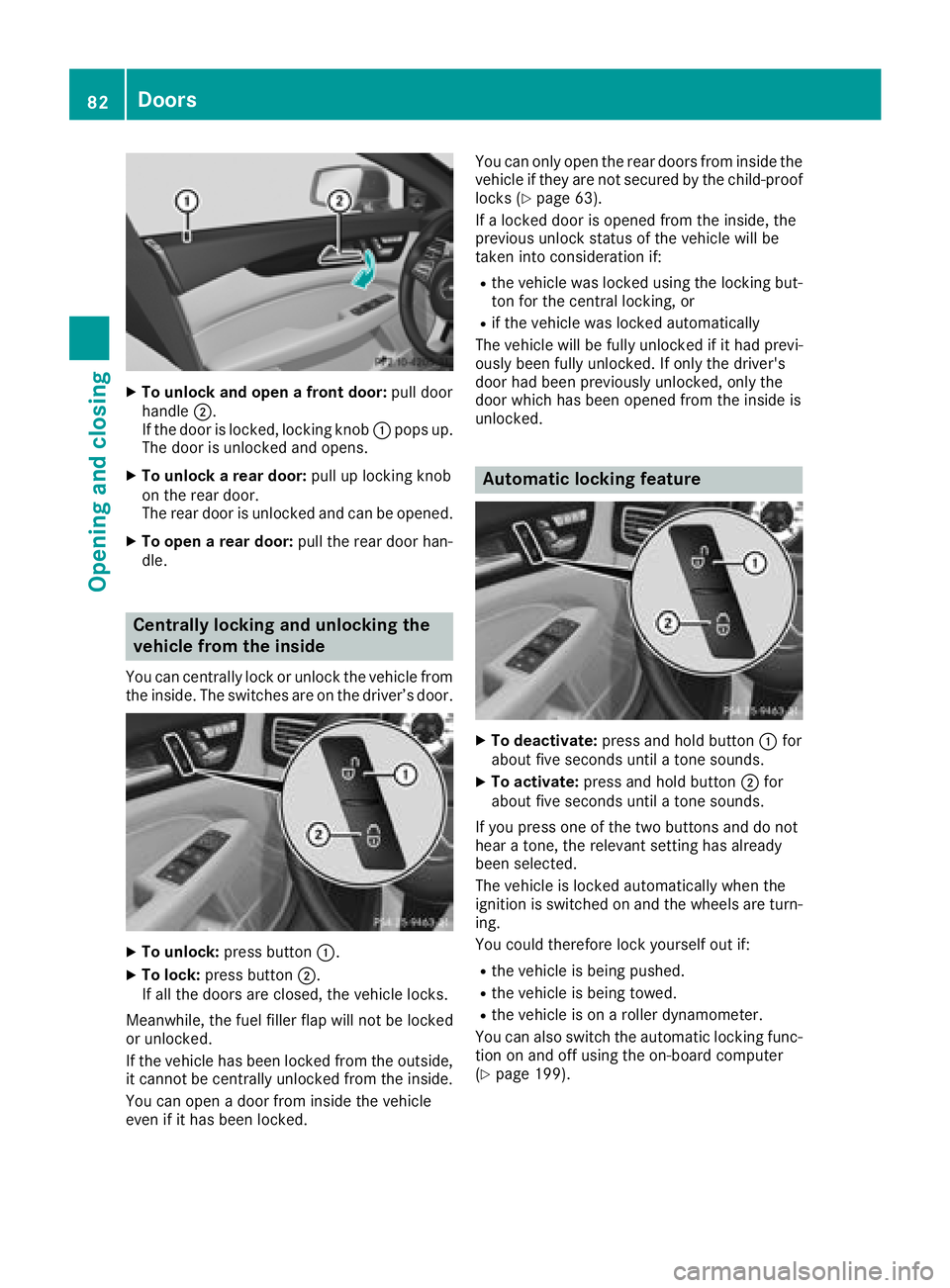
To unlock and open a front door: pull door
handle D .
If the door is locked, locking knob C pops up.
The door is unlocked and opens. X
To unlock a rear door: pull up locking knob
on the rear door.
The rear door is unlocked and can be opened. X
To open a rear door: pull the rear door han-
dle.
Centrally locking and unlocking the
vehicle from the inside You can centrally lock or unlock the vehicle from
the inside. The switches are on the driver’s door.
X
To unlock: press button C .X
To lock: press button D .
If all the doors are closed, the vehicle locks.
Meanwhile, the fuel filler flap will not be locked
or unlocked.
If the vehicle has been locked from the outside,
it cannot be centrally unlocked from the inside.
You can open a door from inside the vehicle
even if it has been locked. You can only open the rear doors from inside the
vehicle if they are not secured by the child-proof
locks ( Y
page 63).
If a locked door is opened from the inside, the
previous unlock status of the vehicle will be
taken into consideration if: R
the vehicle was locked using the locking but-
ton for the central locking, or R
if the vehicle was locked automatically
The vehicle will be fully unlocked if it had previ-
ously been fully unlocked. If only the driver's
door had been previously unlocked, only the
door which has been opened from the inside is
unlocked.
Automatic locking feature
X
To deactivate: press and hold button C for
about five seconds until a tone sounds. X
To activate: press and hold button D for
about five seconds until a tone sounds.
If you press one of the two buttons and do not
hear a tone, the relevant setting has already
been selected.
The vehicle is locked automatically when the
ignition is switched on and the wheels are turn-
ing.
You could therefore lock yourself out if: R
the vehicle is being pushed. R
the vehicle is being towed. R
the vehicle is on a roller dynamometer.
You can also switch the automatic locking func-
tion on and off using the on-board computer
( Y
page 199).82
Doors
Opening and closing
Page 85 of 334
Locking/unlocking the driver's door
with the mechanical key
i If you want to centrally lock the vehicle using
the mechanical key, begin by pressing the
locking button for the interior locking mech-
anism while the driver's door is open. Then
lock the driver's door using the mechanical
key.
X
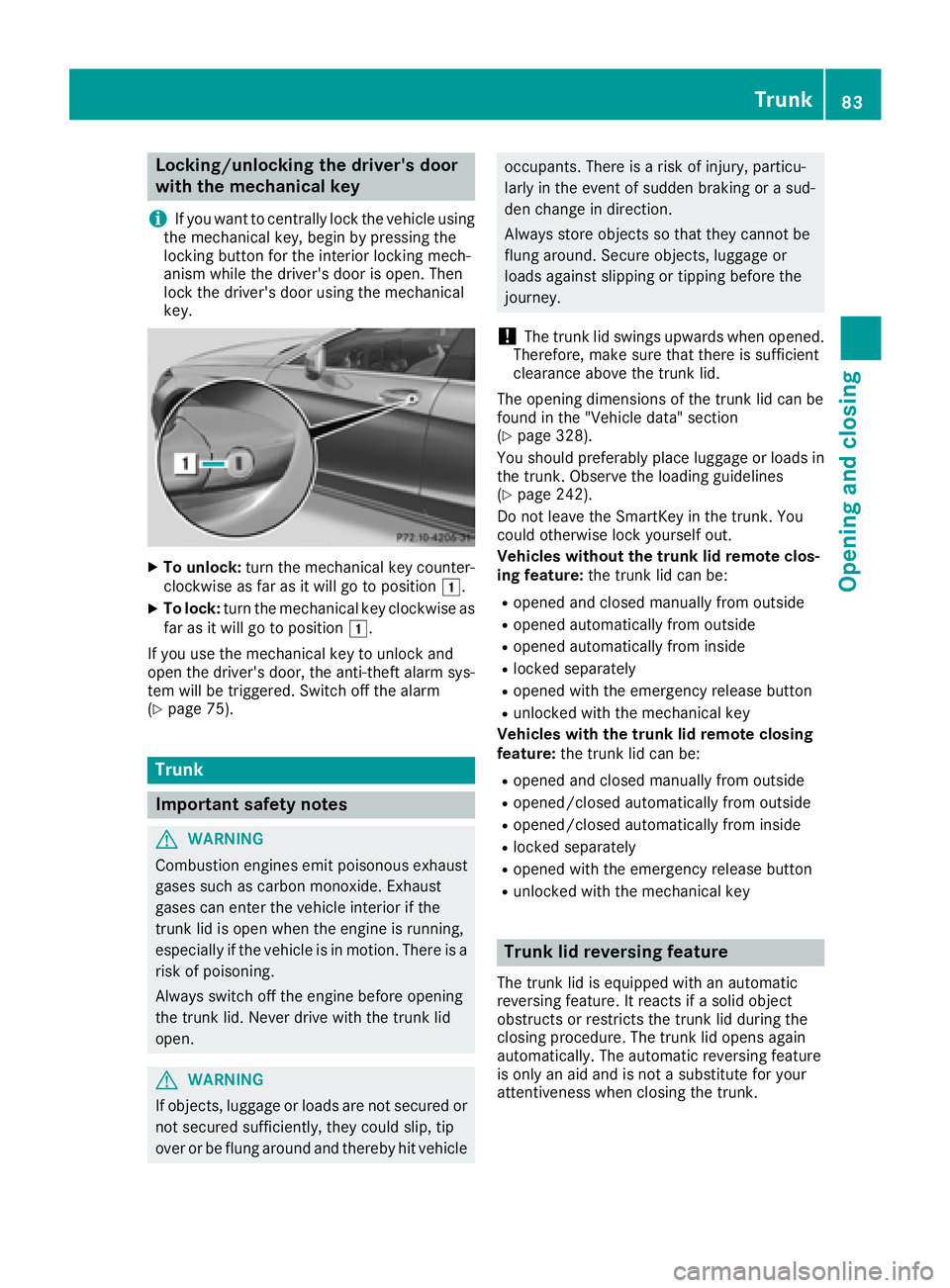
To unlock: turn the mechanical key counter-
clockwise as far as it will go to position G .X
To lock: turn the mechanical key clockwise as
far as it will go to position G .
If you use the mechanical key to unlock and
open the driver's door, the anti-theft alarm sys-
tem will be triggered. Switch off the alarm
( Y
page 75).
Trunk
Important safety notes
G WARNING
Combustion engines emit poisonous exhaust
gases such as carbon monoxide. Exhaust
gases can enter the vehicle interior if the
trunk lid is open when the engine is running,
especially if the vehicle is in motion. There is a
risk of poisoning.
Always switch off the engine before opening
the trunk lid. Never drive with the trunk lid
open.
G WARNING
If objects, luggage or loads are not secured or
not secured sufficiently, they could slip, tip
over or be flung around and thereby hit vehicle occupants. There is a risk of injury, particu-
larly in the event of sudden braking or a sud-
den change in direction.
Always store objects so that they cannot be
flung around. Secure objects, luggage or
loads against slipping or tipping before the
journey.
! The trunk lid swings upwards when opened.
Therefore, make sure that there is sufficient
clearance above the trunk lid.
The opening dimensions of the trunk lid can be
found in the "Vehicle data" section
( Y
page 328).
You should preferably place luggage or loads in
the trunk. Observe the loading guidelines
( Y
page 242).
Do not leave the SmartKey in the trunk. You
could otherwise lock yourself out.
Vehicles without the trunk lid remote clos-
ing feature: the trunk lid can be: R
opened and closed manually from outside R
opened automatically from outside R
opened automatically from inside R
locked separately R
opened with the emergency release button R
unlocked with the mechanical key
Vehicles with the trunk lid remote closing
feature: the trunk lid can be: R
opened and closed manually from outside R
opened/closed automatically from outside R
opened/closed automatically from inside R
locked separately R
opened with the emergency release button R
unlocked with the mechanical key
Trunk lid reversing feature The trunk lid is equipped with an automatic
reversing feature. It reacts if a solid object
obstructs or restricts the trunk lid during the
closing procedure. The trunk lid opens again
automatically. The automatic reversing feature
is only an aid and is not a substitute for your
attentiveness when closing the trunk. Trunk 83
Opening and closing Z
Page 128 of 334
It is only possible to shift the transmission from
position P to the desired position if you depress
the brake pedal. If the brake pedal is not
depressed, the DIRECT SELECT lever can still be
moved but the parking lock remains engaged.
i Upshifts take place at higher engine speeds
after a cold start. This helps the catalytic con-
verter to reach its operating temperature
more quickly.
Hill start assist Hill start assist helps you when pulling away for-
wards or in reverse on an uphill gradient. It holds
the vehicle for a short time after you have
removed your foot from the brake pedal. This
gives you enough time to move your foot from
the brake pedal to the accelerator pedal and to
depress it before the vehicle begins to roll.
G WARNING
After a short time, hill start assist will no lon-
ger brake your vehicle and it could roll away.
There is a risk of an accident and injury.
Therefore, quickly move your foot from the
brake pedal to the accelerator pedal. Never
leave the vehicle when it is held by hill start
assist.
Hill start assist is not active if: R
you are pulling away on a level road or on a
downhill gradient. R
the transmission is in position N .R
the parking brake is applied. R
ESP ®
is malfunctioning.
ECO start/stop function
Introduction The ECO start/stop function switches the
engine off automatically if the vehicle is stopped
under certain conditions.
The engine starts automatically when the driver
wants to pull away again. The ECO start/stop
function thereby helps you to reduce the fuel
consumption and emissions of your vehicle. Important safety notes
G WARNING
If the engine is switched off automatically and
you exit the vehicle, the engine is restarted
automatically. The vehicle may begin moving.
There is a risk of accident and injury.
If you wish to exit the vehicle, always turn off
the ignition and secure the vehicle against
rolling away.
General notes
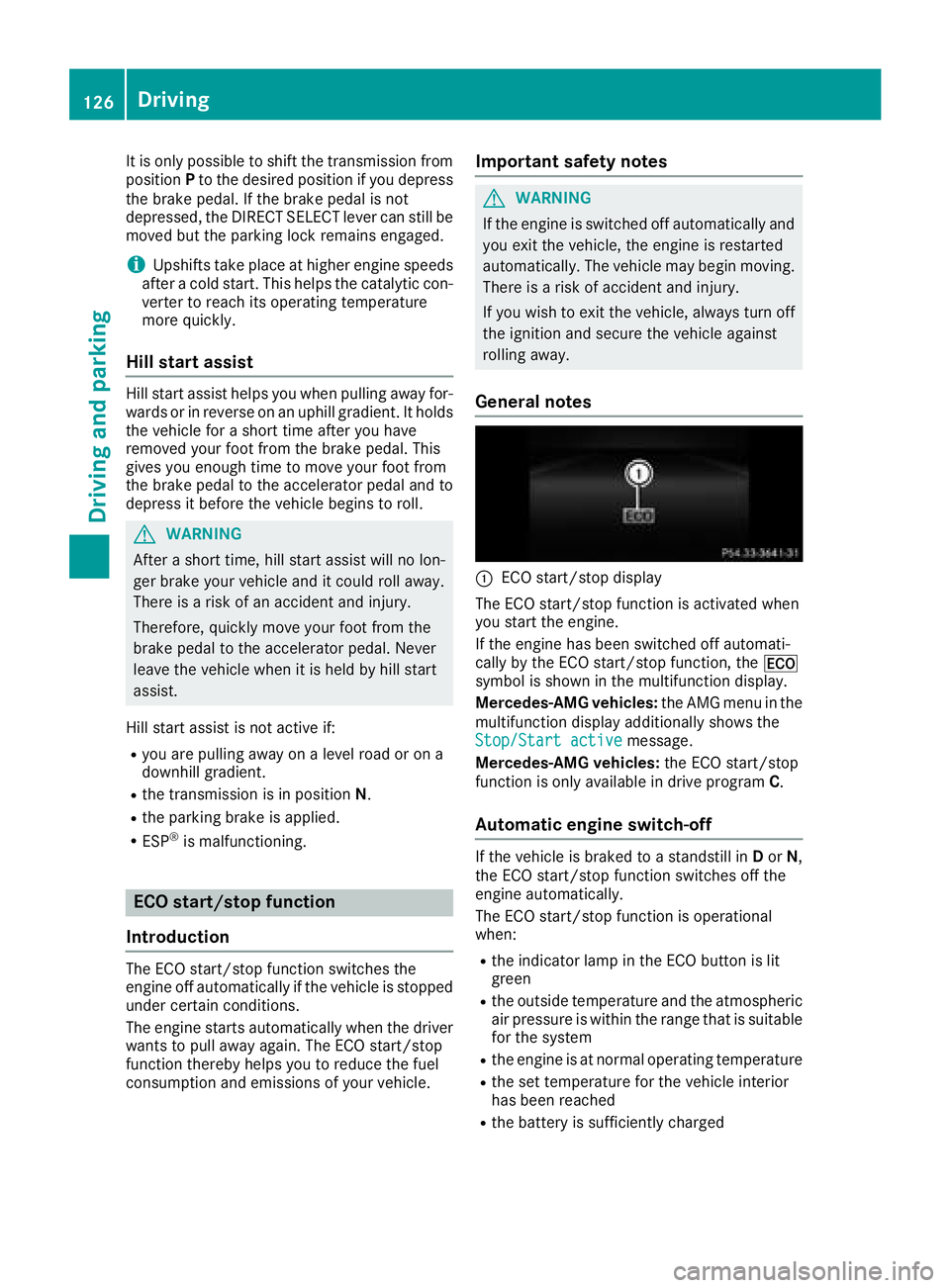
C
ECO start/stop display
The ECO start/stop function is activated when
you start the engine.
If the engine has been switched off automati-
cally by the ECO start/stop function, the
Page 129 of 334
R
the system detects that the windshield is not
fogged up when the air-conditioning system is
switched on R
the hood is closed R
the driver's door is closed and the driver's
seat belt is fastened
i All of the vehicle's systems remain active
when the engine is stopped automatically.
i The HOLD function can also be activated if
the engine has been switched off automati-
cally. It is then not necessary to continue
applying the brakes during the automatic stop
phase. When you depress the accelerator
pedal, the engine starts automatically and the
braking effect of the HOLD function is deac-
tivated.
Automatic engine switch-off can take place a
maximum of four times in a row (initial stop, then
three subsequent stops).
Mercedes-AMG vehicles: the number of con-
secutive automatic engine switch-offs is unlimi-
ted.
All other models: automatic engine switch-off
can take place a maximum of four times in a row
(initial switch-off, then three subsequent switch-
offs).
Automatic engine start The engine starts automatically if: R
you switch off the ECO start/stop function by
pressing the ECO button R
in transmission position D or N the brake
pedal is released and the HOLD function is not
active R
you depress the accelerator pedal R
you engage reverse gear RR
you move the transmission out of position PR
you switch to drive program S , S+ or M
(Mercedes-AMG vehicles) R
you unfasten your seat belt or open the driv-
er's door R
the vehicle starts to roll R
the brake system requires this R
the temperature in the vehicle interior devi-
ates from the set range R
the system detects moisture on the wind-
shield when the air-conditioning system is
switched on R
the battery's condition of charge is too low i Shifting the transmission to position P does
not start the engine.
Deactivating or activating the ECO
start/stop function Mercedes-AMG vehicles X
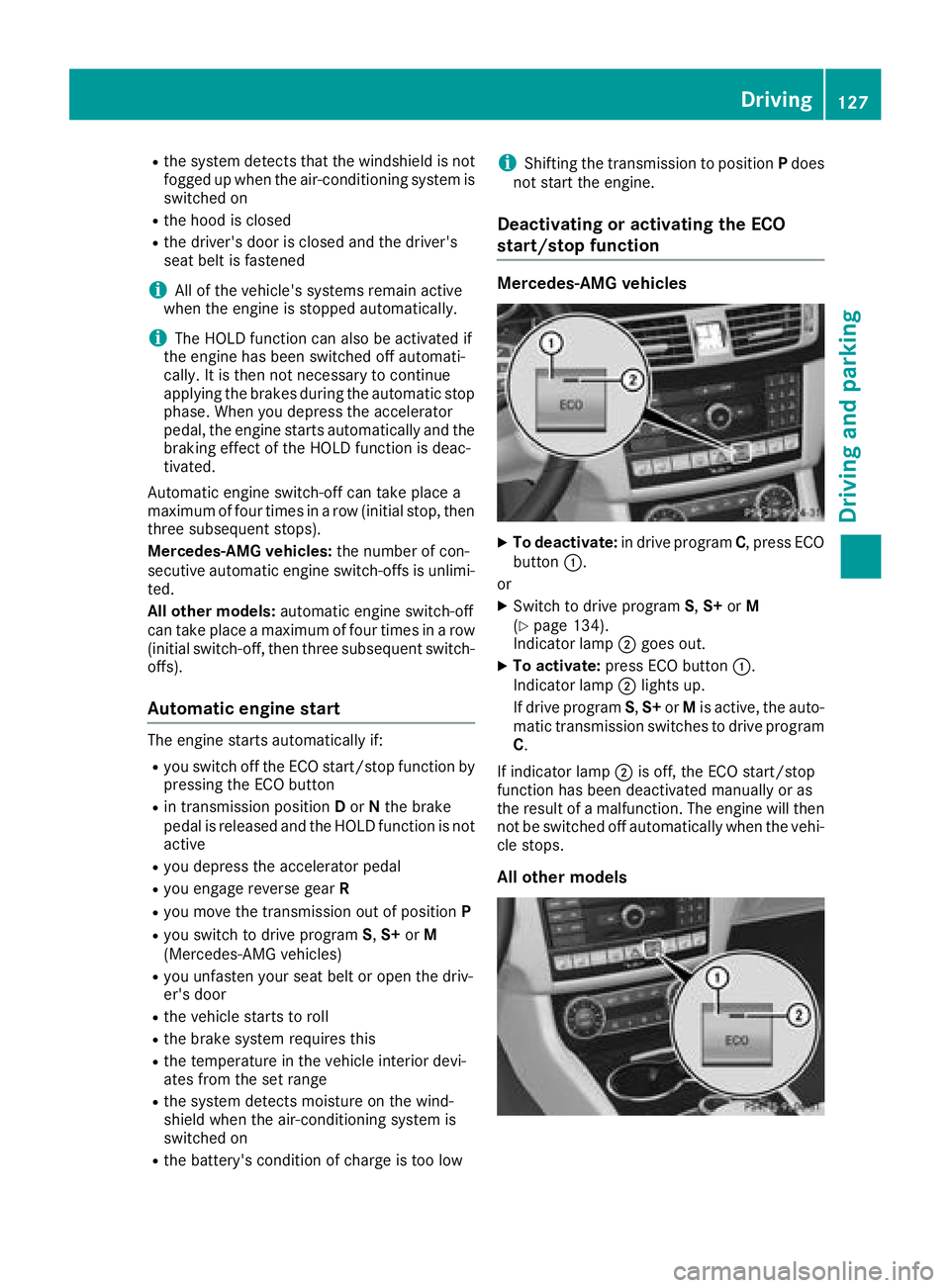
To deactivate: in drive program C , press ECO
button C .
or X
Switch to drive program S , S+ or M
( Y
page 134).
Indicator lamp D goes out.X
To activate: press ECO button C .
Indicator lamp D lights up.
If drive program S , S+ or M is active, the auto-
matic transmission switches to drive program
C .
If indicator lamp D is off, the ECO start/stop
function has been deactivated manually or as
the result of a malfunction. The engine will then
not be switched off automatically when the vehi-
cle stops.
All other models Driving 127
Dr ivi ng an d parking Z
Page 134 of 334
X
Vehicles with KEYLESS-GO: remove the
Start/Stop button from the ignition lock. X
Insert the Smartkey into the ignition lock. X
All vehicles: switch the ignition on.X
Depress the brake pedal and keep it
depressed. X
Shift to neutral N .X
Release the brake pedal. X
Release the parking brake. X
Switch off the ignition and leave the Smartkey
in the ignition lock.
Engaging drive position D X
If the transmission is in position R or N : push
the DIRECT SELECT lever down past the first
point of resistance. X
If the transmission is in position P : depress
the brake pedal and push the DIRECT SELECT
lever down past the first point of resistance. Transmission positions E Park position
Only shift the transmission into posi-
tion P when the vehicle is stationary
( Y
page 142). The parking lock
should not be used as a brake when
parking. Always apply the parking
brake in addition to the parking lock
in order to secure the vehicle.
If the vehicle electronics are malfunc-
tioning, the transmission may be
locked in position P . Have the vehicle
electronics checked immediately at a
qualified specialist workshop.
Park position P is automatically
engaged if: R
you switch off the engine using the
SmartKey and remove the Smart-
Key R
you switch off the engine using the
SmartKey or using the Start/Stop
button and open the driver's door
or front-passenger door R
the driver's door is opened when
the vehicle is stationary or driving
at very low speed and the trans-
mission is in position D or R
F Reverse gear
Only shift the transmission into posi-
tion R when the vehicle is stationary.132
Automatic transmission
Driving and parking