fuel MERCEDES-BENZ CLS-CLASS 2011 Workshop Manual
[x] Cancel search | Manufacturer: MERCEDES-BENZ, Model Year: 2011, Model line: CLS-CLASS, Model: MERCEDES-BENZ CLS-CLASS 2011Pages: 308, PDF Size: 6.07 MB
Page 266 of 308
X
Pull fuel filler flap release : in direction of
arrow.
The fuel filler flap is unlocked.
X Open the fuel filler flap ( Y page 176).
X Reinstall side trim panel.
X Close the trunk. Resetting activated NECK-PRO active
front head restraints
If the NECK-PRO active front head restraints
have been triggered in a rear-end collision,
they must be reset.
You can tell that the NECK-PRO active front
head restraints have been triggered when
they have been moved forward and cannot be
adjusted. G
Warning!
For safety reasons, have the NECK-PRO active
front head restraints checked at an
authorized Mercedes-Benz Center after a
rear-end collision. G
Warning!
When pushing back the head restraint
cushion, make sure your fingers do not
become caught between the head restraint
cushion and the cover. Failing to do so may
lead to injury.
! Be careful not to damage upholstery.
i For your convenience, we recommend
that you have this work carried out at an
authorized Mercedes-Benz Center. X
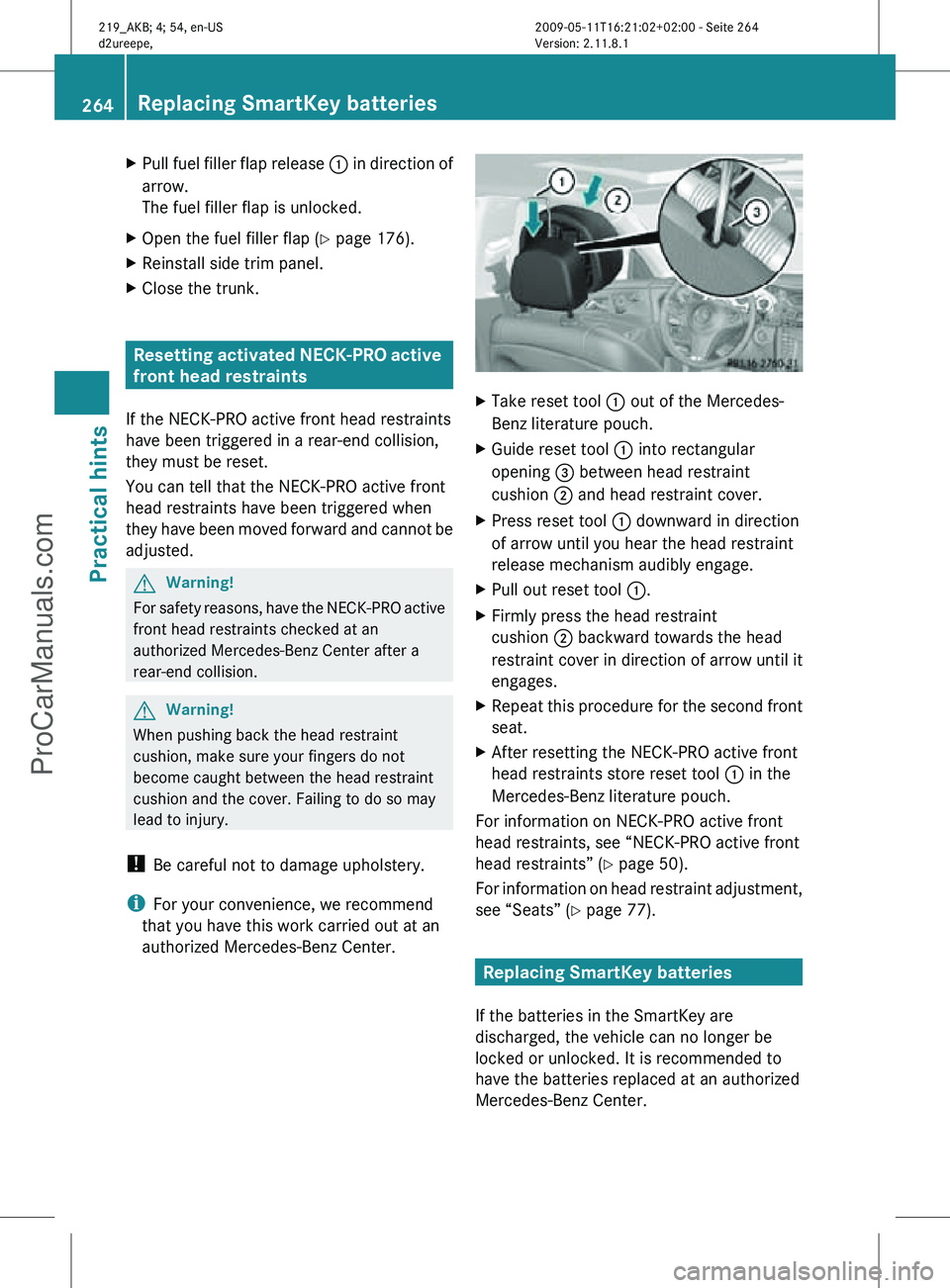
Take reset tool : out of the Mercedes-
Benz literature pouch.
X Guide reset tool : into rectangular
opening = between head restraint
cushion ; and head restraint cover.
X Press reset tool : downward in direction
of arrow until you hear the head restraint
release mechanism audibly engage.
X Pull out reset tool :.
X Firmly press the head restraint
cushion ; backward towards the head
restraint cover in direction of arrow until it
engages.
X Repeat this procedure for the second front
seat.
X After resetting the NECK-PRO active front
head restraints store reset tool : in the
Mercedes-Benz literature pouch.
For information on NECK-PRO active front
head restraints, see “NECK-PRO active front
head restraints” ( Y page 50).
For information on head restraint adjustment,
see “Seats” ( Y page 77). Replacing SmartKey batteries
If the batteries in the SmartKey are
discharged, the vehicle can no longer be
locked or unlocked. It is recommended to
have the batteries replaced at an authorized
Mercedes-Benz Center. 264
Replacing SmartKey batteriesPractical hints
219_AKB; 4; 54, en-US
d2ureepe,
Version: 2.11.8.1 2009-05-11T16:21:02+02:00 - Seite 264
ProCarManuals.com
Page 282 of 308
battery yourself, follow the operating
instructions for your charging device.
Only use a battery charge unit with a
maximum charging voltage of 14.8 V.
X
Charge battery in accordance with the
instructions of the battery charger
manufacturer. Jump starting
G
Warning!
Failure to follow these directions will cause
damage to the electronic components, and
can lead to a battery explosion and severe
injury or death.
Never
lean over batteries while connecting or
jump starting. You might get injured.
Battery fluid contains sulfuric acid. Do not
allow this fluid to come in contact with eyes,
skin or clothing. In case it does, immediately
flush affected area with water, and seek
medical help if necessary.
A battery will also produce hydrogen gas,
which is flammable and explosive. Keep
flames or sparks away from battery, avoid
improper connection of jumper cables,
smoking, etc.
Attempting to jump start a frozen battery can
result in it exploding, causing personal injury.
Read all instructions before proceeding.
! Do not tow-start the vehicle. You could
otherwise seriously damage the automatic
transmission which is not covered by the
Mercedes-Benz Limited Warranty.
! Jump starting should only be performed
using the jump-start terminals located in
the engine compartment.
Avoid repeated and lengthy starting
attempts.
Do not attempt to start the engine using a
battery quick-charge unit. If the engine does not run after several
unsuccessful starting attempts, have it
checked at the nearest authorized
Mercedes-Benz Center.
Excessive unburned fuel generated by
repeated failed starting attempts may
damage the catalytic converter and may
present a fire risk.
Make sure the jumper cables do not have
loose or missing insulation.
Make sure the cable clamps do not touch
any
other metal part while the other end is
still attached to a battery.
If the battery is discharged, the engine can be
started with jumper cables and the fully
charged battery of another vehicle or an
equivalent starter pack. Observe the
following:
R Access to the battery is not possible on all
vehicles. If you cannot access the battery
of the other vehicle, provide jump start
power by an external battery or starter
pack.
R Jump starting should only be performed
when the engine and catalytic converter
are cold.
R Do not jump start the engine or charge the
battery if the battery is frozen. Let the
battery thaw out first.
R Only jump start from batteries with the
same voltage rating (12 V). Jump starting
with a more powerful battery could damage
the vehicle’s electrical system. Such
damage will not be covered by the
Mercedes-Benz Limited Warranty.
R Only use jumper cables with sufficient
cross-section and insulated terminal
clamps.
R Always make sure the jumper cables are
not on or near pulleys, fans or other parts
that move when an engine is started or
running.
R Should the battery be drained completely,
let the donating power source charge the 280
Jump starting
Practical hints
219_AKB; 4; 54, en-US
d2ureepe,
Version: 2.11.8.1 2009-05-11T16:21:02+02:00 - Seite 280
ProCarManuals.com
Page 289 of 308
Vehicle equipment ............................
288
Parts service ..................................... 288
Warranty coverage ...........................288
Identification labels ..........................288
Vehicle specification CLS 550
(219.372) ........................................... 290
Vehicle specification CLS 63 AMG
(219.377) ........................................... 290
Rims and tires ................................... 291
Fuels, coolants, lubricants, etc. ......296 287Technical data
219_AKB; 4; 54, en-US
d2ureepe,
Version: 2.11.8.1 2009-05-11T16:21:02+02:00 - Seite 287
ProCarManuals.com
Page 292 of 308
Vehicle specification CLS 550
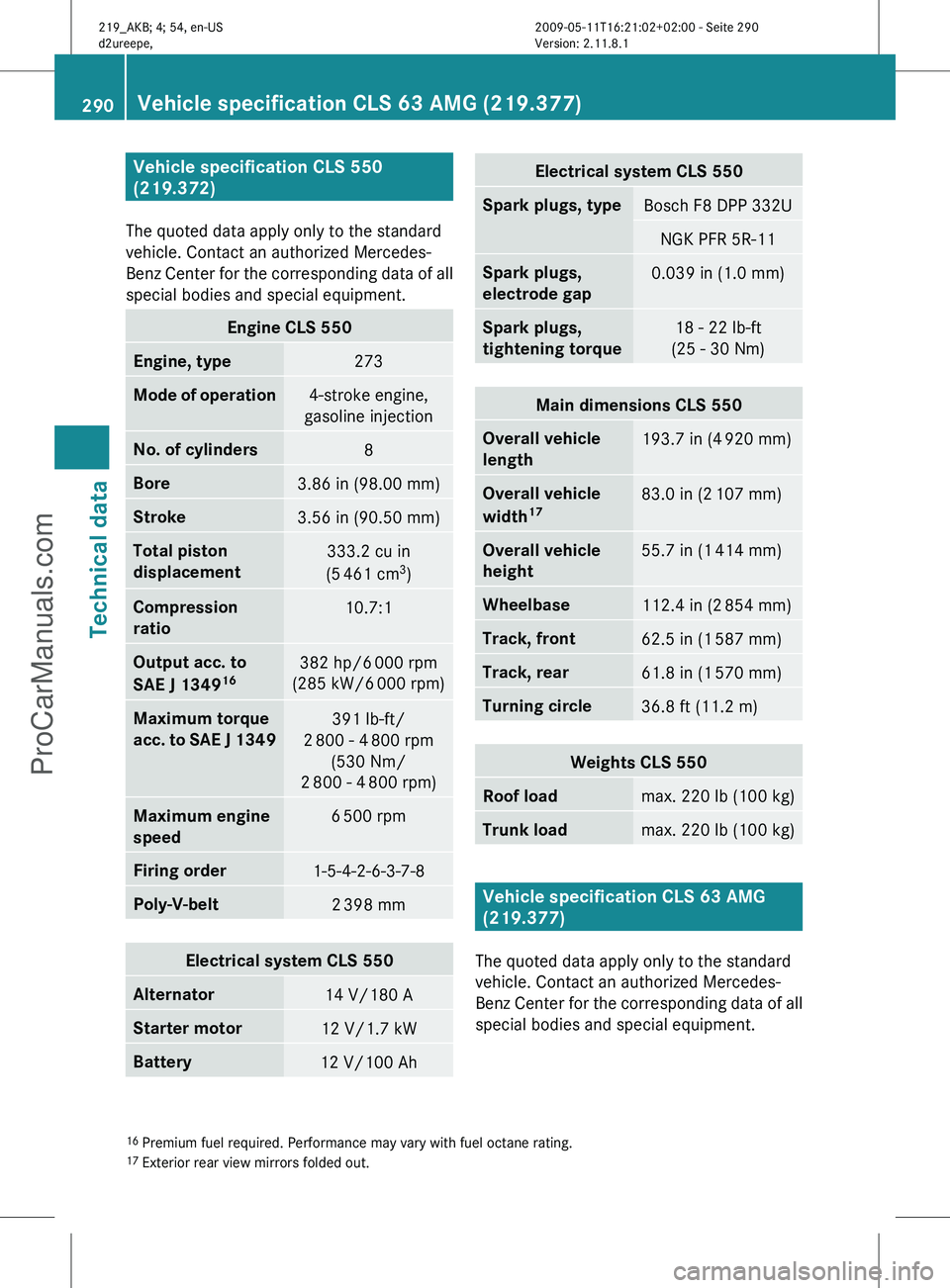
(219.372)
The quoted data apply only to the standard
vehicle. Contact an authorized Mercedes-
Benz
Center for the corresponding data of all
special bodies and special equipment. Engine CLS 550
Engine, type
273
Mode of operation
4-stroke engine,
gasoline injection No. of cylinders
8
Bore
3.86 in (98.00 mm)
Stroke
3.56 in (90.50 mm)
Total piston
displacement
333.2 cu in
(5 461 cm 3
) Compression
ratio
10.7:1
Output acc. to
SAE J 1349
16 382 hp/6
000 rpm
(285 kW/6 000 rpm) Maximum torque
acc.
to SAE J 1349 391 lb-ft/
2 800 - 4 800 rpm
(530 Nm/
2 800 - 4 800 rpm) Maximum engine
speed
6 500 rpm
Firing order
1-5-4-2-6-3-7-8
Poly-V-belt
2 398 mm
Electrical system CLS 550
Alternator
14 V/180 A
Starter motor
12 V/1.7 kW
Battery
12 V/100 Ah Electrical system CLS 550
Spark plugs, type
Bosch F8 DPP 332U
NGK PFR 5R-11
Spark plugs,
electrode gap
0.039 in (1.0 mm)
Spark plugs,
tightening torque
18 - 22 lb-ft
(25 - 30 Nm) Main dimensions CLS 550
Overall vehicle
length
193.7 in (4
920 mm) Overall vehicle
width
17 83.0 in (2
107 mm) Overall vehicle
height
55.7 in (1
414 mm) Wheelbase
112.4 in (2
854 mm) Track, front
62.5 in (1
587 mm) Track, rear
61.8 in (1
570 mm) Turning circle
36.8 ft (11.2 m)
Weights CLS 550
Roof load
max. 220 lb (100 kg)
Trunk load
max. 220 lb (100 kg)
Vehicle specification CLS 63 AMG
(219.377)
The quoted data apply only to the standard
vehicle. Contact an authorized Mercedes-
Benz
Center for the corresponding data of all
special bodies and special equipment.
16 Premium fuel required. Performance may vary with fuel octane rating.
17 Exterior rear view mirrors folded out. 290
Vehicle specification CLS 63 AMG (219.377)
Technical data
219_AKB; 4; 54, en-US
d2ureepe,
Version: 2.11.8.1 2009-05-11T16:21:02+02:00 - Seite 290
ProCarManuals.com
Page 293 of 308
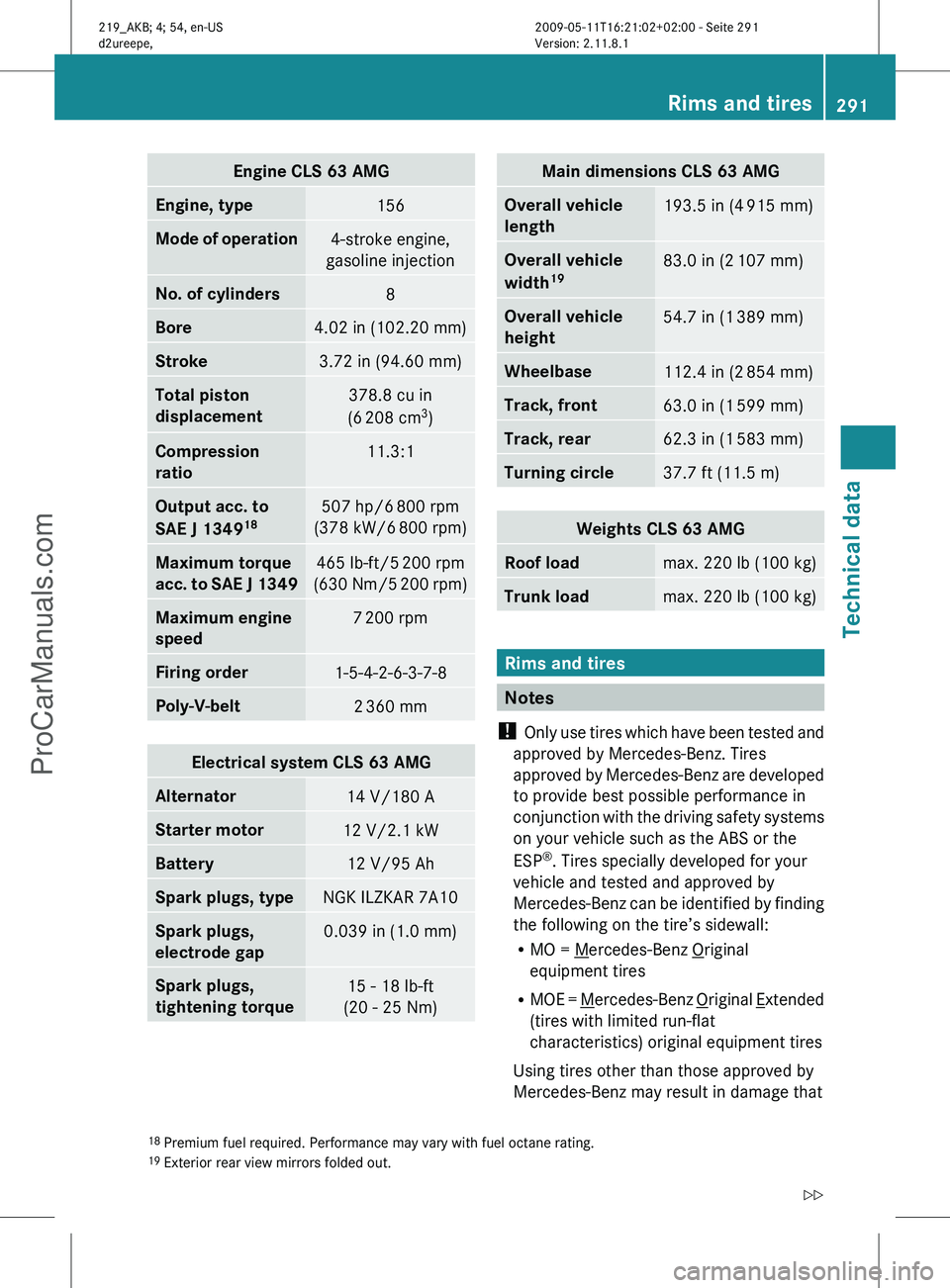
Engine CLS 63 AMG
Engine, type
156
Mode of operation
4-stroke engine,
gasoline injection No. of cylinders
8
Bore
4.02 in (102.20 mm)
Stroke
3.72 in (94.60 mm)
Total piston
displacement
378.8 cu in
(6 208 cm 3
) Compression
ratio
11.3:1
Output acc. to
SAE J 1349
18 507 hp/6
800 rpm
(378 kW/6 800 rpm) Maximum torque
acc.
to SAE J 1349 465 lb-ft/5
200 rpm
(630 Nm/5 200 rpm) Maximum engine
speed
7 200 rpm
Firing order
1-5-4-2-6-3-7-8
Poly-V-belt
2 360 mm
Electrical system CLS 63 AMG
Alternator
14 V/180 A
Starter motor
12 V/2.1 kW
Battery
12 V/95 Ah
Spark plugs, type
NGK ILZKAR 7A10
Spark plugs,
electrode gap
0.039 in (1.0 mm)
Spark plugs,
tightening torque
15 - 18 lb-ft
(20 - 25 Nm) Main dimensions CLS 63 AMG
Overall vehicle
length
193.5 in (4
915 mm) Overall vehicle
width
19 83.0 in (2
107 mm) Overall vehicle
height
54.7 in (1
389 mm) Wheelbase
112.4 in (2
854 mm) Track, front
63.0 in (1
599 mm) Track, rear
62.3 in (1
583 mm) Turning circle
37.7 ft (11.5 m)
Weights CLS 63 AMG
Roof load
max. 220 lb (100 kg)
Trunk load
max. 220 lb (100 kg)
Rims and tires
Notes
! Only
use tires which have been tested and
approved by Mercedes-Benz. Tires
approved by Mercedes-Benz are developed
to provide best possible performance in
conjunction with the driving safety systems
on your vehicle such as the ABS or the
ESP ®
. Tires specially developed for your
vehicle and tested and approved by
Mercedes-Benz can be identified by finding
the following on the tire’s sidewall:
R MO = Mercedes-Benz Original
equipment tires
R MOE
= Mercedes-Benz Original Extended
(tires with limited run-flat
characteristics) original equipment tires
Using tires other than those approved by
Mercedes-Benz may result in damage that
18 Premium fuel required. Performance may vary with fuel octane rating.
19 Exterior rear view mirrors folded out. Rims and tires
291
Technical data
219_AKB; 4; 54, en-US
d2ureepe, Version: 2.11.8.1 2009-05-11T16:21:02+02:00 - Seite 291 Z
ProCarManuals.com
Page 294 of 308
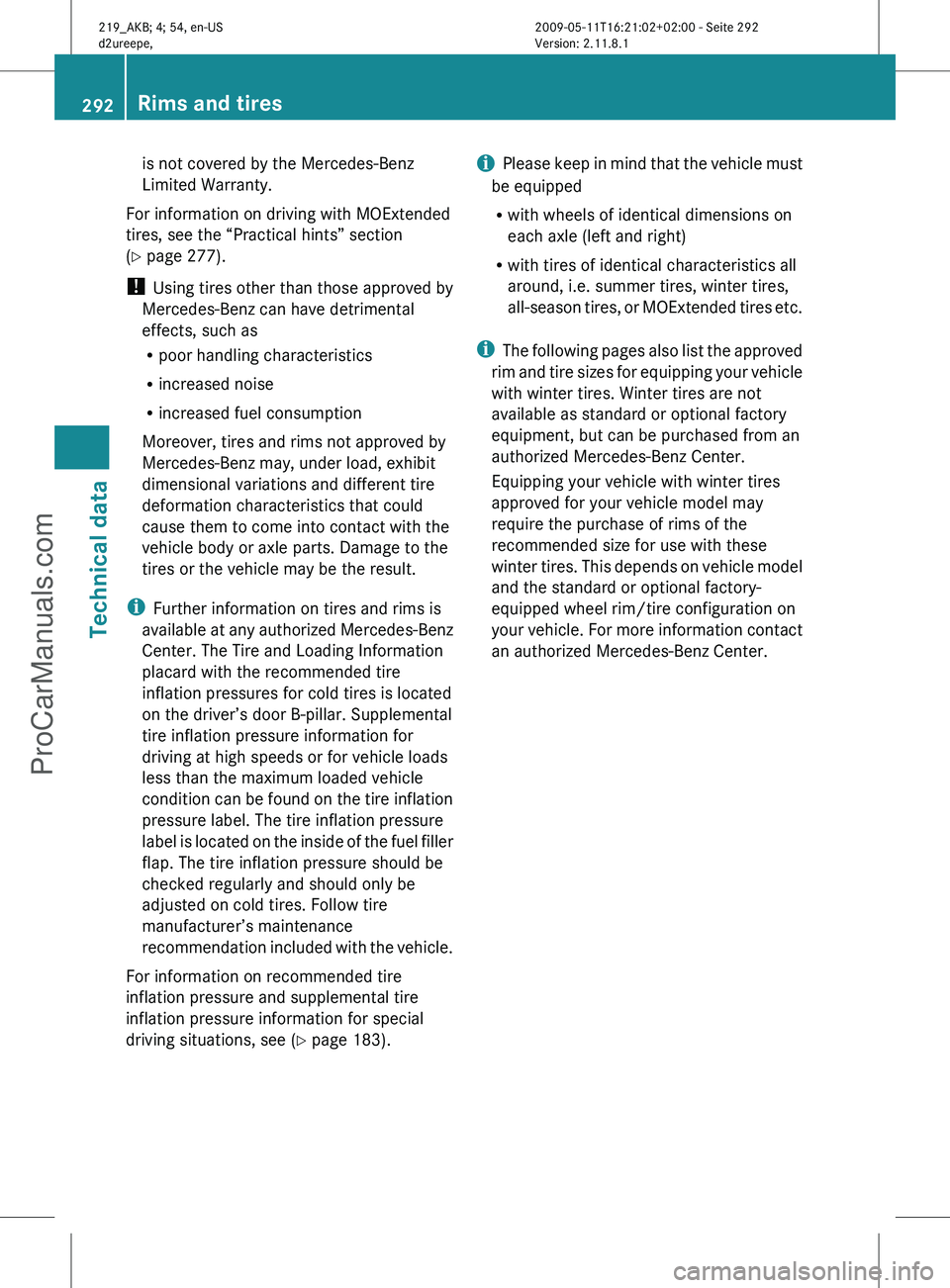
is not covered by the Mercedes-Benz
Limited Warranty.
For information on driving with MOExtended
tires, see the “Practical hints” section
(Y page 277).
! Using tires other than those approved by
Mercedes-Benz can have detrimental
effects, such as
R poor handling characteristics
R increased noise
R increased fuel consumption
Moreover, tires and rims not approved by
Mercedes-Benz may, under load, exhibit
dimensional variations and different tire
deformation characteristics that could
cause them to come into contact with the
vehicle body or axle parts. Damage to the
tires or the vehicle may be the result.
i Further information on tires and rims is
available
at any authorized Mercedes-Benz
Center. The Tire and Loading Information
placard with the recommended tire
inflation pressures for cold tires is located
on the driver’s door B-pillar. Supplemental
tire inflation pressure information for
driving at high speeds or for vehicle loads
less than the maximum loaded vehicle
condition can be found on the tire inflation
pressure label. The tire inflation pressure
label is located on the inside of the fuel filler
flap. The tire inflation pressure should be
checked regularly and should only be
adjusted on cold tires. Follow tire
manufacturer’s maintenance
recommendation included with the vehicle.
For information on recommended tire
inflation pressure and supplemental tire
inflation pressure information for special
driving situations, see ( Y page 183). i
Please keep in mind that the vehicle must
be equipped
Rwith wheels of identical dimensions on
each axle (left and right)
R with tires of identical characteristics all
around, i.e. summer tires, winter tires,
all-season tires, or MOExtended tires etc.
i The following pages also list the approved
rim and tire sizes for equipping your vehicle
with winter tires. Winter tires are not
available as standard or optional factory
equipment, but can be purchased from an
authorized Mercedes-Benz Center.
Equipping your vehicle with winter tires
approved for your vehicle model may
require the purchase of rims of the
recommended size for use with these
winter tires. This depends on vehicle model
and the standard or optional factory-
equipped wheel rim/tire configuration on
your vehicle. For more information contact
an authorized Mercedes-Benz Center. 292
Rims and tires
Technical data
219_AKB; 4; 54, en-US
d2ureepe,
Version: 2.11.8.1 2009-05-11T16:21:02+02:00 - Seite 292
ProCarManuals.com
Page 298 of 308
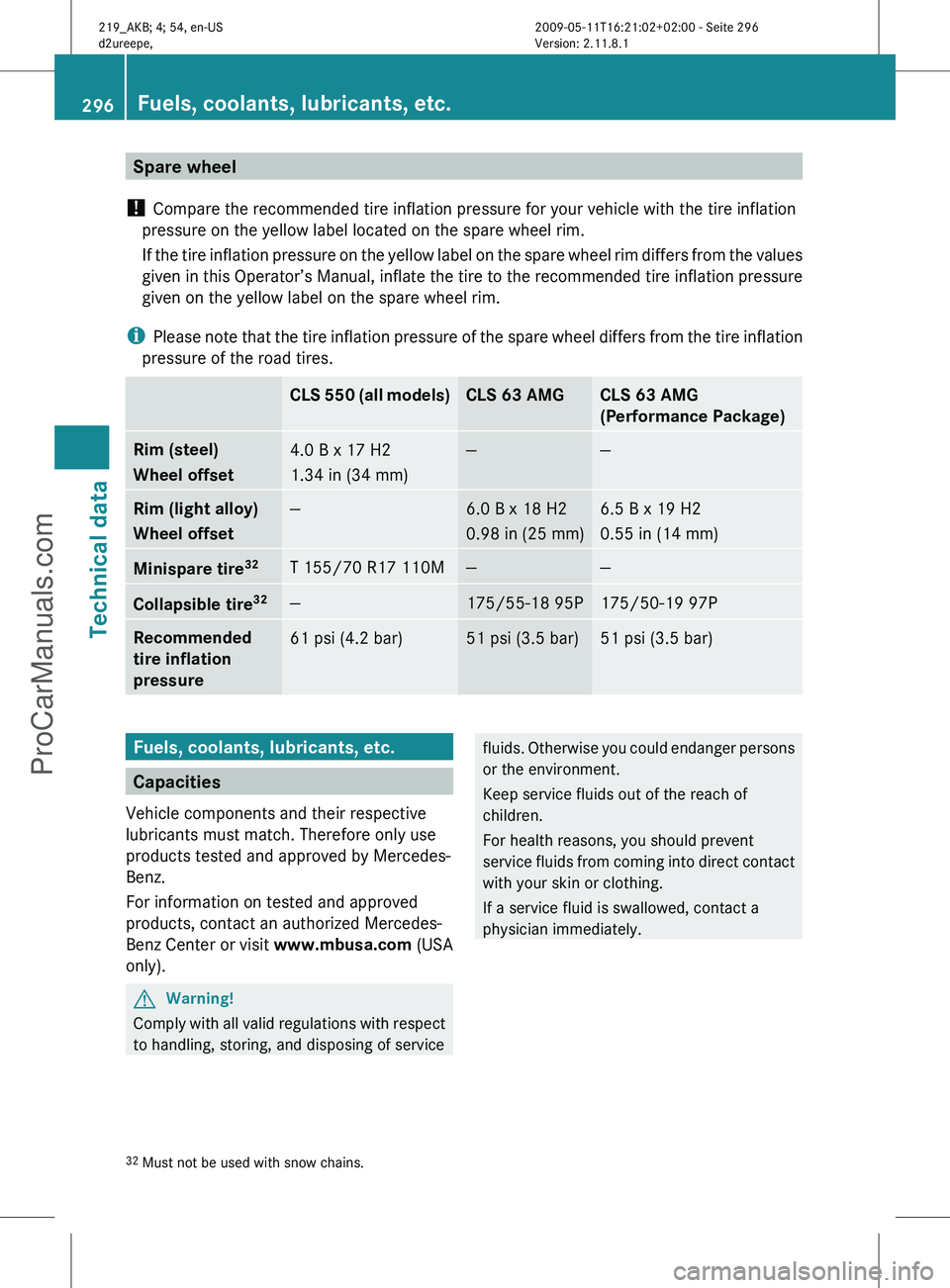
Spare wheel
! Compare the recommended tire inflation pressure for your vehicle with the tire inflation
pressure on the yellow label located on the spare wheel rim.
If
the tire inflation pressure on the yellow label on the spare wheel rim differs from the values
given in this Operator’s Manual, inflate the tire to the recommended tire inflation pressure
given on the yellow label on the spare wheel rim.
i Please note that the tire inflation pressure of the spare wheel differs from the tire inflation
pressure of the road tires. CLS 550 (all models) CLS 63 AMG CLS 63 AMG
(Performance Package)
Rim (steel)
Wheel offset
4.0 B x 17 H2
1.34 in (34 mm) — —
Rim (light alloy)
Wheel offset
— 6.0 B x 18 H2
0.98 in (25 mm) 6.5 B x 19 H2
0.55 in (14 mm)
Minispare tire
32 T 155/70 R17 110M — —
Collapsible tire
32 — 175/55-18 95P 175/50-19 97P
Recommended
tire inflation
pressure
61 psi (4.2 bar) 51 psi (3.5 bar) 51 psi (3.5 bar)
Fuels, coolants, lubricants, etc.
Capacities
Vehicle components and their respective
lubricants must match. Therefore only use
products tested and approved by Mercedes-
Benz.
For information on tested and approved
products, contact an authorized Mercedes-
Benz Center or visit www.mbusa.com (USA
only). G
Warning!
Comply with all valid regulations with respect
to handling, storing, and disposing of service fluids. Otherwise you could endanger persons
or the environment.
Keep service fluids out of the reach of
children.
For health reasons, you should prevent
service
fluids from coming into direct contact
with your skin or clothing.
If a service fluid is swallowed, contact a
physician immediately.
32 Must not be used with snow chains. 296
Fuels, coolants, lubricants, etc.
Technical data
219_AKB; 4; 54, en-US
d2ureepe,
Version: 2.11.8.1 2009-05-11T16:21:02+02:00 - Seite 296
ProCarManuals.com
Page 299 of 308
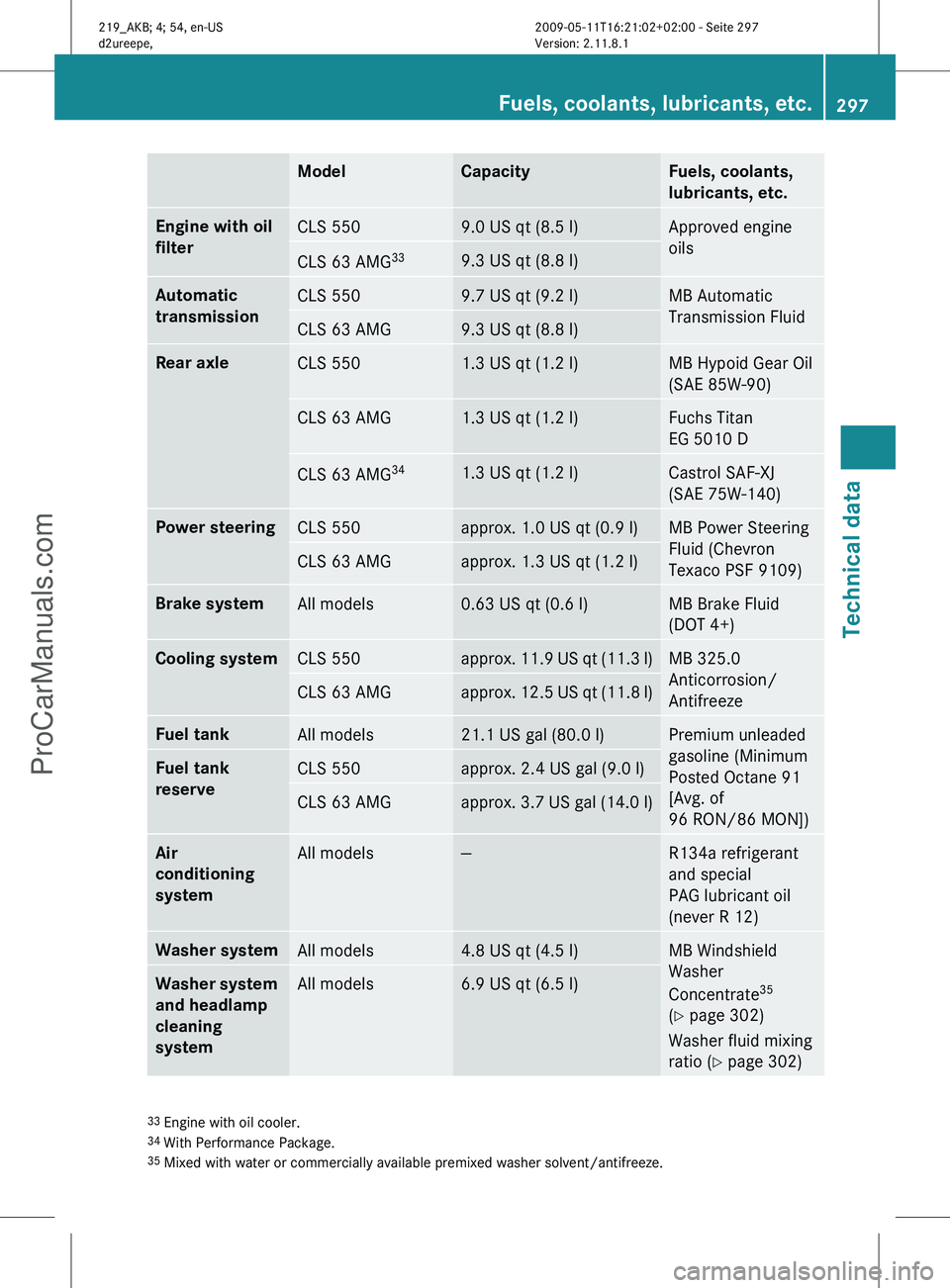
Model Capacity Fuels, coolants,
lubricants, etc.
Engine with oil
filter
CLS 550 9.0 US qt (8.5 l) Approved engine
oils
CLS 63 AMG
33 9.3 US qt (8.8 l)
Automatic
transmission
CLS 550 9.7 US qt (9.2 l) MB Automatic
Transmission Fluid
CLS 63 AMG 9.3 US qt (8.8 l)
Rear axle
CLS 550 1.3 US qt (1.2 l) MB Hypoid Gear Oil
(SAE 85W-90)
CLS 63 AMG 1.3 US qt (1.2 l) Fuchs Titan
EG 5010 D
CLS 63 AMG
34 1.3 US qt (1.2 l) Castrol SAF-XJ
(SAE 75W-140)
Power steering
CLS 550 approx. 1.0 US qt (0.9 l) MB Power Steering
Fluid (Chevron
Texaco PSF 9109)
CLS 63 AMG approx. 1.3 US qt (1.2 l)
Brake system
All models 0.63 US qt (0.6 l) MB Brake Fluid
(DOT 4+)
Cooling system
CLS 550 approx. 11.9 US qt (11.3 l) MB 325.0
Anticorrosion/
Antifreeze
CLS 63 AMG approx. 12.5 US qt (11.8 l)
Fuel tank
All models 21.1 US gal (80.0 l) Premium unleaded
gasoline (Minimum
Posted Octane 91
[Avg. of
96 RON/86 MON])
Fuel tank
reserve
CLS 550 approx. 2.4 US gal (9.0 l)
CLS 63 AMG approx. 3.7 US gal (14.0 l)
Air
conditioning
system
All models — R134a refrigerant
and special
PAG lubricant oil
(never R 12)
Washer system
All models 4.8 US qt (4.5 l) MB Windshield
Washer
Concentrate
35
(Y page 302)
Washer fluid mixing
ratio ( Y page 302) Washer system
and headlamp
cleaning
system
All models 6.9 US qt (6.5 l)
33
Engine with oil cooler.
34 With Performance Package.
35 Mixed with water or commercially available premixed washer solvent/antifreeze. Fuels, coolants, lubricants, etc.
297Technical data
219_AKB; 4; 54, en-US
d2ureepe, Version: 2.11.8.1 2009-05-11T16:21:02+02:00 - Seite 297 Z
ProCarManuals.com
Page 300 of 308
Approved engine oils
Engine oils are specifically tested for their
suitability in our engines and durability for our
service intervals. Therefore, only use
approved engine oils and oil filters required
for vehicles with the Maintenance System.
For a listing of approved engine oils and oil
filters, contact an authorized Mercedes-Benz
Center or visit www.mbusa.com (USA only).
! Using engine oils and oil filters of a
specification other than those expressly
required for the Maintenance System, or
changing of oil and oil filter at change
intervals longer than those called for by the
Maintenance System will result in engine or
emission control system damage not
covered by the Mercedes-Benz Limited
Warranty.
Please follow Maintenance System
recommendations for scheduled oil
changes. Failure to do so will result in
engine or emission control system damage
not covered by the Mercedes-Benz Limited
Warranty.
Mercedes-Benz recommends MOBIL OIL.
Use the table below to determine the
MB sheet number. Model Engine,
type MB sheet
number
CLS 550 273 229.5
CLS 63 AMG 156
229.5
36 i
MB sheet numbers are printed on the
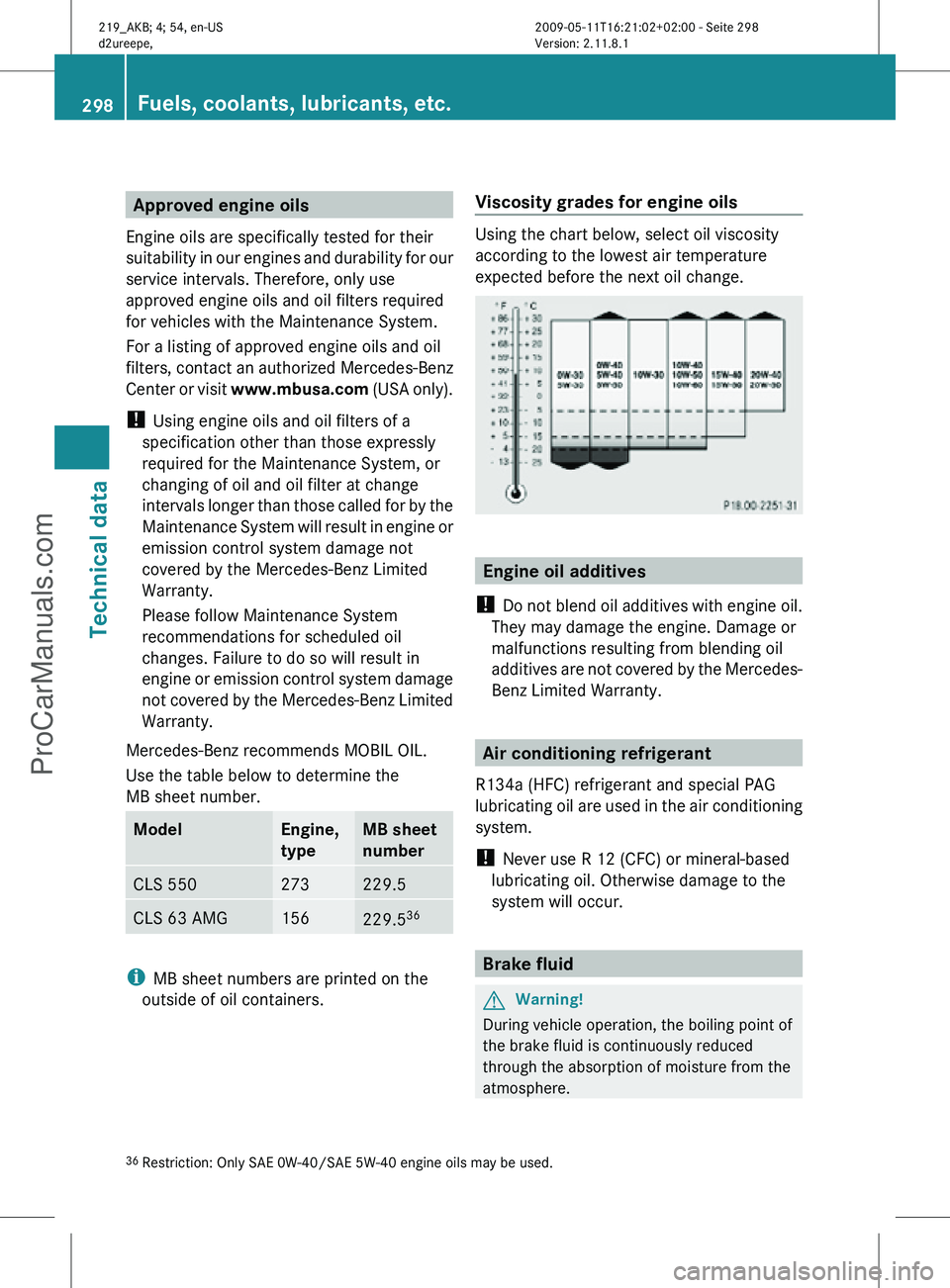
outside of oil containers. Viscosity grades for engine oils Using the chart below, select oil viscosity
according to the lowest air temperature
expected before the next oil change.
Engine oil additives
! Do not blend oil additives with engine oil.
They may damage the engine. Damage or
malfunctions resulting from blending oil
additives are not covered by the Mercedes-
Benz Limited Warranty. Air conditioning refrigerant
R134a (HFC) refrigerant and special PAG
lubricating oil are used in the air conditioning
system.
! Never use R 12 (CFC) or mineral-based
lubricating oil. Otherwise damage to the
system will occur. Brake fluid
G
Warning!
During vehicle operation, the boiling point of
the brake fluid is continuously reduced
through the absorption of moisture from the
atmosphere.
36 Restriction: Only SAE 0W-40/SAE 5W-40 engine oils may be used. 298
Fuels, coolants, lubricants, etc.Technical data
219_AKB; 4; 54, en-US
d2ureepe,
Version: 2.11.8.1 2009-05-11T16:21:02+02:00 - Seite 298
ProCarManuals.com
Page 301 of 308
Under extremely strenuous operating
conditions, this moisture content can lead to
the formation of bubbles in the system, thus
reducing the system’s efficiency.
Therefore, the brake fluid must be replaced
regularly.
Refer to your vehicle’s Maintenance
Booklet for replacement interval.
Only brake fluid approved by Mercedes-Benz
is recommended. Any authorized Mercedes-
Benz Center will provide you with additional
information. Premium unleaded gasoline
G
Warning!
Gasoline is highly flammable and poisonous.
It burns violently and can cause serious
personal injury.
Never allow sparks, flames or smoking
materials near gasoline!
Turn off the engine before refueling.
Whenever you are around gasoline, avoid
inhaling fumes and any skin or clothing
contact. Extinguish all smoking materials.
Direct skin contact with fuels and the
inhalation of fuel vapors are damaging your
health.
! To maintain the engine’s durability and
performance, premium unleaded gasoline
must be used.
If premium unleaded gasoline is not
available and low octane gasoline is used,
follow these precautions:
R Have the fuel tank only partially filled
with
unleaded regular gasoline and fill up
with premium unleaded gasoline as soon
as possible.
R Avoid full throttle driving and abrupt
acceleration.
R Do not exceed an engine speed of
3 000 rpm if the vehicle is loaded with a light load such as two persons and no
luggage.
R Do not exceed 2
/ 3 of maximum
accelerator pedal position if the vehicle
is fully loaded or operating in
mountainous terrain. Fuel requirements
Only use premium unleaded gasoline. The
octane
number (posted at the pump) must be
91 min. It is an average of both the Research
Octane Number (RON) and the Motor Octane
Number (MON): (RON+MON)/2. This is also
known as the ANTI-KNOCK INDEX.
Reformulated gasolines (RFG) and/or
unleaded gasoline containing oxygenates
such as ethanol, TAME, ETBE, IPA, IBA, and
TBA can be used provided the ratio of any one
of these oxygenates to gasoline does not
exceed 10%; MTBE must not exceed 15%.
The ratio of methanol to gasoline must not
exceed 3% plus additional cosolvents.
Using mixtures of ethanol and methanol is not
allowed. Gasohol, which contains 10%
ethanol and 90% unleaded gasoline, can be
used.
These blends must also meet all other fuel
requirements, such as resistance to spark
knock, boiling range, vapor pressure, etc. Gasoline additives
A major concern among engine
manufacturers is carbon build-up caused by
gasoline. Mercedes-Benz recommends only
the use of quality gasoline containing
additives that prevent the build-up of carbon
deposits. Fuels, coolants, lubricants, etc.
299
Technical data
219_AKB; 4; 54, en-US
d2ureepe, Version: 2.11.8.1 2009-05-11T16:21:02+02:00 - Seite 299 Z
ProCarManuals.com