child restraint MERCEDES-BENZ CLS-Class 2014 W218 User Guide
[x] Cancel search | Manufacturer: MERCEDES-BENZ, Model Year: 2014, Model line: CLS-Class, Model: MERCEDES-BENZ CLS-Class 2014 W218Pages: 382, PDF Size: 5.36 MB
Page 52 of 382
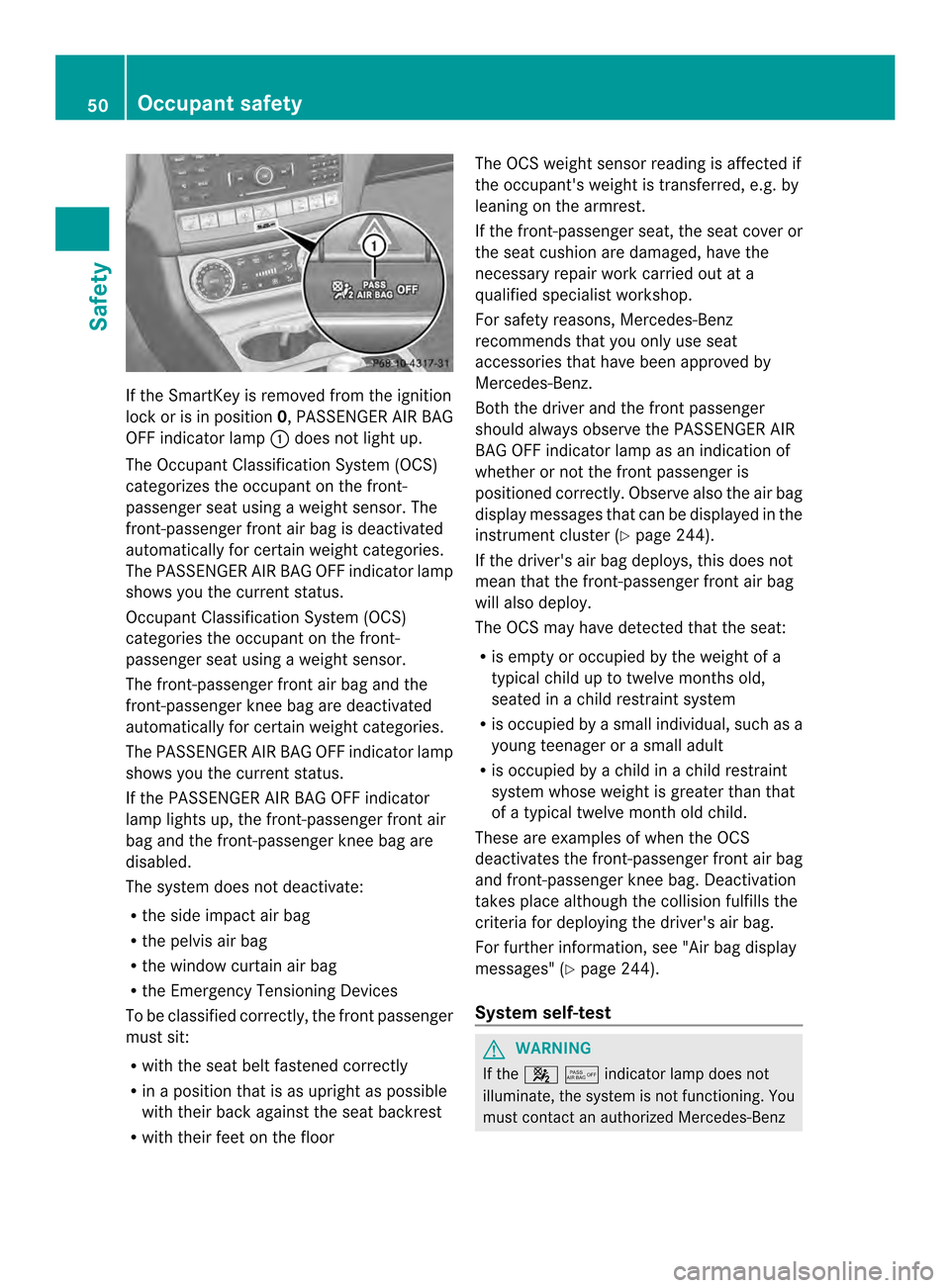
If the SmartKey is removed from the ignition
lock or is in position 0,PASSENGER AIR BAG
OFF indicator lamp 001Adoes not light up.
The Occupant Classification System (OCS)
categorize sthe occupant on the front-
passenge rseat using aweight sensor .The
front-passenger front air bag is deactivated
automatically for certain weight categories.
The PASSENGER AIR BAG OFF indicator lamp
shows you the current status.
Occupant Classification System (OCS)
categories the occupant on the front-
passenger seat using aweight sensor.
The front-passenger front air bag and the
front-passenger knee bag are deactivated
automatically for certain weight categories.
The PASSENGER AIR BAG OFF indicator lamp
shows you the current status.
If the PASSENGER AIR BAG OFF indicator
lamp lights up, the front-passenger front air
bag and the front-passenger knee bag are
disabled.
The system does not deactivate:
R the side impact air bag
R the pelvis air bag
R the window curtain air bag
R the Emergency Tensioning Devices
To be classified correctly, the front passenger
must sit:
R with the seat belt fastened correctly
R in ap osition that is as upright as possible
with their back against the seat backrest
R with their feet on the floor The OCS weight sensor reading is affected if
the occupant's weight is transferred, e.g. by
leaning on the armrest.
If the front-passenger seat, the seat cover or
the seat cushion are damaged, have the
necessary repair work carried out at a
qualified specialist workshop.
For safety reasons, Mercedes-Benz
recommends that you only use seat
accessories that have been approved by
Mercedes-Benz.
Both the driver and the front passenger
should always observe the PASSENGER AIR
BAG OFF indicator lamp as an indication of
whether or not the front passenger is
positioned correctly. Observe also the air bag
displaym essages that can be displayed in the
instrumentc luster (Ypage 244).
If the driver's air bag deploys, this does not
mean that the front-passenger front air bag
will also deploy.
The OCS may have detected that the seat:
R is empty or occupied by the weight of a
typical child up to twelve months old,
seated in achild restraint system
R is occupied by asmall individual, such as a
young teenager or asmall adult
R is occupied by achild in achild restraint
system whose weight is greater than that
of at ypical twelve montho ld child.
These are examples of when the OCS
deactivates the front-passenger front air bag
and front-passenger knee bag. Deactivation
takes place although the collision fulfills the
criteria for deploying the driver's air bag.
For further information ,see "Air bag display
messages" (Y page 244).
System self-test G
WARNING
If the 000F000Bindicator lamp does not
illuminate, the system is not functioning. You
must contac tanauthorized Mercedes-Benz 50
Occupant safetySafety
Page 53 of 382
Cente
rbefore seating any child on the front
passenger seat. G
WARNING
Objects between the seat surface and the
child restraint system could affect the
function of the OCS. This could result in the
front-passenger fron tair bag not functioning
as intended during an accident. This poses an
increased risk of injury or even fatal injury.
Do not place any objects between the seat
surface and the child restraint system. Make
sure that the bottom and back of the child
restraint system make full contact with the
front-passenger seat cushion and backrest.
Always comply with the child restraint system
manufacturer's installation instructions.
The PASSENGER AIR BAG OFF indicator lamp
lights up:
R if you turn the SmartKey in the ignition lock
to position 1or 2
R if you press the KEYLESS-GO Start/Stop
button onceort wice on vehicles with
KEYLESS-GO
R if an adult is seated properly on the front-
passenger seat and the OCS classifies the
occupant as an adult
The PASSENGER AIR BAG OFF indicator
lamp goes out again after approximately six
seconds.
If the seat is not occupied and the OCS
system detects that the front-passenger
seat is empty, the PASSENGER AIR BAG
OFF indicator lamp will continue to light up.
The PASSENGER AIR BAG OFF indicator
lamp will not go out.
For more information about the OCS, see
"Problems with the Occupant Classification
System "(Ypage 52). Occupant safety
51Safety Z
Page 54 of 382
Problems with the Occupant Classification System
G
WARNING
If the 000F000B indicator lamp illuminates and remains illuminated when the weight of atypical
adult or someone larger than asmall individual has been detected on the passenger seat, do not
allow any occupant to use the passenger seat until the system has been repaired. G
WARNING
If the 000F000B indicator lamp does not illuminate or remains out with the weight of atypical
12-month-old child in astandard child restraint or less, or is unoccupied, on the front-passenger
seat, do not transport achild on the front-passenger seat until the system has been repaired. Problem Possiblec
auses/consequencesa nd000B Solutions
The PASSENGER AIR
BAG OFF indicator
lights up and remains
on.
The person on the
front-passenger seat:
R
has the weight of a
typical adult
R has been determined
by the system not to
be achild The COS is malfunctioning.
X
Make sure that the front passenger is sitting in acorrect ,upright
position.
X Have the COS checked as soon as possible at aqualified
specialist workshop.
X Observe the additional displaym essages in the multifunction
display( Ypage 244). 52
Occupant safetySafety
Page 55 of 382
Problem Possible causes/consequences and
000B Solutions
The PASSENGER AIR
BAG OFF indicator
lamp does not light up
and/or does not stay
on.
The front-passenger
seat is:
R
unoccupied
R occupied with the
weight of achild up
to twelve months old
in ac hild restraint
system The COS is malfunctioning.
X
Make sure there is nothingb etween the seat cushion and the
child seat.
X Make sure that the backrest and base of the child restraint
system rest on the front-passenger seat. If necessary, adjust
the position of the front-passenger seat.
X When installing the child restraint system, make sure that the
seat belt is tight. Do not pull the seat belt tight with the front-
passenger seat adjustment .This could result in the seat belt
being pulledt oo tightly.
X Check the installation of the child restraint system.
X Make sure that no objectsa re applying additionalweight onto
the seat.
X If the PASSENGER AIR BAG OFF indicator lamp remains off, have
the COS checked immediatel yataqualified specialist
workshop. Do not transport achild on the front-passenger seat
until the COS has been repaired.
X Observ ethe additional display messages in the multifunction
display ( Ypage 244). NECK-PRO head restraints/NECK-
PRO luxur
yhead restraints
Importan tsafet ynotes G
WARNING
The function of the head restraint may be
impaired if you:
R attach objects such as coat hangers to the
head restraints, for example
R use head restraint covers
If you do so, the head restraint scannot fulfill
their intended protective function in the event
of an accident. In addition, objects attached
to the head restraint scould endanger other
vehicle occupants. There is an increased risk
of injury.
Do not attach any objects to the head
restraint sand do not use head restraint
covers.
NECK-PRO head restraints/NECK-PRO luxury
head restraint sincrease protection of the driver'
sand front-passenger's head and
neck. In the event of arear collision of a
certain severity, the NECK-PRO head
restraints/NECK-PRO luxury head restraints
on the driver' sand the front-passenger seats
are moved forwards and upwards. This
provides better head support.
If the NECK-PRO head restraints/NECK-PRO
luxury head restraint shave been triggered in
an accident, reset the NECK-PRO head
restraints/NECK-PRO luxury head restraints
on the driver' sand front-passenger seats
(Y page 54). Otherwise, the additional
protection will not be available in the event of
another rear-end collision. NECK-PRO head
restraints/NECK-PRO luxury head restraints
that have been triggered are moved forwards
and can no longer be adjusted.
Mercedes-Benz recommends that you have
the NECK-PRO head restraints/NECK-PRO
luxury head restraint schecked at aqualified
specialist workshop after arear-end collision. Occupant safety
53Safety Z
Page 57 of 382
R
if, on vehicles with DISTRONIC PLUS ,the
radar sensor system detect sanimminent
dange rofcollision in certain situations.
R in critical driving situations, e.g. when
physical limits are exceeded and the
vehicle understeers or oversteers severely.
PRE-SAFE ®
takes the following measures
depending on the hazardous situation
detected:
R the front seat belts are pre-tensioned.
R the front-passenger seat is adjusted if it is
in an unfavorable position.
R vehicles with amulticontour seat or active
multicontour seat: the air pressure in the
side bolsters of the seat cushion and
backrest is increased.
R if the vehicle skids, the sliding sunroof and
the side windows are closed so that only a
small gap remains.
If the hazardous situation passes without
resulting in an accident ,PRE-SAFE ®
slackens
the belt pre-tensioning. The air pressure in
the side bolsters on the multicontour seat/
active multicontour seat is reduced again. All
settings made by PRE-SAFE ®
can then be
reversed.
If the seat belts are not released:
X When the vehicle is stationary, move the
backrest or seat back slightly.
The seat belt pre-tensionin gisreduced and
the lockin gmechanism is released.
Information about seat belt adjustment, a
convenienc efunction integrated into PRE-
SAFE ®
,c an be found in the "Seat belt
adjustment" section (Y page 57).Seat belts
Important safety notes G
WARNING
The seat belt does not offer the intended level
of protection if the backrest is not in the
upright position. When braking or in the event of an accident
,you could slide underneath the
seat belt and sustain abdomen or neck
injuries, for example. This poses an increased
risk of injury or even fatal injury.
Adjust the seat properly before beginning
your journey. Always make sure that the seat
is in the upright position. G
WARNING
Seat belts cannot protect as intended, if:
R they are damaged, extremely dirty,
bleached or dyed
R the seat belt buckle is damaged or
extremely dirty
R the Emergency Tensionin gDevices or the
belt anchorage has been modified.
Damage caused to seat belts in an accident
may not be visible, e.g. by splinters of glass.
Modified or damaged seat belts can tear or
fail, for example in the event of an accident.
Modified Emergency Tensionin gDevices may
be deployed unintentionally or fail to be
deployed when required. There is an
increased risk of injury, possibly even fatal.
Never modify seat belts, Emergency
Tensionin gDevices, seat belt anchorages and
inertia reels. Ensure that seat belts are not
damaged or worn and are clean.
Only use seat belts that have been approved
for your vehicle by Mercedes-Benz.
The use of seat belts and infant and child
restraint systems is required by law in:
R all 50 states
R the U.S. territories
R the District of Columbia
R all Canadia nprovinces
Even where this is not required by law,a ll
vehicl eoccupants should correctly fasten
their seat belts before starting the journey.
i See "Children in the vehicle"
(Y page6 0) for further information on
infants and children traveling in the vehicle
as wellasonc hild restraint systems. Occupant safety
55Safety Z
Page 58 of 382
Correct use of th
eseat belts G
WARNING
US ES EATB ELTS PROPERLY
R Seat belt scan only work when used
properly. Never wear seat belt sinany other
way than as describe dinthiss ection, as
that coul dresult in serious injuries in the
event of an accident.
R Eac hoccupan tshould wear their seat belt
at all times, because seat belts help reduce
the likelihood of and potential severity of
injuries in accidents, including rollovers.
The integrated restraint system includes
SRS (driver front air bag, driver's side knee
bag, front-passenger front air bag, side
impact air bags, pelvis air bags, window
curtain air bags for the side windows),
EmergencyT ensioning Devices, seat belt
force limiters, and front seat knee bolsters.
The system is designed to enhance the
protection offered to properly belted
occupants in certain frontal (front air bags,
driver's side knee bag and ETDs) and side
(side impact air bags, window curtain air
bags, and ETDs) impacts which exceed
preset deployment thresholds and in
certain rollovers (window curtain air bags
and ETDs).
R Never wear the shoulder belt under your
arm, across your neck or off your shoulder.
In af rontal crash, your body would move
too far forward. That would increase the
chance of head and neck injuries. The seat
belt would also apply too much force to the
ribs or abdomen, which could severely
injure internal organs such as your liver or
spleen.
Adjust the seat belt so that the shoulder
section is located as close as possible to
the middle of the shoulder. It should not
touch the neck.N ever pass the shoulder
portion of the seat belt under your arm. For
this purpose, you can adjust the height of
the seat belt outlet. R
Position the lap belt as low as possible on
your hips and not across the abdomen. If
the lap belt is positioned across your
abdomen, it could cause serious injuries in
ac rash.
R Never wear seat belts over rigid or
breakable objects in or on your clothing,
such as eyeglasses, pens, keys etc., as
these might cause injuries.
R Make sure the seat belt is alway sfitted
snugly. Take special care of this when
wearing loose clothing.
R Never use aseat belt for more than one
person at atime. Do not fasten aseat belt
around aperson and another person or
other objects at the same time.
R Seat belts should not be worn twisted. In a
crash, you would not have the full width of
the seat belt to distribut eimpact forces.
The twisted seat belt against yourb ody
could cause injuries.
R Pregnant women should also alwaysu se a
lap-shoulder belt. The lap belt portion
should be positioned as low as possible on
the hips to avoid any possible pressure on
the abdomen.
R Place the seat backrest in aposition that is
as upright as possible.
R Check your seat belt during travel to make
sure it is properly positioned.
R Never place your feet on the instrument
panel, dashboard, or on the seat. Always
keep both feet on the floor in front of the
seat.
R When using aseat belt to secure infant
restraints, toddler restraints, or children in
booster seats, alwaysf ollow the child seat
manufacturer' sinstructions.
Fastening seat belts G
WARNING
According to accident statistics, children are
safer when properly restrained on the rear
seats than on the front-passenger seat. Thus,
we strongly recommen dthat children be 56
Occupant safetySafety
Page 59 of 382
placed in the rear seat whenever possible.
Regardless of seatin
gposition ,children 12
years old and under must be seated and
properly secured in an appropriately sized
child restraint system or booster seat
recommended for the size and weight of the
child. For additional information ,see the
"Children in the vehicle" section.
Ac hild's risk of serious or fatal injuries is
significantly increased if the child restraints
are not properly secured in the vehicle and/
or the child is not properly secured in the child
restraint. X
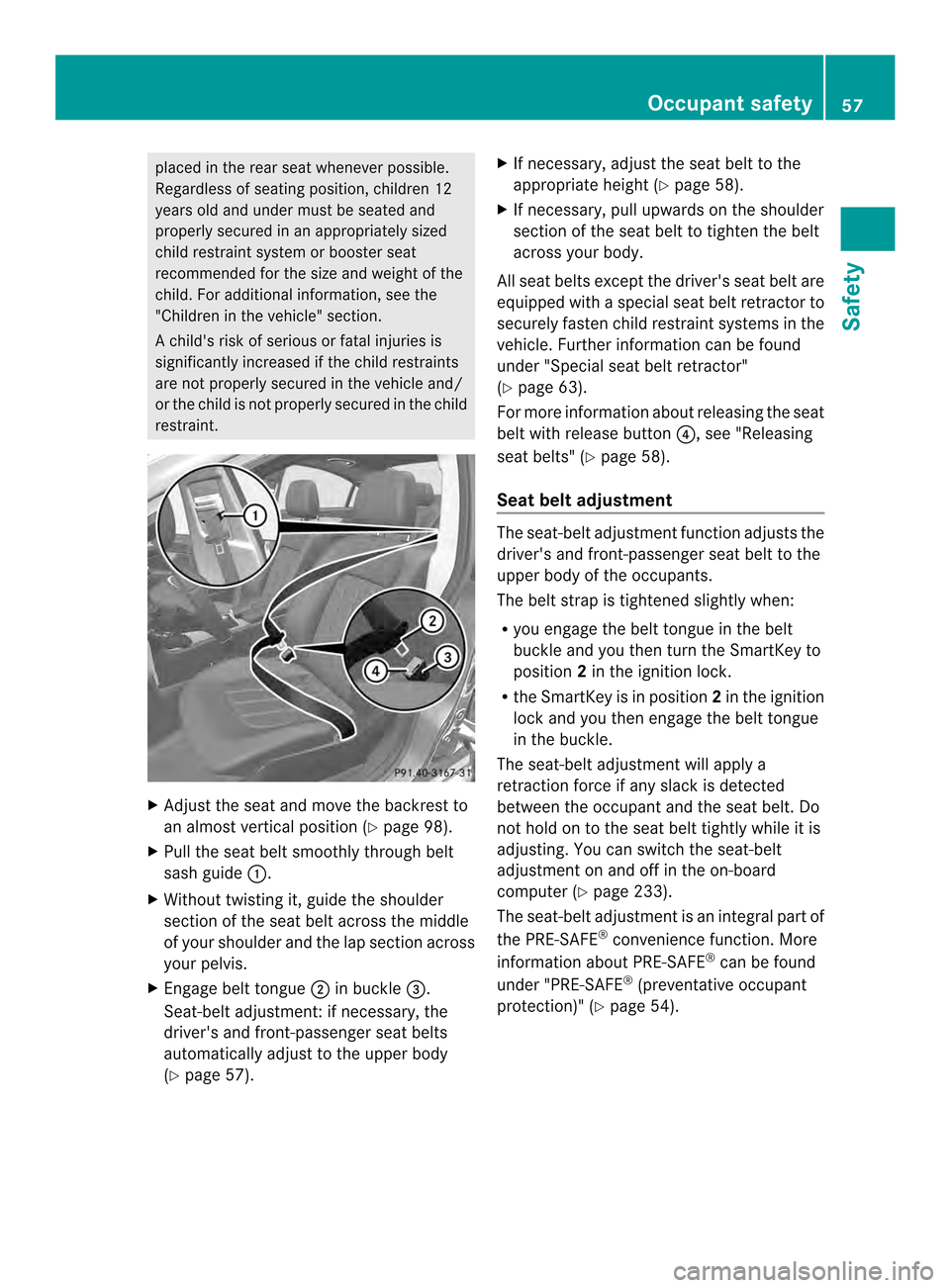
Adjust the seat and move the backrest to
an almost vertical position (Y page 98).
X Pull the seat belt smoothly through belt
sash guide 001A.
X Without twisting it, guide the shoulder
section of the seat belt across the middle
of your shoulder and the lap section across
your pelvis.
X Engage belt tongue 0010in buckle 0024.
Seat-belt adjustment:ifn ecessary, the
driver's and front-passenger seat belts
automatically adjust to the upper body
(Y page 57). X
If necessary, adjust the seat belt to the
appropriate height (Y page 58).
X If necessary, pull upwards on the shoulder
section of the seat belt to tighten the belt
across your body.
All seat belts except the driver's seat belt are
equipped with aspecial seat belt retractor to
securely fasten child restraint systems in the
vehicle. Further information can be found
under "Special seat belt retractor"
(Y page 63).
For more information about releasing the seat
belt with release button 0021,see "Releasing
seat belts" (Y page 58).
Seat belt adjustment The seat-belt adjustment function adjusts the
driver's and front-passenger seat belt to the
upper body of the occupants.
The belt strap is tightened slightly when:
R you engage the belt tongue in the belt
buckle and you then turn the SmartKey to
position 2in the ignition lock.
R the SmartKey is in position 2in the ignition
lock and you then engage the belt tongue
in the buckle.
The seat-belt adjustment will apply a
retraction forc eifany slack is detected
between the occupant and the seat belt. Do
not hold on to the seat belt tightly while it is
adjusting. You can switch the seat-belt
adjustment on and off in the on-board
computer (Y page 233).
The seat-belt adjustment is an integral part of
the PRE-SAFE ®
convenience function .More
information about PRE-SAFE ®
can be found
under "PRE-SAFE ®
(preventativ eoccupant
protection)" (Y page 54). Occupant safety
57Safety Z
Page 62 of 382
health hazard and does not indicate that there
is
af ire in the vehicle. The dust might cause
some temporary breathing difficulty for
people with asthma or other breathing
trouble. To avoid this, you may wish to get out
of the vehicle as soon as it is safe to do so.
You can also open the window to allow fresh
air to enter the vehicle interior. The 0012SRS
warning lamp lights up.
If the seat belt is also equipped with aseat
belt force limiter and this is triggered, the
force exerted by the seat belt on the vehicle
occupant is reduced.
The seat belt force limiters for the front seats
are synchronized with the front air bags,
which take on apart of the deceleration force.
This results in the force exerted on the
occupant being distributed over agreater
area. Children in the vehicle
Child restraint systems
Important safety notes G
WARNING
According to accident statistics, children are
safer when properly restrained in the rear
seating positions than in the front seating
position. Thus, we strongly recommendt hat
children be placed in the rear seats whenever
possible. Regardless of seating position,
children 12 years old and under must be
seated and properly secured in an appropriate
infant restraint,t oddler restraint,orb ooster
seat recommended for the size and weight of
the child.
The infant or child restraint must be properly
secured with the vehicle's seat belt, the seat
belt and top tether strap, or lower anchors and
top tether strap, fully in accordance with the
child seat manufacturer's instructions.
Occupants, especially children, should always
sit as upright as possible, wear the seat belt
properly and use an appropriately sized infant
restraint,t oddler restraint,orb ooster seat recommended for the size and weight of the
child.
Children can be killed or seriously injured by
an inflating air bag. Note the following
important information when circumstances
require you to place
achild in the front
passenger seat:
R Your vehicle is equipped with air bag
technology designed to deactivate the front
passenger front air bag in your vehicle
when the system senses the weight of a
typical 12-month-old child or less along
with the weight of astandard appropriate
child restraint on the front passenger seat.
R For children larger than the typical
12-month-old child, the front passenger
front air bag may or may not be activated.
Always make sure the 000F000Bindicator
lamp is illuminated, indicatin gthat the front
passenger front air bag is deactivated.
R Ac hild in arear-facing child restraint on the
front passenger seat will be seriously
injured or even killed if the front passenger
front air bag inflates in acollision which
could occur under some circumstances,
even with the air bag technology installed
in your vehicle. The only means to
completely eliminate this risk is to never
place achild in arear-facing child restraint
in the front seat. We therefore strongly
recommendt hat you always place achild
in ar ear-facing child restraint in abackseat.
R If you must install arear-facing child
restraint on the front passenger seat
because circumstances require you to do
so, make sure the 000F000Bindicator
lamp is illuminated, indicatin gthat the front
passenger front air bag is deactivated.
Should the 000F000Bindicator lamp not
illuminat eorgoo ut while the restraint is
installed, please chec kinstallation.
Periodically check the 000F000Bindicator
lamp while drivin gtomake sure the 000F
000B indicator lamp is illuminated. If the
000F000Bindicator lamp goes out or
remain sout, do not transport achild on the 60
Children in thev
ehicleSafety
Page 63 of 382
front passenger sea
tuntil the system has
been repaired.
Ac hild in arear-facing child restraint on the
front passenger seat will be seriously
injured or even killed if the front passenger
front air bag inflates.
R If you have to place achild in aforward-
facing child restraint on the front passenger
seat, move the seat as far back as possible,
use the proper child restraint
recommended for the age, size and weight
of the child, and secure child restraint with
the vehicle's seat belt according to the
child seat manufacturer's instructions. G
WARNING
If the child restraint system is installed
incorrectly on asuitable seat, it cannot
protect as intended. The child cannot then be
restrained in the event of an accident, heavy
braking or sudden changes of direction. There
is an increased risk of injury, possibly even
fatal.
Make sure that you observe the child restraint
system manufacturer's installation
instructions and the notes on use. Please
ensure, that the base of the child restraint
system is always resting completely on the
seat cushion. Never place objects, e.g.
cushions, under or behind the child restraint
system. Only use child restraint systems with
the original cover designed for them. Only
replace damaged covers with genuine covers. G
WARNING
If the child restraint system is installed
incorrectly or is not secured, it can come
loose in the event of an accident, heavy
braking or asudden change in direction. The
child restraint system could be thrown about,
strikingv ehicle occupants. There is an
increased risk of injury, possibly even fatal.
Always install child restraint systems
properly, even if they are not being used.
Make sure that you observe the child restraint system manufacturer's installation
instructions.
G
WARNING
Child restraint systems or their securing
systems which have been damaged or
subjected to aload in an accident can no
longer protect as intended. The child cannot
then be restrained in the event of an accident,
heavy braking or sudden changes of direction.
There is an increased risk of injury, possibly
even fatal.
Replace child restraint systems which have
been damaged or subjected to aload in an
accident as soon as possible. Have the
securing systems on the child restraint
system checked at aqualified specialist
workshop, before you install achild restraint
system again. G
WARNING
Infantsa nd small children should never share
as eat belt with another occupant. In the event
of an accident, they could be crushed
between the occupant and seat belt.
Ac hild's risk of serious or fatal injuries is
significantly increased if the child restraints
are not properly secured in the vehicle and/
or the child is not properly secured in the child
restraint.
Children that are too large for achild restraint
must travel in seats using normal seat belts.
Position the shoulder belt across the chest
and shoulder, not the face or neck.Ab ooster
seat may be necessary to achieve proper seat
belt positioning for children over 41 lbs
(18 kg )until they reach aheight where alap/
shoulder belt fit sproperly without abooster
seat.
When th echild restraint is no tinuse, remove
it from the vehicle or secure it with the seat
belt to prevent the child restraint from
becoming aprojectile in the event of an
accident. Children in the vehicle
61Safety Z
Page 64 of 382
G
WARNING
If children are left unsupervised in the vehicle,
they could:
R open the doors, thus endangering other
people or road users.
R get out and disrupt traffic.
R operate the vehicle's equipment.
Additionally, children coul dset the vehicl ein
motion if, for example, they:
R release the parking brake.
R shifting the automatic transmission out of
park position P
R Start the engine.
There is arisk of an accident and injury.
When leaving the vehicle, alwayst ake the
SmartKey with you and lock the vehicle. Never
leave children or animals unattended in the
vehicle. Always keep the SmartKey out of
reach of children. G
WARNING
If persons, particularl ychildren are subjected
to prolonged exposure to extreme heator
cold ,there is ariskofi njury ,possibl yeven
fatal. Never leave children unattende dinthe
vehicle. G
WARNING
If the child restraint system is subjected to
direct sunlight, parts may get very hot.
Children ma yburn themselves on these parts,
particularly on the metal parts of the child
restraint system. There is arisk of injury.
If you leave the vehicle, takin gthe child with
you, alway sensure that the child restraint
system is not exposed to direct sunlight.
Protec titwithablanket ,for example. If the
child restraint system has been exposed to
direct sunlight, let it cool down before
securing the child in it. Never leave children
unattended in the vehicle. If an infan
torchild is traveling in the vehicle:
R Secure the child with achild or infant seat
restraint system appropriate to the age and
weight of the child.
R Make sure that the infant or child is
properly secured at all times while the
vehicle is in motion.
Mercedes-Ben zrecommends that you always
properly secure all infants and children with
ac hild or infan tseat restraint system for the
trip.
The use of seat belts and infan tand child
restraint system sisrequired by la win:
R all50s tates
R the U.S. territories
R the District of Columbia
R allC anadia nprovinces
Infants and children must alwaysbes eated in
an appropriate infant or child restraint system
recommende dfor the size and weight of the
child .The infant or child restraint system
must be properly secured in accordance with
the manufacturer's instructions.
All infant or child restraint systems must meet
the following standards:
R U.S. Federal Motor Vehicle Safety
Standards 213 and 225
R CanadianM otor Vehicle Safety Standards
213 and 210.2
Confirmation that the child restraint system
corresponds to the standards can be found
on an instruction label on the child restraint
system. This confirmation can also be found
in the installation instructions that are
included with the child restraint system.
Always read and follow the manufacturer's
instructions when using an infant or child
restraint system or booster seat.
Observe the warning labels in the vehicle
interior or on the infant or child restraint. 62
Children in the vehicleSafety