engine MERCEDES-BENZ CLS-Class 2014 W218 User Guide
[x] Cancel search | Manufacturer: MERCEDES-BENZ, Model Year: 2014, Model line: CLS-Class, Model: MERCEDES-BENZ CLS-Class 2014 W218Pages: 382, PDF Size: 5.36 MB
Page 19 of 382
Stowag
enet ................................... 281
Unde rdriver' sseat/front-
passenger sea t.............................. 280
Stowage net ....................................... 281
Stowage space Center console (rear) .....................280
Stowage well beneath the trunk
floor .................................................... 283
Summer tires ..................................... 336
Sun visor ............................................ 286
Surround lighting (on-board
computer) .......................................... 231
Suspensio ntuning
AIRMATIC ...................................... 190
AMG adaptive sport suspension
system ........................................... 191
SETUP (on-board computer) ..........234
Switchin gair-recirculation mode
on/off ................................................. 141
Switchin goff the alarm (ATA) ............74 T
Tachometer ........................................ 219
Tail lamps Display message ............................ 246
Tank content
Fuel gauge ............................... 31, 219
Technical data
Capacities ...................................... 373
Emergency spare wheel .................370
Information .................................... 372
Tires/wheels ................................. 362
Vehicle data ................................... 379
TELEAID
Call priority .................................... 294
Downloading destinations
(COMAND) ..................................... 294
Downloading route s....................... 298
Emergency call .............................. 291
Geo fencing ................................... 298
Important safety notes ..................290
Locating astolen vehicl e............... 297
MB info call button ........................293
Remote vehicle locking ..................296
Roadside Assistance button ..........293
Search &Send ............................... 295
Self-test ......................................... 291Speed alert
.................................... 298
System .......................................... 291
Triggering the vehicle alarm ........... 299
Vehicle remote malfunction
diagnosi s....................................... 297
Vehicle remote unlocking ..............296
Telephone
Accepting acall............................. 226
Display message ............................ 262
Menu (on-board computer) ............226
Number from the phone book ....... .226
Redialing ........................................ 227
Rejecting/ending acall................. 226
Temperature
Coolant .......................................... 219
Coolant (on-board computer) ......... 234
Engine oil (on-board computer) ...... 234
Outside temperature ..................... .220
Setting (climate control) ................138
Theft deterren tsystems
ATA (Anti-Theft Alarm system) .........74
Immobilize r...................................... 73
Through-loading feature ...................281
Timing (RACETIMER) .........................235
Tire pressure Calling up (on-board computer) .....342
Checking manually ........................341
Display message ............................ 258
Maximum ....................................... 340
Notes ............................................. 339
Recommended ............................... 338
Tire pressure los swarning system
General notes ................................ 341
Important safety notes ..................341
Restarting ...................................... 342
Tire pressure monitoring system
Checking the tire pressure
electronically ................................. 344
Function/notes ............................. 342
Restarting ...................................... 345
Warning lamp ................................. 276
Warning message .......................... 344
Tires
Aspect ratio (definition) .................356
Averag eweight of the vehicle
occupants (definition) ....................355
Bar (definition) ............................... 354
Changing awheel .......................... 357 Index
17
Page 20 of 382
Characteristics
.............................. 354
Checking ........................................ 335
Definition of terms .........................354
Direction of rotatio n...................... 357
Display message ............................ 258
Distributio nofthe vehicle
occupants (definition) ....................357
DOT, Tire Identification Number
(TIN) .............................................. .354
DOT (Department of
Transportation) (definition) ............355
GAWR (Gross Axle Weight Rating)
(definition) ..................................... 355
GVW (Gross Vehicle Weight)
(definition) ..................................... 355
GVW R(Gross Vehicle Weight
Rating) (definition) .........................355
Important safety notes ..................334
Increase dvehicle weight due to
optional equipment (definition) ......355
Kilopascal (kPa )(definition) ...........355
Labeling (overview )........................ 351
Load bearing index (definition) ......356
Load index ..................................... 353
Load index (definition) ...................355
Maximum loaded vehicle weight
(definition) ..................................... 355
Maximum loa donatire
(definition) ..................................... 356
Maximum permissible tire
pressure (definition) ....................... 356
Maximum tire loa d......................... 353
Maximum tire loa d(definition) .......356
MOExtended tires ..........................336
Optional equipment weight
(definition) ..................................... 356
PSI (pounds per square inch)
(definition) ..................................... 356
Replacing ....................................... 357
Service life ..................................... 336
Sidewall (definition) .......................356
Speed rating (definition) ................355
Storing ........................................... 357
Structure and characteristics
(definition) ..................................... 354
Temperature .................................. 350
TIN (Tire Identification Number)
(definition) ..................................... 356Tire bea
d(definition) ...................... 356
Tire pressure (definition) ................356
Tire pressure s(recommended )...... 355
Tire size (data) ............................... 362
Tire size designation, load-bearing
capacity, spee drating .................... 351
Tire tread ....................................... 335
Tire tread (definition) .....................356
Total loa dlimit (definition) .............357
Traction ......................................... 350
Traction (definition) .......................356
Trea dwear ..................................... 350
Uniform Tire Quality Grading
Standard s...................................... 349
Uniform Tire Quality Grading
Standard s(definition) .................... 355
Unladen weight (definition) ............356
Wea rindicato r(definition) .............356
Whee lrim (definition ).................... 355
see Flat tire
Top Tether ............................................ 64
Towing Important safety guidelines ...........328
Installing the towing eye. ...............329
Removing the towing eye. ..............330
With the rear axle raised ................330
Towing away
With both axle sonthe ground .......330
Tow-starting
Emergency engine starting ............331
Important safety notes ..................328
Transmission
see Automatic transmission
Transmission position display .........156
Transmission position display
(DIRECT SELECTl ever)...................... 156
Transporting the vehicle ..................330
Trim pieces (cleaning instructions) .316
Trip computer (on-board
computer) .......................................... 222
Trip odometer Calling up ....................................... 222
Resetting (on-board computer) ......223
Trunk
Emergency release ..........................87
Important safety notes ....................84
Opening/closing (automatically
from inside) ...................................... 86 18
Index
Page 21 of 382
Opening/closing (automatically
from outside)
................................... 86
Opening/closing (manually from
outside) ............................................ 85
Trunk lid
Display message ............................ 261
Opening/closing .............................. 84
Opening dimensions ......................379
Trunk load (maximum) ......................379
Turn signals Display message ............................ 245
Switching on/off ........................... 119
Type identification plate
see Vehicle identification plate U
Unlocking Emergency unlocking .......................84
From insid ethe vehicle (central
unlocking button) ............................. 83 V
Vanity mirror (in the sun visor) ........286
Vehicle Data acquisition ............................... 27
Display message ............................ 260
Equipment ....................................... 22
Individua lsettings .......................... 229
Limited Warranty ............................. 26
Loading .......................................... 345
Locking (in an emergency) ...............84
Locking (SmartKey) .......................... 76
Lowering ........................................ 361
Maintenance .................................... 23
Parking for along period ................ 169
Pulling away ................................... 150
Raising ........................................... 359
Reporting problems .........................26
Securing from rolling away ............358
Towing away .................................. 328
Transporting .................................. 330
Unlocking (in an emergency) ...........84
Unlocking (SmartKey) ......................76
Vehicle data ................................... 379
Vehicle data ....................................... 379
Vehicle dimensions ...........................379Vehicle emergency locking
................84
Vehicle identification number see VIN
Vehicle identification plate ..............372
Vehicle level AIRMATIC ...................................... 189
Vehicle level (display message) .......252
Vehicle tool kit .................................. 320
Video Operating the DVD ......................... 226
VIN ...................................................... 372 W
Warning and indicator lamps ABS ................................................ 267
Brakes ........................................... 266
Check Engine ................................. 273
Coolant .......................................... 273
Distance warning ........................... 275
DISTRONI CPLUS ........................... 275
ESP ®
.............................................. 269
ESP ®
OFF ....................................... 270
Fuel tank ........................................ 273
Overview .................................. 32, 264
PASSENGER AIR BAG OFF ...............47
Reserve fuel ................................... 273
Seat bel t........................................ 265
SPORT handling mode ...................270
SRS ................................................ 272
Tire pressure monitor ....................276
Warranty ............................................ 372
Washer fluid Display message ............................ 262
Whee lboltt ightening torque ...........361
Whee lchock ...................................... 358
Wheels Changing awheel .......................... 357
Checking ........................................ 335
Cleaning ......................................... 314
Cleaning (warning) .........................357
Emergency spare wheel .................367
Important safety notes ..................334
Interchanging/changing ................357
Mounting anew wheel ................... 360
Mounting awheel .......................... 358
Removing awheel .......................... 360
Storing ........................................... 357 Index
19
Page 23 of 382
Protection of the environment
General notes
H
Environmental note
Daimler's declared policy is one of
comprehensive environmental protection.
The objectives are for the natural resources
that form the basis of our existence on this
planet to be used sparingly and in amanner
that takes the requirements of both nature
and humanity into account.
You too can help to protect the environment
by operating your vehicle in an
environmentally responsible manner.
Fuel consumption and the rate of engine,
transmission, brake and tire wear are affected
by these factors:
R operating condition sofyour vehicle
R your personal driving style
You can influence both factors. You should
bear the following in mind:
Operating conditions:
R avoid short trips as these increase fuel
consumption.
R always make sure that the tire pressures
are correct.
R do not carry any unnecessary weight.
R remove roof racks once you no longer need
them.
R ar egularly serviced vehicle will contribute
to environmental protection. You should
therefore adhere to the service intervals.
R always have service work carried out at a
qualified specialist workshop.
Personal driving style:
R do not depress the accelerator pedal when
startingt he engine.
R do not warm up the engine when the vehicle
is stationary.
R drive carefully and maintain asafe distance
from the vehicle in front.
R avoid frequent, sudden acceleration and
braking. R
change gear in good time and use each gear
only up to 001Bof its maximum engine speed.
R switch off the engine in stationary traffic.
R keep an eye on the vehicle's fuel
consumption. Environmental concerns and
recommendations
Wherever the operating instructions require
you to dispose of materials, first try to
regenerate or re-use them. Observe the
relevant environmental rules and regulations
when disposing of materials. In this way you
will help to protect the environment. Product information
Mercedes-Benz recommends that you use
genuine Mercedes-Benz parts, conversion
parts and accessories that have been
approved for your vehicle.
Mercedes-Benz tests genuine parts as well as
conversion parts and accessories that have
been specifically approved for your vehicle for
their reliability, safety and suitability. Despite
ongoing market research, Mercedes-Benz is
unable to assess other parts. Therefore,
Mercedes-Benz accepts no responsibility for
the use of such parts in Mercedes-Benz
vehicles. This is also the case, even if they
have been independently or officially
approved. The use of non-approved parts
could affect your vehicle's operating safety.
Genuine Mercedes-Benz parts, approved
conversion parts and accessories are
available from any authorized Mercedes-Benz
Center. Here, you will receive advice about
permissible technical modifications, and the
parts will be professionally installed. Introduction
21 Z
Page 24 of 382
Genuine Mercedes-Benz parts
H
Environmental note
Daimle rAGalso supplie sreconditioned major
assemblies and part swhicha re of th esame
qualit yasn ew parts. They are covered by the
same Limite dWarrant yentitlements as new
parts.
! Air bags and Emergenc yTensioning
Devices, as well as control unit sand
sensor sfor these restraint systems ,may be
installe dinthefollowin gareas of your
vehicle:
R doors
R door pillars
R door sills
R seats
R cockpit
R instrumen tcluster
R cente rconsole
Do no tinstall accessorie ssuchasa udio
system sintheseareas. Do not carry out
repairs or welding .You could impair the
operating efficienc yofthe restraint
systems.
Have aftermarket accessories installed at
aq ualified specialist workshop.
You could jeopardize the operating safety of
your vehicle if you use parts, tires and wheels
as well as accessories relevant to safety
which have not been approved by Mercedes.
This could lead to malfunctions in safety-
relevant systems, e.g. the brake system. Use
only genuine Mercedes-Benz parts or parts of
equal quality. Only use tires, wheels and
accessories that have been specifically
approved for your vehicle.
Genuine Mercedes-Benz parts are subject to
strictq ualitycontrol. Every part ha sbeen
specifically developed ,manufactured or
selected for and adapted to Mercedes-Benz
vehicles. Only genuine Mercedes-Benz parts
should therefore be used. More than 300,000 different genuine
Mercedes-Benz parts are available for
Mercedes-Benz models.
All authorized Mercedes-Benz Centers
maintai
nasupply of genuine Mercedes-Benz
parts for necessary service and repair work.
In addition, strategically located parts
delivery centers provide quick and reliable
parts service.
Alwayss pecify the vehicle identification
number (VIN) (Y page 372) and the engine
number (Y page 373) when ordering genuine
Mercedes-Benz parts. Operator's Manual
Vehicle equipment
This Operator's Manual describes all models
and all standard and optional equipment of
your vehicle available at the time of going to
print. Country-specific differences are
possible.B ear in mind that your vehicle may
not feature all function sdescribed here. This
also applies to safety-relevant systems and
functions. The equipment in your vehicle may
therefore differ from that shown in the
descriptions and illustrations.
The original purchase agreement lists all
systems installed in your vehicle.
Should you have any questions concerning
equipment and operation ,please consult an
authorized Mercedes-BenzC enter.
The Operator's Manual and Maintenance
Booklet are important documents and should
be kept in the vehicle. 22
Introduction
Page 26 of 382
Change of address or change of
ownership
In th eevent of achang eofa ddress, please
sen dust he"Notificatio nofAddress Change"
in the Service and Guarantee booklet or
simply call the Mercedes-Benz Customer
Assistance Cente r(USA )att he hotline
number
1-800-FOR-MERCedes(1-800-367-6372 )or
Customer Servic eCenter (Canada) at
1-800-387-0100 .This will assist us in
contacting you in atimely manner should the
need arise.
If you sell your Mercedes, please leave the
entirel iterature in the vehicle so that it is
available to the next owner.
If you have purchased aused car, please send
us the "Notification of Used Car Purchase" in
the Servic eand Guarantee booklet or simply
call the Mercedes-Benz Customer Assistance
Center (USA) at the hotline number
1-800-FOR-MERCedes(1-800-367-6372)or
Customer Servic e(Canada) at
1-800-387-0100. Vehicle operation outside the USA
and Canada
If you plan to operate your vehicle in foreign
countries, please be aware that:
R service facilities or replacement parts may
not be readily available.
R unleaded fuel for vehicles with acatalytic
converter may not be available. Leaded fuel
may cause damage to the catalytic
converter.
R the fuel may have aconsiderably lower
octaner ating. Unsuitable fuel can cause
engine damage.
Some Mercedes-Benz models are available
for delivery in Europe through our European
Delivery Program. For details, consult an
authorized Mercedes-Benz Center or write to
one of the following addresses.
In the USA Mercedes-Benz USA,L
LC
European Delivery Department
One Mercedes Drive
Montvale, NJ 07645-0350
In Canada
Mercedes-Benz Canada, Inc.
European Delivery Department
98 Vanderhoof Avenue
Toronto, Ontario M4G 4C9 Operating safety
Important safety notes
G
WARNING
If you do not have the prescribed service/
maintenance work or any required repairs
carried out, this can result in malfunctions or
system failures. There is arisk of an accident.
Always have the prescribed service/
maintenance work as well as any required
repairs carried out at aqualified specialist
workshop. G
WARNING
If you switch off the ignition while driving,
safety-relevant functions are only available
with limitations, or not at all. This could affect,
for example, the power steering and the brake
boosting effect .You will require considerably
more effort to steer and brake. There is arisk
of an accident.
Do not switch off the ignition while driving. G
WARNING
Modifications to electronic components, their
software as well as wiring can impair their
function and/or the function of other
networked components. In particular,
systems relevant to safety could also be
affected. As aresult, these may no longer
function as intended and/or jeopardize the
operating safety of the vehicle. There is an
increased risk of an accident and injury. 24
Introduction
Page 34 of 382
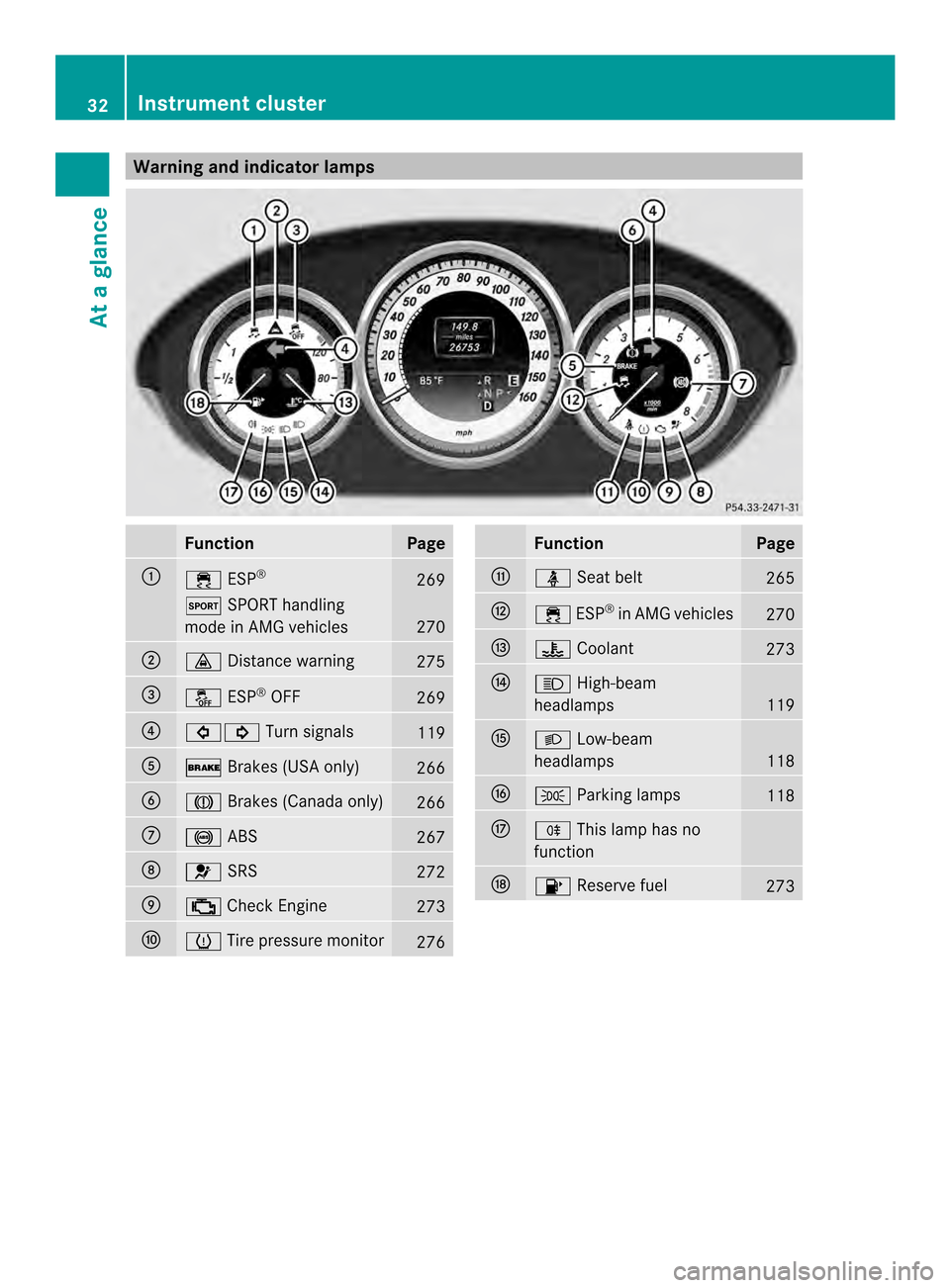
Warning and indicator lamps
Function Page
001A
0011
ESP® 269
0005
SPORT handling
mode in AMG vehicles 270
0010
0008
Distance warning 275
0024
0009
ESP®
OFF 269
0021
00020001
Turn signals 119
001E
0004
Brakes (USA only) 266
0025
0001
Brakes (Canada only) 266
0009
001C
ABS 267
0016
0012
SRS 272
001D
000A
Check Engine 273
000F
0008
Tire pressure monitor 276 Function Page
0004
0006
Seat belt 265
000B
0011
ESP®
in AMG vehicles 270
001C
0017
Coolant 273
000E
0015
High-beam
headlamps 119
0012
001D
Low-beam
headlamps 118
0013
0008
Parking lamps 118
0017
0005
This lamp has no
function 0020
0007
Reserve fuel 27332
Instrument clusterAt
ag lance
Page 43 of 382
i
For information on infants and children
traveling with yo uinthe vehicle as well as
restraint systems for infants and children,
see "Childre ninthe vehicle"
(Y page 60). SRS (Supplemental Restraint System)
Introduction RS consistso
f:
R The 0012 RS warning lamp
R Air bags
R The air bag control unit with crash sensors
R Emergency Tensioning Device for the front
seat belts and the outer seat belts in the
rear
R Seat belt force limiters for the front seat
belts and the outer seat belts in the rear
RS reduces the risk of occupants coming into
contact with the vehicle's interior in the event
of an accident. It can also reduce the effect
of the forces to which occupants are
subjected during an accident.
SRS warning lamp G
WARNING
If SRS is malfunctioning, child restraint
system components may be triggered
unintentionally or might not be triggered at all
in the event of an accident with ahigh rate of
vehicle deceleration. There is an increased
risk of injury, possibly even fatal.
Have SRS checked and repaired immediately
at aq ualified specialist workshop.
SRS functions are checked regularly when
you switch on the ignition and when the
engine is running. Therefore, malfunctions
can be detected in good time.
The 0012 SRS warning lamp in the instrument
cluster lights up when the ignition is switched
on. It goes out no later than afew seconds
after the engine is started. The SRS components are in operational
readiness when the
0012SRS indicator lamp
goes out while the engine is running.
There is amalfunction if:
R the 0012 SRS warning lamp does not light
up when the ignition is switched on
R the engine is running and the 0012SRS
warning lamp does not go out after afew
seconds
R the engine is running and the 0012SRS
warning lamp lights up again.
Safety guidelines for seat belts,
Emergency Tensioning Devices (ETDs)
and air bags G
WARNING
R Damaged seat belts or seat belts that have
been subjected to stress in an accident
must be replaced. Their anchoring points
must also be checked. Only use seat belts
installed or supplied by an authorized
Mercedes-Ben zCenter.
R Air bags and pyrotechnic Emergency
Tensioning Devices (ETDs) contain
perchlorate material, which may require
special handling and regard for the
environment. Check your national disposal
guidelines. California residents, see
www.dtsc.ca.gov/HazardousWaste/
Perchlorate/index.cfm.
R Air bags and ETDs are designed to function
on aone-time-only basis. An air bag or ETD
that has deployed must be replaced. PRE-
SAFE ®
has electrically operated reversible
belt tensionersina ddition to the
pyrotechnic ETDs.
R Do not pass seat belts over sharp edges.
They could tear.
R Do not make any modification that could
change the effectiveness of the seat belts.
R Do not bleach or dye seat belts as this may
severely weaken them. In acrash they may
not be able to provide adequate protection. Occupant safety
41Safety
Z
Page 50 of 382
or if the front-passenger seat is classified as
being empty.
When the OCS senses that the front-
passenger seat occupant is classified as
being up to or less than the weight of atypical
12-month-old child in astandard child
restraint ,the 000F000B indicator lamp will
illuminate when the engine is started and
remain illuminated, indicating that the front-
passenger front air bag is deactivated.
When the OCS senses that the front-
passenger seat is classified as being empty,
the 000F000B indicator lamp will illuminate
when the engine is started and remain
illuminated, indicating that the front-
passenger front air bag is deactivated.
When the OCS senses that the front-
passenger seat occupant is classified as
being heavier than the weight of atypical 12-
month-old child seated in astandar dchild
restraint or as being asmall individual (such
as ayoung teenager or asmall adult), the
000F000B indicator lamp willi lluminate for
approximatel y6seconds when the engine is
started and then ,depending on occupant
weight sensor readings from the front-
passenger seat, remain illuminated or go out.
With the 000F000B indicator lamp
illuminated, the front-passenger fron tair bag
is deactivated. With the 000F000Bindicator
lamp out, the front-passenge rfront air bag is
activated.
When the OCS senses that the front-
passenger seat occupant is classifie dasan
adult or someone larger than asmall
individual, the 000F000Bindicator lamp will
illuminate for approximatel y6seconds when
the engine is started and then go out,
indicating that the front-passenger fron tair
bag is activated.
If the 000F000B indicator lamp is illuminated,
the front-passenger fron tair bag and the
front-passenger knee bag are deactivated and
will not be deployed. If the
000F000B indicator lamp is not
illuminated, the front-passenger fron tair bag
and the front-passenge rknee ba gare
activate dand will be deployed:
R in the event of certain fronta limpacts
R if impact exceed sapreset deployment
threshold
R independentl yofthe side impact ai rbag or
pelvis air bag
If th efront-pa ssenger fron tair bag is
deployed, th erateofi nflation will be
influenced by:
R ther ateofr elevan tvehicle deceleration as
assessed by the air bag control unit
R the fron tpassenger's weigh tcategor yas
identified by OCS G
WARNING
Accordin gtoacciden tstatistics, childre nare
safe rwhen properly restrained on the rear
seats than on the front-passenger seat. Thus,
we strongly recommendt hat children be
placed in the rear seats whenever possible.
Regardless of seating position, children 12
years old and under must be seated and
properly secured in an appropriate infant
restraint,t oddler restraint,orb ooster seat
recommended for the size and weight of the
child.
The infant or child restraint must be properly
secured with the vehicle's seat belt, the seat
belt and Top Tether strap, or lower LATCH-
type (ISOFIX) child seat retaining loops and
Top Tether strap, fully in accordance with the
infant or child seat manufacturer's
instructions.
Occupants, especially children, should always
sit as upright as possible, wear the seat belt
properly and use an appropriately sized infant
restraint,t oddler restraint,orb ooster seat
recommended for the size and weight of the
child.
Children can be killed or seriously injured by
an inflating air bag. 48
Occupant safetySafety
Page 60 of 382

Bel
theight adjustment Yo
uc an adjus tthe seat belt height on the
front seats. Adjust the belt to aheight that
allowst he upper part of the seat belt to be
routed across the center of your shoulder.
X To raise: slide the belt sash guide upwards.
The belt sash guide engages in various
positions.
X To lower: press and hold belt sash guide
release 001A.
X Slide the belt sash guide downwards.
X Release belt sash guide release 001Aand
make sure that the belt sash guide has
engaged.
Releasing seat belts !
Make sure that the seat belt is fully rolled
up. Otherwise, the seat belt or belt tongue
will be trapped in the door or in the seat
mechanism. This could damage the door,
the door trim panel and the seat belt.
Damaged seat belts can no longer fulfill
their protective function and must be
replaced. Visit aqualified specialist
workshop. X
Press release button 0021on belt buckle 0024.
X Guideb elt tongue 0010to belt sash
guide 001A.
Belt warning for the driver and front
passenger Regardless of whether the driver's and front-
passenger seat belts have already been
fastened, the
0013seat belt warning lamp
lights up for six seconds each time the engine
is started. It then goes out if the driver and
the front passenger have already fastened
their seat belts.
If the driver's seat belt is not fastened when
the engine is started, an additional warning
tone will sound. This warning tone stops after
am aximum of six seconds or once the
driver's seat belt is fastened.
If after six seconds, the driver or front
passenger have not fastened their seat belts
and the doors are closed:
R the 0013 seat belt warning lamp remains lit
as long as the driver's or front-passenger's
seat belt is not fastened
and
R ifav ehicle speed of 15 mph (25 km/h) is
exceeded, the 0013seat belt warning lamp
begins to flash. Awarning tone also sounds
wit hincreasing intensit yfor am aximum of 58
Occupant safetySafety