front light MERCEDES-BENZ CLS-Class 2014 W218 User Guide
[x] Cancel search | Manufacturer: MERCEDES-BENZ, Model Year: 2014, Model line: CLS-Class, Model: MERCEDES-BENZ CLS-Class 2014 W218Pages: 382, PDF Size: 5.36 MB
Page 54 of 382
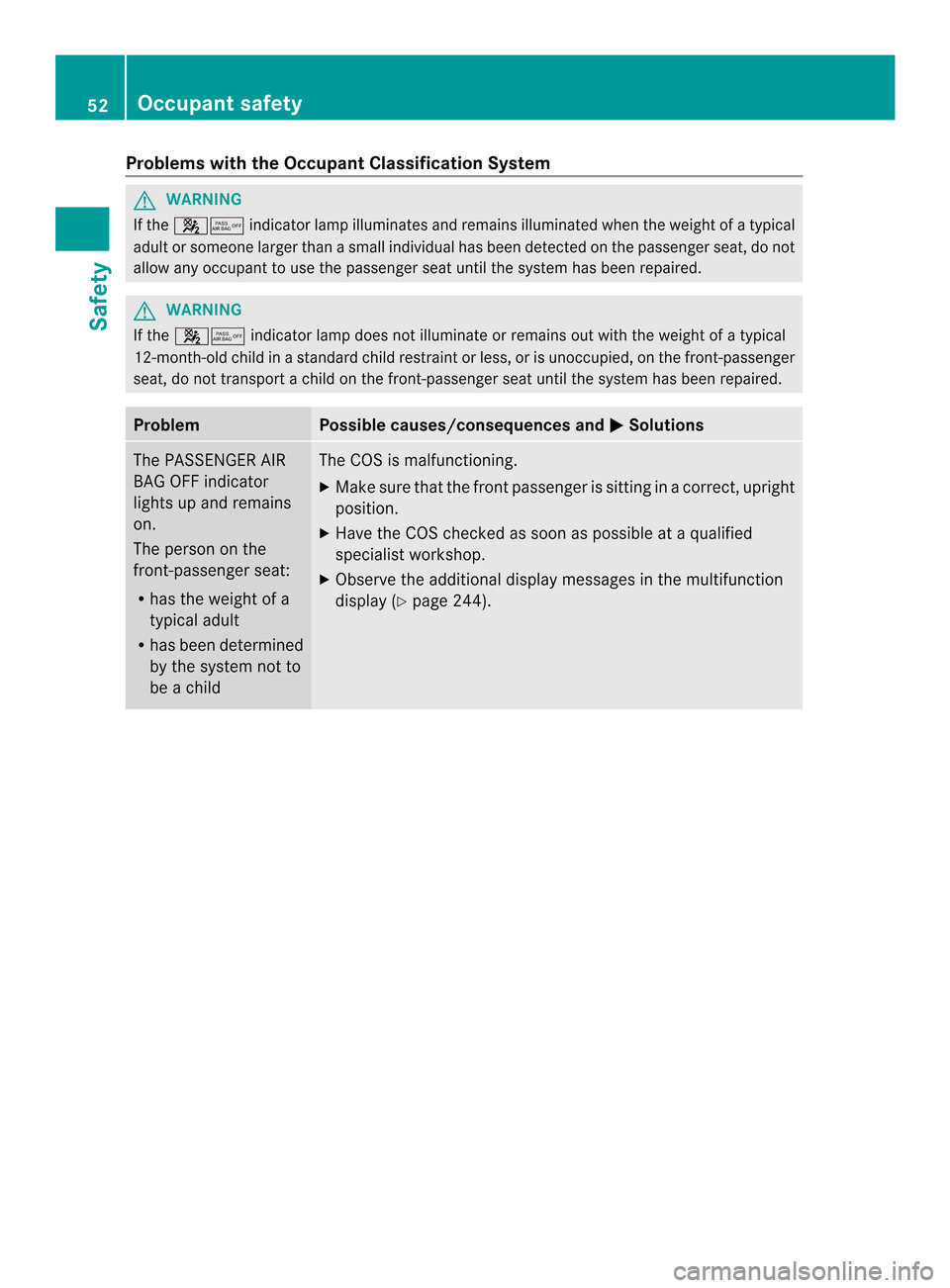
Problems with the Occupant Classification System
G
WARNING
If the 000F000B indicator lamp illuminates and remains illuminated when the weight of atypical
adult or someone larger than asmall individual has been detected on the passenger seat, do not
allow any occupant to use the passenger seat until the system has been repaired. G
WARNING
If the 000F000B indicator lamp does not illuminate or remains out with the weight of atypical
12-month-old child in astandard child restraint or less, or is unoccupied, on the front-passenger
seat, do not transport achild on the front-passenger seat until the system has been repaired. Problem Possiblec
auses/consequencesa nd000B Solutions
The PASSENGER AIR
BAG OFF indicator
lights up and remains
on.
The person on the
front-passenger seat:
R
has the weight of a
typical adult
R has been determined
by the system not to
be achild The COS is malfunctioning.
X
Make sure that the front passenger is sitting in acorrect ,upright
position.
X Have the COS checked as soon as possible at aqualified
specialist workshop.
X Observe the additional displaym essages in the multifunction
display( Ypage 244). 52
Occupant safetySafety
Page 55 of 382
Problem Possible causes/consequences and
000B Solutions
The PASSENGER AIR
BAG OFF indicator
lamp does not light up
and/or does not stay
on.
The front-passenger
seat is:
R
unoccupied
R occupied with the
weight of achild up
to twelve months old
in ac hild restraint
system The COS is malfunctioning.
X
Make sure there is nothingb etween the seat cushion and the
child seat.
X Make sure that the backrest and base of the child restraint
system rest on the front-passenger seat. If necessary, adjust
the position of the front-passenger seat.
X When installing the child restraint system, make sure that the
seat belt is tight. Do not pull the seat belt tight with the front-
passenger seat adjustment .This could result in the seat belt
being pulledt oo tightly.
X Check the installation of the child restraint system.
X Make sure that no objectsa re applying additionalweight onto
the seat.
X If the PASSENGER AIR BAG OFF indicator lamp remains off, have
the COS checked immediatel yataqualified specialist
workshop. Do not transport achild on the front-passenger seat
until the COS has been repaired.
X Observ ethe additional display messages in the multifunction
display ( Ypage 244). NECK-PRO head restraints/NECK-
PRO luxur
yhead restraints
Importan tsafet ynotes G
WARNING
The function of the head restraint may be
impaired if you:
R attach objects such as coat hangers to the
head restraints, for example
R use head restraint covers
If you do so, the head restraint scannot fulfill
their intended protective function in the event
of an accident. In addition, objects attached
to the head restraint scould endanger other
vehicle occupants. There is an increased risk
of injury.
Do not attach any objects to the head
restraint sand do not use head restraint
covers.
NECK-PRO head restraints/NECK-PRO luxury
head restraint sincrease protection of the driver'
sand front-passenger's head and
neck. In the event of arear collision of a
certain severity, the NECK-PRO head
restraints/NECK-PRO luxury head restraints
on the driver' sand the front-passenger seats
are moved forwards and upwards. This
provides better head support.
If the NECK-PRO head restraints/NECK-PRO
luxury head restraint shave been triggered in
an accident, reset the NECK-PRO head
restraints/NECK-PRO luxury head restraints
on the driver' sand front-passenger seats
(Y page 54). Otherwise, the additional
protection will not be available in the event of
another rear-end collision. NECK-PRO head
restraints/NECK-PRO luxury head restraints
that have been triggered are moved forwards
and can no longer be adjusted.
Mercedes-Benz recommends that you have
the NECK-PRO head restraints/NECK-PRO
luxury head restraint schecked at aqualified
specialist workshop after arear-end collision. Occupant safety
53Safety Z
Page 57 of 382
R
if, on vehicles with DISTRONIC PLUS ,the
radar sensor system detect sanimminent
dange rofcollision in certain situations.
R in critical driving situations, e.g. when
physical limits are exceeded and the
vehicle understeers or oversteers severely.
PRE-SAFE ®
takes the following measures
depending on the hazardous situation
detected:
R the front seat belts are pre-tensioned.
R the front-passenger seat is adjusted if it is
in an unfavorable position.
R vehicles with amulticontour seat or active
multicontour seat: the air pressure in the
side bolsters of the seat cushion and
backrest is increased.
R if the vehicle skids, the sliding sunroof and
the side windows are closed so that only a
small gap remains.
If the hazardous situation passes without
resulting in an accident ,PRE-SAFE ®
slackens
the belt pre-tensioning. The air pressure in
the side bolsters on the multicontour seat/
active multicontour seat is reduced again. All
settings made by PRE-SAFE ®
can then be
reversed.
If the seat belts are not released:
X When the vehicle is stationary, move the
backrest or seat back slightly.
The seat belt pre-tensionin gisreduced and
the lockin gmechanism is released.
Information about seat belt adjustment, a
convenienc efunction integrated into PRE-
SAFE ®
,c an be found in the "Seat belt
adjustment" section (Y page 57).Seat belts
Important safety notes G
WARNING
The seat belt does not offer the intended level
of protection if the backrest is not in the
upright position. When braking or in the event of an accident
,you could slide underneath the
seat belt and sustain abdomen or neck
injuries, for example. This poses an increased
risk of injury or even fatal injury.
Adjust the seat properly before beginning
your journey. Always make sure that the seat
is in the upright position. G
WARNING
Seat belts cannot protect as intended, if:
R they are damaged, extremely dirty,
bleached or dyed
R the seat belt buckle is damaged or
extremely dirty
R the Emergency Tensionin gDevices or the
belt anchorage has been modified.
Damage caused to seat belts in an accident
may not be visible, e.g. by splinters of glass.
Modified or damaged seat belts can tear or
fail, for example in the event of an accident.
Modified Emergency Tensionin gDevices may
be deployed unintentionally or fail to be
deployed when required. There is an
increased risk of injury, possibly even fatal.
Never modify seat belts, Emergency
Tensionin gDevices, seat belt anchorages and
inertia reels. Ensure that seat belts are not
damaged or worn and are clean.
Only use seat belts that have been approved
for your vehicle by Mercedes-Benz.
The use of seat belts and infant and child
restraint systems is required by law in:
R all 50 states
R the U.S. territories
R the District of Columbia
R all Canadia nprovinces
Even where this is not required by law,a ll
vehicl eoccupants should correctly fasten
their seat belts before starting the journey.
i See "Children in the vehicle"
(Y page6 0) for further information on
infants and children traveling in the vehicle
as wellasonc hild restraint systems. Occupant safety
55Safety Z
Page 59 of 382
placed in the rear seat whenever possible.
Regardless of seatin
gposition ,children 12
years old and under must be seated and
properly secured in an appropriately sized
child restraint system or booster seat
recommended for the size and weight of the
child. For additional information ,see the
"Children in the vehicle" section.
Ac hild's risk of serious or fatal injuries is
significantly increased if the child restraints
are not properly secured in the vehicle and/
or the child is not properly secured in the child
restraint. X
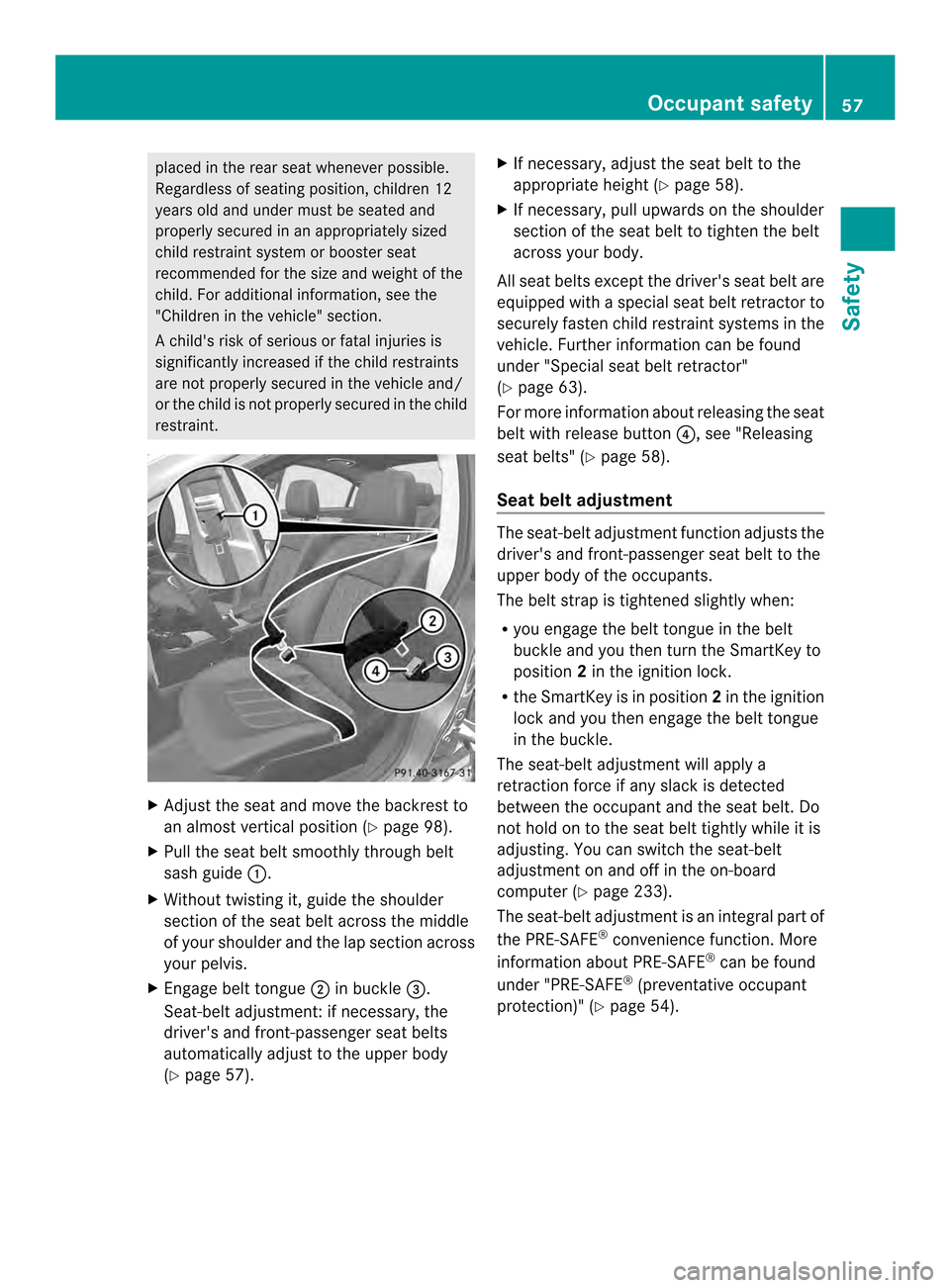
Adjust the seat and move the backrest to
an almost vertical position (Y page 98).
X Pull the seat belt smoothly through belt
sash guide 001A.
X Without twisting it, guide the shoulder
section of the seat belt across the middle
of your shoulder and the lap section across
your pelvis.
X Engage belt tongue 0010in buckle 0024.
Seat-belt adjustment:ifn ecessary, the
driver's and front-passenger seat belts
automatically adjust to the upper body
(Y page 57). X
If necessary, adjust the seat belt to the
appropriate height (Y page 58).
X If necessary, pull upwards on the shoulder
section of the seat belt to tighten the belt
across your body.
All seat belts except the driver's seat belt are
equipped with aspecial seat belt retractor to
securely fasten child restraint systems in the
vehicle. Further information can be found
under "Special seat belt retractor"
(Y page 63).
For more information about releasing the seat
belt with release button 0021,see "Releasing
seat belts" (Y page 58).
Seat belt adjustment The seat-belt adjustment function adjusts the
driver's and front-passenger seat belt to the
upper body of the occupants.
The belt strap is tightened slightly when:
R you engage the belt tongue in the belt
buckle and you then turn the SmartKey to
position 2in the ignition lock.
R the SmartKey is in position 2in the ignition
lock and you then engage the belt tongue
in the buckle.
The seat-belt adjustment will apply a
retraction forc eifany slack is detected
between the occupant and the seat belt. Do
not hold on to the seat belt tightly while it is
adjusting. You can switch the seat-belt
adjustment on and off in the on-board
computer (Y page 233).
The seat-belt adjustment is an integral part of
the PRE-SAFE ®
convenience function .More
information about PRE-SAFE ®
can be found
under "PRE-SAFE ®
(preventativ eoccupant
protection)" (Y page 54). Occupant safety
57Safety Z
Page 60 of 382

Bel
theight adjustment Yo
uc an adjus tthe seat belt height on the
front seats. Adjust the belt to aheight that
allowst he upper part of the seat belt to be
routed across the center of your shoulder.
X To raise: slide the belt sash guide upwards.
The belt sash guide engages in various
positions.
X To lower: press and hold belt sash guide
release 001A.
X Slide the belt sash guide downwards.
X Release belt sash guide release 001Aand
make sure that the belt sash guide has
engaged.
Releasing seat belts !
Make sure that the seat belt is fully rolled
up. Otherwise, the seat belt or belt tongue
will be trapped in the door or in the seat
mechanism. This could damage the door,
the door trim panel and the seat belt.
Damaged seat belts can no longer fulfill
their protective function and must be
replaced. Visit aqualified specialist
workshop. X
Press release button 0021on belt buckle 0024.
X Guideb elt tongue 0010to belt sash
guide 001A.
Belt warning for the driver and front
passenger Regardless of whether the driver's and front-
passenger seat belts have already been
fastened, the
0013seat belt warning lamp
lights up for six seconds each time the engine
is started. It then goes out if the driver and
the front passenger have already fastened
their seat belts.
If the driver's seat belt is not fastened when
the engine is started, an additional warning
tone will sound. This warning tone stops after
am aximum of six seconds or once the
driver's seat belt is fastened.
If after six seconds, the driver or front
passenger have not fastened their seat belts
and the doors are closed:
R the 0013 seat belt warning lamp remains lit
as long as the driver's or front-passenger's
seat belt is not fastened
and
R ifav ehicle speed of 15 mph (25 km/h) is
exceeded, the 0013seat belt warning lamp
begins to flash. Awarning tone also sounds
wit hincreasing intensit yfor am aximum of 58
Occupant safetySafety
Page 61 of 382
60 seconds or until the drive
rorfront
passenger have fastene dtheir sea tbelts.
If the driver/fron tpassenger unfasten their
seat belt while the vehicle is in motion ,the
0013 seat belt warning lamp lights up and a
warning tones ounds again.
The warning tonec eases even if the driver or
front-passenger seat belt has still not been
fastened after 60 seconds. The 0013seat belt
warning lamp stops flashing but remains
illuminated.
After the vehicle comes to astandstill, the
warning toneisr eactivated and the seat belt
warning lamp 0013flashes again if the vehicle
speed again exceeds 15 mph (25 km/h).
The 0013 seat belt warning lamp only goes
out if:
R both the driver and the fron tpassenger
have fastened their seat belts.
or
R thev ehicle is stationar yand adoor is open.
i For mor einformatio nonthe0013 seat
belt warning lamp, see "Warning and
indicator lamps in th einstrumen tcluster,
seat belts" ( Ypage 265).
Emergency Tensionin gDevices, seat
belt force limiters G
WARNING
Pyrotechnic Emergency Tensioning Devices
that have been deployed are no longer
operational and are unable to perfor mtheir
intended protective function. This poses an
increased risk of injury or even fatal injury.
Therefore, have pyrotechnic Emergency
Tensioning Devices which have been
triggered immediately replaced at aqualified
specialist workshop.
! If the front-passenger seat is not
occupied, do not engage the seat belt
tongue in the buckle on the front-
passenger seat. Otherwise, the Emergency Tensioning Device could be triggered in the
event of an accident.
i Vehicles with PRE-SAFE ®
:E mergency
Tensioning Devices that are triggered by an
electric motor can be deployed as often as
desired and do not need to be replaced.
The front seat belts and the outer seat belts
in the rear are equipped with Emergency
Tensioning Devices and seat belt force
limiters.
The ETDs tighten the seat belts in an accident,
pulling them close against the body.
The ETDs do not correct incorrects eat
positions or incorrectly fastened seat belts.
The ETDs do not pull vehicle occupants back
towards the backrest.
The ETDs can only be activated when:
R the ignition is switched on
R the restraint systems are operational; see
"SRS warning lamp 0012"(Ypage 41)
R the belt tongue is engaged in the buckle on
each of the front seat belts.
The ETDs on the outside seats in the rear
compartmenta re triggeredindependently of
the lock status of the seat belts.
The ETDs are triggere ddepending on the type
and severity of an accident:
R if, in the event of ahead-on or rear-end
collision, the vehicl edecelerates or
accelerates rapidly in alongitudinal
direction during the initia lstages of the
impact
R if,int he event of asidei mpact ,onthe side
opposite the impact the vehicle
decelerates or accelerates rapidl yina
latera ldirection
R if,inc ertainsituations where the vehicle
rolls over ,the system determines that it
can provide additional protection
If the ETD sare deployed, you will hear abang,
and asmall amoun tofpowder may also be
released. Only in rare cases will the bang
affect your hearing. The powder that is
released generally does not constitute a Occupant safety
59Safety Z
Page 62 of 382
health hazard and does not indicate that there
is
af ire in the vehicle. The dust might cause
some temporary breathing difficulty for
people with asthma or other breathing
trouble. To avoid this, you may wish to get out
of the vehicle as soon as it is safe to do so.
You can also open the window to allow fresh
air to enter the vehicle interior. The 0012SRS
warning lamp lights up.
If the seat belt is also equipped with aseat
belt force limiter and this is triggered, the
force exerted by the seat belt on the vehicle
occupant is reduced.
The seat belt force limiters for the front seats
are synchronized with the front air bags,
which take on apart of the deceleration force.
This results in the force exerted on the
occupant being distributed over agreater
area. Children in the vehicle
Child restraint systems
Important safety notes G
WARNING
According to accident statistics, children are
safer when properly restrained in the rear
seating positions than in the front seating
position. Thus, we strongly recommendt hat
children be placed in the rear seats whenever
possible. Regardless of seating position,
children 12 years old and under must be
seated and properly secured in an appropriate
infant restraint,t oddler restraint,orb ooster
seat recommended for the size and weight of
the child.
The infant or child restraint must be properly
secured with the vehicle's seat belt, the seat
belt and top tether strap, or lower anchors and
top tether strap, fully in accordance with the
child seat manufacturer's instructions.
Occupants, especially children, should always
sit as upright as possible, wear the seat belt
properly and use an appropriately sized infant
restraint,t oddler restraint,orb ooster seat recommended for the size and weight of the
child.
Children can be killed or seriously injured by
an inflating air bag. Note the following
important information when circumstances
require you to place
achild in the front
passenger seat:
R Your vehicle is equipped with air bag
technology designed to deactivate the front
passenger front air bag in your vehicle
when the system senses the weight of a
typical 12-month-old child or less along
with the weight of astandard appropriate
child restraint on the front passenger seat.
R For children larger than the typical
12-month-old child, the front passenger
front air bag may or may not be activated.
Always make sure the 000F000Bindicator
lamp is illuminated, indicatin gthat the front
passenger front air bag is deactivated.
R Ac hild in arear-facing child restraint on the
front passenger seat will be seriously
injured or even killed if the front passenger
front air bag inflates in acollision which
could occur under some circumstances,
even with the air bag technology installed
in your vehicle. The only means to
completely eliminate this risk is to never
place achild in arear-facing child restraint
in the front seat. We therefore strongly
recommendt hat you always place achild
in ar ear-facing child restraint in abackseat.
R If you must install arear-facing child
restraint on the front passenger seat
because circumstances require you to do
so, make sure the 000F000Bindicator
lamp is illuminated, indicatin gthat the front
passenger front air bag is deactivated.
Should the 000F000Bindicator lamp not
illuminat eorgoo ut while the restraint is
installed, please chec kinstallation.
Periodically check the 000F000Bindicator
lamp while drivin gtomake sure the 000F
000B indicator lamp is illuminated. If the
000F000Bindicator lamp goes out or
remain sout, do not transport achild on the 60
Children in thev
ehicleSafety
Page 70 of 382
As
aresult, BAS PLUS may not intervene in all
critical situations. There is arisk of an
accident.
Always pay careful attention to the traffic
situation and be ready to brake.
In particular, the detection of obstacles can
be impaired if there is:
R dirt on the sensor soranythin gelse
covering the sensors
R snow or heavy rain
R interference by other radar sources
R there are strong radar reflections, for
example in parking garages
R an arrow vehicle travelin ginfront, e.g. a
motorbike
R av ehicle travelin ginfrontonad ifferent line
relative to the center of your vehicle
Following damage to the fron tend of the
vehicle, have the configuratio nand operation
of the rada rsensor schecked at aqualified
specialist workshop. This also applies to
collisions at low speeds where ther eisno
visible damage to the fron tofthe vehicle.
Braking assistance To prevent
acollision with the vehicle in front,
BAS PLUS calculates the brake force
necessary if:
R you approach an obstacle, and
R BAS PLUS has detected arisk of collision
When driving at aspeed under 20 mph
(30 km/h):ify ou depress the brake pedal,
BAS PLUS is activated. The increase in brake
pressure will be carried out at the last
possible moment.
When driving at aspeed greater than
20 mph (30 km/h):ify ou depress the brake
pedal sharply, BAS PLUS automatically raises
the brake pressure to avalue adapted to the
traffic situation.
If BAS PLUS demands particularly high
braking force, preventative passenger protection measures (PRE-SAFE
®
)a re
activated simultaneously.
X Keep the brake pedal depressed until the
emergenc ybraking situation is over.
ABS prevent sthe wheels from locking.
BAS PLUS is deactivated and the brakes
function as usual if:
R you release the brake pedal
R there is no longer arisk of collision
R no obstacle is detected in front of your
vehicle ESP
®
(Electronic Stability Program)
Important safety notes i
Observe the "Important safety notes"
section (Y page 66). G
WARNING
If ESP ®
is malfunctioning, ESP ®
is unable to
stabilize the vehicle. Additionally, further
driving safety systems are deactivated. This
increases the risk of skidding and an accident.
Drive on carefully. Have ESP ®
checked at a
qualified specialist workshop.
! Vehicles with 4MATIC: switch off the
ignition when the parking brake is being
tested on abrake dynamometer.
Application of the brakes by ESP ®
may
otherwise destroy the brake system.
Vehicles without 4MATIC: observe the notes
on ESP ®
(Y page 330) when towing the
vehicle with araised rear axle.
ESP ®
is deactivated if the 0009warning lamp
in the instrument cluster lights up
continuously when the engine is running.
If the 0011 warning lamp and the 0009
warning lamp are lit continuously, ESP ®
is not
available due to amalfunction.
Observe the information on warning lamps
(Y page 269) and display messages which
may be shown in the instrument cluster
(Y page 238). 68
Driving safety systemsSafety
Page 75 of 382
In order to maintain the appropriat
edistance
to the vehicle in front and thus prevent a
collision, you must apply the brakes yourself.
Due to the nature of the system, particularly
complicated driving conditionsm ay cause
unnecessar ywarning sortheunnecessary
intervention of PRE-SAFE ®
Brake.
Followin gdamag etothe front end of the
vehicle, have the configuratio nand operation
of the rada rsensor schecked at aqualified
specialist workshop. This also applies to
collisions at low speeds where ther eisno
visible damage to the fron tofthe vehicle.
Function X
To activate/deactivate: activate or
deactivate PRE-SAFE ®
Brake in the on-
board computer (Y page 228).
If the PRE-SAFE ®
Brake is not activated, the
0001 symbol appears in the multifunction
display.
If you approach avehicle in front very quickly,
this function warns you from aspeed of
approximately 4mph (7 km/h). An
intermittent warning tone sounds and the
0008 distance warning signal lamp in the
instrumentc luster lightsup.
X Brake immediately to defuse the situation.
or
X Take evasiv eaction provided it is safe to do
so.
Fro mas peed of approximately 4mph
(7 km/h), if the driver and fron tpassenger
have fastened their seat belts, PRE-SAFE ®
Brak ecan brake the vehicle automatically at
speeds up to approximately 124 mph
(200 km/h).
You can preven tthe intervention of the PRE-
SAFE ®
Brak eata ny time by:
R depressin gthe accelerator pedal further.
R activating kickdown.
R releasing the brake pedal. The brakin
gaction of PRE-SAFE ®
Brak eis
ended automatically if:
R you maneuver to avoid the obstacle.
R ther eisnol onger any danger of arear-end
collision.
R ther eisnol onger an obstacle detected in
fron tofy our vehicle.
If you approach an obstacle and PRE-SAFE ®
Brak edetects arisk of acollision, the system
will alert you both visually and acoustically. If
you do not brake or tak eevasive action ,the
system will warn you by automatically braking
the vehicle gently. If ther eisanincreased risk
of collision, preventative passenger
protection measures (PRE-SAFE ®
)a re
activated (Y page 54). Ifarisk of collision
remains at speeds of over 20 mph
(30 km/h) and you do not brake, tak eevasive
action or significantly accelerate, automatic
brakin gmay be performed up to and including
emergency braking. Automatic emergency
brakin gisnot performed until immediately
prior to an acciden tthat can no longer be
avoided. Thef
tdeterrent locking system Immobilizer
The immobilizer prevents your vehicle from
being started without the correct SmartKey.
X To activate with the SmartKey: remove
the SmartKey from the ignition lock.
X To activate with KEYLESS-GO: switchthe
ignition off and open the driver' sdoor.
X To deactivate: switchont he ignition.
When leaving the vehicle, always tak ethe
SmartKey with you and lock the vehicle.
Anyone can start the engin eifavalid
SmartKey has been left inside the vehicle.
i The immobilizer is always deactivated
when you start the engine.
In the event that the engin ecannot be
started when the starter battery is fully
charged, the immobilizer may be faulty. Theft deterrent locking system
73Safety Z
Page 91 of 382
block
sorrestrict saside window during the
closin gprocess, the side window opens again
automatically. However ,the automatic
reversing feature is only an aid and does not
relieve you of the responsibility of paying
attention when closin gaside window. G
WARNING
The reversing feature does not react:
R to soft ,light and thin objects, e.g. small
fingers
R over the last 4mmofthe closing movement
R during resetting
R when closing the side window again
manually immediately after automatic
reversing
This means that the reversing feature cannot
prevent someone being trapped in these
situations. There is arisk of injury.
Make sure that no body parts are in close
proximity during the closing procedure. If
someone becomes trapped, press the switch
to open the side window again. Opening and closing the side
windows
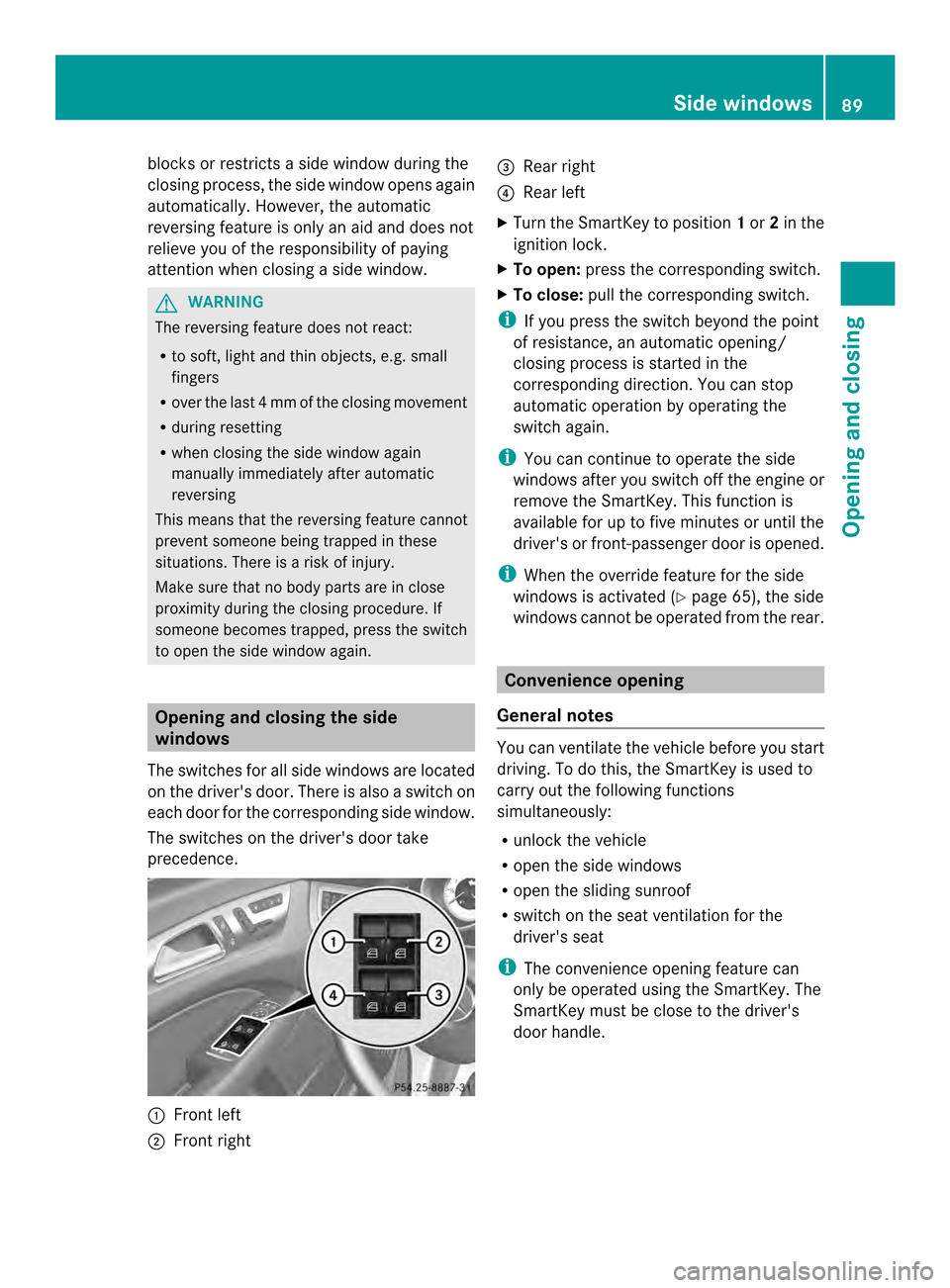
The switches for all side windows are located
on the driver's door. There is also aswitch on
each door for the corresponding side window.
The switches on the driver's door take
precedence. 001A
Front left
0010 Front right 0024
Rear right
0021 Rear left
X Turn the SmartKey to position 1or 2in the
ignition lock.
X To open: press the corresponding switch.
X To close: pull the corresponding switch.
i If you press the switch beyond the point
of resistance, an automatic opening/
closing process is started in the
corresponding direction. You can stop
automatic operation by operating the
switch again.
i You can continue to operate the side
windows after you switch off the engine or
remove the SmartKey. This function is
available for up to five minutes or until the
driver's or front-passenger door is opened.
i When the override feature for the side
windows is activated (Y page 65), the side
windows cannot be operated from the rear. Convenienceo
pening
General notes You can ventilate the vehicle before you start
driving. To do this, the SmartKey is used to
carry out the following functions
simultaneously:
R
unlock the vehicle
R open the side windows
R open the sliding sunroof
R switch on the seat ventilation for the
driver's seat
i The convenience opening feature can
only be operated using the SmartKey. The
SmartKey must be close to the driver's
door handle. Side windows
89Opening and closing Z