fuel pressure MERCEDES-BENZ CLS-Class 2014 W218 User Guide
[x] Cancel search | Manufacturer: MERCEDES-BENZ, Model Year: 2014, Model line: CLS-Class, Model: MERCEDES-BENZ CLS-Class 2014 W218Pages: 382, PDF Size: 5.36 MB
Page 336 of 382
Useful information
i This Operator's Manual describes all
models and all standard and optional
equipment of your vehicle available at the
time of publication of the Operator's
Manual. Country-specific differences are
possible. Please not ethat your vehicle may
not be equipped with all features
described. This also applies to safety-
related system sand functions.
i Read the information on qualified
specialist workshops: (Y page 26).Important safet
ynotes G
WARNING
If wheels and tires of the wrong size are used,
the wheel brakes or suspension components
may be damaged. There is arisk of an
accident.
Always replac ewheels and tires with those
that fulfill the specifications of the original
part.
When replacing wheels, make sure to use the
correct:
R designation
R model
When replacing tires, make sure to use the
correct:
R designation
R manufacturer
R model G
WARNING
Af lat tir eseverely impairs the driving,
steerin gand braking characteristics of the
vehicle. There is arisk of accident.
Tires without run-flat characteristics:
R do not drive with aflat tire.
R immediately replac ethe flat tir ewith your
emergenc yspare wheel or spare wheel, or
consult aqualified specialist workshop. Tires with run-flat characteristics:
R
pay attention to the information and
warnin gnotices on MOExtended tires (tires
with run-flat characteristics).
Accessories that are not approved for your
vehicle by Mercedes-Ben zorthat are not
being used correctly can impair the operating
safety.
Before purchasing and using non-approved
accessories, visit aqualified specialist
workshop and inquire about:
R suitability
R legal stipulations
R factory recommendations
Information on the dimensions and types of
wheels and tires for your vehicle can be found
in the "Wheel/tire combinations" section
(Y page 362).
Information on air pressure for the tires on
your vehicle can be found:
R on the vehicle's Tire and Loading
Information placard on the B-pillar
(Y page 345)
R on the tire pressure label on the fuel filler
flap (Y page 165)
R under "Tire pressure" (Y page 338) Operation
Information on driving
If the vehicle is heavily loaded, check the tire
pressures and correct them if necessary.
While driving, pay attention to vibrations,
noises and unusual handling characteristics,
e.g. pulling to one side. This may indicate that
the wheels or tires are damaged. If you
suspect that atire is defective, reduce your
speed immediately. Stop the vehicle as soon
as possible to check the wheels and tires for
damage. Hidden tire damage could also be
causing the unusual handling characteristics.
If you find no signs of damage, have the tires 334
OperationWheels and tires
Page 340 of 382
Check
Tir
ep ressure specifications
Important safety notes G
WARNING
Tire switht irep ressure sthata re to olow or
to oh igh are associated wit hthe following
hazards:
R they can burst, in particular if th evehicle is
heavily laden or when driven at high
speeds.
R thet ires can wear excessively and/or
unevenly, whic hcan severely impai rtire
traction.
R the driving, steerin gand braking
characteristics may be severely impaired.
There is arisk of accident.
Follow recommended tir einflation pressures
and chec kthe pressure of all the tires
including the spare wheel:
R monthly, at least
R if the load changes
R before beginning along journey
R under different operating conditions,e .g.
off-road driving
If necessary, correct the tire pressure.
i The specifications on the sample Tire and
Loading Information placard and tire
pressure tables are examples. Tire
pressure specifications are vehicle-specific
and may deviate from the data shown here.
The tire pressure specifications that are
valid for your vehicle can be found on the
Tire and Loading Information placard and
tire pressure table on the vehicle.
General notes The recommended tire pressures for the tires
mounted at the factory can be found on the
labelsd escribed here.
Operation with the emergency spare
wheel (Ypage 367). Further information on tire pressures can be
obtained at aqualified specialist workshop.
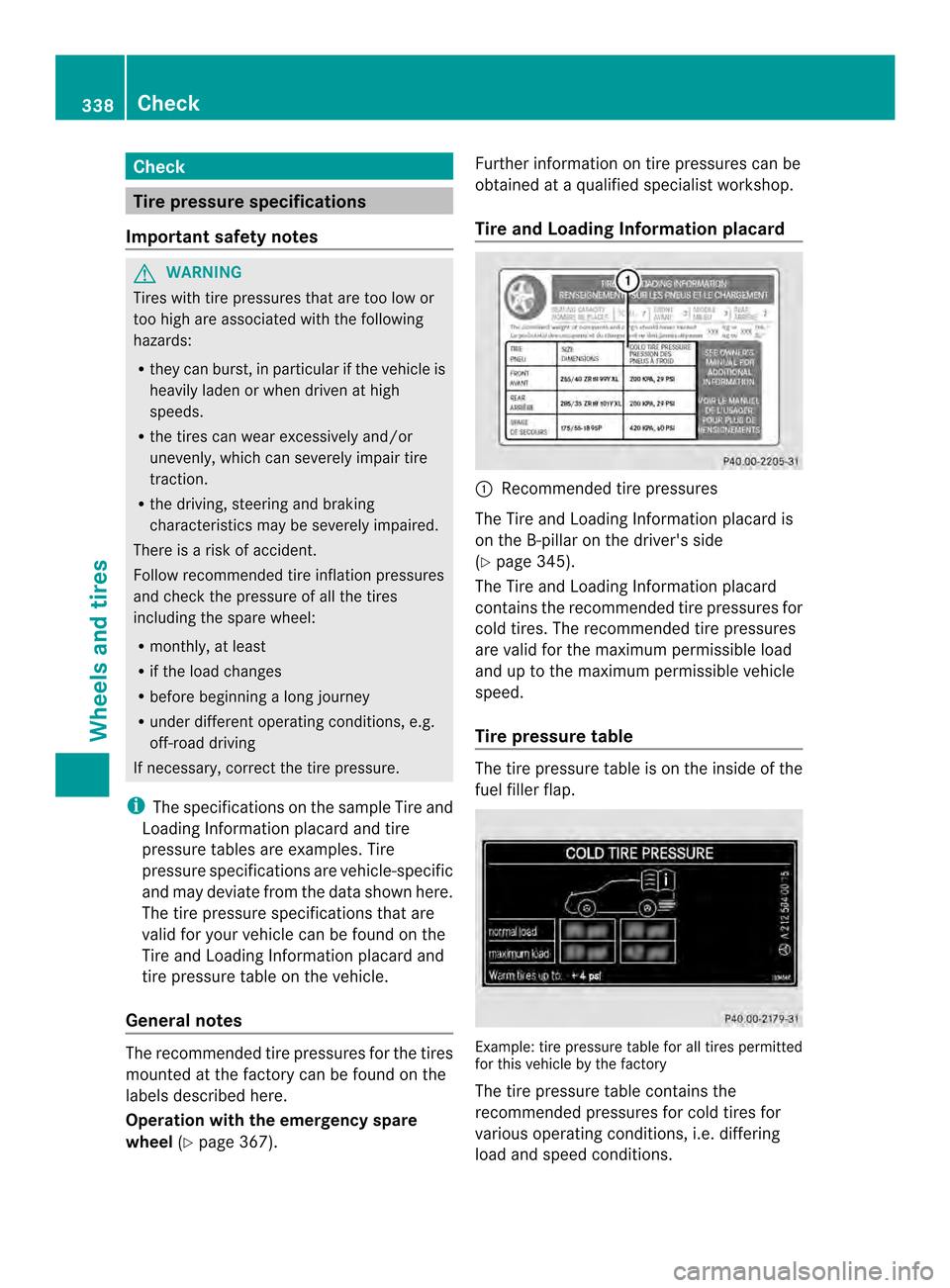
Tire and Loading Information placard 001A
Recommended tire pressures
The Tire and Loading Information placard is
on the B-pillar on the driver's side
(Y page 345).
The Tire and Loading Information placard
contains the recommended tire pressures for
cold tires. The recommended tire pressures
are valid for the maximum permissible load
and up to the maximum permissible vehicle
speed.
Tire pressuret able The tire pressure table is on the inside of the
fuel filler flap.
Example: tire pressure table for all tires permitted
for this vehicle by the factory
The tire pressure table contains the
recommended pressures for cold tires for
various operating conditions, i.e. differing
load and speed conditions.338
CheckWheels and tires
Page 342 of 382
The tires are cold:
R
if the vehicle has been parked without
direct sunlight on the tires for at least three
hours and
R if the vehicle has been driven for less than
1m ile (1.6 km).
The tire temperature changes depending on
the outside temperature, the vehicle speed
and the tire load. If the tire temperature
changes by 18 ‡(10 †), the tire pressure
changes by approximately 10 kPa (0.1 bar/
1.5 psi). Take this into account when
checking the pressure of warm tires. Only
correc tthe tire pressure if it is too low for the
current operating conditions. If you check the
tire pressure when the tires are warm, the
resulting value will be higher than if the tires
were cold. This is normal. Do not reduce the
tire pressure to the value specified for cold
tires. The tire pressure would otherwise be
too low.
Observe the recommended tire pressures for
cold tires:
R on the Tire and Loading Information placard
on the B-pillar on the driver's side
R in the tire pressure table on the inside of
the fuel filler flap
R on the yellow label on the emergency spare
wheel (depending on the vehicle
equipment) Underinflated or overinflated tires
Underinflation G
WARNING
Tires with pressure that is too low can
overheat and burst as aconsequence. In
addition, they also suffer from excessive and/
or irregular wear, which can severely impair
the braking properties and the driving
characteristics. There is arisk of an accident.
Avoid tire pressures that are too low in all the
tires, including the spare wheel. Underinflated tires may:
R
overheat, leading to tire defects
R have an adverse effect on handling
characteristics
R wear quickly and unevenly
R have an adverse effect on fuel consumption
Overinflation G
WARNING
Tires with excessively high pressure can burst
because they are damaged more easily by
road debris, potholes etc. In addition, they
also suffer from irregular wear, which can
severely impair the braking properties and the
driving characteristics. There is arisk of an
accident.
Avoid tire pressures that are too high in all the
tires, including the spare wheel.
Overinflated tires may:
R increase the braking distance
R have an adverse effect on handling
characteristics
R wear quickly and unevenly
R have an adverse effect on ride comfort
R be more susceptible to damage
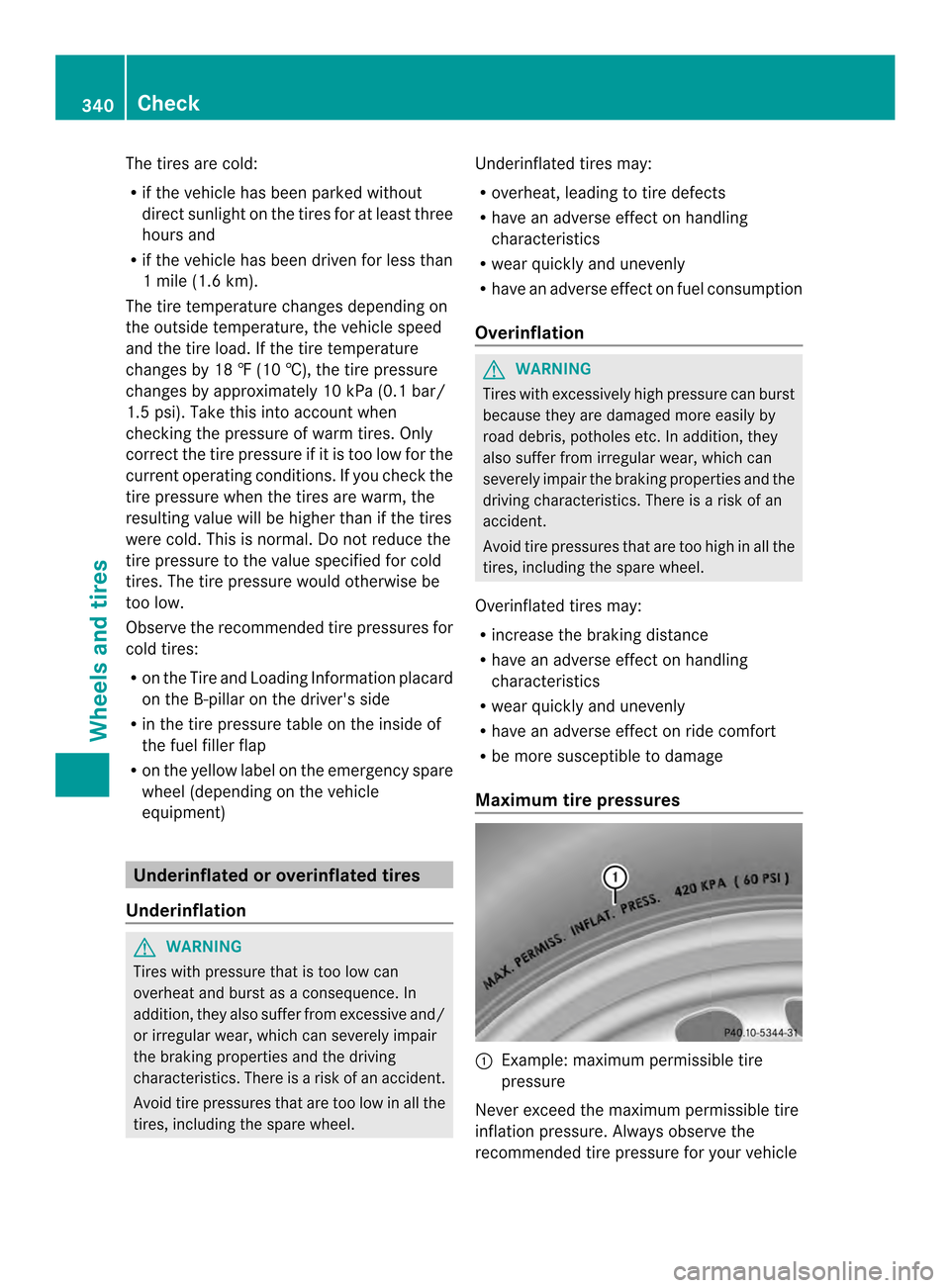
Maximum tire pressures 001A
Example: maximum permissible tire
pressure
Never exceed the maximum permissible tire
inflation pressure. Always observe the
recommended tire pressure for your vehicle 340
CheckWheels and tires
Page 343 of 382
when adjustin
gthe tirep ressure
(Y page 338).
i The actual values for tires are vehicle-
specific and may deviat efromt he values in
the illustration. Checking the tire pressures
Important safety notes Observe the notes on tire pressure
(Y
page 338).
Information on air pressure for the tires on
your vehicle can be found:
R on the vehicle's Tire and Loading
Information placard on the B-pillar
(Y page 345)
R on the tire pressure label on the fuel filler
flap (Y page 165)
R in the "Tire pressure" section
R under "Tire pressure" (Y page 338)
Checking tire pressures manually To determine and set the correct tire
pressure, proceed as follows:
X Remove the valve cap of the tire that is to
be checked.
X Press the tire pressure gauge securely onto
the valve.
X Read the tire pressure and compare it with
the recommended value on the Tire and
Loading Information placard (Y page 338).
X If the tire pressure is too low, increase it to
the recommended value.
X If the tire pressure is too high, release air
by pressing down the metal pin in the valve.
Use the tip of apen, for example. Then,
check the tire pressure again using the tire
pressure gauge.
X Screw the valve cap onto the valve.
X Repeatt hese steps for the other tires. Tire pressurel
oss warning system
(Canada only)
General notes While the vehicle is in motion, the tire
pressure loss warning system monitors the
set tire pressure using the rotational speed of
the wheels. This enables the system to detect
significant pressure loss in
atire. If the speed
of rotation of awheel changes as aresult of
al oss of pressure, acorresponding warning
message will appearint he multifunction
display.
You can recognizet he tire pressure loss
warning by the Run Flat Indicator Active Press 'OK' to Restart message
which appears in the Serv. menu of the
multifunction display. Further information on
the message displayc an be found under
"Restarting the tire pressure loss warning
system" section (Y page 342).
Important safety notes The tire pressure warning system does not
warn you of an incorrectly set tire pressure.
Observe the notes on the recommended tire
pressure (Y
page 338).
The tire pressure loss warning does not
replace the need to regularly check the tire
pressure. An even loss of pressure on several
tires at the same time cannot be detected by
the tire pressure loss warning system.
The tire pressure monitor is not able to warn
you of asudden loss of pressure, e.g. if the
tire is penetrated by aforeign object.Int he
event of asudden loss of pressure, bring the
vehicle to ahalt by braking carefully. Avoid
abrupt steering maneuvers.
The function of the tire pressure loss warning
system is limited or delayed if:
R snow chains are mounted on your vehicle's
tires.
R road conditionsa re wintry.
R you are driving on sand or gravel. Check
341Wheels and tires Z
Page 344 of 382

R
you adop taverys porty driving style
(cornering at high speeds or driving with
high rates of acceleration).
R you are driving with aheavy load( in the
vehicl eoront he roof).
Restarting the tire pressure loss
warnin gsystem Restart the tire pressure loss warning system
if you have:
R changed the tire pressure
R changed the wheels or tires
R mounted new wheels or tires
X Before restarting, make sure that the tire
pressures are set properly on all four tires
for the respective operating conditions.
The recommende dtire pressures can be
found on the Tire and Loading Information
placard on the B-pillar on the driver's side
or the tire pressure table on the fuel filler
flap .The tire pressure loss warning system
can only give reliablew arnings if you have
set the correct tire pressure. If an incorrect
tire pressure is set, these incorrectv alues
will be monitored.
X Als oobserv ethe note sinthesectio nontire
pressures (Y page 338).
X Make sure that the SmartKey is in position
2in the ignition lock (Y page 147).
X Press the 000Aor0004 button on the
steerin gwheel to selec tthe Serv. menu.
X Press the 0006or0005 button on the
steering wheel to select the TirePressure menu.
X Press the 000Cbutton.
The Run Flat Indicator Active Press 'OK' to Restart message
appears in the multifunction display. If you wish to confirm the restart:
X
Press the 000Cbutton.
The Tire Pressure Now OK? message
appears in the multifunction display.
X Press the 0006or0005 button to select
Yes .
X Press the 000Cbutton.
The Run Flat Indicator Restarted message appears in the multifunction
display.
After
ateach-in period, the tire pressure
loss warning system will monitor the set
tire pressures of all four tires.
If you wish to cancel the restart:
X Press the 0002button.
or
X When the Tire Pressure Now OK? message appears, press the
0006
or 0005 button to select Cancel .
X Press the 000Cbutton.
The tire pressure values stored at the last
restart will continue to be monitored. Tire pressurem
onitor
General notes If
at ire pressure monitor is installed, the
vehicle's wheels have sensors that monitor
the tire pressures in all four tires. The tire
pressure monitor warns you if the pressure
drops in one or more of the tires. The tire
pressure monitor only functions if the correct
sensors are installed on all wheels.
Information on tire pressures is displayed in
the multifunction display. After afew minutes
of driving, the current tire pressure of each
tire is shown in the Service menu of the
multifunction display. For further information
on displaying this message, refer to the
"Checking the tire pressure electronically"
section (Y page 344). 342
CheckWheels and tires
Page 345 of 382
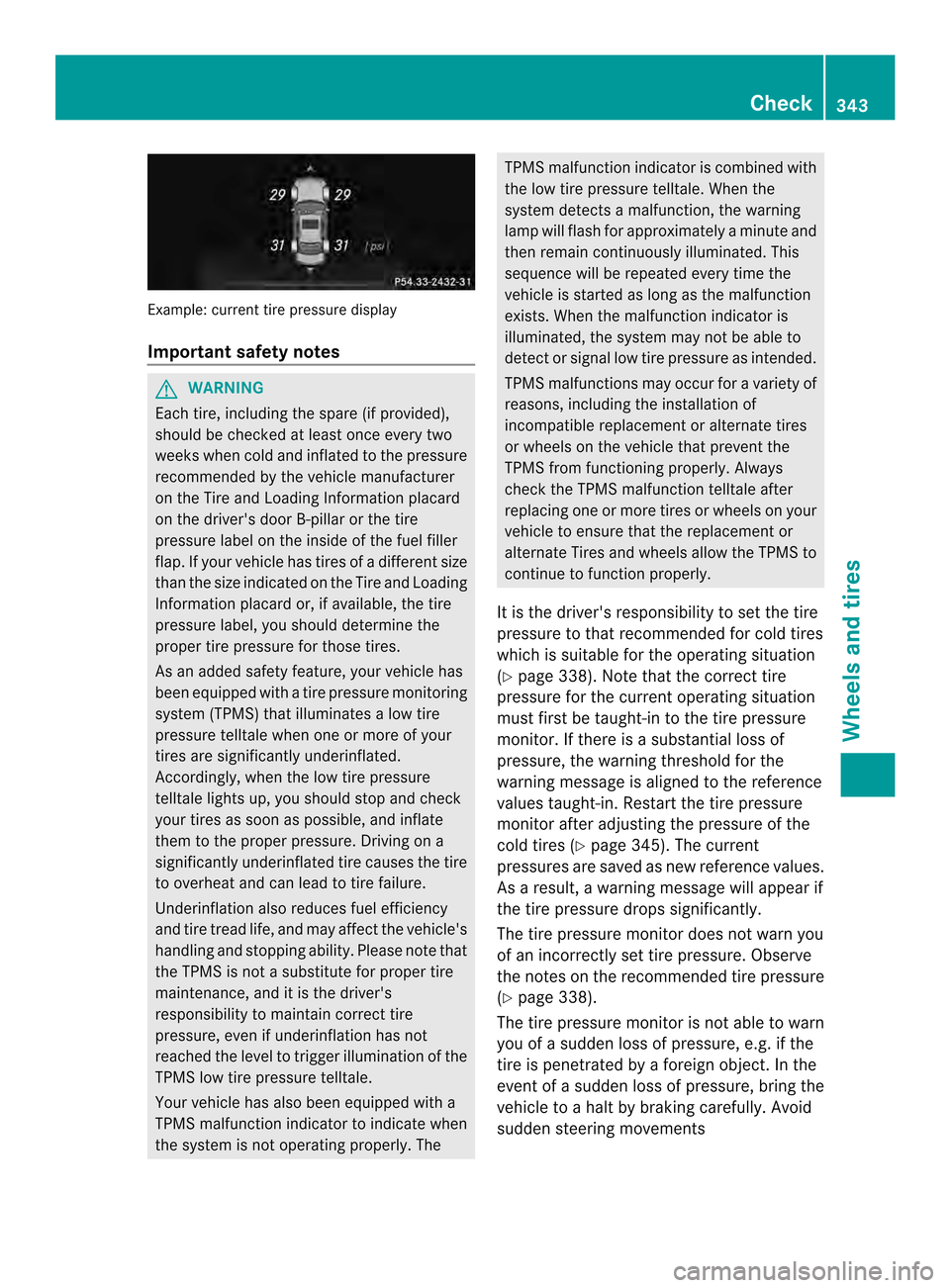
Example: current tire pressure display
Important safety notes
G
WARNING
Each tire ,including the spare (i fprovided),
should be checked at least once every two
weeks when cold and inflated to the pressure
recommended by the vehicl emanufacturer
on the Tire and Loading Information placard
on the driver' sdoor B-pillar or the tire
pressure label on the inside of the fuel filler
flap .Ify our vehicle has tires of adifferent size
than the size indicated on the Tire and Loading
Information placard or, if available, the tire
pressure label, you should determin ethe
proper tire pressure for those tires.
As an added safety feature, your vehicle has
been equipped with atire pressure monitoring
system (TPMS) that illuminates alow tire
pressure telltale when one or more of your
tires are significantly underinflated.
Accordingly, when the low tire pressure
telltale lights up, you should stop and check
your tires as soon as possible, and inflate
them to the proper pressure. Drivin gona
significantly underinflated tire causes the tire
to overheat and can lead to tire failure.
Underinflation also reduces fuel efficiency
and tire tread life, and may affect the vehicle's
handling and stopping ability. Please note that
the TPMS is not asubstitute for proper tire
maintenance, and it is the driver's
responsibility to maintain correc ttire
pressure, even if underinflation has not
reached the level to trigger illumination of the
TPMS low tire pressure telltale.
Your vehicle has also been equipped with a
TPMS malfunction indicator to indicate when
the system is not operating properly. The TPMS malfunction indicator is combined with
the low tire pressure telltale. When the
system detect
samalfunction, the warning
lamp will flash for approximately aminute and
then remain continuously illuminated. This
sequence will be repeated every time the
vehicle is started as long as the malfunction
exists. When the malfunction indicator is
illuminated, the system may not be able to
detect or signal low tire pressure as intended.
TPMS malfunctions may occur for avariety of
reasons, including the installation of
incompatible replacement or alternate tires
or wheels on the vehicle that prevent the
TPMS from functioning properly. Always
check the TPMS malfunction telltale after
replacing one or more tires or wheels on your
vehicle to ensure that the replacement or
alternate Tires and wheels allow the TPMS to
continue to function properly.
It is the driver's responsibility to set the tire
pressure to that recommended for cold tires
which is suitable for the operating situation
(Y page 338). Note that the correc ttire
pressure for the current operating situation
must first be taught-in to the tire pressure
monitor. If there is asubstantial loss of
pressure, the warning threshold for the
warning message is aligned to the reference
values taught-in .Restart the tire pressure
monitor after adjustin gthe pressure of the
cold tires (Y page 345). The current
pressures are saved as new reference values.
As aresult, awarning message will appear if
the tire pressure drops significantly.
The tire pressure monitor does not warn you
of an incorrectly set tire pressure. Observe
the notes on the recommended tire pressure
(Y page 338).
The tire pressure monitor is not able to warn
you of asudden loss of pressure, e.g. if the
tire is penetrated by aforeign object. In the
event of asudden loss of pressure, bring the
vehicle to ahalt by brakin gcarefully. Avoid
sudden steering movements Check
343Wheels and tires Z
Page 347 of 382
one or more tires has dropped suddenly
and the tires must be checked.
Observe the instructions and safety notes in
the display messages in the "Tires" section
(Y page 258).
i If the wheel positions on the vehicle are
rotated, the tire pressures may be
displayed for the wrong positions for a
short time. This is rectified after afew
minutes of driving, and the tire pressures
are displayed for the correc tpositions.
Restarting the tire pressur emonitor When you restart the tire pressure monitor,
all existin gwarning messages are deleted and
the warning lamps go out. The monitor uses
the currently set tire pressures as the
reference values for monitoring. In most
cases, the tire pressure monitor will
automatically detect the new reference
values after you have changed the tire
pressure. However, you can also define
reference values manually as described here.
The tire pressure monitor then monitors the
new tire pressure values.
X Set the tire pressure to the value
recommended for the corresponding
driving situation on the Tire and Loading
Information placard on the B-pillar on the
driver's side (Y page 338).
Additional tire pressure values for different
loads can also be found on the tire pressure
table on the inside of the fuel filler flap
(Y page 338).
X Make sure that the tire pressure is correct
on all four wheels.
X Make sure that the SmartKey is in position
2 in the ignition lock.
X Press the 000Aor0004 button on the
steerin gwheel to select the Serv. menu.
X Press the 0006or0005 button to select
Tire Pressure .
X Press the 000Cbutton.
The multifunction display shows the
current tire pressure for each tire or the Tire pressures will be displayed after driving
afew minutes message.
X Press the 0005button.
The multifunction display shows the Use Current Pressures as New Reference
Values message.
If you wish to confirm the restart:
X Press the 000Cbutton.
The Tire Press. Monitor Restarted message appears in the multifunction
display.
After driving for
afew minutes, the system
checksw hether the current tire pressures
are within the specified range. The new tire
pressures are then accepted as reference
values and monitored.
If you wish to cancel the restart:
X Press the 0002button.
The tire pressure values stored at the last
restart will continue to be monitored. Loading the vehicle
Instruction labels for tires and loads
G
WARNING
Overloaded tires can overheat, causing a
blowout. Overloaded tires can also impair the
steering and driving characteristics and lead
to brake failure. There is arisk of accident.
Observe the load rating of the tires. The load
rating must be at least half of the GAWR of
your vehicle. Never overload the tires by
exceeding the maximum load.
Two instruction labels on your vehicle show
the maximum possible load.
(1) The Tire and Loading Information placard is on the B-pillar on the driver's side. The
Tire and Loading Information placard
shows the maximum permissible number
of occupant sand the maximum
permissible vehicle load. It also contains Loading the vehicle
345Wheels and tires Z
Page 348 of 382
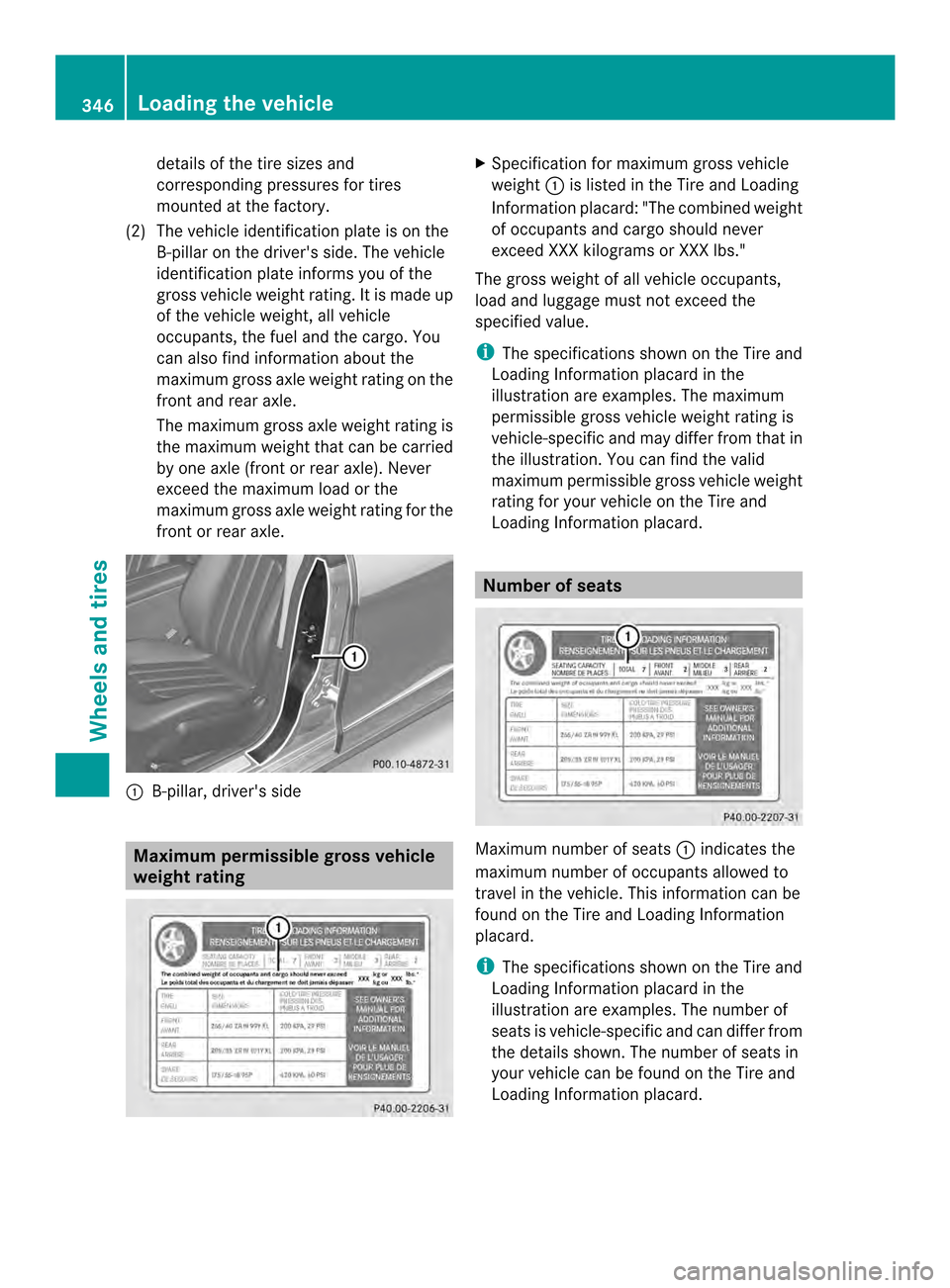
details of the tire sizes and
correspondin
gpressures for tires
mounted at the factory.
(2) The vehicle identification plate is on the B-pillar on the driver' sside. The vehicle
identification plate inform syou of the
gross vehicle weight rating. It is made up
of the vehicle weight, all vehicle
occupants, the fuel and the cargo. You
can also find information about the
maximum gross axle weight rating on the
front and rear axle.
The maximum gross axle weight rating is
the maximum weight that can be carried
by one axle (front or rear axle). Never
exceed the maximum load or the
maximum gross axle weight rating for the
front or rear axle. 001A
B-pillar, driver's side Maximu
mpermissible gros svehicle
weight rating X
Specification for maximum gross vehicle
weight 001Ais listed in th eTire and Loading
Information placard: "The combine dweight
of occupant sand cargo should never
exceed XXX kilogram sorXXX lbs."
The gross weight of all vehicle occupants,
load and luggage must no texcee dthe
specified value.
i The specifications shown on the Tire and
Loading Informatio nplacard in the
illustratio nare examples. The maximum
permissible gross vehicl eweight rating is
vehicle-specific and may differ from that in
the illustration. You can find the valid
maximu mpermissible gross vehicle weight
ratin gfor your vehicle on the Tire and
Loading Information placard. Number of seats
Maximum number of seats
001Aindicates the
maximum number of occupants allowed to
travel in the vehicle. This information can be
found on the Tire and Loading Information
placard.
i The specifications shown on the Tire and
Loading Information placard in the
illustration are examples. The number of
seats is vehicle-specific and can differ from
the details shown. The number of seats in
your vehicle can be found on the Tire and
Loading Information placard. 346
Loading thev
ehicleWheels and tires
Page 357 of 382
100 kilopascals (kPa
)are the equivalent of
1b ar.
DOT (Department of Transportation)
DOT marked tires fulfill the requirements of
the United States Department of
Transportation.
Normal occupant weight
The numbe rofoccupants for which the
vehicl eisdesigned multiplie dby
68 kilograms (150 lb).
Uniform Tire Quality Gradin gStandards
Au niform standard to grade the quality of
tire swithr egards to trea dquali ty,tire traction
and temperatur echaracteristics. Rating sare
determine dbytire manufacturer susing U.S.
government testing procedures. The ratings
ar em olde dinto the sidewall of the tire.
Recommende dtire pressure
The recommende dtire pressure applie sto
the tire smounted at the factory.
The Tire and Loading Informatio nplacard
contain sthe recommende dtirep ressures for
cold tires on afully loaded vehicle and for the
maximum permissible vehicle speed.
The tir epressure table contain sthe
recommende dpressures for cold tires for
various operating conditions, i.e. differing
load and speed conditions.
Increased vehicle weight du etooptional
equipment
This is the combined weight of all standard
and optional equipmen tavailablef or the
vehicle, regardless of whethe ritisactually
installed on the vehicle or not.
Rim
This is the part of the wheel on which the tire
is mounted.
GAWR (Gross Axle Weight Rating)
The GAWR is the maximum gross axle weight
rating. The actual load on an axle must never
exceed the gross axle weight rating. The
gross axle weight rating can be found on the vehicle identification plate on the B-pillar on
the driver's side.
Speed rating
The speed rating is part of the tire
identification. It specifies the speed range for
which the tire is approved.
GVW (Gross Vehicle Weight)
The gross vehicle weight includes the weight
of the vehicle including fuel, tools, the spare
wheel, accessories installed, occupants,
luggage and the drawbarn
oseweight, if
applicable. The gross vehicle weight must not
exceed the gross vehicle weight rating GVWR
as specified on the vehicle identification plate
on the B-pillar on the driver's side.
GVWR (Gross Vehicle Weight Rating)
The GVWR is the maximum permissible gross
weight of afully loaded vehicle (the weight of
the vehicle including all accessories,
occupants, fuel, luggage and the drawbar
noseweight, if applicable). The gross vehicle
weight rating is specified on the vehicle
identification plate on the B-pillar on the
driver's side.
Maximu mloaded vehicle weight
The maximum weight is th esum of:
R thec urbw eight of th evehicle
R thew eight of th eaccessories
R thel oad limit
R thew eight of th efactory installe doptional
equipment
Kilopascal (kPa)
Metric unit for tir epressure. 6. 9kPa
correspond sto1psi. Another unit for tire
pressure is bar. Ther eare 10 0kilopascals
(kPa) to 1bar.
Load index
In addition to th eload-bearing index ,the load
index may also be imprinted on th esidewall
of th etire. This specifie sthe load-bearing
capacity more precisely. All about wheels and tires
355Wheels and tires Z
Page 358 of 382
Cur
bw eight
The weight of avehicle with standard
equipment includin gthe maximum capacity
of fuel, oil and coolant .Italso includes the air-
conditionin gsystem and optional equipment
if these are installed in the vehicle, but does
not include passengers or luggage.
Maximu mload rating
The maximum tir eload is the maximum
permissible weight in kilograms or lbs for
which atireisa pproved.
Maximu mpermissible tir epressure
Maximum permissible tir epressure for one
tire.
Maximu mload on one tire
Maximum load on one tire. This is calculated
by dividin gthe maximum axle load of one axle
by two.
PSI (pounds per squar einch)
As tandar dunitofm easure for tire pressure.
Aspect ratio
Relationship between tire height and tire
width in percent.
Tirep ressure
This is pressure inside the tire applying an
outward forc etoeach square inch of the tire's
surface. The tire pressure is specified in
pounds per square inch (psi), in kilopascal
(kPa) or in bar. The tire pressure should only
be corrected when the tires are cold.
Cold tirep ressure
The tires are cold:
R if the vehicle has been parked without
direct sunlight on the tires for at least three
hours and
R if the vehicle has been driven for less than
1m ile (1.6 km). Tread
The part of the tire that comes intoc
ontact
with the road.
Bead
The tire bead ensures that the tire sits
securely on the wheel. There are several steel
wires in the bead to preven tthe tire from
comin gloose from the wheel rim.
Sidewall
The part of the tire between the tread and the
bead.
Weight of optional extras
The combined weight of those optional extras
that weigh more than the replaced standard
parts and more than 2.3 kilograms (5 lbs).
These optional extras, such as high-
performance brakes, level control, aroof rack
or ah igh-performanc ebattery, are not
included in the curb weight and the weight of
the accessories.
TIN (Tire Identification Number)
This is aunique identifier which can be used
by atire manufacturer to identify tires, for
example for aproduct recall, and thus identify
the purchasers. The TIN is made up of the
manufacturer's identity code, tire size, tire
type code and the manufacturing date.
Load bearing index
The load bearing index (also load index) is a
code that contains the maximum load bearing
capacity of atire.
Traction
Traction is the result of friction between the
tires and the road surface.
Treadwear indicators
Narrow bars (tread wear bars) that are
distributed over the tire tread. If the tire tread
is level with the bars, the wear limit of 0014in
(1.6 mm) has been reached. 356
All about wheels and tiresWheels and tires