height MERCEDES-BENZ CLS-Class 2014 W218 User Guide
[x] Cancel search | Manufacturer: MERCEDES-BENZ, Model Year: 2014, Model line: CLS-Class, Model: MERCEDES-BENZ CLS-Class 2014 W218Pages: 382, PDF Size: 5.36 MB
Page 191 of 382
again after th
evehicle has been driven a
certain distance. AIRMATIC
Vehicle level Important safety notes
G
WARNING
When th evehicle is bein glowered, people
could become trapped if their limbs are
between th evehicle body and th ewheel sor
underneat hthe vehicle .There is arisk of
injury.
Make sure no one is underneath the vehicle
or in the immediate vicinity of the wheel
arches when the vehicle is being lowered. G
WARNING
Vehicles with level control:
The vehicle is slightly lowered if:
R you have selected comfort suspension
tuning and
R you lock the vehicle within approximately
60 seconds of switching off the engine
You and people in the vicinity of the wheel
arch or the underbody may thus become
trapped. There is arisk of injury.
Make sure that nobody is in the vicinity of the
wheel arch or the underbody when you lock
the vehicle.
! The vehicle is lowered by about 15 mm if:
R you have selected "Comfort tuning"
R you switch off the engine and then
R you lock the vehicle within approximately
60 seconds
When parking, position your vehicle so that
it does not make contact with the curb as
the vehicle is lowered. Your vehicle could
otherwise be damaged.
If you lock the vehicle within 60 seconds of
switching the engine off, it lowers slightly to
the selected Comfort suspension mode. Your vehicle regulates its height
automatically
.All-round level control ensures
the best possible suspension and constant
groun dclearance, even with aladen vehicle.
When you drive fast ,the vehicle is lowered
automatically to improve drivin gsafet yand to
reduc efuel consumption.
The followin gvehicle levels are possible:
R normal
R raised: the vehicle is raised by about
0.80 in (20 mm) when compared with the
normal level
R lowered: the vehicle is raised by about
0.40 in (10 mm) when compared with the
normal level
i These changes in level are so slight that
you are hardly aware of them.
The "Normal" and "Raised" vehicle levels can
be set manually.
The "Lowered” vehicle level is set
automatically:
R at speeds above 70 mph (11 3km/ h)
R if you have selected "Sports tuning"
(Y page 190)
Setting th evehicle level
Selec tthe "Normal" settin gfor normal road
surfaces and "Raised" for drivin gwith snow
chain soronp articularly poor road surfaces.
Your selection remain sstored even if you
remove the SmartKey fro mthe ignition lock.
Setting raised level X
Start the engine. Driving systems
189Driving and parking Z
Page 192 of 382
If indicator lamp
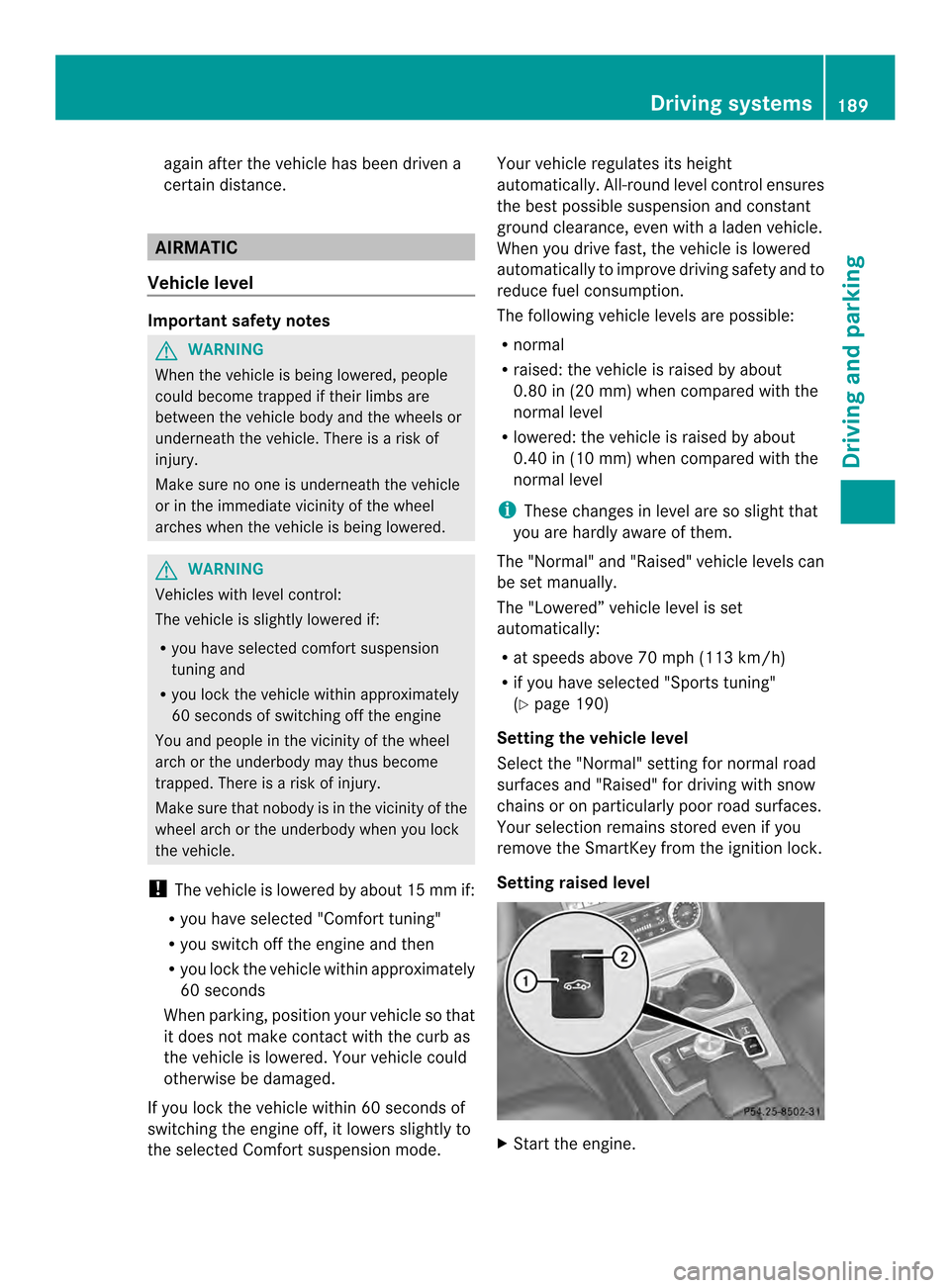
0010is not lit:
X Press the 001Abutton.
Indicator lamp 0010lights up. The vehicle
heightisa djusted to raised level.
The Vehicle Rising message appears in
the display.
The "Raised level" setting is canceled if you:
R drive at aspeed over approximately
75 mph (120 km/h)
R drive for approximately three minutes at a
speed over 50 mph (80 km/h)
The "Raised level" remains active when you
are not driving within these speed ranges.
Setting the normal level
X Start the engine.
If indicator lamp 0010is lit:
X Press the 001Abutton.
Indicator lamp 0010goes out. The vehicle is
adjusted to normal level.
Suspension tuning General notes
The electronically controlled damping system
works continuously. This improves driving
safety and ride comfort.
The damping is tuned individually to each
wheel and depends on:
R your driving style, e.g. sporty
R the road surface condition, e.g. bumps
R your individuals election, i.e. sports or
comfort
Your selection remains stored even if you
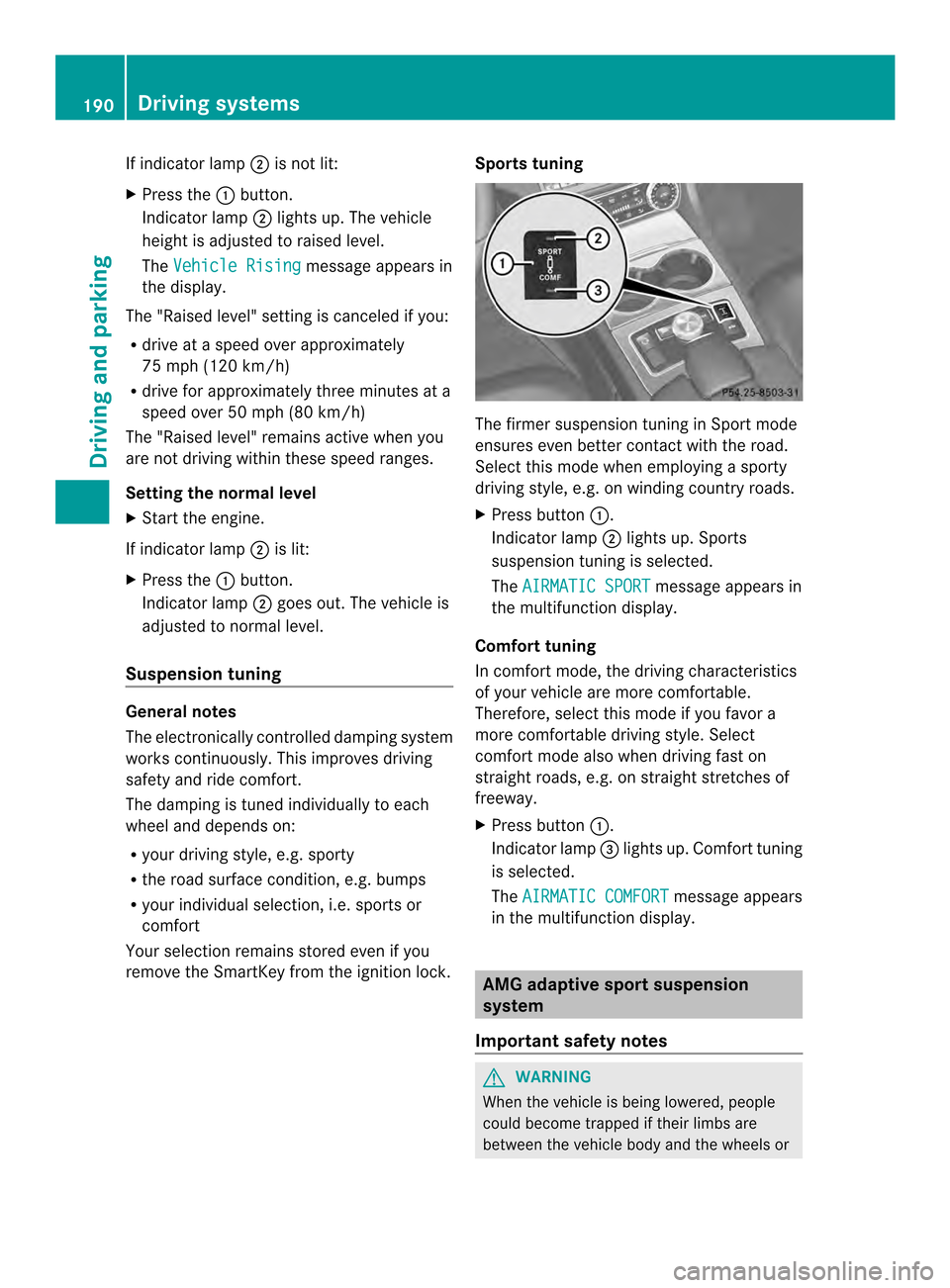
remove the SmartKey from the ignition lock. Sports tuning The firmer suspension tuning in Sport mode
ensures even better contact with the road.
Select this mode when employing
asporty
driving style, e.g. on winding country roads.
X Press button 001A.
Indicator lamp 0010lights up. Sports
suspension tuning is selected.
The AIRMATIC SPORT message appears in
the multifunction display.
Comfort tuning
In comfort mode, the driving characteristics
of your vehicle are more comfortable.
Therefore, select this mode if you favor a
more comfortable driving style. Select
comfort mode also when driving fast on
straight roads, e.g. on straight stretches of
freeway.
X Press button 001A.
Indicator lamp 0024lights up. Comfort tuning
is selected.
The AIRMATIC COMFORT message appears
in the multifunction display. AMG adaptive sport suspension
system
Important safety notes G
WARNING
When the vehicle is being lowered, people
could become trapped if their limbs are
between the vehicle body and the wheels or 190
Driving systemsDriving and parking
Page 194 of 382

The
AMG Ride Control SPORT + message
appears in the multifunction display.
Comfort mode
When comfor tmode is selected, the driving
characteristics of your vehicle are more
comfortable. Select this mode if you prefer a
comfort-oriented driving style. Select
comfor tmode also when driving fast on
straight roads, e.g. on straight stretches of
highway.
X Press button 001Arepeatedly until indicator
lamps 0024and 0021go out.
You have selected Comfort mode.
The AMG Ride Control COMFORT message appears in the multifunction
display.
Storing and calling up settings
Once the suspension tuning and drive
program have been selected, you can store
and call up your settings using AMG
button 0010.
X To store: press AMG button 0010until you
hear atone.
X To call up: press AMG button 0010.
The stored suspension tuning and drive
program are selected.
X To display: briefly press AMG button 0010.
Your selection appears in the multifunction
display.
Vehicle level Important safety notes
G
WARNING
When the vehicle is being lowered, people
could become trapped if their limbs are
between the vehicle body and the wheels or
underneath the vehicle. There is arisk of
injury.
Make sure no one is underneath the vehicle
or in the immediate vicinit yofthe wheel
arches when the vehicle is being lowered. The vehicle lowers when you press the button
for selecting the suspension tuning or the
AMG button
.The vehicle also lowers if it is
stationary.
! If Sport or Sport +suspension tuning has
been selected, th evehicle's ground
clearance decreases. Mak esure that no
object sbecome trapped or that th evehicle
does no tbecome damaged, for example,
on the curb.
i The vehicle level may change visibly at the
rear axle if you park the vehicle and the
outside temperature changes .Ifthe
temperature drops, the vehicle level
lowers; with an increase in temperature,
the vehicle level rises.
Changing the rear axle ride height
This function is only available for the CLS 63
AMG 4MATIC.
The vehicle level at the rear axle depends on
the selected suspension tuning and the
vehicle speed.
The vehicle level at the rear axle changes
during the journey depending on the selected
suspension tuning:
R Comfort: +0.4 in (+10 mm)
R Sport +and Sport: -0.6in( -15 mm)
When switching from Comfort to Sport or
Sport +, the rear axle lowers by approximately
1.0 in (25 mm). When switching from Sport
or Sport +toComfort, the rear axle raises by
approximately 1.0 in (25 mm). This level
change also takes place when the vehicle is
stationary.
If you drive faster than 105 mph (170 km/h),
the rear axle ride height is set to amedium
level. Thi sincreases driving safety and
reduces airr esistance. If you then drive at
speeds below 93 mph (150 km/h), the rear
axle ride height is readjusted to the selected
suspension tuning. 192
Driving systemsDriving and parking
Page 199 of 382

Parking tips:
R
On narrow roads, drive as close to the
parking space as possible.
R Parking spaces that are littered or
overgrown might be identified or measured
incorrectly.
R Parking spaces that are partially occupied
by trailer drawbars might not be identified
as such or be measured incorrectly.
R Snowfall or heavy rain may lead to aparking
space being measured inaccurately.
R Pay attention to the PARKTRONIC
(Y page 195) warning messages during the
parking procedure.
R You can intervene in the steerin gprocedure
to correc titatany time. Active Parking
Assist will then be canceled.
R When transportin gaload which protrudes
from your vehicle, you should not use
Active Parking Assist.
R Never use Active Parking Assist when snow
chains are installed.
R Make sure that the tire pressures are
alway scorrect. This has adirec tinfluence
on the parking characteristics of the
vehicle.
Use Active Parking Assist for parking spaces:
R tha tare paralleltot he direction of travel
R that are on straight roads, not bends
R that are on the same leve lasthe road ,e.g.
not on the pavement
Detectin gparking spaces Objects located above the height range of
Active Parking Assist willn ot be detected
when the parking space is measured. These
are not taken into account when the parking
procedure is calculated ,e.g. overhanging
loads, tail sections or loading ramps of goods
vehicles. G
WARNING
If there are objects above the detection range,
Active Parking Assist may turn prematurely. You may caus
eacollision as aresult. There is
ar isk of an accident.
If there are objects above the detection range,
stop and deactivate Active Parking Assist.
For further information on the detection
range (Y page194).
Active Parking Assist does not support you
with parking spaces paralleltot he direction
of travel if:
R the parking space is on acurb
R thep arking spac eappear sblocke dtothe
system, for example ,byfoliage or grass
pavin gblocks
R thea rea that th evehicl eneeds to
maneuve ristoo small
R the parking space is bordered by an
obstacle, such as atree, apost or atrailer Example: detected parking space
001A
Detected parking space on the left
0010 Parking symbol
0024 Detected parking space on the right
Active Parking Assist is switched on
automaticallyw hen driving forwards. The
system is operational at speeds of up to
approximately 22 mph (35 km/h). While in
operation, the system independently locates
and measures parking spaces on both sides
of the vehicle.
Active Parking Assist will only detect parking
spaces:
R that are parallel to the direction of travel
R that are at least 59 in (1.5 m) wide
R that are at least 51 in (1.3 m) longer than
your vehicle
When driving at speeds below 19 mph
(30 km/h), you will see parking symbol as a Driving systems
197Driving and parking Z
Page 309 of 382

!
Make sure that the windshieldw ipers are
not folded away fro mthe windshield. You
could otherwise damage the windshield
wipers or the hood. X
Make sure that the windshield wipers are
turned off.
X Pull release lever 001Aon the hood.
The hood is released. X
Reach into the gap, pull hood catch
handle 0010up and lift the hood.
If you lift the hood by approximately
15 inches (40c m),the hood is opened and
held open automatically by the gas-filled
strut.
Closing theh ood X
Lower the hood and let it fall from aheight
of approximately 8inche s(20 cm).
X Check that the hood has engaged properly.
If the hood can be raised slightly ,itisnot
properly engaged. Open it again and close
it with alittle more force. Engine oil
General notes Depending on the driving style, the vehicle
consume
supto0.9 US qt (0.8 liters) of oil
over adistanc eof600 miles (1,000 km). The
oil consumption may be higher than this when
the vehicle is new or if you frequently drive at
high engin espeeds.
Depending on the engine, the oil dipstic kmay
be in adifferent location.
When checking th eoil level:
R park th evehicle on aleve lsurface.
R thee ngines hould be switched off for
approximately fiv eminute siftheengin eis
at normal operatin gtem perature.
R if th eengineisn otat normal operating
temperature, e.g .ifthe engine was only
started briefly, wait about 30 minutes
before carrying out the measurement.
Checking the oil level using the oil
dipstick X
Pull oil dipstick 001Aout of the dipstick guide
tube.
X Wipe off oil dipstick 001A.
X Slowly slide oil dipstick 001Ainto the guide
tube to the stop, and take it out again.
If the level is between MIN mark 0024and
MAX mark 0010,the oil level is correct.
X If the oil level has dropped to MIN mark
0024 or below, add 1.1 US qt (1.0 liter) of
engine oil. Engine compartment
307Maintenance and care Z
Page 353 of 382
Tire labeling
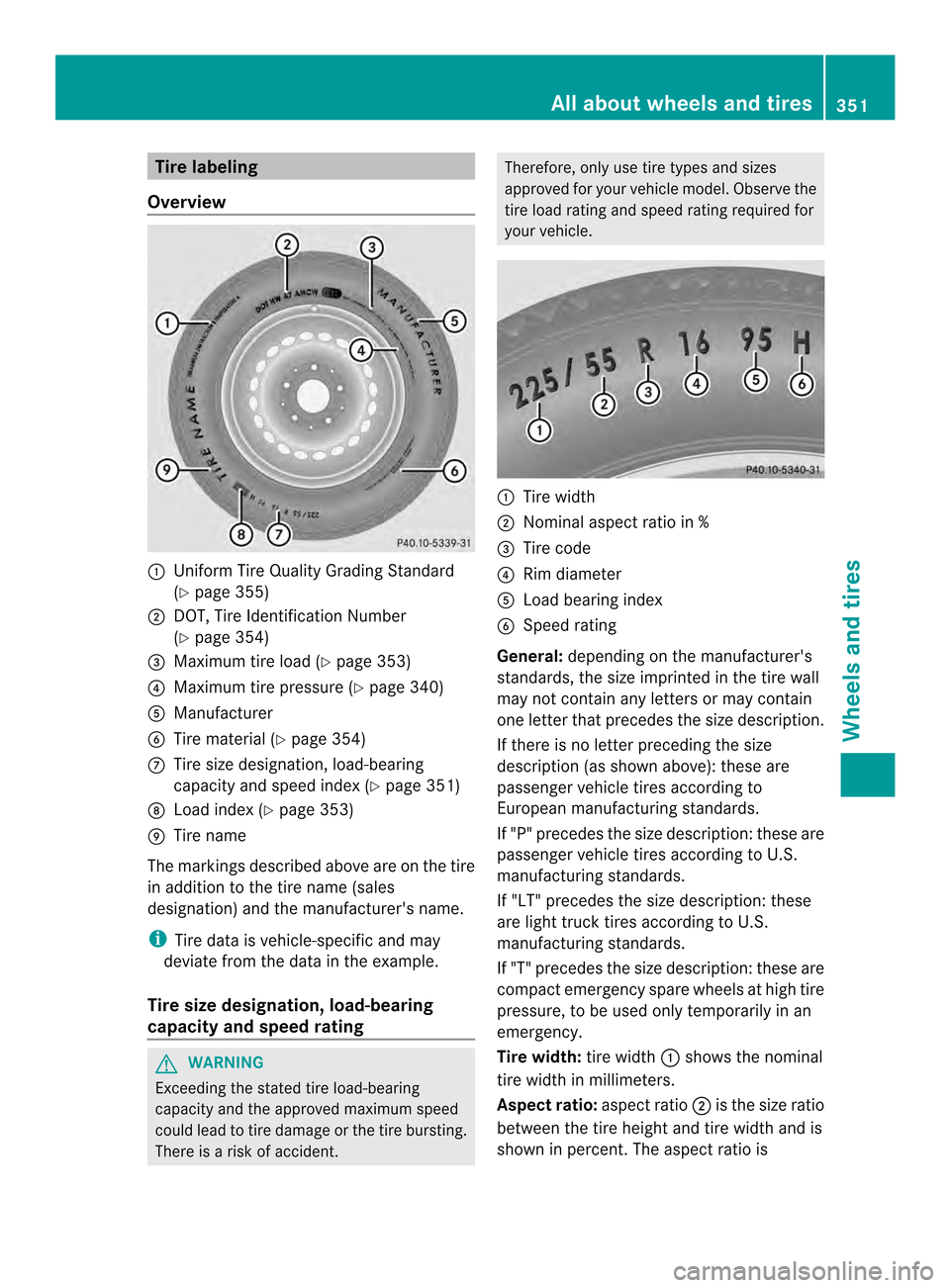
Overview 001A
Unifor mTire Qualit yGrading Standard
(Y page 355)
0010 DOT, Tire Identification Number
(Ypage 354)
0024 Maximum tir eload (Y page 353)
0021 Maximum tir epressure (Y page 340)
001E Manufacturer
0025 Tire material (Y page 354)
0009 Tire size designation ,load-bearing
capacity and speed index (Y page 351)
0016 Load index (Y page 353)
001D Tire name
The markings described above are on the tire
in additio ntothe tire name (sales
designation) and the manufacturer's name.
i Tire data is vehicle-specific and may
deviate from the data in the example.
Tire size designation, load-bearing
capacity and speed rating G
WARNING
Exceeding the stated tire load-bearing
capacity and the approved maximum speed
could lead to tire damage or the tire bursting.
There is arisk of accident. Therefore, only use tire types and sizes
approved for your vehicle model. Observe the
tire load rating and speed rating required for
your vehicle. 001A
Tire width
0010 Nominal aspect ratio in %
0024 Tire code
0021 Rim diameter
001E Load bearing index
0025 Speed rating
General: depending on the manufacturer's
standards, the size imprinted in the tire wall
may not contain any letters or may contain
one letter that precedes the size description.
If there is no letter preceding the size
description (as shown above): these are
passenger vehicle tires according to
European manufacturin gstandards.
If "P" precedes the size description :these are
passenger vehicle tires according to U.S.
manufacturing standards.
If "LT" precedes the size description: these
are light truck tires according to U.S.
manufacturing standards.
If "T" precedes the size description: these are
compact emergency spare wheels at high tire
pressure, to be used only temporarily in an
emergency.
Tire width: tire width001Ashows the nominal
tire width in millimeters.
Aspect ratio: aspect ratio0010is the size ratio
between the tire height and tire width and is
shown in percent.T he aspect ratio is All about wheels and tires
351Wheels and tires Z
Page 354 of 382

calculate
dbydividing the tire width by the tire
height.
Tire code: tire code0024specifies the tire type.
"R "r epresents radia ltires; "D" represents
diagona ltires; "B" represents diagona lradial
tires.
Optionally, tire switham aximum speed of
ove r149 mph (240 km/h )may have "ZR" in
the size description, depending on the
manufacturer (e.g. 245/40 ZR 18).
Rim diameter: rim diameter0021is the
diameter of the bea dseat, not the diameter
of the rim flange. The rim diameter is
specified in inche s(in).
Load-bearin gind ex: load-bearing index 001E
is an umerica lcode that specifies the
maximum load-bearing capacity of atire.
Do not overload the tire sbyexceedingthe
specified load limit. The maximum
permissibl eload can be found on the
vehicle's Tir eand Loadin gInformati on
placard on th eB-pillar on th edriver's side
(Y page 345).
Example:
Load-bearin gind ex 91 indicates amaximum
load of 1356 lb (61 5kg)that th etires can
bear .For further information on th emaximum
tir el oad in kilograms and lbs, see
(Y page 353).
For further informatio nontheload bearing
index ,see "Load index "(Ypage 353).
Speed rating: speedrating 0025specifie sthe
approved maximum spee dofthetire.
i Tire dat aisvehicle-specific and may
deviate from th edataint heexample.
Regardless of th espee drating ,always
observ ethe spee dlimits. Drive carefull yand
adapt your driving style to th etraffic
conditions.
Summer tires Index Speed rating
Q up to 10
0mph (16 0km/ h) R up to 10
6mph (17 0km/ h) Index Speed rating
S up to 11
2mph (18 0km/ h) T up to 11
8mph (19 0km/ h) H up to 13
0mph (21 0km/ h) V up to 14
9mph (24 0km/ h) W up to 16
8mph (27 0km/ h) Y up to 18
6mph (30 0km/ h) ZR...Y up to 18
6mph (30 0km/ h) ZR...(..Y) ove
r186 mph (30 0km/ h) ZR ove
r149 mph (24 0km/ h) R
Optionally, tires wit hamaximum spee dof
ove r149 mph (24 0km/ h) may have "ZR"
in th esized escription ,dependin gonthe
manufacturer (e.g. 245/40 ZR18).
The servic especificatio nismade up of
load-bearing index 001Eand speed rating
0025.
R If the size description of your tire includes
"ZR"a nd there are no service
specifications, ask the tire manufacturer in
order to find out the maximum speed.
If as ervice specification is available, the
maximum speed is limited according to the
speed rating in the service specification.
Example: 245/40Z R18 97Y.In this
example, "97 Y" is the service specification.
The letter "Y" represents the speed rating.
The maximum speed of the tire is limited to
186 mph (300 km/h).
R The size descriptio nfor all tires with
maximum speeds of over 186 mph
(300 km/h) must include "ZR", andthe
service specification must be given in
parentheses. Example:
275/40 ZR 18 (99 Y). Speed rating "(Y)"
indicates that the maximum speed of the
tire is over 186 mph (300 km/h) .Ask the
tire manufacturer about the maximum
speed. 352
All about wheelsa
nd tiresWheels and tires
Page 358 of 382
Cur
bw eight
The weight of avehicle with standard
equipment includin gthe maximum capacity
of fuel, oil and coolant .Italso includes the air-
conditionin gsystem and optional equipment
if these are installed in the vehicle, but does
not include passengers or luggage.
Maximu mload rating
The maximum tir eload is the maximum
permissible weight in kilograms or lbs for
which atireisa pproved.
Maximu mpermissible tir epressure
Maximum permissible tir epressure for one
tire.
Maximu mload on one tire
Maximum load on one tire. This is calculated
by dividin gthe maximum axle load of one axle
by two.
PSI (pounds per squar einch)
As tandar dunitofm easure for tire pressure.
Aspect ratio
Relationship between tire height and tire
width in percent.
Tirep ressure
This is pressure inside the tire applying an
outward forc etoeach square inch of the tire's
surface. The tire pressure is specified in
pounds per square inch (psi), in kilopascal
(kPa) or in bar. The tire pressure should only
be corrected when the tires are cold.
Cold tirep ressure
The tires are cold:
R if the vehicle has been parked without
direct sunlight on the tires for at least three
hours and
R if the vehicle has been driven for less than
1m ile (1.6 km). Tread
The part of the tire that comes intoc
ontact
with the road.
Bead
The tire bead ensures that the tire sits
securely on the wheel. There are several steel
wires in the bead to preven tthe tire from
comin gloose from the wheel rim.
Sidewall
The part of the tire between the tread and the
bead.
Weight of optional extras
The combined weight of those optional extras
that weigh more than the replaced standard
parts and more than 2.3 kilograms (5 lbs).
These optional extras, such as high-
performance brakes, level control, aroof rack
or ah igh-performanc ebattery, are not
included in the curb weight and the weight of
the accessories.
TIN (Tire Identification Number)
This is aunique identifier which can be used
by atire manufacturer to identify tires, for
example for aproduct recall, and thus identify
the purchasers. The TIN is made up of the
manufacturer's identity code, tire size, tire
type code and the manufacturing date.
Load bearing index
The load bearing index (also load index) is a
code that contains the maximum load bearing
capacity of atire.
Traction
Traction is the result of friction between the
tires and the road surface.
Treadwear indicators
Narrow bars (tread wear bars) that are
distributed over the tire tread. If the tire tread
is level with the bars, the wear limit of 0014in
(1.6 mm) has been reached. 356
All about wheels and tiresWheels and tires
Page 361 of 382

Securing the vehicle on slight downhil
lgradients
X On light downhill gradients: place
chocks or othe rsuitabl eitem sinf ront of
the wheel softhe front and rea raxle.
Raisin gthe vehicle G
WARNING
If yo udon ot positio nthe jack correctly at the
appropriate jackingp oint of the vehicle, the
jack could tip over with the vehicle raised.
There is arisk of injury.
Only position the jack at the appropriate
jackingp oint of the vehicle. The base of the
jack must be positioned vertically, directly
under the jackingp oint of the vehicle.
! The jack is designed exclusively for
jackingupt he vehicle at the jackingp oints.
Otherwise, your vehicle could be damaged.
The following must be observed when raising
the vehicle:
R to raise the vehicle, only use the vehicle-
specific jack that has been tested and
approved by Mercedes-Benz. If used
incorrectly, the jack could tip over with the
vehicle raised.
R the jack is designed only to raise and hold
the vehicle for ashort time while awheel
is being changed. It is not suited for
performing maintenancew ork under the
vehicle.
R avoid changing the wheel on uphill and
downhill slopes. R
before raising the vehicle, secure it from
rolling away by applying the parking brake
and insertingw heel chocks. Never
disengage the parking brake while the
vehicle is raised.
R the jack must be placed on afirm, flat and
non-slip surface. On aloose surface, a
large, load-bearing underlay must be used.
On aslippery surface, anon-slip underlay
must be used, e.g. rubber mats.
R do not use wooden blocks or similar
objectsasaj ack underlay.O therwise, the
jac kw ill not be able to achiev eits load-
bearin gcapacity due to the restricted
height.
R mak esure that the distanc ebetween the
underside of the tires and the groun ddoes
not exceed 1. 2in(3cm).
R never place your hands and feet under the
raised vehicle.
R never lie under the raised vehicle.
R never start the engine when the vehicle is
raised.
R never open or clos eadoor or the trunk lid
when the vehicle is raised.
R mak esure that no persons are present in
the vehicle when the vehicle is raised. X
Usin glug wrench 001A,loosen the bolt son
the wheel you wish to change by about one
full turn. Do not unscrew the bolts
completely. Changin
gawheel
359Wheels and tires Z
Page 381 of 382

Refrigerant
instruction label
Example
:refrigeran tinstruction label
001A Warning symbol
0010 Refrigerant filling capacity
0024 Applicable SAE stan dards
0021 PAG oil part number
001E Type of refrigerant
Warning symbols 001Aindicate:
R possible dangers
R having service work carried out at a
qualifie dspeciali stworkshop
Filling capacities All models Capacity
Refrigerant
590
±10g
(20.8 ±0.4 oz) PAG oil
120 g
(4.2 oz) Vehicle data
General notes
Please note that for the specified vehicle
data:
R the heights specified may vary as aresult
of:
- tires
- load
- condition of the suspension
- optional equipment
R the vehicle length specified includes the
front license plate adapter. Vehicle data
379Technicaldata Z