warning light MERCEDES-BENZ CLS-Class 2014 W218 User Guide
[x] Cancel search | Manufacturer: MERCEDES-BENZ, Model Year: 2014, Model line: CLS-Class, Model: MERCEDES-BENZ CLS-Class 2014 W218Pages: 382, PDF Size: 5.36 MB
Page 43 of 382
i
For information on infants and children
traveling with yo uinthe vehicle as well as
restraint systems for infants and children,
see "Childre ninthe vehicle"
(Y page 60). SRS (Supplemental Restraint System)
Introduction RS consistso
f:
R The 0012 RS warning lamp
R Air bags
R The air bag control unit with crash sensors
R Emergency Tensioning Device for the front
seat belts and the outer seat belts in the
rear
R Seat belt force limiters for the front seat
belts and the outer seat belts in the rear
RS reduces the risk of occupants coming into
contact with the vehicle's interior in the event
of an accident. It can also reduce the effect
of the forces to which occupants are
subjected during an accident.
SRS warning lamp G
WARNING
If SRS is malfunctioning, child restraint
system components may be triggered
unintentionally or might not be triggered at all
in the event of an accident with ahigh rate of
vehicle deceleration. There is an increased
risk of injury, possibly even fatal.
Have SRS checked and repaired immediately
at aq ualified specialist workshop.
SRS functions are checked regularly when
you switch on the ignition and when the
engine is running. Therefore, malfunctions
can be detected in good time.
The 0012 SRS warning lamp in the instrument
cluster lights up when the ignition is switched
on. It goes out no later than afew seconds
after the engine is started. The SRS components are in operational
readiness when the
0012SRS indicator lamp
goes out while the engine is running.
There is amalfunction if:
R the 0012 SRS warning lamp does not light
up when the ignition is switched on
R the engine is running and the 0012SRS
warning lamp does not go out after afew
seconds
R the engine is running and the 0012SRS
warning lamp lights up again.
Safety guidelines for seat belts,
Emergency Tensioning Devices (ETDs)
and air bags G
WARNING
R Damaged seat belts or seat belts that have
been subjected to stress in an accident
must be replaced. Their anchoring points
must also be checked. Only use seat belts
installed or supplied by an authorized
Mercedes-Ben zCenter.
R Air bags and pyrotechnic Emergency
Tensioning Devices (ETDs) contain
perchlorate material, which may require
special handling and regard for the
environment. Check your national disposal
guidelines. California residents, see
www.dtsc.ca.gov/HazardousWaste/
Perchlorate/index.cfm.
R Air bags and ETDs are designed to function
on aone-time-only basis. An air bag or ETD
that has deployed must be replaced. PRE-
SAFE ®
has electrically operated reversible
belt tensionersina ddition to the
pyrotechnic ETDs.
R Do not pass seat belts over sharp edges.
They could tear.
R Do not make any modification that could
change the effectiveness of the seat belts.
R Do not bleach or dye seat belts as this may
severely weaken them. In acrash they may
not be able to provide adequate protection. Occupant safety
41Safety
Z
Page 46 of 382
If you sell yourv
ehicle, it is important that you
make the buyer aware of this safety
information .Besure to give the buyer this
Operator's Manual.
If the air bags are deployed, you will hear a
bang, and asmall amount of powder may also
be released. Only in rare cases will the bang
affect your hearing. The powder that is
released generally does not constitute a
health hazard and does not indicat ethat there
is af ire in the vehicle. The dust might cause
some temporary breathin gdifficulty for
people with asthma or other breathing
trouble. To avoid this, you may wish to get out
of the vehicle as soon as it is safe to do so.
You can also open the window to allow fresh
air to enter the vehicle interior. The 0012SRS
warning lamp lights up.
The air bag installation location sare
identified by the AIR BAG symbol.
The air bags are deployed if the air bag control
unit detects the need for deployment. Only in
the event of such asituation will the air bags
provide their supplemental protection.
If the driver and fron tpassenger do no twear
their seat belts, it is not possible for the air
bags to provide their supplemental
protection.
In the event of other types of impacts and
impacts below air bag deployment
thresholds, the air bags will not deploy. The
driver and passenger will then be protected
to the extent possible by aproperly fastened
seat belt. Aproperl yfastened seat beltisa lso
needed to provide the best possible
protection in arollover.
Air bags provide additional protection; they
are not, however, asubstitute for seat belts.
All vehicle occupants must fasten their seat
belts regardless of whether your vehicle is
equipped with air bags or not.
It is important for your safety and that of your
passenger to have deployed air bags replaced
and to have any malfunctioning air bags
repaired. This will help to make sure the air
bags continue to perform their protective function for the vehicle occupants in the
event of
acrash.
i After an air bag has been deployed, have
the vehicle towed to the nearest qualified
specialist workshop, even if your vehicle is
ready to drive.
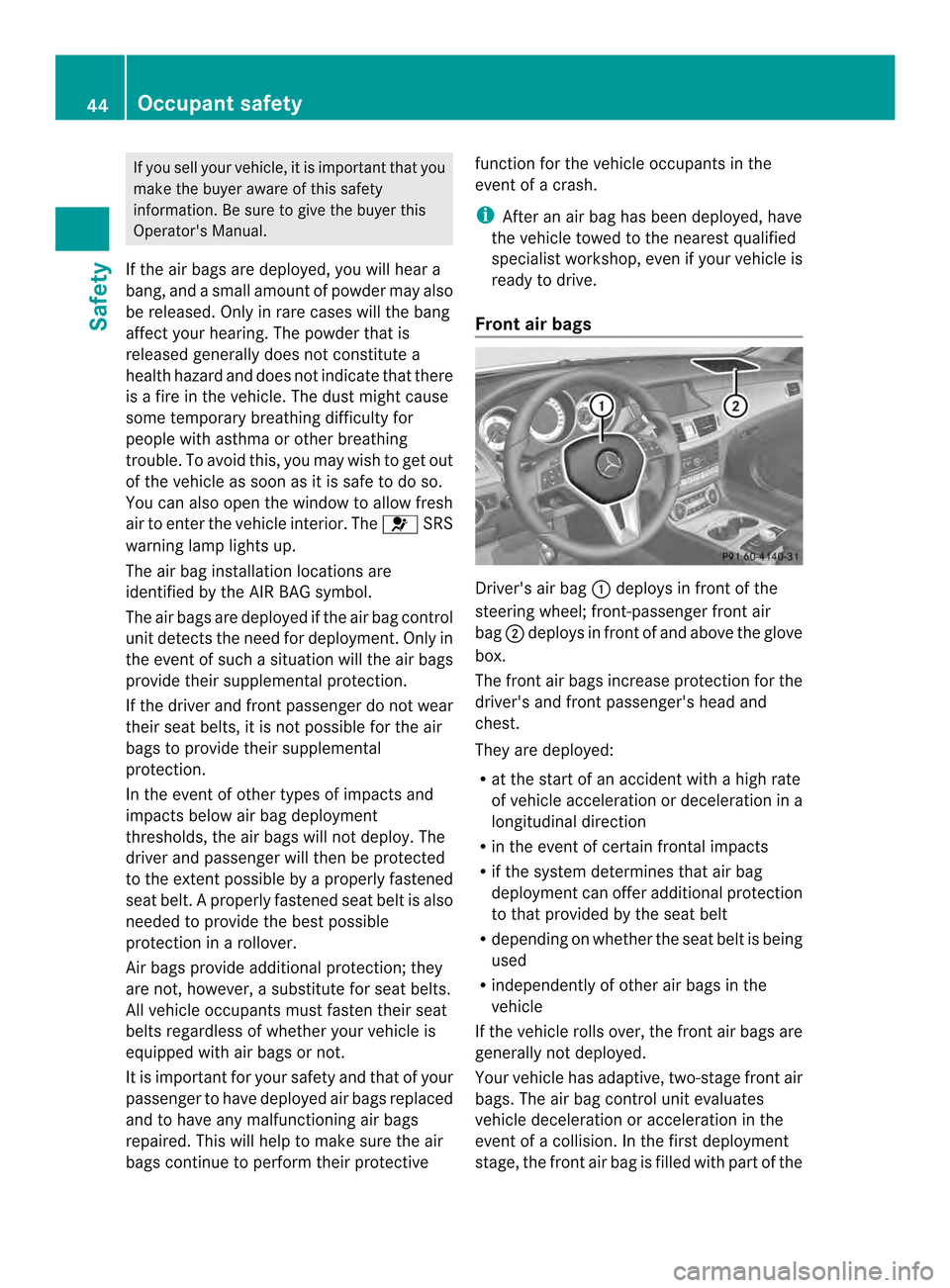
Front air bags Driver's air bag
001Adeploysinf ront of the
steering wheel; front-passenger front air
bag 0010deploysinf ront of and above the glove
box.
The front air bags increase protection for the
driver's and front passenger's head and
chest.
They are deployed:
R at the start of an accident with ahigh rate
of vehicle acceleration or deceleration in a
longitudinal direction
R in the event of certain frontal impacts
R if the system determines that air bag
deployment can offer additional protection
to that provided by the seat belt
R depending on whether the seat belt is being
used
R independently of other air bags in the
vehicle
If the vehicle rolls over, the front air bags are
generally not deployed.
Your vehicle has adaptive, two-stage front air
bags. The air bag control unit evaluates
vehicle deceleration or acceleration in the
event of acollision. In the first deployment
stage, the front air bag is filled with part of the 44
Occupant safetySafety
Page 47 of 382
tota
lavailable propellant gas, thereby
reducing the risk of injury .Ifthe ai rbag
control uni trecognize swithi naf ew
milliseconds tha tthe vehicle is being braked
or accelerated faster than originally
predicted, the front air bag is filled with the
maximum amount of propellant gas available.
The deployment of the front-passenger front
air bag is also influenced by the weight
category of the front passenger, which is
determined by the Occupant Classification
System (OCS) (Y page 47).
The lighter the passenger-side occupant, the
higher the vehicle deceleration rate required
(predicted at the start of the impact) for
second-stage inflation of the front-passenger
front air bag. In the second stage, the front
air bags are inflated with the maximum
amount of propellant gas available.
The front air bags are not deployed in
situations where alow impact severity is
predicted. You will then be protected by the
fastened seat belt.
The front-passenger front air bag will only
deploy if:
R the system, based on the OCS weight
sensor readings, detectst hat the front-
passenger seat is occupied
R the PASSENGER AIR BAG OFF indicator
lamp on the center console is not lit
(Y page 47)
R the air bag control unit predicts ahigh
impact severity
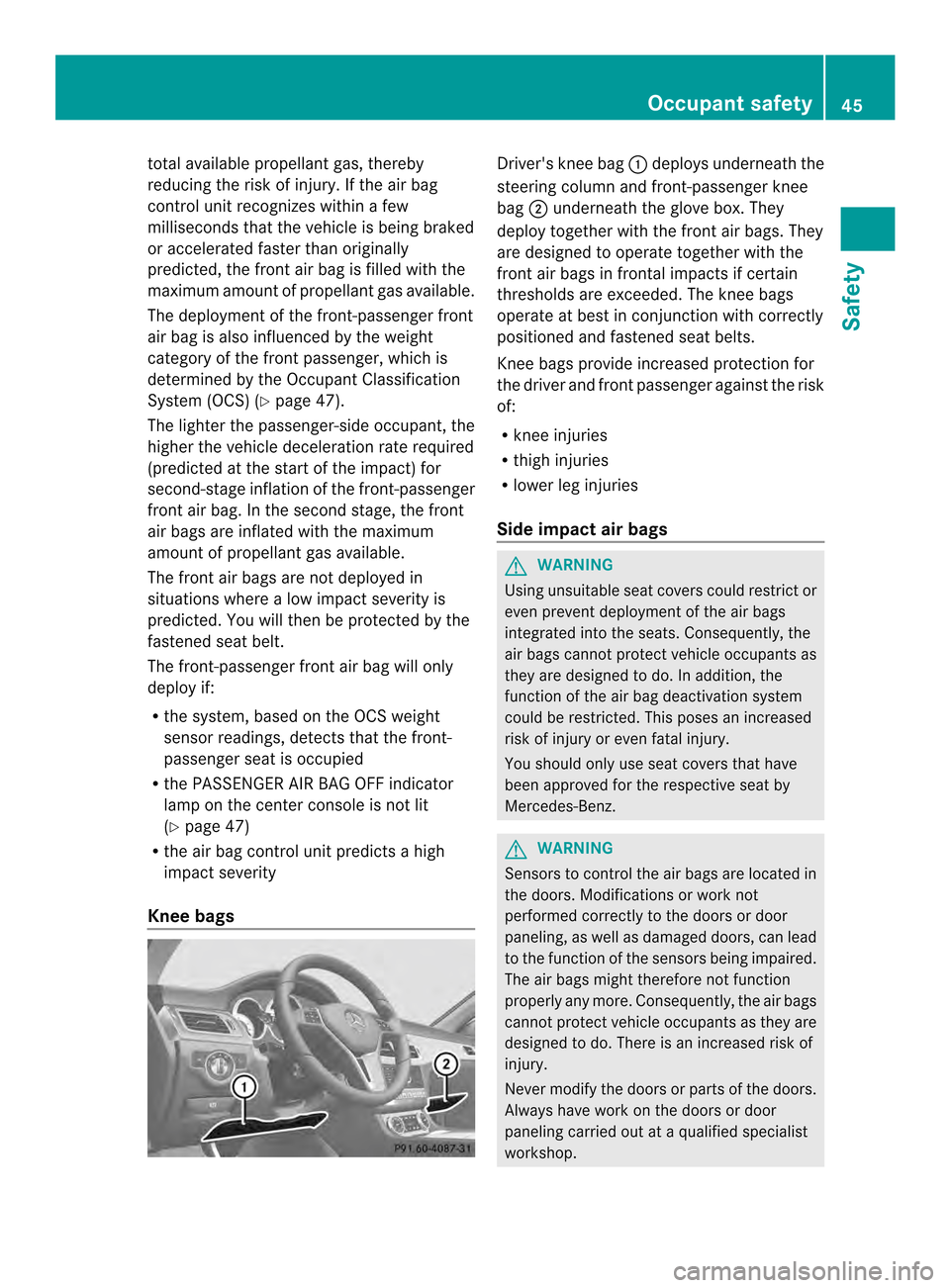
Knee bags Driver's knee bag
001Adeploysu nderneath the
steering column and front-passenger knee
bag 0010underneath the glove box. They
deploy together with the front air bags. They
are designed to operate together with the
front air bags in frontal impacts if certain
thresholds are exceeded. The knee bags
operate at best in conjunction with correctly
positioned and fastened seat belts.
Knee bags provide increased protection for
the driver and front passenger against the risk
of:
R knee injuries
R thigh injuries
R lower leg injuries
Side impact air bags G
WARNING
Using unsuitable seat covers could restrict or
even prevent deployment of the air bags
integrated into the seats. Consequently, the
air bags cannot protect vehicle occupants as
they are designed to do. In addition, the
function of the air bag deactivation system
could be restricted. This poses an increased
risk of injury or even fatal injury.
You should only use seat covers that have
been approved for the respective seat by
Mercedes-Benz. G
WARNING
Sensors to control the air bags are located in
the doors. Modifications or work not
performed correctly to the doors or door
paneling, as well as damaged doors, can lead
to the function of the sensors being impaired.
The air bags might therefore not function
properly any more. Consequently, the air bags
cannot protect vehicle occupants as they are
designed to do. There is an increased risk of
injury.
Never modify the doors or parts of the doors.
Always have work on the doors or door
paneling carried out at aqualified specialist
workshop. Occupant safety
45Safety Z
Page 51 of 382
Note the following important information if it
is necessary to carry achild on the front-
passenger seat:
R Your vehicle is equipped with air bag
technology designed to deactivate the
front-passenger front air bag and the front-
passenger knee bag in yourv ehicle when
the system senses the weight of atypical
12-month-old child or less along with the
weight of astandar dappropriate child
restraint on the front-passenger seat.
R Ac hild in arear-facing child restraint on the
front-passenger seat will be seriously
injured or even killed if the front-passenger
front air bag inflates in acollision which
could occur under some circumstances,
even with the air bag technology installed
in your vehicle. The only means to eliminate
this risk completely is never to place achild
in ar ear-facing child restraint in the front-
passenger seat. We therefore strongly
recommendt hat you always place achild
in ar ear-facing child restraint on the rear
seat.
R If you install arear-facing child restraint on
the front-passenger seat, make sure the
000F000B indicator lamp is illuminated,
indicating that the front-passenger front air
bag and front-passenger knee bag are
deactivated. Should the 000F000B
indicator lamp not illuminate or go out while
the restraint is installed, please check
installation. Periodicall ycheck the
000F000B indicator lamp while driving to
make sure that the 000F000Bindicator
lamp is illuminated. If the 000F000B
indicator lamp goes out or remains out, do
not transport achild on the front-passenger
seat until the system has been repaired.
Ac hild in arear-facing child restraint on the
front-passenger seat could be seriously
injured or even killed if the front-passenger
front air bag is deployed. R
If you place achild in aforward-facing child
restraint on the front-passenger seat:
- move the seat as far back as possible
- use the proper child restraint
recommended for the age, size and
weight of the child
- secure child restraint with the vehicle's
seat belt according to the child seat
manufacturer's instructions
R For children larger than the typical 12-
month-old child, the front-passenger front
air bag and the front-passenger knee bag
may or may not be activated. G
WARNING
If the red 0012SRS warning lamp in the
instrumentc luster and the 000F000B
indicator lamp light up simultaneously ,the
OCS is malfunctioning. The front passenger
front air bag and the front passenger knee bag
will be deactivated in this case. Have the
system checked by qualified technicians as
soon as possible. Contact an authorized
Mercedes-Ben zCenter.
Only have the seat repaired or replaced at an
authorized Mercedes-Ben zCenter.
In order to ensure proper operation of the air
bag system and OCS:
R Sit with the seat belt properly fastened in a
position that is as upright as possible with
your back against the seat backrest.
R When seated, apassenger should not
position him/herself in such away as to
cause the passenger' sweight to be lifted
from the seat cushion as this may result in
the OCS being unable to correctly
approximat ethe passenger' sweight
category.
R Read and observe all warnings in this
chapter. Occupant safety
49Safety Z
Page 52 of 382
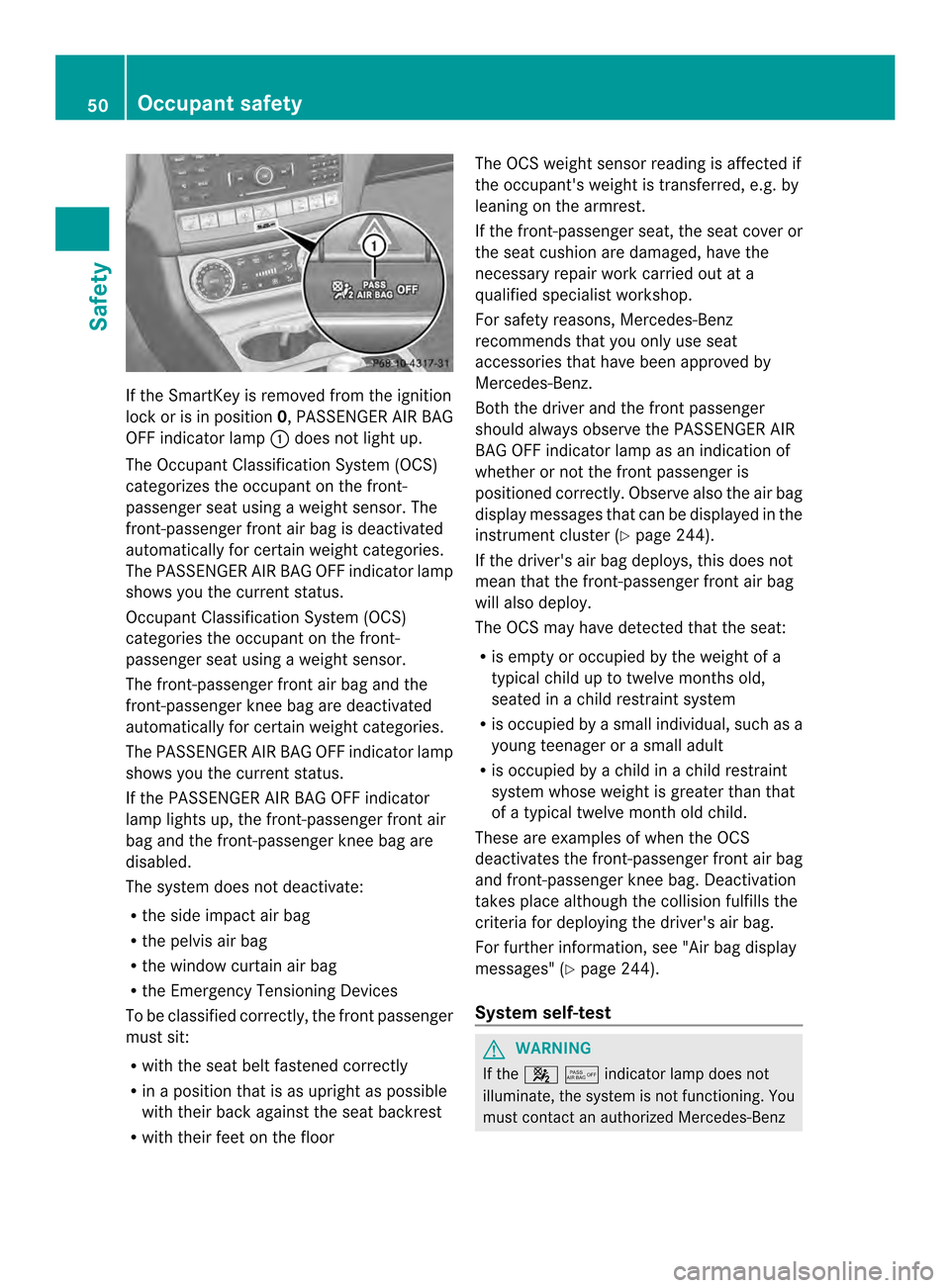
If the SmartKey is removed from the ignition
lock or is in position 0,PASSENGER AIR BAG
OFF indicator lamp 001Adoes not light up.
The Occupant Classification System (OCS)
categorize sthe occupant on the front-
passenge rseat using aweight sensor .The
front-passenger front air bag is deactivated
automatically for certain weight categories.
The PASSENGER AIR BAG OFF indicator lamp
shows you the current status.
Occupant Classification System (OCS)
categories the occupant on the front-
passenger seat using aweight sensor.
The front-passenger front air bag and the
front-passenger knee bag are deactivated
automatically for certain weight categories.
The PASSENGER AIR BAG OFF indicator lamp
shows you the current status.
If the PASSENGER AIR BAG OFF indicator
lamp lights up, the front-passenger front air
bag and the front-passenger knee bag are
disabled.
The system does not deactivate:
R the side impact air bag
R the pelvis air bag
R the window curtain air bag
R the Emergency Tensioning Devices
To be classified correctly, the front passenger
must sit:
R with the seat belt fastened correctly
R in ap osition that is as upright as possible
with their back against the seat backrest
R with their feet on the floor The OCS weight sensor reading is affected if
the occupant's weight is transferred, e.g. by
leaning on the armrest.
If the front-passenger seat, the seat cover or
the seat cushion are damaged, have the
necessary repair work carried out at a
qualified specialist workshop.
For safety reasons, Mercedes-Benz
recommends that you only use seat
accessories that have been approved by
Mercedes-Benz.
Both the driver and the front passenger
should always observe the PASSENGER AIR
BAG OFF indicator lamp as an indication of
whether or not the front passenger is
positioned correctly. Observe also the air bag
displaym essages that can be displayed in the
instrumentc luster (Ypage 244).
If the driver's air bag deploys, this does not
mean that the front-passenger front air bag
will also deploy.
The OCS may have detected that the seat:
R is empty or occupied by the weight of a
typical child up to twelve months old,
seated in achild restraint system
R is occupied by asmall individual, such as a
young teenager or asmall adult
R is occupied by achild in achild restraint
system whose weight is greater than that
of at ypical twelve montho ld child.
These are examples of when the OCS
deactivates the front-passenger front air bag
and front-passenger knee bag. Deactivation
takes place although the collision fulfills the
criteria for deploying the driver's air bag.
For further information ,see "Air bag display
messages" (Y page 244).
System self-test G
WARNING
If the 000F000Bindicator lamp does not
illuminate, the system is not functioning. You
must contac tanauthorized Mercedes-Benz 50
Occupant safetySafety
Page 53 of 382
Cente
rbefore seating any child on the front
passenger seat. G
WARNING
Objects between the seat surface and the
child restraint system could affect the
function of the OCS. This could result in the
front-passenger fron tair bag not functioning
as intended during an accident. This poses an
increased risk of injury or even fatal injury.
Do not place any objects between the seat
surface and the child restraint system. Make
sure that the bottom and back of the child
restraint system make full contact with the
front-passenger seat cushion and backrest.
Always comply with the child restraint system
manufacturer's installation instructions.
The PASSENGER AIR BAG OFF indicator lamp
lights up:
R if you turn the SmartKey in the ignition lock
to position 1or 2
R if you press the KEYLESS-GO Start/Stop
button onceort wice on vehicles with
KEYLESS-GO
R if an adult is seated properly on the front-
passenger seat and the OCS classifies the
occupant as an adult
The PASSENGER AIR BAG OFF indicator
lamp goes out again after approximately six
seconds.
If the seat is not occupied and the OCS
system detects that the front-passenger
seat is empty, the PASSENGER AIR BAG
OFF indicator lamp will continue to light up.
The PASSENGER AIR BAG OFF indicator
lamp will not go out.
For more information about the OCS, see
"Problems with the Occupant Classification
System "(Ypage 52). Occupant safety
51Safety Z
Page 54 of 382
Problems with the Occupant Classification System
G
WARNING
If the 000F000B indicator lamp illuminates and remains illuminated when the weight of atypical
adult or someone larger than asmall individual has been detected on the passenger seat, do not
allow any occupant to use the passenger seat until the system has been repaired. G
WARNING
If the 000F000B indicator lamp does not illuminate or remains out with the weight of atypical
12-month-old child in astandard child restraint or less, or is unoccupied, on the front-passenger
seat, do not transport achild on the front-passenger seat until the system has been repaired. Problem Possiblec
auses/consequencesa nd000B Solutions
The PASSENGER AIR
BAG OFF indicator
lights up and remains
on.
The person on the
front-passenger seat:
R
has the weight of a
typical adult
R has been determined
by the system not to
be achild The COS is malfunctioning.
X
Make sure that the front passenger is sitting in acorrect ,upright
position.
X Have the COS checked as soon as possible at aqualified
specialist workshop.
X Observe the additional displaym essages in the multifunction
display( Ypage 244). 52
Occupant safetySafety
Page 55 of 382
Problem Possible causes/consequences and
000B Solutions
The PASSENGER AIR
BAG OFF indicator
lamp does not light up
and/or does not stay
on.
The front-passenger
seat is:
R
unoccupied
R occupied with the
weight of achild up
to twelve months old
in ac hild restraint
system The COS is malfunctioning.
X
Make sure there is nothingb etween the seat cushion and the
child seat.
X Make sure that the backrest and base of the child restraint
system rest on the front-passenger seat. If necessary, adjust
the position of the front-passenger seat.
X When installing the child restraint system, make sure that the
seat belt is tight. Do not pull the seat belt tight with the front-
passenger seat adjustment .This could result in the seat belt
being pulledt oo tightly.
X Check the installation of the child restraint system.
X Make sure that no objectsa re applying additionalweight onto
the seat.
X If the PASSENGER AIR BAG OFF indicator lamp remains off, have
the COS checked immediatel yataqualified specialist
workshop. Do not transport achild on the front-passenger seat
until the COS has been repaired.
X Observ ethe additional display messages in the multifunction
display ( Ypage 244). NECK-PRO head restraints/NECK-
PRO luxur
yhead restraints
Importan tsafet ynotes G
WARNING
The function of the head restraint may be
impaired if you:
R attach objects such as coat hangers to the
head restraints, for example
R use head restraint covers
If you do so, the head restraint scannot fulfill
their intended protective function in the event
of an accident. In addition, objects attached
to the head restraint scould endanger other
vehicle occupants. There is an increased risk
of injury.
Do not attach any objects to the head
restraint sand do not use head restraint
covers.
NECK-PRO head restraints/NECK-PRO luxury
head restraint sincrease protection of the driver'
sand front-passenger's head and
neck. In the event of arear collision of a
certain severity, the NECK-PRO head
restraints/NECK-PRO luxury head restraints
on the driver' sand the front-passenger seats
are moved forwards and upwards. This
provides better head support.
If the NECK-PRO head restraints/NECK-PRO
luxury head restraint shave been triggered in
an accident, reset the NECK-PRO head
restraints/NECK-PRO luxury head restraints
on the driver' sand front-passenger seats
(Y page 54). Otherwise, the additional
protection will not be available in the event of
another rear-end collision. NECK-PRO head
restraints/NECK-PRO luxury head restraints
that have been triggered are moved forwards
and can no longer be adjusted.
Mercedes-Benz recommends that you have
the NECK-PRO head restraints/NECK-PRO
luxury head restraint schecked at aqualified
specialist workshop after arear-end collision. Occupant safety
53Safety Z
Page 57 of 382
R
if, on vehicles with DISTRONIC PLUS ,the
radar sensor system detect sanimminent
dange rofcollision in certain situations.
R in critical driving situations, e.g. when
physical limits are exceeded and the
vehicle understeers or oversteers severely.
PRE-SAFE ®
takes the following measures
depending on the hazardous situation
detected:
R the front seat belts are pre-tensioned.
R the front-passenger seat is adjusted if it is
in an unfavorable position.
R vehicles with amulticontour seat or active
multicontour seat: the air pressure in the
side bolsters of the seat cushion and
backrest is increased.
R if the vehicle skids, the sliding sunroof and
the side windows are closed so that only a
small gap remains.
If the hazardous situation passes without
resulting in an accident ,PRE-SAFE ®
slackens
the belt pre-tensioning. The air pressure in
the side bolsters on the multicontour seat/
active multicontour seat is reduced again. All
settings made by PRE-SAFE ®
can then be
reversed.
If the seat belts are not released:
X When the vehicle is stationary, move the
backrest or seat back slightly.
The seat belt pre-tensionin gisreduced and
the lockin gmechanism is released.
Information about seat belt adjustment, a
convenienc efunction integrated into PRE-
SAFE ®
,c an be found in the "Seat belt
adjustment" section (Y page 57).Seat belts
Important safety notes G
WARNING
The seat belt does not offer the intended level
of protection if the backrest is not in the
upright position. When braking or in the event of an accident
,you could slide underneath the
seat belt and sustain abdomen or neck
injuries, for example. This poses an increased
risk of injury or even fatal injury.
Adjust the seat properly before beginning
your journey. Always make sure that the seat
is in the upright position. G
WARNING
Seat belts cannot protect as intended, if:
R they are damaged, extremely dirty,
bleached or dyed
R the seat belt buckle is damaged or
extremely dirty
R the Emergency Tensionin gDevices or the
belt anchorage has been modified.
Damage caused to seat belts in an accident
may not be visible, e.g. by splinters of glass.
Modified or damaged seat belts can tear or
fail, for example in the event of an accident.
Modified Emergency Tensionin gDevices may
be deployed unintentionally or fail to be
deployed when required. There is an
increased risk of injury, possibly even fatal.
Never modify seat belts, Emergency
Tensionin gDevices, seat belt anchorages and
inertia reels. Ensure that seat belts are not
damaged or worn and are clean.
Only use seat belts that have been approved
for your vehicle by Mercedes-Benz.
The use of seat belts and infant and child
restraint systems is required by law in:
R all 50 states
R the U.S. territories
R the District of Columbia
R all Canadia nprovinces
Even where this is not required by law,a ll
vehicl eoccupants should correctly fasten
their seat belts before starting the journey.
i See "Children in the vehicle"
(Y page6 0) for further information on
infants and children traveling in the vehicle
as wellasonc hild restraint systems. Occupant safety
55Safety Z
Page 60 of 382

Bel
theight adjustment Yo
uc an adjus tthe seat belt height on the
front seats. Adjust the belt to aheight that
allowst he upper part of the seat belt to be
routed across the center of your shoulder.
X To raise: slide the belt sash guide upwards.
The belt sash guide engages in various
positions.
X To lower: press and hold belt sash guide
release 001A.
X Slide the belt sash guide downwards.
X Release belt sash guide release 001Aand
make sure that the belt sash guide has
engaged.
Releasing seat belts !
Make sure that the seat belt is fully rolled
up. Otherwise, the seat belt or belt tongue
will be trapped in the door or in the seat
mechanism. This could damage the door,
the door trim panel and the seat belt.
Damaged seat belts can no longer fulfill
their protective function and must be
replaced. Visit aqualified specialist
workshop. X
Press release button 0021on belt buckle 0024.
X Guideb elt tongue 0010to belt sash
guide 001A.
Belt warning for the driver and front
passenger Regardless of whether the driver's and front-
passenger seat belts have already been
fastened, the
0013seat belt warning lamp
lights up for six seconds each time the engine
is started. It then goes out if the driver and
the front passenger have already fastened
their seat belts.
If the driver's seat belt is not fastened when
the engine is started, an additional warning
tone will sound. This warning tone stops after
am aximum of six seconds or once the
driver's seat belt is fastened.
If after six seconds, the driver or front
passenger have not fastened their seat belts
and the doors are closed:
R the 0013 seat belt warning lamp remains lit
as long as the driver's or front-passenger's
seat belt is not fastened
and
R ifav ehicle speed of 15 mph (25 km/h) is
exceeded, the 0013seat belt warning lamp
begins to flash. Awarning tone also sounds
wit hincreasing intensit yfor am aximum of 58
Occupant safetySafety