light MERCEDES-BENZ CLS COUPE 2008 Owners Manual
[x] Cancel search | Manufacturer: MERCEDES-BENZ, Model Year: 2008, Model line: CLS COUPE, Model: MERCEDES-BENZ CLS COUPE 2008Pages: 329, PDF Size: 29.26 MB
Page 284 of 329
Flat tyre
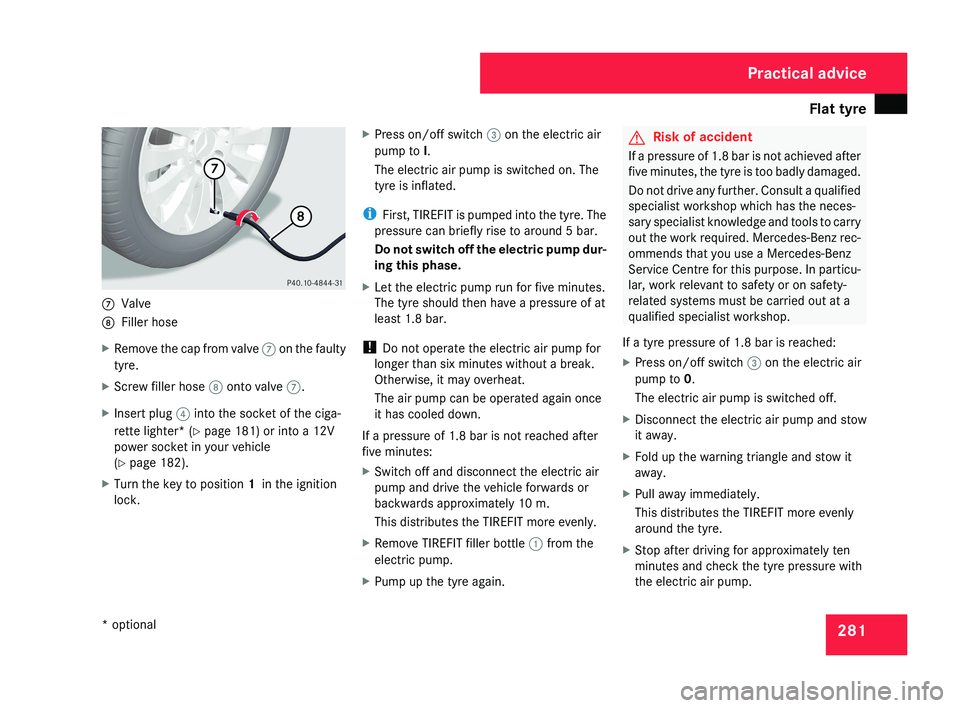
2817
Valve
8 Filler hose
X Remove the cap from valve 7 on the faulty
tyre.
X Screw filler hose 8 onto valve 7.
X Insert plug 4 into the socket of the ciga-
rette lighter* (Y page 181) or into a 12V
power socket in your vehicle
(Y page 182).
X Turn the key to position 1 in the ignition
lock. X
Press on/off switch 3 on the electric air
pump to I.
The electric air pump is switched on. The
tyre is inflated.
i First, TIREFIT is pumped into the tyre. The
pressure can briefly rise to around 5 bar.
Do not switch off the electric pump dur-
ing this phase.
X Let the electric pump run for five minutes.
The tyre should then have a pressure of at
least 1.8 bar.
! Do not operate the electric air pump for
longer than six minutes without a break.
Otherwise, it may overheat.
The air pump can be operated again once
it has cooled down.
If a pressure of 1.8 bar is not reached after
five minutes:
X Switch off and disconnect the electric air
pump and drive the vehicle forwards or
backwards approximately 10 m.
This distributes the TIREFIT more evenly.
X Remove TIREFIT filler bottle 1 from the
electric pump.
X Pump up the tyre again.
G Risk of accident
If a pressure of 1.8 bar is not achieved after
five minutes, the tyre is too badly damaged.
Do not drive any further. Consult a qualified
specialist workshop which has the neces-
sary specialist knowledge and tools to carry
out the work required. Mercedes-Benz rec-
ommends that you use a Mercedes-Benz
Service Centre for this purpose. In particu-
lar, work relevant to safety or on safety-
related systems must be carried out at a
qualified specialist workshop.
If a tyre pressure of 1.8 bar is reached:
X Press on/off switch 3 on the electric air
pump to 0.
The electric air pump is switched off.
X Disconnect the electric air pump and stow
it away.
X Fold up the warning triangle and stow it
away.
X Pull away immediately.
This distributes the TIREFIT more evenly
around the tyre.
X Stop after driving for approximately ten
minutes and check the tyre pressure with
the electric air pump.
Practical advice
* optional
219_AKB; 2; 4, en-GB
mkalafa,
2007-11-13T09:28:36+01:00 - Seite 281
Page 289 of 329
Flat tyre
286
X
Screw union nut 5 on air hose 4 onto the
valve.
X Insert plug 3 into the cigarette lighter
socket* ( Y page 181) or into a 12V socket
in your vehicle ( Y page 182).
X Make sure that the key is in position 2 in
the ignition lock.
X Press on/off switch 2 on the electric air
pump to I.
The electric air pump is switched on. The
tyre is inflated.
X When a tyre pressure of 3.5 bar has been
reached, press 0 on the electric air pump
switch.
The electric air pump is switched off.
! Do not operate the electric air pump for
longer than six minutes without a break.
Otherwise, it may overheat.
The air pump can be operated again once
it has cooled down.
If the tyre pressure is higher than 3.5 bar: X
Open the pressure release screw on the
pressure gauge until the tyre pressure is
correct.
X Disconnect the electric air pump and stow
it away.
Lowering the vehicle X
Lower the vehicle. To do this, turn the crank
of the jack anti-clockwise until the vehicle
is standing firmly on the ground again.
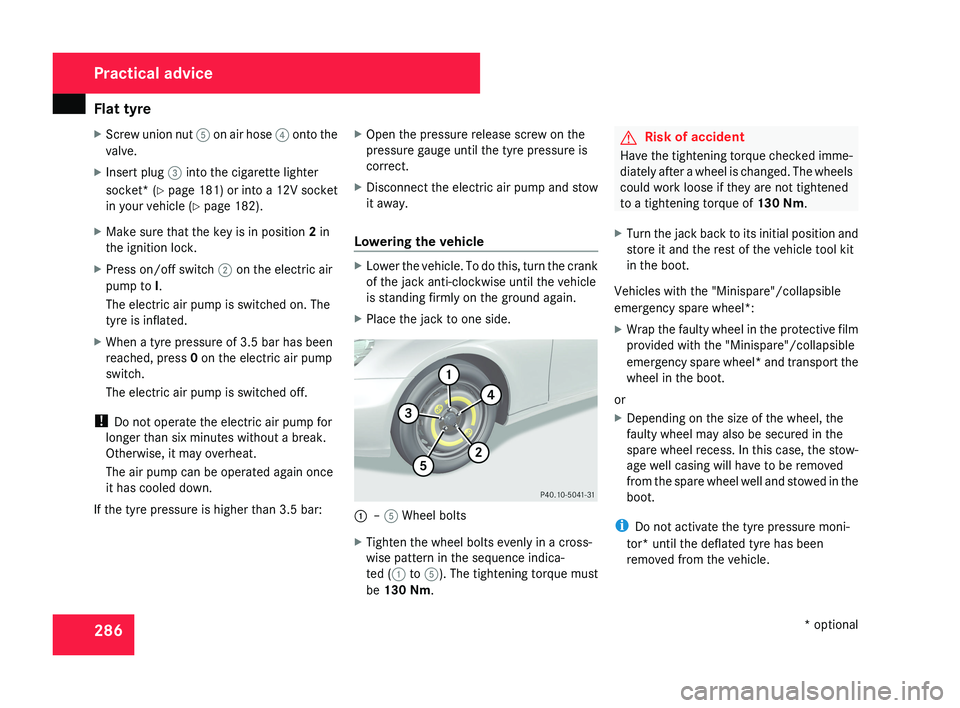
X Place the jack to one side. 1
– 5 Wheel bolts
X Tighten the wheel bolts evenly in a cross-
wise pattern in the sequence indica-
ted ( 1 to 5). The tightening torque must
be 130 Nm. G
Risk of accident
Have the tightening torque checked imme-
diately after a wheel is changed. The wheels
could work loose if they are not tightened
to a tightening torque of 130 Nm.
X Turn the jack back to its initial position and
store it and the rest of the vehicle tool kit
in the boot.
Vehicles with the "Minispare"/collapsible
emergency spare wheel*:
X Wrap the faulty wheel in the protective film
provided with the "Minispare"/collapsible
emergency spare wheel* and transport the
wheel in the boot.
or
X Depending on the size of the wheel, the
faulty wheel may also be secured in the
spare wheel recess. In this case, the stow-
age well casing will have to be removed
from the spare wheel well and stowed in the
boot.
i Do not activate the tyre pressure moni-
tor* until the deflated tyre has been
removed from the vehicle. Practical advice
* optional
219_AKB; 2; 4, en-GB
mkalafa,
2007-11-13T09:28:36+01:00 - Seite 286
Page 295 of 329
Jump-starting
292 G
Risk of injury
There is a risk of acid burns when jump-
starting a vehicle due to the gases which
escape from the battery. Do not lean over
the battery while the engine is being jump-
started. G
Risk of explosion
Gases escaping from the battery during
jump-starting may cause minor explosions.
Avoid creating sparks. Keep naked flames
away from the battery, and do not smoke.
Comply with safety precautions and take
protective measures when handling batter-
ies. You will find these under “Battery” in
the index.
X Make sure that the two vehicles do not
touch.
X Depress the parking brake.
X Move the selector lever to P.
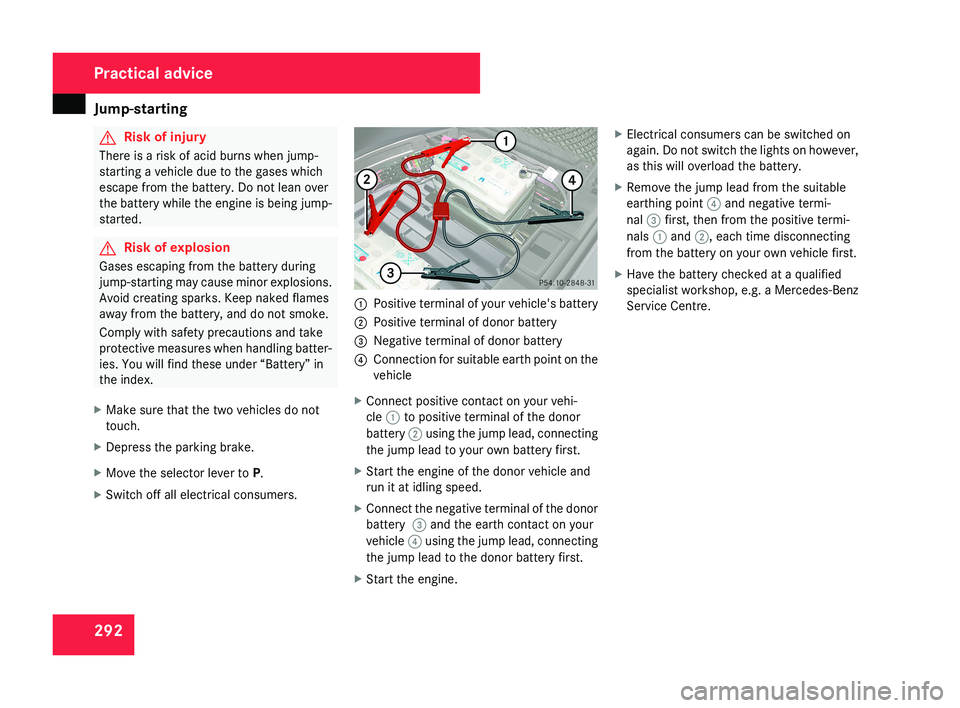
X Switch off all electrical consumers.1 Positive terminal of your vehicle's battery
2 Positive terminal of donor battery
3 Negative terminal of donor battery
4 Connection for suitable earth point on the
vehicle
X Connect positive contact on your vehi-
cle 1 to positive terminal of the donor
battery 2 using the jump lead, connecting
the jump lead to your own battery first.
X Start the engine of the donor vehicle and
run it at idling speed.
X Connect the negative terminal of the donor
battery 3 and the earth contact on your
vehicle 4 using the jump lead, connecting
the jump lead to the donor battery first.
X Start the engine. X
Electrical consumers can be switched on
again. Do not switch the lights on however,
as this will overload the battery.
X Remove the jump lead from the suitable
earthing point 4 and negative termi-
nal 3 first, then from the positive termi-
nals 1 and 2, each time disconnecting
from the battery on your own vehicle first.
X Have the battery checked at a qualified
specialist workshop, e.g. a Mercedes-Benz
Service Centre.
Practical advice
219_AKB; 2; 4, en-GB
mkalafa,
2007-11-13T09:28:36+01:00 - Seite 292