boot MERCEDES-BENZ CLS COUPE 2010 Owner's Guide
[x] Cancel search | Manufacturer: MERCEDES-BENZ, Model Year: 2010, Model line: CLS COUPE, Model: MERCEDES-BENZ CLS COUPE 2010Pages: 337, PDF Size: 7.36 MB
Page 289 of 337
Do not start the engine at any time while the
wheel is being changed.
Do not lie under the vehicle when it is being
supported by the jack. If you do not raise the
vehicle as described, it could slip off the jack
(e.g. if the engine is started or a door or the
boot lid is opened or closed
)and seriously
injure you. G
Ris
kofa ccident
If you fail to position the jack correctly, the
vehicle may:
R slip off the jack
R injure you or others
R be damaged.
Therefore, make sure that the jac kis posi-
tioned correctly in the respective jacking
points. Before positioning the jack, remove
any dirt that may have collected in the jacking
points. Please note that you must position the
jack in the opening of the jacking point. X
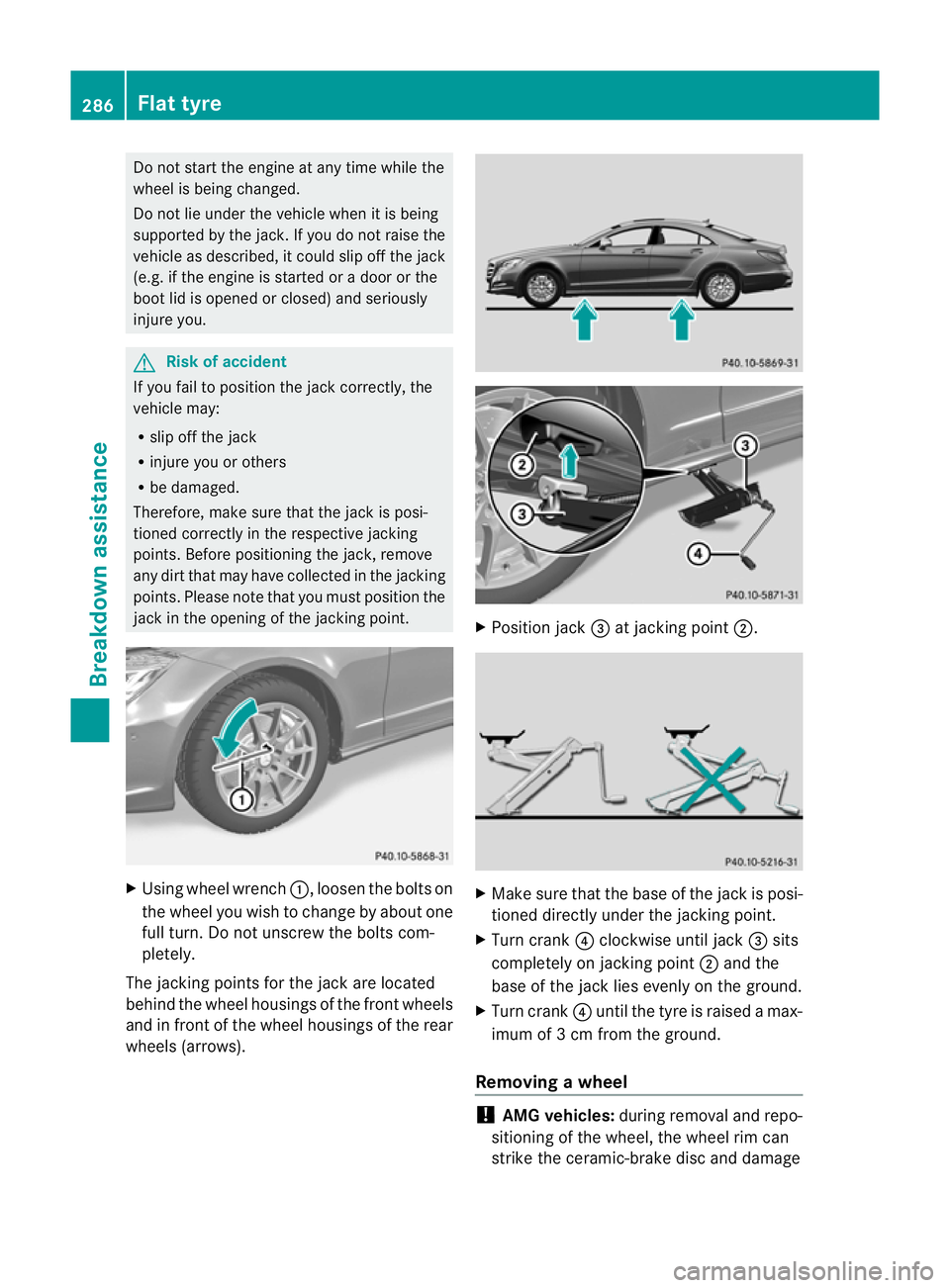
Using wheel wrench :, loosen the bolts on
the wheel you wish to change by abouto ne
full turn. Do not unscrew the bolts com-
pletely.
The jacking points for the jack are located
behind the wheel housings of the front wheels
and in front of the wheel housings of the rear
wheels (arrows). X
Positio njack =at jacking point ;. X
Make sure that the base of the jac kis posi-
tioned directly under the jacking point.
X Turn crank ?clockwise until jack =sits
completely on jacking point ;and the
base of the jack lies evenly on the ground.
X Turn crank ?until the tyre is raised a max-
imum of 3 cm from the ground.
Removing awheel !
AMG vehicles: during removal and repo-
sitioning of the wheel, the wheel rim can
strike the ceramic-brake disc and damage 286
Flat tyreBreakdown assistance
Page 292 of 337
X
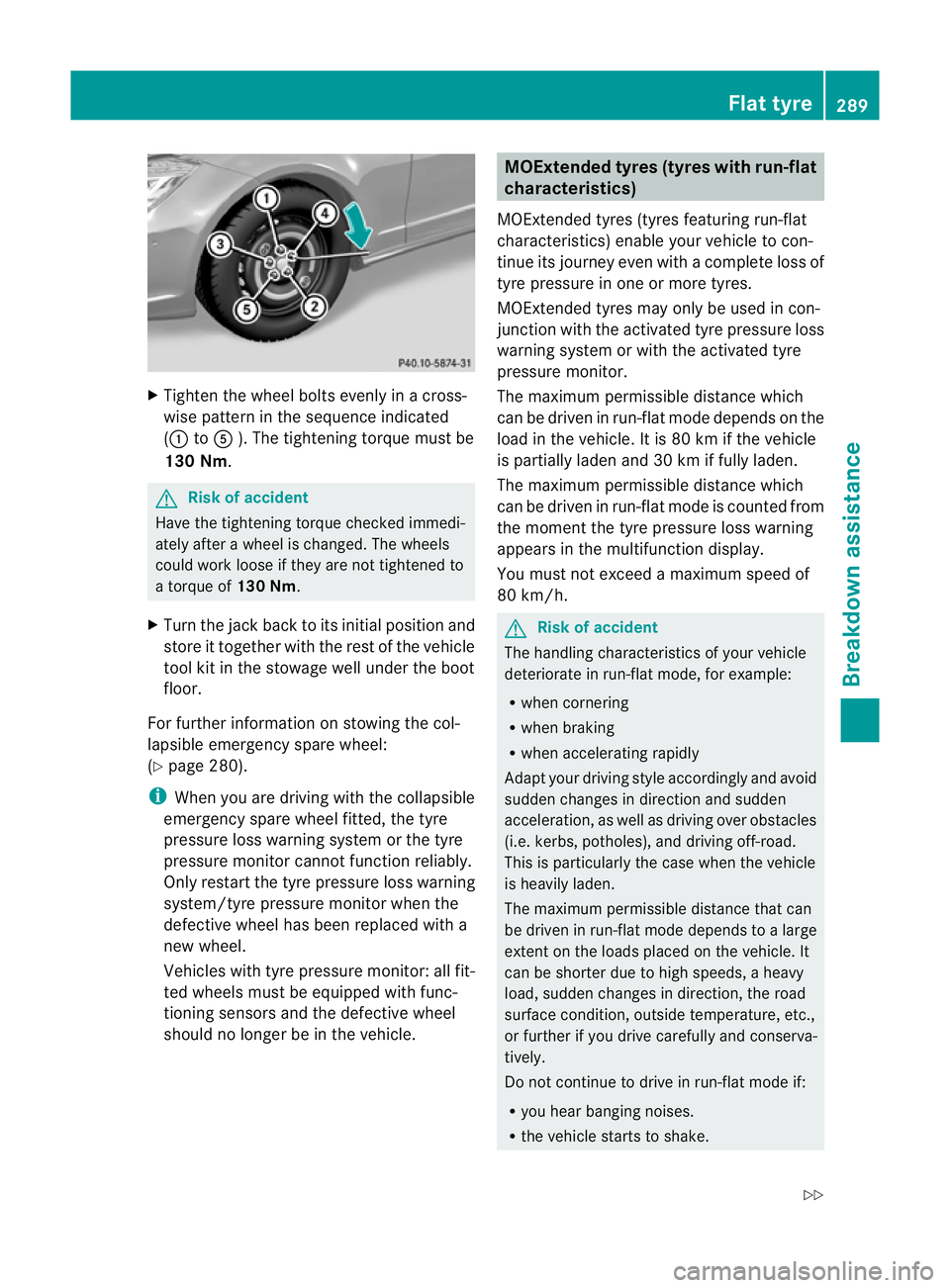
Tighten the wheel bolts evenly in a cross-
wise pattern in the sequence indicated
(: toA ). The tightening torque must be
130 Nm. G
Risk of accident
Have the tightening torque checked immedi-
ately after a wheel is changed. The wheels
could work loose if they are not tightened to
a torque of 130 Nm.
X Turn the jack back to its initial position and
store it together with the rest of the vehicle
tool kit in the stowage well under the boot
floor.
For further information on stowing the col-
lapsible emergency spare wheel:
(Y page 280).
i When you are driving with the collapsible
emergency spare wheel fitted, the tyre
pressure loss warning system or the tyre
pressure monitor cannot function reliably.
Only restart the tyre pressure loss warning
system/tyre pressure monitor when the
defective wheel has been replaced with a
new wheel.
Vehicles with tyre pressure monitor: all fit-
ted wheels must be equipped with func-
tioning sensors and the defective wheel
should no longer be in the vehicle. MOExtended tyres (tyres with run-flat
characteristics)
MOExtended tyres (tyres featuring run-flat
characteristics) enable your vehicle to con-
tinue its journey even with a complete loss of
tyre pressure in one or more tyres.
MOExtended tyres may only be used in con-
junction with the activated tyre pressure loss
warning system or with the activated tyre
pressure monitor.
The maximum permissible distance which
can be driven in run-flat mode depends on the
load in the vehicle. It is 80 km if the vehicle
is partially laden and 30 km if fully laden.
The maximum permissible distance which
can be driven in run-flat mode is counted from
the moment the tyre pressure loss warning
appears in the multifunction display.
You must not exceed a maximum speed of
80 km/h. G
Risk of accident
The handling characteristics of your vehicle
deteriorate in run-flat mode, for example:
R when cornering
R when braking
R when accelerating rapidly
Adapt your driving style accordingly and avoid
sudden changes in direction and sudden
acceleration, as well as driving over obstacles
(i.e. kerbs, potholes), and driving off-road.
This is particularly the case when the vehicle
is heavily laden.
The maximum permissible distance that can
be driven in run-flat mode depends to a large
exten tonthe loads placed on the vehicle. It
can be shorter due to high speeds, a heavy
load, sudden changes in direction, the road
surface condition, outside temperature, etc.,
or further if you drive carefully and conserva-
tively.
Do not continue to drive in run-flat mode if:
R you hear banging noises.
R the vehicle starts to shake. Flat tyre
289Breakdown assistance
Z
Page 301 of 337
X
Switch on the hazard warning lamps
(Y page 101).
X Leave the key in position 2in the ignition
lock.
i Whe ntowing with the hazard warning
lamps switched on, use the combination
switch as usual to signal achange of direc-
tion. In this case, only the turn signals for
the desired direction flash. When the com-
bination switch is reset, the hazard warning
lamps start flashing again. Transporting the vehicle
The towing eye can be used to pull the vehicle
onto a trailer or transporter for transporting
purposes.
X Vehicles with automatic transmission:
turn the key to position 2in the ignition
lock.
X Shift the automatic transmission to posi-
tion N.
As soon as the vehicle is loaded:
X Prevent the vehicle from rolling away by
applying the parking brake.
X Turn the key in the ignition lock to position
0and remove the key from the ignition
lock.
X Secure the vehicle.
! Only lash the vehicle down by the wheels
or wheel rims, not by parts of the vehicle
such as axle or steering components. Oth-
erwise, the vehicle could be damaged. Electrical fuses
Important safety notes
The fuses in your vehicle serve to close down
faulty circuits. If afuse blows, all the compo-
nents on the circuit and their functions will
fail. G
Risk of fire
Only use fuses that have been approved for
Mercedes-Ben zvehicles and which have the
correct fuse rating for the systems con-
cerned. Do not attempt to repair or bridge
faulty fuses. Otherwise, a circuit overload
could cause a fire. Have the cause traced and
rectified at a qualified specialist workshop,
e.g. a Mercedes-Benz Service Centre.
Blown fuses must be replaced with fuses of
the same rating, which you can recognise by
the colour and value. The fuse ratings are lis-
ted in the fuse allocation chart .AMercedes-
BenzS ervice Centre will be happy to advise
you.
If the newly inserted fuse also blows, have the
cause traced and rectified at a qualified spe-
cialist workshop, e.g. a Mercedes-Benz
Service Centre.
! Only use fuses that have been approved
for Mercedes-Benzv ehicles and which
have the correct fuse rating for the system
concerned. Otherwise, components or sys-
tems could be damaged. Before changing a fuse
X Park the vehicle and apply the parking
brake.
X Switch off all electrical consumers.
X Remove the key from the ignition lock.
The fuses are located in various fuse boxes:
R fuse box in the engine compartment on the
left-hand side of the vehicle, when viewed
in the direction of travel
R fuse box in the boot on the right when
viewed in the direction of travel
The fuse allocation chart is located in the
vehicle tool kit (Y page 279) in the stowage
compartment under the boot floor. 298
Electrical fusesBreakdown assistance
Page 302 of 337
Fuse box in the engine compartment
X Make sure that the windscree nwipers are
turned off. G
Risk of injury
Make sure that the windscreen wipers are
turned off and the key is pulled out of the igni-
tion lock before you open the cover of the fuse
box. Otherwise, the windscreen wipers and
the wiper rods above the cover could be set
in motion. This could lead to you or others
being injured by the wiper rods.
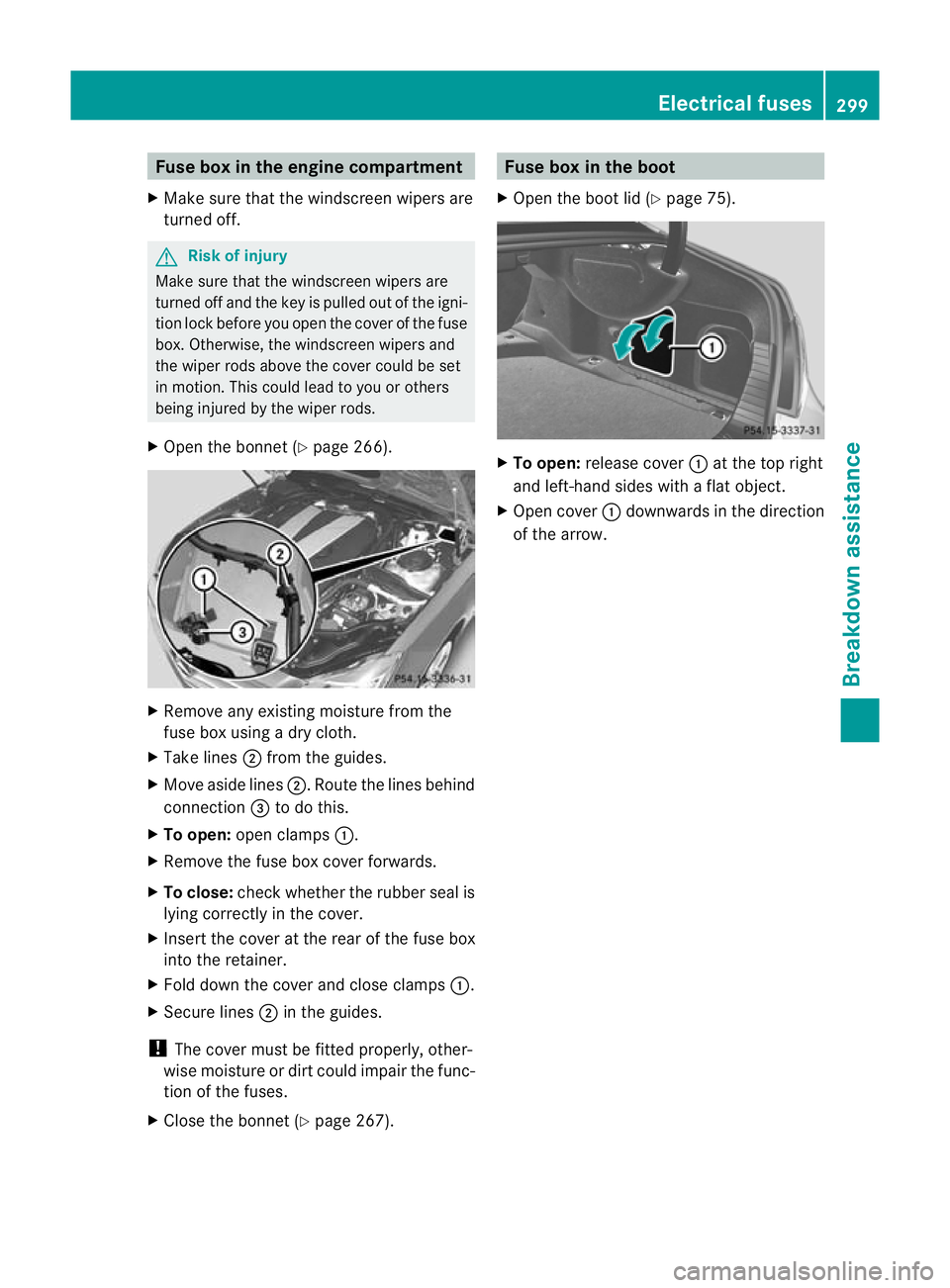
X Open the bonnet (Y page 266).X
Remove any existing moisture fro mthe
fuse box using a dry cloth.
X Take lines ;from the guides.
X Move aside lines ;.Route the lines behind
connection =to do this.
X To open: open clamps :.
X Remove the fuse box cover forwards.
X To close: check whether the rubber seal is
lying correctly in the cover.
X Insert the cover at the rear of the fuse box
into the retainer.
X Fold down the cover and close clamps :.
X Secure lines ;in the guides.
! The cover must be fitted properly, other-
wise moisture or dirt could impair the func-
tion of the fuses.
X Close the bonnet (Y page 267). Fuse box in the boot
X Open the boot lid (Y page 75). X
To open: release cover :at the top right
and left-hand sides with a flat object.
X Open cover :downwards in the direction
of the arrow. Electrical fuses
299Breakdown assistance Z
Page 318 of 337
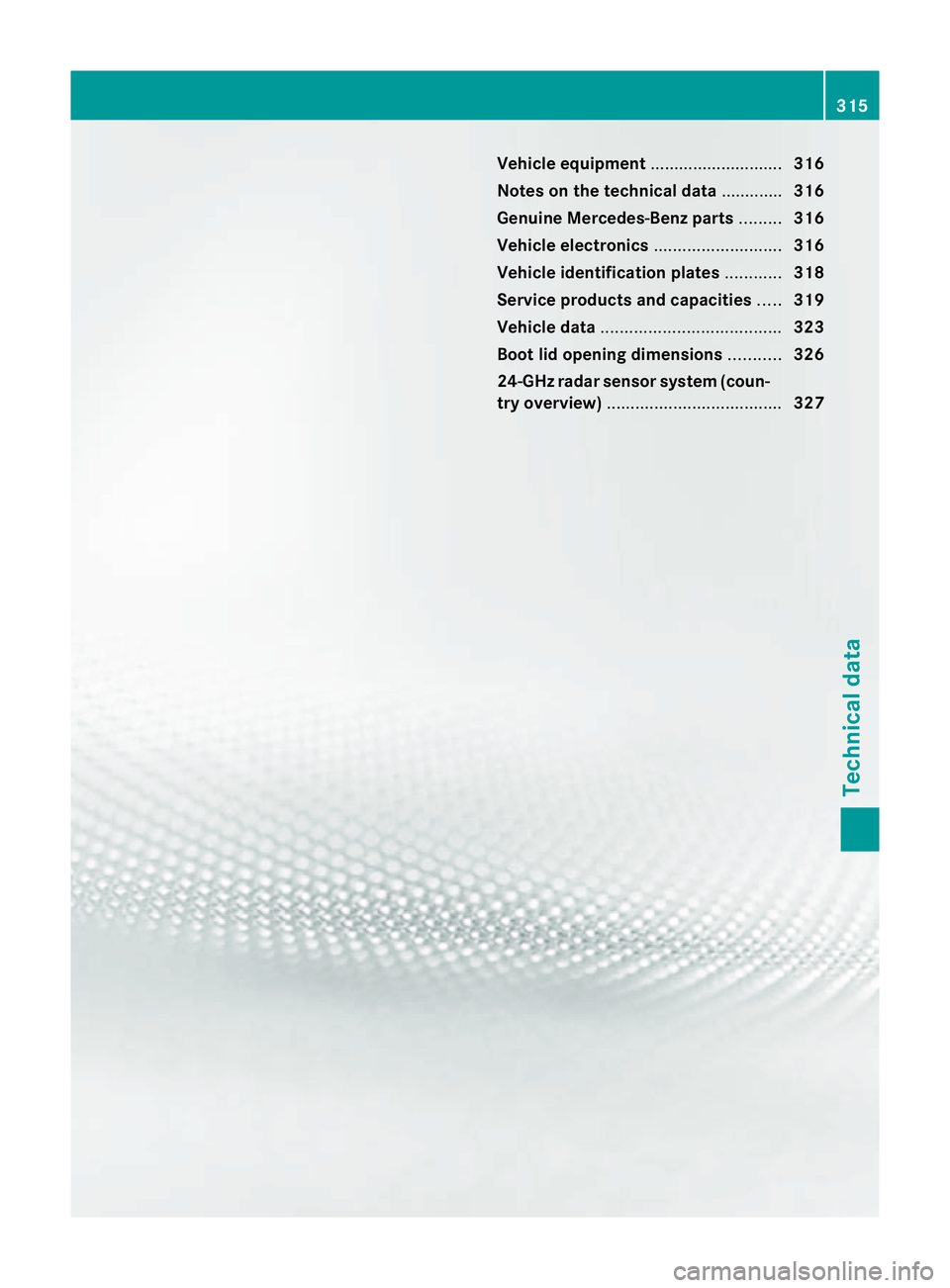
Vehicle equipment
............................316
Notes on the technical data .............316
Genuine Mercedes-Benz parts .........316
Vehicle electronics ...........................316
Vehicle identification plates ............318
Service products and capacities .....319
Vehicle data ...................................... 323
Boot lid opening dimensions ...........326
24-GHz radar sensor system (coun-
tryo verview) ..................................... 327 315Technical data
Page 320 of 337
ist workshop, e.g. a Mercedes-Ben
zService
Centre. Vehicle componentsm ay other-
wise wear more quickly and the vehicle's
operating permit may be invalidated. Retrofitting of two-way radios and
mobile phones (RF transmitters)
Use the Technical Specification
ISO/TS 21609 45
implementation regulation
when retrofitting RF (radio frequency) trans-
mitters.
If your vehicle has fittings for two-way radio
equipmen t(e.g. taxis, hire cars or official vehi-
cles), use the power supply or aerial connec-
tions intended for use with the basic wiring.
Be sure to observe the manufacturer's addi-
tional instructions when installing the fittings.
! Have aftermarket radio frequency trans-
mitting equipment installed at a qualified
specialist workshop. Mercedes-Benzr ec-
ommends that you use a Mercedes-Benz
Service Centre for this purpose.
The transmission output at the aerial base
must not exceed the maximum values below. Waveband Maximum trans-
mission output
(PEAK)
Short wave (f <
54 MHz) 100 W
4 m waveband 30 W
2 m waveband 50 W
Trunked radio/Tetra 35 W
70 cm waveband 35 W
GSM 900/AMPS 10 W
GSM 1800 10 W
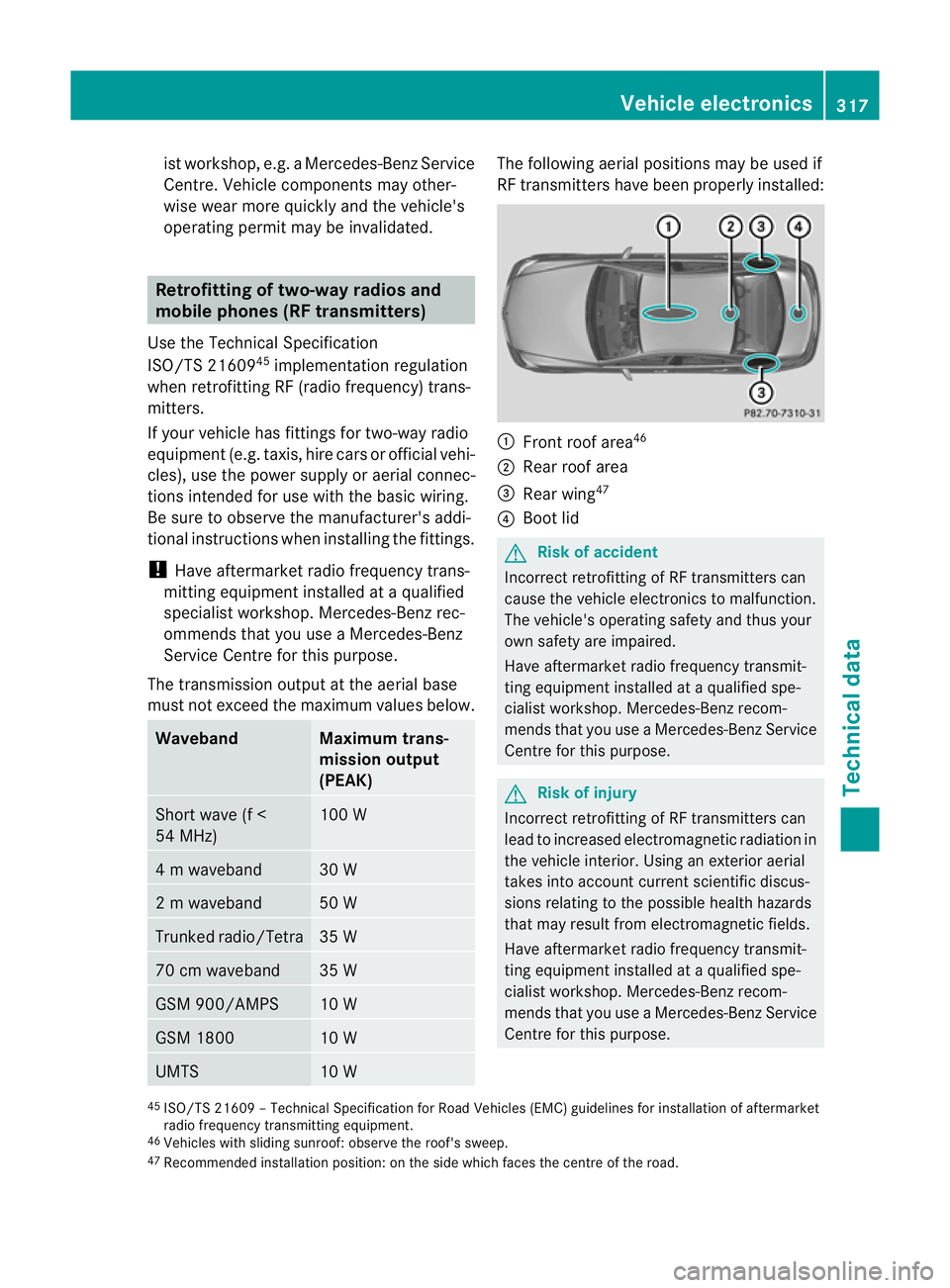
UMTS 10 W The following aerial positions may be used if
RF transmitters have been properly installed:
:
Front roof area 46
; Rear roof area
= Rear wing 47
? Boot lid G
Risk of accident
Incorrect retrofitting of RF transmitters can
cause the vehicle electronics to malfunction.
The vehicle's operating safety and thus your
own safety are impaired.
Have aftermarket radio frequency transmit-
ting equipment installed at a qualified spe-
cialist workshop. Mercedes-Benz recom-
mends that you use a Mercedes-Benz Service
Centre for this purpose. G
Risk of injury
Incorrect retrofitting of RF transmitters can
lead to increased electromagnetic radiation in
the vehicle interior. Using an exterior aerial
takes into account current scientific discus-
sions relating to the possible health hazards
that may result from electromagnetic fields.
Have aftermarket radio frequency transmit-
ting equipment installed at a qualified spe-
cialist workshop. Mercedes-Benz recom-
mends that you use a Mercedes-Benz Service
Centre for this purpose.
45 ISO/TS 2160 9–Technical Specification for Road Vehicles (EMC) guidelines for installation of aftermarket
radio frequency transmitting equipment.
46 Vehicles with sliding sunroof: observe the roof's sweep.
47 Recommended installation position: on the side which faces the centre of the road. Vehicle electronics
317Technical data Z
Page 326 of 337
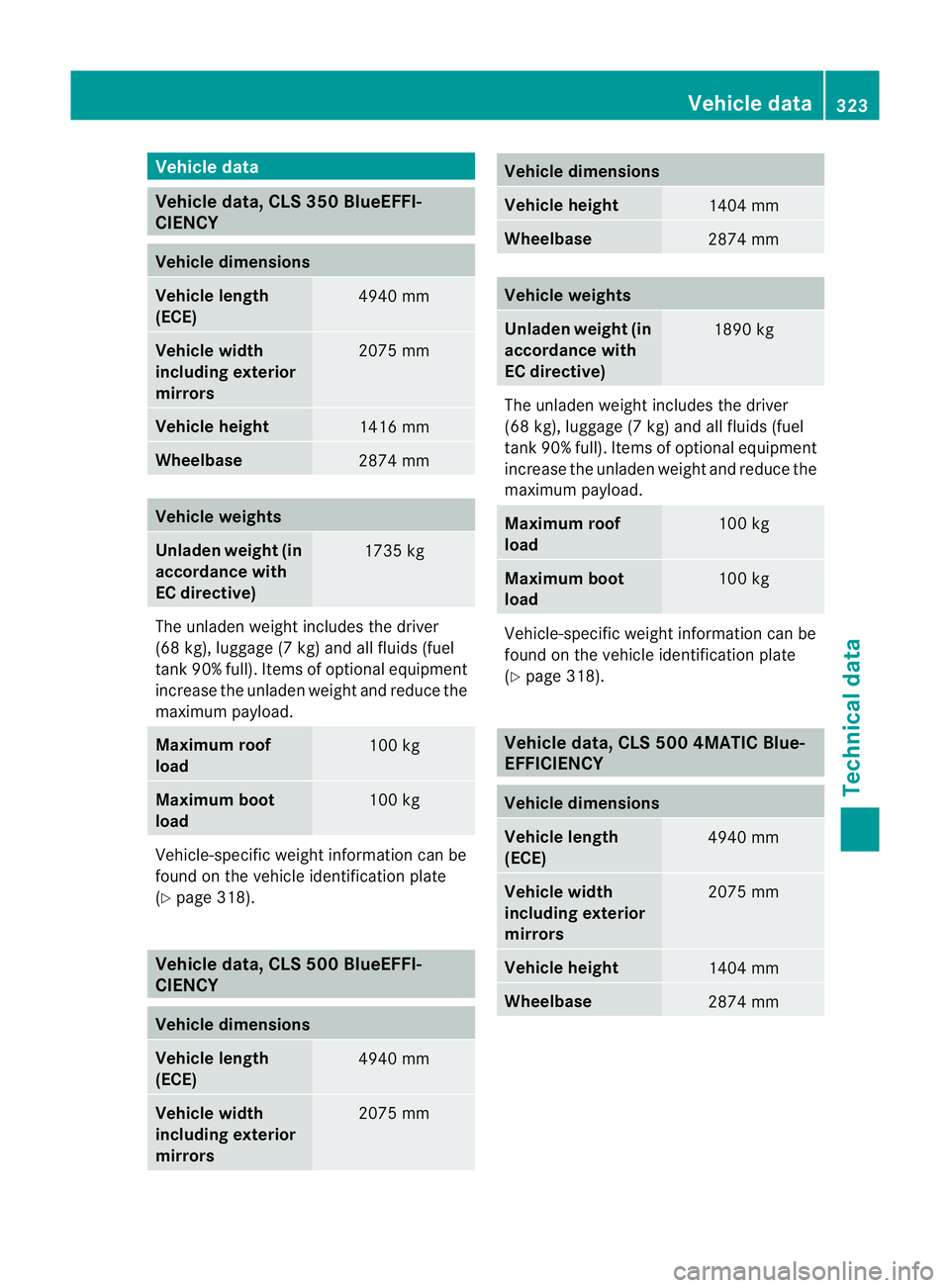
Vehicle data
Vehicle data, CLS 35
0BlueEFFI-
CIENCY Vehicle dimensions
Vehicle length
(ECE)
4940 mm
Vehicle width
including exterior
mirrors
2075 mm
Vehicle height
1416 mm
Wheelbase
2874 mm
Vehicle weights
Unladen weight (in
accordance with
EC directive)
1735 kg
The unladen weight includes the driver
(68 kg), luggage (7 kg) and all fluids (fuel
tan k90% full). Items of optional equipment
increase the unladen weight and reduce the
maximu mpayload. Maximum roof
load
100 kg
Maximum boot
load
100 kg
Vehicle-specific weigh
tinformation can be
found on the vehicle identificatio nplate
(Y page 318). Vehicle data
,CLS 500 BlueEFFI-
CIENCY Vehicle dimensions
Vehicle length
(ECE)
4940 mm
Vehicle width
including exterior
mirrors
2075 mm Vehicle dimensions
Vehicle height
1404 mm
Wheelbase
2874 mm
Vehicle weights
Unladen weight (in
accordance with
EC directive)
1890 kg
The unlade
nweight includes the driver
(68 kg), luggage (7 kg) and all fluids (fuel
tank 90% full). Items of optional equipment
increase the unladen weight and reduce the
maximum payload. Maximum roof
load
100 kg
Maximum boot
load
100 kg
Vehicle-specific weight information can be
found on the vehicle identification plate
(Y
page 318). Vehicle data, CLS 500 4MATIC Blue-
EFFICIENCY
Vehicle dimensions
Vehicle length
(ECE)
4940 mm
Vehicle width
including exterior
mirrors
2075 mm
Vehicle height
1404 mm
Wheelbase
2874 mmVehicle data
323Technical data Z
Page 327 of 337
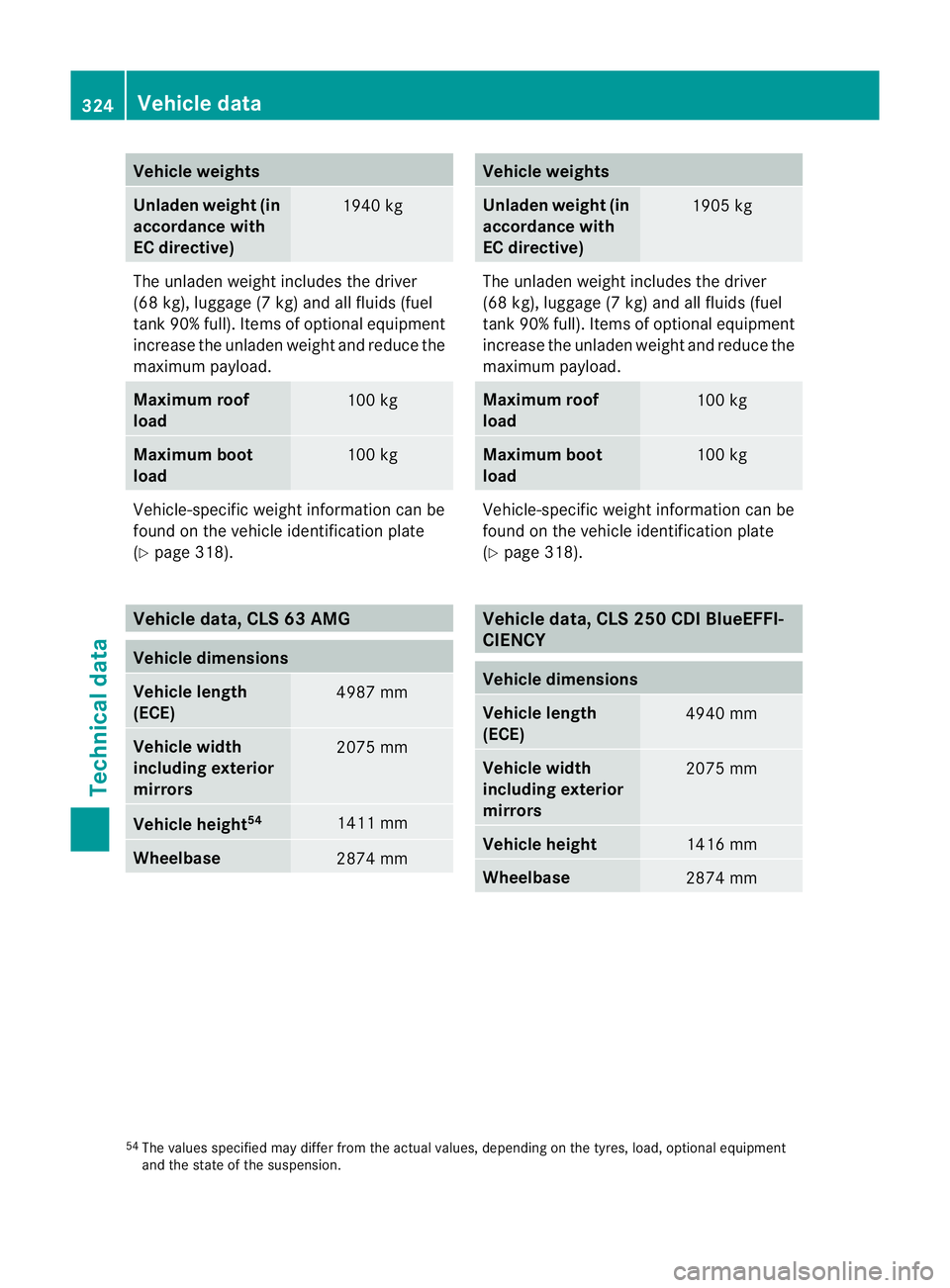
Vehicle weights
Unladen weight (in
accordance with
EC directive)
1940 kg
The unladen weight includes the driver
(68 kg), luggage (7 kg) and all fluids (fuel
tank 90% full) .Items of optional equipment
increase the unladen weight and reduce the
maximum payload. Maximum roof
load
100 kg
Maximum boot
load
100 kg
Vehicle-specifi
cweight information can be
found on the vehicle identification plate
(Y page 318). Vehicle data, CLS 63 AMG
Vehicle dimensions
Vehicle length
(ECE)
4987 mm
Vehicle width
including exterior
mirrors
2075 mm
Vehicle height
54 1411 mm
Wheelbase
2874 mm Vehicle weights
Unladen weight (in
accordance with
EC directive)
1905 kg
The unladen weight includes the driver
(68 kg), luggage (7 kg) and all fluids (fuel
tank 90% full). Items of optional equipment
increase the unladen weight and reduce the
maximum payload. Maximum roof
load
100 kg
Maximum boot
load
100 kg
Vehicle-specific weight information can be
found on the vehicle identification plate
(Y
page 318). Vehicle data, CLS 250 CDI BlueEFFI-
CIENCY
Vehicle dimensions
Vehicle length
(ECE)
4940 mm
Vehicle width
including exterior
mirrors
2075 mm
Vehicle height
1416 mm
Wheelbase
2874 mm
54
The values specified may differ from the actual values, depending on the tyres, load, optional equipment
and the state of the suspension. 324
Vehicle dataTechnical data
Page 328 of 337
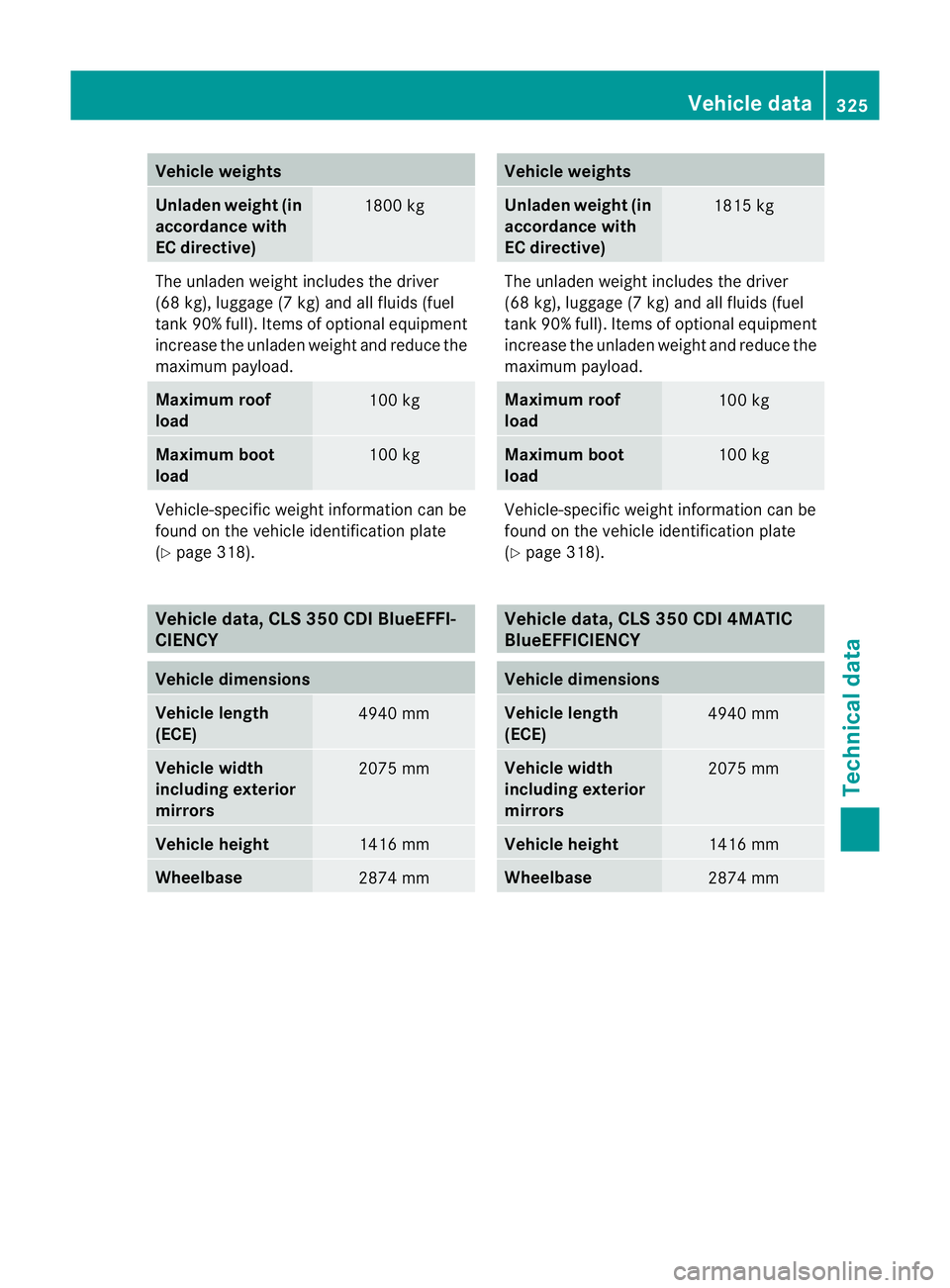
Vehicle weights
Unladen weight (in
accordance with
EC directive)
1800 kg
The unladen weight includes the driver
(68 kg), luggage (7 kg) and all fluids (fuel
tank 90% full) .Items of optional equipment
increase the unladen weight and reduce the
maximum payload. Maximum roof
load
100 kg
Maximum boot
load
100 kg
Vehicle-specifi
cweight information can be
found on the vehicle identification plate
(Y page 318). Vehicle data, CLS 350 CDI BlueEFFI-
CIENCY
Vehicle dimensions
Vehicle length
(ECE)
4940 mm
Vehicle width
including exterior
mirrors
2075 mm
Vehicle height
1416 mm
Wheelbase
2874 mm Vehicle weights
Unladen weight (in
accordance with
EC directive)
1815 kg
The unladen weight includes the driver
(68 kg), luggage (7 kg) and all fluids (fuel
tank 90% full). Items of optional equipment
increase the unladen weight and reduce the
maximum payload.
Maximum roof
load
100 kg
Maximum boot
load
100 kg
Vehicle-specific weight information can be
found on the vehicle identification plate
(Y
page 318). Vehicle data, CLS 350 CDI 4MATIC
BlueEFFICIENCY
Vehicle dimensions
Vehicle length
(ECE)
4940 mm
Vehicle width
including exterior
mirrors
2075 mm
Vehicle height
1416 mm
Wheelbase
2874 mmVehicle data
325Technical data Z
Page 329 of 337
Vehicle weights
Unladen weight (in
accordance with
EC directive)
1875 kg
The unladen weight includes the driver
(68 kg), luggage (7 kg) and all fluids (fuel
tank 90% full) .Items of optional equipment
increase the unladen weight and reduce the
maximum payload. Maximum roof
load
100 kg
Maximum boot
load
100 kg
Vehicle-specifi
cweight information can be
found on the vehicle identification plate
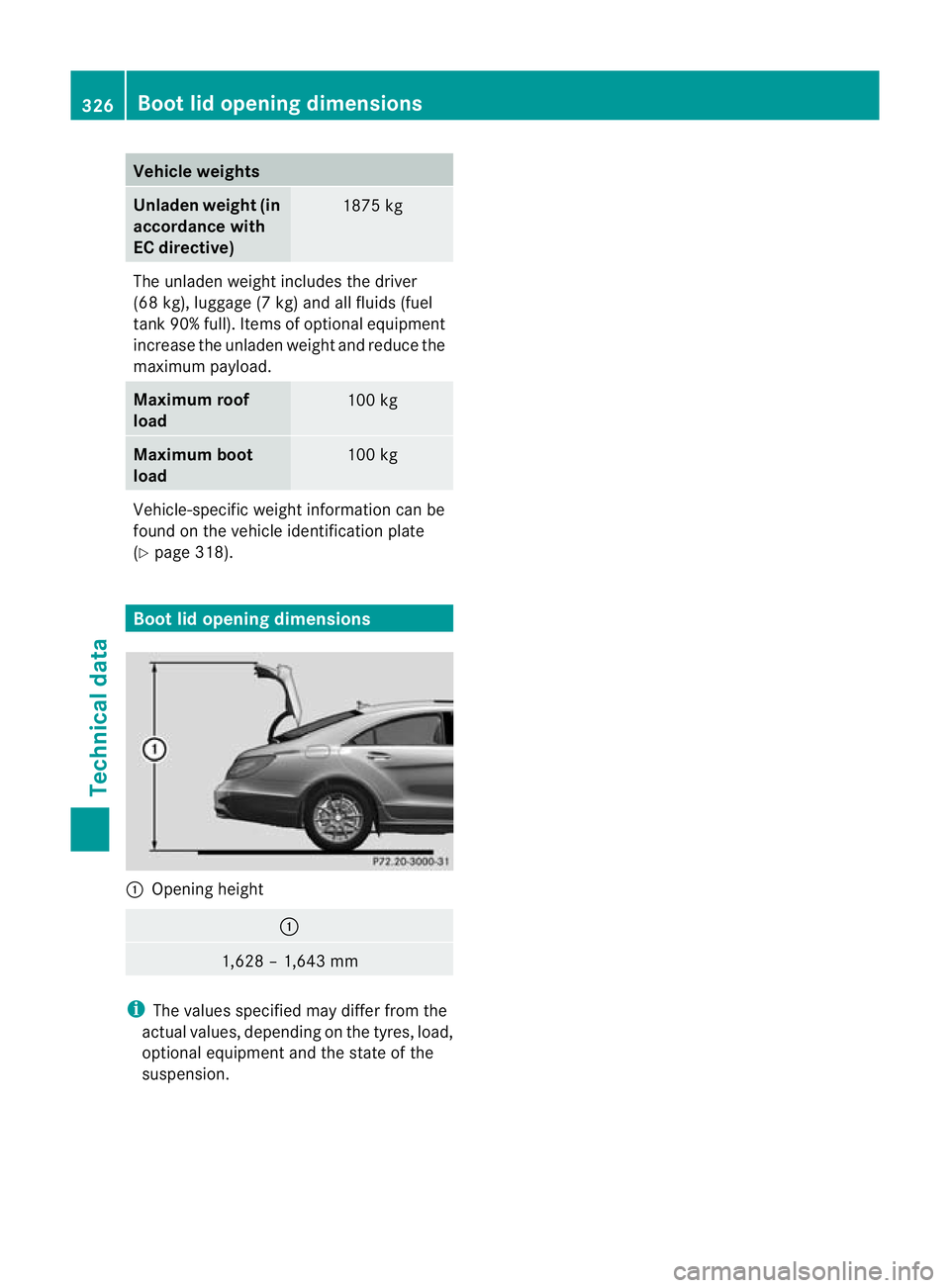
(Y page 318). Boot lid opening dimensions
:
Opening height :
1,628 – 1,643 mm
i
The values specified may differ from the
actual values, depending on the tyres, load,
optional equipment and the state of the
suspension. 326
Boot lid opening dimensionsTechnical data